Showing posts with label ferns. Show all posts

Sunday, November 20, 2011

Mosses (and More) on the Mountain

Just because all the flowers are gone by now, that doesn't mean there's nothing for botanizers to seek out in the woods.  There's still lots of wonderful stuff to be found, since many mosses, lichens, liverworts, and even some ferns are unaffected by the freezing weather and can be sought all winter long.  Of course, it helps to know what you're looking for, and I can't imagine a better teacher than Nancy Slack, shown here examining  a clump of Tetraphis pellucida, one of the mosses to be found on nearly every rotting tree stump and fallen log.


A longtime biology professor at Russel Sage College who still teaches botany courses there,  Nancy joined me on Friday morning for a hike up the Red Oak Ridge Trail in Moreau Lake State Park.  Our destination was a group of limestone caves on the top of the ridge, but we took our time to get there, stopping to take a closer look at many of the fascinating mosses along the way.  Here's a closer view of that Tetraphis pellucida, revealing the pellucid leaves that suggest its specific name.


This trio of ferns also caught our attention, since it's unusual to find all three of our common evergreen ferns together in one location.  Top left is Intermediate Wood Fern, its leaflets (pinnae) more intricately cut than those of the Marginal Wood Fern on the right.  The fern on the bottom is Christmas Fern, distinctive for the Christmas-stocking shape of its individual pinnae.


The Intermediate Wood Fern is named for the way its spore cases (sori) are arranged on the back of the pinnae, midway between the spine and the margin.


The Marginal Wood Fern bears its sori right at the outer edges (margins) of its pinnae.  (We have a third wood fern, the Spinulose Wood Fern, but that fern won't be found this time of year, since it's not evergreen.)


When we reached the caves near the top of the ridge, I was eager to show Nancy the boulders where Walking Fern grows.  This is a rather uncommon fern that is usually found only on limestone or marble.  When I first found this rather unfern-like fern several years ago, there was just a small clump near the cave entrance, but it has since "walked" the whole width of the moss-covered boulder to where Nancy is standing to take its photo.


This photo shows the long thin fronds that produce new plants wherever the tips touch the moss.


On a nearby boulder we found this beautiful moss that looks like tiny palm trees.  Its name, Atrichum undulatum, refers to the rippled (undulating) texture of its leaves.


Another particularly beautiful moss is Rhodobryum roseum, which looks like tiny green flowers.


A sure sign that we were among limey rocks was this large patch of Anomodon attenuata, which is found only on limestone or marble.


How odd, then, that on the other side of the very same boulder where we found that Anomodon, we found this wooly-textured Dicranum fulvum, a moss that can grow only on acidic rock, such as quartzite.  We surmised, then, that our boulder was made up of at least two different kinds of rocks.


This brown bedraggled-looking stuff is Hedwigia, a moss that is not particular about the acidity of the rocks it grows on.


An interesting aspect of Hedwigia is that, no matter how shriveled and brown it appears, it will  plump up and turn green as soon as it is dampened.  Nancy picked a sprig and wet it in a nearby stream.  A few minutes later it looked like this.


We found a rotting log nearly covered by this shiny reddish-brown liverwort called Nowellia curvifolia.   Sorry, but my camera proved too stubborn and would not focus close enough to show the curving leaves that give this pretty liverwort its specific name.


I love how this moss, Hypnum pellescens, has sent out tendrils that trace the cracks in the rock it grows on, creating a very spidery appearance.


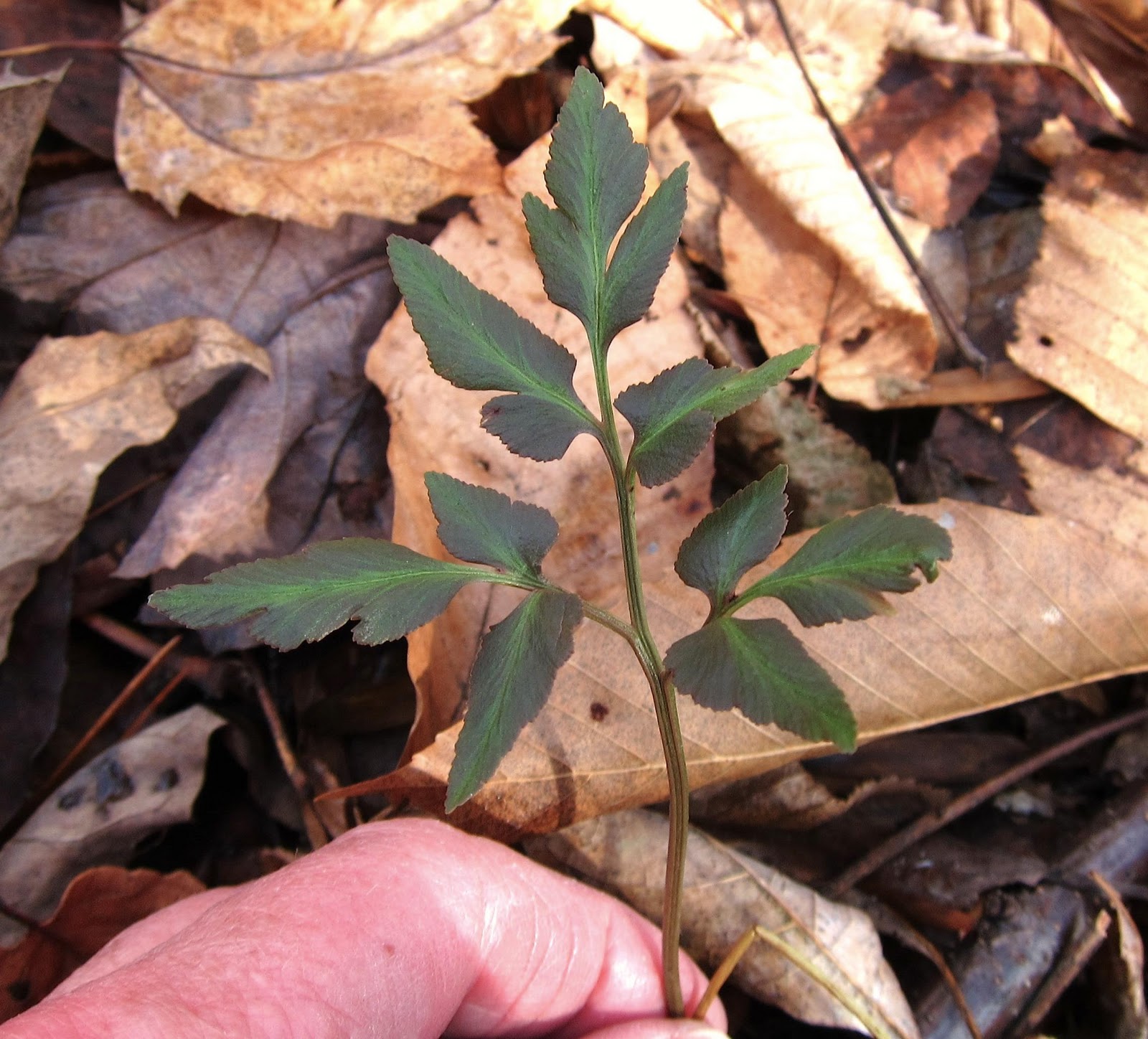
I hadn't known that this fern, a Botrychium or Grape Fern, was evergreen, but there it was, lifting its pretty bi-colored frond above the dead leaves of the forest.  Nancy has suggested that this is Botrychium lanceolatum, a species that I have never seen before.
Saturday, May 14, 2011

A Botanical Day in Three Acts

We were lucky the rain held off until mid-afternoon today, giving us time for three distinct botanical adventures. The first was a wildflower walk I led through the Skidmore Woods this morning, sponsored by the local Audubon chapter. I was a bit concerned that participants might be disappointed not to find such showy spring ephemerals as Bloodroot, Hepatica, and Trout Lily (now long gone), but I shouldn't have worried. There's always SOMEthing worth seeing in the woods, such as that lovely trillium pictured above, a Large-flowered White, which turns pink as it matures. With dozens and dozens still in bloom in one area, they put on quite a show.


A bit less showy but still very pretty, Perfoliate Bellwort was just starting to bloom today. Note how the stem appears to pierce the leaf, a feature this bellwort shares with the Large-flowered Bellwort, which we found today, too, although most of those we found were starting to fade.


Wood Betony is a flower that most of the flower walk's participants had never seen, and well worth an extra quarter-mile off our route to go find it. I know of only one other place in Saratoga County where I have seen it. I find the leaves of this plant even more attractive than its flowers. Wood Betony flowers can also be pink, but the two populations I know of are both yellow.


I was happy to be able to show our group several other plants that grow in the Skidmore Woods but probably nowhere else in the county, such as Goldenseal and Green Violet. The Green Violet was only in bud today, but even when it's in bloom, the flowers -- indeed,the whole plant -- look nothing like the typical violet. I will post photos of it when it does bloom. A far more common woodland plant blooming today was Red Baneberry. The puff of white flowers of this species of baneberry is more spherical than that of its closely related White Baneberry.


Since this morning's walk was arranged by the Audubon group, most of the participants were avid birders, armed with binoculars as well as wildflower guides. It was a great treat for me to have them put a name to the birdsongs filling the woods all around us. Indigo Bunting, Scarlet Tanager, Great Crested Flycatcher, Tufted Titmouse, Wood Thrush, Red-eyed Vireo -- these and others were all birds I could not see with my eyes, but I sure could hear with my ears.

* * *
My friend Sue was one of the walk's participants, and after the rest of the group had left, she and I continued to explore the steep limestone faultline where lots of interesting ferns and mosses grow. There were also some lovely clumps of Columbine punctuating the rocks with their blazing red, which Sue is here attempting to photograph.


I was enchanted by the contrasting texture of the tender green ferns (Bulblet Ferns here, I believe) with their soft lacy foliage arrayed against the craggy dark boulders.


Herb Robert likes these limestone boulders, too, which it shares with many different ferns and mosses. This plant will have pretty little bright pink flowers when it blooms, but even now its bright pink stems and lacy green leaves are beautiful in their own right.


I love the delicate curving fronds of the little Maidenhair Spleenworts, how they curl up snug against the nooks and crannies of the rock.

* * *

Had we had enough birding and botanizing, Sue and I? Nope, not yet. After pausing for lunch, we next headed to Bog Meadow Nature Trail just outside of town to explore a section of the trail Sue had never been on. We accessed the trail from the Meadowbrook Road entrance, and although we found the first part of the trail very muddy, we were compensated by masses of pale-purple Dog Violets carpeting the edges of the trail.


Another plant to be found there in great abundance was Tussock Sedge, which today was fully in bloom, its caramel-colored flowerheads nicely contrasted against the vivid green of its grassy leaves.


I was intrigued by these rigid stalks of Horsetail Reeds growing in the wet ditches along the trail. I'm not sure, but these may be Water Horsetail, a third kind of horsetail I've found at Bog Meadow (after Field Horsetail and Woodland Horsetail). Those cute little nubbins encircling the stalks will grow out to be well over a foot long as the summer comes on.


Here's a closer view of those nubbins, also showing the beautiful structure of the jointed stalk. As a kid I used to love to pull these stalks apart like pop beads, then pop them back together -- no doubt seriously damaging the plant in the process. So I don't do that any more. Although sometimes I'm tempted. Oh what the heck? There're hundreds of them here.


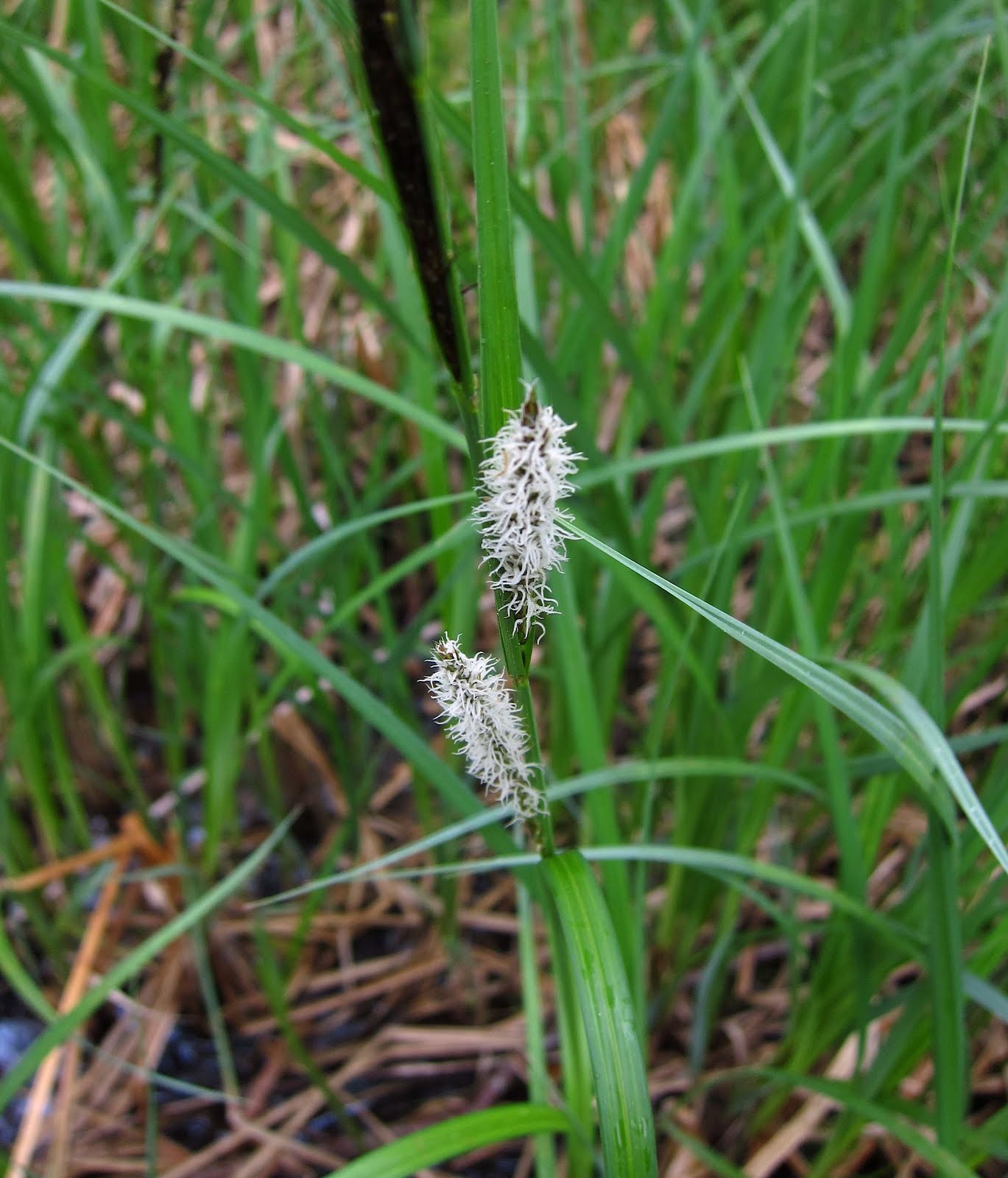
Compared to me, Sue has amazing eyesight. She could see a Yellow Warbler hiding out in a patch of Phragmites and flying up now and then to snatch a fly from the air. I would never have seen this pretty bird had she not pointed it out to me. I also would have missed seeing this large handsome sedge growing among the tall grasses if Sue hadn't seen it first. It's quite a distinctive sedge, at least three feet tall, with what look like multiple flower heads, both staminate and pistillate. The staminate ones, with their wild blond hair-dos, are on top.


The pistillate flowers, lower down on the stalk, looked to me like fuzzy white caterpillars.

This was surely a new sedge for me. How could I have missed seeing it before? For a graminoid, it's very large and showy. I would have taken more and better photos of it, but it started to rain in earnest, so Sue and I packed up our cameras and headed home. Such a busy, botany-filled day. Now it was time for a nap.

Monday, May 9, 2011

A Fine Day, A Good Friend, and Lots of Flowers and Ferns

Just look at that sky! That beautiful light filtering through those translucent spring leaves! A perfect day for a walk in the Skidmore Woods with my friend Ed Miller, to check on what's blooming today. One of the first flowers we found was this whole row of Columbine, blazing away at the top of a mossy boulder.


We usually look down on Wild Sarsaparilla, ubiquitous bloomer of the forest floor, but today our path took us below a ridge and gave us a different perspective on this plant, now starting to bud.


I was happy to show Ed my secret stashes of Goldenseal, a plant that's nearly extirpated from Saratoga County. Ed knew another place where they grew, and let me in on his secret.


I'm always glad to have Ed help me ID ferns, although I didn't need any help to identify this Walking Fern, the fern that doesn't even look like one.


And it was easy to know this zig-zaggy juvenile frond was Polypody, since its evergreen adult fronds were lying right below it.


This juvenile fern, however, was not such a cinch to identify. Ed guessed it was Fragile Fern and I'll take his word for it. I was able to recognize the little Maidenhair Spleenworts growing out of the moss behind it.


I also knew that this was Rattlesnake Fern, although Ed would prefer that I call it by its scientific name, Botrychium, since too many plants have the word "rattlesnake" in their name. OK. Botrychium. Also called Grape Fern because of its round clustered spore cases, which somewhat resemble a bunch of grapes when they grow from the center frond later in the summer.


Could this be Broad Beech Fern? It has the right triangular shape, but as Ed remarked, juvenile ferns are notoriously hard to identify. Cute, though.


A couple of weeks ago, I posted an entry showing the dark purple flowers of a species of Blue Cohosh, Caulophyllum giganteum. Today we found some plants that had yellow, not purple, flowers, but otherwise the plants all looked exactly alike. Could this be the species C. thalictroides that Newcomb shows in his wildflower guide?


Here's another bloom to puzzle those of us who depend on flower color to help us identify a species. It's no doubt a Common Blue Violet that couldn't make up its mind whether to be white or purple and so chose both.


And speaking of violets, the Common Blues were carpeting the banks in Saratoga's Congress Park today, right next to masses of Cuckoo Flower blooming in the grass. I couldn't resist picking a small bouquet, they are so pretty together.

Wednesday, June 30, 2010

Another Adventure with Ed

Ed Miller's a native-plant enthusiast of great renown throughout the Albany/Adirondack region, a man of exhaustive botanical knowledge to whom many professional botanists turn when they want to know what grows where. A few posts back I recounted our trip to the Landis Arboretum, where Ed has almost single-handedly created a collection of New York native woody plants. Today, Ed took me to another of his remarkable spots: Joralemon Park in Coeymans, NY, a small town south of Albany. Adjoining this community park is a nature preserve that a former state chief botanist once called the best area he knew of for its botanical riches. Thanks to Ed's generosity (he personally put up the funds for the Nature Conservancy to purchase the land), this wooded area with a limestone substrate is now protected from further development.

The place reminded me a lot of the Skidmore woods, which has a similar limestoney soil and many of the same plants, including such rarities as Green Violet, Goldenseal, and Ginseng. One plant I've never found at Skidmore, though, is Virginia Waterleaf, which was growing abundantly in the Joralemon preserve. As was true for most of the woodland flowers, the waterleaf was long past its blooming time and was now bearing fruit.


One of the very few deep-woods blossoming plants was Lopseed, a flower I have never been able to photograph clearly, because it's so tiny and grows where the shade is so dark. A little sun filtered in to light up this one, but even so, it's not as clear as I'd like. The plant gets its name from its blossoms' habit of turning down to cling to the stalk when they form their seeds.


We found a large patch of Wild Leeks, a plant I found earlier this year up north in Warren County. Its deliciously edible leaves, also called Ramps, have long withered away so that all that remains by now are the flower stalks, going to seed.


This cluster of Harebells was crowning a limestone cliff overhanging an open marsh, the water below completely covered with several shades of green duckweeds. The spindly-stemmed Harebell normally grows as isolated individuals. I have never before seen it gather together into such a large clump.


Those limestone cliffs yielded many more remarkable botanical treasures. We found Creeping Shadblow and Fragrant Sumac (two shrubs I have never seen before in the wild) and many species of mosses and ferns. I was very glad to have Ed as my guide as we scoured the rocks, for he could point out to me many plants of interest, such as this tiny asplenium fern called Wall-rue. I'm certain I would never have seen it if Ed had not pointed it out. The whole clump was maybe two to three inches across.


That Wall-rue was a sure sign that the underlying rock was calcium rich, since it requires that nutrient for its very existence. The same could be said for a number of other ferns we found, such as Bulblet Fern, Fragile Fern, Walking Fern, Maidenhair Spleenwort, and the Ebony Spleenwort pictured here, so slender and gracefully curving.


I assumed this furry, spiky stuff was a moss, but Ed most kindly corrected my misunderstanding, explaining that this Rock Spikemoss (Selaginella rupestris) was more closely related to ferns than it was to mosses.


I won't go into the complicated botanical explanation -- it has something to do with it having a true vascular system, which mosses don't have and ferns do. Ed also had me look into its greenery with my magnifier to detect minute specks of bright yellow spores, another feature of the spikemoss's structure that sets it apart from regular mosses.

When I go on adventures like this one, with wonderfully knowledgeable folks like Ed, I become so aware of how much I still have to learn about the botanical riches that surround us. But I am also struck by how kind most plant-people are to students like me, how eager they are to share what they know with folks who express an interest. Thanks so much, Ed. I had a wonderful time.