These are the days we hikers wait for all year. The air is crisp and cold in the morning, with a warming sun that coaxes us to shed our jackets by noon. The woods are ablaze with red and gold, and the paths are covered with fallen leaves that release a sweet oaken fragrance as we hike along, neither bothered by bugs nor sticky with sweat. And, oh, what options we have for autumn walks at Moreau Lake State Park! If one route doesn't work out, there are many more trails to choose from.
Sue and I had planned to hike the Palmertown Mountain Ridge in the park, so we met this morning at the summit trailhead near a powerline clearcut. But it didn't take long for us to change our plans. The parking lot was filled with pickup trucks, a sign that many hunters were up in the mountains today. Then a gunshot booming from not far away clinched the decision for us. Let's choose a trail somewhere in the park where we're sure we won't get shot at. And we had an embarrassment of riches to choose from, with over 4000 acres of forest, mountains, lake, ponds, streams, and riverbanks awaiting our explorations.
First, though, we did explore the powerline clearcut a while, delighting in the rich variety of mosses and lichens that carpet the boulders here. Low Blueberry bushes, their bright-red leaves lit up by the morning sun, glowed as if they were on fire.
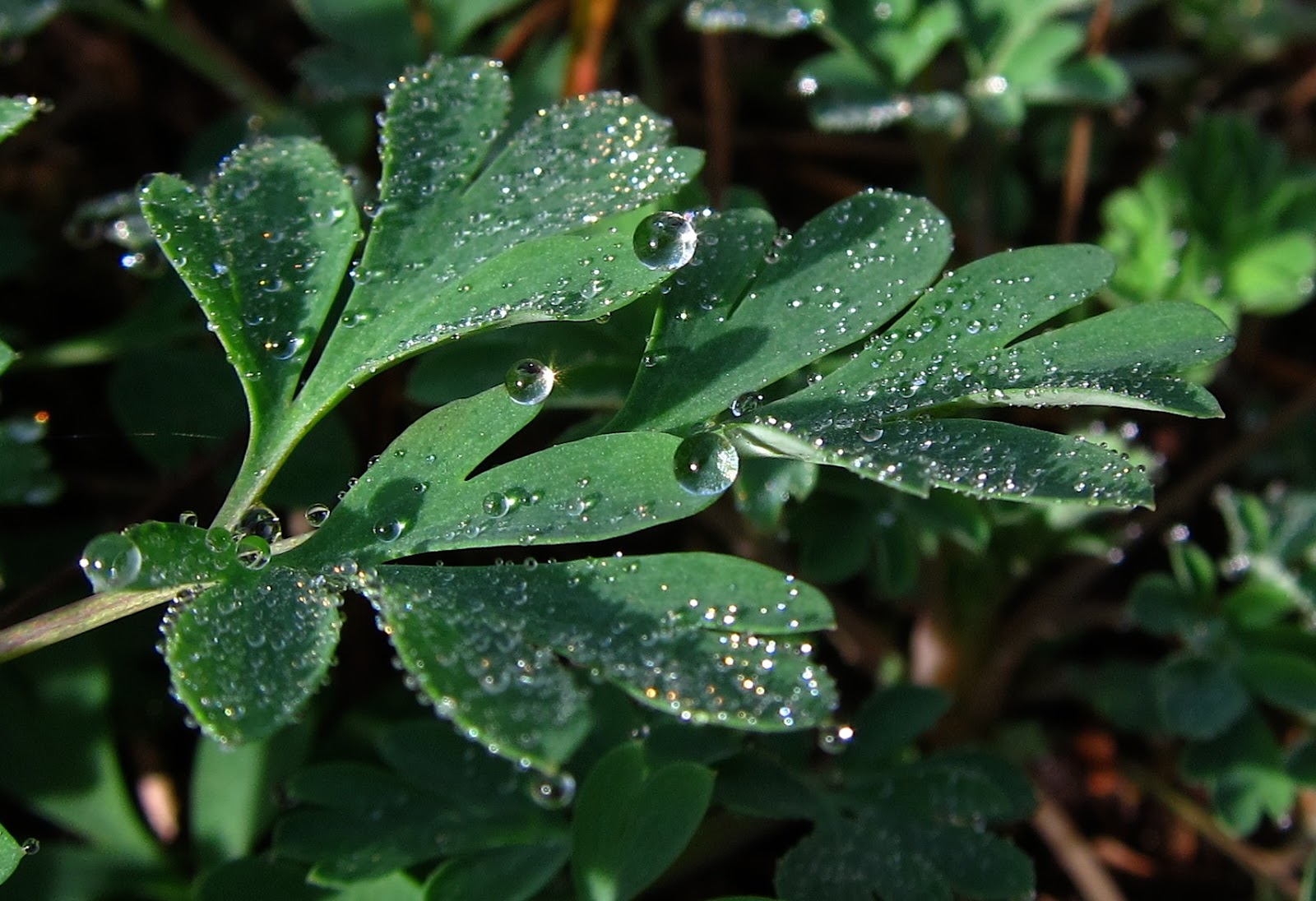
Masses of Pale Corydalis had found a niche in the cracks of some boulders, their lacy blue-green foliage sparkling with dew.
While much of Moreau Lake State Park is open to hunters, the trails around the lake and close to the camping sites are considered a safety zone, so that's where Sue and I decided to hike. We chose the Red Oak Ridge Trail, which runs midway up the mountains that stand on the western side of the lake.
It was on this trail that we earlier found the tiny orchid called Autumn Coralroot, so we searched to see if we could find it again. And wonder of wonders, so we did! It sure would have been hard to see if we hadn't known exactly where to look.
This little mushroom, although very small (see the Hickory nut shell behind it), was easy to spot because of its luminous yellow color.
The same could be said for these blazing red mushrooms, the largest of which was only a little bigger than a pea.
More little mushrooms and a couple of golden Bigtooth Aspen leaves.
Several little streams tumble down the mountain to cross the Red Oak Ridge Trail, most of them reduced to only a trickle this time of year. But this one actually contained enough water to splash and shimmer along its way.
We lingered a while to enjoy its lively music and enchanting reflections.
Near the stream we found this moss-covered log adorned with clusters of Wolf's Milk slime mold, which is peachy pink when young but turns gray like the clump on the right as it ages.
Sue had to leave for work by noon, but I lingered on, reluctant to leave the woods on this glorious day, and headed next to Mud Pond, another beautiful area of Moreau Lake State Park.
Sue had told me about a cluster of Pinesap she'd seen, dressed in its autumn scarlet, that stood along one of our "secret" trails, so I went to see if I could find it. And I did. How could I miss it, lit by a ray of sun and glowing in the dark woods?
This little Red Maple didn't need to be lit by the sun to glow in the woods.
Witch Hazel was fully unfurled today, and I pressed my nose into its flowers to breathe in its delicious fragrance, very subtle, slightly sweet and faintly citrus, reminiscent of clean laundry that's been dried outside in the sun.
There were still more areas of the park to explore, and more hours of the day left to do so, so I headed next to Spier Falls Road to walk along the Hudson River.
WOW! Most of our Red Maples have wimped out this fall, dropping their shriveled and browning leaves before turning their customary glorious red, but here was one that was living up to its reputation for autumn splendor.
And here was another, backlit by a lowering sun, leaning over the calm blue river.
Instead of taking the highway home, I chose Old Saratoga Road, a scenic route through fields and forests and mountains. As I stopped to marvel at this mountainside ablaze with chrysanthemum colors, I recalled that Moreau Lake State Park was in the process of acquiring this very tract. Imagine! There will someday be even more trails, cut through these beautiful mountainous woods, providing ever more options for hikers and hunters alike.
For more than thirty years I've been wandering the woods and waterways of Saratoga County, New York, and regions nearby, looking closely, listening carefully, and recording what I experience. We are blessed in this region with an amazing amount of wilderness right at hand. With this blog I share my year-round adventures here, seeking out what wonders await in my own Madagascar close to home.
Showing posts with label Red Oak Ridge Trail. Show all posts
Wednesday, October 17, 2012
Saturday, September 8, 2012
Elusive Orchids Along the Red Oak Ridge
Summer's end. All the kids are back in school, and the beach at Moreau Lake State Park was absent of even their footprints yesterday morning when Sue and I met at the park to go searching for Autumn Coralroot (Corallorhiza odontorhiza), one of the last of our native orchids to bloom.
We had found this diminutive orchid last fall along the Red Oak Ridge trail in the park, so that's where we headed today, soon to be joined by our friend Laurie. With a flower so inconspicuous, it's good to have extra eyes along to look for it. Also, Laurie's a geologist, and she always has interesting information about the rocks that line this beautiful woodland trail that heads up into the mountains overlooking Moreau Lake.
Because I have such poor eyesight, I can't believe that I was the one who saw it first. Sure enough, it was right in the same spot we found it last year, but it sure can hide in plain sight. There it is, right in the center of that red circle. Plain as day, right? Then, after spying that one, we found a few more close by.
Since there's no botanical record of this orchid growing in Saratoga County, we had hoped to collect a specimen in full bloom to send to the state herbarium. But we couldn't figure out if these were in bud or had already gone by, so we didn't collect any plants. It was only later that we learned that this particular coralroot often bears no open blooms, ever. This may be as much flower as we were ever going to see.
Now that we had a search image in our minds, we continued to look for the leafless reddish stems hung with pale green pods, walking up and down the streambed where we found our first plants. If there were others growing here, we couldn't find them.
It was only after we had given up searching that we found several other specimens, in locations quite some distance apart, and in every case, just a single plant. Since the population seemed so sparse, we decided not to collect even one, although I did mark each location with a GPS device. I hope someday our state herbaria will accept photographs and signed affidavits as proof of a plant's existence in a county, rather than insisting on actual specimens. Especially in the case of native orchids, all of which are protected by law.
Even if we had not found our sought-after plant, we would have had a marvelous time exploring the heaps of limestone boulders that are a prominent feature along the Red Oak Ridge trail. And even if we had not had our geologist friend along to identify these rocks, we could have guessed their mineral content from the abundance of such lime-loving plants as this Walking Fern meandering across the moss.
Another indicator of rich soil was this Rattlesnake Fern scattered about the forest floor.
We found evidence, too, that porcupines were also fond of these boulders, when we spied this opening in the rocks that was littered with quills and piles of feces distinctive of porcupines.
If you clicked on the link to our last fall's hike along this same trail, you would be struck by the wonderful abundance and variety of fungi we found. This year, following one of the hottest and driest summers on record, we found hardly any fungi at all. This marvelous mass of white-edged ruffles was an exception. At first, I did not recognize this dark brown fungus as Turkey Tail (Trametes versicolor), but after searching the internet, I was astounded to see the incredible color variations this beautiful shelf fungus can exhibit.
Here was another of the really scarce fungi we found, and it looks like this hungry slug was very happy to have found it, as well. I must confess, this is the first time I have ever noticed slug poop. Sue saw it first and pointed it out to me, or I wouldn't have seen it. Dedicated naturalists as we are, we are often delighted to find stuff that most folks would have no interest in.
Most folks, however, would be happy enough to notice these pretty wildflowers, Nodding Bur Marigold (Bidens cernua), which were blooming along the sandy south shore of the lake, where we sat to eat our picnic lunch. We were fascinated to also find miniature specimens of this same species growing in other areas of the beach, and wondered what would cause such a diminishment in size.
Peering closely to admire the Bur Marigold's blooms, I discovered this beetle, whose black-spotted yellow coloring provided quite effective camouflage while it sat on the flower. A google search for black-spotted yellow beetles immediately informed me that this is a Spotted Cucumber Beetle (Diabrotica undecimpunctata), considered quite a pest by gardeners and farmers. Its appetite for flowers is certainly evident in the tattered petals of this Bur Marigold bloom.
We had found this diminutive orchid last fall along the Red Oak Ridge trail in the park, so that's where we headed today, soon to be joined by our friend Laurie. With a flower so inconspicuous, it's good to have extra eyes along to look for it. Also, Laurie's a geologist, and she always has interesting information about the rocks that line this beautiful woodland trail that heads up into the mountains overlooking Moreau Lake.
Because I have such poor eyesight, I can't believe that I was the one who saw it first. Sure enough, it was right in the same spot we found it last year, but it sure can hide in plain sight. There it is, right in the center of that red circle. Plain as day, right? Then, after spying that one, we found a few more close by.
Since there's no botanical record of this orchid growing in Saratoga County, we had hoped to collect a specimen in full bloom to send to the state herbarium. But we couldn't figure out if these were in bud or had already gone by, so we didn't collect any plants. It was only later that we learned that this particular coralroot often bears no open blooms, ever. This may be as much flower as we were ever going to see.
Now that we had a search image in our minds, we continued to look for the leafless reddish stems hung with pale green pods, walking up and down the streambed where we found our first plants. If there were others growing here, we couldn't find them.
It was only after we had given up searching that we found several other specimens, in locations quite some distance apart, and in every case, just a single plant. Since the population seemed so sparse, we decided not to collect even one, although I did mark each location with a GPS device. I hope someday our state herbaria will accept photographs and signed affidavits as proof of a plant's existence in a county, rather than insisting on actual specimens. Especially in the case of native orchids, all of which are protected by law.
Even if we had not found our sought-after plant, we would have had a marvelous time exploring the heaps of limestone boulders that are a prominent feature along the Red Oak Ridge trail. And even if we had not had our geologist friend along to identify these rocks, we could have guessed their mineral content from the abundance of such lime-loving plants as this Walking Fern meandering across the moss.
Another indicator of rich soil was this Rattlesnake Fern scattered about the forest floor.
We found evidence, too, that porcupines were also fond of these boulders, when we spied this opening in the rocks that was littered with quills and piles of feces distinctive of porcupines.
If you clicked on the link to our last fall's hike along this same trail, you would be struck by the wonderful abundance and variety of fungi we found. This year, following one of the hottest and driest summers on record, we found hardly any fungi at all. This marvelous mass of white-edged ruffles was an exception. At first, I did not recognize this dark brown fungus as Turkey Tail (Trametes versicolor), but after searching the internet, I was astounded to see the incredible color variations this beautiful shelf fungus can exhibit.
Here was another of the really scarce fungi we found, and it looks like this hungry slug was very happy to have found it, as well. I must confess, this is the first time I have ever noticed slug poop. Sue saw it first and pointed it out to me, or I wouldn't have seen it. Dedicated naturalists as we are, we are often delighted to find stuff that most folks would have no interest in.
Most folks, however, would be happy enough to notice these pretty wildflowers, Nodding Bur Marigold (Bidens cernua), which were blooming along the sandy south shore of the lake, where we sat to eat our picnic lunch. We were fascinated to also find miniature specimens of this same species growing in other areas of the beach, and wondered what would cause such a diminishment in size.
Peering closely to admire the Bur Marigold's blooms, I discovered this beetle, whose black-spotted yellow coloring provided quite effective camouflage while it sat on the flower. A google search for black-spotted yellow beetles immediately informed me that this is a Spotted Cucumber Beetle (Diabrotica undecimpunctata), considered quite a pest by gardeners and farmers. Its appetite for flowers is certainly evident in the tattered petals of this Bur Marigold bloom.
Sunday, February 19, 2012
A Walk on the Ridge
What an awful dream I had last night! I was supposed to get to my job in Glens Falls by hopping on foot all the way from Saratoga (that's about 20 miles), but after a few blocks I just couldn't make any progress because I was so exhausted, with legs as heavy as lead. So when I woke up, I was already feeling tired. Oh boy, I think that dream was a message that I need to exercise more. So I made myself go for another hike that took me up and down hills, the Red Oak Ridge Trail at Moreau Lake State Park.
This trail is probably my favorite in the park, requiring enough effort to get my heart pounding at times, but also with relatively level stretches that allow me to enjoy the walk and look around at the scenery. During the leafy seasons, that scenery consists mostly of close-by trees and dramatic rock formations, but this time of year you can look right through the trees to the lake below and mountains beyond.
I had planned to keep up a good pace on this hike, not expecting to find much along the trail to interrupt my stride. But I did have to stop to take a closer look at the abundant growth of mosses adorning these rocks with different textures and colors.
One of those "mosses" (the one on the right side of this photo) turned out, on closer inspection, to be not a moss, but a liverwort called Scapania. This is one of the very few liverworts I know the name of, thanks to my friend Evelyn Greene, who first showed it to me. The moss on the left I believe is one of the Dicranums, possibly Dicranum scoparium. Liverworts and mosses are related, both being bryophytes and lacking in vascular tissue, but I would be very hard pressed to give a simple explanation of how to distinguish them from each other, other than what they look like. Something I need to study up on.
Here's a closer look at that liverwort, showing its individual leaves.
During this season of dull browns and grays, the vivid green of the moss on these boulders certainly catches the eye.
A closer view of that vivid green moss, most likely Dicranum scoparium.
Lots of different mosses can be found along this trail, including this delicate fern-like moss.
And these cute little hedgehogs of spiky green.
Aha! I found another moss I do know the name of: these cute little green "posies" are called Rhizomnium punctatum. Without any snow cover this winter to protect them, they look a little frayed around the edges.
Here's a photo of another, less tattered R. punctatum I took in the spring two years ago. See how the center is filled with shiny black sperm, just waiting to be splashed out by falling rain.
One-way, the Red Oak Ridge Trail is about 1.35 miles from start to finish, where it descends the mountain ridge to meet the road that circles the lake. But of course, that terminus is just about that far again from where I parked my car near the park office. Since the day was growing late, I tried to pick up my pace, a difficult thing to do when descending a steep rocky trail.
While I was completing the last stretch of the trail, it began to snow, just a flake or two at first, and then, by the time I reached the beach, the air became filled with flakes falling straight down, soft and silent and oh, so beautiful! How I have missed the experience of snow this winter, the way it softens the edges of things and absorbs all sounds! Maybe we'll get our fill at last, I thought as I hurried around the lake toward my car. But then, by the time I got home, there was not a trace left. Ah well.
This trail is probably my favorite in the park, requiring enough effort to get my heart pounding at times, but also with relatively level stretches that allow me to enjoy the walk and look around at the scenery. During the leafy seasons, that scenery consists mostly of close-by trees and dramatic rock formations, but this time of year you can look right through the trees to the lake below and mountains beyond.
I had planned to keep up a good pace on this hike, not expecting to find much along the trail to interrupt my stride. But I did have to stop to take a closer look at the abundant growth of mosses adorning these rocks with different textures and colors.
One of those "mosses" (the one on the right side of this photo) turned out, on closer inspection, to be not a moss, but a liverwort called Scapania. This is one of the very few liverworts I know the name of, thanks to my friend Evelyn Greene, who first showed it to me. The moss on the left I believe is one of the Dicranums, possibly Dicranum scoparium. Liverworts and mosses are related, both being bryophytes and lacking in vascular tissue, but I would be very hard pressed to give a simple explanation of how to distinguish them from each other, other than what they look like. Something I need to study up on.
Here's a closer look at that liverwort, showing its individual leaves.
During this season of dull browns and grays, the vivid green of the moss on these boulders certainly catches the eye.
A closer view of that vivid green moss, most likely Dicranum scoparium.
Lots of different mosses can be found along this trail, including this delicate fern-like moss.
And these cute little hedgehogs of spiky green.
Aha! I found another moss I do know the name of: these cute little green "posies" are called Rhizomnium punctatum. Without any snow cover this winter to protect them, they look a little frayed around the edges.
Here's a photo of another, less tattered R. punctatum I took in the spring two years ago. See how the center is filled with shiny black sperm, just waiting to be splashed out by falling rain.
One-way, the Red Oak Ridge Trail is about 1.35 miles from start to finish, where it descends the mountain ridge to meet the road that circles the lake. But of course, that terminus is just about that far again from where I parked my car near the park office. Since the day was growing late, I tried to pick up my pace, a difficult thing to do when descending a steep rocky trail.
While I was completing the last stretch of the trail, it began to snow, just a flake or two at first, and then, by the time I reached the beach, the air became filled with flakes falling straight down, soft and silent and oh, so beautiful! How I have missed the experience of snow this winter, the way it softens the edges of things and absorbs all sounds! Maybe we'll get our fill at last, I thought as I hurried around the lake toward my car. But then, by the time I got home, there was not a trace left. Ah well.
Wednesday, January 4, 2012
A Frosty Walk Up the Red Oak Ridge
Oof! The consequences of too many weeks of overeating and undermoving were evident today as I huffed and puffed up the steep parts of the Red Oak Ridge Trail at Moreau Lake State Park. I really gotta get back in shape! It's too easy to make excuses not to go out for a walk when the weather's really cold, as it was this morning -- about 5 below zero when I came down for breakfast. But the sun was up, too, and the morning soon warmed up to the teens, so no more excuses, Jackie, get out there and get moving.
When I got to Moreau, I was pleased to see the lake entirely frozen over at last. It's still too thin to walk on, though, so I hiked around the shore to the trail that would take me about half way up the mountain seen here in this photo and then continue along the ridge.
There's enough up and down to this trail to give you a pretty good workout, but the best part about it is how beautiful it is in every season, as it passes through oak/hickory and mixed conifer forest and crosses several pretty tumbling streams.
The streams were rushing full from recent rains, and the frigid night had turned the watercourses into fairy castles of ice.
After leaving the trail to follow a stream up the mountain, I came to an area of hemlocks and huge boulders, perfect habitat for porcupines, who make their dens in a series of caves that run underneath the boulders and who dine each night up high in the surrounding trees. I've yet to see one in the flesh up here, but when there's snow, I have seen their well-trodden trails leading from dens to the trees.
Here's one of the caves where they make their dens, detectable from some distance away by a strong odor like rancid sawdust emanating from the depths. As I crouched in this opening to peer in, I could feel warm humid air wafting upwards and out, which explains the festoons of hoarfrost decorating porky's doorway.
Leaning further into the mouth of the cave, I could see many porcupine quills littering the passageway. I also heard odd sounds coming from deep within, a sort of grunting and muttering with an occasional squeal that let me know that someone was home. I've never heard porcupines make any noises, but I was hoping it was indeed a porcupine (or two!), and not a bear whose sleep I had disturbed. (I did record just a few of these sounds, which you can hear in the post below this one.)
Here are some close-up shots of those frosty festoons.
As I walked around the area among the boulders and caves, I saw several similar accumulations of frost, and when I knelt down to examine them, I felt that similar rush of warm humid air and discovered openings leading deep down into and under the rocks. I wonder just how extensive this cave system is, and if they are all connected. The porcupine caves are big enough that I could crawl into them if I stayed on my hands and knees (and could bear the odor!), but this opening was much smaller.
And this one smaller still. When I lifted that maple leaf, I could feel a draft of that warm humid air and see a small passage leading down until it disappeared in darkness.
I sure had a wonderful time up there, poking about in the woods and the rocks and the water just as I used to do when I was a kid. Pure contentment washes over me, a feeling that I possess everything I could ever need or want, and that all is well. I was reminded of a poem by Mary Oliver that I looked up when I got home, and yes, she says it exactly right:
When I Am Among the Trees
When I am among the trees,
especially the willows and the honey locust,
equally the beech, the oaks and the pines,
they give off such hints of gladness,
I would almost say that they save me, and daily.
I am so distant from the hope of myself,
in which I have goodness, and the discernment,
and never hurry through the world
but walk slowly, and bow often.
Around me the trees stir in their leaves
and call out, "Stay awhile."
The light flows from their branches.
And they call again, "It's simple," they say,
"and you too have come
into the world to do this, to go easy, to be filled
with light, and to shine."
I took the slow road home, stopping by the farm where I used to see two huge and beautiful Belgian horses. In their place today were these two huge and beautiful Paints, who came right up to the fence and let me pet them. I think they could sense my feeling of sweet contentment. They certainly added to it with the gentle gazes from their lovely eyes.
When I got to Moreau, I was pleased to see the lake entirely frozen over at last. It's still too thin to walk on, though, so I hiked around the shore to the trail that would take me about half way up the mountain seen here in this photo and then continue along the ridge.
There's enough up and down to this trail to give you a pretty good workout, but the best part about it is how beautiful it is in every season, as it passes through oak/hickory and mixed conifer forest and crosses several pretty tumbling streams.
The streams were rushing full from recent rains, and the frigid night had turned the watercourses into fairy castles of ice.
After leaving the trail to follow a stream up the mountain, I came to an area of hemlocks and huge boulders, perfect habitat for porcupines, who make their dens in a series of caves that run underneath the boulders and who dine each night up high in the surrounding trees. I've yet to see one in the flesh up here, but when there's snow, I have seen their well-trodden trails leading from dens to the trees.
Here's one of the caves where they make their dens, detectable from some distance away by a strong odor like rancid sawdust emanating from the depths. As I crouched in this opening to peer in, I could feel warm humid air wafting upwards and out, which explains the festoons of hoarfrost decorating porky's doorway.
Leaning further into the mouth of the cave, I could see many porcupine quills littering the passageway. I also heard odd sounds coming from deep within, a sort of grunting and muttering with an occasional squeal that let me know that someone was home. I've never heard porcupines make any noises, but I was hoping it was indeed a porcupine (or two!), and not a bear whose sleep I had disturbed. (I did record just a few of these sounds, which you can hear in the post below this one.)
Here are some close-up shots of those frosty festoons.
As I walked around the area among the boulders and caves, I saw several similar accumulations of frost, and when I knelt down to examine them, I felt that similar rush of warm humid air and discovered openings leading deep down into and under the rocks. I wonder just how extensive this cave system is, and if they are all connected. The porcupine caves are big enough that I could crawl into them if I stayed on my hands and knees (and could bear the odor!), but this opening was much smaller.
And this one smaller still. When I lifted that maple leaf, I could feel a draft of that warm humid air and see a small passage leading down until it disappeared in darkness.
I sure had a wonderful time up there, poking about in the woods and the rocks and the water just as I used to do when I was a kid. Pure contentment washes over me, a feeling that I possess everything I could ever need or want, and that all is well. I was reminded of a poem by Mary Oliver that I looked up when I got home, and yes, she says it exactly right:
When I Am Among the Trees
When I am among the trees,
especially the willows and the honey locust,
equally the beech, the oaks and the pines,
they give off such hints of gladness,
I would almost say that they save me, and daily.
I am so distant from the hope of myself,
in which I have goodness, and the discernment,
and never hurry through the world
but walk slowly, and bow often.
Around me the trees stir in their leaves
and call out, "Stay awhile."
The light flows from their branches.
And they call again, "It's simple," they say,
"and you too have come
into the world to do this, to go easy, to be filled
with light, and to shine."
I took the slow road home, stopping by the farm where I used to see two huge and beautiful Belgian horses. In their place today were these two huge and beautiful Paints, who came right up to the fence and let me pet them. I think they could sense my feeling of sweet contentment. They certainly added to it with the gentle gazes from their lovely eyes.
Subscribe to:
Posts (Atom)


