Showing posts with label Bog Meadow. Show all posts

Wednesday, December 19, 2012

Winter Weeds: An ID Challenge


 Gray and gusty today.  Not the nicest day for a walk, but hey, it wasn't raining!  I needed to take a break from holiday busyness and get a little exercise, so a walk along nearby Bog Meadow Nature Trail seemed just right.  Close to home, easy walking, and I could work up a little aerobic speed, since there's nothing to bring me to a halt this time of year.  Right?  Nah.  There's always something out there that requires close inspection by us nature nuts, whatever the season.

My amusement today was trying to identify the dried-up remains of summer's flowers and other curiosities.  Some of them I knew right away, others I'm not so sure of.  I thought it might be fun to let you, my readers, guess what these are, then compare your answers to mine when I return to label the photos in a day or so.  I'm hoping some of my botanist friends will fill in my knowledge gaps.  So take a stab at this and leave your guesses in the comments.  Have fun!

Update:  I've posted the answers in the comments, but don't let that stop you from still trying this quiz.

 1.


2.


3.


4.


5.


6.


7.


8.


9.


10.


11.


12.


13.


14.

Friday, July 27, 2012

Botanical Errand-running

Two days of rain in a row.  You won't hear me complain, since we really need the water.  Also, with the soggy weather discouraging me from outdoor adventures, it gave me a chance to run a number of little botanical errands, most of which could be accomplished just a few yards from my car. 

I've been collecting and pressing botanical specimens for a couple of years now, and I finally have the GPS device that can pinpoint each plant's location.  So yesterday and today I drove around to various sites to take the GPS readings, then came home to prepare the documentation to accompany each specimen.  Tomorrow I'll be meeting with folks from the Adirondack Botanical Society for a meeting at Whiteface Mountain near Lake Placid, so at last I can hand these specimens off to botanical professionals who can then document the plants' existence in their respective counties.  And I won't have to worry any more that my cats will rip them apart.

The first stop on my GPS run was the Wilton Wildlife Preserve, where last year I found a single plant of Tall Ironweed (Vernonia gigantea) growing right by the road.  And sure enough, there it was again as big and bright as ever.


This is a plant that is not supposed to grow in Saratoga County, nor has it been found in any county nearby, so it was quite a surprise to find it in Wilton last year.  This is a plant that is really hard to miss, since it surely lives up to its name, being taller than any other plants surrounding it.


We are surmising that this plant's seed may have slipped into Saratoga County along with grass seed
imported by the state for its grasslands restoration project here at Wilton Wildlife Preserve.   There certainly are a lot of really interesting native grasses to be found now at this site.


My next stop was the Orra Phelps Nature Preserve, also in Wilton, to get a GPS reading for specimens of Fringed Gentian (Gentianopsis crinita) I collected last September when they were in bloom.   When I reached the site, I was dismayed to see that the poplars and pines we cut down a couple of years ago were once again encroaching on the open space where dozens of these radiant-blue flowers can usually be found each late summer.  I think next time we cut these trees down, we should paint their stumps with an herbicide to prevent their regrowth.  Or else brush-hog the site each late autumn after frost.  If we don't clear this site, I'm afraid the gentians will disappear from this, the only place where they are known to grow in Saratoga County.


While still at Orra Phelps Preserve, I also took a GPS reading on a huge shrub of Rosebay Rhododendron (Rhododenron maximum) that grows by a stream.  State floral records do not show this plant as growing in Saratoga County, but it's certainly thriving happily here at Orra Phelps.  It's possible that it was planted by Orra, but I also find this shrub growing in a woods near the Yaddo Estate in Saratoga Springs.  I haven't yet collected a specimen, because I always seem to miss its blooming season.  I can see by spent flower heads on this shrub that it did indeed bloom this summer.


Next stop was Bog Meadow Nature Preserve just outside Saratoga Springs, but on my over there from Wilton, I pulled off into a vacant lot along Ingersol Road.  This dry, open, sandy "waste place" of disturbed soil was the first place I ever saw the bushy tumbleweed-like plants of Winged Pigweed (Cycloloma atriplicifolium), a plant that's native to more central states of the U.S., but which can now be found in more eastern parts of the country.  I gathered a specimen and took its GPS coordinates so that it can now be recorded as present in Saratoga County.


My purpose in visiting Bog Meadow Nature Trail was to obtain coordinates for Buckbean (Menyanthes trifoliata), which grows there in a swampy area along the trail.  Of course, there's not a sign of the plant this late in the year, but I know exactly where it grows so I was able to take a reading to accompany the pressed specimen I obtained a year ago last May.

Mission accomplished, I hurried back to my car before the next rainstorm, but stopped in my tracks when I saw these lovely buds of Swamp Thistle (Cirsium muticum).  I think these buds are as intricate and beautiful as Ukrainian Easter eggs, and if you look close, you can already see the web of fine threads that encase the buds, a feature that is diagnostic for this, one of our few native thistles.


Just in case there was no record of their presence in Saratoga County, I did take a GPS reading of their location, and sure enough, when I checked the records at home, they were not in the atlas for this county.  I'll have to return in a couple of weeks when they are in bloom to obtain a specimen.  Wearing thick gloves.  Those prickers are sharp!

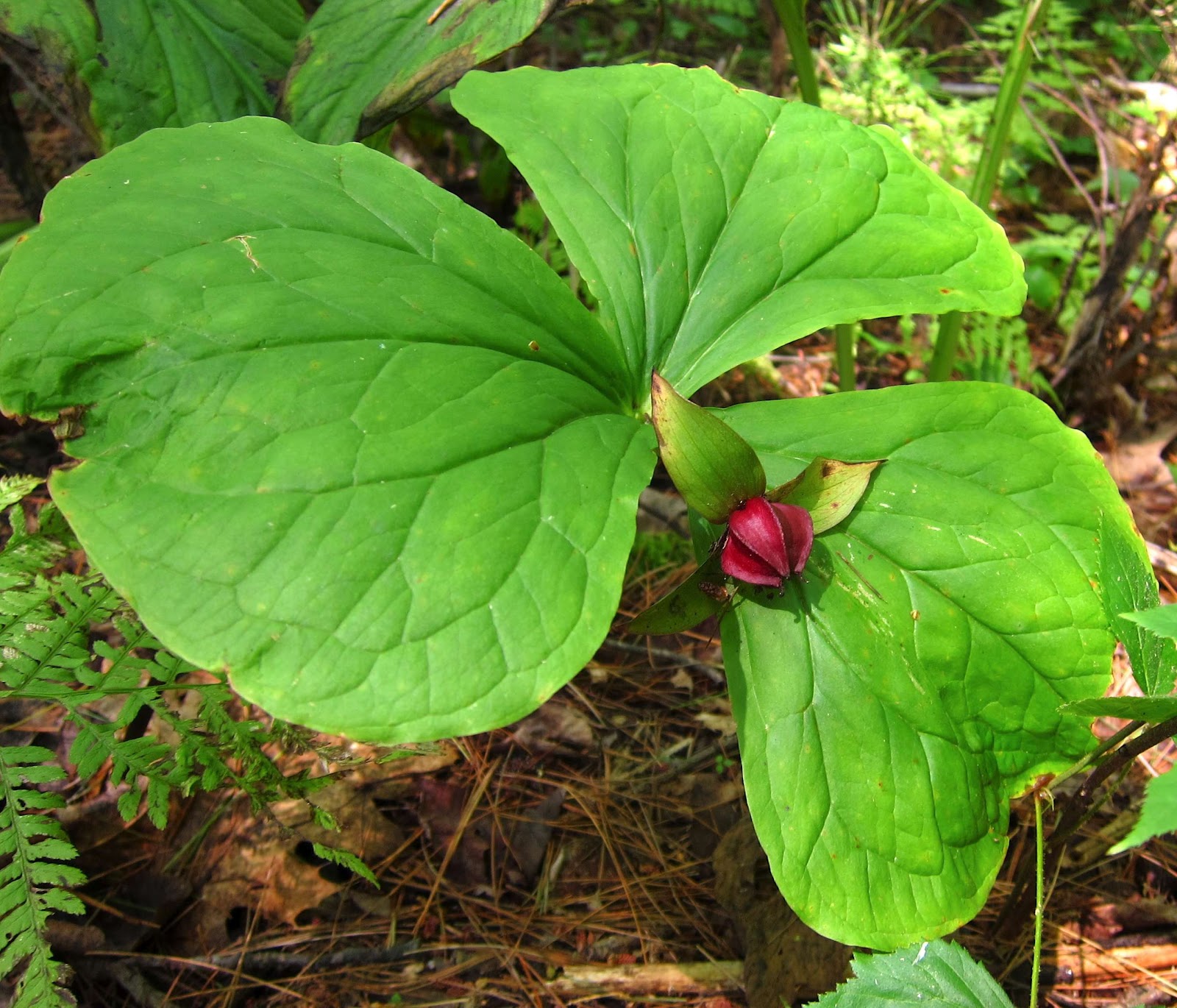
My progress back to my car was also slowed by the sight of this beautifully red Red Trillium fruit . . .


. . .  as well as by these bright-orange tines of Spindle Coral poking up from the path.


Okay, last stop was Yaddo, an artists' colony on the outskirts of Saratoga Springs that has extensive wild woodlands as well as manicured gardens that are open to the public.  Luckily, I had gathered specimens of both the flowers and the fruit of American Bladdernut (Staphlea trifolia) in May and June of 2011, because by the spring of 2012, groundskeepers at Yaddo had cut all the shrubs to the ground.  However, I could still obtain a GPS mark for where they used to be, and when I reached the site, I was glad to see that the shrubs were regrowing vigorously.  Let's hope they're allowed to prosper again, since Saratoga is probably the northernmost site they are likely to be found.  I know that they grow along the Mohawk River on the county's southern border, but as yet there is no official record of their existence anywhere in Saratoga County.  I hope my specimen will remedy that.


Close by those American Bladdernut bushes was a thicket of Northern Prickly Ash (Zanthoxylum americanum), and the female trees were laden with bunches of bright red fruits.  When the fruits split open, they spill out seeds that are very shiny and black.   This small tree is also called "Toothache Tree" because of the numbing sensation achieved by chewing on its twigs.  I tried it once, and sure enough, my lips and tongue went numb for half an hour or so, but I don't think it would have helped a toothache.


I wonder how the plant affects this Stink Bug nymph that was crawling on one of its leaves.  Stink Bugs are known to pierce fruits of many kinds, but I'll bet this nymph will get a surprise if it tries to feed on Prickly Ash berries.  Or maybe not.  Bugs can eat mushrooms that would be deadly to humans, after all.   This is one colorful bug, is it not?


Tuesday, June 19, 2012

Blooms and Bugs

This is turning out to be a very flower-filled week, with far-flung excursions planned for the rest of it.  So yesterday and today I hurried off to catch up on some of my favorite places close to home.  My first stop yesterday was Woods Hollow Nature Preserve in Ballston Spa, where almost as soon as I stepped from my car, I was nearly bowled over by the beauty of this meadow chock full of snowy Oxeye Daisies and pretty pink Crown Vetch.


That sunny meadow was so full of just those two flowers,  I had to really search to locate the one I had come to find.  But find it I did:  Spiked Lobelia.


The air over the meadow was filled with darting and dashing dragonflies, and I couldn't believe my good luck when this Widow Skimmer sat still for its portrait, the sun glinting off its gossamer wings and touching its body with gold.


These two flower beetles were too wrapped up in each other to pay me the slightest mind, as I poked my camera into their intimate space.


There were several species of tiny hoverflies zipping in and out of the Common Milkweed flowers, and this tiger-tailed one took a moment to rest on a blade of grass.


As the mid-day heat bore down on my head, I was glad to seek the shade of the pine woods that makes up much of Woods Hollow.


It's under these pines that I know to look for the elusive Checkered Rattlesnake Plantain.  I always find the distinctively patterned basal leaves of many plants, but finding a flowering stalk is not always a given.  This year, I found but two flower stalks among some 20 plants in one area.  Sometime in the next few weeks, those tight green buds will open into tiny white orchids.


Sharing that same pine-needled forest floor were many Pipsissewa plants, easily seen, with their glossy evergreen leaves.  And as with the Rattlesnake Plantain, not so easy to find are the occasional flower clusters.


Tiny flies have no problem finding these flowers.  I don't think I have ever turned over one of these waxy pink blooms when I didn't find it crawling with little black flies.


When and where Pipsissewa blooms, it's almost a guarantee  that Shinleaf Pyrola will not be far away.


I see I wasn't the first one to find this lovely fat boletus mushroom with the rusty brown cap.


I next headed down to the pond that forms the heart of Woods Hollow Preserve, so cool and green and shady on this hot summer day.


There's a sweet little brook that flows into this pond, and its water (which must be spring-fed) is always icy cold and refreshing to my hot dusty feet.


I didn't have to wade far to find American Brooklime with its dainty little blue flowers, one of our native Speedwells.


 *  *  *

Well, today was even hotter and muggier than yesterday, and I really thought twice about visiting Bog Meadow Nature Preserve just outside Saratoga, a beautiful trail but which is more infested with Deer Flies than any other place I know.  Ah, but then I remembered my Tred-not Deerfly Patches, which, as this photo reveals,  saved me from being bitten by these 18 flies.


But not all the bugs along this trail are the kind we dread.   This butterfly eluded me for the longest time, but eventually it lit on a leaf and spread its glorious wings.   If it had closed its wings, it would have looked more like a dead brown leaf.  But then I could have determined if it was a Question Mark or a Comma, according to little white marks that can only be seen on the underside of the wings.  One thing I can say for sure is that this is one of the angel-winged butterflies, a species that will winter over as adults.

Update:  A loyal reader has left a comment positively IDing this butterfly as an Eastern Comma (Polygonia comma), noting the three dark spots across the middle of the forewing.  A Question Mark Butterfly would have a 4th spot that looks like a dash.


This little guy, on the other hand, has underwings  that are showier than the top.  I believe that this is an Eastern Eyed Brown, but there are several brown butterflies that look very much alike, and this one was not about to let me examine it closely.  It's a wonder I even got this close to it.


I hope this little Candy-striped Leafhopper is not some dreaded pest, because I am always delighted to see one.  Have you ever seen a little bug more colorfully attired?


It even sat still long enough for me to get a side view, so I could see its vivid yellow underside.


This tiny blue leafhopper, species unknown, did not sit still for one moment, so my camera had to keep chasing it as fast as it ran away.  It was quite a vivid blue, and if it had not been so colorful, I never would have noticed it.


And if I hadn't been chasing that little blue bug all over the leaves, I never would have turned this leaf over to find this little green caterpillar all snug in its silken hammock.  What a lovely sheer veil it has spun for itself.  I wonder if it's just resting in there, or is it getting ready to undergo metamorphosis?


Monday, April 16, 2012

A Nature-adventure Weekend

Whew!  It was one busy weekend, with so many nature adventures I hardly had time to sleep, let alone post a blog.   So I'll try to cover them all in one post.

Audubon Walk at Bog Meadow

Saturday morning had me up early to head out to Bog Meadow Nature Trail for an Audubon-sponsored birdwalk with noted expert Rich Speidel leading a small group of avian enthusiasts, all with much better eyesight than I.   I figured it was a great opportunity to increase my awareness of many birds I will never see, and I was right.


If you asked any of the folks in the photo above about what birds they saw, they would be able to describe in wonderful detail the cant of the Wilson's Snipes' bills as they flew by in a rapid blur, or the diagnostic vertical white stripe on the sides of the Green-winged Teals that kept slipping out of sight behind reeds on the faraway side of the marsh.  They could also cock an ear to a sound and tell me immediately that that was the call of the very elusive Virginia Rail, or the constant chatter of several Swamp Sparrows, or the ritardando drumming of a Yellow-bellied Sapsucker as it pounded away on a hidden tree in the woods along the trail.

At the end of the walk, my birding friends were able to count over 30 species they'd either seen or heard, and I was happy to take their word for it and be amazed.  As for me, I couldn't even see this Ruby-crowned Kinglet circled in the photo below until after I had blown up the picture on my computer.  My companions kept pointing at this shrub just a few feet from my face, so I pointed my camera and snapped a shot of the twigs, hoping the camera would catch what my eyes could not.


Happily, this Yellow-bellied Sapsucker announced its presence with more fanfare, so that all I had to do was wait until the bird made its way back around the trunk it was pecking at with its distinctive pattern of knocks.


The multitudes of Red-winged Blackbirds also were not shy about showing themselves, and I did actually lay my eyes upon two Brown-headed Cowbirds profiled against the sky.  For the most part, however, I just took pleasure in knowing what others were seeing and kindly attempting to show me.  Of course, there were many botanical pleasures to be had, as well, such as these tiny Panicled Dogwood leaves lit up like Christmas-tree lights by the early morning sun.


*  *  *
Forest Trekking with Evelyn

Sunday came, and again I rose early, in time to meet my friend Evelyn Greene for adventures in the Charles Lathrop Pack Demonstration Forest north of Warrensburg.  Named after an Adirondack lumberman who donated this 2500-acre tract to the State University of New York's College of Environmental Science and Forestry,  the forest contains an 85-acre lake plus miles of trails leading to mountain vistas, marshes, and old-growth stands containing some of the tallest White Pines in the Adirondacks.  On the needle-cushioned ground beneath these pines grows one of our most uncommon Rattlesnake Plantains, a little orchid called Goodyera repens, and finding those plants was one of the goals that Evelyn had set for our adventure today.  But first we were going to climb little Ben Wood Mountain in the northern end of the tract, following several miles of forested trails that led to a lovely overlook.


Along the way to the mountain top we passed by a beaver pond, beautifully serene in the still morning air and a place of welcome refreshment for our doggy companion, Brio.


I believe that Ben Wood Mountain offers one of the finest payoffs for the least amount of huffing and puffing I have ever experienced.  Wide logging roads at an easy incline brought us out onto this rocky overlook, with views of the many-tiered mountains beyond.


Accompanying us all along our trail were three of the sweetest singers in all the forest:  the piccolo-plaintive White-throated Sparrow, the coloratura Winter Wren, and the mezzo-soprano Hermit Thrush, a bird I think of as the Marilyn Horne of the north woods.  How wonderful to have these marvelous voices back among us!  We were also serenaded by the constant twittering of dozens of Pine Warblers high in the treetops.  I've heard that this bird looks something like a flying lemon when viewed from below, but this is all we could see of them, even though these pines were alive with fluttering flocks of them.  Evelyn did catch sight of one with her binoculars, but only a glimpse that allowed her to be quite positive as to the species.


Fortunately, there were other beauties along the trail that we could feast our eyes on at length, such as these vividly yellow Round-leaved Violets.


We also saw masses of Hepaticas, a flower that's nearing the end of its blooming time down in Saratoga but which still bloomed profusely along the Pack Forest trails.


Considerably more cryptic in its coloration, this American Toad would have remained unseen if it had just stayed put.  At least it didn't hop so far and fast I couldn't snap its photo.


* * *

Goodyera and Grandmother


The next phase of our day's adventure took us to the southern end of the Pack Forest tract, to a well-marked nature trail that took us into the heart of an old-growth woods, where pines of astounding height and girth towered over our heads.


Evelyn remembered finding our sought-after Goodyera repens a year or so ago,  but that was before the terrible storms of last summer brought down vast numbers of trees, making it difficult to search the ground under the blow-down.


But find the Goodyera she did, a nice patch of it, at least 15 plants clustered near the shore of an open marsh.  This is the smallest and least common of our native Goodyeras, with the most appropriate name of Dwarf Rattlesnake Plantain.  The distinctive pattern of the leaves, as well as its diminutive size, are what set it apart from the other two Rattlesnake Plantains we can find in our area, the Downy (G. pubescens) and the Checkered (G. tesselata).  All bear tiny white orchid flowers in a tall spike later in the summer.


I think this photo should reveal how amazing it is that Evelyn found those tiny plants.   Once she had shown them to me and I now had a search image, I, too, found a single plant not far from the patch she had found.  We shall have to come back again in July to maybe find them in bloom.


Almost as hard to see as the Goodyera, this Wood Frog tried to hide itself among some Hemlock blow-down.


As long as we were here and so near, we decided to visit Grandmother,  as this enormous pine that stands along the boardwalk is called.  What's remarkable is that this particular tree hardly stands out, surrounded as it is by other giants.   But yes, when you stand right beneath it, its girth impresses mightily as its top disappears in the faraway canopy above.  How lucky it is, that last summer's hurricane did not bring it down, as it did so many other huge trees in surrounding areas.


This sign explains how the tree got its name.  We noticed a gash caused by lightning along its trunk, reminding us that even giants can be vulnerable.  So if you live anywhere near it, be sure to visit this amazing tree while it still stands.