I've been collecting and pressing botanical specimens for a couple of years now, and I finally have the GPS device that can pinpoint each plant's location. So yesterday and today I drove around to various sites to take the GPS readings, then came home to prepare the documentation to accompany each specimen. Tomorrow I'll be meeting with folks from the Adirondack Botanical Society for a meeting at Whiteface Mountain near Lake Placid, so at last I can hand these specimens off to botanical professionals who can then document the plants' existence in their respective counties. And I won't have to worry any more that my cats will rip them apart.
The first stop on my GPS run was the Wilton Wildlife Preserve, where last year I found a single plant of Tall Ironweed (Vernonia gigantea) growing right by the road. And sure enough, there it was again as big and bright as ever.

This is a plant that is not supposed to grow in Saratoga County, nor has it been found in any county nearby, so it was quite a surprise to find it in Wilton last year. This is a plant that is really hard to miss, since it surely lives up to its name, being taller than any other plants surrounding it.

We are surmising that this plant's seed may have slipped into Saratoga County along with grass seed
imported by the state for its grasslands restoration project here at Wilton Wildlife Preserve. There certainly are a lot of really interesting native grasses to be found now at this site.

My next stop was the Orra Phelps Nature Preserve, also in Wilton, to get a GPS reading for specimens of Fringed Gentian (Gentianopsis crinita) I collected last September when they were in bloom. When I reached the site, I was dismayed to see that the poplars and pines we cut down a couple of years ago were once again encroaching on the open space where dozens of these radiant-blue flowers can usually be found each late summer. I think next time we cut these trees down, we should paint their stumps with an herbicide to prevent their regrowth. Or else brush-hog the site each late autumn after frost. If we don't clear this site, I'm afraid the gentians will disappear from this, the only place where they are known to grow in Saratoga County.

While still at Orra Phelps Preserve, I also took a GPS reading on a huge shrub of Rosebay Rhododendron (Rhododenron maximum) that grows by a stream. State floral records do not show this plant as growing in Saratoga County, but it's certainly thriving happily here at Orra Phelps. It's possible that it was planted by Orra, but I also find this shrub growing in a woods near the Yaddo Estate in Saratoga Springs. I haven't yet collected a specimen, because I always seem to miss its blooming season. I can see by spent flower heads on this shrub that it did indeed bloom this summer.

Next stop was Bog Meadow Nature Preserve just outside Saratoga Springs, but on my over there from Wilton, I pulled off into a vacant lot along Ingersol Road. This dry, open, sandy "waste place" of disturbed soil was the first place I ever saw the bushy tumbleweed-like plants of Winged Pigweed (Cycloloma atriplicifolium), a plant that's native to more central states of the U.S., but which can now be found in more eastern parts of the country. I gathered a specimen and took its GPS coordinates so that it can now be recorded as present in Saratoga County.

My purpose in visiting Bog Meadow Nature Trail was to obtain coordinates for Buckbean (Menyanthes trifoliata), which grows there in a swampy area along the trail. Of course, there's not a sign of the plant this late in the year, but I know exactly where it grows so I was able to take a reading to accompany the pressed specimen I obtained a year ago last May.
Mission accomplished, I hurried back to my car before the next rainstorm, but stopped in my tracks when I saw these lovely buds of Swamp Thistle (Cirsium muticum). I think these buds are as intricate and beautiful as Ukrainian Easter eggs, and if you look close, you can already see the web of fine threads that encase the buds, a feature that is diagnostic for this, one of our few native thistles.

Just in case there was no record of their presence in Saratoga County, I did take a GPS reading of their location, and sure enough, when I checked the records at home, they were not in the atlas for this county. I'll have to return in a couple of weeks when they are in bloom to obtain a specimen. Wearing thick gloves. Those prickers are sharp!
My progress back to my car was also slowed by the sight of this beautifully red Red Trillium fruit . . .
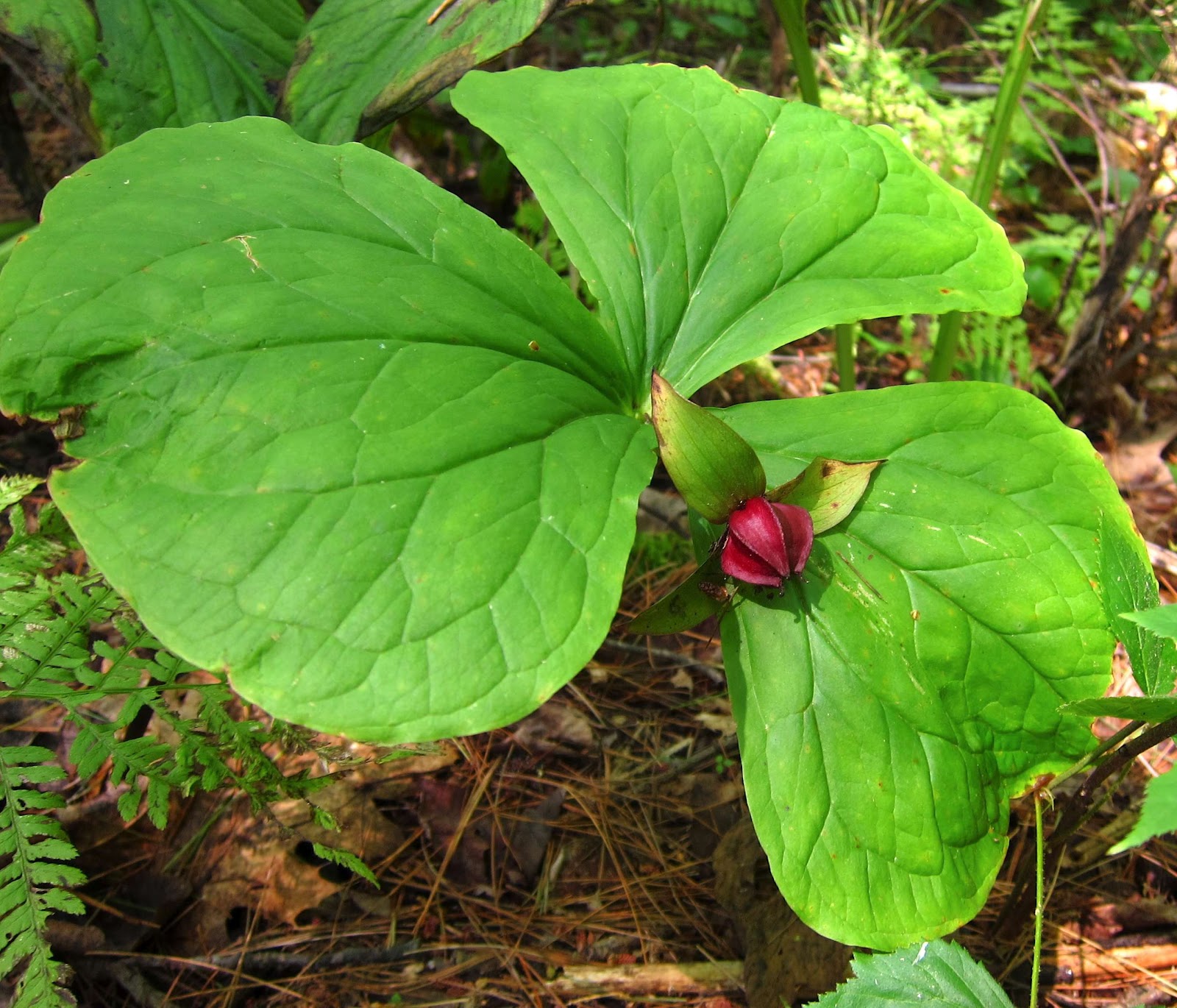
. . . as well as by these bright-orange tines of Spindle Coral poking up from the path.

Okay, last stop was Yaddo, an artists' colony on the outskirts of Saratoga Springs that has extensive wild woodlands as well as manicured gardens that are open to the public. Luckily, I had gathered specimens of both the flowers and the fruit of American Bladdernut (Staphlea trifolia) in May and June of 2011, because by the spring of 2012, groundskeepers at Yaddo had cut all the shrubs to the ground. However, I could still obtain a GPS mark for where they used to be, and when I reached the site, I was glad to see that the shrubs were regrowing vigorously. Let's hope they're allowed to prosper again, since Saratoga is probably the northernmost site they are likely to be found. I know that they grow along the Mohawk River on the county's southern border, but as yet there is no official record of their existence anywhere in Saratoga County. I hope my specimen will remedy that.

Close by those American Bladdernut bushes was a thicket of Northern Prickly Ash (Zanthoxylum americanum), and the female trees were laden with bunches of bright red fruits. When the fruits split open, they spill out seeds that are very shiny and black. This small tree is also called "Toothache Tree" because of the numbing sensation achieved by chewing on its twigs. I tried it once, and sure enough, my lips and tongue went numb for half an hour or so, but I don't think it would have helped a toothache.

I wonder how the plant affects this Stink Bug nymph that was crawling on one of its leaves. Stink Bugs are known to pierce fruits of many kinds, but I'll bet this nymph will get a surprise if it tries to feed on Prickly Ash berries. Or maybe not. Bugs can eat mushrooms that would be deadly to humans, after all. This is one colorful bug, is it not?


