Yes, I know. My garden's a mess. Rather colorful now, with the neighbor's maples ablaze and my Monkshood exploding in radiant blueness, but it sure wouldn't win any prizes for tidiness. And that's exactly the way I like it. More importantly, that's the way the wee creatures like it: those micro-insects that munch away underneath the unraked leaves, turning them into nourishing mulch and drawing new nutrients into the soil; the various larvae that burrow into the dead flower stalks where they'll spend the winter and then serve as food for baby birds next spring; and the wintering birds that will feast on the seeds of spent asters and goldenrods and sunflowers, whose stalks I won't be cutting down until spring. My garden won't be featured in Better Homes and Gardens, that's for sure, but it does meet the standards the National Wildlife Federation sets for establishing a Certified Wildlife Habitat. I even have a plaque to prove it. (Your garden can meet those criteria, too. Just go to their website to learn the easy instructions.)
Since my Certified Wildlife Habitat pretty much takes care of itself, I'm free to go visit Mother Nature's gardens more often, and today I went out to the Gick Farm section of the Wilton Wildlife Preserve and Park. I love the many muted colors of various grasses that thrive in the sandy soil of the oak/pine savannah habitat here.
The trails also move through a conifer woods, where the dim understory is brightened by the golden leaves of many baby beeches. When I look around, I can find only the dark trunks of mature White Pines and not a single silvery trunk of a mature American Beech. How do these little ones get here?
This patch of Black Raspberry puts on quite a show of dazzling red each autumn.
The Hazelnut shrubs have all shed their leaves by now, the better to see the little greenish male catkins. These catkins will hang on the twigs all winter before expanding to shed their pollen next spring, when itsy-bitsy red female flowers will emerge to receive that pollen.
I kept seeing these tiny fuzzy blue dots wafting about in the air and finally managed to capture one in my hand. Remember that fluffy white clump of Wooly Alder Aphids I pictured a few posts back? This is the winged form of those same aphids.
When the wingless aphids have depleted the resources of the alder twig
they are feeding on, they will sprout wings to go in search of fresh
twigs. Somehow they must shed quite a bit of that long-stranded
wooliness, since all that remains is a trace of fuzziness on its tiny
rear. Wooly Alder Aphids are not considered to be serious pests of
alder trees, since they only weaken a few twigs at a time. I'm glad to
know that, so that I may more freely delight in their absolute
adorableness.
For more than thirty years I've been wandering the woods and waterways of Saratoga County, New York, and regions nearby, looking closely, listening carefully, and recording what I experience. We are blessed in this region with an amazing amount of wilderness right at hand. With this blog I share my year-round adventures here, seeking out what wonders await in my own Madagascar close to home.
Showing posts with label Wilton Wildlife Preserve. Show all posts
Wednesday, October 24, 2012
Thursday, September 6, 2012
Late Summer, Lovely Grass
The weather continues summer-like, but except for a few goldenrods and asters, most of the summer-blooming flowers are gone. But that doesn't mean that the landscape is bereft of colorful beauty. On a walk through the Gick Farm parcel of the Wilton Wildlife Preserve today, I delighted in the many colors and textures of grasses that inhabit this extensive oak-pine savanna.
This parcel of the Wilton Wildlife Preserve is the site of an ambitious grasslands-restoration project, with Fall Witchgrass (the fluffy pink one) and Little Bluestem (the darker reddish one) among the native grasses being reintroduced to this sandy tract that once was cultivated as farmland.
Sometimes the Little Bluestem looks just as pink as the Fall Witchgrass.
In other lights, and as the wind moves across it in waves, the same grass assumes a paler and more tawny hue.
When I chose this site for my walk today, I was hoping to find the variety of interesting galls that oaks are known to host, but to my surprise, I didn't find a single gall of any kind on the oaks that lined the path. What I did find, though, were oak leaves that were wrinkled and shriveled. Are they infected with some kind of blight, or is this just the result of an exceptionally hot and dry summer?
There are still a few more flowers coming into bloom, although in the case of the tiny Sand Jointweed, you have to look very carefully or you might miss these spindly little blooms.
No chance you will miss the gorgeous purple New England Aster, though. Oh oh, that shiny black beetle better watch out, there's a predatory spider lurking among the ray flowers.
Although the Wilton Wildlife Preserved is famous as a habitat for the endangered Karner Blue Butterfly, I believe this one may be an Eastern Tailed Blue, because of the tiny spikes protruding from the hind wings. It sure was beautifully blue, while it was on the wing. But as soon as it landed and closed its wings, it became a very dull gray.
I believe this caterpillar is a Yellow Bear, the larval form of the Virginia Tiger Moth. Although it looks soft and fuzzy, some of those hairs can be irritating if you pick this caterpillar up.
Before I went home, I made a detour to the Orra Phelps Nature Preserve, also in Wilton, to check on the status of the Fringed Gentians that are known to bloom there, and nowhere else that I know of in Saratoga County. Wow! Just look at them all! Is there any flower more vividly blue than this? When I came here about 10 days ago, I could find only one plant, still in tight bud, and was afraid their numbers would be sharply down this year. I'm very glad to say I was misled.
This parcel of the Wilton Wildlife Preserve is the site of an ambitious grasslands-restoration project, with Fall Witchgrass (the fluffy pink one) and Little Bluestem (the darker reddish one) among the native grasses being reintroduced to this sandy tract that once was cultivated as farmland.
Sometimes the Little Bluestem looks just as pink as the Fall Witchgrass.
In other lights, and as the wind moves across it in waves, the same grass assumes a paler and more tawny hue.
When I chose this site for my walk today, I was hoping to find the variety of interesting galls that oaks are known to host, but to my surprise, I didn't find a single gall of any kind on the oaks that lined the path. What I did find, though, were oak leaves that were wrinkled and shriveled. Are they infected with some kind of blight, or is this just the result of an exceptionally hot and dry summer?
There are still a few more flowers coming into bloom, although in the case of the tiny Sand Jointweed, you have to look very carefully or you might miss these spindly little blooms.
No chance you will miss the gorgeous purple New England Aster, though. Oh oh, that shiny black beetle better watch out, there's a predatory spider lurking among the ray flowers.
Although the Wilton Wildlife Preserved is famous as a habitat for the endangered Karner Blue Butterfly, I believe this one may be an Eastern Tailed Blue, because of the tiny spikes protruding from the hind wings. It sure was beautifully blue, while it was on the wing. But as soon as it landed and closed its wings, it became a very dull gray.
I believe this caterpillar is a Yellow Bear, the larval form of the Virginia Tiger Moth. Although it looks soft and fuzzy, some of those hairs can be irritating if you pick this caterpillar up.
Before I went home, I made a detour to the Orra Phelps Nature Preserve, also in Wilton, to check on the status of the Fringed Gentians that are known to bloom there, and nowhere else that I know of in Saratoga County. Wow! Just look at them all! Is there any flower more vividly blue than this? When I came here about 10 days ago, I could find only one plant, still in tight bud, and was afraid their numbers would be sharply down this year. I'm very glad to say I was misled.
Sunday, August 12, 2012
Catching Up
Time to catch up on the past week's outings. I did get out several times, but what with houseguests and feeling ill part of the week, I sure didn't feel like sitting up late to write my blog. But I hate to let a whole week go by without recording something about what's happening in the natural world around me, so here's a brief recap.
Thursday, August 9: Mud Pond walk with the Thursday Naturalists
What a great gang to go for a walk with! And it's not just that everyone in the Thursday Naturalists is an expert in some aspect of nature -- although that, of course, is a big plus. But they're also just wonderful fun to be with, alert to the wonders around us, eager to learn, and just as eager to share what they know with each other. I felt tremendously pleased when they asked me to lead the group on a walk around Mud Pond in Moreau Lake State Park, primarily to explore the mud flats along one shore, where a marvelous variety of plants uniquely suited to this habitat can be found. (We were also treated to a Bald Eagle soaring over the pond and landing several times in spots where we could all get a clear view.)
Of course, it took us a while to get there, moving as we did at a botanical pace, which means lots of stopping to examine all kinds of plants along the way. We started our walk in a dry sandy part of the trail, where Blue Curls were in their glory, demanding that we all bend down to peer more closely at their tiny exquisite blooms with the curving stamens.
Nearby, at the edge of the pond, we found lots of Humped Bladderworts, little bright-yellow flowers standing straight up on thin naked stalks, the inflatable bladders with which they capture tiny organisms for food splayed beneath them in the wet mud.
When we finally reached our destination mud flats, we found more tiny yellow flowers growing out of damp ground, the sweet little Dwarf St. Johnsworts.
Another shoreline denizen is Wild Mint, strongly scented and adorned with puffs of tiny lavender flowers.
The green carpet visible in the photo above is made up almost exclusively of masses of Water Purslane, which bears tiny 4-parted flowers in its leaf axils. One of our group, Ruth Schottman, noted how the box-like structure of the flower resembled that of Seedbox, which is not surprising, since both plants are members of the Evening Primrose Family.
Common Smartweed is rather a scrawny, homely flower by itself, but masses of it heaped on a hummock and punctuated by the vivid blue sprays of Blue Vervain made quite a lovely sight.
The chubby little blooms of Ditch Stonecrop looked quite striking, set among leaves with dark-red stems.
Saturday, August 11: Exploring the Ice Meadows with two new friends
The world of internet connections is amazing indeed. Because I am Facebook friends with one botanist from Ohio, I also became a Facebook friend of John Manion, a botanist from Alabama. It also happens that John studied at SUNY Cobleskill where Anne Donnelly (no relation) is a professor, and they became friends there. Anne is also on the board at Landis Arboretum where Ed Miller is curator of native woody plants. So Anne is also a friend of Ed, who is also a friend of mine. Small world! And all of us got together this week because John is visiting here in New York and wanted to explore the Ice Meadows north of Warrensburg, and he wanted his friend Anne to join us, and both of them wanted Ed and me to be their guides. And it was wonderful fun!
This particular stretch of Hudson River bank has a distinctive habitat influenced by masses of ice that pile up on the shores each winter, creating what is one of the richest botanical sites in the state. Although the full flush of summer flowers has mostly gone by, we were treated to many just-opening spikes of the lovely little native orchid, Nodding Ladies' Tresses.
In other summers, we would not expect to see this species of Ladies' Tresses until several weeks later than this. But almost all of our native wildflowers have bloomed about two weeks early this year. It is difficult to distinguish the Nodding Ladies' Tresses from the very similar Hooded Ladies' Tresses, and one of the ways we tell them apart is by bloom time, with the Hooded species blooming earlier in the summer. But this year their bloom time is almost overlapping, since it was only last week that I went up to Thirteenth Lake to see the Hooded ones, which were just starting to fade.
Another way to distinguish this Nodding species is by the shape of the lower petal, which does NOT narrow into a fiddle shape as does that of the Hooded. But these distinctions are often difficult to discern.
We were presented with another puzzle when we found these bladderworts blooming in the little pools that lie among the rocks. We could plainly see the bottle-brush leaves of the species called Flat-leaved Bladderwort, and since the little yellow flowers were protruding from these leaves, we would ordinarily assume that these were the flowers of those leaves. Problem is, Flat-leaved Bladderworts bloom early in the summer and have larger flowers than these. The species of bladderwort we would expect to find this late in the summer is the Humped Bladderwort, which has a flower that is very small. Like these.
I was able to extract one plant carefully from the mass of Flat-leaved Bladderwort leaves, and it appeared to have no leaves at all. I suppose they could have broken off, but I'm going to surmise that this is actually a Humped Bladderwort that just happened to share the same little puddle as the Flat-leaved kind. I would, however, be happy to stand corrected if I am wrong.
At least I had no doubt at all that these were Pipeworts protruding from the foamy water at the river's edge.
This stand of Canadian Burnet made a good hiding spot for this similarly colored moth.
The vividly colored Monarch Butterfly doesn't need to hide, since its orange color is a warning sign to predators that it is poisonous to eat. Happily, the butterfly did not find ME poisonous to eat, and it sat on my hand for quite a while, apparently licking the salt from my skin with its long thin proboscis.
One of my goals for visiting this site, called the Old Gick Farm parcel, was to see if a particular aster was blooming again this year. This is the Late Purple Aster (Symphyotrichum patens), a species that is considered far out of its range in Saratoga County. I found one plant blooming last August, and this year I discovered there were two, so it not only survived, but it also appears to be spreading. This photo is of a single stem with two flowers in bloom. This aster has a very stiff wiry dark stem with leaves that completely clasp the stem. Nobody knows how it got here, but it will be interesting to see if it continues to survive and establish a population.
I suppose it's possible the aster's seed arrived with grass seed that's being used to restore native grasses to the Wilton site. This is a wonderful time to visit this preserve and see the various grasses in flower and in seed. Some of them are quite lovely, like this fluffy bunch.
Or this tall stately cluster.
The goldenrods are coming into their glory, too.
I wonder if this grasshopper was the victim of a Jagged Ambush Bug, a predatory insect that likes to lurk in flowers. This is the deadest-looking grasshopper I could imagine. I don't think the yellow striped beetle had anything to do with the 'hopper's demise, since this is a Locust Borer Beetle that eats only pollen.
Here's that same kind of beetle feeding on Boneset. This spectacular creature with the glossy red legs is a native beetle that is considered a pest of Black Locust trees because its larvae bore into the tree's wood. Looking at this photo now, I'm noticing that the antennae appear to be coming right out of the insect's eyes. Yikes!
Here's another pollen eater, a Feather-legged Fly, quite an interesting-looking critter with that orange-and-black abdomen, giant-sized eyes, and feathery hind legs. I love that ombre edge to its wings, as well.
On my way home I noticed a large patch of tall sunflower-like plants in a ditch by the side of the road. They didn't look exactly like any flowers I recognized, so I promptly pulled over and went to take a closer look. Wow, these are really odd, I thought, with their flopped-back petals and distinctively winged stems. Sort of like Sneezeweed on steroids.
Thursday, August 9: Mud Pond walk with the Thursday Naturalists
What a great gang to go for a walk with! And it's not just that everyone in the Thursday Naturalists is an expert in some aspect of nature -- although that, of course, is a big plus. But they're also just wonderful fun to be with, alert to the wonders around us, eager to learn, and just as eager to share what they know with each other. I felt tremendously pleased when they asked me to lead the group on a walk around Mud Pond in Moreau Lake State Park, primarily to explore the mud flats along one shore, where a marvelous variety of plants uniquely suited to this habitat can be found. (We were also treated to a Bald Eagle soaring over the pond and landing several times in spots where we could all get a clear view.)
Of course, it took us a while to get there, moving as we did at a botanical pace, which means lots of stopping to examine all kinds of plants along the way. We started our walk in a dry sandy part of the trail, where Blue Curls were in their glory, demanding that we all bend down to peer more closely at their tiny exquisite blooms with the curving stamens.
Nearby, at the edge of the pond, we found lots of Humped Bladderworts, little bright-yellow flowers standing straight up on thin naked stalks, the inflatable bladders with which they capture tiny organisms for food splayed beneath them in the wet mud.
When we finally reached our destination mud flats, we found more tiny yellow flowers growing out of damp ground, the sweet little Dwarf St. Johnsworts.
Another shoreline denizen is Wild Mint, strongly scented and adorned with puffs of tiny lavender flowers.
The green carpet visible in the photo above is made up almost exclusively of masses of Water Purslane, which bears tiny 4-parted flowers in its leaf axils. One of our group, Ruth Schottman, noted how the box-like structure of the flower resembled that of Seedbox, which is not surprising, since both plants are members of the Evening Primrose Family.
Common Smartweed is rather a scrawny, homely flower by itself, but masses of it heaped on a hummock and punctuated by the vivid blue sprays of Blue Vervain made quite a lovely sight.
The chubby little blooms of Ditch Stonecrop looked quite striking, set among leaves with dark-red stems.
* * *
Saturday, August 11: Exploring the Ice Meadows with two new friends
The world of internet connections is amazing indeed. Because I am Facebook friends with one botanist from Ohio, I also became a Facebook friend of John Manion, a botanist from Alabama. It also happens that John studied at SUNY Cobleskill where Anne Donnelly (no relation) is a professor, and they became friends there. Anne is also on the board at Landis Arboretum where Ed Miller is curator of native woody plants. So Anne is also a friend of Ed, who is also a friend of mine. Small world! And all of us got together this week because John is visiting here in New York and wanted to explore the Ice Meadows north of Warrensburg, and he wanted his friend Anne to join us, and both of them wanted Ed and me to be their guides. And it was wonderful fun!
This particular stretch of Hudson River bank has a distinctive habitat influenced by masses of ice that pile up on the shores each winter, creating what is one of the richest botanical sites in the state. Although the full flush of summer flowers has mostly gone by, we were treated to many just-opening spikes of the lovely little native orchid, Nodding Ladies' Tresses.
In other summers, we would not expect to see this species of Ladies' Tresses until several weeks later than this. But almost all of our native wildflowers have bloomed about two weeks early this year. It is difficult to distinguish the Nodding Ladies' Tresses from the very similar Hooded Ladies' Tresses, and one of the ways we tell them apart is by bloom time, with the Hooded species blooming earlier in the summer. But this year their bloom time is almost overlapping, since it was only last week that I went up to Thirteenth Lake to see the Hooded ones, which were just starting to fade.
Another way to distinguish this Nodding species is by the shape of the lower petal, which does NOT narrow into a fiddle shape as does that of the Hooded. But these distinctions are often difficult to discern.
We were presented with another puzzle when we found these bladderworts blooming in the little pools that lie among the rocks. We could plainly see the bottle-brush leaves of the species called Flat-leaved Bladderwort, and since the little yellow flowers were protruding from these leaves, we would ordinarily assume that these were the flowers of those leaves. Problem is, Flat-leaved Bladderworts bloom early in the summer and have larger flowers than these. The species of bladderwort we would expect to find this late in the summer is the Humped Bladderwort, which has a flower that is very small. Like these.
I was able to extract one plant carefully from the mass of Flat-leaved Bladderwort leaves, and it appeared to have no leaves at all. I suppose they could have broken off, but I'm going to surmise that this is actually a Humped Bladderwort that just happened to share the same little puddle as the Flat-leaved kind. I would, however, be happy to stand corrected if I am wrong.
At least I had no doubt at all that these were Pipeworts protruding from the foamy water at the river's edge.
This stand of Canadian Burnet made a good hiding spot for this similarly colored moth.
The vividly colored Monarch Butterfly doesn't need to hide, since its orange color is a warning sign to predators that it is poisonous to eat. Happily, the butterfly did not find ME poisonous to eat, and it sat on my hand for quite a while, apparently licking the salt from my skin with its long thin proboscis.
* * *
Sunday, August 12: Surprising finds at Wilton Wildlife Preserve
There's
an oak/pine savanna restoration site at Wilton Wildlife Preserve and
Park, where the Nature Conservancy is working with New York's DEC and folks from WWPP to create and
maintain an open grasslands habitat. That's where I went today.
One of my goals for visiting this site, called the Old Gick Farm parcel, was to see if a particular aster was blooming again this year. This is the Late Purple Aster (Symphyotrichum patens), a species that is considered far out of its range in Saratoga County. I found one plant blooming last August, and this year I discovered there were two, so it not only survived, but it also appears to be spreading. This photo is of a single stem with two flowers in bloom. This aster has a very stiff wiry dark stem with leaves that completely clasp the stem. Nobody knows how it got here, but it will be interesting to see if it continues to survive and establish a population.
I suppose it's possible the aster's seed arrived with grass seed that's being used to restore native grasses to the Wilton site. This is a wonderful time to visit this preserve and see the various grasses in flower and in seed. Some of them are quite lovely, like this fluffy bunch.
Or this tall stately cluster.
The goldenrods are coming into their glory, too.
I wonder if this grasshopper was the victim of a Jagged Ambush Bug, a predatory insect that likes to lurk in flowers. This is the deadest-looking grasshopper I could imagine. I don't think the yellow striped beetle had anything to do with the 'hopper's demise, since this is a Locust Borer Beetle that eats only pollen.
Here's that same kind of beetle feeding on Boneset. This spectacular creature with the glossy red legs is a native beetle that is considered a pest of Black Locust trees because its larvae bore into the tree's wood. Looking at this photo now, I'm noticing that the antennae appear to be coming right out of the insect's eyes. Yikes!
Here's another pollen eater, a Feather-legged Fly, quite an interesting-looking critter with that orange-and-black abdomen, giant-sized eyes, and feathery hind legs. I love that ombre edge to its wings, as well.
On my way home I noticed a large patch of tall sunflower-like plants in a ditch by the side of the road. They didn't look exactly like any flowers I recognized, so I promptly pulled over and went to take a closer look. Wow, these are really odd, I thought, with their flopped-back petals and distinctively winged stems. Sort of like Sneezeweed on steroids.
It took me just a minute to key them out, using the system in Newcomb's Wildflower Guide (it really works!). Turns out that this is the rare Wingstem (Verbesina alternifolia), a plant has never been mapped as existng in Saratoga County and which is also listed as Threatened in New York State. Adding this plant to that Late Purple Aster (and also the Tall Ironweed that grows near that aster), this stretch of Wilton highway is turning out to be quite a hotbed of plants that are not supposed to be here.
Friday, July 27, 2012
Botanical Errand-running
Two days of rain in a row. You won't hear me complain, since we really need the water. Also, with the soggy weather discouraging me from outdoor adventures, it gave me a chance to run a number of little botanical errands, most of which could be accomplished just a few yards from my car.
I've been collecting and pressing botanical specimens for a couple of years now, and I finally have the GPS device that can pinpoint each plant's location. So yesterday and today I drove around to various sites to take the GPS readings, then came home to prepare the documentation to accompany each specimen. Tomorrow I'll be meeting with folks from the Adirondack Botanical Society for a meeting at Whiteface Mountain near Lake Placid, so at last I can hand these specimens off to botanical professionals who can then document the plants' existence in their respective counties. And I won't have to worry any more that my cats will rip them apart.
The first stop on my GPS run was the Wilton Wildlife Preserve, where last year I found a single plant of Tall Ironweed (Vernonia gigantea) growing right by the road. And sure enough, there it was again as big and bright as ever.
This is a plant that is not supposed to grow in Saratoga County, nor has it been found in any county nearby, so it was quite a surprise to find it in Wilton last year. This is a plant that is really hard to miss, since it surely lives up to its name, being taller than any other plants surrounding it.
We are surmising that this plant's seed may have slipped into Saratoga County along with grass seed
imported by the state for its grasslands restoration project here at Wilton Wildlife Preserve. There certainly are a lot of really interesting native grasses to be found now at this site.
My next stop was the Orra Phelps Nature Preserve, also in Wilton, to get a GPS reading for specimens of Fringed Gentian (Gentianopsis crinita) I collected last September when they were in bloom. When I reached the site, I was dismayed to see that the poplars and pines we cut down a couple of years ago were once again encroaching on the open space where dozens of these radiant-blue flowers can usually be found each late summer. I think next time we cut these trees down, we should paint their stumps with an herbicide to prevent their regrowth. Or else brush-hog the site each late autumn after frost. If we don't clear this site, I'm afraid the gentians will disappear from this, the only place where they are known to grow in Saratoga County.
While still at Orra Phelps Preserve, I also took a GPS reading on a huge shrub of Rosebay Rhododendron (Rhododenron maximum) that grows by a stream. State floral records do not show this plant as growing in Saratoga County, but it's certainly thriving happily here at Orra Phelps. It's possible that it was planted by Orra, but I also find this shrub growing in a woods near the Yaddo Estate in Saratoga Springs. I haven't yet collected a specimen, because I always seem to miss its blooming season. I can see by spent flower heads on this shrub that it did indeed bloom this summer.
Next stop was Bog Meadow Nature Preserve just outside Saratoga Springs, but on my over there from Wilton, I pulled off into a vacant lot along Ingersol Road. This dry, open, sandy "waste place" of disturbed soil was the first place I ever saw the bushy tumbleweed-like plants of Winged Pigweed (Cycloloma atriplicifolium), a plant that's native to more central states of the U.S., but which can now be found in more eastern parts of the country. I gathered a specimen and took its GPS coordinates so that it can now be recorded as present in Saratoga County.
My purpose in visiting Bog Meadow Nature Trail was to obtain coordinates for Buckbean (Menyanthes trifoliata), which grows there in a swampy area along the trail. Of course, there's not a sign of the plant this late in the year, but I know exactly where it grows so I was able to take a reading to accompany the pressed specimen I obtained a year ago last May.
Mission accomplished, I hurried back to my car before the next rainstorm, but stopped in my tracks when I saw these lovely buds of Swamp Thistle (Cirsium muticum). I think these buds are as intricate and beautiful as Ukrainian Easter eggs, and if you look close, you can already see the web of fine threads that encase the buds, a feature that is diagnostic for this, one of our few native thistles.
Just in case there was no record of their presence in Saratoga County, I did take a GPS reading of their location, and sure enough, when I checked the records at home, they were not in the atlas for this county. I'll have to return in a couple of weeks when they are in bloom to obtain a specimen. Wearing thick gloves. Those prickers are sharp!
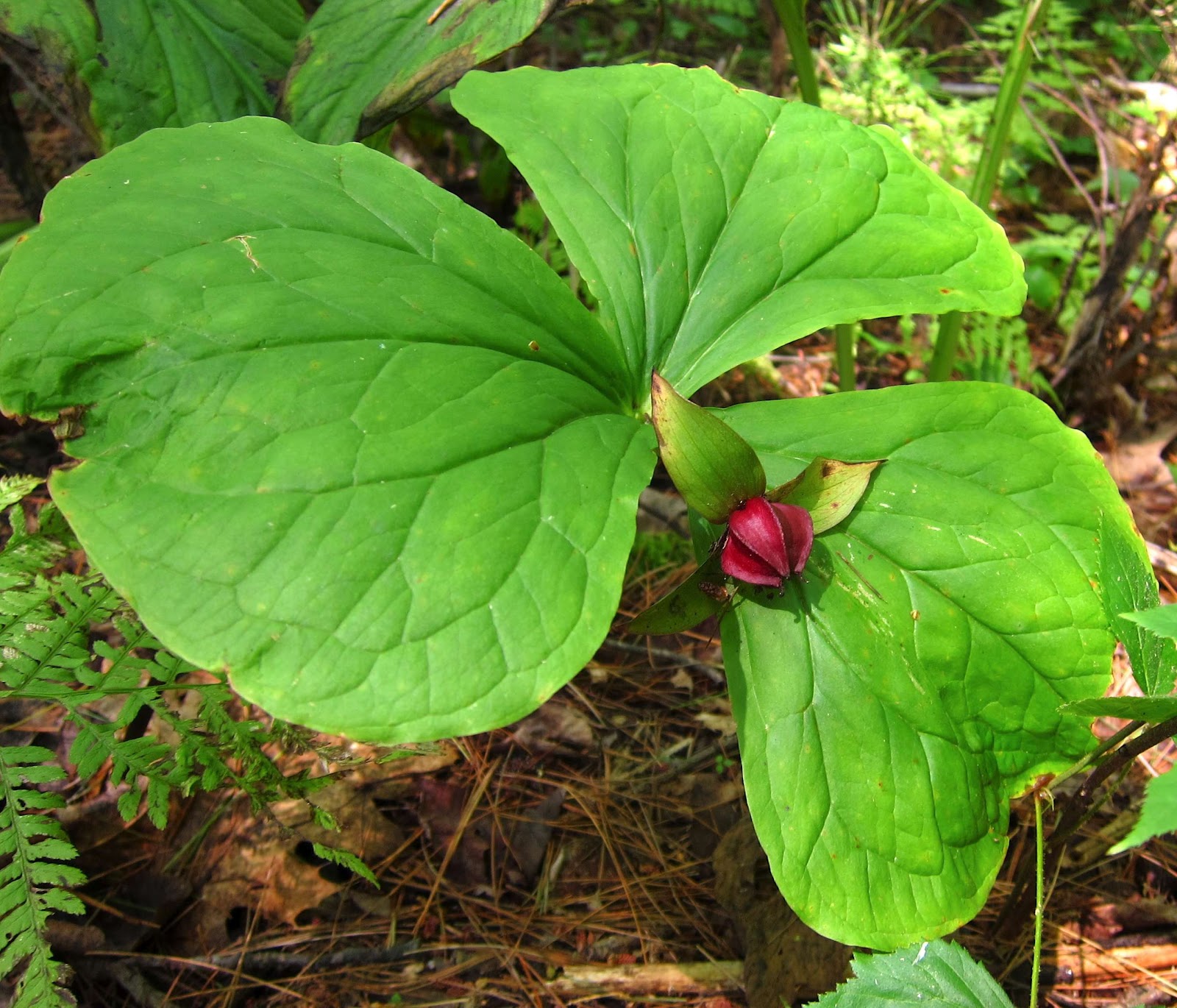
My progress back to my car was also slowed by the sight of this beautifully red Red Trillium fruit . . .
. . . as well as by these bright-orange tines of Spindle Coral poking up from the path.
Okay, last stop was Yaddo, an artists' colony on the outskirts of Saratoga Springs that has extensive wild woodlands as well as manicured gardens that are open to the public. Luckily, I had gathered specimens of both the flowers and the fruit of American Bladdernut (Staphlea trifolia) in May and June of 2011, because by the spring of 2012, groundskeepers at Yaddo had cut all the shrubs to the ground. However, I could still obtain a GPS mark for where they used to be, and when I reached the site, I was glad to see that the shrubs were regrowing vigorously. Let's hope they're allowed to prosper again, since Saratoga is probably the northernmost site they are likely to be found. I know that they grow along the Mohawk River on the county's southern border, but as yet there is no official record of their existence anywhere in Saratoga County. I hope my specimen will remedy that.
Close by those American Bladdernut bushes was a thicket of Northern Prickly Ash (Zanthoxylum americanum), and the female trees were laden with bunches of bright red fruits. When the fruits split open, they spill out seeds that are very shiny and black. This small tree is also called "Toothache Tree" because of the numbing sensation achieved by chewing on its twigs. I tried it once, and sure enough, my lips and tongue went numb for half an hour or so, but I don't think it would have helped a toothache.
I wonder how the plant affects this Stink Bug nymph that was crawling on one of its leaves. Stink Bugs are known to pierce fruits of many kinds, but I'll bet this nymph will get a surprise if it tries to feed on Prickly Ash berries. Or maybe not. Bugs can eat mushrooms that would be deadly to humans, after all. This is one colorful bug, is it not?
I've been collecting and pressing botanical specimens for a couple of years now, and I finally have the GPS device that can pinpoint each plant's location. So yesterday and today I drove around to various sites to take the GPS readings, then came home to prepare the documentation to accompany each specimen. Tomorrow I'll be meeting with folks from the Adirondack Botanical Society for a meeting at Whiteface Mountain near Lake Placid, so at last I can hand these specimens off to botanical professionals who can then document the plants' existence in their respective counties. And I won't have to worry any more that my cats will rip them apart.
The first stop on my GPS run was the Wilton Wildlife Preserve, where last year I found a single plant of Tall Ironweed (Vernonia gigantea) growing right by the road. And sure enough, there it was again as big and bright as ever.
This is a plant that is not supposed to grow in Saratoga County, nor has it been found in any county nearby, so it was quite a surprise to find it in Wilton last year. This is a plant that is really hard to miss, since it surely lives up to its name, being taller than any other plants surrounding it.
We are surmising that this plant's seed may have slipped into Saratoga County along with grass seed
imported by the state for its grasslands restoration project here at Wilton Wildlife Preserve. There certainly are a lot of really interesting native grasses to be found now at this site.
My next stop was the Orra Phelps Nature Preserve, also in Wilton, to get a GPS reading for specimens of Fringed Gentian (Gentianopsis crinita) I collected last September when they were in bloom. When I reached the site, I was dismayed to see that the poplars and pines we cut down a couple of years ago were once again encroaching on the open space where dozens of these radiant-blue flowers can usually be found each late summer. I think next time we cut these trees down, we should paint their stumps with an herbicide to prevent their regrowth. Or else brush-hog the site each late autumn after frost. If we don't clear this site, I'm afraid the gentians will disappear from this, the only place where they are known to grow in Saratoga County.
While still at Orra Phelps Preserve, I also took a GPS reading on a huge shrub of Rosebay Rhododendron (Rhododenron maximum) that grows by a stream. State floral records do not show this plant as growing in Saratoga County, but it's certainly thriving happily here at Orra Phelps. It's possible that it was planted by Orra, but I also find this shrub growing in a woods near the Yaddo Estate in Saratoga Springs. I haven't yet collected a specimen, because I always seem to miss its blooming season. I can see by spent flower heads on this shrub that it did indeed bloom this summer.
Next stop was Bog Meadow Nature Preserve just outside Saratoga Springs, but on my over there from Wilton, I pulled off into a vacant lot along Ingersol Road. This dry, open, sandy "waste place" of disturbed soil was the first place I ever saw the bushy tumbleweed-like plants of Winged Pigweed (Cycloloma atriplicifolium), a plant that's native to more central states of the U.S., but which can now be found in more eastern parts of the country. I gathered a specimen and took its GPS coordinates so that it can now be recorded as present in Saratoga County.
My purpose in visiting Bog Meadow Nature Trail was to obtain coordinates for Buckbean (Menyanthes trifoliata), which grows there in a swampy area along the trail. Of course, there's not a sign of the plant this late in the year, but I know exactly where it grows so I was able to take a reading to accompany the pressed specimen I obtained a year ago last May.
Mission accomplished, I hurried back to my car before the next rainstorm, but stopped in my tracks when I saw these lovely buds of Swamp Thistle (Cirsium muticum). I think these buds are as intricate and beautiful as Ukrainian Easter eggs, and if you look close, you can already see the web of fine threads that encase the buds, a feature that is diagnostic for this, one of our few native thistles.
Just in case there was no record of their presence in Saratoga County, I did take a GPS reading of their location, and sure enough, when I checked the records at home, they were not in the atlas for this county. I'll have to return in a couple of weeks when they are in bloom to obtain a specimen. Wearing thick gloves. Those prickers are sharp!
My progress back to my car was also slowed by the sight of this beautifully red Red Trillium fruit . . .
. . . as well as by these bright-orange tines of Spindle Coral poking up from the path.
Okay, last stop was Yaddo, an artists' colony on the outskirts of Saratoga Springs that has extensive wild woodlands as well as manicured gardens that are open to the public. Luckily, I had gathered specimens of both the flowers and the fruit of American Bladdernut (Staphlea trifolia) in May and June of 2011, because by the spring of 2012, groundskeepers at Yaddo had cut all the shrubs to the ground. However, I could still obtain a GPS mark for where they used to be, and when I reached the site, I was glad to see that the shrubs were regrowing vigorously. Let's hope they're allowed to prosper again, since Saratoga is probably the northernmost site they are likely to be found. I know that they grow along the Mohawk River on the county's southern border, but as yet there is no official record of their existence anywhere in Saratoga County. I hope my specimen will remedy that.
Close by those American Bladdernut bushes was a thicket of Northern Prickly Ash (Zanthoxylum americanum), and the female trees were laden with bunches of bright red fruits. When the fruits split open, they spill out seeds that are very shiny and black. This small tree is also called "Toothache Tree" because of the numbing sensation achieved by chewing on its twigs. I tried it once, and sure enough, my lips and tongue went numb for half an hour or so, but I don't think it would have helped a toothache.
I wonder how the plant affects this Stink Bug nymph that was crawling on one of its leaves. Stink Bugs are known to pierce fruits of many kinds, but I'll bet this nymph will get a surprise if it tries to feed on Prickly Ash berries. Or maybe not. Bugs can eat mushrooms that would be deadly to humans, after all. This is one colorful bug, is it not?
Subscribe to:
Posts (Atom)