Two days of rain in a row. You won't hear me complain, since we really need the water. Also, with the soggy weather discouraging me from outdoor adventures, it gave me a chance to run a number of little botanical errands, most of which could be accomplished just a few yards from my car.
I've been collecting and pressing botanical specimens for a couple of years now, and I finally have the GPS device that can pinpoint each plant's location. So yesterday and today I drove around to various sites to take the GPS readings, then came home to prepare the documentation to accompany each specimen. Tomorrow I'll be meeting with folks from the Adirondack Botanical Society for a meeting at Whiteface Mountain near Lake Placid, so at last I can hand these specimens off to botanical professionals who can then document the plants' existence in their respective counties. And I won't have to worry any more that my cats will rip them apart.
The first stop on my GPS run was the Wilton Wildlife Preserve, where last year I found a single plant of Tall Ironweed (Vernonia gigantea) growing right by the road. And sure enough, there it was again as big and bright as ever.
This is a plant that is not supposed to grow in Saratoga County, nor has it been found in any county nearby, so it was quite a surprise to find it in Wilton last year. This is a plant that is really hard to miss, since it surely lives up to its name, being taller than any other plants surrounding it.
We are surmising that this plant's seed may have slipped into Saratoga County along with grass seed
imported by the state for its grasslands restoration project here at Wilton Wildlife Preserve. There certainly are a lot of really interesting native grasses to be found now at this site.
My next stop was the Orra Phelps Nature Preserve, also in Wilton, to get a GPS reading for specimens of Fringed Gentian (Gentianopsis crinita) I collected last September when they were in bloom. When I reached the site, I was dismayed to see that the poplars and pines we cut down a couple of years ago were once again encroaching on the open space where dozens of these radiant-blue flowers can usually be found each late summer. I think next time we cut these trees down, we should paint their stumps with an herbicide to prevent their regrowth. Or else brush-hog the site each late autumn after frost. If we don't clear this site, I'm afraid the gentians will disappear from this, the only place where they are known to grow in Saratoga County.
While still at Orra Phelps Preserve, I also took a GPS reading on a huge shrub of Rosebay Rhododendron (Rhododenron maximum) that grows by a stream. State floral records do not show this plant as growing in Saratoga County, but it's certainly thriving happily here at Orra Phelps. It's possible that it was planted by Orra, but I also find this shrub growing in a woods near the Yaddo Estate in Saratoga Springs. I haven't yet collected a specimen, because I always seem to miss its blooming season. I can see by spent flower heads on this shrub that it did indeed bloom this summer.
Next stop was Bog Meadow Nature Preserve just outside Saratoga Springs, but on my over there from Wilton, I pulled off into a vacant lot along Ingersol Road. This dry, open, sandy "waste place" of disturbed soil was the first place I ever saw the bushy tumbleweed-like plants of Winged Pigweed (Cycloloma atriplicifolium), a plant that's native to more central states of the U.S., but which can now be found in more eastern parts of the country. I gathered a specimen and took its GPS coordinates so that it can now be recorded as present in Saratoga County.
My purpose in visiting Bog Meadow Nature Trail was to obtain coordinates for Buckbean (Menyanthes trifoliata), which grows there in a swampy area along the trail. Of course, there's not a sign of the plant this late in the year, but I know exactly where it grows so I was able to take a reading to accompany the pressed specimen I obtained a year ago last May.
Mission accomplished, I hurried back to my car before the next rainstorm, but stopped in my tracks when I saw these lovely buds of Swamp Thistle (Cirsium muticum). I think these buds are as intricate and beautiful as Ukrainian Easter eggs, and if you look close, you can already see the web of fine threads that encase the buds, a feature that is diagnostic for this, one of our few native thistles.
Just in case there was no record of their presence in Saratoga County, I did take a GPS reading of their location, and sure enough, when I checked the records at home, they were not in the atlas for this county. I'll have to return in a couple of weeks when they are in bloom to obtain a specimen. Wearing thick gloves. Those prickers are sharp!
My progress back to my car was also slowed by the sight of this beautifully red Red Trillium fruit . . .
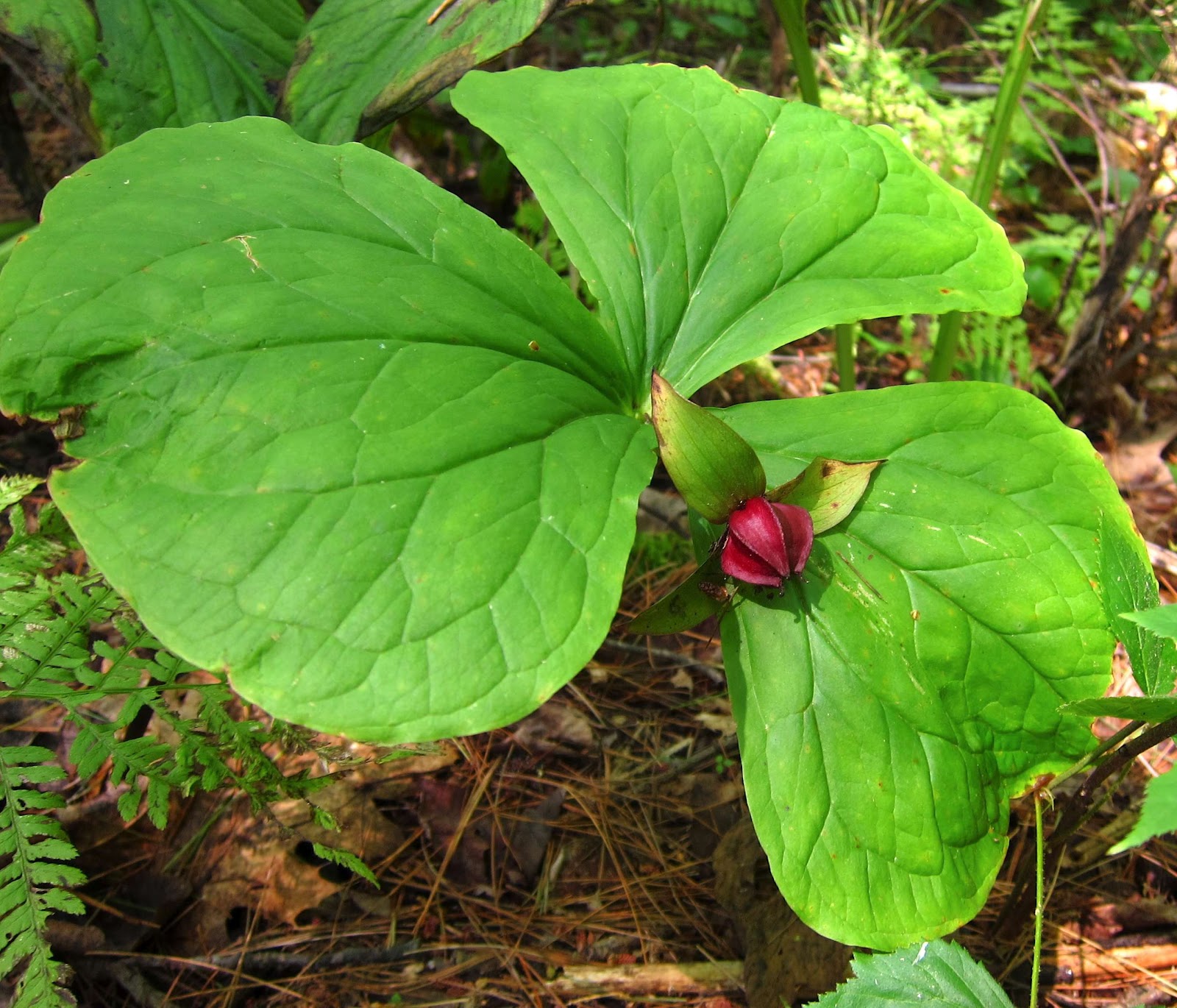
. . . as well as by these bright-orange tines of Spindle Coral poking up from the path.
Okay, last stop was Yaddo, an artists' colony on the outskirts of Saratoga Springs that has extensive wild woodlands as well as manicured gardens that are open to the public. Luckily, I had gathered specimens of both the flowers and the fruit of American Bladdernut (Staphlea trifolia) in May and June of 2011, because by the spring of 2012, groundskeepers at Yaddo had cut all the shrubs to the ground. However, I could still obtain a GPS mark for where they used to be, and when I reached the site, I was glad to see that the shrubs were regrowing vigorously. Let's hope they're allowed to prosper again, since Saratoga is probably the northernmost site they are likely to be found. I know that they grow along the Mohawk River on the county's southern border, but as yet there is no official record of their existence anywhere in Saratoga County. I hope my specimen will remedy that.
Close by those American Bladdernut bushes was a thicket of Northern Prickly Ash (Zanthoxylum americanum), and the female trees were laden with bunches of bright red fruits. When the fruits split open, they spill out seeds that are very shiny and black. This small tree is also called "Toothache Tree" because of the numbing sensation achieved by chewing on its twigs. I tried it once, and sure enough, my lips and tongue went numb for half an hour or so, but I don't think it would have helped a toothache.
I wonder how the plant affects this Stink Bug nymph that was crawling on one of its leaves. Stink Bugs are known to pierce fruits of many kinds, but I'll bet this nymph will get a surprise if it tries to feed on Prickly Ash berries. Or maybe not. Bugs can eat mushrooms that would be deadly to humans, after all. This is one colorful bug, is it not?
For more than thirty years I've been wandering the woods and waterways of Saratoga County, New York, and regions nearby, looking closely, listening carefully, and recording what I experience. We are blessed in this region with an amazing amount of wilderness right at hand. With this blog I share my year-round adventures here, seeking out what wonders await in my own Madagascar close to home.
Showing posts with label Orra Phelps. Show all posts
Friday, July 27, 2012
Friday, April 13, 2012
Spring Progress Report, April 13
Sorry, dear readers, I've just been too busy to blog much this week, running all over the county (and beyond) to stay abreast of all that is happening in the woods. But I've finally sorted through all the daunting hundreds of photos I took (most of them discards), so now I can file this report on what's doing the blooming.
On Wednesday, I stopped by the Orra Phelps Nature Preserve on my way to the Hudson River at Moreau. In a dampish area along the trail, masses of Dog Violets were just starting to open their pale lavender blooms. This is one of our "stemmed" violets, with flowers and leaves both sprouting from the same stem, distinguishing it from our Common Blue Violet, which has basal leaves only and a leafless flower stem.
On a higher and dryer bank further on, I found the Dutchman's Breeches dangling their little white pantaloons. In a few days, those yellow tips will open and spread to allow the bumblebees to insert their long proboscises into the nectaries deep inside the blossoms.
A surprising find in a nature preserve renowned for its native flora, this Siberian Squill, a horticultural species, must have escaped from some neighboring flower garden. Let's hope that it knows how to mind its company manners and not take over the woods, as introduced species are often wont to do.
The Periwinkle is just such a species of introduced plant that has taken to our native woodlands way too happily. There's no question that it's a beautiful plant, bearing abundant blooms of the loveliest blue.
The problem is, that wherever Periwinkle grows, absolutely no other flower is allowed to share its ground. In this thoroughly periwinkled patch of woods that borders the Hudson River at Moreau, not a violet nor trillium nor Jack-in-the-pulpit can be found for acres around.
On Thursday I joined the Thursday Naturalists on a trip to a nature preserve south of Albany (an adventure that will be described in a separate post), and today, Friday, I went for a walk through the Skidmore Woods. This particular woods, with its limey soils, is famous for its wonderful array of spring ephemerals, including many different species of violets. The first ones I came across today were the beautiful Long-spurred Violets, snuggled into crannies of the many boulders that form the forest substrate. These violets can be quite pale in color, almost as if all their color had run to pool in dark patches at the center.
Another violet blooming today was the Downy Yellow Violet, with an obviously downy stem.
Dwarf Ginseng was just beginning to open its clusters of tiny white flowers. Unlike its much larger cousin that is sought after for medicinal uses and which persists into the fall, this tiny plant will completely disappear soon after its blooming period ends.
Wood Anemone held its pristine white flowers completely open to the warm sun today. If a chill descends, or clouds cover the sky, those blooms will retreat into their pinkish bud covers.
The purplish-brown variety of Blue Cohosh bloomed last week (and continues blooming still), but this variety with greener flowers was just opening today.
My botanist friends cannot all agree upon whether we have two species, or just some variations. Some botanical sites I've visited indicate that the earlier bloomers with consistently purple flowers are Caulophyllum giganteum, while this one, which opens a little later with flowers that are assuredly green, is C. thalictoides. In all other respects except flower color and blooming time, the plants appear identical.
Mayapple has pushed its tightly folded umbrellas up from the earth. The fully mature plants that have two leaves will bear a flower (and later, a fruit), the bud of which can be seen peeking out from between the still-folded leaves.
In a couple of weeks, stunning masses of Large-flowered White Trilliums will cover large areas of the woods. For the present, we have to search to find the much more solitary Red Trillium, which tends to hide its pretty face by bending downward under its leaves. I confess that I lifted this bloom up and placed it atop its leaves, the better to capture its vivid color in a photograph.
The odd weather this spring has played tricks with the normal schedule of bloom for many spring flowers, with many blooming far earlier than ever before. The recent stretch of much colder weather has slowed that process considerably, so that many early bloomers are still with us. The Bloodroot, for example, which usually comes and goes in a few brief days, is still coming up and opening its sweet sunny faces all over the woods.
The Trout Lilies have just exploded into bloom from when I reported finding just one or two a few days ago. Now they carpet some areas of the woods so thickly it's impossible to walk among them. I hope those darned Red-necked False Blister Beetles finally get their fill of lily pollen and leave some of those lovely crimson anthers alone.
Speaking of crimson, the maple trees are now unfolding their bunches of tiny red leaves. What a sight it is, when these translucent leaves catch the sunlight and glow like stained glass.
This Red Maple tree stands in front of my house, where the sight of its vivid red boughs against that deep blue sky just took my breath away as I arrived home today.
On Wednesday, I stopped by the Orra Phelps Nature Preserve on my way to the Hudson River at Moreau. In a dampish area along the trail, masses of Dog Violets were just starting to open their pale lavender blooms. This is one of our "stemmed" violets, with flowers and leaves both sprouting from the same stem, distinguishing it from our Common Blue Violet, which has basal leaves only and a leafless flower stem.
On a higher and dryer bank further on, I found the Dutchman's Breeches dangling their little white pantaloons. In a few days, those yellow tips will open and spread to allow the bumblebees to insert their long proboscises into the nectaries deep inside the blossoms.
A surprising find in a nature preserve renowned for its native flora, this Siberian Squill, a horticultural species, must have escaped from some neighboring flower garden. Let's hope that it knows how to mind its company manners and not take over the woods, as introduced species are often wont to do.
The Periwinkle is just such a species of introduced plant that has taken to our native woodlands way too happily. There's no question that it's a beautiful plant, bearing abundant blooms of the loveliest blue.
The problem is, that wherever Periwinkle grows, absolutely no other flower is allowed to share its ground. In this thoroughly periwinkled patch of woods that borders the Hudson River at Moreau, not a violet nor trillium nor Jack-in-the-pulpit can be found for acres around.
On Thursday I joined the Thursday Naturalists on a trip to a nature preserve south of Albany (an adventure that will be described in a separate post), and today, Friday, I went for a walk through the Skidmore Woods. This particular woods, with its limey soils, is famous for its wonderful array of spring ephemerals, including many different species of violets. The first ones I came across today were the beautiful Long-spurred Violets, snuggled into crannies of the many boulders that form the forest substrate. These violets can be quite pale in color, almost as if all their color had run to pool in dark patches at the center.
Another violet blooming today was the Downy Yellow Violet, with an obviously downy stem.
Dwarf Ginseng was just beginning to open its clusters of tiny white flowers. Unlike its much larger cousin that is sought after for medicinal uses and which persists into the fall, this tiny plant will completely disappear soon after its blooming period ends.
Wood Anemone held its pristine white flowers completely open to the warm sun today. If a chill descends, or clouds cover the sky, those blooms will retreat into their pinkish bud covers.
The purplish-brown variety of Blue Cohosh bloomed last week (and continues blooming still), but this variety with greener flowers was just opening today.
My botanist friends cannot all agree upon whether we have two species, or just some variations. Some botanical sites I've visited indicate that the earlier bloomers with consistently purple flowers are Caulophyllum giganteum, while this one, which opens a little later with flowers that are assuredly green, is C. thalictoides. In all other respects except flower color and blooming time, the plants appear identical.
Mayapple has pushed its tightly folded umbrellas up from the earth. The fully mature plants that have two leaves will bear a flower (and later, a fruit), the bud of which can be seen peeking out from between the still-folded leaves.
In a couple of weeks, stunning masses of Large-flowered White Trilliums will cover large areas of the woods. For the present, we have to search to find the much more solitary Red Trillium, which tends to hide its pretty face by bending downward under its leaves. I confess that I lifted this bloom up and placed it atop its leaves, the better to capture its vivid color in a photograph.
The odd weather this spring has played tricks with the normal schedule of bloom for many spring flowers, with many blooming far earlier than ever before. The recent stretch of much colder weather has slowed that process considerably, so that many early bloomers are still with us. The Bloodroot, for example, which usually comes and goes in a few brief days, is still coming up and opening its sweet sunny faces all over the woods.
The Trout Lilies have just exploded into bloom from when I reported finding just one or two a few days ago. Now they carpet some areas of the woods so thickly it's impossible to walk among them. I hope those darned Red-necked False Blister Beetles finally get their fill of lily pollen and leave some of those lovely crimson anthers alone.
Speaking of crimson, the maple trees are now unfolding their bunches of tiny red leaves. What a sight it is, when these translucent leaves catch the sunlight and glow like stained glass.
This Red Maple tree stands in front of my house, where the sight of its vivid red boughs against that deep blue sky just took my breath away as I arrived home today.
Tuesday, March 27, 2012
Frost-hardy Survivors
As these icicles dripping from cliffs along Spier Falls Road attest, it did indeed go below freezing last night. Way below. Down into the 20s. Concerned about how that deep freeze might have affected some of our way-too-early bloomers, I drove out to Orra Phelps Nature Preserve in Wilton today to check on them. My first concern was a patch of Snow Trillium, but as I hurried across the bridge toward where I knew those rare trilliums would be growing, a dot of bright yellow along the stream bank caused me to halt in my tracks. What?! Could that really be a Round-leaved Violet? Blooming in March?! And after a freezing night? Well, that is indeed what it was. Just one, but hard to miss that vivid lemon-yellow bloom, apparently untouched by frost.
As for the Snow Trilliums, they too survived the freezing night unscathed. In fact, they looked perkier than ever, with many new plants emerged from the ground since last I visited.
Nearby, I could see the bank where Dutchman's Breeches grow every spring, and I noticed this frilly cluster of leaves that told me the Dutchman's Breeches were well on their way. Isn't it amazing that such newborn leaves would be so impervious to frost damage?
This itsy bitsy Red Spider Mite was also undaunted by the cold, scurrying so fast around a patch of Mnium moss I had a very hard time taking its photo, since it would not stay within macro focal range. I snapped about 20 shots and this was the best I could get.
Monday, December 12, 2011
Icy Delights
A sparkling day, clear and fresh and cold as the tumbling stream that runs through the Orra Phelps Nature Preserve in Wilton. That's where I took my walk today, seeking a landscape that matched the beauty of this crystalline day.
We've had little snow so far, but the nights are now cold enough for ice to form along the stream, where droplets splash on overhanging boughs.
Not even diamonds are more beautiful than the crystal spears that dangle over the rushing water.
Bubbles collect along the banks, and there they freeze into brittle plates of froth.
As winter approaches, it always amazes me to see the bare buds of Hobblebush, leaves and flowers already formed, protected against the coming season's icy blasts by no more than the merest fuzz.
We've had little snow so far, but the nights are now cold enough for ice to form along the stream, where droplets splash on overhanging boughs.
Not even diamonds are more beautiful than the crystal spears that dangle over the rushing water.
Bubbles collect along the banks, and there they freeze into brittle plates of froth.
As winter approaches, it always amazes me to see the bare buds of Hobblebush, leaves and flowers already formed, protected against the coming season's icy blasts by no more than the merest fuzz.
Friday, September 16, 2011
Yes, We Have Gentians
With dire predictions for a killing frost tonight, I thought I'd better go pick a Fringed Gentian to press for the state herbarium before they shrivel. After my friend Sue and I enjoyed the sight of masses of these beautiful flowers growing along the bike trail in Queensbury, Sue checked their distribution status and discovered there was no record of them growing in either Warren or Saratoga County. Well, we'd better remedy that, we agreed, and obtained permission from the New York Natural Heritage Program to obtain vouchered specimens of this state-protected wildflower.
Sue will collect her specimen in Warren County, and I went to Orra Phelps Nature Preserve in Wilton to collect mine. Legend has it that Orra planted the ones on her preserve, but even if true, they have certainly naturalized there, blooming in great profusion every September. Two years ago I participated in efforts to restore the site where they grow, cutting down dozens of young pines and poplars that threatened to overshadow these sun-loving flowers. Our efforts have been rewarded with a wonderful expansion in the number of plants growing there, I am happy to report. I'm also happy that now there will be an official botanical record of their presence in Saratoga and Warren counties.
While walking the trails at Orra Phelps, I saw many Indian Cucumber Root plants in fruit, their glossy blue-black berries beautifully set off by their colorful trefoils of terminal leaves.
Friday, April 29, 2011
A Flood of Flowers and Other Wonders
While out checking the state of floodwaters today, I was also trying to keep up with the flood of wildflowers now coming into bloom. For flower nuts like me, every day is like Christmas now, as I hurry out to see what marvels Mother Nature has left for me under the trees. Along Spier Falls Road in Moreau, these Christmas-Ribbon-Red Trilliums were massed on a steep bank rising over my head, so that every one of their gorgeous nodding flowers was faced in my direction. What a sight!

Trout Lily always averts its gaze, so you have to put your finger under its chin to lift its face. But today I was happy to notice the back of its bloom, where all three sepals were tinged with pink to distinguish them from the pure-yellow petals.
Early Saxifrage is already in bloom, and I did find their bright-white clustered flowers today, but I love even more these chubby little bunches of buds set off by their wreaths of scalloped leaves.
The twin trumpets of American Fly Honeysuckle are dangling now from single stalks.
Dog Violets, with their pale-purple flowers that grow on leafy stems, were starting to carpet the woods at Orra Phelps Nature Preserve.
Also at Orra Phelps today, the Dutchmen had hung their Breeches above their clumps of lacy leaves.
Massed along this rushing stream, Sessile-leaved Bellworts were trying to hide their pale-yellow blooms beneath their stem-clasping leaves. I think this photo demonstrates how I manage to get tick bites in my eyebrows, since I had to lie down on my stomach to get this shot.
There were other marvels besides flowers beautifying the woods today. Wherever the sunlight shone down through the trees, the translucent baby leaves of Red Maple lit up like stained glass.
Ferns of every kind are now unscrolling their fiddleheads. I think this may be Wood Fern, since I see all those fronds surrounding this clump, still green although flattened by winter's deep snow.
For the same reason, I'm pretty sure that these fuzzy coils belong to the Christmas Fern that lies there so green beside them.
Speaking of green . . . . This beautiful bright-green moss was decorating the huge damp boulders that lie at the foot of the cliffs opposite Spier Falls Dam.
Some of that moss was sprouting a dense coat of hair-fine spore stalks.
Inhabiting those same damp boulders were mats of brown Dog Lichen, with a wee little tan-colored mushroom hiding out amid the similarly colored "ears" of the lichen.
Not every flower that's beautiful is a delight to see. At first I thought these shiny yellow blooms might be Marsh Marigold, except I didn't remember any of that plant growing along this particular stream at Orra Phelps Nature Preserve. Then a closer inspection (involving very muddy shoes) revealed that this is Lesser Celandine, a dreaded invasive alien that, left to its own devices, could soon take over the area, supplanting all the rich diversity of plants now found there.
Here's a closer look at its flower, pretty enough, with shiny yellow petals.
I hope that's the last of its pretty face we will find at Orra Phelps, since I promptly pulled it out. Luckily, there was only one clump. But now I'll be watching for it, in case it returns. To learn more about this invasive plant and how to help eradicate it, go to the New York Flora Association's blog by clicking here.
Subscribe to:
Posts (Atom)


