Showing posts with label Nancy Slack. Show all posts

Saturday, October 13, 2012

First Frost!


Brrrr!  Down into the 20s last night.  We canceled our plans for a paddle, Sue and Nancy and I, and decided to hike a mountain trail in Moreau Lake State Park instead.  But first we stopped off at the powerline clearcut above Mud Pond, thinking we might find a few Frostweed curls on this frozen morning.   The frost-adorned sumacs and blueberries and mosses that first met our eyes encouraged us to believe that we just might find some Frostweed exhibiting the very process that gives this plant its common name.  (Scientific name: Helianthemum canadense)


And so we did!  Almost every single Frostweed plant in this open sandy area had produced these curls of frozen vapor at the base of their stems. This phenomenon will be repeated each calm frosty morning until the plant has depleted all of its moisture, so we can expect to find these fragile frothy extrusions on other mornings yet this fall.  IF we get there before the sun does, that is, since the curls promptly disappear with the sun's warming touch


There were other interesting finds on the clearcut this morning, and we were lucky to have bryologist Nancy Slack along to identify many of the lichens and mosses that carpet this open area.  Although she couldn't remember offhand the name of this very tiny orange lichen, she could at least assure us that it was indeed a lichen.  I was amazed that we even found it, it was so tiny.  Sue is the one whose amazing eyesight can espy such miniatures as this, hardly bigger than the heads of pins.


Sue and I found it hard to believe that a Sphagnum moss would be growing out here in this dry sandy spot, but Nancy assured us that this puffy pink stuff was indeed a Sphagnum, S. capillifolium.  She also told us that its presence indicated there must be a source of moisture nearby.


We were having so much fun finding such a variety of mosses, we decided to bypass our mountain trail and instead show Nancy the wonderful rockgardens of mosses that rise from the road across from the Spier Falls Dam.  These rocky cliffs are watered by tiny springs that dampen the surface in every season, creating a perfect habitat for mosses and other plants, including white clouds of Early Saxifrage that adorn these rocks each spring.


Just a bit beyond the mossgarden cliffs, we could hear a little waterfall splashing down the mountain side,  and its moss-covered watercourse tempted us to explore it further.


We followed the course of the stream quite a ways up the mountain,  delighting in the beauty of the woods and the mossy banks.


Each water-splashed streamside rock was covered with a marvelous mix of mosses, liverworts, and lichens.  There's Hedwigia here and Dicranum, too (both mosses), and that patch of verdigris-colored frilly stuff is a foliose lichen called Flavoparmelia.


A patch of large bright-green Sphagnum girgensonii  provided a sharp contrast in color and texture to the small dark Scapania liverwort clinging to the same damp rock.


I don't recall ever finding American Yew (Taxus canadensis) in the Moreau woods before, but here it was growing along this little stream that tumbled down the mountain.


What a day of delights!  What a world of wonders waits just off the shoulder of the road!  Sure, I love to travel to new places and have new adventures in lands unfamiliar to me, but oh, how lucky I am to have such a wealth of woods and waterways close to my home -- and such dear companions to share my delight with me.  Every day brings new joy.

Saturday, June 9, 2012

Rainy Hike up a Mossy Trail

Rain, rain, rain!  Hey, c'mon, it's JUNE, already!  As in "then, if ever, come perfect days."  Ah well, I guess a rainy day is a perfect kind of day to go looking for mosses, as it was last Wednesday when I met noted moss expert Nancy Slack for a hike up the Baker Trail in Moreau Lake State Park.

 The sun came out for a few minutes on this otherwise rainy day in Moreau Lake State Park.


Our primary destination for our hike up into the Palmertown Mountains was to find a pool that's nearly chock-full of Wild Calla, and we were successful in finding it, although the Calla flowers were well past their prime.  Almost all flowers are blooming earlier than expected this spring.


Here's a closer look at one of those Calla flowers well on its way to becoming fruit.


Although the Wild Calla almost completely filled the pond, there were a few other plants that shared the site, including a nice variety of grasses and sedges and large clumps of Blue Flag.


The hike to this pool is not a particularly long one, but it took us a couple of hours to reach it, with so many intriguing distractions for a bryologist along the way.  I usually associate Sphagnum Moss with low-lying acidic bogs, but Nancy informed me that some Sphagnums (such as the one she's examining here) prefer upland sites that are less acidic.


There appeared to be a variety of soil chemistries along our trail.  In one location below some rocky outcroppings, the plants, such as these Maidenhair Ferns and Rattlesnake Ferns, were those that usually indicate a rich, limey soil.


This Ebony Spleenwort is also a fern that prefers a limey substrate.


But then we also found rocks that Nancy identified as definitely acidic, such as this one adorned with at least three different kinds of moss, all of which prefer an acidic environment.  (Nancy told me the names of all the mosses we found, as well as the name of this rock, but I had left my notebook in my car, not wanting to get it wet, and I promptly forgot what she told me.  I'll try to come back and identify these later.)


I didn't recognize this Rock Tripe immediately, because I usually see it when it is dry and brown.  But Nancy told me that it will turn green after being drenched with rain.  As we all have been these last few weeks.


Hiding in among that Rock Tripe was another foliose lichen, smaller and curlier, its upturned edges rimmed with powdery white.  Again, Nancy told me its name, but I didn't write it down.


This velvety green moss always grows on tree trunks, Nancy told me.  She also told me its name but, well, same song, second verse.


At least I DID know the name of these odd little whitish fungi.  They're called Dead Man's Fingers, and they will turn black as they mature.  The tallest of these was perhaps an inch long.


From small and pale to huge and vivid!  It was quite a surprise to see this beautiful Chicken of the Woods, a fungus I usually don't look for until fall.  These many days of rain seem to be bringing out the fungi earlier than ususal.


Certainly, the rain brings out the little Red Efts, which were everywhere in the woods on Wednesday.  We constantly had to watch our step, lest we squash them on the trail.


Neither one of us could figure out what happened to this old Beech tree to create those odd rings in the trunk.


Another tree that got our attention was this old Black Tupelo, with deeply furrowed bark on one side, smoother bark on the other.  That was our first clue as to the species of this tree, plus we found some of last year's oval leaves on the ground beneath.  We could not see the top of the tree at all, nor any of its branches, hidden as they were above the leafy tree limbs of encroaching oaks and maples.  Certainly, the swampy habitat up here near the Wild Calla pool was appropriate for tupelos.


Sunday, November 20, 2011

Mosses (and More) on the Mountain

Just because all the flowers are gone by now, that doesn't mean there's nothing for botanizers to seek out in the woods.  There's still lots of wonderful stuff to be found, since many mosses, lichens, liverworts, and even some ferns are unaffected by the freezing weather and can be sought all winter long.  Of course, it helps to know what you're looking for, and I can't imagine a better teacher than Nancy Slack, shown here examining  a clump of Tetraphis pellucida, one of the mosses to be found on nearly every rotting tree stump and fallen log.


A longtime biology professor at Russel Sage College who still teaches botany courses there,  Nancy joined me on Friday morning for a hike up the Red Oak Ridge Trail in Moreau Lake State Park.  Our destination was a group of limestone caves on the top of the ridge, but we took our time to get there, stopping to take a closer look at many of the fascinating mosses along the way.  Here's a closer view of that Tetraphis pellucida, revealing the pellucid leaves that suggest its specific name.


This trio of ferns also caught our attention, since it's unusual to find all three of our common evergreen ferns together in one location.  Top left is Intermediate Wood Fern, its leaflets (pinnae) more intricately cut than those of the Marginal Wood Fern on the right.  The fern on the bottom is Christmas Fern, distinctive for the Christmas-stocking shape of its individual pinnae.


The Intermediate Wood Fern is named for the way its spore cases (sori) are arranged on the back of the pinnae, midway between the spine and the margin.


The Marginal Wood Fern bears its sori right at the outer edges (margins) of its pinnae.  (We have a third wood fern, the Spinulose Wood Fern, but that fern won't be found this time of year, since it's not evergreen.)


When we reached the caves near the top of the ridge, I was eager to show Nancy the boulders where Walking Fern grows.  This is a rather uncommon fern that is usually found only on limestone or marble.  When I first found this rather unfern-like fern several years ago, there was just a small clump near the cave entrance, but it has since "walked" the whole width of the moss-covered boulder to where Nancy is standing to take its photo.


This photo shows the long thin fronds that produce new plants wherever the tips touch the moss.


On a nearby boulder we found this beautiful moss that looks like tiny palm trees.  Its name, Atrichum undulatum, refers to the rippled (undulating) texture of its leaves.


Another particularly beautiful moss is Rhodobryum roseum, which looks like tiny green flowers.


A sure sign that we were among limey rocks was this large patch of Anomodon attenuata, which is found only on limestone or marble.


How odd, then, that on the other side of the very same boulder where we found that Anomodon, we found this wooly-textured Dicranum fulvum, a moss that can grow only on acidic rock, such as quartzite.  We surmised, then, that our boulder was made up of at least two different kinds of rocks.


This brown bedraggled-looking stuff is Hedwigia, a moss that is not particular about the acidity of the rocks it grows on.


An interesting aspect of Hedwigia is that, no matter how shriveled and brown it appears, it will  plump up and turn green as soon as it is dampened.  Nancy picked a sprig and wet it in a nearby stream.  A few minutes later it looked like this.


We found a rotting log nearly covered by this shiny reddish-brown liverwort called Nowellia curvifolia.   Sorry, but my camera proved too stubborn and would not focus close enough to show the curving leaves that give this pretty liverwort its specific name.


I love how this moss, Hypnum pellescens, has sent out tendrils that trace the cracks in the rock it grows on, creating a very spidery appearance.


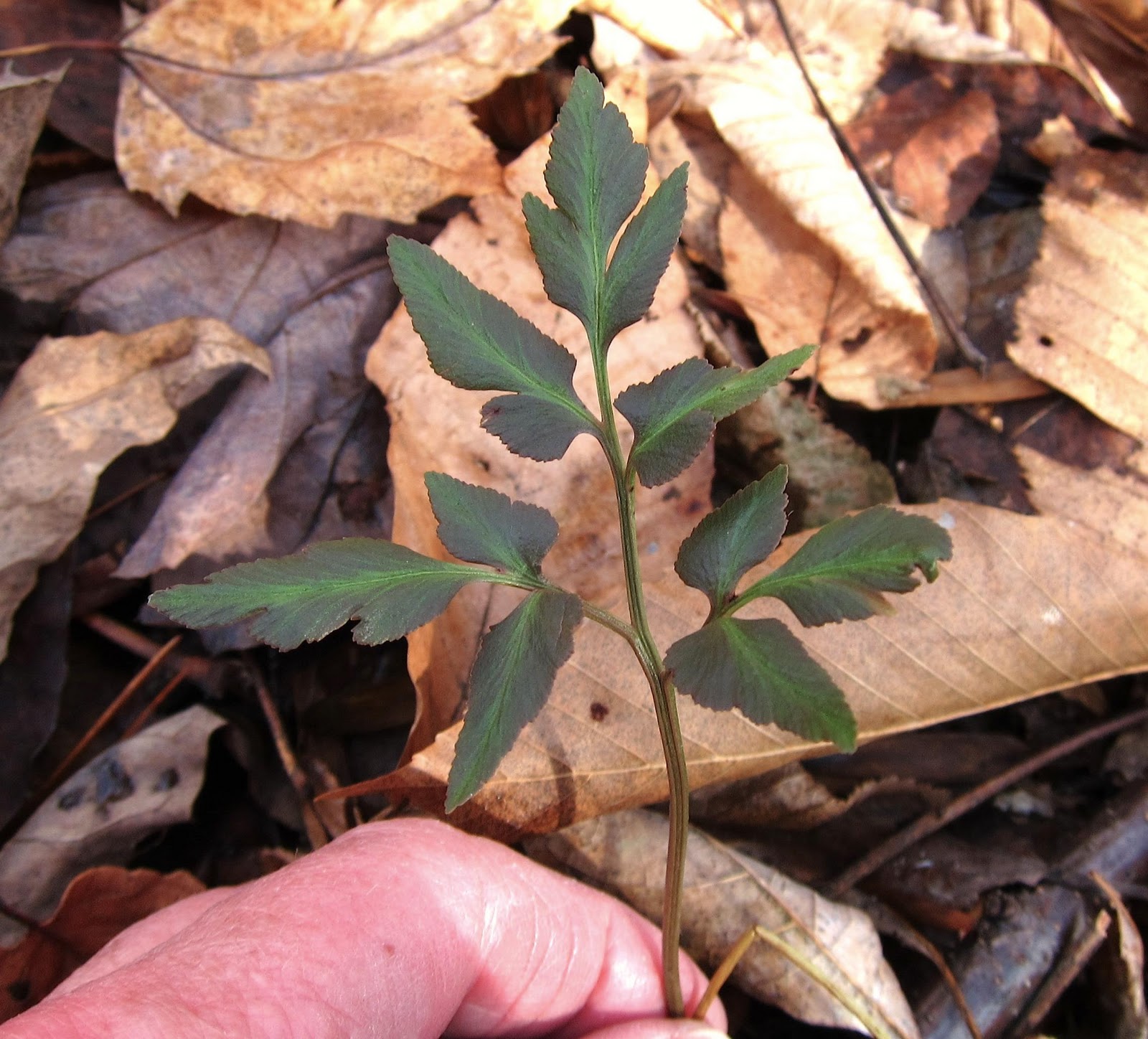
I hadn't known that this fern, a Botrychium or Grape Fern, was evergreen, but there it was, lifting its pretty bi-colored frond above the dead leaves of the forest.  Nancy has suggested that this is Botrychium lanceolatum, a species that I have never seen before.