Wednesday, December 19, 2012

Winter Weeds: An ID Challenge


 Gray and gusty today.  Not the nicest day for a walk, but hey, it wasn't raining!  I needed to take a break from holiday busyness and get a little exercise, so a walk along nearby Bog Meadow Nature Trail seemed just right.  Close to home, easy walking, and I could work up a little aerobic speed, since there's nothing to bring me to a halt this time of year.  Right?  Nah.  There's always something out there that requires close inspection by us nature nuts, whatever the season.

My amusement today was trying to identify the dried-up remains of summer's flowers and other curiosities.  Some of them I knew right away, others I'm not so sure of.  I thought it might be fun to let you, my readers, guess what these are, then compare your answers to mine when I return to label the photos in a day or so.  I'm hoping some of my botanist friends will fill in my knowledge gaps.  So take a stab at this and leave your guesses in the comments.  Have fun!

Update:  I've posted the answers in the comments, but don't let that stop you from still trying this quiz.

 1.


2.


3.


4.


5.


6.


7.


8.


9.


10.


11.


12.


13.


14.

Sunday, December 16, 2012

Hiking an "Elder-Growth" Forest


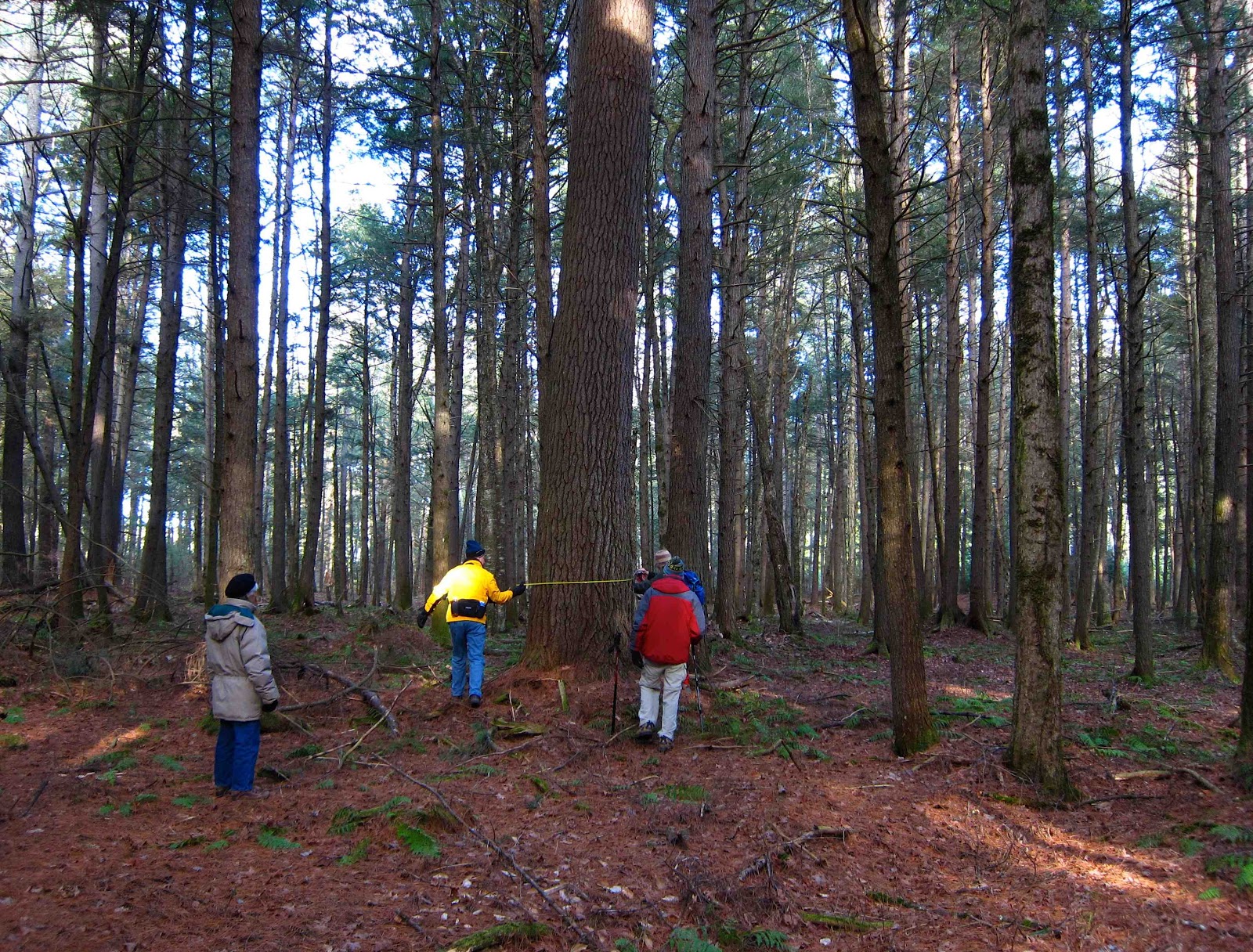
A fine day, a fun bunch of folks, and a hike to a lovely old Adirondack forest -- it just doesn't get much better than this!  On Saturday, my friend Evelyn Greene invited a few of her friends -- all of us of "a certain age" -- to test out the accessibility of a stand of old trees near The Glen north of Warrensburg, and I'm happy to report that all of us made it there and back with energy to spare.

One of Evelyn's acquaintances is involved in a project to locate patches of old growth forest that could be easily accessed by the general public (including the elderly and the non-athletic), once trails could be built to accommodate their abilities.  This particular stand of trees, we found, was quite easily reached by following old roads that are still relatively passable, despite having been abandoned 120 years ago when New York State designated this particular woods as part of the permanent Forest Preserve.  Obviously, some improvements would need to be made to allow folks of limited ability complete access to the area, such as a bridge across this little stream that we all managed to cross on stepping-stones.


Technically, the patch of woods we reached can't truly be called "old growth," since the site was logged-over during the nineteenth century.   But a hundred-and-twenty years is long enough for pines to reach an impressive size and for the surrounding forest to achieve that open, underbrush-free quality that is distinctive of old-growth sites.  Perhaps we could call this an "elderly-growth" woods.  The diameter of this particular White Pine was measured to be about four feet.


In addition to some very big old trees, we also found a nice sphagnum swamp there in the middle of the woods.  Evelyn (in red pants) has a particular interest in mosses and liverworts, so she was able to point out and identify a number of different species of the bryophytes that constituted this emerald-green carpet.


Historically, one of the reasons these forests were placed off-limits to logging was to protect the watershed of the nearby Hudson River and to hold back much of the run-off from spring rains, thereby helping to prevent severe flooding of areas further downstate.  We continued our hike through the forest until we reached the banks of the Hudson along a stretch of river that white-water paddlers call "Racehorse Run."   One of our companions is an avid paddler of these waters, and he explained that this stretch of whitewater provides a rollicking up-and-down ride similar to that of a ride on a galloping horse.


An interesting historical remnant at this site is the presence of old stone abutments, all that remains of a toll bridge that during the nineteen-hundreds offered access across the river.


A bit further downstream, the river widens and deepens into a relatively still pool that local folks refer to as the "Washburn Eddy,"  a favorite swimming hole in summer as well as a great fishing site, with deep cold spots for trout to hide in.  On this particular brisk cold day,  the sun-warmed rocky banks made a wonderful spot for us to enjoy our picnic lunches and just sit and enjoy the music of the river.


Rather than return through the woods the way we had come, a few of us continued our hike downstream along the sky-blue river, taking in the beauty of the scenery and breathing the sweet cold air as the sun warmed our backs.


Eventually, though, the shoreline narrowed as rocky cliffs began to rise ever closer to the water's edge, so we reluctantly turned away from the river and found our way through the woods and back to our waiting cars.  All in all, a splendid day in the forest and along the river!


Here are just a few of the colorful little treasures we found along the trail.

These Blue Cohosh fruits had us stumped for a bit until I picked one and discovered it was not really a berry, but rather a hard seed coated with a thin blue skin.  Very blue skin!


This dead White Birch limb covered with tiny Lemon Drop Fungi looked extra colorful lying next to an emerald-green frond of Wood Fern.


This vividly red Lacquer Polypore certainly drew attention to itself, even though it was hardly bigger than a 50-cent piece.


It's always a sweet surprise to encounter the beautiful mottled leaves of Checkered Rattlesnake Plantain, one of our native orchids that is very much at home in old piney woods.


Wednesday, December 12, 2012

Scenes of the Season

If I needed a snowy scene for a Christmas card, I'd be out of luck.  No snow out there.  But I did find a few things that were Christmassy-pretty today as I prowled the mountainsides along the Hudson River near Spier Falls Road.

I often pull off the road by the dam, to explore the rocky cliffs that rise steeply up from the roadside there.  The niches and cracks and shelves in these cliffs support lovely gardens of mosses and lichens, watered by springs that seep down the rocks, which today were cold enough to turn that dripping water into cascading icicles.


Some of the mosses that grow there have put on their Christmas colors of red and green.


Nestled in among the moss were pretty rosettes of Early Saxifrage, next spring's flowerbuds tightly furled and tucked at the center of a ring of rosy ruffled leaves.


This Beech leaf was sealed to the face of the rocks by a thin sheet of ice that intensified its rich golden bronze.


Further along the road, a sprightly little waterfall tumbled down the mountain, its splashing waters reinvigorated by this past week's frequent rains.  I made my way into the woods at this point to follow the waterfall's course up the mountainside.


The splashing droplets created glistening icicles along every overhanging streamside branch.


This streamside boulder, covered with Greenshield Lichen, appears to have been decorated with frosted Christmas greenery.


Carpets of moss appeared as festive as patterned Christmas wrap.


Even this dead baby pine seemed to get into the spirit of the season when a sunbeam turned its normally dull-brown needles a startling red.


Normally, I truly hate Asiatic Bittersweet for its terrible habit of overwhelming native trees with its masses of strangling vines.  But who could not be struck with delight by the sight of these ruby orbs turned luminous as Christmas lights by a ray of late-day sun?


Tuesday, December 11, 2012

Bank Reshaping Along the Kayaderosseras

The weather was really crummy this past week: rainy, dark, and cold.  Even crummier was the bellyache that laid me low for several days, so I didn't want to go outdoors, anyway.  So no new blog posts  all week.  But today the sun shone a little, and I was up and moving about a little, eager to get some sky over my head and some easy woodsy trail under my feet.  Where could I go to catch up on what was happening outdoors without taxing my still-tender innards?  I chose Burl Trail along the Kayaderosseras Creek just outside of Ballston Spa.  It's a level trail that follows the creek closely for half of its one-mile length, then circles back to the parking lot through an open meadow head-high with asters and goldenrods.  Nice!  And close to home.


I was surprised to see how lush and green the trail looked.  Then a closer look reminded me of how overgrown this trail is with invasive species of many kinds, including this Wild Chervil, whose overwintering basal plants will have a headstart in crowding out any native plant species that may try to regain a foothold along these banks next spring.  Ah well, at least its lacy foliage makes a pretty groundcover.


We can be thankful that some native species still tower over them all, including the massive and shaggy Silver Maples that line the creek banks here, providing welcome shade in the summertime.   With all the competing greenery died back for the winter, it's easier to sense how giant these trees really are.  The head of a six-foot man would barely reach the first crotch of the divided trunk on the left in this photo.


Another plant that flourishes here is Wild Cucumber, whose loofah-like fruits still dangle from the tendrilled vines, the translucent layered mesh of the fruit's interior revealed as the thin outer skin sloughs away.  Today, with a lowering sun lighting them from behind, they glowed like tiny Japanese lanterns bobbing in the breeze.


As I walked along, I was constantly reminded of the ravages Tropical Storm Irene wreaked upon this little stream a year ago last August.  Huge trees still lay toppled where they fell, the force of rampaging waters having blasted the steep banks where the trees once stood, gouging channels,  undermining the banks,  and washing away the soil that had held the trees' roots for generations before.  In many places along the creek, there were many tangled masses of trunks still cloggng the water, still many heaps of smashed shrubbery lying half buried in heaps of outwashed sand.


But all that natural-disaster damage still did not prepare me for this sight, as I rounded a bend of the creek and beheld this long stretch of bank completely stripped of all vegetation, the earth scraped and bare, the steep banks sheared away, the creekside trail abruptly ending in a sea of ankle-deep mud.  And the instruments of destruction were still hard at it, a bulldozer noisily shoving piles of dirt around on that ravaged field.


But before I fainted away from dismay that this beautiful trail was on its way to becoming a shopping mall, I noticed long rows of red twigs laid purposefully along the banks.  Oh! Look at that!  This looks like some kind of streamside restoration and flood mitigation project, doesn't it?  And those are all newly planted shrubs.  Probably Red Osier Dogwood, to judge from their scarlet color.

 
And so they were.  And that's only a start to the massive planting project about to take place along this stretch of the Kayaderosseras Creek.  I was lucky to find and speak with one of the fellows involved in the work, and he explained that the banks were being beveled at an angle to the water's edge to allow future floodwaters to flow up onto the floodplain and dissipate their energy, rather than being forced through steep banks and thereby increasing the damaging power of the flow.  When all the earth-moving and shaping is completed, he continued, the site will be replanted with a variety of appropriate native shrubs and trees, and efforts will be made to remove and control the return of the invasive species that once dominated this streamside.  Here's a list of some of the plant species that will be planted at this site.


There's another interesting angle to this story.  I was curious as to why this particular stretch of creek was being re-engineered, since flood damage here in this natural area (it's actually part of Saratoga Spa State Park) didn't really cause loss or danger to humans or their enterprises and the land here would eventually heal itself anyway or adapt and evolve in other ways.  At least, that's how it seemed to me.  Well, it turns out that the New York State Department of Transportation (?) needed a streambank in need of remediation, and this one happened to be handy.

Say what!?

It seems that the NYSDOT had unavoidably caused damage to a wetland and streambank when a stream in southern Saratoga County was dangerously encroaching on a roadway, with consequent threat to human life.  Okay, these things happen.  But the U.S. Army Corps of Engineers has a regulation that if the DOT damages one wetland in a region (for whatever reason) and the wetland can't be remediated at the original site, the DOT is required to remediate another wetland of equal size within that same region.  And the Kayaderosseras creekside fit the bill.   And yes, now that I think of it, the Kayaderosseras runs under and/or close by a number of roads in the area, so diminishing the force of its floodwaters probably does have a foreseeable possible impact on human lives or enterprises.

But still . . . .

I saw from the list that 126 Butternut trees will eventually replace this mature specimen gracefully arching over the creek last summer, a tree that had to be removed to serve this project.  But I doubt I will live long enough to go looking for nuts under any of the new ones.  This tree was old enough to bear nuts, and it bore them abundantly.


This handsome Butternut was one of the attractions that drew me here today, hoping I might find a few nuts still lying under the tree, their husks conveniently already rotted away.  Oh well.  It will be fun to observe the proliferation of the new plantings.  And interesting to watch how the multitudinous invasives lurking nearby will attempt to regain their ground.

Wednesday, December 5, 2012

Gray Day, Bright Berries


Gray and blustery today, and growing colder by the hour.  It wasn't the nicest day for a walk, but I hadn't seen my friend Sue all week, so we arranged to meet at her place in Queensbury and go walk on the Warren County Bike Path by the Glen Lake Fen.  Those huge flocks of Snow Geese in Saratoga had raised our hopes that we might see lots of birds in this shrubby wetland, but aside for a single Red-tailed Hawk that came soaring over to inspect us, we saw not a flap nor a flutter of any feathery critter.  That struck us as strange, since this area is usually alive with birds.  This year, though, the wild grapes and crabapples that normally offer abundant food to both migrant and resident birds have long ago been devoured, and we could not find even a single Winterberry still clinging to the branches.  There were still some Smooth Sumac berries (see photo above) and a bright patch of rose hips (below), but little else that might attract birds to visit or winter here.


There was little to attract our attention, either, the landscape being mostly brown and gray and dead, but here and there we did find spots of delightful color, such as this baby oak with its deep coral leaves.


The Staghorn Sumac had dropped its leafy stems, and its skeletal branches, backlit by a feeble and momentary sun, appeared to be outlined in light.


A closer look reveals all the tiny hairs that capture and hold the light.  I suppose it's this velvety texture, similar to that of a buck deer's newly formed antlers,  that suggested the name Staghorn for this native shrub.  In spring, new leaves will sprout from each of those knobby buds.


Part of the fun of nature walks this late in the year is to try to identify the plants that now stand shriveled and dry, their flowers long gone and their leaves turned brown.  We pondered over this one (below) for a long time, noting its opposite leaves and long slender flower stalks holding spherical seed heads. 


It wasn't until I got home and looked through my old photo files for similar seed heads that I decided this must be Fringed Loosestrife.  The wetland habitat was certainly right for that flower, as well.

Monday, December 3, 2012

Snow is Gone, Snow Geese Are Still Here


A day of rain and another of 50-degree temperatures, and our snow is all gone.  But our Snow Geese are still here by the many hundreds on Loughberry Lake in the middle of Saratoga Springs.  Lots of birders with binoculars and scopes stood on the shore of the lake when I stopped to view the geese today.  I chatted with a few of them, and none had ever seen such an enormous flock stop off on Loughberry Lake.  I have seen reports of other unusually huge flocks of these beautiful white birds landing on other waterways and fields in the surrounding area.  I'm wondering if this summer's drought in the central U.S. has created a severe grain shortage along this goose's typical migration routes, causing them to alter their flight patterns as they move from the far north to warmer waters.


I couldn't get the whole flock in a single still photo, so I made a short video:


Saturday, December 1, 2012

Snow! And Snow Geese!


December 1.  I turned the calendar page and the season also turned.  Official winter doesn't start for three weeks or so, but winter weather arrived today with our first real snow of the season.  It was barely more than a dusting, but it stayed on the ground all day.

I drove over to the Hudson River along Spier Falls Road and was struck by the dramatic beauty of dark water and snow-dusted banks.


On my way home, I passed by Loughberry Lake, which serves as the reservoir for Saratoga Springs, and was startled to see the surface of the lake nearly covered by a huge flock of Snow Geese.  It's a rare occurrence to see any of these beautiful snow-white birds, but to see a flock this size is truly astounding.  This photo shows only about half the number that were moving noisily across the smooth water of this small inner-city lake.


The Snow Geese were joined by a number of Canada Geese, all honking loudly.  I wonder what they have to say to one another?


I also wonder if this is the same flock of Snow Geese that my fellow blogger at Northview Dairy Farm in Fultonville reported landing on the Mohawk River yesterday.  You can see her video footage of them filling the air like snow flurries by visiting her blog Northview Diary.