Showing posts with label Kayaderosseras Creek. Show all posts

Tuesday, December 11, 2012

Bank Reshaping Along the Kayaderosseras

The weather was really crummy this past week: rainy, dark, and cold.  Even crummier was the bellyache that laid me low for several days, so I didn't want to go outdoors, anyway.  So no new blog posts  all week.  But today the sun shone a little, and I was up and moving about a little, eager to get some sky over my head and some easy woodsy trail under my feet.  Where could I go to catch up on what was happening outdoors without taxing my still-tender innards?  I chose Burl Trail along the Kayaderosseras Creek just outside of Ballston Spa.  It's a level trail that follows the creek closely for half of its one-mile length, then circles back to the parking lot through an open meadow head-high with asters and goldenrods.  Nice!  And close to home.


I was surprised to see how lush and green the trail looked.  Then a closer look reminded me of how overgrown this trail is with invasive species of many kinds, including this Wild Chervil, whose overwintering basal plants will have a headstart in crowding out any native plant species that may try to regain a foothold along these banks next spring.  Ah well, at least its lacy foliage makes a pretty groundcover.


We can be thankful that some native species still tower over them all, including the massive and shaggy Silver Maples that line the creek banks here, providing welcome shade in the summertime.   With all the competing greenery died back for the winter, it's easier to sense how giant these trees really are.  The head of a six-foot man would barely reach the first crotch of the divided trunk on the left in this photo.


Another plant that flourishes here is Wild Cucumber, whose loofah-like fruits still dangle from the tendrilled vines, the translucent layered mesh of the fruit's interior revealed as the thin outer skin sloughs away.  Today, with a lowering sun lighting them from behind, they glowed like tiny Japanese lanterns bobbing in the breeze.


As I walked along, I was constantly reminded of the ravages Tropical Storm Irene wreaked upon this little stream a year ago last August.  Huge trees still lay toppled where they fell, the force of rampaging waters having blasted the steep banks where the trees once stood, gouging channels,  undermining the banks,  and washing away the soil that had held the trees' roots for generations before.  In many places along the creek, there were many tangled masses of trunks still cloggng the water, still many heaps of smashed shrubbery lying half buried in heaps of outwashed sand.


But all that natural-disaster damage still did not prepare me for this sight, as I rounded a bend of the creek and beheld this long stretch of bank completely stripped of all vegetation, the earth scraped and bare, the steep banks sheared away, the creekside trail abruptly ending in a sea of ankle-deep mud.  And the instruments of destruction were still hard at it, a bulldozer noisily shoving piles of dirt around on that ravaged field.


But before I fainted away from dismay that this beautiful trail was on its way to becoming a shopping mall, I noticed long rows of red twigs laid purposefully along the banks.  Oh! Look at that!  This looks like some kind of streamside restoration and flood mitigation project, doesn't it?  And those are all newly planted shrubs.  Probably Red Osier Dogwood, to judge from their scarlet color.

 
And so they were.  And that's only a start to the massive planting project about to take place along this stretch of the Kayaderosseras Creek.  I was lucky to find and speak with one of the fellows involved in the work, and he explained that the banks were being beveled at an angle to the water's edge to allow future floodwaters to flow up onto the floodplain and dissipate their energy, rather than being forced through steep banks and thereby increasing the damaging power of the flow.  When all the earth-moving and shaping is completed, he continued, the site will be replanted with a variety of appropriate native shrubs and trees, and efforts will be made to remove and control the return of the invasive species that once dominated this streamside.  Here's a list of some of the plant species that will be planted at this site.


There's another interesting angle to this story.  I was curious as to why this particular stretch of creek was being re-engineered, since flood damage here in this natural area (it's actually part of Saratoga Spa State Park) didn't really cause loss or danger to humans or their enterprises and the land here would eventually heal itself anyway or adapt and evolve in other ways.  At least, that's how it seemed to me.  Well, it turns out that the New York State Department of Transportation (?) needed a streambank in need of remediation, and this one happened to be handy.

Say what!?

It seems that the NYSDOT had unavoidably caused damage to a wetland and streambank when a stream in southern Saratoga County was dangerously encroaching on a roadway, with consequent threat to human life.  Okay, these things happen.  But the U.S. Army Corps of Engineers has a regulation that if the DOT damages one wetland in a region (for whatever reason) and the wetland can't be remediated at the original site, the DOT is required to remediate another wetland of equal size within that same region.  And the Kayaderosseras creekside fit the bill.   And yes, now that I think of it, the Kayaderosseras runs under and/or close by a number of roads in the area, so diminishing the force of its floodwaters probably does have a foreseeable possible impact on human lives or enterprises.

But still . . . .

I saw from the list that 126 Butternut trees will eventually replace this mature specimen gracefully arching over the creek last summer, a tree that had to be removed to serve this project.  But I doubt I will live long enough to go looking for nuts under any of the new ones.  This tree was old enough to bear nuts, and it bore them abundantly.


This handsome Butternut was one of the attractions that drew me here today, hoping I might find a few nuts still lying under the tree, their husks conveniently already rotted away.  Oh well.  It will be fun to observe the proliferation of the new plantings.  And interesting to watch how the multitudinous invasives lurking nearby will attempt to regain their ground.

Wednesday, September 7, 2011

Another Rainy Day


 A good day for ducks


The Kayaderosseras Creek charges through Rock City Falls.


The meadow's colors glow through the falling rain.

Wednesday, August 31, 2011

The Sand Plain Abloom, The Creek Bed A Mess

The sun smiled down so kindly today, the sky was such an innocent blue, and the breeze was nothing but tenderly carressing. It's hard to believe, now that it's calm, that Nature's fury thrashed our region so terribly just three days ago.  Today I drove over to Woods Hollow Nature Preserve in Ballston Spa to check on any storm damage there.  Yes, I found a few trees toppled, but otherwise all that rain had done nothing but spur the Spiranthes into blooming -- and boy, were they in bloom!  There were more than I could count of these sturdy spikes of tiny white orchids, studding a meadow that's part of an oak/pine sand plain.


Nodding Ladies' Tresses is the common name for Spiranthes cernua, although it has never seemed to me that the flowers are really nodding.  They look pretty perky to me.


Another common inhabitant of such sand plains as Woods Hollow is Sand Jointweed (Polyganella articulata), whose wiry jointed stems were bursting with tiny white blooms today.


Those minute white blooms are almost invisible against the bare sand, but if you look close, you might see that some of the blooms are just touched with a tinge of pink.


There's no question about the pinkness of Pinkweed (Persicaria pensylvanica).  This species of knotweed, a cousin to Lady's Thumb, usually inhabits damp places, but here at Woods Hollow it shares the dry sand with Blue Curls.  Don't they look pretty together?


Here's another kind of plant I usually associate with damp spots but which seems to be thriving here in the sand.  It sure looks like some kind of moss to me.  Those red spikes must be diagnostic for this species, wouldn't you think?  I've searched my (very limited) moss guides and can find nothing like it that prefers a sterile dry habitat. Anybody know?


UPDATE, 11/10/2022: I chanced to return to this blog post 11 years after posting it, and by now I do recognize this species of Haircap Moss.  I can see the fine white "hairs" that project from each leaf, which indicates this is the Bristly Haircap Moss (Polytrichum piliferum), a species that actually prefers the sandy, dry, acidic habitat that this was growing in.


The season of colorful grasses is now upon us, and none is lovelier than Little Bluestem, which fills this sandy field at Woods Hollow.  It's a bit of mystery how it got that name, since its stems look more rosy than blue to me.


This grass will be at its loveliest in a few weeks, when it will be fully in bloom with these fluffy white tufts up and down its rosy stems.


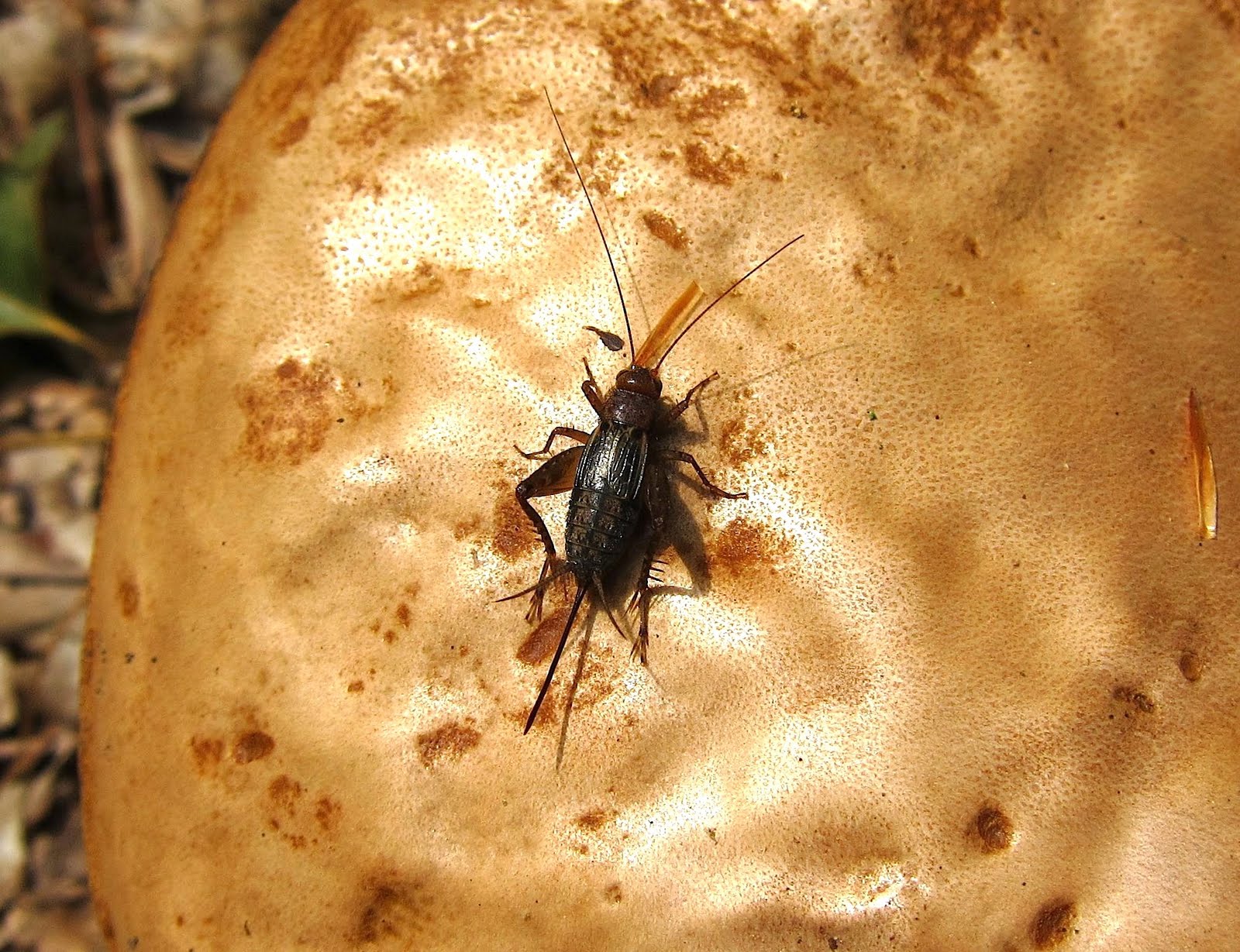
The recent heavy rains have brought us a wealth of fungi of every color and shape.  This very large brown bolete looked like a big Kaiser roll left on the sand by a forgetful picnicker.


Maybe this cricket landed here to take a bite.


This Jagged Ambush Bug was having a bite, that's certain.  But wait a minute, is that one bug or two?


A closer look from another angle reveals a smaller darker bug on top of the larger yellow one.  Are they mating?  Or is the weaker male hitching a ride on the stronger female, who is more adept at snagging prey?  That's what one of the experts at BugGuide.net suggests.


*  *  *


My next stop today was to see how the storm had affected the Kayaderosseras Creek near Ballston Spa, so I headed over to the canoe launch site at Gray's Crossing, off of Northline Road.  It was obvious at a glance that the creek had flooded well over its banks, toppling trees, flattening all the creekside vegetation, and filling the path with heaps of sand.


I managed to make out the Burl Trail that follows the creek, but it took some doing to pick my way through the blowdown wreckage.


When I last walked here just over a week ago, the Great Ragweed and Pokeweed and Jewelweed towered over my head, but the force of the rushing water knocked them all down.


Large swaths of the creekside were covered with a thick layer of mud, smothering all that was growing there before.  It will be interesting to see what plants will take advantage of this altered terrain.  Will the ones that were there recover?  Or will other species take advantage of the opportunity to move in?  I'll have to keep coming back to watch the progression.


Saturday, August 20, 2011

Mountain Trails Yesterday, Sand Plains and Creek Beds Today


Looking over the Hudson River from a mountain ledge in Moreau Lake State Park
How lucky I am to have so many nature sites to choose from! Last Thursday, Sue and I sat on that Moreau mountain ledge and shared ideas about where to meet next: A paddle on river or pond or fen? A hike through calcareous woodlands or a slog through a bog? Shall we wander an oak-pine savannah or climb to a height where limestone boulders are riddled with caves? The Ice Meadows beckon with lots of rare plants, as well as a great place to swim. How about those shale cliffs where Grass of Parnassus should just be starting to bloom? Truly, an embarrassment of riches, and all within a short drive away.

Just yesterday, I managed to explore two very different habitats hardly a mile apart, fitting both in between lunch and dinner, with time to spare to run errands.


The Woods Hollow Sand Plains

My first stop was the Woods Hollow Nature Preserve in Ballston Spa, a site that offers both wooded wetlands and open sand plains. I chose to spend my time there exploring the open sands.


While much of that open area is barren and dry, some damper parts are now lush with meadow flowers, including these handsome Black-eyed Susans.


Although the invasive Purple Loosestrife has found a too-comfortable niche in this meadow, it sure looks like many of our native wildflowers, like Boneset and Tall Goldenrod, have managed to keep that botanical bully in its place. There's no denying that those purple spires sure look lovely as part of the mix. (Many butterflies also added their colorful notes to this scene, but none would sit still for the picture-taking.)


A much smaller, low-growing native wildflower also thrives here in this sandy soil. This is Slender Gerardia (Agalinis tenuifolia), which bears its half-inch blooms on slender stalks.


I was happy to have caught a few blooms still remaining on the Blue Curls plants (Trichostema dichotumum). They usually shed their flowers by noon, but because the day was overcast, with occasional showers, some of the flowers had hung on into the afternoon. This plant is very happily at home in barren sands where little else will grow.


Here's a closer view of those long curling stamens that give this flower its common name.


Here's another plant that occupies barren sands where little else will grow. It's called Winged Pigweed (Cycloloma atriplicifolium), and don't bother to look in Newcomb's for it, because it's only a recent resident of the northeastern states. Originally a native of the central plains, it has expanded its range so successfully that the USDA distribution map shows it now inhabiting most of the U.S. and Canada. But not Saratoga County, oddly enough.


Ouch! Oh yeah, Sandbur grows here, too. Prolifically. Be careful where you walk. It's no fun pulling those burs from your tangled shoelaces.


Now, this was quite a surprise! Sue and I couldn't find Nodding Ladies' Tresses (Spiranthes cernua) on our climb up the mountain on Thursday, but here it was growing abundantly among the horsetail reeds in a sandy meadow. It wasn't yet in bloom to confirm the species, but what other Spiranthes could it be this late in summer?


In the shady woods at the edge of the meadow, Virgin's Bower (Clematis virginiana) was now fully in bloom, winding its leaf stalks around the neighboring shrubs' supporting branches.


While no butterflies would hold still long enough for their portraits, these Goldenrod Soldier Beetles were so occupied with their own affairs they completely ignored my camera.


This Locust Borer Beetle was also occupied, exploring every floret for food, but I did have to chase it around the top of the Boneset bloom. This is one big handsome bug, with its tiger stripes and bright red legs.


Another big handsome critter, this Argiope garden spider was also occupied with eating, its mouth parts busily working over that silk-wrapped bundle caught in its signature zig-zag web.


The Kayaderosseras Creek Bed

A few drops of rain were wetting the sand and thunder was rumbling overhead, but I took a chance I could still explore a very different kind of site just a short drive away from Woods Hollow. From the Northline Road parking lot at Woods Hollow, I travelled east no more than a mile to the Gray's Crossing Canoe Access site along the Kayaderosseras Creek. Here is a habitat as lush and green as the sand plains were barren and dry.


Most of the plants along this creek bottom seem super-sized, especially the Great Ragweed (Ambrosia trifida) that thrives here. These six-foot shade-growing plants were less than half the size of others that were towering over the creek in open sun, their stalks as big around as my wrist.


Pokeweed (Phytolacca americana) is a big plant everywhere it is found, but here along the creek it reaches giant proportions. The plant as a whole is kind of sprawling and homely, but its berries sure are beautiful. Lime-green now, the berries will turn a deep purple later, while the pedicels remain this vivid hot pink.


Wild Cucumber (Echinocystis lobata) sprawls across acres of shrubbery here, its starry flowers on upright stalks spilling a heavenly fragrance as I walked among its vines.


Here's a closer look at the Wild Cucumber's flowers and leaves, plus the tightly coiled tendrils by which it grabs and overwhelms every obstacle in its unrelenting progress. By autumn, plum-sized hollow fruits that look like little green hedgehogs will dangle from those vines.


A second surprise today! I hardly ever come across Butternut trees, but here was one standing tall along the creek, laden with nuts.


The Butternut resembles its close relative, the Black Walnut, in having thick, green, lemony-scented husks, but the Butternut fruits are ovate, rather than round like the walnut's.


There were heaps and heaps of Jewelweed, both Spotted and Pale, growing along the creek. I tried about 50 shots before I captured this big bee disappearing into the throat of a bloom. The bee was in and out in a flash, before my camera could focus. I can't believe my lucky stars that one photo came out.


The trail that takes you along the creek eventually turns to pass through a meadow before returning to the parking area. The goldenrod species towering overhead sure lives up to its common name of Tall Goldenrod (Solidago canadensis var. scabra), especially along this trail.


Joining the goldenrod to signal approaching autumn was this coral-colored willow branch.


Whoa! Did I say autumn? Come on, it's still high summer, isn't it? So what's this New England Aster doing in bloom? I think it's New England Aster, anyway, since I know of no other aster that blooms around here whose flowers are such a rich purple. But hey, this species isn't supposed to bloom until late September.


I wish this Yellow-collared Scape Moth would have opened its wings a bit more for the picture-taking. When it flew, its abdomen flashed a beautiful blue, but then when it landed it closed those chocolate wings. There were dozens of these colorful creatures feeding in the Joe Pye-weed, and I snapped lots and lots of photos. They were too fast for my camera, though, so none were perfectly in focus. At least you can see the colors in this shot.