Monday, September 12, 2016

A Glorious Day on the River!

Oh, what relief!  Summer's soggy heat disappeared overnight, and today dawned sparkling and cool.  It was a perfect day for a paddle on my favorite section of the Hudson River, above the Sherman Island Dam. Here the water flows back into quiet bays and coves, where trees lean over the gleaming water and the water holds the surrounding mountains in perfect reflection. Some banks are soft with deep green moss, punctuated with brilliant flowers, while others are craggy with giant boulders that are crowned with shrubs and ferns.

As usual, I took way too many photos!  I'm posting just a sampling here, simply to try to offer some sense of what Paradise looks like on a sparkling late-summer day.


The berries of Silky Dogwood are turning to royal blue.


A few brave remnants of Cardinal Flower still dazzle, sharing the shady banks with Sneezeweed and Spotted Jewelweed.


I believe there is no bluer blue than the blue of Closed Gentians.


A wee little moth rests on a bloom of Turtlehead.


The pretty pink wild roses no longer bloom, but in the flowers' place are their vivid red rose hips.


Marsh St. Johnswort has both flower buds and seed pods that are colored a deep ruby-red.  Are these the buds or the seed pods?  I admit, I really don't know!


The blue-black fruits of Sassafras have already been eaten by birds, but their vivid red pedicels remain on the tree.


Out on the wide open river, the gleaming cerulean water holds the rippling reflections of puffy white clouds.


In a swamp that lies behind an island, the leaves of this young Black Tupelo tree have already begun to turn a glossy scarlet.


Most Blue Vervain plants have long gone to seed, but here are a couple still holding their topmost tufts of tiny blue flowers.


Although their green leaves will fall with the first frost, the bright-red Winterberry fruits will cling to the branches through much of the winter.


This Solomon's Plume still holds its terminal cluster of pretty red berries.


A few patches of Pickerelweed still lift their spikes of deep-purple blooms, while the dark water holds their reflections.


The Buttonbush pods are well on their way to turning their typical shade of red in autumn.


Back in the sheltered coves, the river slows its current and calms its waters to mirror-like stillness.


This shoreline boulder is crowned with Wild Sarsaparilla and Polypody Ferns.


It was so quiet and peaceful back here, I regretted stirring the water's calm with my paddle.  So I sat in my boat for quite a long time, just breathing this cool green beauty.


A single Partridgeberry fruit has taken up residence in a neighboring patch of lime-green sphagnum moss.


I was quite surprised to find Hedge Nettle blooming so late in the season.  I love the moire pattern of its pretty purple florets.


A lone stalk of Sneezeweed still held its summer-bright blooms.


A Spicebush shrub holds shiny red fruits. If left to dry, these berries can be ground and used as a substitute for Allspice.  But I prefer to leave them on their branches.


Wednesday, September 7, 2016

Amazing Nature!

I've been having my mind blown by Nature this week.  Yesterday I found those zombie flies glued by a fungus to milkweed leaves.  Today I found a fungus that looks like a dog turd and which actually draws pollutants out of the soil.  And  last weekend I found a little red beetle whose larva creates an ant-repellant shield out of its own feces.  Nature is just amazing!

Here's a photo of that Dog Turd Fungus (yes, that's really one of its common names!) shedding brown powdery spores all over a sandy path at Woods Hollow Nature Preserve near Ballston Spa.


This is the fungus called Pisolithus tinctorius, or Dyemaker's False Puffball, in addition to that ruder name that refers to its lumpy brown appearance.  It grows under conifers and oaks in very poor soil, drawing its nutrients from the roots of these trees.


Although it's not very pretty, this fungus can be very useful in reclamation and reforestation of disturbed and polluted soils, such as strip mines poisoned with heavy metals, since it can thrive in acidic and nutrient-poor soils.

When this fungus is fresh and before the spores are ripe, it can be used to dye wool a reddish brown color, hence the common name Dyemaker's False Puffball.  Its scientific name, Pisolithus, literally means "pea stone" and refers to the pea-shaped peridioles (the spore-producing parts) seen in the interior of the fungus when it's broken open.  The "tinctorius" part of its name refers to its ability to produce a dye.


This pretty little red-and-white striped beetle was crawling on a Staghorn Sumac leaf when I found it along the Hudson River at South Glens Falls last Saturday.  As I later learned (many thanks, BugGuide.net!), the sumac shrub was exactly the right place to find this Sumac Flea Beetle (Blepharida rhois).


I have since read, on a website called "Chemoecology," that both adults and larvae of this beetle are dietary specialists that feed only on sumac.  After ingesting the sumac leaves, the larvae, instead of discarding their feces, paste it on their backs to form fecal shields that protect it from attacks by marauding ants.  Scientists have determined that the protection these shields render is more chemical than physical.  Apparently, there are substances found only in sumac leaves and excreted in the feces that provide this kind of protection.  When the larvae are fed a substitute diet, their feces does not contain the protective chemicals, and the fecal shields prove to be ineffective.

Wow!  I learn something new almost every day.

Some Things Change, Some Don't

Wildflower nut that I am, I like to revisit many of my favorite flowers each year, just to make sure I still know where to find them.  This is especially true for plants that I personally know from only a single location,  even if they're not necessarily classified as rare in the state.   In the case of Tall Ironweed (Vernonia gigantea), I know of only one location where I've found it in Saratoga County: by the parking area for the Gick Farm Parcel of the Wilton Wildlife Preserve and Park.   As it happens, Tall Ironweed is also listed as Endangered in New York State, the rarest category of all.   Realizing it was getting late this summer to find this showy purple flower in bloom, I hurried out to Wilton today, hoping I hadn't missed it.  But as I pulled into the parking lot, the dread realization came over me that I will probably never find this plant again in Saratoga County.  The grassy area where it once had thrived was mowed to an inch from the ground.  Along with all the wildflowers that used to grow there.  The neat freaks had struck again!


Here's what this same site looked like one year ago.


I remember being so very pleased to see how the Ironweed was thriving here, producing more stems in glorious bloom than ever before.  It towered over the other native plants -- goldenrods, asters, and milkweeds -- that shared its plot, attracting numerous butterflies, bees, and other pollinators to its gorgeous purple flowers.  I felt so privileged to be able to gaze on it here, so far from other sites in the state where this rare plant has been reported.  And now it is gone.  Not an inch of its sturdy stalks could I find, in all the close-shorn stubble.

Nor could I find any trace of another unusual plant I used to find here, the Late Purple Aster (Symphyotricum patens).  This pretty purple flower with oval clasping leaves tends to grow further south in the state, but it somehow had made it to Wilton to bloom within a few feet of the Ironweed, in this little patch of unmowed land.  Or what USED to be unmowed land.  Now it is gone forever.  Why some people prefer the look of featureless stubble to the glorious mix of colorful wildflowers, is a great mystery to me. And I sure am angry about it.  Two plants that I've never found anywhere else have been destroyed, and for no good reason.


Update:  Actually, since both the ironweed and the aster are perennials, they will probably come up again next year.  But since they need their leaves to provide nutrients to their roots,  if they get mowed down again every year, they will die out for good.  But Margo Bloom Olson, the executive director of the Wilton Wildlife Preserve and Park, is doing whatever she can to make sure this area is never again mowed during the growing season.  She was not aware that this mowing occurred and would not have allowed it, since this parcel of the Wilton Wildlife Preserve and Park is especially protected as a breeding site for the endangered Karner Blue Butterfly.


I went looking for another oddity today, not a plant but rather a freaky fungus/fly interaction I'd encountered just a year ago at Moreau Lake State Park, and I wondered if I would find it again.  And I did. Right in the same patch of Common Milkweed where I'd found it before, near the parking lot for the beach.  The milkweed flowers had long gone to seed, and the leaves showed no signs of Monarch caterpillar feeding, but when I overturned many of the leaves, I found the same strange phenomenon I came upon last year:  a bunch of dead flies, all stuck tight to the undersides of the leaves, the segments of their abdomens bursting with some kind of strange brown stuff.


Here's a photo I posted a year ago, of a fly in the same situation and in the same milkweed patch.  I didn't have any idea what was happening here, but one of my readers did.  Kathie Hodge,  a professor of mycology at Cornell University informed me that these flies were infested with what she called an "Entomophthora" fungus, the word meaning "insect destroyer."  And destroy these flies, this fungus certainly did!


This particular fungus produces spores that land on the fly's body, where they germinate and penetrate the fly's exoskeleton.  Some scientists have reported that this fungus can affect the brain of the insect, controlling its action and forcing the fly to crawl up to the highest nearby vegetation, thereby obtaining an advantageous spot for wind distribution of the fungus's future spores.  When the fly reaches this highmost spot, the fungus causes a substance to grow around the fly's body that will bind the fly to the leaf, thus cementing it there even after the fly has died. The fungus continues to grow inside the fly's body, digesting its innards and eventually killing it.  Cracks open in the fly, and the fungus exits the interior to form sporangia on the fly's surface.  These sporangia contain the new spores, which are forcibly shot off, to land on other flies and continue the cycle.

Sounds pretty horrible, doesn't it?  But also pretty amazing!  It's hard to imagine how a fungus could strategize a way to control an insect's behavior for the fungus's own benefit.  And there's even a potentially "good" use for this Entomophthora fungus as a biological control of harmful insects, creating bio-insecticides that are specifically targeted for certain insects, while being harmless to others.

Anyway, I find such interspecies interactions absolutely fascinating, and I was glad to find evidence of this phenomenon just where I found it last year.

But I'm still really mad about that Ironweed getting mowed down.

Thursday, September 1, 2016

Iris Eradication Efforts

 There's no question that Yellow Iris (Iris pseudoacorus) is beautiful.  I'm sure that's why it was welcomed to American gardens from its native lands overseas.  The problem is, it did not stay in those gardens, but now has spread to waterways across the U.S., threatening to supplant vast swaths of native riparian flora to form impenetrable monocultures where no other plants can grow.  By now, one of those waterways is my cherished Hudson River at Moreau, which is part of Moreau Lake State Park.  I've been paddling this section of the Hudson between the Spier Falls and Sherman Island dams for nearly 25 years, and I know the shoreline vegetation pretty much by heart.  So I was quite surprised last summer when I found two giant clumps of Yellow Iris where I had not seen them before.  The clumps occurred quite a distance apart, one in a little cove just upstream from the Sherman Island Dam (above), and the second far back in a swampy area a quarter-mile or so further upstream (below).


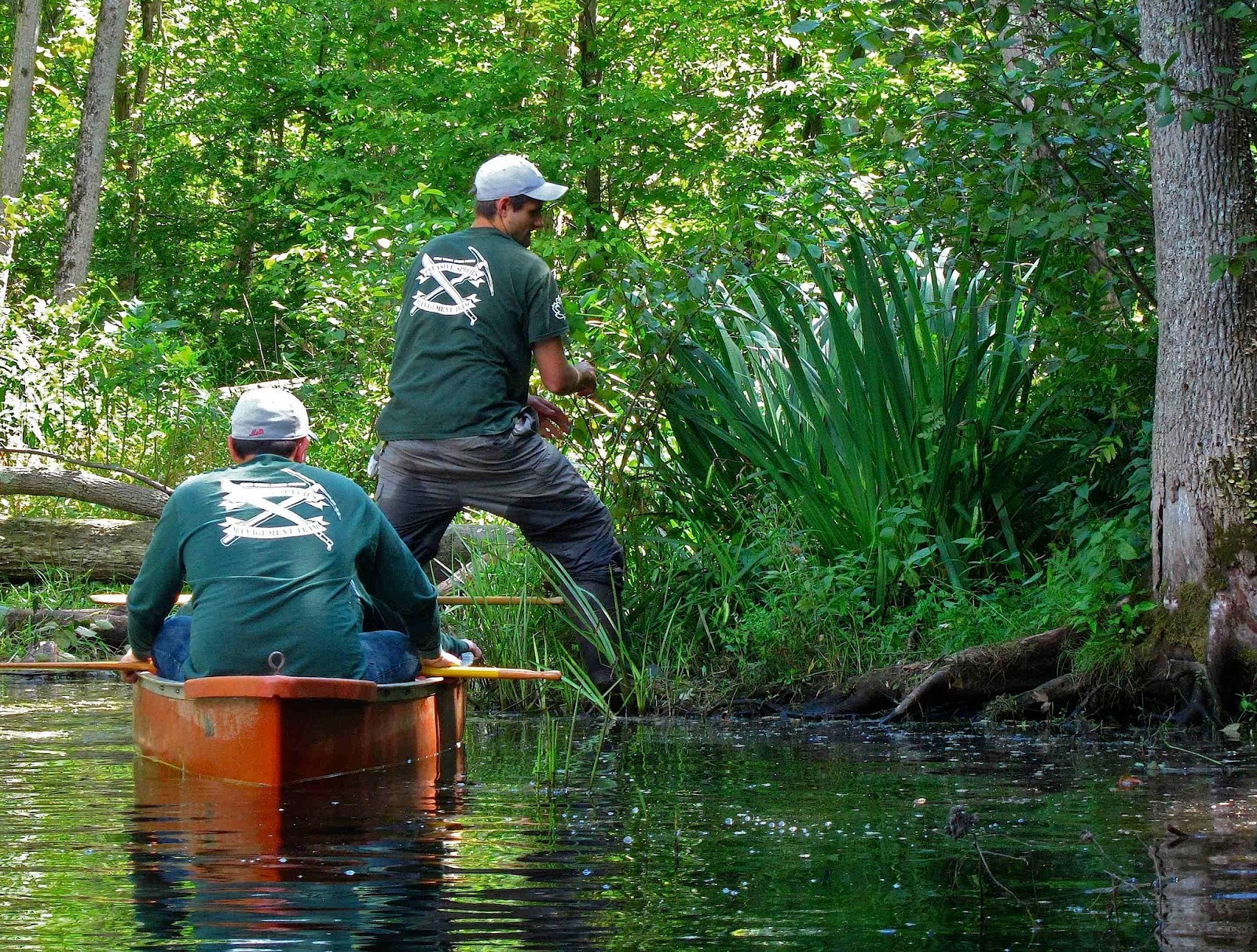
Of course, I tried to pull them out.  OH boy!  No such luck!  They were rooted so deep, it seemed it would take some dynamite to dislodge them.  But today I learned it just took a dynamite team of New York State Parks Invasive Species Management folks to do the job.  After I reported finding these iris clumps to Moreau Lake State Park Manager Peter Iskenderian, he arranged for this crew to eradicate them, and he asked if I could accompany the crew to show them where the iris grew.  Well, sure I could!


We were lucky we had such a beautiful day to be paddling on the river and then mucking about in the swamp.  Even though the crew had boots on, they were soon up to their knees, or higher, in muddy water as they worked to dislodge the iris.  I was lucky I got to sit in my boat while Dave, Casey, Taylor, and Mike did all the heavy digging.  NY State Parks Regional Natural Resource Steward Casey Holzworth, seen standing in the photo above, supervised the effort.


This crew member, also named Casey, managed to smile, despite the discomforts.  It was not easy to dig out those giant tuberous roots, bag all parts of the plants, and haul them away.


One clump down, we next headed downstream to take on the second one, at the back of a quiet cove.


This was one BIG clump of Yellow Iris!


By the time we were done, each canoe (we had three, including my little Hornbeck) was laden with many bags of iris leaves, roots, and the mud that they grew in.  I carried two bags, too heavy for me to lift on my own, in my own little boat.  We were lucky we had a brisk wind at our backs to push us the mile or so upstream to our landing site.


Yes, we had work to do today, but we also had many pleasures paddling this gorgeous stretch of the Hudson.  How beautiful are these vivid blue Closed Gentians?  These are just one of our native species that the Yellow Iris, left to spread, would overwhelm and supplant.  Mixed in with this cluster of Gentians are some other native flowers, including white Turtlehead blooms and the yellow-centered Beggar Ticks.


This mating pair of Autumn Meadowhawk Dragonflies found my sun-burned knee a convenient place to rest and didn't seem to mind my poking my camera lens at them.


And here was the highlight of my trip today: finding a large population of Small Floating Bladderwort (Utricularia radiata) back in the swampy area we visited first.


This little yellow flower, borne along on inflated "pontoons," is listed as a "Threatened" species in New York, but I found dozens of them floating among the Pickerelweed plants and Buttonbush shrubs.  I have found this species in abundant numbers before, but in a section of the Hudson some miles -- and two dams! -- downstream, near Glens Falls.  This is the highest upstream I have found them so far, and in waters that are within the boundaries of Moreau Lake State Park.   If those Yellow Iris had been left to spread, the Small Floating Bladderwort is just one of the native species that might have been supplanted.  So I'm very grateful to the New York State Parks Invasive Species Management team for the work they accomplished today.  Thank you,  dear folks, for protecting "my" beloved river and all the native plants that populate its banks and waters.

Postscript:  The invasive-species crew also removed a big Autumn Olive (Elaeagnus umbellata) and a small shrub I asserted was Glossy Buckthorn (Frangula alnus) from the powerline that runs just north of Mud Pond at Moreau Lake State Park.  Neither of these isolated shrubs had yet grown invasive at their sites, but left in place, they were likely to.  Good to nip these nuisances in the bud!

Tuesday, August 30, 2016

Off to the Other Side

I don't venture over to "the other side" very often.  Meaning, the Warren County parts of Moreau Lake State Park.  There are some really nice trails over here, as this map displays, but the access road to the parking area can be daunting, especially since I don't own a high-axle car to carry me safely over the boulders and ruts. But at this time of year, it's the only place I know of to find three interesting plants in particular, so on Sunday I geared up my courage and made the trip.


My friend Sue met me at the Hawk Rd. entrance near Lake Luzerne, and together we survived the jolting half-mile drive to the parking area.  I was eager to show her the three plants I find over here, where the soil has a somewhat different composition than it does in the Saratoga County parts of the park.  And who could know what else we might find as we walked the pleasant old road that still provides access to the Spier Falls Dam?  We took this old road instead of the wooded trails, mostly because it offered easier traveling on this brutally hot and humid day, and also because we might find more blooming along this open roadway than we would in the dark shade of the forest.


The first flower we found, almost as soon as we stepped from the car, were dozens and dozens of Purple Milkwort flowers (Polygala sanguinea), a plant that prefers the dry, thin, rocky soil that surrounds the parking area here.  Some years I find only a few, but this year they were abundant.  State distribution maps indicate that this flower is not rare and occurs widely across the state.  But I never find it anywhere else but here.  And I do get around!


Here's a closer photo I took from my files, the better to show the beautiful structure of the Purple Milkwort blooms, like miniature bouquets of multicolored flowers wrapped in purple tissue paper.


Here is another flower, American Pennyroyal (Hedeoma pulegioides) that state records indicate is a common and widespread plant.  But I have never found it anywhere but here on the Warren County side of the Hudson River.  And I have looked for it elsewhere for years.  I grant it would be easy to overlook, tiny as it is, with flowers that fall from the three-toothed bracts at a touch.  But all you have to do is pass near a patch of it, and the strong minty fragrance reaches out to tell you "Here I am!"  Some years I search and search this site, only to find a couple of struggling plants, but this year the patch was vigorous and plentiful.


Slender Three-seeded Mercury (Acalypha gracilens) is probably not as uncommon as the NY state floral distribution map would indicate. I think it is more likely just overlooked by botanists, little nondescript weed that it appears to be. Its flowers are just little ruddy nubbins borne in the leaf axils, but they are surrounded by winged bracts that are far more interesting to look at than the almost invisible flowers. After all, these winged bracts, resembling the wings on the heels of the Roman god Mercury, are what inspired this plant's common name. Nestling within those bracts are tight little clusters of three seeds, contributing inspiration for the other part of the common name. I have found this little native American plant in only two places in all my years of wildflower hunting, but I bet it's hiding out in lots of other places, too. I'm happy I consistently find it over here on the Warren County side of the park, and this year the plants looked healthier than ever (if always a little bug-eaten).


This photo reveals the tiny glandular hairs on the winged bracts, a feature that distinguishes this Acalypha gracilens from the much more common vacant-lot weed, Acalypha rhomboidea.


The tiny cluster of three seeds contained within the winged bracts are doubtless what inspired this plant's name of Three-seeded Mercury.


We managed to walk at least a couple of miles this day, there and back again, finding lots of beautiful mosses and colorful fungi as well.  But not many other flowers, aside from Tall Goldenrods and the ubiquitous Bonesets that crowded the road.  We might have gone further, but I began to feel absolutely enervated from the heat and humidity and begged to go home.  I was too tired to even take more photos, so I'm posting this photo from an earlier outing to Moreau Lake the Friday before.  This was the first Monarch Butterfly I had seen all summer, one of at least three I saw feeding on the Bonesets that grow on the shore of the lake.  Let's hope that populations are recovering, now that people are becoming more aware of the importance of nurturing milkweeds for their larvae.


And this was a lovely Swamp Thistle (Cirsium muticum) I found growing along Bog Meadow Trail last week.  We have five thistles that are native to New York, and this is one of the prettiest.  I think its buds are beautiful, too, finely interwoven with fibers as fine as spider silk and with a texture that is reminiscent of elegantly jeweled Easter eggs.