Wednesday, September 7, 2011

Another Rainy Day


 A good day for ducks


The Kayaderosseras Creek charges through Rock City Falls.


The meadow's colors glow through the falling rain.

Kitten Cuteness. And Chaos!

Yes, the little darlings are still with us.  The Capital District Humane Association told me they have too many kittens now and can't take any more, but if we would continue to foster them, they will help with veterinary care and include them in their weekend adoption clinics at PetSmart.  Sounds like a plan.  We've decided to keep the little gray-and-white cutie we've named Cleo, but Helen the calico and Bebert the tiger still need loving homes with folks who agree to have them neutered.  Spread the word.

In the meantime, we sure are having fun.


Mushrooms and More Mushrooms, and More

These past soggy days have kept me close to home, just running out to local spots for an hour or so between rainstorms.  On Saturday I headed out to the Skidmore Woods, mushroom basket in hand, hoping to forage for some of the myriad fungi sprouting now all over the forest floor.  Maybe I could find some Honey Mushrooms or, even better, a nice big Bear's Head fungus.

Did I say "sprouting?"  I think "EXPLODING!" would be a better word for what these big brown boletes were doing.  This one was about the size of a medium pizza.  Could this be the mushroom that's called King Bolete (Boletus edulis)?  I was hoping so, since that species is supposed to be a prized edible. And just one of these was more than enough for a meal.


I broke one in half to look at the flesh, which was snowy white and didn't turn color on exposure to air or upon being pressed.  That was a good sign.    Another sign that this could be the King Bolete was the yellow-green color of the tubes.  Trouble was, though, that this yellow-green color indicated that the mushroom was old, for its tubes are white when fresh and good to eat.  Alas, no mushrooms for supper this night!


In fact, most of the mushrooms I found in the Skidmore Woods were well past their prime, and many of them were being consumed themselves by other kinds of fungi. The process had just begun on this big brown bolete, blotched with fungal infection.


This mushroom was so completely covered and distorted by a chrome-yellow mold, it was impossible to tell which species it was (had been?).


But at least it still possessed its mushroomy shape, unlike the completely disfigured blobs below, which looked more like pink-stained dough than any kind of mushroom.


Ooh , look at this oozy mess, all covered with some kind of gray mold and weeping drops of amber fluid.


So on Saturday, I went home with an empty basket.


Today, Tuesday, the clouds thinned a bit this afternoon, so I wanted to venture out.  But where to?  I usually think of our local state park as a place for golf courses and swimming pools and picnic pavilions, rather than as a place for a woodsy walk.  But then I remembered the park had a nature trail through some old-growth woods off of Crescent Avenue and decided to give it a try.


Turns out, it's a lovely trail through mixed hardwoods and conifers, over little brooks and passing through several clearings shaded by towering Black Walnuts.  Today, the trail was a bit muddy in spots, but not so swampy I couldn't find my way around.  And my oh my, were there mushrooms!  All over the place were these fluffy clumps of white coral fungi, looking like whole families of white hedgehogs out for a stroll in the woods.


I also found several logs that were dotted with the fruiting bodies of Blue Stain Fungus, a fungus that more often makes its presence known by the way it stains rotten wood a dark blue-green.


Well, you could see these mushrooms coming a mile away!  Such a vivid color and looking like nothing I'd ever seen before, either out in the woods or in any of my mushroom books.


I picked one up to examine its structure, noting its free gills, the ring around the stem, and a white cup at the base (not shown here), as well as the yellow-orange color of both stalk and gills.  Could this be the mature stage of the American Caesar Amanita, a mushroom I've seen before only in its button stage?  After looking at many photos on the web, I'm willing to venture a guess that that's what this is. (For an image of American Caesar in its button stage, see my post for 8/30, "After Irene.")


These tiny orange wormy things were sprouting up all over the ground around a rotten stump.  You can see how small they are by comparing them to the Red Maple leaves around them.  Could they be Ramariopsis laeticolor?  I wish I had broken one off to see if it was solid or hollow, perhaps tasted a tiny bit to see if it was bitter or mild.  Then I could make a better-educated guess.


This twisty yellow fungus could possibly be one of the Earth Tongues, or at least I think it belongs to the sac fungi group.  The closest match I can find in my books is Neolecta irregularis, which, as its name suggests, can assume different shapes.  Including this convoluted one.


This lovely apricot-colored mushroom presents quite a puzzle to me.  It's obviously a gilled mushroom,  but not like any gilled mushroom I've ever come across.


I have never seen a gilled mushroom that has a flattened hollow stem like this one.  I sure hope that some mushroom expert might see this photo and tell us in a comment what it is.


Update:  Ruth Schottman has offered the suggestion that this is a species of Hygrophorus, or Waxcap. After searching among images, I do believe she is right and that this is an Orange Gill Waxcap (Hygrophorus marginatus), a mushroom quite varied in coloration.  It's also varied in nomenclature, as it is also known as Hygrocybe marginata and Humidicutus marginatus.


Not everything of interest these past few days was fungal.  For example, I found this Orange-fruited Horse Gentian fully in fruit at Skidmore,  its little tomato-colored berries circling the stalks in tiers.


In lots of low damp spots where Jack-in-the-pulpits grow, their fat clusters of brilliant red berries are much in evidence now.


Lining the Hemlock Trail at Spa Park were thickets of Panicled Dogwood, its snowy-white waxy berries held on hot-pink pedicels. Quite a lovely color combination.


Here's another lovely color combination: a bright yellow mushroom and an equally vivid Red Eft.


This little toad is remarkable for its almost complete absence of color.  Have you ever seen such a black toad?  I would never have seen it if it hadn't hopped onto those bright green leaves.  It was living in a very deeply shaded Hemlock woods where the earth beneath the trees was very dark.  I wonder if toads who live in a sunny, silvery Beech woods take on a lighter color?

Friday, September 2, 2011

A Brief Paddle, A New Mushroom

A gorgeous blue-sky day today, and Sue and I wanted to paddle.  Rivers and creeks are too turbulent still, so Sue suggested the fen at Glen Lake, a beautiful wetland with meandering channels, resident waterfowl, and dramatic views of the mountains that surround Lake George. It sure looked lovely this morning, with baby Red Maples already turning scarlet and a noble Great Blue Heron there in its midst, adding his handsome profile to the scene.


With all the recent rain, the water level in the fen should have been high enough to grant us access to its farthest reaches.  Well, we tried, as these upturned Water Lily pads attest, their red-backed leaves standing erect to mark where we paddled through them.  But we didn't get far.  The water was high enough, but the channels were clogged with so much Eurasion Milfoil we could only progress by poling and hitching.  It felt like trying to paddle through porridge.  No fun at all!  So we made our way back to shore and went for a walk instead.


The fen at Glen Lake is bordered by the Warren County Bike Path, which runs from Glens Falls to Lake George.  We set out to walk along the bike path but soon left the pavement to enter a dark cool woods, where we found huge numbers of many different kinds of mushrooms.  Among the most brightly colored mushrooms were these chrome-yellow ones with slimy caps and with brownish flakes around the edges that made them look like little lemon pies.  They were vey numerous under stands of White Pine.


Curious as to what this mushroom could be, I bent down and picked one to examine its structure.  The first thing I noticed was the absence of gills and the presence instead of the distinctive pores that mark this mushroom as one of the boletes.  In this case, the pores were as yellow as the caps, and so was the stem.


I next noticed that these yellow pores promptly stained brown where my fingers had crushed them.  My fingers also turned brown where they were slick from touching the slimy caps.  I noticed the mushrooms had a rather pleasant fragrance, so I wondered if they might be the kind of boletus that's good to eat.  Sue gave me a plastic bag from her pack, and I picked a nice mess to take home for positive identification.


After searching all my mushroom guides and looking at lots of images on the internet, I was convinced that this mushroom was Suillus americanus, with common names of White Pine Bolete or Chicken-fat Suillus.  All sources mentioned that this species was, indeed, a good edible,  so I washed the pine needles off, dried them carefully, then sliced a few and fried them up in butter.


So how did they taste?  Meh.  To me, not so good.  They stayed kind of slimy and gelatinous, although I tried to fry them crisp.  They smelled delicious, but they had a kind of lemony acidity that I didn't much care for.  My husband, though, thought they tasted great, and he ate them all up.  As for me, I'll stick to morels when I crave wild mushrooms.

The Days Grow Short . . .

. . . And the shadows grow long.  September.  Summer's end.  Yes, the calendar says we have three whole weeks of summer left, but the shift has already begun.  It began, in fact, several weeks ago, arriving with the first goldenrods and the afternoon cricket songs.  I used to feel melancholy this time of year, but lately I don't.  Perhaps it's because, ever since I retired, I've had the time and the freedom to spend nearly every day in nature, to completely immerse myself in each season's delights and come to feel in tune with each season's changes.  So let the autumn come, and after that, the winter.  I welcome both.

Today still felt summer-warm and humid, with an overcast sky letting down a few raindrops now and then.  Although it was calm and would have been a good day for a paddle, the Hudson was still on a post-storm rampage, roiling with tumbling debris that could pummel my boat like a battering ram.  Besides, all the riverbank plants are still covered with silt, the petals all ripped from the flowers.  So I went to Moreau Lake State Park instead, to walk the trail I've volunteered to steward, which circles the lake's back bay.


My trail was in pretty good shape today, no fallen trees, little litter.  No mosquitoes, either, which amazed me some, since the path passes through deep-shaded woods that lie close to water.  The declining population of biting bugs is certainly one of the season's changes I welcome.


I did find strewn beer cans and candy wrappers when my trail led down toward the water's edge, but the loveliness of the landscape there helped to compensate me for the rage I felt toward those who would sully this splendid place.

The seed heads of Buttonbush are just as handsome, in their own rosy way, as the white pincushion flower heads had been in midsummer.


Scarlet Smartweed just keeps getting prettier as its flower stalk grows longer.


Even these fishbones took on a kind of pearlescent beauty, stripped as they were of any offending flesh, revealing their elegant structure.


And oh, the mushrooms!  Mushrooms of every shape and size and color!  Here's a gallery of some of the more interesting ones I found along my trail today.

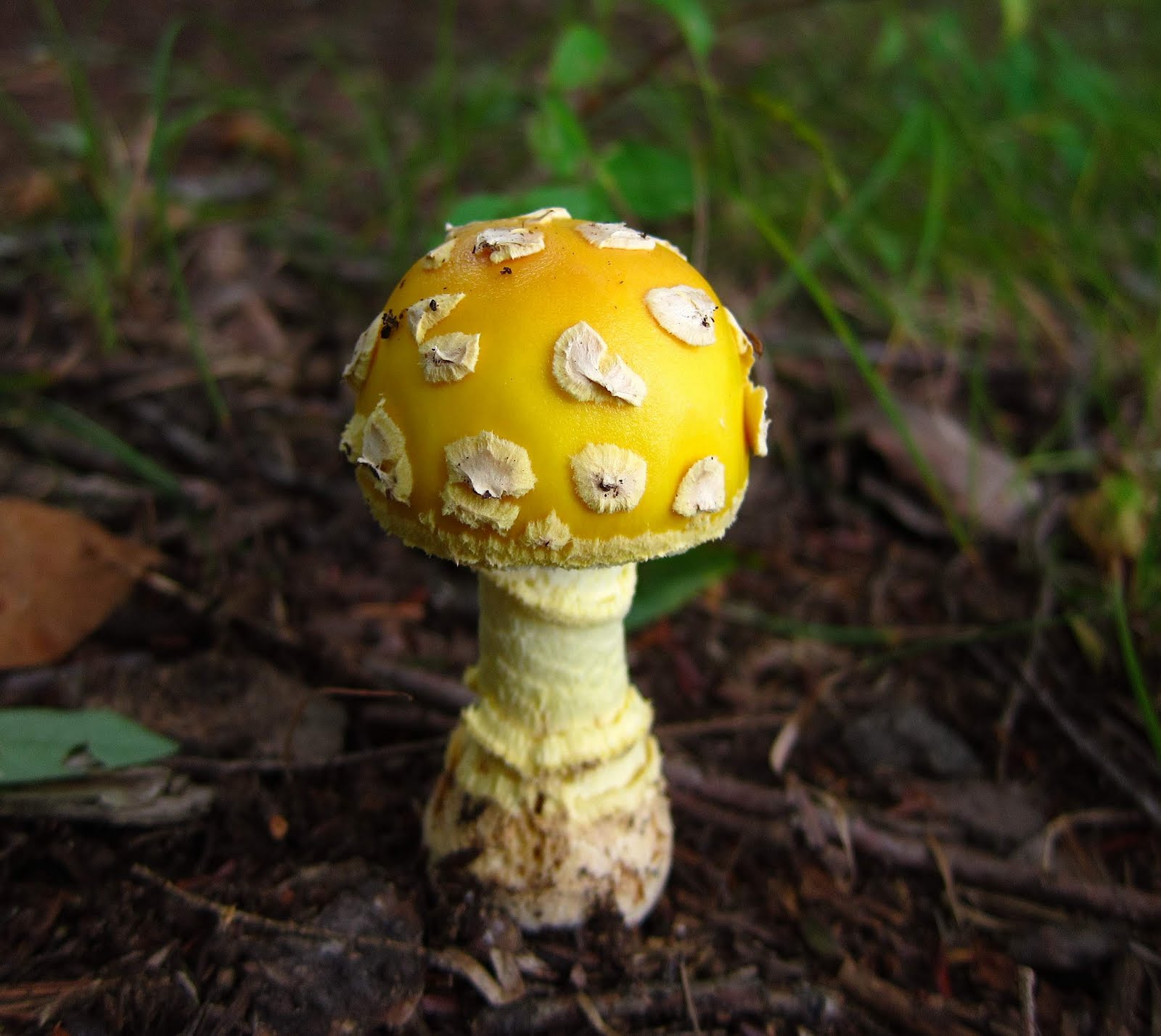
This, I believe, is a budding Amanita muscaria, also known as Fly Agaric.  This mushroom can also be red, but red or yellow, it looks like the classic mushroom of fairy tales.  (Update:  I heard from a friend suggesting this might rather be A. flavoconia because of its yellowish stalk.  The stalks of A. muscaria are snowy white, whether the caps are red or yellow.)


Here's a whole log-full of Scaly Pholiota (Pholiota squarrosa), whose toasty-brown scaly puffs remind me of coconut macaroons.


This photo doesn't show the snowy-white stalks that support these rich-red Russulas (Russula emetica) and are diagnostic for this species.  There's something tender about the way these two lean into each other, like a loving couple.


Could this be a Yellow Russula (Russula claroflava)?  I really don't know, because to properly identify a mushroom you have to dismantle it, noting how gills are attached and making spore prints and so forth.  But I didn't want to disassemble this lovely little tableau, with the glossy Pipsissewa leaves matching the shine of the mushroom cap, and the frosted pine cone arranged just so, as if some floral designer had put this scene together.


Here's another pretty arrangement, with a rusty-red, mohair-tufted Painted Bolete (Suillus spraguei) surrounded by a cluster of open beechnuts, their gaping husks reminding me of baby birds clamoring for food.


Of all the lovely fungi I saw today, this beautiful arrangement takes the prize.  Too bad those intensely orange gilled mushrooms (species unknown to me) can't be preserved, as the Turkey Tail (Trametes versicolor) shelf fungus can.  Wouldn't this make a spectacular Thanksgiving decoration?


Update:  Ed Miller's son Nick has suggested that these orange mushrooms are Mycena leailana, a species commonly found sprouting in abundant clusters from rotting logs.


This last mushroom, called Bitter Tooth (Sarcodon scabrosus) may not look as lovely as some, with its wrinkled scaly brown caps, but it sure is interesting.


This is a toothed mushroom, which means that it bears its spores on the outside of toothlike spines, rather than gills or pores. When I turned this mushroom over, I could see those hundreds of teeth under the cap, as well as the tell-tale greenish stalk, distinctive to this species.


According to George Barron, author of Mushrooms of Northeast North America, this toothed group contains  relatively few species of macrofungi, although there are a number of them that are widespread and easily recognized, including this Bitter Tooth.  As its name implies, this mushroom is bitter to the taste and therefore not palatable, while many other species of toothed fungi are actually quite good to eat. (Bear's Head, another toothed fungus that looks like a frozen waterfall, is one of my favorites.)


Here's a cutaway view of all those tiny teeth on the underside of Bitter Tooth's cap.