Showing posts with label fungi. Show all posts

Wednesday, October 19, 2011

More Adventures at Pyramid Lake


Ever since noted botanist Ruth Schottman joined me for a botanical adventure at Pyramid Lake last July, we've been meaning to return to further explore together this beautiful wilderness lake in the Adirondacks.  We finally got there on Monday morning and found we had the whole lake to ourselves, with not another human soul around.  Although the day proved too windy for comfortable paddling in our tandem canoe, we were happy enough to leave our boat on shore and set off on a couple of hikes through the woods and around the lake.

Not only is Ruth a delightful hiking companion, she is also a walking encyclopedia of botanical knowledge.  We hadn't walked far before she spotted this interesting anomalous clump in an alder along the shore and didn't even have to check a guide to give it a name.  This is Taphrina, she promptly told me, an alder gall caused by a fungus that affects just the female flowers.


I knew right away this was going to be fun and that I would learn a lot from my companion.   There are so many fascinating phenomena in the woods in every season, adding interest to every walk, even long after the flowering plants have shriveled and died.  Most mosses, for example, stay fresh and green all year, including this Bartramia pomiformis, with its long silky leaves and little brown "pomiform" (apple-shaped) fruiting bodies.


On the other hand, most mushrooms are really ephemeral, disappearing almost as fast as they arise.  We were lucky to spot this handsomely studded, somewhat slimy Pholiota clump, sharing its cut-log surface with several other (unidentified) fungi.


Our morning hike took us along a trail that was bordered by huge boulders that were covered with many different kinds of lichens.  This aptly named foliose lichen called Toadskin Rock Tripe (Lasallia papulosa) was sharing its boulder with smooth-skinned rock tripes not visible in this photo.


Although this Dog Lichen (Peltigera polydactyla) often grows on woody substrates, it can sometimes be found on boulders, too.   I have read that it gets its name from having once been used as a (futile!) treatment for rabies in dogs, but I remember its name from the little brown fruiting bodies folded over like dogs' ears.  Its dark, almost black, thallus is a clue that this lichen associates with cyanobacteria as well as the fungi and algae that typically constitute all lichens.


I'm going to have to get back to Ruth to see if she can name this red-brown liverwort.  It looks similar to the Frullania liverworts that grow on trees, but this was growing on the face of a boulder.


Another liverwort I don't know the name of, this one growing on tree bark and of a bright green color.


As our trail climbed higher and higher above the lake, we soon came to lookout point where we could see the majestic Pharaoh Mountain rising to the south.


Our trail reached its summit in a rocky outcropping where we stood and gazed out at the beauty of the lake and surrounding forests and mountains, all part of the Pharaoh Lake Wilderness Area.  How lucky I am to have access to such splendid wilderness, just an hour's drive from my home!


We retraced our steps back to Pyramid Life Center, where we had left our car and our lunch bags.  One of the structures that make up the retreat center at Pyramid Lake is this charming little meditation hut right on the water.  Here, we could take shelter from the wind and eat our midday meal in comfort while enjoying the view.


After lunch, we set off in another direction, choosing a trail that leads toward Eagle Lake just a mile or so to the east.


Our trail crossed several woodland streams still rushing with water as if it were springtime snowmelt, instead of autumn.  I could stand and gaze at such miniature musical waterfalls for a long, long time.


This woodland trail offered abundant sightings of fungi, including whole logs full of Angel's Wings (Pleurocybella porrigens), a good edible if we had found it a day or so earlier.


Another good edible is Late Fall Oyster Mushroom (Panellus serotinus), which was still fresh and firm when we found it.  I hadn't planned on cooking dinner that night (it takes a long slow stewing), or I might have collected a mess to bring home.


We were struck by the beautiful rich red-brown tops of these shelf fungi, possibly Artist's Conk (Ganoderma applanatum).


Here's the smooth, white underside of that Artist's Conk, with a flesh that is easily bruised.   Detailed drawings can be etched into that flesh, which will retain those drawings permanently after drying.


Boy, I don't know what this one is!  At first I thought it was Ochre Spreading Tooth, but on closer inspection that orange stuff doesn't look like teeth, and I can't find anything in my mushroom books that fits that description.  Whatever it is, it was quite colorful.


I remember finding Ravenel's Stinkhorn (Phallus ravenelii) along this same trail last year, so I wasn't surprised to find it again, surrounded by flies attracted to its fetid odor.


Such a lush bright-green patch of feathery moss!  It looked familiar, but I couldn't remember its name, although Ruth knew it right away.  This is Stair-step Moss (Hylocomium splendens), a boreal species so named for its habit of growing a single layer every year, the new growth sprouting from the middle of the old.


Yet another liverwort, this one decorating a rotting log with its pretty bright-green branchings.  At first I thought it was a moss, but Ruth corrected me.  A closer inspection with a magnifier revealed it to be the leafy liverwort Lophocolea bidentata.


Here's a view as close as I could get with my camera.  If you click on this photo, you might see the two-teethed leaves that give this liverwort its specific name of bidentata.


Friday, September 2, 2011

The Days Grow Short . . .

. . . And the shadows grow long.  September.  Summer's end.  Yes, the calendar says we have three whole weeks of summer left, but the shift has already begun.  It began, in fact, several weeks ago, arriving with the first goldenrods and the afternoon cricket songs.  I used to feel melancholy this time of year, but lately I don't.  Perhaps it's because, ever since I retired, I've had the time and the freedom to spend nearly every day in nature, to completely immerse myself in each season's delights and come to feel in tune with each season's changes.  So let the autumn come, and after that, the winter.  I welcome both.

Today still felt summer-warm and humid, with an overcast sky letting down a few raindrops now and then.  Although it was calm and would have been a good day for a paddle, the Hudson was still on a post-storm rampage, roiling with tumbling debris that could pummel my boat like a battering ram.  Besides, all the riverbank plants are still covered with silt, the petals all ripped from the flowers.  So I went to Moreau Lake State Park instead, to walk the trail I've volunteered to steward, which circles the lake's back bay.


My trail was in pretty good shape today, no fallen trees, little litter.  No mosquitoes, either, which amazed me some, since the path passes through deep-shaded woods that lie close to water.  The declining population of biting bugs is certainly one of the season's changes I welcome.


I did find strewn beer cans and candy wrappers when my trail led down toward the water's edge, but the loveliness of the landscape there helped to compensate me for the rage I felt toward those who would sully this splendid place.

The seed heads of Buttonbush are just as handsome, in their own rosy way, as the white pincushion flower heads had been in midsummer.


Scarlet Smartweed just keeps getting prettier as its flower stalk grows longer.


Even these fishbones took on a kind of pearlescent beauty, stripped as they were of any offending flesh, revealing their elegant structure.


And oh, the mushrooms!  Mushrooms of every shape and size and color!  Here's a gallery of some of the more interesting ones I found along my trail today.

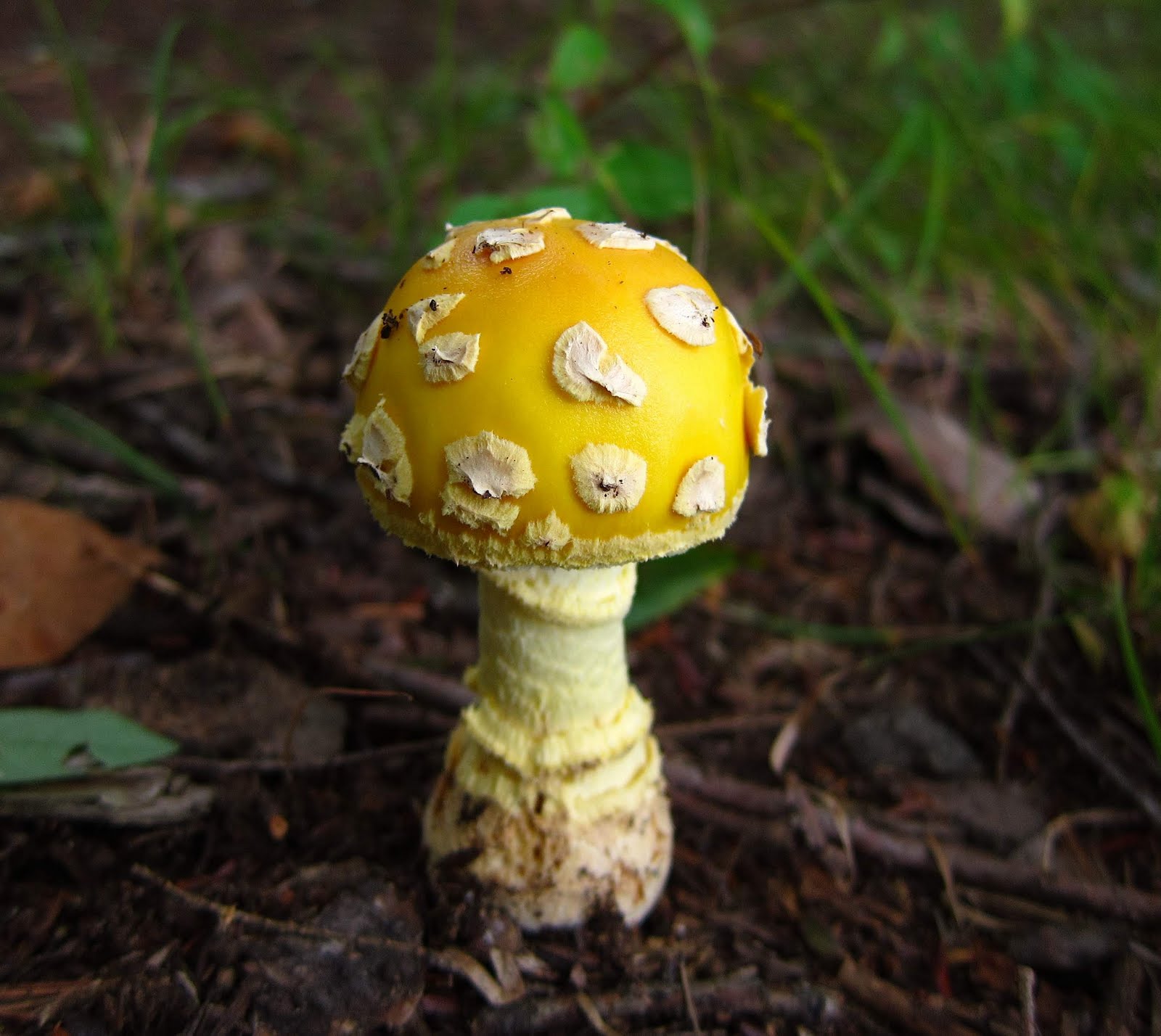
This, I believe, is a budding Amanita muscaria, also known as Fly Agaric.  This mushroom can also be red, but red or yellow, it looks like the classic mushroom of fairy tales.  (Update:  I heard from a friend suggesting this might rather be A. flavoconia because of its yellowish stalk.  The stalks of A. muscaria are snowy white, whether the caps are red or yellow.)


Here's a whole log-full of Scaly Pholiota (Pholiota squarrosa), whose toasty-brown scaly puffs remind me of coconut macaroons.


This photo doesn't show the snowy-white stalks that support these rich-red Russulas (Russula emetica) and are diagnostic for this species.  There's something tender about the way these two lean into each other, like a loving couple.


Could this be a Yellow Russula (Russula claroflava)?  I really don't know, because to properly identify a mushroom you have to dismantle it, noting how gills are attached and making spore prints and so forth.  But I didn't want to disassemble this lovely little tableau, with the glossy Pipsissewa leaves matching the shine of the mushroom cap, and the frosted pine cone arranged just so, as if some floral designer had put this scene together.


Here's another pretty arrangement, with a rusty-red, mohair-tufted Painted Bolete (Suillus spraguei) surrounded by a cluster of open beechnuts, their gaping husks reminding me of baby birds clamoring for food.


Of all the lovely fungi I saw today, this beautiful arrangement takes the prize.  Too bad those intensely orange gilled mushrooms (species unknown to me) can't be preserved, as the Turkey Tail (Trametes versicolor) shelf fungus can.  Wouldn't this make a spectacular Thanksgiving decoration?


Update:  Ed Miller's son Nick has suggested that these orange mushrooms are Mycena leailana, a species commonly found sprouting in abundant clusters from rotting logs.


This last mushroom, called Bitter Tooth (Sarcodon scabrosus) may not look as lovely as some, with its wrinkled scaly brown caps, but it sure is interesting.


This is a toothed mushroom, which means that it bears its spores on the outside of toothlike spines, rather than gills or pores. When I turned this mushroom over, I could see those hundreds of teeth under the cap, as well as the tell-tale greenish stalk, distinctive to this species.


According to George Barron, author of Mushrooms of Northeast North America, this toothed group contains  relatively few species of macrofungi, although there are a number of them that are widespread and easily recognized, including this Bitter Tooth.  As its name implies, this mushroom is bitter to the taste and therefore not palatable, while many other species of toothed fungi are actually quite good to eat. (Bear's Head, another toothed fungus that looks like a frozen waterfall, is one of my favorites.)


Here's a cutaway view of all those tiny teeth on the underside of Bitter Tooth's cap.


Tuesday, August 30, 2011

After Irene


We lost a few trees.  Parts of the county lost power when trees fell across lines.    That was about all the damage Hurricane Irene brought to us hereabouts.  Wow, what a bunch of hurricane hype, I was thinking.  But that was before I heard about what happened up north in the Adirondacks.   And down in the Catskills and along the Mohawk.  And over in the valley towns of Vermont.  Roads and bridges washed out, houses collapsed and swept away,  folks caught in their cars as the waters rose, a woman drowned where she'd taken refuge inside her creekside cottage.  I could hardly believe what I was hearing.  Aren't hurricanes supposed to lose power as they move this far inland?  Ah, but it wasn't the wind that did the damage, it was the rain.  And it was the mountains themselves.  The colder air at high elevations kept condensing all the moisture the far-flung arms of this enormous storm were gathering from the ocean far away.  The unrelenting rain poured down from the mountainsides and filled the valleys, more than all the creeks and streams and lakes and ponds and rivers could hold.  It will be a long, long time before these valleys recover.  If ever.  God help the folks who live there and have lost so much.

We had not heard of these disasters, Sue and I, when we met at Moreau Lake State Park on Monday morning, rejoicing in a cool clear day, with sparkling sunlight dancing on a world washed clean by rain and swept by the rushing winds of the day before.  We have both volunteered as trail stewards at the park, and we thought we should walk our trails to see if any downed trees needed to be cleared.  Well, apparently a downed tree somewhere had cut the power to the park headquarters, for the park was closed that day.


No problem for us.  We just drove around to Spier Falls Road and accessed the trails we were there to police from Mud Pond.  Walking the trails around the pond, we were surprised to find no trees down at all, just limbs and branches we could easily lift from the trails by hand.  Or kick away with our feet.  The pond lay sweetly calm under that innocent blue sky, stirred only by Whirligig bugs and herons' wingbeats and a pair of snorkeling beavers.  All was so serene, it was hard to imagine the driving wind and rain that had whipped it just the day before.


We next cut through the woods to Moreau Lake and walked around the back bay.  Here too, we found little wind damage, but only basking turtles and scurrying flocks of ducks that seemed annoyed by our arrival.  The park had been closed to all campers and boaters in advance of the hurricane, so all was very quiet.  No beer cans or candy wrappers or bait boxes, either.    This day turned out to be an easy one for trail stewarding.


On my way home from Moreau yesterday, I took Spier Falls Road along the Hudson.  The river was big and brown and full of flotsam and foam, but not over its banks at all, nor even near to being so.  Wondering how it looked upstream, I drove up to Lake Luzerne today to observe the Hudson where it falls through a gorge at Rockwell Falls.  Well, as this photo taken from the Hadley-Luzerne bridge shows, the river was rowdy and roiling, but still within its banks, even here where the Sacandaga pours its waters into the Hudson.


The stream that carries the overflow from Lake Luzerne to the Hudson was also rowdy and roiling, tumbling wildly over boulders on its steep descent from lake to river.  But again, well within its banks, except for a little sloshing around the base of this tree.  We were very, very lucky to have survived this hurricane with so little damage.


To read reports and see photos of the devastation caused by Irene not too many miles north of Lake Luzerne,  visit the Adirondack Almanack by clicking here.

*  *  *


Trailside Distractions


As I'm sure most of my regular readers know, neither Sue nor I can walk a trail without stopping again and again to marvel at what we see.  And take lots of photos.  In no particular order, here's a catalog of some of the fascinating things we found yesterday and today, including an incredible variety of colorful fungi stirred to fruiting by inches and inches of drenching rain.


Pinesap, in its beautiful red coloration


The bright pink pedicels of Elderberries


Nodding Ladies' Tresses (Spiranthes cernua), one of our latest orchids to bloom


A big, bright-yellow mushroom, possibly an Amanita, but I'm not sure


This, too, is likely an Amanita of some species, emerging from its cup.


I know that this is an Amanita, called American Caesar.  Most Amanitas are poisonous, but this one is supposed to be quite edible.  I would rather look at it than eat it.


I don't know the official name of this fungus, so I'll call it Fortune Cookie.  Or Brown Baby's Bottom.


This is an orange coral fungus, species unknown (to me).


Frost's Boletus, the richest, reddest mushroom I've ever seen.  Unmistakeable.  


The velvety red underside of the Frost's Boletus cap.  If you break the cap open, the inside flesh is butter yellow that quickly turns blue when exposed to air.


The fuzziest mushroom I've ever seen.  Shall I call it Teddy Bear Shelf Fungus?  
Or can somebody tell me its official name?


The bright orange color of this Lobster Mushroom is caused 
by a parasite embedded in the flesh of a Lactarius mushroom.


I suspect that the yellow color coating this mushroom is also some kind of parasite.


This Parasol Mushroom is the tallest-stalked member of the Lepiotas, and edible, too.


What a cute little pixie cap this is.  Pretty color, too. Wish I knew its name.


I believe this is a Gemmed Puffball, so-called for the pretty pattern of bumps that adorn it.


This is obviously a Boletus species with a distinctive-looking stalk, but nothing in my mushroom books is a match.  Update:  Ruth Schottman has suggested that this is Russell's Bolete (Boletellus russellii), and after checking my mushroom guides again, I tend to agree.  Thanks, Ruth.


Sue pointed out to me this iridescent bright-green fly, and we both tried to get photos that displayed its brilliant iridescence.  We were surprised that the fly didn't fly away when we poked our camera lenses at it.  Then we saw the Crab Spider beneath, perfectly camouflaged by the White Snakeroot blooms, clasping the fly in a death grip.  Aha, that's why it didn't move! But I still couldn't capture that brilliant green.