Wednesday, April 19, 2017

Hey Spring, Not So Fast!

 Hold on there, little Snow Trilliums!  I promised my friends in the Thursday Naturalists that they would see these tiny trilliums when we visit Orra Phelps Nature Preserve tomorrow.  But when I checked on them yesterday, I found they were fading fast.  That hot Easter Sunday didn't help, with temperatures nearing 90 degrees.  Let's hope we can at least see some remnants of their pretty white blooms.  For sure we will find the small leaves, like those in the photo below.  I had hoped these plants would still produce flowers, but it seems they won't, this year.


Oh well, at least I am sure we will see many other pretty flowers, such as this violet-studded mossy bank along the stream.


Here's a closer look at those lemon-yellow flowers of the Round-leaved Violets (Viola rotundifolia), one of our earliest violets to bloom around here.  This is a violet that seems to prefer mountainous habitats -- it truly thrives along Adirondack trails -- so I rarely find it on my ordinary excursions around the county.  How lucky we can find them in the Orra Phelps Nature Preserve.


Hundreds of Sessile-leaved Bellworts (Uvularia sessifolia) have sprung up along the creek, and I bet by Thursday this week they will be dangling their yellow flowers.


We might even see a Red Trillium (Trillium erectum) or two, opening their fat buds that already show just a bit of red.


For sure, we will find the Dutchman's Breeches (Dicentra cucullaria) dangling their little pantaloons.


I seldom find many Hepaticas blooming at Orra Phelps, but the few that grow there are definitely now in flower.


Also blooming now is Plantain-leaved Sedge (Carex plantaginea), with its tufts of staminate flowers that look like Rod Stewart's wild blond hairdo.  The pistillate flowers are those tiny white hairs on the stalk.


The Skunk Cabbage (Symplocarpus foetidus) bloomed long ago, its pollenaceous spadices sheltered within its Morocco-red bulbous spathes.  But now its big, showy, bright-green leaves have unfurled in the muddy swale where this plant thrives by the hundreds.


Striped Maple (Acer pensylvanicum) is a long way from blooming yet, but its velvety pink-tinged leaf buds, held as erect as candle flames, glow with a pearly light throughout the woods.


Friday, April 14, 2017

The Floral Fest Has Begun!

No stopping Spring now!  The floral floodgates have opened!  After weeks of searching and searching for even the tiniest sign of spring, a few days of warmth and rain and sun have spurred new growth everywhere I look.  With family soon arriving for the Easter weekend, I had just a few moments yesterday to run out for a quick circuit of the trails at Skidmore woods, and flowers were popping up here, there, and everywhere!

Those hepatica buds I found tightly furled just a few days ago?  Wide open now!  And in all of the lovely colors hepaticas come in.  I had barely stepped on the path from my car when I spied the first perfect little bouquet of them crowning a sun-warmed rock.


I love how many hepatica flowers seem to glow from within, as the color of each petal-like sepal pales to almost white toward the edge, creating a halo effect around each flower.  Just see how luminous these blooms appear, especially when arrayed against the background of their wintered-over dark leaves.


There are years I find only white hepatica flowers, or those tinged only slightly with other colors.  But on this day I found most of the lovely variety of colors hepatica can bloom in.  Here were some pretty pink ones.


There were others, in a soft lavender hue.


Of course, I found many in sparkling iridescent white.


And here was a tiny white one that was outlined in rosy pink.


This cluster of blooms was closer to blue than purple, and I love the mottled color of the plant's variegated leaves.  I noted that these leaves appeared rounder than the leaves of other hepaticas I found.  So this must be the Round-loved Hepatica (Anemone americana) instead of the Sharp-lobed species (Anemone acutiloba) that tends to dominate in Skidmore's lime-rich woods.


After finding so many hepaticas abundantly in bloom, I was encouraged to think that one of my favorite early violets might be blooming as well.  And so they were!  This is the white variety of the English Violet (Viola odorata var. alba), the very earliest of the violet species to bloom in Saratoga.  An introduced, rather than native species, I'm nevertheless delighted to find it here, since of all our violets, native or not, this is the most fragrant one of all.  Note the pure white petals of this violet, a feature that distinguishes this species from our native early white violets, which have dark purple veining on the lower petals.  The white variety of English Violet does have a purple spur, however, a bit of which can be seen on the left-hand flower in this photos.


The Skidmore campus is home to both varieties of English Violet, the pure white one shown above, and the deep purple one shown below.  Their populations are widely separated, making me wonder how they came to thrive here.  My guess is that they were planted long ago by the ladies who once lived in the Victorian mansions that used to stand where Skidmore College buildings do now.  Ladies of that era often carried little nosegays of these extremely fragrant flowers.  When I pick a tiny bouquet for myself, I can detect their delightful scent as soon as I enter the room where I have placed them.  In this photo, the hooked style that is one of the characteristics that distinguishes this species is plainly visible.


Here's another early bloomer I always find in the lime-rich Skidmore woods, the little yellow trumpets of Eastern Leatherwood (Dirca palustris).  Even though deer have been browsing many of the leatherwood shrubs that thrive here, new growth is providing us as many flowers as ever.


With all these other flowers blooming now, I hurried to where I know Blue Cohosh rises from the leaf litter, thinking it might be blooming already as well.  Well, there was no sign of its purple shoots, but the presence of this persistent blue seed, a remnant of last year's flowers,  reassured me that I was searching in the right spot.  I bet by this time next week, this early-blooming species of Blue Cohosh (Caulophyllum giganteum) will be up and unfurling both leaves and flowers at once.


Well, it wasn't only flowers that delighted me on my walk through the Skidmore woods.  The elegant Mourning Cloak butterflies were wafting through the warm air and spreading their brown-velvet wings to the sun.  This butterfly winters over as an adult, emerging from its bark or leaf-litter  shelters on the very first warm days of spring.


The Eastern Garter Snakes were also active on this day.  I saw several slithering through the leaves, but this one impressed me the most by its convoluted posture as it held perfectly still, hoping I wouldn't notice it against the roots of that tree.  I did see it, of course, and I also noticed the speckled leaves of Trout Lily poking up from the dead brown tree leaves.  Oho!  Another lovely spring flower about to arise!


Tuesday, April 11, 2017

Sudden Heat

Wow!  It is HOT today!  Up near 80, I would guess.  Yesterday was nearly as warm, too, which is why I could assure my friend Emily DeBolt that we would find Snow Trillium blooming at Orra Phelps Nature Preserve, if she wanted to meet me there on Monday.  Emily and her husband run the Fiddlehead Creek Farm and Native Plant Nursery in Fort Ann, so she has a deep and wide experience with most wildflowers, but she had never seen this miniature trillium in bloom.  One reason would be that it really doesn't grow around here (its native range being further south and west), and also, it would be easy to miss in the wild, the flowers are so very tiny.  But yesterday, we did find them! Thanks, of course, to naturalist Orra Phelps, who planted these on her property many years ago.


I have promised to bring my friends in the Thursday Naturalists here to see these trilliums on April 20,  ten days from when I took these photos, so I'm glad to see the weather should cool down a bit between now and then, hoping the flowers will not be faded.  I was also glad to see a number of tiny sprouts of new trillium plants coming up, so we should see even more flowers by next week.


Ten more days should also bring us many other wildflowers blooming at Orra Phelps.  We found dozens of Toothwort shoots scattered across the forest floor, most of them laden with buds.


These tight fuzzy buds of Hepatica should also be open by then.


This summer-like warmth has brought out more than the wildflowers, too.  Here was the first Garter Snake I have seen this year.


The Snapping Turtles are also awakened now from their winter slumber under the mud.  I found this big one in the middle of a country road today.  Since the turtle was heading toward a pond, I assumed this was a female returning to water after crossing the road to lay her eggs in the sun-warmed sand on the other side.  Fearful that she would be crushed by a speeding car, I stopped to help her safely toward the pond and out of the road.  I've been told one should always push a turtle in the direction it was heading.


Not such an easy thing to do, especially since she turned to defend herself and to challenge me.


Luckily, I still had in my car the tool I use to push snow off the roof, so I didn't have to risk injury from her strong jaws when she fiercely resisted my efforts to move her.  But I finally did succeed in getting her off the road and safely on the pond's bank.  Do you think this look she's giving me is one of gratitude?  Ha ha!  I really doubt it!


Monday, April 10, 2017

New Signs of Life at Ballston Creek

What an amazing transformation, over the past few weeks!  When I last visited the Ballston Creek Preserve toward the end of March, I had to wear snowshoes to make it through deep snow.  But today, with temperatures well into the 70s and accompanied by my good pal Sue, we walked through the woods in shirtsleeves, kicking up sun-warmed dry leaves as we went.


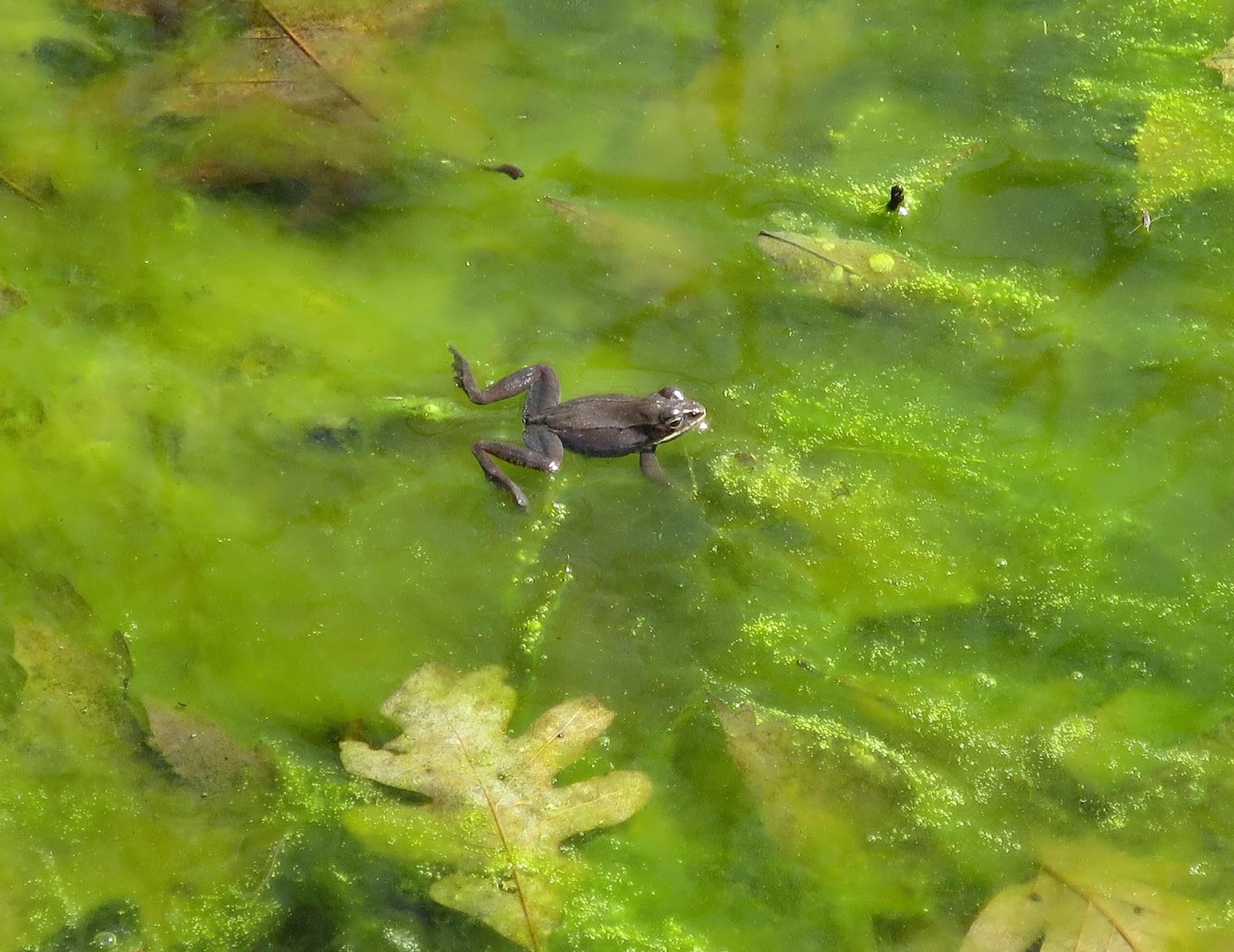
We were on our way to visit the heronry, which we'd heard was newly reoccupied by returning numbers of Great Blue Herons, but first, loud croaking from vernal pools drew us off the trail to investigate the source of that sound.  Sure enough, the Wood Frogs were roiling the pools with their amorous activities.  Of course, they fell silent as we approached, but we could still spy a few floating in the green water.


Last time I was here, these pools were silent and covered with snow-heaped ice.


Yes, indeed, the herons were back and busy at restoring the nests they had occupied last year. Solitary sentries guarded the few nests that remained after spring gales had torn many other nests from surrounding snags.  There were no signs at all of the osprey and owl pairs that once shared this nesting site, and we wondered if other herons would soon return to rebuild the nests that had been destroyed.


Here was another sign of spring, one I found just yesterday in a most unexpected site:  masses of the tiny Mustard-family plant called Draba verna were carpeting a strip of poor soil along the perimeter road of the Wilton Mall.  The flowers are way too tiny to be noticed by anyone but a wildflower-obsessed nature nut like me, desperately searching for the smallest signs that the winter is over and done.


Whenever I find this miniature early bloomer, I recall the naturalist Aldo Leopold's wonderful words in praise of this little no-account weed in A Sand County Almanac:

"Within a few weeks now Draba, the smallest flower that blows, will sprinkle every sandy place with small blooms.  He who hopes for spring with upturned eye never sees so small a thing as Draba.  He who despairs of spring with downcast eye steps on it, unknowing.  He who searches for spring with his knees in the mud finds it, in abundance. . . .

"Draba plucks no heartstrings.  Its perfume, if there is any, is lost in the gusty winds.  Its color is plain white.  Its leaves wear a sensible woolly coat.  Nothing eats it; it is too small.  No poets sing of it.  Some botanist once gave it a Latin name, and then forgot it.  Altogether it is of no importance -- just a small creature that does a small job quickly and well." 

Thursday, April 6, 2017

What A Difference a Week of Rain Makes!

Rain, rain, and MORE rain!  We've had so much rain the last few days, the creeks are starting to flood.  But one good thing that rain has done, is to melt all the snow.  Just one week ago, the woods at Orra Phelps Nature Preserve in Wilton still lay deep in snow and ice.  The trail was so sloppy and slippery I turned around and went home.


But see what the same trail looked like today -- ALL that snow is GONE!  Even though the day was rainy, I still found this trail quite inviting, and I started down toward the creek that runs through the heart of this lovely preserve.


Here's what that creek looked like one week ago today:  ice-covered and heaped with snow.


What a difference a week of rain makes!


Another view of that same creek from one week ago, still locked in wintry ice:


Same part of that creek today, rushing and tumbling over the rocks, singing a song of spring:


I had come to Orra Phelps last week, wondering if -- hope beyond hope! -- the Snow Trillium might have been blooming.  They're not named Snow Trillium for nothing, for yes, some years I have found them in bloom while snow still lay in some shaded hollows.  But last week's deep snow cover was more than even they could cope with.  Today, I rather doubted they'd yet be up, but I just wanted to see if the ground where they grow was bare of snow.  So wow!  Was I surprised! These little guys sure don't waste any time.  Just buds, as yet, but this coming weekend's sunny warmth will coax them to open wide.  But they won't grow any bigger.  What a miniature masterpiece of a spring wildflower!


By now, the rain was coming down hard.  Rather than hang around in a soggy woods, I got in my car and drove on over to the Corinth Mountain Road, wondering if the pretty little waterfall that plunges through rocky boulders close to the road was full of rowdy water.  Yes, indeed it was.


Continuing on to Spier Falls Road, I drove along the banks of the Hudson River, noting how the river was filled to its brim with snowmelt and rainwater.  Just before I reached the Spier Falls Dam, I pulled over, waited for the rain to stop coming down in torrents, and then got out to admire this long lively waterfall plunging down the mountain.  Another gift from our days of rain.


Tuesday, April 4, 2017

Something Odd in the Hazelnuts

We had a few warm sunny days -- warm enough to spur the Coltsfoot into blooming, anyway (see my previous post).  So although our weather has once again turned dark and rainy, I was hoping I might find American Hazelnuts in bloom, since I often find their tiny red female flowers well before finding Coltsfoot. So I donned my raingear today and headed over to Mud Pond at Moreau, where hazelnut shrubs grow abundantly in the powerline that runs along the north shore of the pond.


The first thing I noticed was Wow! Mud Pond had WATER in it! A couple of droughty years had deprived the pond of its usual rainfall and snowmelt until it became more like a muddy marsh than a pond.  But today I could see rain-dappled water filling the pond from shore to shore under a leaden sky.  It was still lower than it should be, but today the pond was liquid enough for a pair of Hooded Mergansers to be doing their courting dance out on its gleaming water.

The second thing I noticed were the hazelnut shrubs festooned with dangling male catkins.  These catkins have been present on the shrubs throughout the winter, but only in the past week or so have they lengthened to the point where they actually sway in the breeze.  I flicked a few with my fingers, but I didn't see clouds of pollen releasing yet.   I did not know if this was because they were wet from the rain or if they were not yet ripe.  If the males were not yet shedding pollen, I doubted that I would find any female flowers opening to receive it.  But I searched through the twigs anyway, hoping to find some tiny spots of bright red.


Ooh, there's something red in this shrub!  Nearsighted as I am, I took off my glasses to peer into the branches, where I discovered that the red stuff certainly wasn't a flower.  Yikes!  What IS this gunky coating on the twigs?


Again and again, in dozens of shrubs in a limited area of the powerline clearcut, I found globs of this reddish stuff, probably a fungus, coating the hazelnut twigs. Notably, it always occurred where twigs came in contact with each other, with the fungus gluing the twigs fast together.


I also noticed a whitish coating that ran along the same twigs.  A different fungus or another form of the same?  Is this a benign concomitant that will do the shrubs no harm? Or will it spread to ultimately impair the shrubs' ability to thrive?  I really don't know!  But I do know some mycologists I might ask.  I'll be back to post an update if and when I learn what this is.

UPDATE:  Well, my go-to expert, mycology professor Kathie Hodge of Cornell University, told me she was "darned if she knew" what this was, but she suggested that it might be "a wounding response where the twigs rubbed" together.  Could it be a substance produced by the hazelnut shrub itself, like our bodies produce when we grow a scab?  The mystery remains!

SECOND UPDATE: I took a specimen of these glued twigs over to the Moreau Lake State Park Office and charged Assistant Environmental Educator Maranda Welch with researching what this stuff could possibly be.  She promptly came up with Hymenochaete corrugata (Glue Crust Fungus) as a possibility, and she showed me the Wikipedia link where she learned something about it. We're still not sure (the Google images don't look quite the same), but Wikipedia did comment that one of the primary hosts for this fungus is hazel, and that it essentially glued dead twigs to living ones to prevent the dead ones from falling to the ground where they could be decomposed by rival fungi. Sure sounds like the same behavior, even if it's not exactly that fungus.