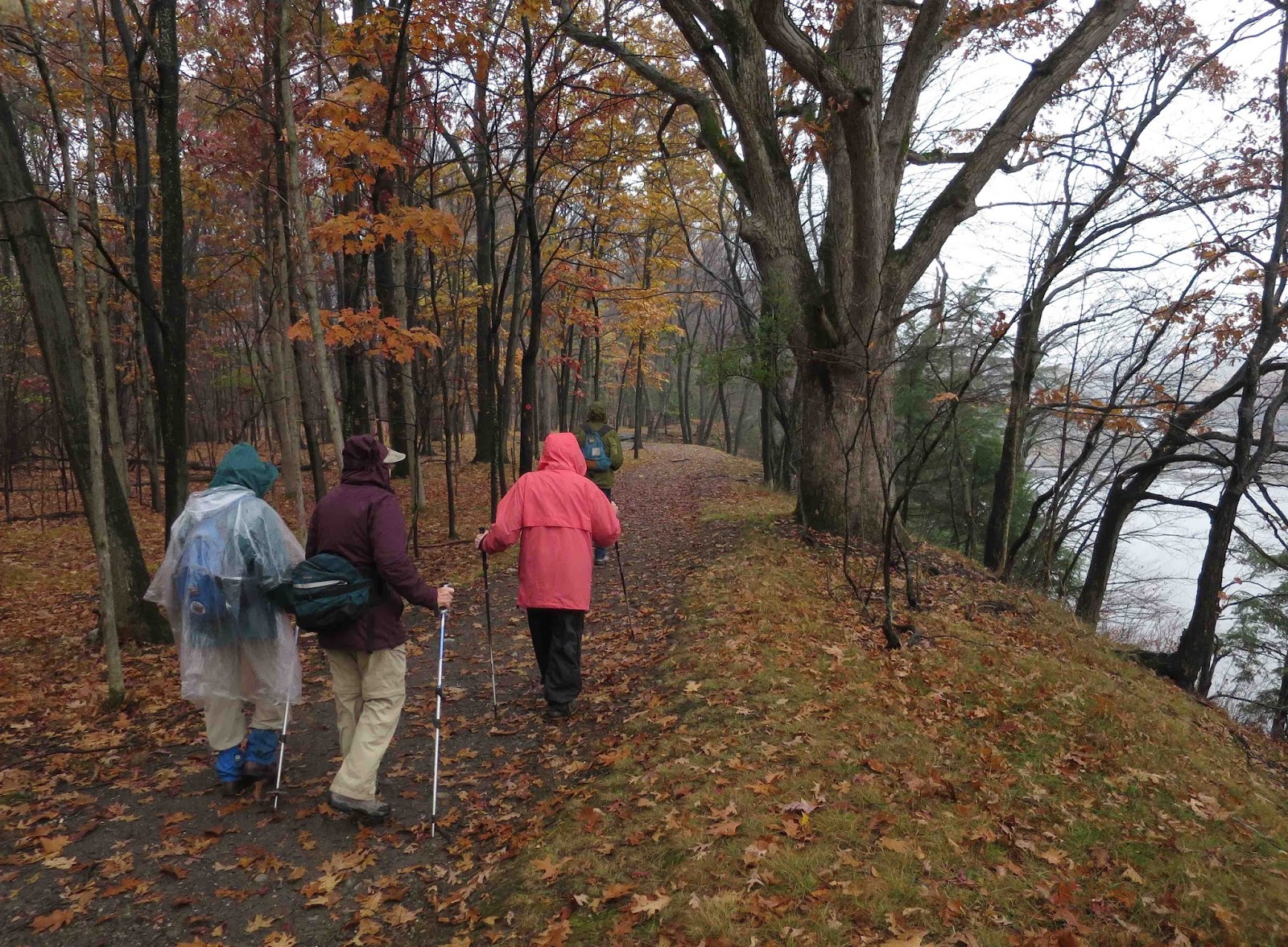
Despite my assertion that the focus of this blog is Saratoga County, I rarely get down to my home county's southern border, which is defined by the Mohawk River. So I was quite happy this week when my friends in the Thursday Naturalists decided to walk the trails of Peebles Island near Waterford, a large island that lies at the intersection of the Mohawk and Hudson Rivers.
Map provided by Google Maps
According to a brochure provided by the visitors' center of what is now Peebles Island State Park, this island was created thousands of year ago when glaciers receded from the Hudson Valley and the Mohawk River cut channels into the bedrock as it flowed into the Hudson, creating steep-banked islands as well as alluvial flats. Both Native Americans and early colonial European settlers used these islands for agriculture and grazing cattle.
Later, during the American Revolution, American forces built fortifications on Peebles Island to defend against a British invasion, and remains of these earthen fortifications can still be seen.
During much of the first three-quarters of the Twentieth Century, Peebles Island was owned by a Troy-based manufacturer of men's shirts, which operated a fabric-bleaching plant there, where the process of "Sanforizing" (a process of pre-shrinking cotton fabrics) was invented. Since the early 1970s, the New York State Office of Parks, Recreation and Historic Preservation has owned all of Peebles Island, and the former industrial buildings now house the Peebles Island Resource Center, which is home to historic preservation, conservation, and heritage programs.
Obviously, Peebles Island is certainly rich in cultural and commercial history, but my friends and I were more interested in the natural history of the island this day as we set off to explore the nearly two-mile trail that follows the island's perimeter. It wasn't the very nicest of days for a nature walk, with a slow steady rainfall persisting for most of our visit, but we simply donned our rain gear and set off to enjoy the fabulous views of the Mohawk from the island's steep shale cliffs.
Unlike on our usual walks, we did very little botanizing, aside from noting the preponderance of oaks in the trailside woods and marveling at the tenacity of the trees as they clung to the cliffs. Mostly, we just delighted in each other's companionship and enjoyed the mist-veiled views. Here are a few of those views.
\
For more than thirty years I've been wandering the woods and waterways of Saratoga County, New York, and regions nearby, looking closely, listening carefully, and recording what I experience. We are blessed in this region with an amazing amount of wilderness right at hand. With this blog I share my year-round adventures here, seeking out what wonders await in my own Madagascar close to home.
Friday, November 4, 2016
Wednesday, November 2, 2016
Going for the Green
Summer's flowers have faded, and autumn's leaves are falling fast. One might think there were not many colorful things to find in the woods these gray November days. And one would be right -- unless the sought-after color was GREEN! Yes, indeed, the woods are still full of lots of green plants, and those are what my friend Nancy Slack and I set out to find this week as we walked around Mud Pond at Moreau Lake State Park.
Nancy, a professor of ecology at Russell Sage College and a well-known bryologist, has offered a nature walk called "What's Green in November" to be held November 15 as a fund-raising activity for the nature-education organization Ecological Clearing House of Schenectady (ECOS). So she and I set out around Mud Pond to scout the trail and see what we could find.
If either of us worried that we might not find enough to hold a group's interest, those fears were soon allayed as our list of finds filled up very fast. We found more than 50 green items in all, beginning with a wide array of mosses, lichens, and club mosses all growing within the first few yards of where we set out.
Here's just a sampling of what we found, beginning with a group of mosses.
MOSSES
Common Haircap Moss (Polytrichum commune)
Broom Moss (Dicranum scoparium)
Green Velvet Moss (Dicranum montanum)
A species of Bryum moss
UPDATE: I'm wondering if this moss, with its sharply pointed leaves and touches of red at the center could be the one called Marsh Cardinal Moss (Ptychostomum pseudotriquetrum), which I believe has an alternative name of Bryum pseudotriquetrum.
Big Redstem Moss (Pleurozium schreberi)
Tree Moss (Climacium americanum)
Brocade Moss (Hypnum imponens)
Plus at least half a dozen other mosses I did not get clear photos of.
LICHENS
We also found lots of fascinating lichens, and again, here are just some of what we found. Very few have common names.
Tiny multi-tiered trumpets called Cladonia verticillata
British Soldiers (Cladonia cristatella)
Green Shield Lichen (Parmelia caperata)
Another Cladonia lichen, but one neither Nancy nor I had ever seen, nor do we know the name of it as yet.
CLUB MOSSES
Three of our most common Club Mosses occurred throughout the woods, in both open and shaded areas:
Running Ground Pine (Lycopodium clavatum)
Tree Club Moss (Dendrolycopodium obscurum)
Fan Club Moss (Dyphasiastrum digitatum)
As we continued our walk through the forest, we were delighted to find a few trees still holding their beautifully colored leaves.
SHRUBS
Along the wooded trail, we noted the green twigs of Lowbush Blueberries, one of the "wintergreens" I hadn't thought to include until we saw them. Their chlorophyll will continue to provide nourishment for the shrubs via photosynthesis throughout the winter.
Neither of us could imagine why it would benefit many Shadblow shrubs to produce baby leaves this late in autumn. Perhaps they are trying to grab the last bit of sunlight they can, as the canopy opens up. This is a phenomenon I notice every year.
FLOWERING PLANTS
Two of our native orchids, the Goodyeras, produce rosettes of beautifully patterned green leaves that persist through the winter. We had to brush aside a covering of Pitch Pine needles to find these leaves of Checkered Rattlesnake Plantain (Goodyera tesselata).
And here are the gorgeous leaves of Downy Rattlesnake Plantain (Goodyera pubescens). Nancy and I failed to find them on our walk this week, but I know where they grow, so I will be sure to locate them by the time we lead our ECOS group.
Partridgeberry (Mitchella repens)
Wintergreen (Gaultheria procumbens)
Pipsissewa (Chimaphila umbellata)
Spotted Wintergreen (Chimaphila maculata)
Fringed Polygala (Polygala paucifolia)
When we rounded the south end of the pond, I chose to lead us below the steep bank, rather than follow the upland trail through the woods, because I knew of the abundance of evergreen plants we would find on this bank or in the mud along the shore.
I have never seen such an abundance of Trailing Arbutus (Epigaea repens) as grows on this north-facing bank. Its leaves will winter over under the snow, ready to produce its fragrant flowers very early in spring. A close look reveals that the flower buds are already present.
Other evergreen plants that share this steep bank with the Trailing Arbutus include these furry basal rosettes. I haven't decided if these are a species of Hawkweed (Hieracium) or Pussytoes (Antennaria), so I will have to return next summer to clinch the ID.
FERNS
This steep shady bank is home to many ferns, including several that will hold their green fronds all winter. The first one we saw was this Christmas Fern (Polystichum acrostichoides), with its individual pinnae shaped like miniature Christmas stockings.
Another evergreen fern is Marginal Wood Fern (Dryopteris marginalis).
SEDGES
We found a number of evergreen sedges, both in the muddy shore of the pond and also along a streambed that meandered through the woods. This one is called Plantain-leaved Sedge (Carex plantagenea), or sometimes "Seersucker Sedge" because of its crinkled leaves.
LIVERWORTS
When we turned from exploring the plants that grew on the steep bank, we noticed a patch of vivid green plants that stood out from all the others covering the muddy flats at the edge of the pond.
A closer look revealed masses of the liverwort sometimes called Fringed Heartwort (Ricciocarpus natans). This liverwort normally floats on the water, but Mud Pond is so low now, due to a prolonged shortage of rainfall and snowmelt, that the liverwort was stranded on the mud.
We found another liverwort tucked up into the bank, this one a lacy-looking one with shiny leaves called Featherwort (Plagiochila porelloides).
Variable-leaved Logwort (Lophocolea heterophylla) lives up to its common name by growing on rotting logs, and that's just where we found it.
Another liverwort that grows on rotting logs is Lovely Fuzzwort (Ptillidium pulcherrimum). Who wouldn't love to meet a liverwort with a name like that?
Obviously, this is only a sampling of the more-than-50 green (or greenish) plants we found, so I hope the folks who come on our walk will feel they are getting their money's worth. Nancy and I sure had lots of fun on our scouting trip. And we even found a few brightly colored items:
The berry-less pedicels of White Baneberry (Actaea pachypoda)
A Ladybug resting on the flowers of Witch Hazel (Hamamelis virginiana)
Nancy, a professor of ecology at Russell Sage College and a well-known bryologist, has offered a nature walk called "What's Green in November" to be held November 15 as a fund-raising activity for the nature-education organization Ecological Clearing House of Schenectady (ECOS). So she and I set out around Mud Pond to scout the trail and see what we could find.
If either of us worried that we might not find enough to hold a group's interest, those fears were soon allayed as our list of finds filled up very fast. We found more than 50 green items in all, beginning with a wide array of mosses, lichens, and club mosses all growing within the first few yards of where we set out.
Here's just a sampling of what we found, beginning with a group of mosses.
MOSSES
Common Haircap Moss (Polytrichum commune)
Broom Moss (Dicranum scoparium)
Green Velvet Moss (Dicranum montanum)
A species of Bryum moss
Big Redstem Moss (Pleurozium schreberi)
Tree Moss (Climacium americanum)
Brocade Moss (Hypnum imponens)
Plus at least half a dozen other mosses I did not get clear photos of.
LICHENS
We also found lots of fascinating lichens, and again, here are just some of what we found. Very few have common names.
Tiny multi-tiered trumpets called Cladonia verticillata
British Soldiers (Cladonia cristatella)
Green Shield Lichen (Parmelia caperata)
Another Cladonia lichen, but one neither Nancy nor I had ever seen, nor do we know the name of it as yet.
CLUB MOSSES
Three of our most common Club Mosses occurred throughout the woods, in both open and shaded areas:
Running Ground Pine (Lycopodium clavatum)
Tree Club Moss (Dendrolycopodium obscurum)
As we continued our walk through the forest, we were delighted to find a few trees still holding their beautifully colored leaves.
SHRUBS
Along the wooded trail, we noted the green twigs of Lowbush Blueberries, one of the "wintergreens" I hadn't thought to include until we saw them. Their chlorophyll will continue to provide nourishment for the shrubs via photosynthesis throughout the winter.
Neither of us could imagine why it would benefit many Shadblow shrubs to produce baby leaves this late in autumn. Perhaps they are trying to grab the last bit of sunlight they can, as the canopy opens up. This is a phenomenon I notice every year.
FLOWERING PLANTS
Two of our native orchids, the Goodyeras, produce rosettes of beautifully patterned green leaves that persist through the winter. We had to brush aside a covering of Pitch Pine needles to find these leaves of Checkered Rattlesnake Plantain (Goodyera tesselata).
And here are the gorgeous leaves of Downy Rattlesnake Plantain (Goodyera pubescens). Nancy and I failed to find them on our walk this week, but I know where they grow, so I will be sure to locate them by the time we lead our ECOS group.
Partridgeberry (Mitchella repens)
Wintergreen (Gaultheria procumbens)
Pipsissewa (Chimaphila umbellata)
Spotted Wintergreen (Chimaphila maculata)
Fringed Polygala (Polygala paucifolia)
When we rounded the south end of the pond, I chose to lead us below the steep bank, rather than follow the upland trail through the woods, because I knew of the abundance of evergreen plants we would find on this bank or in the mud along the shore.
I have never seen such an abundance of Trailing Arbutus (Epigaea repens) as grows on this north-facing bank. Its leaves will winter over under the snow, ready to produce its fragrant flowers very early in spring. A close look reveals that the flower buds are already present.
Other evergreen plants that share this steep bank with the Trailing Arbutus include these furry basal rosettes. I haven't decided if these are a species of Hawkweed (Hieracium) or Pussytoes (Antennaria), so I will have to return next summer to clinch the ID.
FERNS
This steep shady bank is home to many ferns, including several that will hold their green fronds all winter. The first one we saw was this Christmas Fern (Polystichum acrostichoides), with its individual pinnae shaped like miniature Christmas stockings.
Another evergreen fern is Marginal Wood Fern (Dryopteris marginalis).
SEDGES
We found a number of evergreen sedges, both in the muddy shore of the pond and also along a streambed that meandered through the woods. This one is called Plantain-leaved Sedge (Carex plantagenea), or sometimes "Seersucker Sedge" because of its crinkled leaves.
LIVERWORTS
A closer look revealed masses of the liverwort sometimes called Fringed Heartwort (Ricciocarpus natans). This liverwort normally floats on the water, but Mud Pond is so low now, due to a prolonged shortage of rainfall and snowmelt, that the liverwort was stranded on the mud.
We found another liverwort tucked up into the bank, this one a lacy-looking one with shiny leaves called Featherwort (Plagiochila porelloides).
Variable-leaved Logwort (Lophocolea heterophylla) lives up to its common name by growing on rotting logs, and that's just where we found it.
Another liverwort that grows on rotting logs is Lovely Fuzzwort (Ptillidium pulcherrimum). Who wouldn't love to meet a liverwort with a name like that?
Obviously, this is only a sampling of the more-than-50 green (or greenish) plants we found, so I hope the folks who come on our walk will feel they are getting their money's worth. Nancy and I sure had lots of fun on our scouting trip. And we even found a few brightly colored items:
The berry-less pedicels of White Baneberry (Actaea pachypoda)
A Ladybug resting on the flowers of Witch Hazel (Hamamelis virginiana)
Monday, October 31, 2016
BOO! It's Halloween, Time to Revisit Nature's Nastier Side
Ooh, it's Halloween! What better time to visit a bit of Nature's nastier aspect? I've been waxing a bit Hallmarky of late about Nature's beauty, but lest we forget about her shadow side, I'm reposting my blog from a year ago to remind us that Nature can be just as creepy as she is wondrous and amazing.
I found this Goldenrod Ball Gall yesterday. The neat little hole in it indicates the larva inside was probably gobbled down by a downy woodpecker. (No, it's not the gall resident's exit hole; that would be much tinier.) Chickadees also rifle these galls, but make a real mess of them when they do. And squirrels cut them off and carry them away. I learned this from John Eastman's Book of Field and Roadside, which I turned to again to learn more about this gall. And its parasite. (Be warned!)
While I'm at it, here are a few more creepy images from my archives:
I found this Goldenrod Ball Gall yesterday. The neat little hole in it indicates the larva inside was probably gobbled down by a downy woodpecker. (No, it's not the gall resident's exit hole; that would be much tinier.) Chickadees also rifle these galls, but make a real mess of them when they do. And squirrels cut them off and carry them away. I learned this from John Eastman's Book of Field and Roadside, which I turned to again to learn more about this gall. And its parasite. (Be warned!)
The gall is caused by a fruitfly, Eurosta solidaginis, which lays a single egg on the stem of the goldenrod (almost exclusively tall goldenrod, Solidago altissima) just before the plant's leaves open. When the larva hatches, it eats its way inside the stem. Nobody seems to know why the plant reacts the way it does, but a swelling ball of solid tissue forms around where the larva is feeding. Come fall, the larva chews its way outward through this tissue, making an exit tunnel but leaving the door unopened. It doesn't leave but retreats to the center, where it sleeps through winter, snug in its now-dead gall, pupating only a few weeks before spring arrives. Spring comes, the adult emerges inside the gall, crawls up the tunnel it bored last fall, and finds the door still closed. Now, the adult fly doesn't have the chewing mouthparts its larva had, so how will it get outside? Undaunted, it clamps itself to the door, pumps bodily fluids into a special part of its head, and this swelled head bursts the gall's external membrane. The adult fly then pulls itself out. Cool!
But that's only if all goes well. And all will go terribly wrong if its parasite Eurytoma obtusiventris comes along. This tiny wasp finds the fruitfly egg even before the fly hatches and starts forming its gall. The wasp sticks its ovipositor into the fly egg and lays an even tinier wasp egg there. The wasp larva bores into the fly larva and lurks there unnoticed until the latter is full grown. It then proceeds to devour its host from the inside out. Eewww! (Don't say I didn't warn you.)
Actually, I think it's pretty neat how all god's chillun get fed. In nature, that is. I don't think our factory farms that knowingly torture livestock are fine at all.
Dead Man's Fingers (Xylaria polymorpha), a fungus (or is Mickey Mouse reaching up from his grave?)
Jelly Leaf fungus (Tremella foliacia), oozing a blood-red fluid all over my hand. (Actually, this one is edible, and not just by Zombies!)
And how could I forget Witch's Brooms on Halloween? These tangles of twigs are caused by some kind of irritant to the branches of woody trees and shrubs. This was one I found in a Shadblow tree, a frequent host for Witch's Brooms.
Oh wait! I thought of some MORE gory stuff! Here's some Oozy Orange Slime that looks like some tree stumps have vomited. It's caused by a yeast that feeds on the sugars in tree sap, and you can read all about it on the Cornell Mushroom Blog.
Subscribe to:
Posts (Atom)