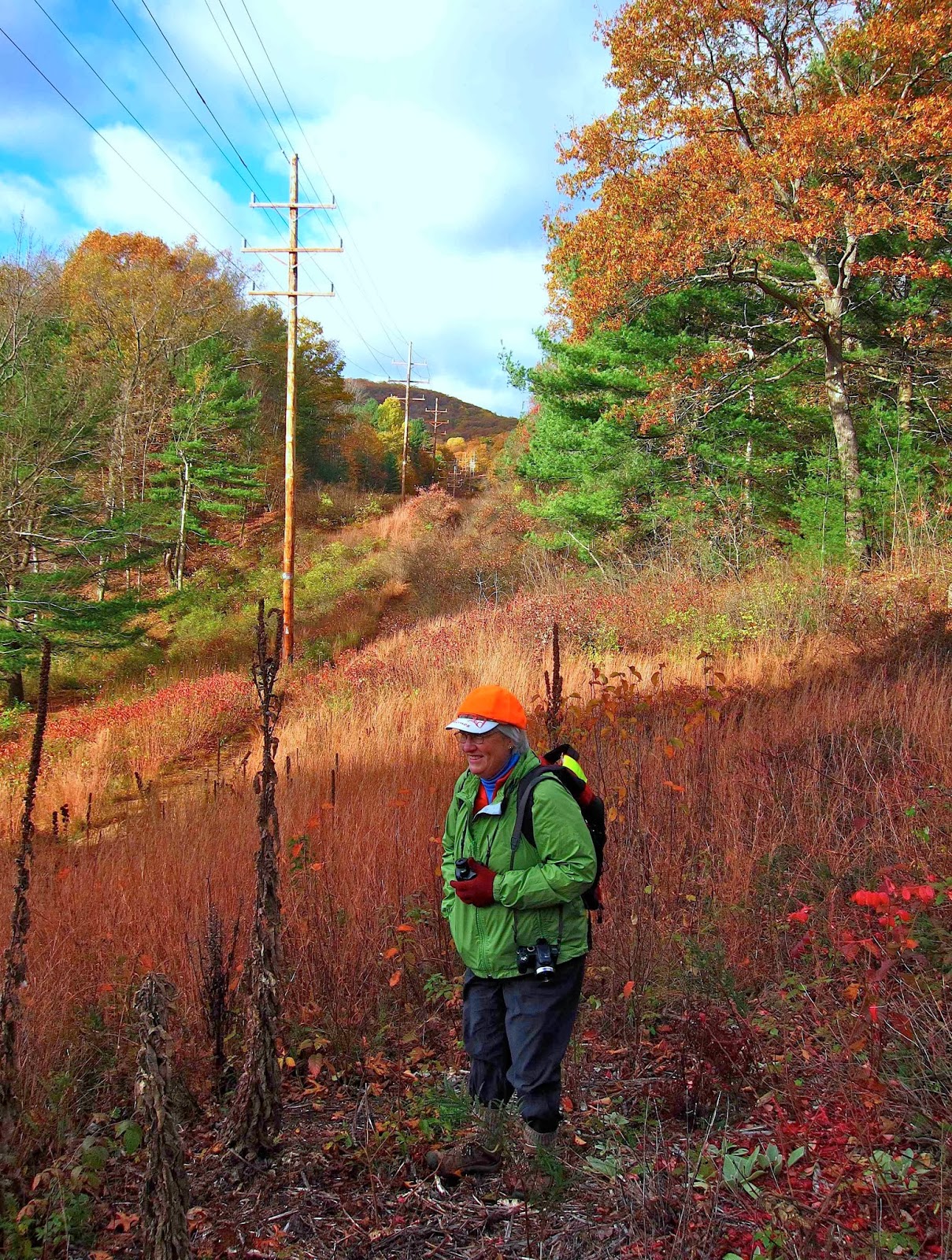
For more than thirty years I've been wandering the woods and waterways of Saratoga County, New York, and regions nearby, looking closely, listening carefully, and recording what I experience. We are blessed in this region with an amazing amount of wilderness right at hand. With this blog I share my year-round adventures here, seeking out what wonders await in my own Madagascar close to home.
Monday, November 4, 2013
The "Undead" in the Autumn Woods
While exploring the Woodcock Preserve in Clifton Park last week with my friends in the Thursday Naturalists, we kept seeing these Quaking Aspen leaves with distinctive green patches all over the forest floor. Once our attention was drawn to this phenomenon, we noticed it on almost every single shed Quaking Aspen leaf we saw. We also noticed a small brown spot at the base of each green patch. What on earth is happening here?
Well, one of the great pleasures of walking with these extremely knowledgeable folks is that someone is almost always certain to know the answer to every nature question. I can't remember now exactly who it was that gave us the answer, but the gist of it was something like this: there's a tiny critter inhabiting the leaf that manages to prevent the chlorophyll from withdrawing from parts of the leaf, thus keeping the leaf tissue alive for the critter to continue feeding on it. Now, isn't that the most amazing thing?
Our friend wasn't quite sure what the mechanism was for achieving this effect, so when I got home I searched around on the internet and found the answer here, where a fellow named Bryan Pfeiffer explains what causes these "zombie undead aspen leaves." If you go to his site you will see a photo of the miniscule moth caterpillar that resides in a tiny pocket of tissue at the base of the green patch, secreting a substance that prevents the leaf tissue from dying. Pfeiffer also has a photo of the adult moth, a creature so small and well camouflaged we are never likely to see it out in the woods. But we sure are likely to see the results of its larva at work, as any walk in an aspen woods this week would certainly prove. "Zombie undead leaves." That's a good one. Especially considering we found them on Halloween!
We encountered another organism at the Woodcock Preserve that could also fit the category "Undead," on a twig that was covered with the white fluted cups of the Split-gill Fungus (Schizophyllum commune). Aside from being a ghostly white, this fungus has another "spooky" characteristic, that of being able to dry up completely, to the point where it's only a shriveled husk, and then rehydrate with every subsequent rainfall to keep functioning sexually again and again.
According to mycologists, this fungus has a number of amazing properties, including the fact that it has not just two, but at least 28,000 different sexes. Don't ask ME how that works, but you could go to this website here to have a fellow named Tom Volk describe the complex process.
Sunday, November 3, 2013
One Last Paddle
A week of rather unpleasant weather got me thinking it might be time to stow my boat away for the winter. But then Saturday dawned calm and balmy, perfect for one last paddle on my favorite stretch of the Hudson River below the Spier Falls Dam at Moreau.
Although the fall foliage is way past peak by now, it's surprising how vividly colored the trees -- mostly oaks and beeches -- appear along the riverbaks.
The banks themselves were aflame with the brilliant color of shrubs like Meadowsweet and Black Huckleberry.
Looking up through pure stands of American Beech was like looking into a flaming fire.
I was startled to find these twigs that were colored so vividly red. At first I thought they might be Striped Maple, but then I noticed the peculiar shape of the buds, which I once heard described as looking like "mice in motorcycle helmets." Just as with the shape of American Basswood leaves, basswood buds share a comparable asymmetry.
The presence of these distinctive bracts confirmed the identification as American Basswood.
The American Hornbeam, too, bears fruits with distinctively shaped bracts, like a set of paired wings surrounding each pair of seeds.
I have never seen so few Witch Hazel flowers as I have this fall, nor so many of the chubby seed pods. All the Witch Hazel shrubs I found today had branches thickly weighed down with pods that had already discharged their seeds. The pods that we find this fall were formed from flowers that bloomed last year. The genus name for Witch Hazel -- Hamamelis -- actually means "together with fruit," referring to the simultaneous occurrence of flowers with the maturing fruit of the previous year.
After paddling downstream for an hour or so, I returned upstream to explore the little islands that lie just off the boat launch site where I'd put my canoe in the river. I noticed the water level was quite high, flooding the low-lying areas where I usually find many interesting plants. I wasn't going to find them today.
I beached my canoe on the middle island and walked about beneath the trees. A bright patch of Wintergreen with fat red berries carpeted the mossy ground.
The leaves of Black Huckleberry seemed extra brilliant out here on the island.
Tucked in among tumbled boulders, the bright pink flowers of Herb Robert continue to bloom, despite recent frosts that have killed most other flowers.
As the afternoon wore on, a brisk wind arose and clouds began to thicken, threatening rain. It was time to bid farewell to my beautiful Hudson for another year. How lucky I am to have such a splendid stretch of river to paddle, where forested mountains drop right down to the water, and with vistas unbroken by the presence of houses or docks or other signs of human habitation. I'll return to hike these mountains and walk these shores throughout the winter, looking forward to when the ice recedes and I once again slip my boat into these lovely waters.
Driving home over Mount McGregor, the sight of this amazing abundance of Winterberry shrubs had me pulling over to the side of the road to feast my eyes on their splendor. Wow! A year ago, I searched and searched and could not find any Winterberries. The shrubs sure are making up for lost time this year!
Although the fall foliage is way past peak by now, it's surprising how vividly colored the trees -- mostly oaks and beeches -- appear along the riverbaks.
The banks themselves were aflame with the brilliant color of shrubs like Meadowsweet and Black Huckleberry.
Looking up through pure stands of American Beech was like looking into a flaming fire.
I was startled to find these twigs that were colored so vividly red. At first I thought they might be Striped Maple, but then I noticed the peculiar shape of the buds, which I once heard described as looking like "mice in motorcycle helmets." Just as with the shape of American Basswood leaves, basswood buds share a comparable asymmetry.
The presence of these distinctive bracts confirmed the identification as American Basswood.
The American Hornbeam, too, bears fruits with distinctively shaped bracts, like a set of paired wings surrounding each pair of seeds.
I have never seen so few Witch Hazel flowers as I have this fall, nor so many of the chubby seed pods. All the Witch Hazel shrubs I found today had branches thickly weighed down with pods that had already discharged their seeds. The pods that we find this fall were formed from flowers that bloomed last year. The genus name for Witch Hazel -- Hamamelis -- actually means "together with fruit," referring to the simultaneous occurrence of flowers with the maturing fruit of the previous year.
After paddling downstream for an hour or so, I returned upstream to explore the little islands that lie just off the boat launch site where I'd put my canoe in the river. I noticed the water level was quite high, flooding the low-lying areas where I usually find many interesting plants. I wasn't going to find them today.
I beached my canoe on the middle island and walked about beneath the trees. A bright patch of Wintergreen with fat red berries carpeted the mossy ground.
The leaves of Black Huckleberry seemed extra brilliant out here on the island.
Tucked in among tumbled boulders, the bright pink flowers of Herb Robert continue to bloom, despite recent frosts that have killed most other flowers.
As the afternoon wore on, a brisk wind arose and clouds began to thicken, threatening rain. It was time to bid farewell to my beautiful Hudson for another year. How lucky I am to have such a splendid stretch of river to paddle, where forested mountains drop right down to the water, and with vistas unbroken by the presence of houses or docks or other signs of human habitation. I'll return to hike these mountains and walk these shores throughout the winter, looking forward to when the ice recedes and I once again slip my boat into these lovely waters.
Driving home over Mount McGregor, the sight of this amazing abundance of Winterberry shrubs had me pulling over to the side of the road to feast my eyes on their splendor. Wow! A year ago, I searched and searched and could not find any Winterberries. The shrubs sure are making up for lost time this year!
Friday, November 1, 2013
Baby Pictures
Our sweet baby kitty (we've named him Henri) is getting quite used to living with humans by now. He purrs when we pet him, snuggles up in our laps and falls asleep there, chases a little ball all over the kitchen, bites our fingers when we play tickle-tummy with him, and he's made friends already with Finn, our big Maine Coon cat. Our four other cats still hate the sight of him, though. If you or someone else you know could give this little darling a loving forever home, please let me know. He's already neutered, had a distemper shot, and been defleaed. And if he stays with us much longer, our hearts will break when we bid him good-bye.
Update: Little kitten has found a forever home with a nice family in Schuylerville. All of a sudden, our house feels very empty. But my heart is full of gratitude that there's one little kitty who won't have to suffer the rigors of a feral existence. Bye bye, Henri. We feel blessed that we had you to love for just a little while.
Tuesday, October 29, 2013
A Week of Wild Cats
Just look at this sweet little fluffball! A miniature Sylvester puddy-tat! He is one of four kittens of a second litter our back-yard feral cat bore this summer, and he really needs someone to love him forever. Could that be you? We are keeping him in a crate indoors, hoping to tame him enough to not be so afraid of humans, so that he could be adopted by a loving and patient person. He is still very timid, but snuggles right into our arms when we hold him, and my husband even got a big purr out of him this afternoon. He is the softest kitty I have ever held!
We captured him yesterday and he has already been neutered, thanks to a wonderful low-cost neutering organization called HOPE (Hope for Orphaned Pets Exists). His older brother, an all-black kitten born earlier last spring and pictured below with his mother and sibling, was captured last week and released after neutering, because he was just too wild already to make a good house pet. Mom cat is in the trap right now, captured today and awaiting a visit to HOPE first thing tomorrow. (The long-haired black-and-white kitten pictured below disappeared shortly after this photo was taken in June, a fate that often awaits feral kittens left to fend for themselves outdoors.)
Two more kittens remain to be captured and neutered (the fourth littermate has already disappeared), and we will also try to find homes for them if we capture them early enough. They are already about 8 weeks old, so I hope we can trap them soon, while young enough to tame. If not, we will release them to live out their (probably shortened) lives outdoors. Our best hope is to slow the feral cat population explosion taking place in our own backyard, and by capturing mom, I think we have made a good start.
Thursday, October 24, 2013
First Frost!
It was COLD this morning! But instead of getting the snow that had been predicted, we found instead a bright blue sky, clear ground, no wind, and frost all over the windshield of my car. Oh boy, I thought, perfect conditions for Frostweed! My friend Sue and I had arranged to meet at Moreau Lake this morning to hike in the woods, but I was sure she would want to go look for Frostweed instead. And so she did, but first we had to stop by the lake to watch the mist rise from the surface. Lovely!
We then made our way to Mud Pond and the powerline right-of-way that runs along the north shore. Here in the clearcut is where we find lots and lots of Frostweed (Helianthemum canadense) growing in the sandy soil, as well as many other low-growing plants that we expected to find covered with a fine coating of frost.
And so we did. Here's beautiful blue-green Sweetfern and rosy Little Bluestem Grass, all dusted with silver sparkles.
The bright red leaves of Cinquefoil were outlined in frost.
The baby Bear Oaks had leaves of the most amazing colors, enhanced by a fine dusting of sparkles.
Last year, the power company treated all of the shrubs under the powerline with herbicide, so that most of the Bear Oaks and American Hazelnuts died off. But now these shrubs seem to be recovering, sending forth new shoots from the old roots, new growth that seems to be far more colorful than the old shrubs ever were. This photo is of a new shoot of American Hazelnut,
Common Mullein has produced its leafy rosettes that will winter under the snow and then send up tall flower stalks next summer. This morning's frost emphasized the fuzziness of the leaves.
These little gray mushrooms looked as if they had been rimmed in silver.
And there they were -- the frothy curls that emerge from the stems of Frostweed when the nights are cold enough that the stems develop fissures, releasing a fine vapor of sap that freezes solid in the air.
Not very solid, though, since this frothy frozen vapor melts at a touch, or even if we breathe on it too closely. So fragile! And so pretty.
Within a matter of just a few moments, a breeze developed and blew across the water of the pond, carrying with it warmer, more humid air. When we turned around to retrace our steps, we found that the frost had promptly disappeared, leaving only a trace of dampness that lent a shining gleam to the leaves.
We then made our way to Mud Pond and the powerline right-of-way that runs along the north shore. Here in the clearcut is where we find lots and lots of Frostweed (Helianthemum canadense) growing in the sandy soil, as well as many other low-growing plants that we expected to find covered with a fine coating of frost.
And so we did. Here's beautiful blue-green Sweetfern and rosy Little Bluestem Grass, all dusted with silver sparkles.
The bright red leaves of Cinquefoil were outlined in frost.
The baby Bear Oaks had leaves of the most amazing colors, enhanced by a fine dusting of sparkles.
Last year, the power company treated all of the shrubs under the powerline with herbicide, so that most of the Bear Oaks and American Hazelnuts died off. But now these shrubs seem to be recovering, sending forth new shoots from the old roots, new growth that seems to be far more colorful than the old shrubs ever were. This photo is of a new shoot of American Hazelnut,
Common Mullein has produced its leafy rosettes that will winter under the snow and then send up tall flower stalks next summer. This morning's frost emphasized the fuzziness of the leaves.
These little gray mushrooms looked as if they had been rimmed in silver.
And there they were -- the frothy curls that emerge from the stems of Frostweed when the nights are cold enough that the stems develop fissures, releasing a fine vapor of sap that freezes solid in the air.
Not very solid, though, since this frothy frozen vapor melts at a touch, or even if we breathe on it too closely. So fragile! And so pretty.
Within a matter of just a few moments, a breeze developed and blew across the water of the pond, carrying with it warmer, more humid air. When we turned around to retrace our steps, we found that the frost had promptly disappeared, leaving only a trace of dampness that lent a shining gleam to the leaves.
Monday, October 21, 2013
Autumn's Embers
The temperature will be falling fast this week, with even a threat of snow by Wednesday night. I can hardly complain, we've had such a balmy stretch the whole month of October, including a warm and pleasant day today. It was perfect for a walk around Mud Pond, to catch the remnants of autumn's glory as the colors start to fade.
God bless the beeches for holding their golden and copper leaves when all other broad-leaved trees are fading fast toward Novemberish brown.
But the duller the big oaks and maples grow, the more vibrant glows the Maple-leaved Viburnum, lighting up the forest floor with flaming color. Especially when backlit by the sun.
Out on the mudflats, the fat little seedheads of Ditch Stonecrop had turned the prettiest rose, far more colorful than their greenish-yellow flowers had ever been.
Under the powerlines that run along the north shore of the pond, American Hazelnut shrubs are rebounding with vigorous new growth, after having been sprayed with herbicides last year. Is it only young branches that turn so intensely red? I can't remember ever seeing such colorful shrubs at this site.
Tiny dots of blue fluff were wafting around in the air, the winged form of the Wooly Alder Aphid, quite possibly setting forth to start a new generation of aphids.
I didn't have to look far to find just such a colony of the wingless form of this tiny insect clustered on a branch of Speckled Alder. I have read that all of these individual aphids are females clones of one other, produced asexually without requiring a male. After their feeding has depleted the resources of the twig they're affixed to, then they will produce clones with wings -- including some males -- that can fly away to mate and lay eggs on other twigs, most often on Silver Maples. Isn't nature amazing?
Until I enlarged this photo on my computer, I hadn't noticed the presence of ants among this colony of Wooly Alder Aphids. I was aware that ants exploit the common garden-variety of aphids for their exudant honeydew, but I didn't know that they did the same with this particular aphid. I wonder if that white waxy fluff that the aphids exude is collected as food by the ants. I shall have to do some research to find out.
Update: Here's a link to a site with lots of information about this fascinating insect. Apparently, it's not just ants that feed on this aphid's honeydew, and some other creatures feed on the aphids themselves. On another site from Northern Woodlands magazine, I read that the larvae of Lacewings burrow in among the aphids and feed on them, plucking off threads of fuzz and fastening them to their own bodies, so as to disguise themselves and avoid detection by the guardian ants, who would kill the larvae if they were discovered. Like wolves in sheeps' clothing, they freely feed on the flock!
God bless the beeches for holding their golden and copper leaves when all other broad-leaved trees are fading fast toward Novemberish brown.
But the duller the big oaks and maples grow, the more vibrant glows the Maple-leaved Viburnum, lighting up the forest floor with flaming color. Especially when backlit by the sun.
Out on the mudflats, the fat little seedheads of Ditch Stonecrop had turned the prettiest rose, far more colorful than their greenish-yellow flowers had ever been.
Under the powerlines that run along the north shore of the pond, American Hazelnut shrubs are rebounding with vigorous new growth, after having been sprayed with herbicides last year. Is it only young branches that turn so intensely red? I can't remember ever seeing such colorful shrubs at this site.
Tiny dots of blue fluff were wafting around in the air, the winged form of the Wooly Alder Aphid, quite possibly setting forth to start a new generation of aphids.
I didn't have to look far to find just such a colony of the wingless form of this tiny insect clustered on a branch of Speckled Alder. I have read that all of these individual aphids are females clones of one other, produced asexually without requiring a male. After their feeding has depleted the resources of the twig they're affixed to, then they will produce clones with wings -- including some males -- that can fly away to mate and lay eggs on other twigs, most often on Silver Maples. Isn't nature amazing?
Until I enlarged this photo on my computer, I hadn't noticed the presence of ants among this colony of Wooly Alder Aphids. I was aware that ants exploit the common garden-variety of aphids for their exudant honeydew, but I didn't know that they did the same with this particular aphid. I wonder if that white waxy fluff that the aphids exude is collected as food by the ants. I shall have to do some research to find out.
Update: Here's a link to a site with lots of information about this fascinating insect. Apparently, it's not just ants that feed on this aphid's honeydew, and some other creatures feed on the aphids themselves. On another site from Northern Woodlands magazine, I read that the larvae of Lacewings burrow in among the aphids and feed on them, plucking off threads of fuzz and fastening them to their own bodies, so as to disguise themselves and avoid detection by the guardian ants, who would kill the larvae if they were discovered. Like wolves in sheeps' clothing, they freely feed on the flock!
Saturday, October 19, 2013
Following the Yellow Beech Trail
It's called the Western Ridge Trail, the trail that Sue and Laurie and I hiked on Friday in Moreau Lake State Park. If you study the full-color map provided by the park, it's the yellow trail that follows a mountain ridge that runs for six miles or so, up and down through woods high above the Hudson River. And yellow was certainly the predominant color now, with mostly the beeches still holding on to their sunshine-colored leaves, filling the forest with golden light, even in the deepest shade. A few Red Maples still held some leaves, but even these were mostly yellow, although we found evidence all over the forest floor that some of the maples had once held the brilliant scarlet foliage this tree is famous for.
This fallen log provided another bright splash of color from the Turkey Tail fungus and Green Shield lichens colonizing its moss-covered length.
We found long stretches of bedrock covered with green-velvet mosses of many different kinds. We were grateful to have Laurie, who is a geologist, point out to us the different kinds of rocks that underlie this mountainous forest, and we noted how different species of moss were growing on the different kinds of rocks, whether composed of granitic gneiss or quartzite or marble. I confess that I could identify only a few of the mosses. (Note that we are wearing blaze orange, now that hunting season has begun.)
Here's one moss I think I know the name of, the starburst-shaped ones called Atrichum undulatum surrounding the tiny red mushroom that could be a Scarlet Waxcap.
Talk about tiny! None of us had ever seen a Red Eft so itty bitty as this fingernail-sized cutie wriggling along on the same clump of moss as the normal-sized eft next to it.
The bears should be fat and happy going to winter rest this year, to judge from the massive numbers of nuts we found throughout the woods. We found Pignut Hickory nuts now shedding their thin green husks, as well as thousands of bristly-husked beechnuts popped open and releasing the tasty morsels within. We filled our pockets with the little wedge-shaped nuts, peeling and eating them as we strode along.
We didn't hike the full length of the trail, choosing a destination only a couple of miles from the trailhead. We started at the high end of the trail to minimize the amount of climbing we would have to do to reach a spectacular overlook, although the hike did require a certain amount of huffing and puffing up steep slopes and carefully picking our way down rocky ones. Here we are, about to take our final steps to a rocky outcropping that will grant us glorious views of the Hudson valley.
Yes. Glorious views, indeed!
That's the Spier Falls Dam on the far left, with the Luzerne Mountain range beyond the forest across the river.
Here's the view directly below where we sat to enjoy a picnic lunch. Except for the dam site and the powerline clearcuts, plus a state road that runs close to the river, Moreau Lake State Park owns the land on both banks of the river here, so all that forest and river shoreline will remain in its naturally beautiful state for generations to come.
The Hudson flows in a northeasterly direction along this stretch, heading toward Glens Falls and Hudson Falls, where it will take a sharp turn to flow directly south to New York City and the sea.
This fallen log provided another bright splash of color from the Turkey Tail fungus and Green Shield lichens colonizing its moss-covered length.
We found long stretches of bedrock covered with green-velvet mosses of many different kinds. We were grateful to have Laurie, who is a geologist, point out to us the different kinds of rocks that underlie this mountainous forest, and we noted how different species of moss were growing on the different kinds of rocks, whether composed of granitic gneiss or quartzite or marble. I confess that I could identify only a few of the mosses. (Note that we are wearing blaze orange, now that hunting season has begun.)
Here's one moss I think I know the name of, the starburst-shaped ones called Atrichum undulatum surrounding the tiny red mushroom that could be a Scarlet Waxcap.
Talk about tiny! None of us had ever seen a Red Eft so itty bitty as this fingernail-sized cutie wriggling along on the same clump of moss as the normal-sized eft next to it.
The bears should be fat and happy going to winter rest this year, to judge from the massive numbers of nuts we found throughout the woods. We found Pignut Hickory nuts now shedding their thin green husks, as well as thousands of bristly-husked beechnuts popped open and releasing the tasty morsels within. We filled our pockets with the little wedge-shaped nuts, peeling and eating them as we strode along.
We didn't hike the full length of the trail, choosing a destination only a couple of miles from the trailhead. We started at the high end of the trail to minimize the amount of climbing we would have to do to reach a spectacular overlook, although the hike did require a certain amount of huffing and puffing up steep slopes and carefully picking our way down rocky ones. Here we are, about to take our final steps to a rocky outcropping that will grant us glorious views of the Hudson valley.
Yes. Glorious views, indeed!
That's the Spier Falls Dam on the far left, with the Luzerne Mountain range beyond the forest across the river.
Here's the view directly below where we sat to enjoy a picnic lunch. Except for the dam site and the powerline clearcuts, plus a state road that runs close to the river, Moreau Lake State Park owns the land on both banks of the river here, so all that forest and river shoreline will remain in its naturally beautiful state for generations to come.
The Hudson flows in a northeasterly direction along this stretch, heading toward Glens Falls and Hudson Falls, where it will take a sharp turn to flow directly south to New York City and the sea.
Subscribe to:
Posts (Atom)