Thursday, May 20, 2010

Some Fruits in Bloom

Just a quick trip out to Skidmore today to see what's up in the woods. I thought it might be a little too early to find Orange-fruited Horse Gentian in bloom, but the plants were certainly looking healthy and full-grown. Although this plant is not on New York's rare plant list, I believe it is not very common around here, and it's certainly threatened in many surrounding states. I think it's such an interesting plant, so I'm really happy to know where it grows.


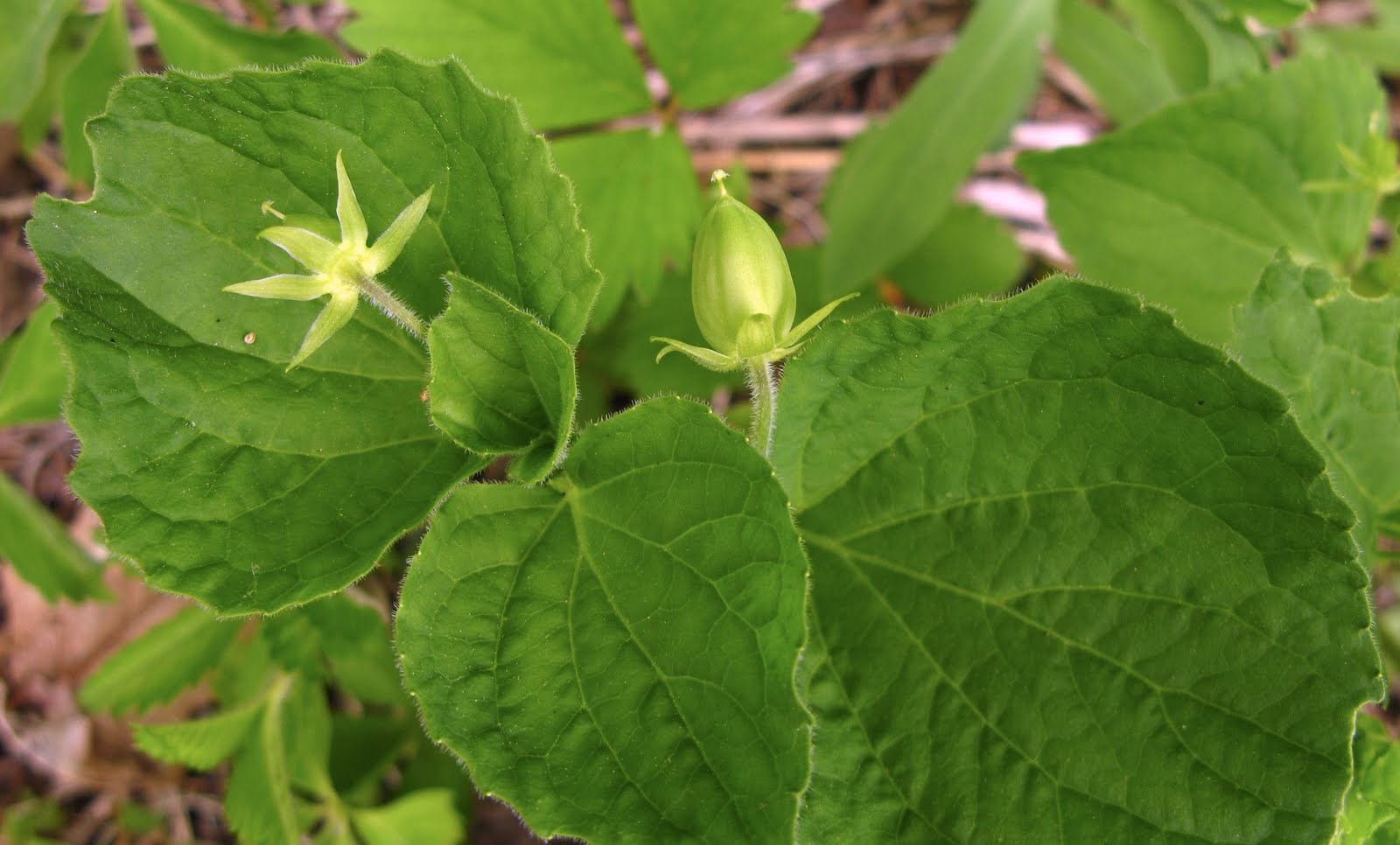
At a glance, it looked like the flowers that circle the stems were still hiding among their dark sepals, but then a sunbeam sneaked under the leaves and lit up this wreath of blooms down low on the stalk.


Here's a closer view of one flower, revealing a pollen-dusted protruding pistil.

These blooms will turn into marble-sized orange berries containing the three hard seeds that inspired this plant's scientific name: Triosteum aurantiacum, meaning "three-boned orange-colored plant" (or something like that). A closely related species, T. perfoliatum or Wild Coffee, has similar berries that can be roasted like coffee beans. I've never found that plant, nor have I tried roasting the seeds of T. aurantiacum and brewing some ersatz coffee. I have tasted the fruits, however, and found them seedy and insipid but mildly sweet.

Here's a plant whose fruit is certainly worth picking and eating, if you don't mind spending an hour to gather maybe a cup. This is the Wood Strawberry (Fragaria vesca ssp. americana), related to the more common Wild Strawberry (F. virginiana) and having even smaller but even more intensely flavored fruits.

What distinguishes this strawberry is the way the flowers, growing on stalks of unequal length, are held high above the leaves. Its flowers are also a little smaller than those of the Wild Strawberry, and its berries have their seeds on the surface instead of being imbedded in the flesh.

Unfortunately, the only place I ever find them is here in the Skidmore woods, where I would not be allowed to pick them. Well, maybe just a few, if the birds haven't got them first.

Wednesday, May 19, 2010

A Rainy Day (and Some Rarities) on the River Banks

Well, we thought it would be a nice sunny day. But when Ellen and I got together today to explore the Ice Meadows -- a rare-plant habitat along the Hudson River north of Warrensburg -- the clouds were low and grey and the rain was making slippery the rocks we had to scramble across to get down to the water's edge. We didn't let that stop us, though, because we'd heard that the Dwarf Sand-cherry was in bloom. We wouldn't have many more chances to see this diminuitive shrub in bloom, since, first, it's a rarely found threatened species, and second, a hard rain could knock off all its petals. So down to the river we went, and yes, indeed, we found it.

Lots and lots of Dwarf Sand-cherry was sprawling across the sand amid the rocks, its low-lying branches well adapted to being pressed down every winter by up to 10 feet of deposited "frazil" ice, a particular kind of ice that forms in fast-moving water. Those heavy deposits of ice take a long, long time to melt, retarding the growing season along these shores. I was really surprised to find Wood Anemone still in bloom (a plant long gone to seed in Saratoga now), although with the chilly rain today, the white blooms retreated into the shelter of their pretty pink sepals.


Bluets, of course, don't hide their pretty faces from even the nastiest weather, and they manage to find a foothold to grow in the harshest of habitats. Here they share their crack in a rock with some ferns and a violet or two.

I believe those salmon-colored fronds belong to Royal Fern. Here's a closer view. Don't they just seem to glow in the low-light conditions of this dark rainy day?


Talk about glow! These Golden Alexanders lit up even the darkest shade in the woodsy path leading down to the river.


That's not a cloud or a ghost back there in the woods behind this little pool, but a smear on my photo image from raindrops hitting my lens.

I was going to chuck this photo, but changed my mind because it reveals so well the effect of all that ice piling up on the shore each winter. See how abruptly the shrubbery comes to an end? Any tree or shrub that would venture out into the ice build-up zone -- what are called the Ice Meadows -- would promptly be pressed to death or else only survive in miniaturized forms that cast little shade. Even those alien aggressors that tend to usurp other habitats can't get a foothold here, leaving the land to those native plants that have evolved to cope with these harsh conditions.

And here's a photo of one of those plants: Brown Bog (or Buxbaum's) Sedge, a species of sedge considered threatened in New York State and other places, but which has found a happy home here.

Many more rarities will be springing into bloom along these shores as the season progresses. In fact, there are probably some out there now, but it started to rain so hard we decided to call it quits today before we ruined our cameras. But we'll be back!


Tuesday, May 18, 2010

Blooms and Birds and Buds and One Good Buddy

What a lucky lady I am! Every day, it seems, I am gifted with new delights. My greatest delight today was meeting up with my friend and fellow blogger Ellen, who wanted to see some of the remarkable flowers along the Warren County Bikeway near Glen Lake, and so drove down from Newcomb to meet me there. Here she is trying to photograph the flowers of Nodding Trillium, which are not that easy to see from an upright position. I still marvel that Sue ever saw them! (See my post for May 12.)


Ellen also wanted to see that Glaucous Honeysuckle, and wonder of wonders, we got a bonus treat: a Hummingbird Moth leisurely exploring this native honeysuckle's confetti-colored blooms. (Be sure to check Ellen's blog Adirondack Naturalist to enjoy her photos. I believe hers are far better focused than mine.)


Another critter that delighted us by its presence was this very BIG American Toad. Ellen was quick enough to grab it gently and kind enough to hold it a moment so I could take its portrait.


While Ellen was photographing the Early Azalea and some of the other treasures along the trail, I was revisiting some of the earlier-blooming flowers that now have gone to seed, including this Trailing Arbutus with its remarkably ruddy spent blooms and fuzzy emerging fruits.


The seed pod of this Downy Yellow Violet is just as lovely, in its own way, as its former flower, now faded.


There were also plants that have not yet flowered, but whose leaves and buds possess an elegance of form and color in their own right. In fact, this bud-bedeckeded, purple-tendriled vine of Carrion Flower is far more beautiful than the nondescript almost-invisible, greenish-white flowers that will follow and stink up the place, causing you to wonder if something in the area has died.


When it blooms, this Whorled Loosestrife's stalk will be circled by small yellow flowers. For now, though, its deep maroon whorls of leaves are as handsome as crysanthemums.


The same could be said for the purple-tinged leaves of Spotted Joe-Pye Weed.


The flowers of Mountain Maple aren't exactly pretty, but they are remarkable for their perky upright posture. When they go to seed, the keys will dangle down like any other maple's, but now their flower clusters stick right up and help us distinguish this smallish tree from all the others in the understory.


Ellen and I had a little botanical brainstorming session, literally taking this violet apart to try to discern its species. Something about it looked just a little different from the Common Blue Violet it resembled at first glance: the flower-heads seemed quite large in comparison to the rest of the plant, and its heart-shaped leaves were broader than long. Time to get out the Newcomb's.


It was also time to check out the lower petal, which we found to have "a tuft of hairs at the base." The leaves and stems were smooth, not downy, so perhaps this plant is the "Broad-leaved Wood Violet" Newcomb describes on page 30.

Or maybe not. When I got home and checked my desk copy of Newcomb's with updated taxonomy penciled in, I discovered the Broad-leaved Wood Violet is no longer considered a species separate from the Common Blue. Harumph! Well, maybe botanists don't distinguish it any more, but we sure thought it looked different.

The treasures along the bikeway are not all botanical, for we had some ornithological pleasures as well. There are tall trees and low thickets, rushing streams and still pools, creating a veritable birdwatcher's Paradise. Or rather, bird hearer's Paradise, since most of the birds hide from view in the trees, while they serenade us with wonderful songs and drive us nuts trying to see them. Ellen identified Common Yellowthroat (witchety witchety witchety) and Yellow-rumped Warbler (also called "Butterbutt") just by their songs alone, but one Yellow Warbler actually let us lay eyes on him as, looking like a nice plump lemon tossed into the bush, he sang his little heart out in a Speckled Alder. The loudest, most melodic song of all, however, was that of the Baltimore Oriole, which we glimpsed now here! now there! as he flitted from tree to tree. And then wonder of wonders, he landed right within view. See that blaze of bright orange in that tree?


Then we couldn't believe our lucky stars. He flew right into the sumac in front of us, where we could feast our eyes on him.

And even get a photograph.


Monday, May 17, 2010

Up North to Lake George

I have a friend who can't drive anymore, so once I week I try to take him out for some nature adventures. Today we headed north to Lake George, with a quick stop along the way at Glen Lake to walk on the bikeway there and torment ourselves with trying to ID the birds that were singing away in the bushes. Way hidden in the bushes and the tops of the trees, always eluding our scanning binoculars. Does anyone know which bird goes "witchety witchety witchety" over and over again?

Since my friend wasn't up for a long walk today, we took a long drive instead, 50 miles north to Hague with a stop in Bolton Landing for lunch at a lakeside restaurant. The food was pretty bad, but hey, what a million dollar view! I don't think there's any prettier lake in the world than Lake George at its northern end.


At Hague we headed west toward Brant Lake and Exit 25 of the Northway, then sped on home in good time. But just as we left the village of Hague, we spied this beautiful waterfall right by the road, with a parking area and a path leading into the woods and along the stream. Of course, we had to stop and admire the view.


While standing on the rustic bridge overlooking the waterfall, we were entertained by a pair of Phoebes swooping across the brook again and again, snacking on gnats as they flew. They would land on a twig and sit there, wagging their tails up and down and teasing me into trying to take their picture. Ha! Fooled you again! And again! And again! I guess you'll have to look them up in a book to see what they look like. Sort of greyish brown, the color of bark. If they weren't in constant motion, even when they perch, you'd never see them.

Sunday, May 16, 2010

Exploring Moreau Park's New Trail

A great day for a walk in the woods -- in fact, a great day for any activity outdoors, so clear and sunny and pleasant it was today. I had learned of a new trail at Moreau Lake State Park that leads to the Hudson on the Warren County side of the river, so that's where I went this afternoon. My pleasant adventure started as soon as I stepped from my car at a parking area alive with clouds of little Pearl Crescent butterflies. The butterflies never hold still, of course, but I did manage to catch one resting for just a second on a rock. (For a much better photo of lovely Pearl Crescent, scroll down my sidebar photos on the right.)


And here's what the butterflies were visiting: these bright little Common Cinquefoil, which covered the broad rocky outcroppings in the sun. The red-capped lichen called British Soldiers provided a colorful accent to the yellow cinquefoils.


The trail quickly descends from the sunny parking area into a deep shaded forest and promptly crosses a tiny stream lined with mosses and Sweet White Violets.


While pausing to admire those violets, I was serenaded with the sweetest song imaginable, and it came from right over my head. Looking up to the treetop, I spied a male Scarlet Tanager, lit up by the sun and as red as a big ripe tomato. Alas, by the time I could focus my camera's lens, the bird flew away. I would have liked to share that image with my blog readers, but I know I shall never forget it.

Many birds filled the forest with song as I moved through deep hemlock woods on paths made soft by generation upon generation of fallen needles. I could hear the Black-throated Green Warbler calling his Zee zee zee zoo zee and the questioning conversation the Red-eyed Vireo holds with himself. Then the Hermit Thrush pealed his bell-like song, a phrase repeated three times, each time at a slightly different pitch, the final time pitched so exquisitely high I could barely hear it.

Much of the first part of the trail passes through towering dark hemlock stands, beneath which hardly anything else can grow, since so little sunlight reaches the needle-covered ground. But after a while, the darkness lightened as the trail moved closer to high banks along the river, and oaks and beeches began to predominate. Here, old stone walls suggest that a road may have followed the river here, or else that the land had been cleared for some kind of farming.


Soon, I began to catch glimpses of bright blue sun-spangled water glittering through the trees.


And finally, just as the trail took a turn to return to its starting point, the beautiful Hudson came into clear view down below. I recognized the rocks across the river as marking where the river takes its sharp turn from Corinth to head northeast toward Glens Falls.


Continuing on as the trail looped back, I spied this little patch of Downy Rattlesnake Plantain emerging from the dead leaves of the forest floor. This is one of our least showy native orchids, with spikes of late-summer-blooming small white flowers that in some ways are far less impressive than its swirly white-veined green leaves.


And then, what a treat! This American Red Admiral butterfly came flitting through the shadowy woods, and landed in a pool of bright sunlight, spreading its wings to display all its vivid colors -- including those two blue dots at the bottom of each wing. (Click on the photo to see them better.)


The trail soon joined the old service road that provides access to Spier Falls Dam, as well as an easy walk to return to my car. All along this road, clouds of Bluets crowded close to the path.


And forests of newly unfurling Hay-scented Ferns spread masses of greenery along the way.


I hurried my steps as the hour grew late, but the sight of these Hair Cap Moss spore stalks lit up by the lowering sun stopped me dead in my tracks. The road here is bordered with expanses of broad flat rocky outcrops that are carpeted with this moss, whose bright red stalks and flame-shaped spore caps almost appeared to be on fire.


Saturday, May 15, 2010

Woods-hopping Here and There

I've been hopping all over the place these last two days, but not stopping to blog. Tonight is catch-up time. First, what's happening in the Skidmore woods? I try to get out there at least once a week, since it's such a rich habitat, with new wildflowers in bloom every day. Yesterday was a violet day: Canada Violets in full bloom, sharing the shady forest floor with graceful ferns and the lacy, fern-like leaves of Sweet Cicely (not yet in bloom). There's that pretty moss, too, that looks like miniature dahlias, Rhodobryum roseum.


As far as I know, the Skidmore woods is the only place in the county where the oddly non-violetty Green Violet grows. And grows and grows and grows! Hundreds of them, a miniature forest about two feet high, grow right next to the path. Here's a photo of the entire plant, with the small green flowers dangling from the leaf axils. Does this tall plant look like a violet to you?


The little humpbacked blooms don't look much like violets, either.


The last of the bellworts have just started blooming. If you look closely at the inside of the petals of Perfoliate Bellwort, you can see the granules that distinguish this one from the earlier blooming Large-flowered Bellwort, which also has stem-pierced leaves.


The Large-flowered Bellwort is now past its bloom time and just starting to grow its fruits.


Here's another fruit just forming: the Prickly Gooseberry. I guess it's obvious how it got its common name. I wonder how any critter could eat this berry without scratching its throat?


These aren't fruits, but some kind of warty galls covering this leaf. (I should know what kind of leaf it is, but I don't.) I don't think that bug had anything to do with those warts, but who knows? I thought the bug was kind of pretty, with its stained-glass wings.


Okay, that was yesterday at Skidmore woods. This morning I headed to Kawing Crow Nature Awareness Center in Greenfield for a mushroom walk with mycologist Sue Van Hook. The center's owner, Vince Walsh, had found a whole bunch of Black Morels just outside his front door, so of course we were hoping to find lots more as we searched his many-acred woods. Alas, we did not, although we found lots of little brown inedible mushrooms I can't remember the name of -- and had a great time tromping about in a beautiful woods with a group of fun folks. I, myself, was happy to find a nice big patch of Rhizomnium punctatum, a leafy green moss with ripening sperm granules filling the center of its posy-shaped structures.
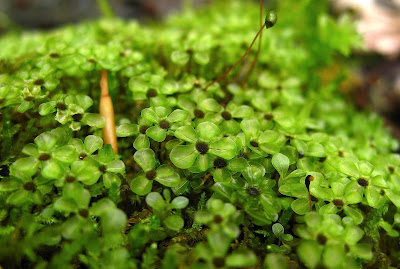

Here's a close-up shot of those granules, with a few already shed. These sperm will be splashed about by the rain, and where they land on female parts of the moss, a spore stalk will emerge, like the one at the top of this photo. That stalk is just ripening now, after starting to grow last year. When ripe, it will open and spill its spores on the wind, which will carry them off to start a new colony somewhere else.


This little toad hopped up on the boardwalk that crosses the Kawing Crow marsh. And sat there just long enough for me to take his picture.


After lunch today, I convinced my husband to bring his long-lensed camera to that Ballston Creek Preserve and heron rookery where I found the Osprey nest this week. And we were richly rewarded with an Osprey air show, as the magnificent bird soared and sailed and swooped on the winds that were whipping the trees around. Most of my photos did not turn out, but my husband managed to capture this shot, with the light passing through the bird's feathers.

Photo by Denis Donnelly

When I came to this rookery earlier this week, I spied just one Great Blue Heron, standing next to its nest. Today, I was happy to find not only that one (now settled into the nest), but two other nests also occupied, with herons in them.

I've heard from the folks at Saratoga PLAN (the land trust organization responsible for preserving this remarkable habitat) that they were very happy to learn that this rookery is now active, since earlier reports had indicated the nests had been abandoned for some time.


Another treat we found at the Ballston Creek Preserve was this jewel-toned Leopard Frog. Or is it a Pickerel Frog? I have a hard time telling the two apart, so I'm hoping one of my readers might set me straight. Whatever species it is, it sure is a beauty!