Showing posts with label gentians. Show all posts

Tuesday, September 27, 2011

A Summery Day, Early Autumn

 Summer came back for a few balmy days.  We reopened the windows, unpacked the shorts and tees, and I took my canoe to the Hudson for the first time in many weeks.  With, first, the spring floods and then, the summer hurricanes filling the river with roiling mud and rampaging flotsam this year, I think I got out on the river fewer than a dozen times this summer.  But as these calm-water photos show, it was safe to go back on the water today, and I jumped at the chance.  What bliss it was, to glide across these glassy waters, the sun warm on my back, the water sweet and cool to my trailing fingers.


The autumn foliage color is quite late this year, with just a tinge in some of the beeches and maples.  But Black Tupelos always put on a brilliant show, starting as early as August.  By now, their lipstick-red and emerald-green glossy leaves are joined by blue-black berries on hot-pink stems.


Winterberry is also in full display now, with fat red berries that will cling to the branches long after the leaves have withered and dropped and the berries are capped with snow.


I was afraid that I'd missed the Closed Gentians.  Because they grow so low on the banks, just inches above the water,  I thought they might have been swept away by the late-summer floods.  But there they were, right where I've found them for years, some of the flowers a little bruised, but as radiantly blue as ever.


How amazing to still find Cardinal Flower blazing away on the banks!


In the woods where I walked to get down to the river, mushrooms were still as abundant as the mosquitoes.  Some were so beautiful, I just had to stop to enjoy their colors and shapes.


This charming little clump of mosses, lichen, and polypody also caught my eye and caused me to linger long enough to take a photo.  How I love these miniature gardens!


Heading home, I pulled over to the side of the road to gaze at this majestic thunderhead. A burgeoning mass of snowy white against that blue sky, it looked, at first, like a huge cauliflower until its upper reaches began to spread out to make the anvil shape so typical of this kind of cloud.

As I sit to post this blog about 9pm, the thunder is rumbling outside and rain has begun.  I'm glad I took the opportunity to enjoy this sunny, summery day in my little canoe.  It may be a while before I can do it again.

Wednesday, September 14, 2011

A Blaze of Glory

Did I hear that right?  We might have a FROST this week?!  I sure hope not, since some of the most brilliant of the season's flowers are blooming now, and I haven't yet had my fill of their beauty.  So when my friend Sue invited me to join her on a walk through a goldenrod meadow in Queensbury today, I didn't have to think twice.  There may not be many more chances to see what's in bloom.


This meadow has wide mowed paths through acres and acres of goldenrods and asters alive with the hopping and flying and fluttering and buzzing and trilling of thousands of insects, including the exquisite Monarch Butterfly, whose lovely orange wings are a perfect complement to the blooms of New England Asters.


The air was filled with the long drawn-out trills of Tree Crickets, which I never expected to lay my eyes on, since their jade-green bodies are well camouflaged among all the fading leaves of the trailside plants.  But of course, I was with Sue, who has the most incredible eyesight, and she found this one.  It was quite a task to keep the cricket in focus, since it kept crawling around to the underside of the leaf.


Sue also spied this gorgeous Argiope spider suspended on its web.   You'd think this spider would be easy to see, with that brilliant yellow and black pattern on her back, but it only helped to hide her from view among all the goldenrods.


I had no trouble at all discerning this emerald Leopard Frog, who leapt from the path to a puddle, then turned to look at us with those incredible golden eyes.


At the back of the meadow, a trail led into a dark damp woods, where we encountered billowing clouds of hungry mosquitoes.  Their tortures kept us moving through the woods at a faster pace than we normally keep, despite the temptations of many colorful fungi just begging to have their pictures taken.  I did stop long enough to photograph this unusual arrangement of Blue Stain and Lemon Drop fungi sharing a rotting log.  Of course, my camera refused to focus again and again, as the mosquitoes made their way down my ears and onto my eyelids.  Oh bag it, I said as I clicked one last shot that turned out to be almost OK.   Part of the challenge, in addition to it being very dark and shady, was that the smallest of those Lemon Drops were about as big as the head of a pin.


Fleeing our tormenters, we hurried back to our car and drove to another wonderful spot not far away, along the Warren County Bike Path.  Here in a weedy ditch by a busy road we found the first Fringed Gentians of the season.  One of the last flowers to bloom before frost, they represent the flower season coming to a close in a blaze of glory.  It's hard to imagine a more radiant blue, or a flower head more generous in its display of gorgeous color.


The asters are doing their bit to add to the season's final glory, with colors ranging from deepest purple to lavender to palest blue to snowy white.  While many of the white-flowered asters are a bit scraggly in appearance, the Heath Aster tightly clusters its small white flowers into quite showy bunches.


Many Bidens species have flowers that are quite inconspicuous, some having no petals at all, or very small ones.  We often know we've encountered them only because of the barbed seeds ("beggar ticks") embedded in our clothing after we've passed unknowing through a patch of them.   A notable exception is Bidens cernua, or Nodding Bur Marigold, which is just now coming into bloom in many roadside ditches and other low damp spots, where it puts on quite a show.


I know that when the Gentians and Bidens come into bloom, I have turned to the final page of my annual flower journal.  There won't be many species left to go hunting for.  I haven't yet found Oxeye or Jerusalem Artichoke, but it won't be long.  Witch Hazel will be unfurling its yellow ribbons along the river soon, but I won't see the brilliant blue Monkshood in my garden until October.  Then that will be it for the flowers.  Aren't we blessed that Mother Nature saves some of her best for last?

Saturday, July 31, 2010

Riverbank Blooms -- and a Mystery Plant

Paddling through golden light along the Hudson banks

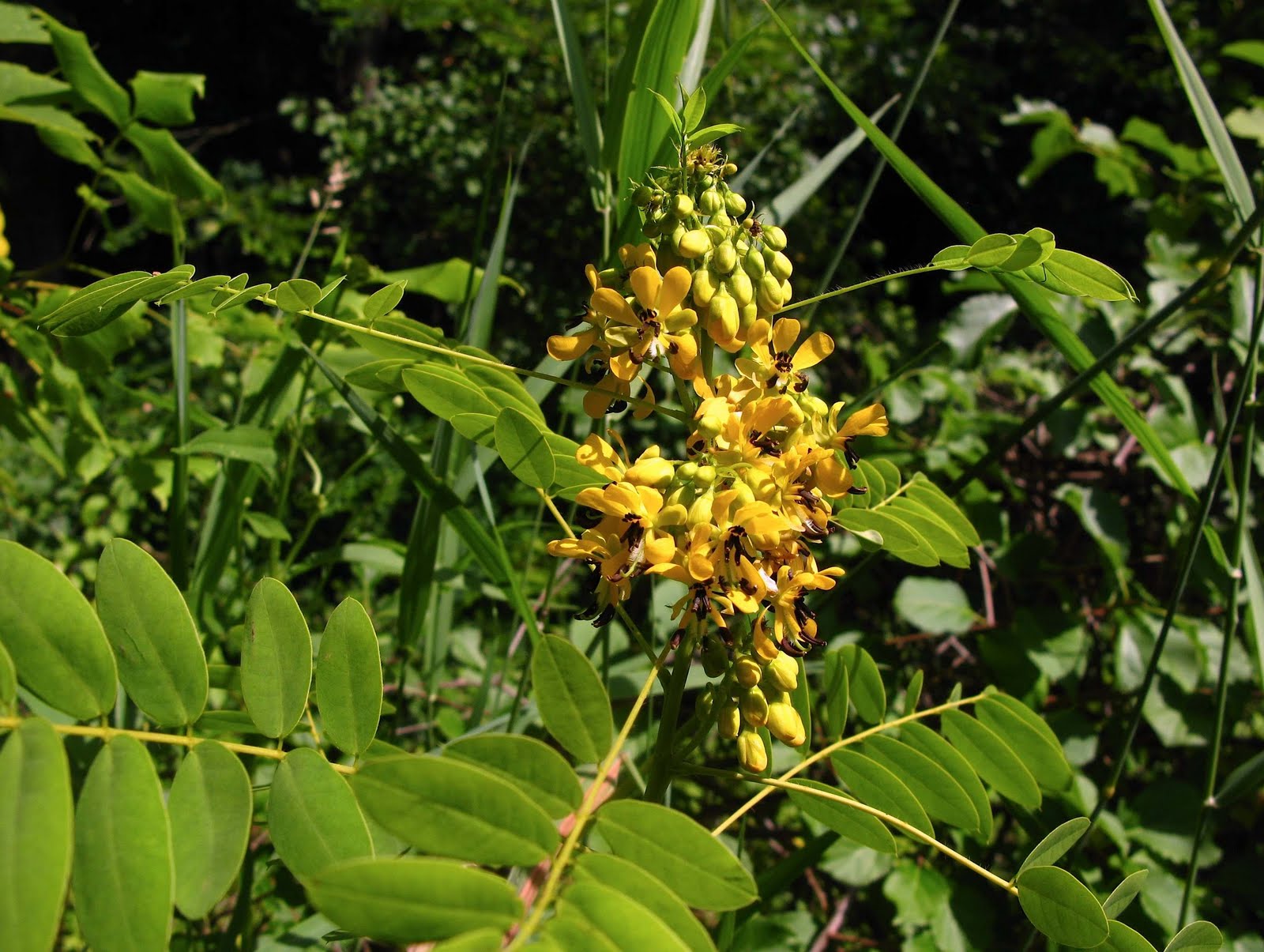
Another bright and beautiful day, and lucky me, I had arranged to meet my friend Sue for a paddle on the Hudson this morning. I wanted to show her that Wild Senna I'd found last week (Thanks, Ed!), which was sure to be blooming today. And so it was. Its large cluster of yellow blossoms shining in the sun were hard to miss.


Although this is a Pea Family plant -- and its leaves and seed pods certainly show that family's resemblance -- its flowers don't look very pea-like at all. What funny little pig-snout stamen tubes, positioned to spill their pollen grains on that furry, curving green pistil below.


On our way to the senna's location, we passed this beautiful patch of Narrow-leaved Gentians, their vivid blue flower heads standing out against the leafy green of the bank. Oh dear, is it that time of year already? I always associate gentians with fall, although the narrow-leaved species does bloom a bit earlier than other gentians.


Our next stop was a trio of little islands, where we beached our boats to wander around snacking on Black Huckleberries while we searched the islands for flowers. We had planned on a swim from the rocky shore there, but a brisk breeze and the cool morning air convinced us that wading around in the warm shallow water would be more pleasant. Amid a sea of glowing Golden Pert, these snowy blooms of Grass-leaved Arrowhead stood out.

I had never seen arrowhead blooms with these pink blushes in the center of each petal. I wonder if they turn pink with age as the Large White Trillium does.

The shores of the islands were aglow with clusters of ripening Elderberries and stalks of radiant Cardinal Flower. We stood very still for quite a long time, watching a pair of Ruby Throated Hummingbirds feasting among the Cardinal Flowers, hoping to maybe capture a photo of them. Well, folks, hummingbirds move very fast, so this is the best I could do with my little point-and-shoot camera.


Back on the open water, the wind at our backs, we paddled downstream a ways to where we had found an American Chestnut tree in bloom earlier this summer. Today, the tree was laden with green burry balls.

The chance that any of those husks harbor fertile nuts is very small, since there are no other chestnuts of flowering age in the area to provide the necessary pollen. It's quite unusual to find any chestnuts surviving to this fruit-bearing age before they are killed by the blight that eliminated this tree from American forests.


Our final stop today was to ponder a mystery plant we had found last week: these tall, leafy, many-bracted spikes towering over the surrounding Cardinal Flowers on a muddy shore.


Up closer, we see little purple wormy things emerging from a very bushy stalk.


Here's an even closer view of one of those wormy things.


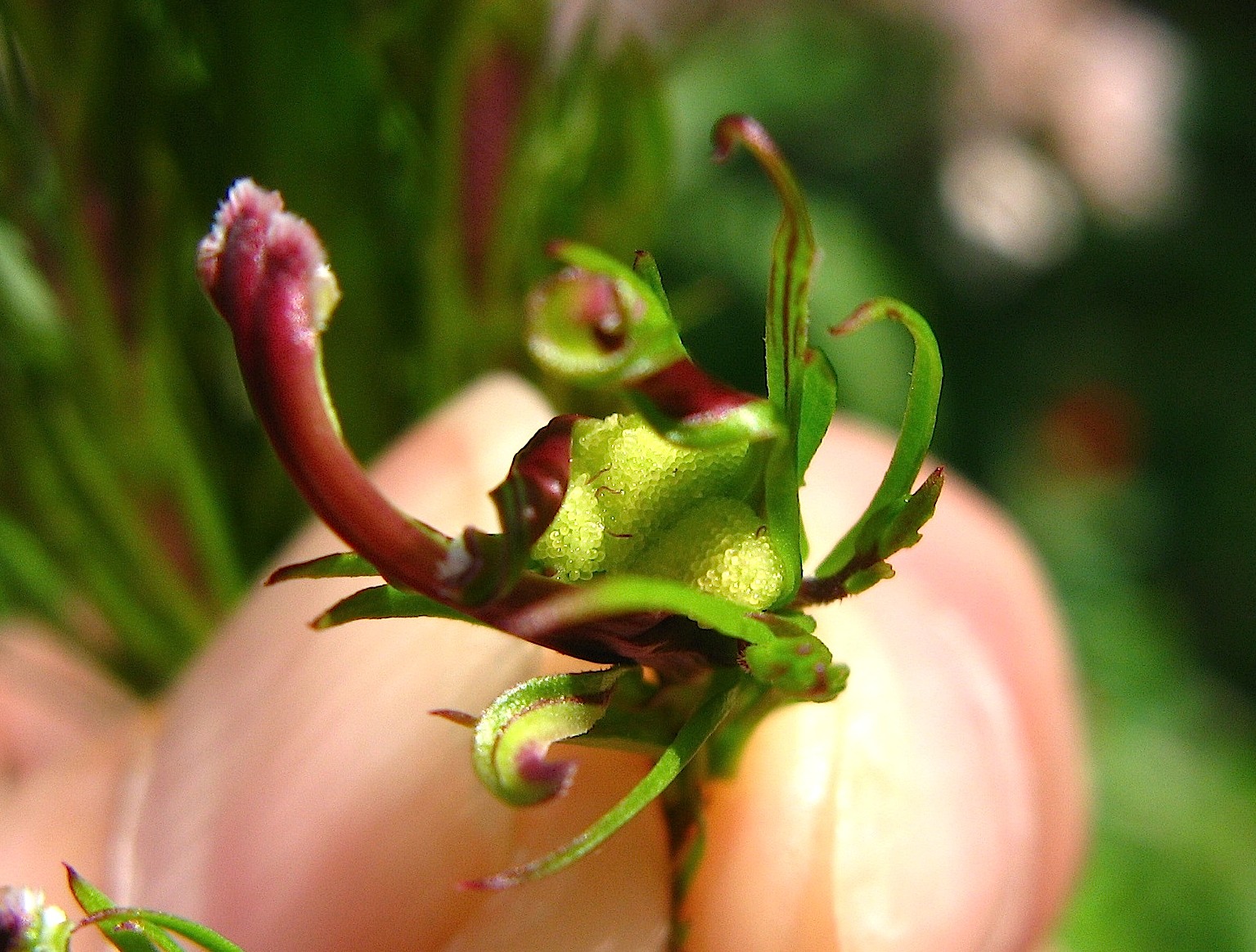
On some of the blooming tips, I found these lumpy masses made up of minute green spheres.


A very odd plant, indeed! But something about it seemed so familiar. It had a fluted stem and alternate toothed leaves like those of the nearby Cardinal Flowers, and the shape of those little wormy things reminded me of the stamen tubes of those Cardinal Flowers. Here's a photo of those stamen tubes (a bit out of focus, but I think the resemblance can be noted).


So here's what I'm thinking: our mystery plant is a diseased form of Cardinal Flower, stimulated by some kind of infectious agent or genetic mutation to grow into this deformed version. We find similar deformities in the cases of galls and witch's brooms, although in those cases only parts of a plant are affected. This whole plant, consisting of 4 or 5 stalks, exhibits the anomalous structure. But who knows? I asked our state's chief botanist for his opinion, and he suggested that this is a witch's broom of a Cardinal Flower. I guess I'll go with that.

I just hope it's not contagious. The Hudson banks at Moreau are just teeming with Cardinal Flower, and I sure would hate to see them eventually fall prey to whatever has deformed this plant.