Showing posts with label Betar baclwater. Show all posts

Saturday, August 25, 2012

Another Day, Another Stretch of River

Where the Hudson River forms the northern boundary of Saratoga County, its plummeting waters are caught and controlled by a number of dams, creating a series of catchments perfectly suited for flatwater canoeing.  On Friday I put my little Hornbeck in the section that lies above the dam at Glens Falls, entering the river at a quiet backwater that can be accessed via the Betar Byway in South Glens Falls.


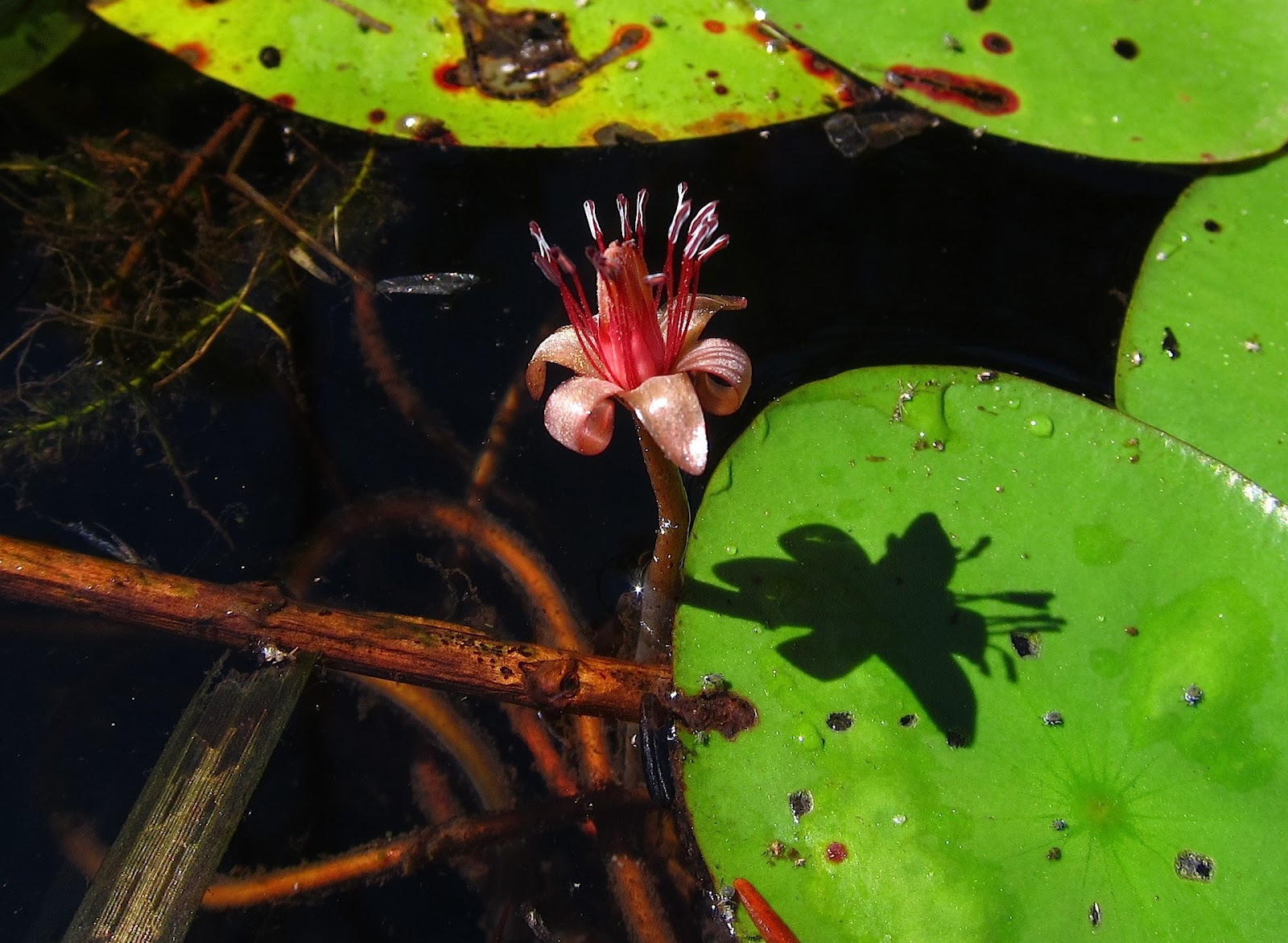
Only a few miles downstream from my regular haunts above the Sherman Island Dam, this section of river is home to a number of quite unusual plants that I never find in my home waters, including some that are listed as threatened species in New York State.  Water Marigold is one of these, and I was a bit disappointed to find only one rather scraggly specimen in bloom.


Perhaps I had come looking for them too early, since I saw plenty of their emergent leaves in one section of the backwater.   This plant is remarkable in that the lance-shaped leaves that protrude above the water are quite different from the very fine hair-like leaves that form whorls along the underwater stem.


A second rare plant that thrives in this catchment is Small Floating Bladderwort, which was blooming in great numbers a month ago.  Even now, a few stragglers still lifted their chubby yellow blooms above their inflated pontoons.


I next paddled upstream toward the Feeder Dam, approaching the shale cliffs that rise steeply from the water's edge.  Black as coal, the shale is constantly watered by springs that provide a rich environment for a number of interesting plants that make their home in this bare rock.


Grass of Parnassus is one of the plants that thrive on these cliffs, sharing its niche with Bulblet Fern and Coltsfoot in this particular spot.


I believe that the ring of yellow dots circling the pistil are nectaries, which would explain why I often see lots of little flies visiting Grass of Parnassus flowers.


A number of different mosses and liverworts also cling to the dampened shale.


Dainty blue Kalm's Lobelia also prefers this lime-rich environment, clinging to the cliff face at just the right height for enjoying a close-up eye-level view of their pretty blooms.


Other parts of the riverbank were also decorated with some of the season's prettiest blooms, including this trio of radiantly blue Closed Gentians.


A Winterberry shrub graced a fallen log with a bough full of abundant red fruit.


A Great Blue Heron would let me get only so close before lifting off with those enormous wings, long legs trailing behind.


I couldn't believe how close this Painted Turtle let me approach.  I could see that it had me fixed with its gaze, but it never did slip from its sunlit perch.


There were other creatures enjoying this beautiful day on the river, and if I'd been wearing my bathing suit, I would have been tempted to join them.


Wheeee!


Wednesday, July 25, 2012

Quiet Waters, Unexpected Pleasures

Ah, what a perfect summer day today:  blue sky, bright sun, a cool morning that warmed as the sun rose higher, the grass and trees and flowers freshly washed by yesterday's drenching rains.  It was, perhaps, a bit too windy for easy paddling on open waters, but my friend Sue and I did not intend to venture out onto open waters, since our destination was the quiet backwaters of the Hudson near the Betar Byway in South Glens Falls.


Sue had paddled this shallow, sheltered area a few days ago, and she had found colonies of strange "moss animals," gelatinous masses called Pectinatella magnifica that form on underwater branches.  So we were here to look for them, and thanks to Sue's sharp vision, we found them lurking down under the murky water.


I was able to grasp the end of a branch one colony had formed on, and lifting it out of the water, was able to get a closer look at its complicated structure.  To learn more about the fascinating life forms -- called "bryozoans" -- that make up these colonies, you can visit a University of Massachusetts site that tells all about them by clicking here.


A second goal of our paddle today was to see the pretty pink flowers of Water Shield, now in bloom by the hundreds in one of the quiet bays.


Most of the Water Shield flowers were tipped with the whitish anthers of the male flowers, but occasionally we could find one that had what we assumed were the rosy pink pistillate structures of female flowers.  Or at least the female phase of the flower.  I'm not well-versed in this flower's reproductive strategies.  This Hudson backwater is the only place I have ever seen Water Shield in bloom.


Update:  My friend and fellow plant enthusiast Ed Miller has written to explain the Water Shield's fertilization strategy.  Each flower contains both staminate (male) and pistillate (female) parts, with the male parts ripening first.  After the stamens have shed their pollen, the flower retracts underwater until the female parts ripen, at which time the flower re-emerges to accept pollen from other plants, a process that impedes self-pollination.  After the flower is fertilized, the stem retracts it under water, where its seeds will develop and be "planted" again in the mud.


We were very pleased that we'd found the two things we had come here to see, but then we came upon some plants that were highly unexpected.  There's a narrow island that runs through the middle of this quiet backwater, and there we found Wild Senna growing in abundant numbers.  This is only the second location of all my nature wanderings where I have found this native pea-family plant.  Sue saw it first, and the sighting rendered her nearly speechless, as she pointed excitedly to the bright yellow blooms.


Wild Senna has some of the oddest looking flowers I have ever seen.  They sure don't look like the flowers of most other pea-family plants.


So far, we were having a very lucky day, and we also counted ourselves quite lucky to get a nice long look at this large Painted Turtle sunning itself on a log.  Neither one of us could recall ever getting this close to a sunning turtle before it tumbled off into the water.  It just sat there and sat there and let us each take lots and lots of close-up photos.


To top off our day of lucky finds, this gorgeous Giant Swallowtail Butterfly landed right at our feet, where it stayed and stayed, fluttering about a little, but always remaining within camera range, with its beautiful wings outspread.


There was obviously something that butterfly craved in that mud, since it refused to leave the site, plunging its proboscis into the mud again and again.


Even I was able to take a nice clear photo of this beautiful creature, its perfection only slightly marred by a tear in one of its wings.