Wednesday, September 20, 2023

Late-summer Pleasures Paddling a Pond

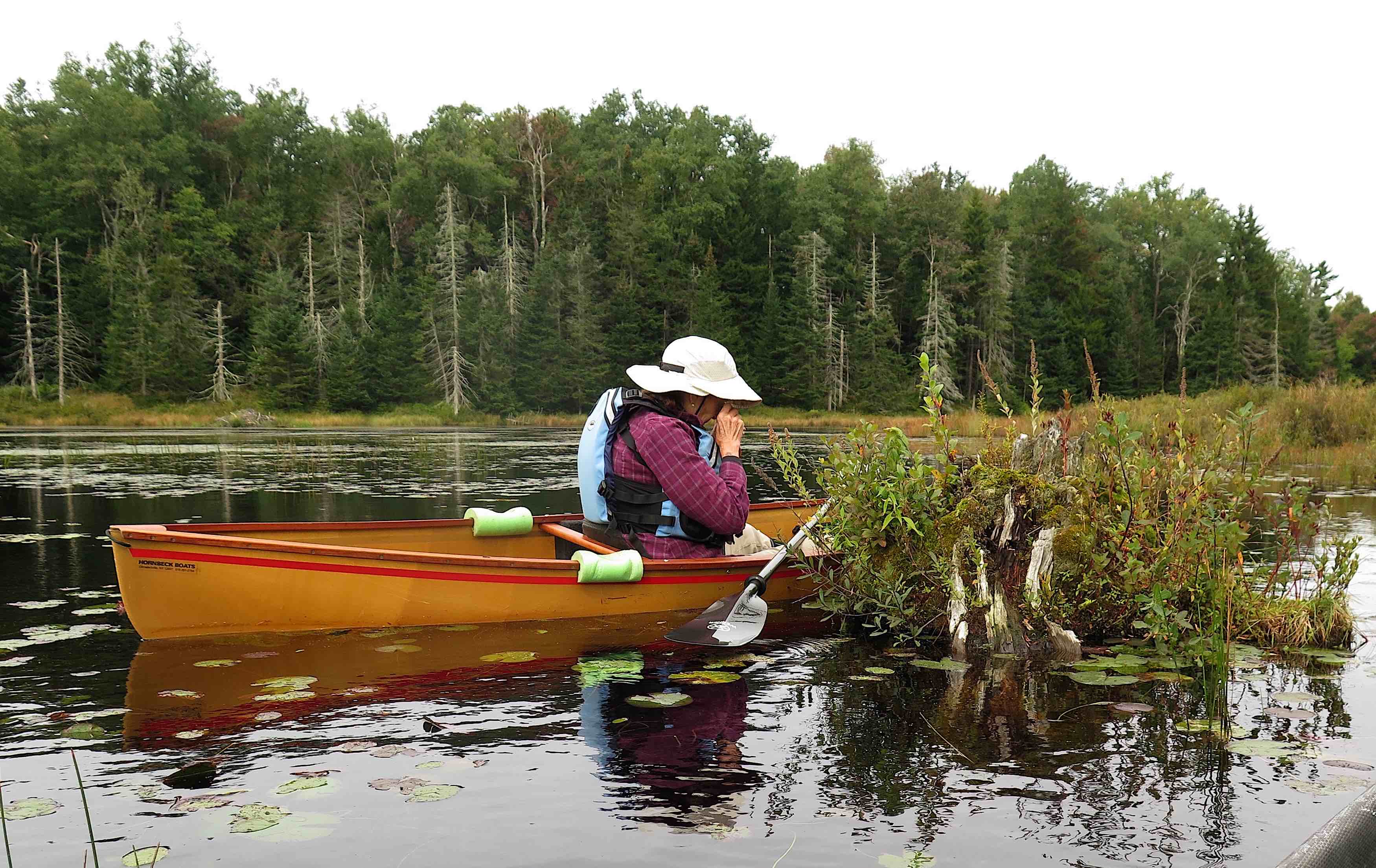
How to choose a favorite season of the year? As a naturalist, I feast so thoroughly in what natural wonders each season has to offer, I always feel ready to move on to the next "course." But oh my, I do think late summer-early autumn is especially delightful. High-summer's sweltering heat has given way to mornings when a sweater feels comforting and the midday warmth is welcome.  The explosion of autumn's brilliant foliage is still a few weeks away, but the berry bushes are heavy with colorful fruits and the meadows appear like tawny seas as the wind moves in waves through the tufted grasses. I can't think of any better way to enjoy this season than paddling a quiet Adirondack pond.   Especially the pond my friend Ruth Brooks and I chose to paddle this week, a beaver-formed pond in northern Saratoga County, with a varied shoreline that offers several diverse habitats: sedge meadow, forested rocky banks, muddy shallows, and boggy shores.

Sedge-meadow Shore

A bright overcast sky turned the pond's quiet surface to liquid silver as we set off along the sedge-meadow shore, where a wide swath of sedges, rushes, and low shrubs stood between the water and the vast forest that surrounds the pond.


It was obvious from our first paddle strokes that this pond itself was once forested land, before the beavers dammed its outlet stream at its northeastern end.  Dotting the shallows are numerous stumps of long-drowned and toppled trees, the woody remains now populated by marvelous mixes of mosses, lichens, fungi, and flowering plants.


The most colorful of those flowering plants right now are masses of Marsh St. John's Wort (Hypericum virginicum), with pink-tinged lime-green leaves, scarlet stems, and glossy ruby-red seedpods.


Ruth is an avid student of mosses, so she found much to engage her interest in the mosses that carpeted the stumps.


I was grateful to have Ruth's tutelage, for although I admired this velvety green moss with its spiky reddish sporestalks, I did not know what name to call it by until Ruth told me it was Dicranum flagellare, also known as Fragile Broom Moss.


Ruth was also able to put a name to this fluffy-looking lime-green moss that carpeted another stump: Aulacomnium palustre, or Ribbed Bog Moss.


At least I did recognize this spiky denizen of many stumps, the carnivorous insect-eating pads of the wetland-dwelling wildflower called Round-leaved Sundew (Drosera rotundifolia). Those spiky "hairs" are tipped with a sticky fluid that is attractive to insects, who land on the pads expecting a snack, only to become the plant's meal when the pad folds over the now-trapped insect and digests it for its own nutrients.


Along this shore, wide swaths of Carex lasiocarpa (also known as Slender Sedge) fill the shallows between the forest and the open water.  That vernacular name is so descriptive of this lovely grass-like sedge, with its gracefully curving slender tips.  It is soft and fine, not stiff like many other sedges, so it is almost constantly swaying either slowly or briskly, according to how gentle or strong is the wind that sets it to dancing.


The Slender Sedge's tawny monoculture is livened by occasional patches of Marsh St. John's Wort, with its leaves of an almost incandescent hot-pink.


Not a ridged-stem sedge but rather a round-stemmed rush, Canada Rush (Juncus canadensis) was bearing dark-maroon spikelets that stood out against the background of pale Slender Sedge.


Wetland shrubs like Leatherleaf and Sweet Gale punctuate this sedge meadow, and we were astounded to find this Hornworm clinging to a Sweet Gale twig, its body covered with the pale larval cocoons of a parasitic wasp, most likely the wasp Cotesia congregata.  Sometime earlier, the wasp used her ovipositor to lay her eggs inside the Hornworm, where the larvae hatched and fed on the insides of the caterpillar.  Eventually, the larvae emerge onto the caterpillar's skin, where they attach and spin cocoons from which the next generation of wasps will emerge. Of course, this eventually kills the Hornworm, but it still looked very much alive on this Sweet Gale leaf. Poor thing!  Very interesting, of course.  But still . . . .!


Behind the sedge meadow, thousands of acres of state forest spread for miles. I photographed this short stretch of the forest because I was intrigued by how so many of the typical conifers of the Adirondacks were clustered here along the shore. The two small trees are Balsam Fir (left) and White Pine (right), while a tall skinny Tamarack (yellowish needles) rises left of center. I am pretty sure the darker conifers include both Northern Hemlock and Black Spruce, but I could not get close enough to examine their needles for positive ID.


Forested Rocky Banks

We soon turned into a quiet bay that offered quite a different, steeply rocky forested shoreline that directly met the water's edge with no intermediate strip of shoreline sedges. At the far end of this bay stretched a long beaver dam, an impressive construction of logs and branches and rocks and mud that held back all but a trickle of the pond's entire water.  A few years ago, we could not paddle this pond because this dam had been breached, and the water in the pond was too low to paddle on. But beavers didn't earn their epithet "busy" for nothing,  and that dam was soon repaired.


We could paddle right up to the edge of the dam, the top of which stood at least eight feet above the wet meadow that lay below.


The beaver dam allowed enough of the pond's water through to feed the small creek that flowed away toward the woods.


As we paddled very close along the rocky banks of this bay, we were startled to see abundant patches of Narrow-leaved Gentians, fading now but still vividly blue. This species of closed-flowered gentian (Gentiana linearis) started blooming at least a month ago, and the now-browning flowers attested to the aging of these plants.


It amazed us, though, to see the quantity and brilliance of blue the flowers retained.


Just as amazing was the presence of newly blooming flowers on the shrubs of Sheep Laurel (Kalmia angustifolia) that grew right at the water's edge.  This species of laurel first blooms in late June/early July, but it does occasionally bloom again in the fall.


And the presence of these tightly folded Sheep Laurel buds were an indication that this shrub still had some blooming to do!


Muddy Shallows, Sphagnum Bog 

Proceeding around the pond, we came to an area so shallow that each paddle-pull lifted mud and released the gagging swamp-smell of methane gas.  I sometimes had to push my canoe instead of paddling it, to creep a little closer to these mats of ruby-red glistening Spatulate-leaved Sundew (Drosera intermedia) that were studded with the bright-yellow tiny flowers of Humped Bladderwort (Utricularia gibba). I have seen these species of sundew and bladderwort individually on other sites, but it is only on this pond that I have ever seen this truly delightful combination. Worth the struggle, for me!


Here's a closer look at the tiny blossom of Humped Bladderwort, revealing how it might have acquired its vernacular name.  This is a bladderwort species I have always found firmly embedded in mud, even when protruding from the water, not freely floating as some other Utricularia species do.


We were right on the edge of a vast Sphagnum bogmat, where masses of Cottongrass waved their white terminal tufts in the now-stiff breeze. The Cottongrass was waving so wildly, none of my photos of it were in focus.  I did manage to spy another typical denizen of bogs right at the edge of the mat, sheltered enough from the wind that it sat quietly for the picture-taking. A Pitcher Plant (Sarracenia purpurea), its now-aging flower still held aloft above its vase-shaped carnivorous leaves. These leaves hold water, along with digestive enzymes, so that any insect that happens to fall in will be drowned and digested.


Heading Home

Growing a bit tired from pushing against both mud and a stiffening wind, Ruth and I headed back toward where we'd launched our canoes.  I felt a moment's panic as I surveyed the far shore and could not detect our put-in place.  But then I recalled that we had lingered there to admire some berry-laden shrubs, the likes of which we had not seen anywhere else on our circuit around the pond.  So all we had to do was look for the raspberry-red fruits of Wild Raisin (Viburnum cassinoides).


Near that Wild Raisin was an Arrowwood shrub (Viburnum dentatum) that bore blue-black fruits.


And a lower-growing shrub called American Bush Honeysuckle (Diervilla lonicera) bore leaves that had already turned wine-red, and each twig held clusters of brighter-red seedpods of a most amusing shape, like something that Dr. Seuss might have invented.


Those three colorful shrubs served as very reliable guideposts, and we easily found our trail to where we had parked our cars.  Nature saved one last treat to top off our already wonder-filled time on this pond.   As we lifted our canoes to dry land, right there in the shoreline grasses was a gorgeous Ladies' Tresses Orchid (Spiranthes sp.), shining so white, like a beacon. 


 How could we have missed this beautiful flower when we first launched? I think we were focused on what wonders awaited us on the water, and we overlooked a marvel like this that was growing on land. This orchid was like a perfect dessert that crowned a delicious meal!


Wednesday, September 13, 2023

A Changing Scene Along the Hoosic and Hudson

Some places are so rich in botanical treasures that I return to them several times each year.  Canal Park at Lock 4 of the Hudson River/Champlain Canal is just such a place.  Here, the canal bypasses the Hudson rapids at Stillwater, NY, and rejoins the main river just downstream from where the Hoosic River flows into the Hudson from the east.  All that watery shoreline along both rivers, steep shale banks, surrounding forest, and alluvial floodplain provide habitat for a marvelous variety of native plants, easily accessed along trails that follow the waterways and wend through the woods.  The nature group I belong to, called the Thursday Naturalists, has visited this site many times, but we are always up to returning to sites as rich as this, especially when some of its most unusual plants are blooming. Mid-September is one of those times, so I paid a visit to Canal Park this week to check on how these plants were doing. Perhaps it was time for our group to revisit.

Standing at the junction of the rivers and gazing downstream toward the bridge at Mechanicville, I could see right away that the water in both rivers was higher than normal.  Many of the plants that thrive along both shores were now well under water, and the sandy strip of shoreline I usually explore at this point was now inaccessible without wearing waders.


I next made my way through the woods to a low floodplain where a curve of the Hoosic delivers rich alluvial sediments that encourage the plants there to grow to prodigious size. 


I was not prepared for the scene that met my eyes. Gigantic Sycamores still towered over the site, but an  equally huge Cottonwood tree had crashed to the ground, littering the flat area with heaps of broken limbs and leafy branches


While violent winds had toppled those Cottonwoods, raging floodwaters had delivered heaps of river-borne flotsam that now covered the trails we once walked to reach the shore. The footing here now seemed too treacherous for some of my Thursday Naturalist friends to navigate.


 I myself managed to teeter through this jumble of limbs and logs with hopes of finding a few of the many Green Dragon plants (Arisaema dracontium) that normally thrive to enormous size at this site.  And to my surprise, I did find one plant still standing, its cluster of brilliant-red fruit still attached to its stem and with rather tattered leaves still intact.


Thanks to that brilliant red color, I could spy many other Green Dragon berry clusters, crushed beneath heaps of Cottonwood limbs. I hope the plants that sprout next spring can make their way through the maze of all this blow-down.


I could see down the shore bright flashes of blue that told me Great Lobelia still bloomed some distance upstream, but I did not risk a fall by trying to get close enough to take a photo.  The footing along the flotsam-heaped sandy shore was truly daunting.  Instead, I moved downstream to where shale banks rose steeply from the water's edge. I had hoped to navigate a rocky ledge beneath the banks, but that ledge was now underwater, too slippery to risk wading over (as I knew from previous experience!).


At least I was able to access some parts of these shale banks, where one of New York State's rarest plants was still thriving.  I had counted over 200 basal rosettes of Provancher's Fleabane (Erigeron philadelphicus var. provancheri) on these banks a couple of years ago, and there may still be that many, sprouting from banks I could not see today. I did count a few dozen leafy rosettes clinging to the vertical shale banks that I was able to access.  


There were even a few Provancher's Fleabane plants still blooming.  The flowers look very much like those of the ordinarily abundant variety of Philadelphia Fleabane,  so how can this very-rare variety be distinguished?  Its distinctive habitat -- seasonally exposed and scoured calcareous bedrock of large rivers -- is a major clue, but the smaller flower size, shorter stem, scarcity of stem leaves, and the persistence of basal rosettes late in the year are further evidence that convinced a state botanist that the fleabanes growing here were indeed the real deal.


Many other interesting plants thrive on these steep shale banks, and I was particularly interested in two green leafy liverworts that were actually "in bloom" (meaning, they had developed some reproductive parts).  These flat leaves ("thallus") of the liverwort called Marchantia polymorpha are dotted with what are called "gemmae cups," receptacles that contain the developing sex organs. Later, two different structures, male and female, will emerge, the females looking like tiny palm trees, the males like miniature parasols.


This second green leafy liverwort is called Marchantia (formerly Preissia) quadrata, and I can see that some small reproductive parts have formed on the leathery thallus.


Here's a closer look at one of those reproductive parts, but I am not sure exactly how this species of liverwort produces its young and what function this tiny four-sided organ plays. If a liverwort expert informs me, I will return with details. 


The trail back to the parking area leads through a mixed hardwood/conifer forest high above the Hoosic river atop steep shale cliffs.  I could hear the full river rushing rapidly below.  In  other years, when the river was low, I could walk at the foot of these cliffs, enjoying the many interesting plants that grew there. Not today.


I did spy an interesting MOSS on the cliff face, however: little mounds of moss tipped with silvery "hairs". The moss looked like a number of little mice all napping on the rock. I dangled my feet over the edge of the cliff, trying to get a better view. But I had to lie down on my belly to reach down, clutching a nearby shrub with one hand, while I peeled off a small specimen. Such an unusual color for a moss!


It does look like a small furry creature, doesn't it?  I believe it is the moss called Grimmia pilifera, but if somebody who knows mosses better than I do corrects me, I will be back to add the correct name.


UPDATE: Turns out that this moss is NOT what I thought it might be, but is rather the globally rare species called Coscinodon cribrosus (Sieve-toothed Dry Rock Moss), as has been confirmed by expert bryologists, and my tiny specimen has been sent on to the New York Botanical Garden to be preserved in their permanent collections.


I was so happy to find a truly thriving population of Stiff Aster (Ionactis linariifolia) looking so perky and pretty.  Since their natural habitat is sunny, dry, and sandy soil, they sometimes look a bit dehydrated.  But we had lots and lots of rain this summer.  I think these asters were happy about it.  (The little spider seems happy, too.)


I don't think this Creeping Bushclover (Lespedeza repens) liked the weather this summer, though. I came here this week expecting this rare species of bushclover to be fully in bloom with its pretty pinky-purple flowers. But the hot days must have pushed its bloom time earlier, because all I could find were seedpods today, and its leaves were starting to turn yellow. Despite its presence in Rensselaer County not being recorded in the New York Flora Association's Plant Atlas, two ample populations do thrive at Canal Park. But they are not blooming now.


And here was another disappointment.  The tiny Whorled Milkwort with alternate leaves (Polygala verticillata var. alternifolia) is hard enough to find when it's in full bloom, but today it was obviously past its prime, with most of its florets and leaves long gone. I felt grateful to have found at least this withered remnant, since I have not found this milkwort at any other place than Canal Park.


But this sad little has-been of a flower was the clincher: this is not the year for the Thursday Naturalists to visit Canal Park in September.

Sunday, September 10, 2023

Late-summer Color at Orra Phelps Nature Preserve

As summer draws to a close, I love to visit the Orra Phelps Nature Preserve in nearby Wilton, hoping to visit some of my favorite late-season wildflowers.   Standing on the bridge that spans the usually rushing Little Snook Kill, what I mostly saw (aside from the lack of rushing water!) was vast amounts of green. Would I find many colorful wildflowers today?


I certainly saw lots of lush green mosses, including this patch of lacy moss called (most appropriately) Delicate Fern Moss (Thuidium delicatulum).  And there, popping right out of all this lacy green stuff was a tiny mushroom of the most vivid shade of orange!


And nearby was a Russula mushroom with the most gorgeous deep-pink cap.


The most colorful part of Jack-in-the-Pulpit (Arisaema triphyllum) shows up as the rest of the plant withers away. You just can't miss the blazing red of its glossy berries!


Indian Cucumber Root (Medeola virginiana) spends most of its growing season kind of hiding amid all the other greenery of the forest floor, with its small, spidery flowers dangling mostly unseen beneath its top tier of leaves. But as fall approaches, those small flowers move up to the top and produce shiny blue-black berries standing erect on red pedicels.  And those berries would be showy enough in their own right, but the leaves beneath them create a fine foil for the fruit by splashing the center of the leaf cluster with brilliant scarlet.


A ray of sunshine beamed through the still-green canopy overhead, and this arching stem of Common Agrimony (Agrimonia gryposepala) revealed itself as if it had been lit by a spotlight.


That sunlight also illuminated the numerous native sunflowers that lined the creekbank.   We have a number of native sunflowers that resemble these, but I have difficulty telling them apart.  This one might be the Pale-leaved Sunflower (Helianthus strumosus), since its leaves felt like sandpaper. 


As I continued along the creek bank I nearly stepped on this generous display of Closed Gentian (Gentiana clausa).  Having toppled under the weight of its large flower clusters, the plant lay hidden among the surrounding greenery until I was nearly upon it.


The gentians I was especially hoping to see today were of another genus altogether, the Fringed Gentians (Gentianopsis crinita) that grow in an open wet meadow some distance from the creek. Since surrounding pines and poplars keep moving into their sunlit sandy-soiled space, I always fear that the population of this queen of the autumn wildflowers may not persist at this site.  But all these glints of bright blue awaited me as I entered their bright space,  calming my fears for at least one more year.


The numbers of plants vary each year, since Fringed Gentian is a biennial, growing from seed to form basal leaves the following year and then producing flowers the year after that. It seemed that there were fewer individual plants this year, but most of the plants that did spring up bore multiple blooms of the most incredible radiant royal blue.


Such a spectacular gift from the wildflower gods! Oh, Fringed Gentians, you are always worth the wait!