Monday, June 19, 2023

Orchids, Islands, Larval Chambers: Sunday Afternoon on the Hudson

I was alerted by a Facebook Memory that the wee little native orchid called Shining Ladies' Tresses (Spiranthes lucida) was blooming exactly one year ago this week on the shore of the Hudson River at Moreau. So that's where I went yesterday, setting off in my solo canoe to hug the river's shore.  These orchids are so small, they hide easily among the riverbank grasses.  So I stashed my paddle and inched along, grabbing rocks and branches to pull me along as close to the banks as the water's depth would allow me passage.


Aha!  Could those be my orchids, snuggled in tight between a couple of boulders?


Indeed they were!  And this year, TWO plants were sharing this narrow space.  Although the white florets were just beginning to open, I could distinctly see their yellow lower lips, a defining trait of this early-blooming species of Spiranthes.


Delighted by locating "my" orchids (and hoping the predicted rain would hold off a while),  I happily paddled further along the shore, wondering what other treasures I might find.  I drew to a halt when I spied this patch of Marsh Marigold (Caltha palustris), its showy yellow flowers long gone, but its now-split-open seedpods as pretty as any flower.


Another nearby Marsh Marigold plant held some seedpods that were not yet open, and colored a remarkable pink.


Lovely! And amusing, too. Each pod resembled a pink-backed porpoise, leaping in formation with its fellows.


I next paddled out on the river to pull up on the shore of a small island, the closest one of a cluster of four that lie in mid-river.


When I first started paddling this stretch of the Hudson, back in the 1990s, these islands were thinly forested with oaks and birches, but over the years, beavers and high water have toppled most trees except for a few pines. The habitat is now more meadow-like, with Low Blueberry, Black Huckleberry, Arrowwood and Silky Dogwood shrubs, Virginia Creeper, Royal Fern, and lots of Poison Ivy.  I'm happy to note, however, that some wildflowers still persist, including this lovely Blue Flag (Iris versicolor). And best of all, lots of Early Azalea thrives here to perfume the air in late May.


In the damper, sandier parts of the the islands, many plants of Blue-eyed Grass (Sisyrinchium sp.) abound.


Sharing the space with the Blue-eyed Grass are many bright-yellow Small Sundrops (Oenothera perennis) and scatterings of Bluets (Houstonia caerulea).


Later this summer, the flowers of several species of St. John's Wort will decorate the damp sand, and even now, the leaves of hundreds of Marsh St. John's Wort plants (Hypericum virginicum) glow ruby red when backlit by the sun. They will later have pretty pink flowers.


Uh oh!  Here's a very pretty flower that makes me very worried when I find it where native wildflowers are rightfully at home.  This is Yellow Iris (Iris pseudacoris) and it is definitely not growing where it is rightfully at home.  This iris is a highly invasive import from Eurasia and Africa, and left to its own devices, it will eventually completely supplant our native riparian wildflowers.  Well, you can be sure I did not leave it to expand its footprint here on this shore. 


One of our wildflowers that that Yellow Iris would endanger is a native orchid called Tubercled Orchid (Platanthera flava), which in other years I have found thriving by the dozen on the same river island as that invasive iris.  Not this year,  though.   Orchids are like that. They sometimes wait a few years between blooming, or they just move on.  At least I found some of their basal leaves, although they looked ratty enough to be from a previous year. Ah well, maybe next year!


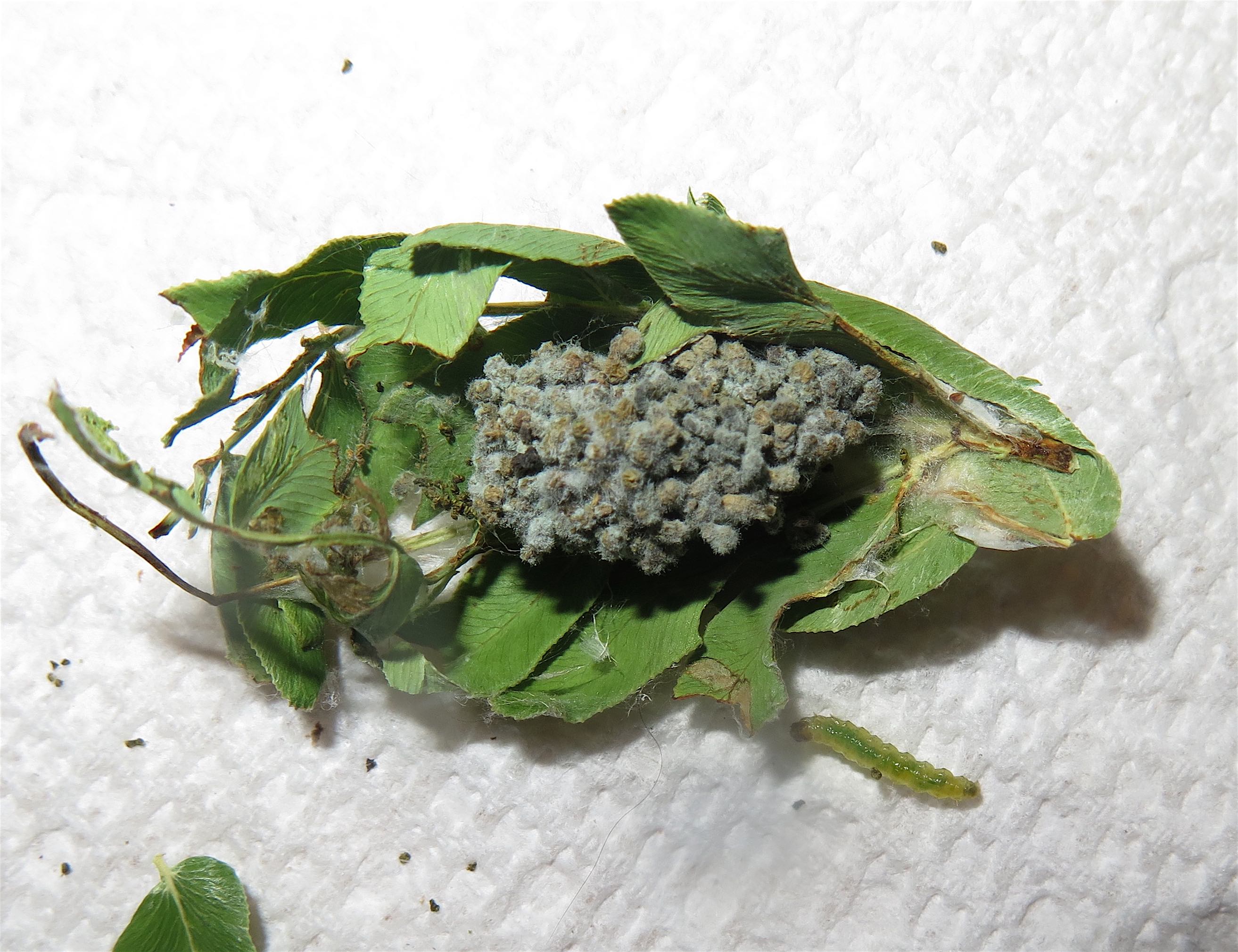
I could not find any Tubercled Orchids, but I sure did find an interesting phenomenon among the Royal Ferns.  Just as I had discovered for the first time a year ago,  the tips of many fronds had been rolled into hollow orbs, secured with silk. But this year, I knew immediately what they most likely were: protective chambers where sawfly larvae can safely feed until they pupate there within.


Here's a closer look at one of these orb-shaped chambers, shaped and secured with silken threads.


After much searching on Google last year, I finally found a site that mentioned a likely candidate for the little green larva feeding inside the rolled-up fern leaves. On a site from the University of Wisconsin/Milwaukee,  I learned that "the sawfly on  the Royal and Cinnamon ferns is probably in the genus Strongylogaster, whose larvae famously enjoy ferns."


How the heck did that tiny green larva poop out so many and such big pellets of frass?! Sorry, little critter!  I did sacrifice you (but mercifully quickly) in my search for information about you.


Did I mention the larvae were tiny?


Friday, June 16, 2023

A Year-old Mystery Solved!

Exactly one year ago, I set off along this very shore of the Hudson River at Moreau.  I was searching for one of our native orchids, called Shining Ladies' Tresses (Spiranthes lucida), that I'd found blooming on this date along this same bank in other years.


So that bank was where I was moseying along, close to shore under the overhanging trees, when I saw this odd collection of tiny green jelly-like orbs cohering into floating shapes like hunks of miniature corn cob or six-parted posies. 


What the heck WAS this stuff?!  I had seen floating green jelly-like orbs of a cyanobacterium called Nostoc balls before, but they didn't stick together like this, nor do they show up until the fall.  Also, I could pick Nostoc balls up and the gray-green opaque orbs kept their perfectly round shape in my hand. As soon as I touched these shapes, they disintegrated into amorphous slime.  The  only way I could bring them closer to examine them was to hold water in my hand.  Then I could see that each "posy" was made up of tinier transparent orbs. I had never seen anything quite like this in my life.


 So back in June of 2022, I posted the above photos on Facebook, asking any of my naturalist friends if they knew what these green blobs were.  Nobody ventured a guess, back then.  But then, THIS year, on the same date, Facebook Memories posted the same photos again, along with my query.  I shared that Memory again, and this year, I got an answer!  At first I found that answer hard to believe.  A fellow naturalist named Mike Adamovic wrote: "They look like Spongy Moth caterpillar droppings."

Say what!?  SPONGY Moth frass? (I'd been showered with Spongy Moss caterpillar poop last year, and I did not recall it looking like this.)  "Yep," Mike replied, adding, "You can even see the leaf fragments they were chewing on floating on the water."  I looked at my photo again, and he was right about the leaf fragments.

Still skeptical, I searched Google Images for photos of Spongy Moth frass.  Most images looked nothing like my photo.  But then I saw this one:

Aw gee, except for these being brown and dry, this Google Image of Spongy Moth frass looked exactly like the shapes I'd found floating in the river.  And who knows what this dry brown poop would look like after soaking in river water? Also, the accompanying leaf fragments in my photo indicate that MY caterpillar poop was probably very fresh.

How amazing! What a complex digestive tract this caterpillar must have, to extrude this complicated shape of poop!

Thanks Mike Adamovic, for providing the answer to this year-old mystery.  And thanks, Facebook Memories, as well, for posting this photo once more, just when the right expert was seeing my post.  This is exactly what Facebook can be great for.

Oh, by the way:  I did find the Shining Lady's Tresses, right where I hoped I would find it. This is our earliest Spiranthes species to bloom, and easily identified by the noticeable yellow lower lip.


Wednesday, June 14, 2023

Roadside Wonders

A busy week, with many delightful botanical finds!  So many, in fact, that I'm only going to hit the highlights in this post, featuring mostly those I found close to a roadway.   I do include one exception, though, where we had to create our own "road" to the treasures we found.

Beach Road, Moreau Lake State Park

Obviously, I did not take this photo this week. It was taken last December, when I first spotted the evidence that a rare plant was growing right close to the road near the parking area for the swimming beach at Moreau Lake State Park.  The plant was Green Rock Cress  (Borodinia missouriensis), a Threatened species in New York State and also rated as Rare to Extremely Rare in New England.  It happens to thrive abundantly in several locations at Moreau Lake State Park, and it is immediately identifiable all year long, because of its long arching seed pods that persist throughout the winter. And it's easily seen from the road (if you know what you're looking for!).


Those arching seedpods were brown last December, while this week they were green.  But the distinctive pods were still quite visible from the road, even against the overall green of the background woods.


The wee little white flowers of Green Rock Cress would not be so visible from the roadway. In fact, I had to search a bit for them, standing right next to the plants.


I was also delighted to find two other native wildflowers in the same vicinity as the Green Rock Cress.  Both of these, too, had gone to seed, but their seeds are among the most interesting parts of the plants.  Note how the stalks of the chubby, three-parted seeds of Perfoliate Bellwort (Uvularia perfoliata) seem to poke right through the leaves before they rest on them.


Although this lush patch of Solomon's Seal (Polygonatum biflorum) was truly evident along the road, its seeds were actually still well-hidden within the berries dangling from the leaf axils.

If you lift up a leaf, the berries of Solomon's Seal are easy to see:


Powerline Road, Moreau, NY


Lucky for me, I arrived at this powerline roadway before the skies opened up and drenched me as well as this tiny little Virginia Dwarf Dandelion (Krigia virginica), or I never would have seen it. After the rain, the flower had closed so tightly it became invisible. Despite the "dandelion" part of its name, this denizen of dry sandy soils is one of our native wildflowers.  A really cute one, too.


I was surprised to see our native Wild Lupine (Lupinus perennis) still in beautiful  bloom along this sandy roadway.  At many other sites in Saratoga County, the flowers are now going to seed.  Although this species is rated as a Rare plant in the state, I find it occurring naturally in many sandy-soiled sunny areas of our county, and it is also massively planted in some preserves, since it provides the only larval food for the Federally Endangered Karner Blue Butterfly.  


I love how the texture of Wild Lupine's leaves allow the raindrops to bead up and sparkle like jewels.


Here was the wildflower I was quite willing to get soaking wet to see.  Thankfully, the rain barely penetrated the thick pine woods I pushed through to find a nice patch of Green-flowered Pyrola (Pyrola chlorantha). Otherwise, I would not have risked getting my camera wet to take this picture. Green-flowered Pyrola is not a rare plant in our state, but it usually takes some searching to find it, and I was delighted to find it blooming now.


An Old Logging Road, Warren County


Almost exactly one year ago, I reported finding a new-to-me species of Blue-eyed Grass that was growing along an old logging road up in northern Warren County.  Imagine my surprise when I learned that Sharp-tipped Blue-eyed Grass (Sisyrinchium mucronatum) was an Endangered species in New York State and had never been reported from Warren County. Until I reported it. (This species is also either extremely rare or no longer existent in most New England states.) 

When it was time for it to bloom again, Richard Ring, chief botanist with the New York Natural Heritage Program, asked me to escort him to where I had found this rare Blue-eyed Grass. That's Richard, above (peering through his loupe), along with his assistant Rachael Renzi, in the process of assessing the abundant population we once again encountered, and at several different locations along the road.

The most obvious evidence that this is no ordinary Blue-eyed Grass is how very fine and rather floppy its leaves are.  My Newcomb's Wildflower Guide informed me that S. mucronatum's stems were very slender and barely winged, compared to other species of Sisyrinchium. I also learned from Newcomb's that its "Stem [was] without a bract in the middle and unbranched, [its] flower cluster overtopped by a pointed bract."


And sure enough, the flower clusters were indeed "overtopped by a pointed bract."


Forging a Trackless Path to a Hidden Bog

After assessing that Sisyrinchium mucronatum population, Rich Ring hoped my companion Ruth Brooks and I might escort him and Rachel to a well-hidden bog nearby.  Of course we would! But we did add that we'd have to push our way through a moat full of masses of tangled branches and blow-down, and teeter over slippery moss-covered logs to avoid slipping knee-deep into muck.  Ruth was careful to mark a trail with pink tape, so we could be sure to find our way out.


Ah, but the effort was surely worth it!  We eventually emerged onto a broad sphagnum-carpeted bogmat surrounding a Black-Spruce-ringed kettle pond.  Aside from the shrubs of Sheep Laurel and Labrador Tea, the most obvious denizens here were the tall-stalked, red-flowered Purple Pitcher Plants (Sarracenia purpurea) protruding above the sphagnum.


It took some searching, but then we came upon a good-sized population of the Dragon's Mouth Orchid (Arethusa bulbosa) trying to hide from our view among the taller vegetation.  Well, any flower this brightly colored is not likely to stay hidden for long, and Rich and Rachel and Ruth and I counted at least 40 gorgeous specimens, more than we'd found on last year's venture here.


If Arethusa bulbosa announces its presence through its vivid color and ample size, this next Threatened species,  Carex chordorrhiza, does its successful best to remain well hidden from view. (Well hidden, that is, from everyone except such an expert botanist as Rich Ring, who easily spotted it and showed it to us!)  First, its stems are slender and spikelets small, easily overlooked among all the bog grasses.  And then it buries its most distinguishing feature down deep in the sphagnum, the previous year's vegetative stem now lengthened dramatically and lying flat and nestling within the moss, with this year's new growth sprouting from its internodes. That now-brown stem could easily be mistaken for a rhizome, a feature that inspired its vernacular name, Rope-root Sedge.  Once Rich had shown it to us, we could spot it almost everywhere.  We New Yorkers are lucky to have this sedge, even as a Threatened species. It is rated as Extremely Rare in New England states.


Another sedge, called Few-flowered Sedge (Carex pauciflora), was much easier to spot, for its larger, sharply pointed yellow spikelets were quite evident against the deep red of the sphagnum. This attractive sedge is a common species in New York, although it is ranked as Extremely Rare in Massachusetts and considered Historical in Connecticut.  


As a plant enthusiast, I sure feel lucky to live in New York, especially up here in the northeastern region of the state, where some of our rarest plants can be found simply a short walk away from where I parked my car.  Although, of course, some can't.


Friday, June 9, 2023

Green Woods and Rugged Rocks

May 20 was bright overcast and cool, perfect conditions for exploring the Mount Tom State Forest, a 1700-acre preserve in Washington County, very close to New York's border with Vermont. This field trip, offered by the New York Flora Association and led by the New York Natural Heritage Program's chief botanist, Richard Ring, was attended by a happy group of adventurers, eager to see what plants might be flourishing in this rich woods.  With the tree canopy only recently closed over by spring's new leaves, the very air was luminous, lit by a soft green light as we eagerly set off into the forest.


Our trip leader, Rich Ring (red jacket), confers with fellow plant enthusiast Tom Phillips, while Rich's  Natural Heritage Program colleague, Elizabeth Spencer, prepares to document all our botanical finds as we explore this forested and mountainous terrain.  Two of our fellow attendees (center) are already busy exploring a boulder's botanical offerings.


Much of our trail passed between gigantic cliffs and rocky ledges, whose mineral content contributes to a calcareous habitat for many lime-loving plants that thrive on the forest floor.  And the "bryo-philes" among us found much to attract their interest among the cliffs' myriad cracks and crannies, home to many different species of mosses, liverworts, and lichens. 


A recent regional heatwave brought many spring wildflowers into bloom much earlier than usual, so we considered ourselves lucky to find a few still-flourishing blooms on the many Large-flowered White Trilliums (Trillium grandiflorum) that abound in this rich woods.


Some Large-flowered White Trilliums were obviously fading, while many Foamflowers (Tiarella stolonifera) still flourished with sparkler-like inflorescences.  The yellowing leaves in this photo belong to our native wild leek, called Ramps (Allium tricoccum), which loses its leaves before it even starts to flower.


As our trail began to pass through a hemlock-dominated section, I mentioned to one of my companions that a hemlock woods was a good place to look for Painted Trillium (Trillium undulatum), one of our very few native wildflowers that can tolerate the tannin-saturated soil under hemlocks.  And guess what? Et voila!!!


I look forward to reading Elizabeth Spencer's plant list to remind me of all the wildflowers we found but which I did not manage to photograph, while trying to keep up with our more able-bodied companions (huff puff!).  I did manage to snap a few, including this puffy white inflorescence atop a White Baneberry plant (Actaea pachypoda), distinguishable from that of Red Baneberry by the stubbier pedicels and more oval (rather than spherical) shape of the bloom.


Lots of violets of several colors flourish here, including some called Downy Yellow Violet (Viola pubescens), a stemmed species frequently found in calcareous habitats like this.


Hundreds of tiny white basal-leaved violets lined the trail and confounded even the professional botanists among us as to which species of small white violet they might be.  Somebody's cellphone app claimed they were Viola macloskeyi. But wait!  Isn't that a species native only to the northwestern U.S.? Or has violet-expert Harvey Ballard's new monograph on northeastern violets re-assigned one of our eastern early white violets to this taxon? Aaargh!! 


At least none of us had any doubts as to what this lovely stemmed violet's name was. The yellow-throated, pure-white face and purple petal-backs are distinguishing traits of no other violet but Canada Violet (Viola canadensis).  As is the calcareous habitat.  And the neighboring Maidenhair Fern (Adiantum pedatum) is often found accompanying Canada Violets, since both are calciphiles.


Is Blue Cohosh a calciphile?  And which Blue Cohosh is this, surrounded by Christmas Fern and some species of wild currant? I can distinguish the purple-flowered Early Blue Cohosh (Caulophyllum giganteum) from the later-blooming yellowish-flowered Blue Cohosh (C. thalictroides) when they are new, but by this late in spring, they both look alike to me. I know that I do find both species in a limestone-underlaid woods in Saratoga Springs, but I do not know if that is exclusively their habitat.


But I have found this next fern, called Goldie's Fern (Dryopteris goldieana) only in lime-rich forests.  The last time I saw it (years ago!) was near marble quarries in Vermont, but I recognized it here right away, first by its larger-than-most-ferns size, and also by how its green color seems to fade to nearly gold by the tips of its pinnules.


(My friend Sue Pierce's photo of Goldie's Fern better captured the golden glow of this lovely fern.  Her photo also included a few fronds of Glade Fern, another fern known to prefer such a lime-rich habitat.) 

Photo by Sue Pierce


Glade Fern (Homalosorus pycnocarpos) -- formerly known as Diplazium pycnocarpon -- is a species that I have seen before only near marble or limestone. Its upright posture with closely-held narrowish fronds are distinctive, as are the slender shiny-green uncut pinnae, which tend at the apex to curl at the tips like a fiddlehead. In many ways, ferns all kind of look alike at first, while close examination reveals all the ways one fern can be told from another.


Time for lunch!  Some happy hikers find the best seats in the house. My friend Sue Pierce caught hungry me putting my camera away so that I could grab my sandwich.

Photo by Sue Pierce
 

Those "mossers" over there must have missed the dinner bell (or, more likely ignored it for interrupting their fascinated examinations).  But they'd better take some sustenance for the challenges about to ensue.


Yep.  Now we're heading up.  And up and up and up.  Sometimes on my hands and knees, in fact.  Do you see that narrow trail on the left, leading up and around this crag?  That's where we're going next. And that's where my photographing ends, since I needed my hands to grasp tree trunks to haul myself up steep slopes.  But I made it! What a trip!  Lots of plants, lots of fun, lots of great friendly and knowledgeable folks.  And only a few sore muscles the next day.