Tuesday, July 12, 2022

Mountain-top Botanizing


From left: Steve Young, Bruce Gilman, Tom Phillips, Ruth Brooks, Jackie Donnelly, Katie Beeles
Does this look like a happy bunch of botanizers?  Well, why wouldn't we be happy?  We couldn't have had a more beautiful day for seeking out those plants that thrive best at high altitudes, on a field trip offered by the New York Flora Association.  And we made it all the way to the top of Whiteface Mountain, one of the highest peaks of the Adirondacks,  while having to hike only the last 1500 feet or so. 

Granted, it was kind of a steep 1500 feet, along a walkway from the parking area at the end of the Whiteface Memorial Highway (a 5-mile-long toll road) to the actual summit. But that sturdy handrail helped to assuage any traces of acrophobia.  And it also helped me lift some weight off my arthritic knee as I climbed.


But of course, we didn't exactly charge up that walkway, either.  Being plant people, we stopped every few feet or so to examine what plants were growing along the trail. Our leader, Steve Young (only recently retired as Chief Botanist for New York's Natural Heritage Program), has been monitoring the plants at this site for years, and he brought along a checklist of all the plants that have been recorded for this location. Some of those plants are exceedingly rare, as well as found only in such high-altitude locations.


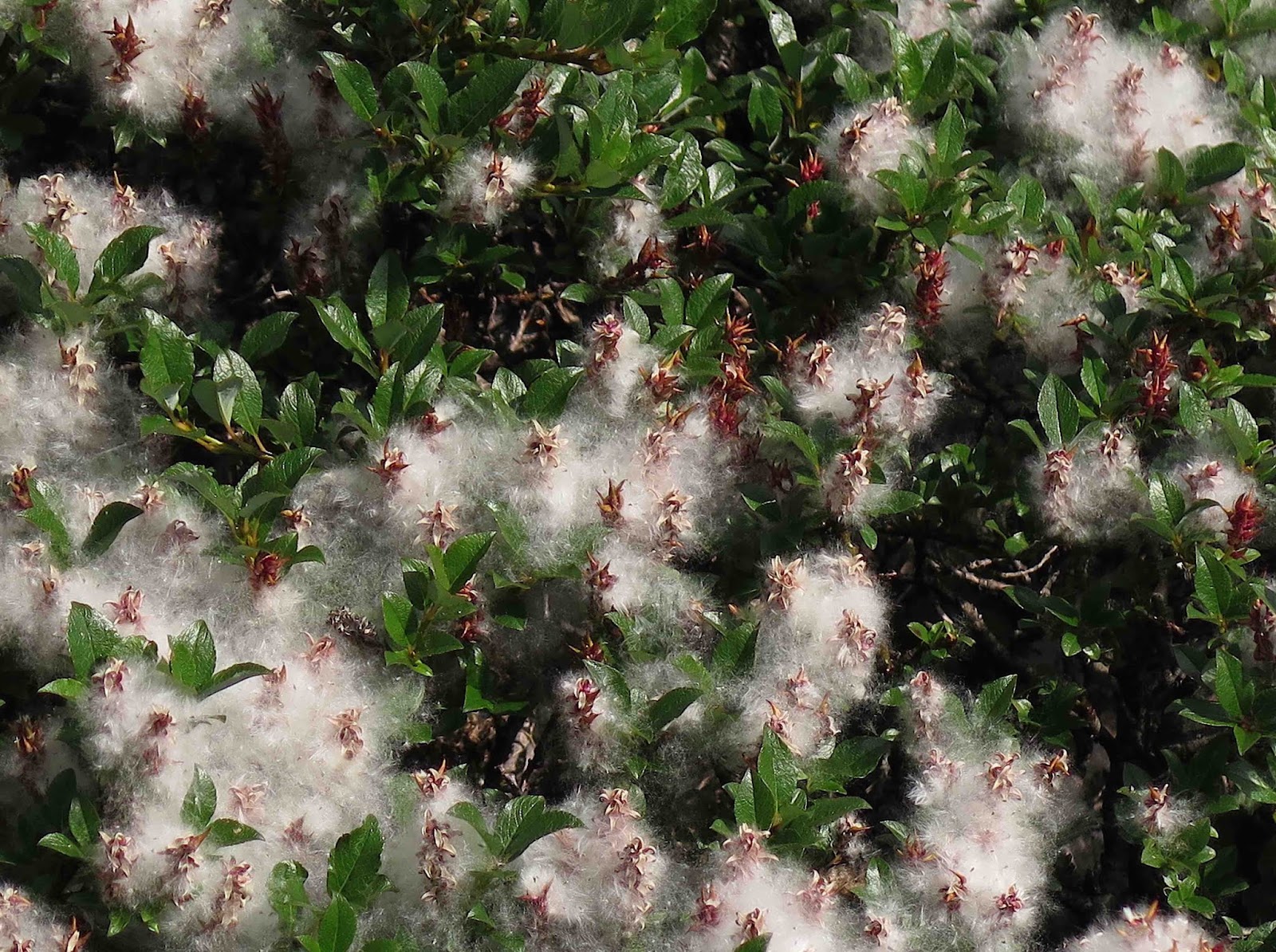
It seemed hard to believe that some of the plants we observed could actually be thought of as rare, they were so abundant on this mountaintop.  This Bearberry Willow (Salix uva-ursi), for example, while rated a Threatened species in our state (and similarly rare in surrounding states), spread its sprawling branches of shiny green leaves across wide swaths of bare rock near the summit. On our visit, those branches were studded with fluffy catkins, this plant's strategy for dispersing its seeds, aided by the near-constant winds that blow across mountaintops.


Here is a typical patch of mountain greenery, easily observed by simply leaning over the iron rail along the walkway. The small, rounded, blue-green leaves are those of Bog Bilberry (Vaccinium uliginosum), a typical resident of high-elevation habitats (also called Alpine Blueberry). The lime-green, spiky, inrolled leaves atop fuzzy orange stems belong to Labrador Tea (Rhododendron groenlandicum), a common inhabitant of lower-elevation bogs that can also tolerate the rigors of mountain-top habitats.  The small conifer is Balsam Fir (Abies balsamea), displaying much shorter and rounder needles than we see on our typical Christmas trees, a morphological response by this fir to the extreme weather conditions at this height. And the broader, lighter-green leaves belong to Mountain Paper Birch (Betula cordifolia), a species of birch adapted to the very cold temperatures of high-elevation regions.


This fruiting Green Alder (Alnus alnobetula ssp. crispa) is a cold-tolerant species of alder found only in northern regions of our state. This dwarfed specimen has found its happy place in a cleft of the rock.


Not all the plants we saw are exclusive to alpine or sub-alpine habitats.  I do indeed find Bunchberry flowers (Cornus canadensis) at lower altitudes, but it is known to prefer the colder regions of our state, and it certainly looked very happy here, nestled among the leaves of Bog Bilberry. It was unusual, though, to see this flower's normally snow-white bracts tinged with pink.


Mountain Sandwort (Mononeuria groenlandica) lives up to its vernacular name by definitely preferring the rocky clefts of mountain summits, and it was beautifully in bloom on this day. I love how it grows in such pincushion-shaped clumps, so thickly covered with blooms I could hardly make out its needle-fine spiky leaves.


Here is another denizen of the dry, rocky, mountain-top habitat,  the sprawling, low-growing, woody-stemmed wildflower called Three-toothed Cinquefoil (Sibbaldia tridentata). We were lucky to visit it while it bore such abundant blooms.


The Alpine Goldenrod (Solidago leiocarpa) was just starting to open its tufts of yellow blooms. Although rated a Threatened species in New York, this goldenrod is abundant atop Whiteface Mountain.


Here was the rarest flower we found on the summit today, Boott's Rattlesnake Root (Nabalus boottii), and we were lucky to find just a few blooms beginning to open out of abundant patches of leaves. Known from only a few mountain peaks in New York and New England, Boott's Rattlesnake Root is not only classified as an Endangered species in New York State, but it is also rated as a Threatened species around the globe.  Up on this mountain top, though, you might never imagine it to be such a rare plant, considering how it thrives here.


We also found a number of rare grassy plants, including this sprightly tuft of Highland Rush  (Oreojuncus trifidus), a Threatened species in New York that is mostly restricted to high-altitude sites.  (You can gauge how high up it was growing by how far down Lake Placid appears in the distance.) It  certainly seemed very happy atop this mountain, to judge by how many clumps of it we found sprouting from bare rock. The brown tips of the leaves is a distinctive feature of this rush, even while young, not an indication that it is fading. 


This Canadian Single-spike Sedge (Carex scirpoidea ssp. scirpoides) is an even rarer plant, an Endangered species found nowhere else in New York but here on Whiteface Mountain. One would hardly be able to guess at such rarity, to judge by how many plants were thriving  up here.


Here, our friends edged quite close to precipitous cliffs in search of another prize plant that grows very near the summit of Whiteface, a nice patch of the Endangered species called Bigelow's Sedge (Carex bigelowii ssp. bigelowii). Known from only two counties in New York, this sedge can tolerate very open alpine conditions.


I'm very glad we had our sedge experts with us today, for I would have walked right by this unprepossessing patch of green stuff and never have noticed Bigelow Sedge's distinctive (and quite pretty!) green and brown spikelets.


We made it to the very top! And as this photo reveals, so did many other folks on this beautiful blue-sky day, with mild temperatures and gentle winds.  It was quite a challenge for me to guess what were all the different languages I overheard in passing. The presence of that toll road up most of the mountain, plus an elevator that can lift even disabled folks very close to the summit, contribute to Whiteface Mountain being quite a tourist attraction. I wonder how many of this summit's visitors are aware of the amazing rarity of some of the plants they pass on their way to the top.


And now we had to go down! Although Ruth and I chose to return to the parking area via the hand-railed walkway we came up on, the others in our group chose the more challenging trail down, one that required more scrambling over boulders and lowering oneself down steeper inclines than my arthritic knee could safely carry me.  I have descended by this trail several time, before I broke my kneecap, so I remember quite well its difficulties, even when I was more able-bodied.  Here, Katie bids us goodbye as she prepares to descend, while also demonstrating good trail etiquette, by staying on the rocks.


Ruth kept me company on the alternate route down, although both of us did stand at the top of the descending trail and gazed down, wondering what botanical rarities we might be missing.


Ah well, by eschewing the more difficult route, we were present when this enormous shiny black bug came winging by, dangling its orange-colored legs in a flight posture similar to that of a wasp. But neither of us had ever seen a wasp as big and fat as this. It must have measured at least an inch and a half from its head to the end of its segmented abdomen. 


When it kindly landed on a grassy stalk and turned its back to us, we could see the distinctive white patch on its thorax and take photos that might better help us obtain its ID. Thanks to cell service atop the mountain, Ruth was able to get a response from iNaturalist, informing us that our bug was most likely an Elm Sawfly (Cimbex americanus).  Sawflies are a kind of wasp, yet without the narrow "waist" nor a stinger. Since I did risk annoying this bug by nosing my camera in close, I'm glad to know I never risked being stung.


And then we climbed down.  And down and down and down and down. Even on this "easier" route, to my tired legs it seemed even longer going down than it did climbing up! But the scenic views were absolutely fantastic!


We re-connected with our friends at a picnic area below,  where we had a chance to see one of the rarest herbaceous flowers yet of our adventure, the diminutive Lesser Shinleaf (Pyrola minor), hiding well back in the woods. 


When I first met this small Pyrola some years ago, I learned that Whiteface Mountain was the only place this Endangered species was known to grow in all the state.  The New York Flora Association's plant atlas now shows it as vouchered from neighboring Hamilton County as well as Essex County, but it's still a very rare plant -- even rarer now than when I last saw it up here three years ago, in a ditch since cleared by road work. At least in this second wooded location, this rare plant seems less likely to be destroyed by human activity. I am so happy I once again got to see its distinctively globular florets, with no styles projecting beyond the florets (a feature of other Pyrola species).  One last little treat to end this amazing day of many other botanical treats!

Monday, July 4, 2022

Some Flag-colored Flowers (and others) at Orra Phelps

What a lovely day it was to celebrate our nation's independence!  Warm enough, but not too hot, with a gentle breeze and no rain to ruin folks' cook-outs. As for me, I usually try to lie low on The Fourth, feeling grateful for my nation's stated high values but not wishing to join in the widespread celebration of the bellicose with "bombs bursting in air and rockets' red glare." But this is a noisy holiday it's often hard to avoid.  I did spend a quiet firecracker-free hour wandering the Orra Phelps Nature Preserve in nearby Wilton, and even there, I found the flowers blooming in all the colors of the American flag.

The RED ones you sure couldn't miss, with a beam of sunlight illuminating the flaming red of Oswego Tea (Monarda didyma):


As for the WHITE, there were several choices.  The biggest, showiest white flowers were those of Rosebay Rhododendron (Rhododendron maximum):


The fluffiest whites were the delicate blooms of Tall Meadow Rue (Thalictrum pubescens):


And the tiniest whites were the easy-to-overlook miniature blooms of Enchanter's Nightshade (Circaea canadensis):


As for BLUE, there was just one native option right now. Two species of Gentians will bloom here later, but today the only blue flowers were those of Spiked Lobelia (Lobelia spicata):


So, Hurrah for the Red, White, and Blue!


And to round out the color spectrum, I also found some gorgeous YELLOW Canada Lilies (Lilium canadense):


Some GREEN berries atop the Indian Cucumber Root plants (Medeola virginiana):


And finally, some PURPLE Flowering Raspberry blooms (Rubus odoratus):


So there we have it:  a whole RAINBOW of colors, to celebrate the whole spectrum of folks from every part of the world in every era who have made their home on this land. May we yet make of our nation the UNITED States of America. May we yet find a way to celebrate one another and live together in peace.

Happy Birthday, America!


The explosive red of this Oswego Tea (Monarda didyma) growing in my backyard and the silent twinkling of fireflies at night are the kind of fireworks I (and our cats) like best. Unlike "rockets red glare" and "bombs bursting in air," they are peaceful and quiet, leading me into contemplation of nature's beauty rather than celebration of my nation's military might. I love my country and heartily wish us a very Happy Birthday. The ideals our founders set forth for us are truly worth celebrating. But I also wish that my country's birth had not been achieved by war, thus setting the template for what many Americans consider victorious and heroic. What if we'd never fought the American Revolution, but somehow found a way to peaceably settle our conflicts with our sister-nation, England? Maybe we'd still be under England's heavy thumb and have to live in tyranny like those poor Canadians. Just think of it!

Friday, July 1, 2022

Frolicking and Fighting Among the Florets

With milkweeds of various species blooming now, many different insects are flocking to the fragrant Asclepias blooms, some to partake of the nectar and pollen, others to feast on the leaves.  I mentioned the Swamp Milkweed Leaf Beetle in my last post as one example of a leaf-eater, but the leaf-eater I find far more frequently is the Red Milkweed Beetle (Tetraopes tetrophthalmus).  As big and bright-red as it is, it would be hard NOT to see it.  Not that it feels any need to hide.  Achieving its own toxicity by imbibing the toxic sap of the milkweed leaves,  the Red Milkweed Beetle warns off potential predators by its vivid color.  And it's also obvious this beetle feels no need to hide its amours, since I almost always encounter it unabashedly in flagrante delicto. And sometimes I see other interested parties wanting to join the party. Or at least look on.  

Here is a dramatic sequence of insect erotica I observed on one occasion:

In this particular milkweed patch, almost every plant had multiple pairs of Red Milkweed Beetles doing what comes naturally during mating season.


Was this lone beetle just a voyeur, or was he hoping to join the party over on the next milkweed leaf?


Uh oh!  Looks like he decided to move in, either to get a closer view or else to challenge his rival.


What followed was a fierce battle for dominance. Coitus interrupted, the two male beetles began to brawl, locking jaws and yanking each other this way and that. Here, the winner has flipped his rival onto his back.  As the champion backed off, the defeated one squirmed to his feet and scurried away.


At this point, my camera lens got too close to the scene of this battle, jiggled the leaf, and tipped the conqueror onto the ground. So I never got to see if he was able to continue where he left off. Chances were probably good, though, that another rival had already taken his place. It appeared that his lady had many suitors to choose from.

Thursday, June 30, 2022

Notes from a Nature Week

This time of year, I hardly have time to post a blog, I'm so busy out in the woods or on the water. But I've got to clear my camera now for further adventures, so just for the record, here are some photos from some of the places I wandered this past week.

The "Green Team" Tours the Mud Pond Powerline


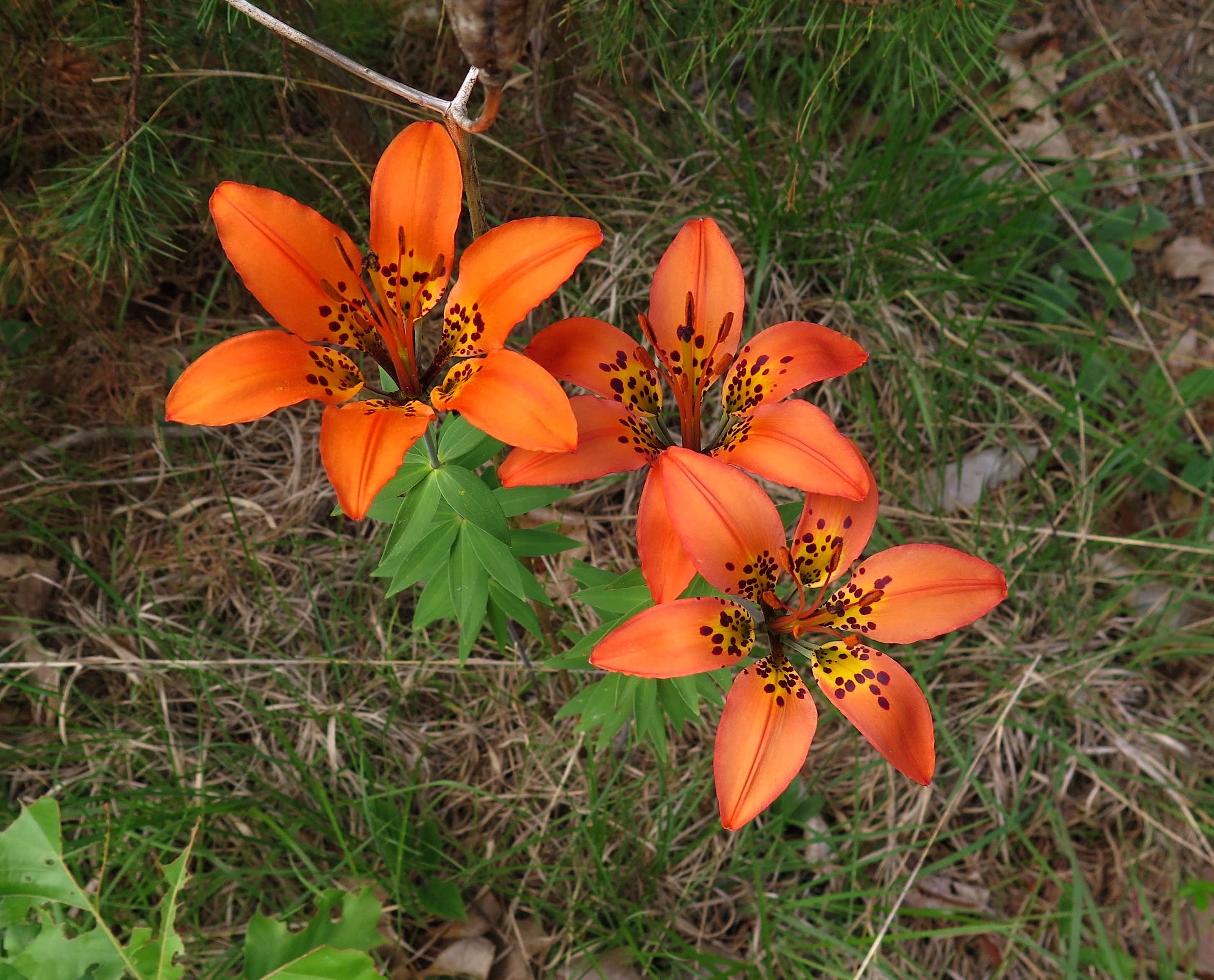
The "Green Team" is a group of volunteer master gardeners who beautify Moreau Lake State Park with flower gardens, using mostly those plants that are native to our region.  My friend Sue Pierce and I have been leading these gardeners to areas of the park where some of our most beautiful native wildflowers thrive, in order to witness these plants in their native habitat.  The last week of June is probably the most spectacular time to visit the powerline clearcut just north of Mud Pond, for that's when some of our showiest native wildflowers have come into bloom.  In the photo above, you can see how the brilliant Wood Lilies (Lilium philadelphicum) thrive among the wild grasses, actually preferring the sterile sandy soil here, over the rich soil that most garden plants prefer.

Here's a closer look at the Wood Lily's spectacular blooms.


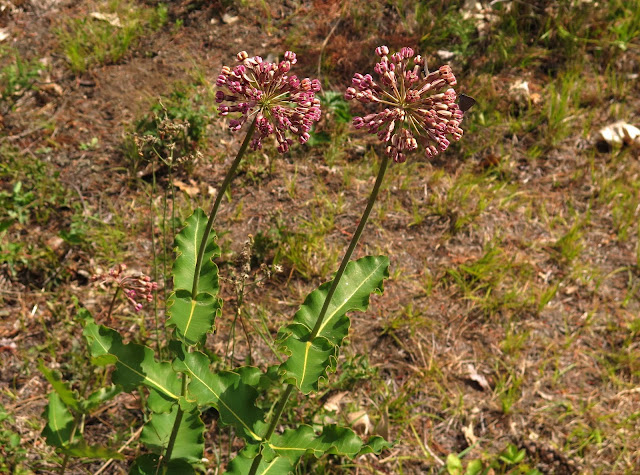
A second gorgeous wildflower that shares this sandy sun-baked site is the Blunt-leaved Milkweed (Asclepias amplexicaulis), which opens its exquisitely fragrant blooms at the same time that Wood Lilies do.


We weren't the only ones drawn to these milkweeds' beautiful blooms.  We saw Banded Hairstreak Butterflies feeding on nearly every plant.  Often, multiples of them.


I'm not sure what this ant was doing on this Frostweed flower (Crocanthemum canadense), another native beauty that shares this sandy-soiled site.  Sue and I make sure to visit this flower on the first sub-freezing days of autumn, when the frozen sap curling around the frost-split stems reveals how this flower acquired its vernacular name.


Many of the Bear Oak shrubs (Quercus ilicifolia)  and other young oaks that line this powerline had been completely stripped of their leaves by now, due to voracious hordes of Spongy Moth larvae feeding on them.  But now that the caterpillars have done their worst and are preparing to  pupate, the young trees are putting out new leaves, colored red by the substance called anthocyanin, which helps to protect the fragile young leaves from sunburn.


I have read that a virus called Nucleopolyhedrosis is beginning to kill many of the Spongy Moth larvae still feeding in our forests.  On a walk near Moreau Lake just today, every caterpillar I saw was shriveled and limp, hanging dead from the tree bark.  It's too bad the virus didn't show up sooner in the season, before the caterpillars had defoliated whole forests of their deciduous leaves and conifer needles. But it certainly is encouraging to know that this scourge has at least one control.  In addition to Black-billed Cuckoos, which have recently moved in to gobble the caterpillars up.


The Graphite Range Community Forest in Wilton


This 200-acre mountainous forest just north of Saratoga along Rte. 9 won't be open to the public until the fall, not until the professional trail-builders have completed the 5 miles of specialized trails that will serve many different recreational needs, for hikers, mountain bikers, and forest bathers alike.  So what was I doing there, now?  As an early donor to the site's development and one who has some knowledge about native plants, I had been invited to tour the site in the early spring, but that was well before any plants had come into bloom. Now I wanted to see what might be growing along the trails. And I asked my best co-nature-nerds Sue Pierce and Ruth Brooks to help me with this task.

It didn't take long to pass through the open meadow until the trail climbed steeply into the mountainous terrain, where a stream tumbled down a deep gorge and the forest grew thick over our heads.


As we examined the bare-rock ledges that lined portions of the main trail, we noted the presence of Ebony Spleenwort (Asplenium platyneuron).  Although this fern is known to tolerate soils of varying pH, I usually find it in alkaline (higher pH) habitats, on substrates like limestone or marble.  Would we find other plants that would indicate calcareous soils?


We did find other plants that I have found only in rich calcareous woodlands, like the limestone underlaid woods at Skidmore College in Saratoga or near marble quarries atop a mountain in Vermont. One of those plants was Wood Betony (Pedicularis canadensis), and we found a huge patch of them. I really look forward to returning next year when all these plants are in bloom.


We eventually reached the site of the old graphite mines that suggested the name of this community forest preserve. And oh my, were they impressive, with great gaping entrances leading deep into rocky cliffs! Long abandoned now, the mines were in operation during the late 1800s and early 1900s. Other evidence of the mining operations can be found nearby, including an old dam once used to process the graphite, crumbling stone foundations of buildings, and large grinding stones.


We were prevented from exploring the walls of the mines by pools of water covering the floors.  The water was the most beautiful color of blue, and we wondered what mineral or other substance might be the cause of that color.


This property, obtained by a private citizen to eventually be owned by Saratoga County, will provide a link to a future trail through the Palmertown Mountain Range that will connect Moreau Lake State Park to Saratoga Springs. The land conservation organization called Saratoga PLAN (Preserving Land And Nature) as well as the Open Space Institute were instrumental in the efforts to preserve this remarkable site and prepare to make it available to the public in the fall.


The Exposed Shores of the Hudson River at South Glens Falls

Wow!  Where did the river go?  As a matter of fact, it was being held back behind dams upstream, while work on the dam at Glens Falls is being undertaken. I have heard that the level has been lowered 8 feet, and that level will be maintained for some weeks, until the work is completed.  This section of the Hudson is one of our favorite places to paddle toward the close of summer, when some of our most interesting native wildflowers (some quite rare) thrive in a series of shallow backwaters, sorting pools carved out of the bank back in the logging era.  Each lumber company would store its own logs, floated down from the Adirondacks, in separate pools along here.  They would not be able to do that this week! Nor would we be able to paddle those shallow backwaters to find such floral rarities as Small Floating Bladderwort or Water Marigold. I can't help but wonder how they will survive this prolonged exposure.
It was interesting to see the remnants of the underwater plants now stranded high and dry on the mud. Most had been shriveled to unidentifiable shreds, but sweeping strands of Water Bulrush (Schoenoplectus subterminalis) revealed why I had made up my own name for it: Mermaid's Hair.  A more official common name is Swaying Bulrush.


I wonder what this Great Blue Heron makes of his disappearing pool? I'm sure it could still find a frog or two for its supper. 


At least some big patches of Pickerelweed (Pontederia cordata) still looked as beautiful as ever.


Higher up on the banks, we found some Swamp Milkweed (Asclepias incarnata) also beautifully in bloom. And look down there on one of its leaves: a colorful beetle had found this plant, too.


Such a pretty beetle! And so aptly named: the Swamp Milkweed Leaf Beetle (Labidomera clivicollis), seen here munching its favorite food.  A smart little bug, too. So as not to get a snoot full of milkweed latex that could glue its jaws shut, the beetle has severed the leaf veins upstream, so the milky sap flows out before it reaches the edge of the leaf the beetle is feeding on.  And similar to most other insects that feed on toxic milkweed, its bright red coloration serves as a warning to potential predators that this bug is not palatable.