Monday, June 13, 2022

Bog-Trotting With My Best Nature-Nut Pals

I am such a lucky nature nut!  Not only do I live surrounded by fabulous natural areas, I have the best equally nature-besotted pals who love to explore them with me. These are friends who don't mind taking an hour to walk fifty yards, often spending as much time on their knees examining tiny finds through their loupes as they do on foot. Or searching the treetops for a sight of the loudly vocalizing Scarlet Tanager that hides from view despite its vivid plumage.  Or thumbing through guidebooks or smartphone apps for assistance in identifying some unfamiliar species.  And these friends not only happily share all they know about plants or birds or bugs or fungi or mosses and more, they also know secret places to go to find the best stuff. And they share those secrets with me.

In this photo above, three of my best nature pals -- Sue Pierce, Ruth Brooks, and Evelyn Greene -- are leading me toward a secret bog that they know of, where we hope to find some really rare plants. And we only had to walk about a mile down an old logging road before we plunged through dense forest to reach that bog.

There are no nicely groomed trails through this woods, so we had to make our own way to the bog, pushing through face-clawing spruce boughs and teetering over ankle-twisting blowdown.


Hmmm . . . .  Evelyn seems to be pondering which rotting log could support her progress through boot-sucking muck.


The swamp-soggy logs were covered with so much and so many kinds of beautiful mosses, we often felt reluctant to step on them. And of course, our pace was slowed for another reason, simply because we had to stop to see if we could put a name to many of them.


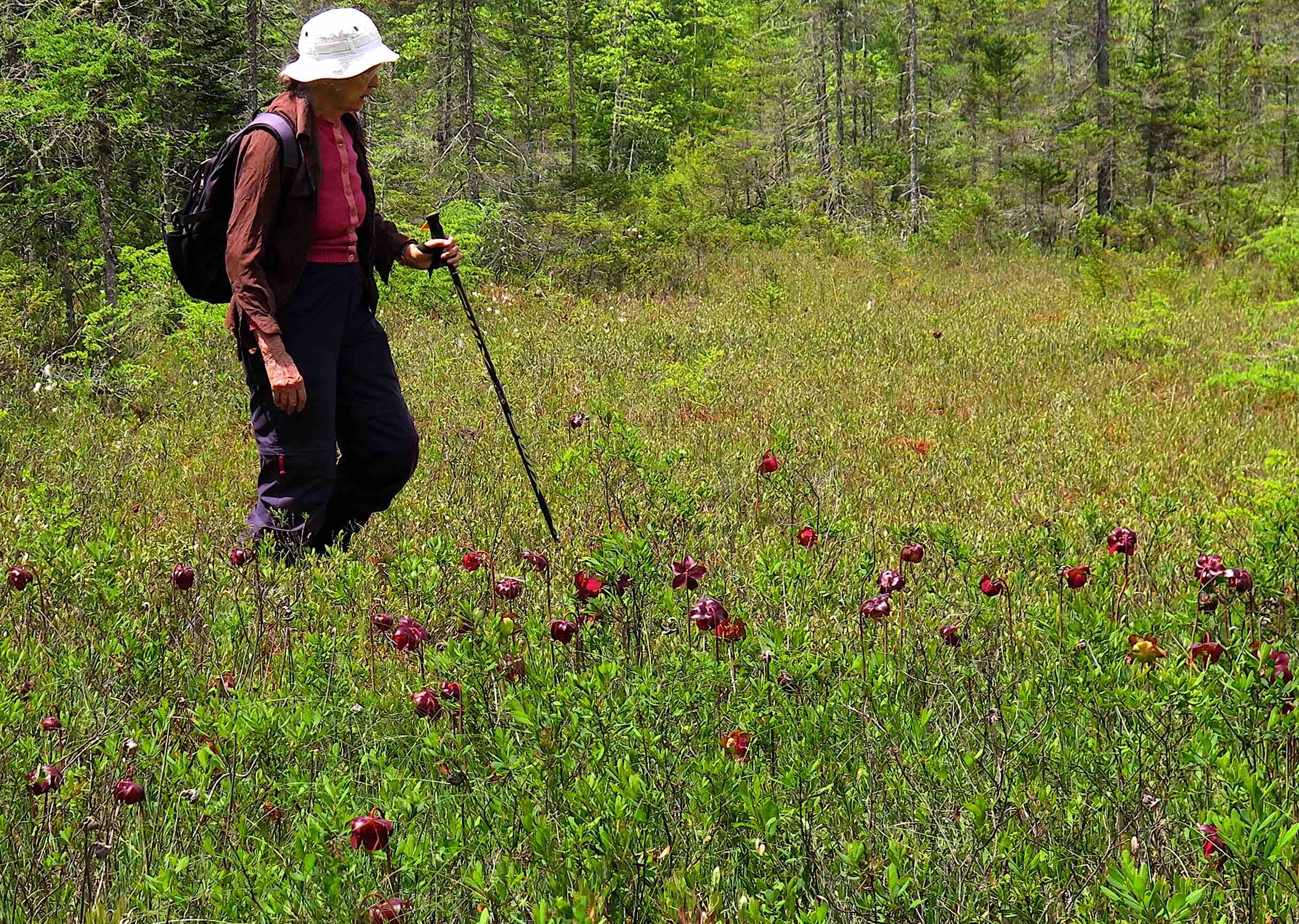
Ahhh! We reached the bog at last!  A large sun-drenched sphagnum mat stretched to the edge of a pool that was rimmed with Black Spruce, typical vegetation of a northern bog.


The sphagnum mat was dotted with hundreds of the dark-red flower heads of Northern Pitcher Plant (Sarracenia purpurea).


Sprouting up from mats of red sphagnum, the vase-shaped leaves of the Pitcher Plants were filled with water, this carnivorous plant's method of obtaining nutrients by drowning insects trapped within the leaves.  The plant will then absorb and digest the insects.


The flowerheads of Northern Pitcher Plant can be quite beautiful. And they certainly have a very distinctive structure!


Another common inhabitant of northern bogs, called Labrador Tea (Rhododendron groenlandicum), was currently in full bloom, bearing clusters of white flowers above its leathery inrolled leaves that are green above but covered with orange fuzz beneath. The flowers are not noticeably fragrant, but the crushed leaves certainly are, with an aromatic scent that produces the signature smell of northern bogs.


Sheep Laurel (Kalmia angustifolia) is another shrub common to northern bogs, and we were visiting this bog at the right time to enjoy its beautiful flowers.


The bright-yellow flowers of Flat-leaved Bladderwort (Utricularia intermedia), while small, were easy to spot, protruding from the dark water at the edge of the bog mat. We could even see the spiky underwater leaves of this carnivorous plant, although I could not make out the tiny sacs the plant uses to suck up even tinier underwater organisms.  Most members of this genus, being leafless, depend solely on their underwater sacs to obtain needed nutrients.  But this species,  since it does bear leaves, appears to obtain at least some of its nutrients through its green leaves, via photosynthesis.


As we walked near the edge of the woods that surrounded the bog, we found large patches of one of our prettiest late-spring wildflowers, a diminutive species called Twinflower (Linnaea borealis), each plant bearing two identical pendant pink flowers atop a single hairy stalk.


We had encountered hundreds of Bog Buckbean's three-leaved plants (Menyanthes trifoliata), but only a very few were still bearing the distinctive white flowers, each bloom lined with curly hairs. All others had gone to seed by this late in the spring.


We were lucky today to have Evelyn with us, for she alone among us knew what we were looking at when we found this heap of old water-logged deer droppings.  What looked to the rest of us as if it could be some kind of green algae, Evelyn recognized as a special moss that only grows on animal dung.  In fact, it is called Pennsylvania Dung Moss (Splachnum pensylvanicum). It looks as if a spider has spun some webbing (now strung with tiny water beads) among the dung, as well. A surprise find, indeed!


And here was the treasure we'd hiked a long distance and struggled through clawing blowdown and boot-sucking mud to find: the exquisite native orchid called Dragon's Mouth (Arethusa bulbosa). Although it is classified as a Threatened species in New York State, when this orchid finds a habitat that meets its requirements (cold northern acidic bogs and fens), it can sometimes appear in large local populations. I can't recall exactly how many my friends and I found this day, but I believe it was somewhere around 30 beautiful hot-pink specimens.


Our treasured bog species located and admired, we were ready to start the somewhat difficult journey back to our cars.  Ah, but where did we come out?  We had to study the deeply wooded edge of the bog before one of us sighted the bright tape Ruth had tied to a tree where we had emerged.


Trudging somewhat wearily back along the same abandoned logging road we had walked before, we were delighted to find that these flowers of Blue-eyed Grass (Sisyrinchium sp.) had opened since we'd passed them some hours before, when the flowers were still in tight bud. We were intrigued by the very slender leaves and stalks, as well as the plant's clumping habit, and hoped that the open flowers might help us determine its species.


Well, the flowers looked pretty much the same as those of other Sisyrinchium species we frequently find, so that didn't help. But the long, almost needle-fine bracts surmounting the flowers were an important clue. As were the very narrow leaves, barely one-sixteenth of an inch wide. Also, the slender stem was not winged the way the stems of some other species of Sisyrinchium are.


When I got home, I searched my Newcomb's Wildflower Guide and there I found a description that seemed to perfectly describe our plant: "Stem without a bract in the middle and unbranched, flower cluster overtopped by a pointed bract. Stem very slender, barely winged, 1/16" wide, leaves much shorter than the flowering stems."  Newcomb called it "Slender Blue-eyed Grass (S. mucronatum),"  which would be the same species the New York Flora Association's Plant Atlas calls "Sharp-tipped Blue-eyed Grass," in reference to the sharp bract that surmounts the flower.

Here's what else I learned about Sisyrinchium mucronatum from the NYFA Plant Atlas: this particular species of Blue-eyed Grass is actually an Endangered species and has never been reported from the county where we found it.  Wow!  If this Blue-eyed Grass is truly what I believe it is, it is rated even rarer than the Dragon's Mouth orchid we'd ventured out onto that bog to see. And we found dozens of the plant along that old logging road. 

I guess you can imagine how excited this wildflower-obsessed nature nut was to learn what we  had found.


Monday, June 6, 2022

A Few Busy Days and Their Flowers

This past week has been a busy one, and next week will be even more so. I'm having so much fun out there, it's hard to find time to post blogs.  Just for the record, then, here are some of the highlights of the past few days, before the next few days start to fill up my calendar and my photo files again.

Friday, June 3, The Hoosic River at Canal Park

Since I'm leading a nature walk here this coming Tuesday, I needed to see what was happening now at this site where the Hoosic River joins the Champlain Canal of the Hudson River. A remarkable feature of Canal Park is a low-lying alluvial area where a large number of rare and interesting plants are known to grow.  Also, the view of the Hoosic here is really nice (see photo above).

One of the most remarkable plants we find here is Green Dragon (Arisaema dracontium), an Arum Family plant related to Jack-in-the-Pulpit. Like those more familiar Jacks, this plant bears its tiny flowers on a spadix enclosed within an enveloping sheaf called a spathe, with the spadix protruding in a long slender spire that turns yellow as it matures. In this rich alluvial soil, where river silt is deposited by spring floods, the Green Dragons grow here to prodigious size, and in abundant numbers. 


Sadly, another lover of riverbanks has gained a foothold here, the horribly invasive Yellow Iris (Iris pseudacorus).  If left to its own devices, this non-native iris will drive out all the herbaceous native plants that grow here now, no doubt including even the sturdy Green Dragons mentioned above.  Well, let's just say I wasn't going to let that happen. The participants on Tuesday's nature walk will not find most of these botanical villains here anymore.


Just downstream from the low-lying alluvial area where the Green Dragons grow, shale banks rise steeply from the river's edge.  This shale is habitat for various plants that grow right out of the rock, including many interesting mosses and liverworts, which my friend Ruth is examining closely here.


No, wait!  I think that Ruth is instead examining the flower heads of these small daisy-like plants that are growing right out of the shale.  They look very much like the very common Philadelphia Fleabane, except that the flowers are somewhat smaller and they grow on shorter stalks than does that common fleabane.  These are instead the Threatened variety called Provancher's Fleabane (Erigeron philadelphicus var. provancheri), and they grow here on this shale by the hundreds. Their identity has been verified by one of New York State's rare-plant investigators.


I hope the Hoosic water levels stay low enough next week, so that I can lead our nature-walkers out along this rocky shoreline, where many more interesting plants have found a happy home.


I sure hope these plants of Hairy Beardtongue (Penstemon hirsutus) will still have a few of their pretty purple flowers left on Tuesday. And also, that their location is accessible by foot.  I've been exploring this park for several years and it wasn't until just last year that I discovered how abundantly this species grows on this low rocky stretch of Hoosic shore.   This shoreline is often underwater, prohibiting on-foot exploration by wildflower seekers.


The lovely and fragrant Caroline Rose (Rosa carolina) also grows abundantly along this rocky stretch.


It would be great if the flower buds of this Canada Onion were open by Tuesday.  The small pink flowers are really pretty and such an unexpected find on an onion.  This tiny grasshopper was basking atop the clonal bulblets. This photo does not include the tiny spider I also saw lurking there, probably wondering if that grasshopper could be a likely candidate for its lunch, despite being three times its size.


Here's that little spider.  It looks as if the spider already has plenty in its pantry for its lunch:


On our return walk through a shady mixed hardwood/conifer woods, we stopped to search for the Sheep Laurel flowers (Kalmia angustifolia) hiding under its leaves.


This was just a small sampling of the many interesting Canal Park plants that I hope to show to my fellow woodswalkers this coming Tuesday, as well as to another group of friends who'll be visiting this same site just two days later. Did I mention my week would be busy?

UPDATE: When I returned to the Hoosic banks on Tuesday, I witnessed hundreds of tiny dust-colored moths (and one more-colorful visitor) feeding on the flowers of Indian Hemp:


Those moths intrigued me enough to go searching the internet, and there I learned (from a University of Wisconsin site) that these most likely belong to a group of moths called Petrophila (rock-lovers), and that they are always found near the eastern North American rivers that their larvae inhabit. The moths are found near rivers because that's where they lay their eggs, on underwater rocks in moving water. The female, clutching an air-bubble against her ventral surface to allow her to breathe, climbs down the surface of a submerged rock and deposits her eggs there. There are many different species of Petrophila moths, and it looks as if two different species have landed on this patch of Indian Hemp. UPDATE: I have since learned that the more colorful moth, while equally as tiny as the Petrophila  moths, probably is not related, although it shares the same habitat. It is called Spotted Thyris (Thyris maculata).

You can find out more fascinating information about these scuba-diving Petrophila moths and how their larvae cope underwater by visiting this site:


Saturday, June 4, The North Woods at Skidmore College

When a fellow wildflower nerd reported seeing the diminutive Four-leaved Milkweed (Asclepias quadrifolia) blooming now in the woods adjoining Skidmore College, I dropped all other stuff I was doing at home and scurried out there to see it. This is one of our only milkweeds that prefers the shade of the woods, as well as a lime-rich habitat such as that found in the Skidmore woods. Some years I have to search and search to find just a few of its dainty, pink-tinged flower clusters.  But this is a banner year for it, so I barely had to step onto the trail before spying it in many places. What a perfectly lovely little plant! I always make sure to kneel down to breathe in its exquisite fragrance, too.

While there, I took a short detour to the mucky edge of a mid-forest pond, expecting to find uncountable numbers of Tufted Loosestrife (Lysimachia thyrsiflora) blooming now.  And I definitely was not disappointed!


Heading back to my car through an open sunny area under a powerline,  I could see at a glance the tiny red trumpet-shaped flowers wreathing the stems of Orange-fruited Horse Gentian (Triosteum aurantiacum).


I also noticed I wasn't the only one stopping to visit the flowers.  Although this Silver-spotted Skipper had other reasons to stop there.


Back home again, I happened to visit my own back yard, and there I discovered that these adorable little native wildflowers, called Venus's Looking Glass (Triodanis perfoliata), had popped up between the bricks in our patio. 


There were hundreds of them, just starting to bloom with vividly purple flowers, starting at the top but eventually flowering from each leaf axil along the stiffly erect stem.  How the heck did they get here?  Are Triodanis seeds included in birdseed?  That's how we get volunteer sunflowers, amaranth, and sorghum, anyway. At any rate, I am happy to have them add their charms to our other delightful backyard volunteers like Lady's Thumb, Purple Morning Glory, Motherwort, Clearweed, Black Nightshade, Three-seeded Mercury, and Creeping Buttercup. I don't know where any of those others came from, either. But I'm happy to welcome them. If only they'd crowd out the Goutweed!


Sunday, June 5, The Village of Lake Luzerne, NY

Sunday was a spectacular summer day in Saratoga, the kind of day it would have been perfect to drive up to Lake Luzerne (20 miles north) to have lunch at Upriver Cafe, on a porch overlooking the Hudson River roaring over Rockwell Falls. Sadly, that charming cafe has closed, but my husband and I did the next best thing.  We bought subs at a great Italian deli in Saratoga and took them up to Lake Luzerne, to picnic in this lovely little park on a bench overlooking the river, just above where the Hudson plunges over the falls.

After lunch on the shore of the Hudson, we next walked up a steep pine-lined trail to Mill Park, where the Stewart Creek rushes down the mountainside, dancing and splashing and tumbling over rocks.


Stewart Creek runs from Lake Luzerne to the Hudson River, falling steeply over boulders in its precipitous course to the river. We sat on a nearby bench and zoned out to the sounds of splashing water and musical  birdsong, breathing the sweet clean pine-scented air. We felt so grateful to live in a part of our country so green and lush and with so many clean and beautiful waterways.


I have read that the splashing water of waterfalls or crashing surf releases negative ions into the air, a condition that is known to have beneficial effects on our physical and emotional well-being. I highly recommend the experience!  My husband and I had quarreled a bit during the ride from Saratoga to Lake Luzerne. But we leaned lovingly against one another while sharing that bench by the creek. And walked to our car holding hands.


Wednesday, June 1, 2022

Back on the Hudson Again!

Ah, to be back on the beautiful Hudson River again!   With the water lying mirror-still and the forested mountains like deep-green cliffs rising steeply from the banks!  And even better, to be paddling with my dear friend Ruth Brooks, and for two gorgeous days in a row, this past weekend. When we put in at the Sherman Island Boat Launch on Sunday, we even had the river all to ourselves.  What a paddler's dream!

This was my first paddle of the year, since for weeks earlier, the river had been so rowdy from rain and raging with boat-bashing flotsam I'd not dared to venture out on it with my tiny canoe.  But all was serene at last.  And after I heard reports of Early Azalea blooming now on that little island I am heading toward in this photo below,  nothing was going to keep me off the river any longer.  And nothing did.


Even before we reached the island, the clove-like scent of Early Azalea (Rhododendron prinophyllum) wafted across the water to beckon us.  And then, to wander among the many flowering shrubs dotting this rocky island was my idea of Heaven, the radiantly pink flowers still gorgeous and fragrant even as they begin to decline.


Other flowers, like Black Huckleberry and Dewberry, also thrive on this little island, and this beautiful Viceroy Butterfly came floating in to seek their nectar.  Viceroys are easily mistaken for Monarchs because their colors and markings are so similar, but the bars that cross the hindwing stripes are a definitive fieldmark of the Viceroy.


We had to step carefully to avoid crushing the low-growing flowers like these bright-yellow Small Sundrops (Oenothera perennis) and dainty sky-blue Bluets (Houstonia caerulea).


These Meadowsweet plants (Spiraea alba var. latifolia) had yet to produce their pretty clusters of tiny pink-tinged white florets, but their finely toothed leaves had a beauty all their own.


We next set off to explore the riverbanks in this catchment between the Sherman Island and Spier Falls dams.  Unlike many other boaters arriving now and charging down the center of the river, we slowly edged as close as we dared to the shoreline bedrock, delighting in the many wildflowers and lush green mosses that thrive atop the ledges and within the cracks in the rocks. 


Here were more Bluets, plus a tuft of the starry white flowers of Canada Mayflower (Maianthemum canadense) and the ruffly green leaves of Tall Meadow Rue (Thalictrum pubescens).


This Black Huckleberry shrub (Gaylussacia baccata) dangled its flower-heavy branches over the water.


Before we ended our paddle, we made sure to re-visit this tiny cove, where last fall we had found some very interesting mosses growing right under the shallow water.


The first one we found (perhaps Fontanalis antipyretica?) had long stems that spread across the sandy bottom.


The second underwater moss had shorter stems and it clung very tightly to the rocks it was growing on. Ruth believed it might be Fissidens fontanus, a species quite rare around here, but pinning down mosses as to their species often requires microscopic examination.  And we did not have a microscope with us in our canoes.


Ruth did have her cellphone, however, and here she was searching among the botanical resources she could access through her phone.  The mosses remained a mystery, though, until she could examine them microscopically and confer with some folks who are expert at moss IDs. But even if we couldn't pin a name on our underwater mosses right then, it sure was fun to find them.


* * *

We had such a wonderful time on Sunday, we agreed to return to the Hudson on Monday.  But this time we launched our canoes quite a bit further downstream, in an area above the Sherman Island Dam where the river flows back behind a large island and in and around a number of promontories. Once again, the river lay mirror-still beneath a bright-blue sky, reflecting the beautiful contours of the rocky shoreline.


Although the day was hot, here we could pass beneath the cool shade of cedars leaning over steep banks.


I used to always find an ample patch of Lance-leaved Violets (Viola lanceolata) tucked in among these rocky banks, and I was delighted to discover that those violets still thrived here.


Many of our violet species have finished blooming by now, but these Marsh Blue Violets (Viola cucculata) still held vivid purple blooms high above their heart-shaped leaves.


I remember gathering handfuls of juicy blueberries from the Lowbush Blueberry shrubs (Vaccinium spp.) that grow close to the water here, and I was pleased to note that it looks as if there will be an abundant crop again this year.


The flowers of Black Chokeberry (Aronia melanocarpa) are quite lovely, and the shiny black fruits are also attractive, later. But the bitter-tasting fruit reveals how this species might have acquired its vernacular name!


The fruits of these Wintergreen plants (Gaultheria procumbens) are much more pleasant to taste, and the bright-red berries are also attractive when they form later in the summer.  But these red-tinged new leaves are already quite beautiful.


As we paddled in and out of the series of coves that mark this section of riverbank, we were struck by how many huge trees have been toppled by windstorms that raged through here several years ago.  And when these shallow-rooted trees fell, they also peeled all the soil away from the rocks the trees had grown on.


I used to call this Three-pine Island, but alas, two of those three pines now lie uprooted across the bedrock.


And what the wind hasn't brought down, the beavers are trying to finish.  The marshy area behind what I once called Three-pine Island remains lined with towering Black Tupelo trees (Nyssa sylvatica).  But most have had their bark girdled by beavers, and many are already dead.  It amazes me, though, how many of them still leaf out and still produce fruit, despite what should have been mortal damage to the trees' vascular system. This photo reveals the beaver damage to the trunk, but also the seemingly healthy abundance of leaves that still sprout from the twigs.  I also found many flower buds among these branches, staminate and pistillate flowers on separate trees.


That many healthy pines still grow abundantly along these shores was made evident by the yellow pollen filming the water's surface. The swirling current and rippling wavelets created interesting patterns in the pollen.


We were mesmerized as we sat in our boats, watching Whirlygig Beetles move through the pollen film, their every movement recorded in dark lines traced through the film.


I like to think those beetles were writing an invitation to us to come back anytime.  And of course, I will!