Sunday, April 11, 2021

Whoa! Spring Races Forward!

Hold on there, heat! It was over 80 degrees, yesterday! I can't keep up with all the wildflowers a whole string of over-warm days have pushed into blooming this past week.  Here's a brief report, just for the record.

Tuesday, April 6: Lake Bonita at Moreau Lake State Park


Last Tuesday, I joined my friends Sue and Nadine to continue an inspection of the Eastern Hemlock trees (Tsuga canadensis) that constitute much of the forest along the shore of this pretty little lake atop Mt. McGregor in the Palmertown Mountains.  Both Sue and Nadine have been trained in how to identify Hemlock Woolly Adelgids, the white woolly insects that pose a truly dire threat to our northern forests, and I came along to assist.  I am very happy to report that we found not a single sign of these insects or their damage on any of the representative sample of trees we inspected.  We did find this pretty little object dangling from a hemlock twig, however.  Some insect-expert friends have suggested it could be the pupal case of one of the Geometridae moths.


We found no blooming wildflowers in the parts of the lakeshore deeply shaded by hemlocks, but when we reached a sunlit stretch along the south-facing northern shore, we were delighted to find some snowy-white blooms of Trailing Arbutus (Epigaea repens) newly emerged from their buds.


We also found some animal life along the way, including a number of Red-backed Salamanders hiding out under fallen logs that littered the forest floor. I replaced this one to its hiding spot after momentarily placing it on some dry oak leaves, the better to photograph it.


The Spotted Newts certainly weren't hiding!  At least, not successfully.  There were such astounding numbers of them basking in shallow water close to the sun-warmed shore, that even when they quickly wriggled into the leafy muck on the lake bottom, their thrashing roiled the water so, we easily detected them.  The one in this photo was quite the exception, floating quietly along, unmoving, as if mesmerized by the warmth of the sun's rays and seemingly unconcerned about the camera lenses pointed in its direction.


Thursday, April 8, North Woods at Skidmore College, Saratoga Springs


The hepatica explosion is upon us now, for sure! And the limestone underlaid woods at Skidmore College provides habitat for both the lime-loving Sharp-lobed Hepatica (Hepatica acutiloba) pictured above, and the more habitat-tolerant Round-lobed Hepatica (H. americana), pictured below. I found abundant numbers of specimens in nearly all the pretty colors this early-blooming native wildflower comes in, from sparkling white through pale lavenders and pinks to deep purple.


I found no other herbaceous flowers this day, but the bare twigs of Northern Spicebush shrubs (Lindera benzoin) were brightened by tufts of yellow flowers bursting into bloom.


All the Leatherwood shrubs (Dirca palustris) were now festooned with dangling clusters of bright-yellow trumpet-shaped flowers. Last week, I had to search for a shrub that might have opened one or two buds, but today all I had to do was glance around to witness their floral abundance.


It will be a few more warm days before we begin to see the flowers of the hundreds of Yellow Trout Lilies (Erythronium americanum) that thrive in the Skidmore woods, but I could see many of their brown-mottled green leaves poking up from the leaf litter -- including the one pictured here, within the uncoiling length of an Eastern Garter Snake.


Friday, April 9, Denton Wildlife Sanctuary, Washington County

Another warm sunny day, and I joined my friend Sue Pierce for a shirt-sleeves-only walk through the Denton Wildlife Sanctuary, a Nature Conservancy preserve that lies along Route 4 between Schuylerville and Fort Edward. Deep gullies remain of what once was a site for shale mining, with the shale now overgrown with a forest of oaks and maples and conifers.  Sue and I know this preserve as THE place to visit each spring to witness uncountable numbers of Spring Beauties carpeting a portion of the forest, and our hopes were high we might find them here this day.

Well, we did find a few.  But only a few of the pretty pink-striped, pink-anthered Carolina Spring Beauties (Claytonia caroliniana) poked up from amid the dry leaves.  It will take a few days yet before their floral explosion occurs. At least we didn't miss it entirely.


As a kind of compensation, we found a Round-lobed Hepatica (H. americana) that displayed a remarkably vivid hue of purple.  Most other hepaticas we found were either white or very pale in color.


Lots of Red Maple trees (Acer rubrum) were blooming in this woods this day, and most of the trees held vividly red clusters of pistillate flowers, so striking against the deep blue of the sky. But here was a tree with clusters of yellow flowers, all of them the staminate flowers of Red Maple.


As we neared the end of what seemed like a very long up-and-down trail, we came upon a deep-shaded moss-carpeted swale that held pools of very shallow water. Carpeting the surface of that water were the small round leaves of the aptly named Water Carpet.  This native wetland plant is also called Golden Saxifrage (Chrysosplenium americanum), and today it was actually in bloom! You have to look very close, however, to see the tiny but bright-red anthers that constitute all the flower you will get from this interesting shady-wetland species.


Sharing that shady swale was this lovely clump of Tree Moss (Climacium americanum) sprouting from a patch of smaller moss called Atrichum undulatum. In the lower left quadrant of this photo, you can see some examples of how Atrichum moss shrivels up when cold or dry. It will open again when wetted or warmed.


I don't have a photo of what we saw later, while picnicking at a small park along the Champlain Canal near Fort Miller.  But I sure wish I did!   While following the antics of a pair of iridescently plumaged Tree Swallows guarding a nest box,  Sue looked skyward and chanced to see a pair of Bald Eagles directly overhead, swooping and swirling as if in a dance. It was quite a show, it lasted quite a while, and we were there to see it!  Lucky us!


Saturday, April 10, Shenantaha Creek Park, Ballston Spa

My thermometer in Saratoga read over 80 degrees when I left my house to drive about 10 miles south to Shenantaha Creek Park, so I was pretty certain I would find Bloodroot (Sanguinaria canadensis) blooming there, where I've always found them. And I sure did!


But I certainly wasn't expecting to find Dutchman's Breeches (Dicentra cucullaria) blooming yet, as I made my way along the bike path that runs through this park.  All of my previous photos of this native spring wildflower were taken toward the end of April. But seeing is believing!


When I saw the still-rolled-inward leaves of Wild Ginger in the verge along the bike path, I never dreamed these leaves would already be sheltering the fully-opened brownish flowers.  But I did take a peek, and this is what I found!


I also spied some Early Meadow Rue plants (Thalictrum dioicum) nearby and assumed they were still in bud, since I didn't see any slender anthers dangling down and shimmying in the breeze.  But a closer look revealed these were female plants, with buds fully open and already erupting with stubby, pinkish pistils.


OK, you native-plant purists and weedless-lawn obsessives, ignore this photo of a plant you may hate but I do love.  Or at least, I love it more than the useless and equally non-native turf grasses of the lawns that Ground Ivy (Glechoma hederacea) usually invades, to the consternation of groundskeepers. As for me, I would rather my backyard were paved with these lovely blue flowers and ruffly aromatic leaves that never grow more than ankle high and --in the rare case they ever need mowing -- release their minty fragrance with every swath of the mower. This patch was blooming under spruces that lined the park's parking lot.


The previous four photos were flowers that were actually in bloom, but I also found some flowers showing buds that were close to opening.  The solitary bud of this Red Trillium (Trillium erectum) was already showing the deep-red petals of the flower within.


I believe it will be only a matter of a day or two before the white four-petaled flowers of both these species of toothwort (Cardamine spp.) emerge.  This first photo is of the Two-leaved Toothwort (C. diphylla).


And this is the aptly named Cut-leaved Toothwort (C. concatenata). Both toothwort species thrive in certain areas of this large park.


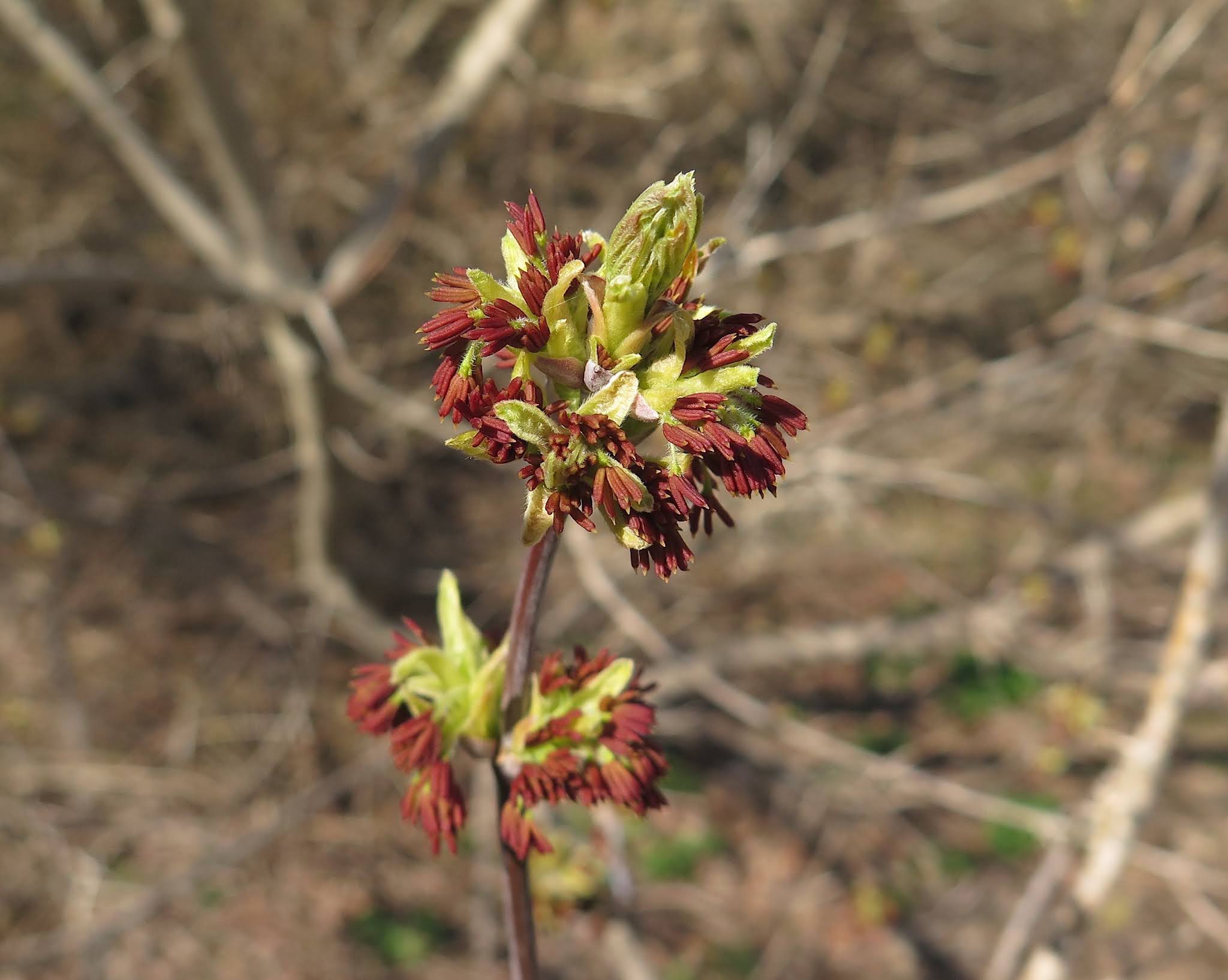
There were also many trees and shrubs with close-to-opening flower buds. In fact, I wonder if I could say that these ruddy-anthered male Box Elder flowers (Acer negundo) were already in bloom.  They were certainly quite showy!


Just starting to open their scales to release their floral parts, these Cottonwood flower buds (Populus deltoides) were already large and impressive, and the leaf buds were sticky and fragrant.


Very soon, every wooded hillside will be studded with snowy drifts of bloom from the various species of Shadblow (Amelanchier spp.) that are native to our region. I think I can see partly opened blooms among this furry cluster of buds.


Sunday, April 4, 2021

Disappointment and Delight at Ballston Creek

I met a number of very disappointed birders at Ballston Creek Preserve today.  They had come to observe the nesting Great Blue Herons this preserve had grown famous for.  For quite a number of years, the standing snags in the Ballston Creek Swamp had held the nests of many Great Blue Herons, including two heron nests commandeered by mated pairs of Ospreys and Great Horned Owls. Dependably, this swamp was a most amazing site for observing the behavior of all three species of giant birds.  Here's my photo of what a few of those snags looked like just a few years ago (and this is just a small section of the heronry):


Sadly, here's what that same section of swamp looked like today. Not a heron, nor any shred of a nest could be seen, not to mention any sign of ospreys or owls:


Over the years, windstorms have toppled many snags, or torn the supportive branches from those that remained upright, or blown the large stick-composed nests completely or partially away.  But why haven't the herons returned to rebuild?  Have they found better fishing in some other swamp? Those are questions I can't answer.


I shared the visiting birders' disappointment, for I too had enjoyed observing these birds in their home habitat, and for several years.  But I was here today instead to see if any of the wildflowers that thrive in this preserve's woods had made an appearance yet.  I have rarely found any other site so thoroughly carpeted with Carolina Spring Beauty (Claytonia caroliniana), a very early bloomer in the spring woods.  Would I find any sign of it today?  Eventually, I certainly did:  many, many bud-bearing sprouts were made visible among the leaf litter by their tapering green leaves. Admittedly, it took some searching to find them.


After finding only leaves and buds after all that diligent searching, it was quite a treat to find just one single Spring Beauty plant that was actually in bloom.  These dainty pink-striped, pink-anthered flowers are such a delightful find, so early in spring, when so few other wildflowers are blooming. And I'll find them here by the thousands in just a couple of weeks.


My next quest was to see if any of the Round-lobed Hepaticas (Hepatica americana) that grew here down by the creek had put forth any flowers yet.  It was easy to find their rather bedraggled but beautifully rosy wintered-over leaves among the leaf litter.  Were any flowers hiding down there at the center of the leaves?


Searching among the many plants, again and again I found only the flower buds, none even close to blooming.  But what amazingly furry buds!  Like tiny bunnies!  Most appropriate for this Easter Sunday.


Then, just as I had given up my search, this pretty little purple flower caught my eye. One more delightful surprise!


Pleased that my wildflower search had been successful, I sat on the bench overlooking the swamp and observed the scene. As I sat there quietly, I soon became aware of an odd, putt-putting growl from across the water.  Pickerel Frogs! Sending their come-hither calls to one another.  Love was in the air!


Searching the water's surface for any sign of the frogs, my eyes lit on this hummock, the vegetation oddly flattened as if some critter had sat on it frequently.  And then I noticed the fish scales. Aha! A critter HAS sat on this hummock quite often, for this was an otter's latrine.


I don't know too many other folks who would be delighted to find an otter's poo.  But lucky for me, I know a few.  And I'm happy to share this find and this photo with them.

Saturday, April 3, 2021

Spring, Interrupted, Resumes

A bit prematurely, I closed my last post with great celebration: "The wildflower season is now upon us!" Then wintry weather returned for several days, with 20-degree nights and 30-degree days and even a brief blizzard as an April Fool's Day prank. Thankfully, the snow didn't last, and today the sun shone and the temps rose into the 50s once more. But it sure was a see-saw week, weatherwise. At least I did get out to the woods a few times.

Tuesday, March 30, Lake Bonita at Moreau Lake State Park

The sun was warm but the breeze was chilly the day I joined my friends Sue and Nadine as they checked the Eastern Hemlocks along the shore of Lake Bonita for signs of the Hemlock Woolly Adelgid. Both Sue and Nadine had attended an information session about this significant threat to our northern forests and had been assigned this stretch of state-park lakeshore to look for any signs of infestation. I came along to observe, and to check a few hemlocks myself.


The day was certainly sunny and bright, but with significant quantities of ice remaining on the lake, the breeze carried remnants of winter's chill as it moved across the icy expanse.


We could hear geese honking at the far end of the lake. I wondered why this solitary goose was keeping to itself near our shore.  At least it was obvious that its feet were not frozen into the ice, since the goose was ambling quite freely on the icy surface.  Beyond this goose, you can see the ruddy-hued little sphagnum-covered islands that dot Lake Bonita and support a wonderful variety of interesting acid-tolerant plants, including masses of Leatherleaf shrubs, whose rosy leaves lend their color to the islands all winter long.


I am very happy to report that we did not find a single sign of Hemlock Woolly Adelgid infestation on any of the hemlock needles we examined.  We did, however, find an amazing population of Snow Fleas hopping about on the forest floor and gathering in masses on this fallen tree limb.  Snow Fleas are amazing and perfectly harmless creatures, not fleas at all, nor is the creature even an insect, despite its six legs. They exist, apparently, in a class all their own, called Collembola. Here's an article from the magazine Northern Woodlands with lots more information about this fascinating animal.


Our hemlock inspections completed, we ambled along a rushing stream that carried us deeper into the many acres of forest that surround Lake Bonita.


There's something deeply joy-producing about being in the presence of tumbling mountain streams. That's actually a scientific fact and not just a personal feeling of mine.  I have read that water droplets flung into the air by turbulence produce negative ions in the surrounding atmosphere that promote good health and a sense of well-being. (Here's an article about this.)  I can certainly attest that we felt very happy to be there.  It might have been the water, and it also might have been because we had found no immediate threat to these woods from those Hemlock Woolly Adelgids.


Wednesday, March 31, Orra Phelps Nature Preserve, Wilton

This mild but overcast day encouraged me to return to the Orra Phelps Nature Preserve, where I had found Snow Trilliums (Trillium nivale) in bud just a few days earlier.  Would they have opened their snowy-white petals by now?  They certainly had!  At least, one of them had, and a few more, still in tight bud, had emerged from the ground. Since this preserve is the only place I know of in the entire state to lay my eyes on this lovely little flower, I always make sure not to miss it when it blooms.


I found no other wildflowers blooming in this preserve today, but I was excited to see many fat buds on a Rosebay Rhododendron (Rhododendron maximum) that leans over the creek. The presence of these buds promises to be be a good year for finding these gorgeous flowers blooming in late June/early July.  Last year, I did not find a single flower on this shrub.


There was one more sure sign of spring at Orra Phelps this day: sprouts of Wild Leeks, also called Ramps (Allium tricoccum), were shooting up from the muddy ground. I'm glad this plant is protected in this preserve, since other populations of this tasty wild onion are in danger of being over-collected by foragers. 


Saturday, April 3, The North Woods at Skidmore College, Saratoga Springs

After a stretch of below-freezing days -- and even a snowy one last Thursday! -- it felt great to see a clear blue sky and a bright warm sun that promised to push today's temps up close to 50. My friend Sue came down from Hudson Falls to Saratoga today, seeking more signs of spring down here than she'd been able to find 20 miles north.  We met at Skidmore College to explore the marvelous limestone underlaid woods that lies adjacent to the campus. The same geological faults that bring mineral springs to the city of Saratoga Springs have created great rocky ridges throughout these woods. All kinds of fascinating plants -- including some that are truly rare -- can be found tucked in among these rocks. Would we find any today?


We did find some Walking Fern (Asplenium rhizophyllum), a known lime-lover, making its way across these moss-covered boulders.


On the same moss-covered rocks, we found many plants of the gracefully curving Maidenhair Spleenwort (Asplenium trichomanes) tucked in among the cracks.


Those two ferns were certainly interesting, but we were craving some flowers! Just as we were wondering if we'd find any flowers today, we spied these fat purple flower-bud clusters of Red-berried Elder (Sambucus racemosa) springing forth from among the unfurling leaves. These colorful flower buds are actually more attractive than the rather spindly off-white flower clusters they will produce.  But still.  These were just the buds.  Not the flowers.


At last, we did find some actual flowers.  The pale-lavender flower of this Round-leaved Hepatica (Hepatica americana) was still sheltering from the morning's chill beneath its fur-covered bracts, but it was fully in bloom, as we could see when we gently lifted it up.  Lots of fuzzy buds were clustered beneath, waiting their turn to bloom.


I also had to lift this bloom of English Violet (Viola odorata) in order to espy the hooked style within, a definite diagnostic feature of this non-native early-blooming violet. This is the white-flowered variety of this sweet-smelling violet, which bears a purple spur behind a pure-white face that is unlined with the dark veins so typical of other violets.  A deep-purple patch of this same species grows on the opposite side of the Skidmore campus.   I have always believed that both varieties of these extremely fragrant flowers were planted long ago by Victorian ladies who carried small nosegays of them to ward off less pleasant odors.


Another exciting find today were several Leatherwood shrubs (Dirca palustris) dangling small yellow trumpet-shaped flowers below their very furry, newly opened brown buds. I did a little happy dance to celebrate finding one of my favorite native shrubs in bloom.


Saturday, April 3, Orra Phelps Nature Preserve, Wilton

After Sue and I had explored several trails through the Skidmore woods today, we headed a few miles north to see what we could find at the Orra Phelps Nature Preserve.  This is a small (1.8-acre) preserve but a lovely one, with a mixed hardwood/conifer forest covering its rolling terrain and two branches of a tumbling creek rushing over rock-lined courses.


Aside from the Snow Trilliums I had found earlier this week and hundreds of huge purple Skunk Cabbage plants, we found no new flowers in bloom.  But we did enjoy seeing this beautiful patch of Partridge Berry (Mitchella repens), with its glossy green leaves and bright-red berries looking as fresh today as they had last fall before they were covered by winter's snow.


The exciting find today was not a flower, but rather a liverwort -- and a liverwort with the perfectly wonderful vernacular name of Handsome Woollywort (Trichocolea tomentella)!  Sue is the one who found it, wandering a swale punctuated by hundreds of Skunk Cabbage spathes and carpeted with pretty mosses like Delicate Fern Moss (Thuidium delicatulum).  Sue noticed first its yellow-green color, which set it apart from the darker-green Thuidium that surrounded it. She knew right away it was nothing she had ever seen before.


It just happens that I had once -- and only once -- seen it before, in a cedar swamp up in the Adirondacks.  Our mutual friend Evelyn Greene had been with us that day, and she had corrected me when I called her attention to this pretty "moss."  No, no, she said, that's a liverwort!  Evelyn told me its scientific name, which led me to finding its absolutely delightful vernacular name of Handsome Woollywort.  I took this close-up photo today, which shows pretty clearly how it got that "woolly" part of its name.  


Great find, Sue!  What a fun way to cap off our truly wonderful day in the woods!