I've been traveling around New York's north country this past week, delighting in the beauty that autumn grants us around this region. Here's just a digest of some of the splendor I beheld.
Pyramid Lake and Paradox Creek, Essex County:
Pyramid Lake, at dawn
Waterfall on Paradox Creek, with morning mist
Mud Pond at Moreau Lake State Park, Saratoga County:
Back bay shoreline
Shining Sumac thicket, Little Bluestem Grass meadow
Autumn's vivid colors in a single oak leaf
Another colorful oak leaf rests on a bed of Haircap Moss
Red Oak Ridge Trail, Moreau Lake State Park, Saratoga County:
Lake shore and mountain, morning light
White Baneberry with "doll's eyes" fruit
Striped Maple leaf with a colorful fungal spot
Saratoga National Historical Park (the Saratoga Battlefield), Saratoga County:
Colorful hardwoods, Round-headed Bushclover stalks in a rolling meadow of Little Bluestem Grass
The Hudson River and Washington County mountains, viewed from a battlefield height
Another view of the Hudson River, with farm fields beyond and a passing boat
For more than thirty years I've been wandering the woods and waterways of Saratoga County, New York, and regions nearby, looking closely, listening carefully, and recording what I experience. We are blessed in this region with an amazing amount of wilderness right at hand. With this blog I share my year-round adventures here, seeking out what wonders await in my own Madagascar close to home.
Wednesday, October 16, 2019
Thursday, October 10, 2019
Paddling a Paradise of Vibrant Color on Lens Lake
As of yet, the fall foliage around my home in Saratoga Springs is looking rather muted. Growing impatient to be wowed by this annual spectacle of vibrant color, I headed north up to Lens Lake in Warren County on Wednesday afternoon, in search of where the season might be more advanced. And when I got to this secluded Adirondack lake, was I wowed by autumn color? Oh yeah! You betcha!
The mountains that surround the lake were covered in a crazy quilt of vibrant color.
In addition to its beauty, a remarkable feature of Lens Lake is the amount of floating bog mat that covers its waters. These bog mats are like vast meadows composed of Sphagnum Moss, with acres of Cottongrass blowing in the breeze, each cottony tuft bobbing and swaying as if to a music it alone could hear.
The Sphagnum grows in multiple shades of gold and red, as colorful as any Persian carpet.
Here, a patch of golden moss was "peopled" by baby Northern Pitcher Plants of a deep, rich scarlet .
This quartet of orange mushrooms had sprung from a solid carpet of red moss.
I've been paddling on Lens Lake every year since 2011, and each year I have to find a different route to reach the far end of the lake, since the bog mats are not grounded and slowly move into new positions every year. When I reached a place where my passage was blocked unless I took a wide detour, I decided to head back toward my launch site and explore some quiet backwaters near where I'd put in.
Here in these quiet bays, the water is very shallow, with many old tree stumps and fallen logs serving as nursery beds for abundant numbers of beautiful plants.
The tree that produced this ancient stump must surely have been a giant!
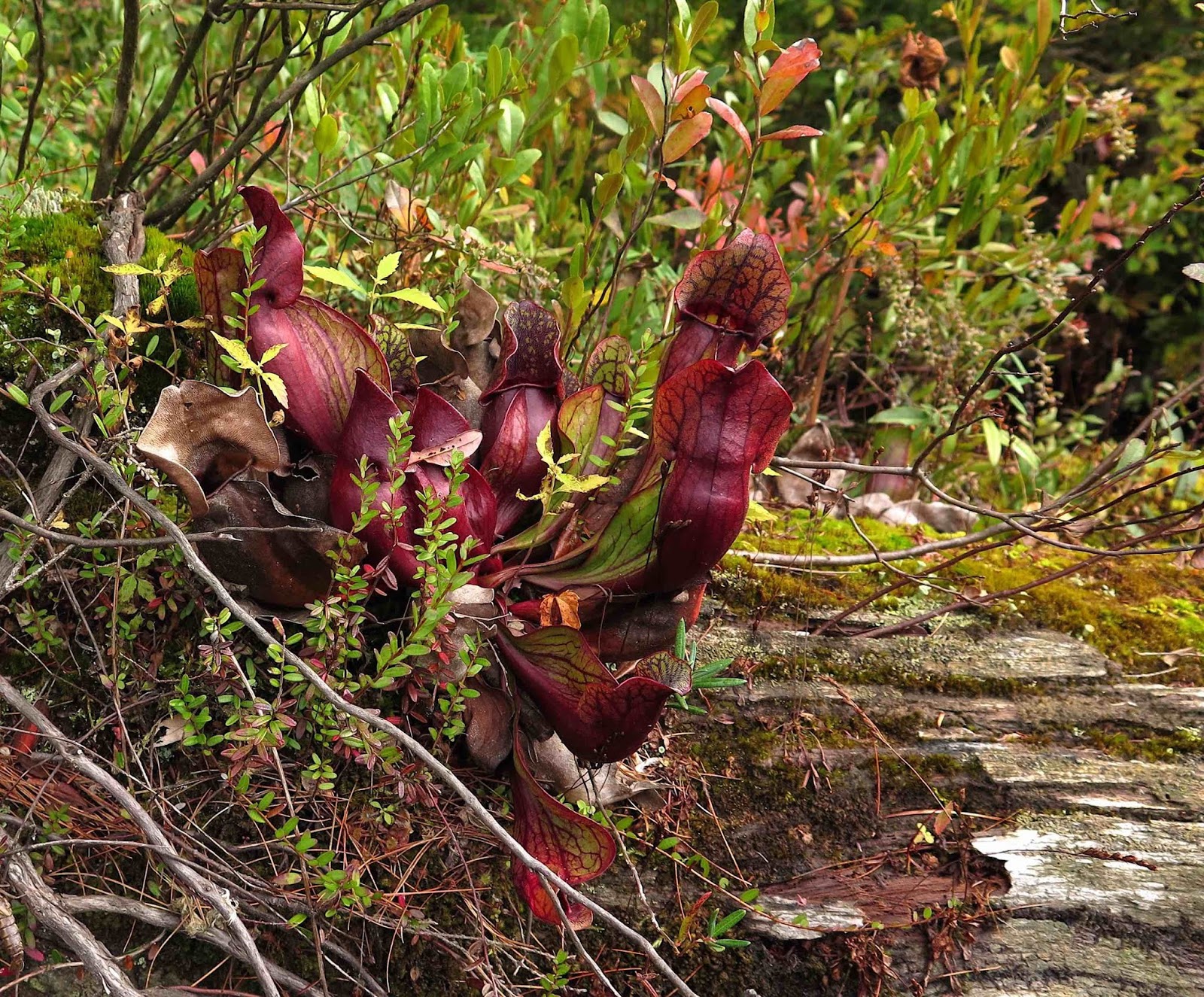
Another old stump was now overgrown with Leatherleaf shrubs, Large Cranberry vines, and one magnificent Northern Pitcher Plant.
This fallen log was now home to a multi-colored garden of Large Cranberry, Marsh St. Johnswort, Northern Pitcher Plants, some Red Maple saplings, a few Leatherleaf shrubs and one juvenile White Pine. (I think there's a little Spotted Alder in there, too.)
The cranberries that grew on this log were covered with a bloom that turned the brilliant red berries a distinctive shade of purple.
A few shrubs of Labrador Tea have found their niche among the general thickets of Leatherleaf, Sweet Gale, and Sheep Laurel that populate the shores of Lens Lake. And this time of year, the Labrador Tea produces terminal buds of the prettiest pink. Tucked inside these scaled buds are clusters of flowers, safely protected from winter's cold until spring's warmth beckons them into bloom.
Tall White Pines reach for the sky along the shore, with thickets of now-scarlet blueberry bushes clustered at their feet.
The ride back home continued to delight me with scenes like this, from Roaring Brook Road as it descends toward the village of Stony Creek.
And I also had to stop to admire the beauty of this historic bow bridge where it crosses the turbulent Sacandaga River at Hadley, near where the Sacandaga joins the Hudson River at Lake Luzerne.
Monday, October 7, 2019
Meadows, Mosses, Fruits, and Flowers
There's a high ridge of rolling hills I like to walk this time of year, where the Palmertown mountains make their way down to the shores of the Hudson River. Here, a power line follows the voluptuous curves of the land, and the grasses, flowers, ferns, and forest take on the gorgeous colors of autumn. These colors will doubtless intensify in the week or so to come, but they already glowed green and gold and rose and cinnamon when I walked there yesterday afternoon, under a soft gray sky.
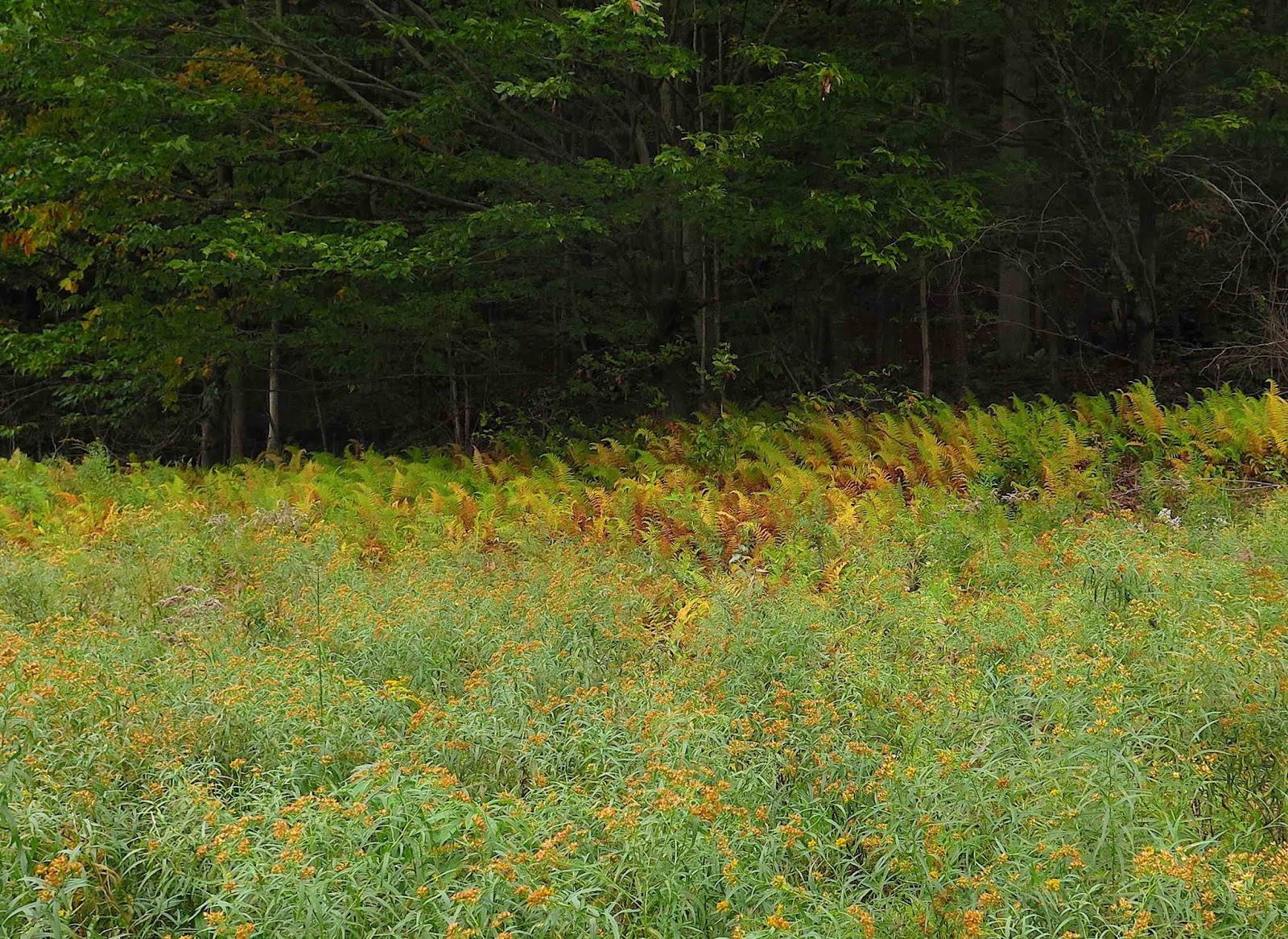
Acres and acres of Grass-leaved Goldenrod (Euthamia graminifolia) spread across the hillsides, interrupted by patches of ruddy Little Bluestem Grass (Schizachyrium scoparium), and masses of Hay-scented Ferns (Dennstaedtia punctilobula) glowed ochre and green and burnt sienna against the deep shade of the surrounding woods.
While Little Bluestem makes up the preponderance of meadow grasses along this ridge, occasional bursts of Big Bluestem Grass (Andropogon gerardii) reach for the sky in towering tufts.
The Palmertown ridge is mostly composed of granitic rock, with occasional outcroppings of marble or quartzite. When I noticed a patch of bare bedrock here on the powerline, I promptly examined it for clues to its origin.
A translucent, almost glassy quality of this outcropping led me to believe that it must be quartzite, a very hard rock that is formed when quartz sandstone is metamorphosed by heat and pressure. Much of the surface of this outcropping was covered by a pretty variety of mosses and lichens that had taken root in the quartzite's cracks and crevices.
A nearby ledge of rock that was striped with shades of gray and ivory appeared more typical of the granitic gneiss that forms the bulk of these mountain ridges. A little stream tumbled over parts of this ledge, watering the various mosses that spread across the surface.
Where water actually flowed on the rock, patches of vivid-green Fountain Moss (Philonotis fontana) had found a happy home.
One pillowy patch of Fountain Moss appeared to be competing with an incursion of Haircap Moss (Polytrichum sp.) for its spot on the rock. I wonder which moss got there first.
A feathery patch of Big Red-stem Moss (Pleuozium schreberi) was draped over a drier spot on this ledge, with only a tiny tuft of what looks to be a species of Broom Moss (Dicranum sp.) for possible competition.
There were a number of Hawthorn trees (Crataegus sp.) standing out away from the forest edge, which I could see were hung with fruit, despite being nearly swamped by invading Oriental Bittersweet vines.
The Hawthorn fruits are a brilliant red and serve as a valuable food source for birds and other wildlife. I have read that the fruits of some species of Hawthorn are palatable to humans as well, but since we have dozens of species of this circumpolar genus, I would not be able to tell you the species of this particular Hawthorn tree. Whether or not the fruits were tasty, they sure were a feast for the eyes!
To judge from all the seedheads protruding above the meadow grasses, abundant numbers of Wild Bergamot (Monarda fistulosa) must also have presented a feast for the eyes up here, when all these flowers were in beautiful lavender bloom. I can just imagine, too, the throngs of hummingbirds and clearwing moths that would have been sipping their nectar.
And lo! Here were some flowers that looked as fresh and pretty as others of their kind had appeared last spring! Dear little Herb Robert (Geranium robertianum), such a faithful flower that starts blooming early and stays with us right to the end of the growing season! I have even seen it blooming away, well after frost, in sheltered nooks of a sun-warmed stone wall. And its lacy green foliage is almost as pretty as its perky little purple flowers.
And Lo, once again! Just LOOK at the gorgeous colors on this beautiful Marbled Orb Weaver! She looks as if she's covered her pumpkin-shaped abdomen with Jack-o'-lantern markings for Halloween. Or is that a black cat I see etched on her back?
I know she's a she because of her globular shape -- her mate's abdomen, while equally colorful, is more ovate than globular. Since she normally weaves an orb web for catching prey, I'm wondering why she is wrapping this milkweed leaf with web. Is she making a snug nest to house herself over the winter? Or a safe place to leave an egg sac that will yield tiny spiderlings in spring? I guess I'd better read up on the Marbled Orb Weaver's life cycle. But in the meantime, other suggestions are welcome.
UPDATE: I have now learned that this species of spider does not rest on its orb web, but rather it retreats to an adjacent lair it constructs nearby, either made completely of web or of a folded leaf. A thread leads from the lair to the orb web, so the resting spider can detect when a prey insect has been trapped.
Acres and acres of Grass-leaved Goldenrod (Euthamia graminifolia) spread across the hillsides, interrupted by patches of ruddy Little Bluestem Grass (Schizachyrium scoparium), and masses of Hay-scented Ferns (Dennstaedtia punctilobula) glowed ochre and green and burnt sienna against the deep shade of the surrounding woods.
While Little Bluestem makes up the preponderance of meadow grasses along this ridge, occasional bursts of Big Bluestem Grass (Andropogon gerardii) reach for the sky in towering tufts.
The Palmertown ridge is mostly composed of granitic rock, with occasional outcroppings of marble or quartzite. When I noticed a patch of bare bedrock here on the powerline, I promptly examined it for clues to its origin.
A translucent, almost glassy quality of this outcropping led me to believe that it must be quartzite, a very hard rock that is formed when quartz sandstone is metamorphosed by heat and pressure. Much of the surface of this outcropping was covered by a pretty variety of mosses and lichens that had taken root in the quartzite's cracks and crevices.
A nearby ledge of rock that was striped with shades of gray and ivory appeared more typical of the granitic gneiss that forms the bulk of these mountain ridges. A little stream tumbled over parts of this ledge, watering the various mosses that spread across the surface.
Where water actually flowed on the rock, patches of vivid-green Fountain Moss (Philonotis fontana) had found a happy home.
One pillowy patch of Fountain Moss appeared to be competing with an incursion of Haircap Moss (Polytrichum sp.) for its spot on the rock. I wonder which moss got there first.
A feathery patch of Big Red-stem Moss (Pleuozium schreberi) was draped over a drier spot on this ledge, with only a tiny tuft of what looks to be a species of Broom Moss (Dicranum sp.) for possible competition.
There were a number of Hawthorn trees (Crataegus sp.) standing out away from the forest edge, which I could see were hung with fruit, despite being nearly swamped by invading Oriental Bittersweet vines.
The Hawthorn fruits are a brilliant red and serve as a valuable food source for birds and other wildlife. I have read that the fruits of some species of Hawthorn are palatable to humans as well, but since we have dozens of species of this circumpolar genus, I would not be able to tell you the species of this particular Hawthorn tree. Whether or not the fruits were tasty, they sure were a feast for the eyes!
To judge from all the seedheads protruding above the meadow grasses, abundant numbers of Wild Bergamot (Monarda fistulosa) must also have presented a feast for the eyes up here, when all these flowers were in beautiful lavender bloom. I can just imagine, too, the throngs of hummingbirds and clearwing moths that would have been sipping their nectar.
And lo! Here were some flowers that looked as fresh and pretty as others of their kind had appeared last spring! Dear little Herb Robert (Geranium robertianum), such a faithful flower that starts blooming early and stays with us right to the end of the growing season! I have even seen it blooming away, well after frost, in sheltered nooks of a sun-warmed stone wall. And its lacy green foliage is almost as pretty as its perky little purple flowers.
And Lo, once again! Just LOOK at the gorgeous colors on this beautiful Marbled Orb Weaver! She looks as if she's covered her pumpkin-shaped abdomen with Jack-o'-lantern markings for Halloween. Or is that a black cat I see etched on her back?
I know she's a she because of her globular shape -- her mate's abdomen, while equally colorful, is more ovate than globular. Since she normally weaves an orb web for catching prey, I'm wondering why she is wrapping this milkweed leaf with web. Is she making a snug nest to house herself over the winter? Or a safe place to leave an egg sac that will yield tiny spiderlings in spring? I guess I'd better read up on the Marbled Orb Weaver's life cycle. But in the meantime, other suggestions are welcome.
UPDATE: I have now learned that this species of spider does not rest on its orb web, but rather it retreats to an adjacent lair it constructs nearby, either made completely of web or of a folded leaf. A thread leads from the lair to the orb web, so the resting spider can detect when a prey insect has been trapped.
Wednesday, October 2, 2019
Plant People Tour the Skidmore Woods
There sure were lots of plant people in town this week! And they came from all over the country, as well as a few from across the sea, to attend a joint conference sponsored by the North American Invasive Species Management Association, together with the New York Invasive Species Research Institute. I probably wouldn't have known anything about it, except I was asked to co-conduct a tour of Skidmore College's North Woods as an outing for conference participants. Steve Young, chief botanist with the New York Natural Heritage Program, knows that this woods is my personal bailiwick, and he asked me if I would help him lead a group of about a dozen conference participants through these remarkable limestone underlaid woods on Wednesday.
The day was a bit drizzly, but that didn't deter the woodswalkers, who might have been happy to turn their attention from concentrating on the problems of invasive species to just enjoy a walk through a woods renowned for its abundance of native and rare plants. Unfortunately, the Skidmore woods has its own share of invasive species -- most notably Burning Bush, Buckthorn, Barberry, and Bittersweet -- but once we had noted the occasional presence of these invading plants, we were able to enjoy the native plants that continue to thrive in this woods in healthy numbers.
When I lead a walk, I rarely have the time to take photos, but Steve Young and I had a chance to preview our walk on the preceding Monday, and I did take a few then, some of which I'm posting here. I also gathered a few from my photo files. But what I am posting here is just a sampling of all the marvelous variety of plants, both woody and herbaceous, that we encountered on our walk.
Aside from lots of woodland asters and goldenrods, the only other plant we found actually blooming today was Witch Hazel (Hamamelis virginiana), a common understory tree in the Skidmore woods.
This next photo is not of a flower, although it does kind of look like a cluster of tiny green dahlias. And it does have the flowery common name of Rose Moss (Rhodobryum ontariense). This is a real lime-loving moss, and we found it abundantly covering some of the limestone rocks that litter the forest floor in this woods.
One of the most abundant spring wildflowers here in this woods is the Sharp-lobed Hepatica (Hepatica acutiloba), and although its flowers have been gone for months, its leaves remain on the plant all winter, often assuming beautiful shades of red.
Probably the rarest plant I was able to show our walkers today was the Green Violet (Hybanthus concolor), acres of which thrive in the Skidmore woods and nowhere else in the county, that we know of. This is a plant that looks very little like other members of the Violet Family, except for its three-parted seed pods that split open to reveal the little orbs of seeds inside.
One of the most frequent shrubs we encountered was Spicebush (Lindera benzoin), which this time of year bears shiny red fruits that do indeed taste similar to the spice called Allspice and can be used (I've been told) as a substitute for that sweet spice in baking. The twigs also have a sweet aromatic smell, which we could detect by scraping a bit of the bark.
Blue Cohosh (Caulophyllum giganteum) is a lime-loving plant that thrives in this woods and is one of our earliest flowers to bloom in the spring. By this time of year, the flowers as well as most of its leaves are long gone, but its beautifully-blue seeds, held stiffly erect, persist on the plants well into the winter. They look like berries, but they are hard seeds encased in a thin blue skin.
Orange-fruited Horse Gentian (Triosteum aurantiacum) is not listed as an uncommon plant in New York State, but most people I show it to have never seen it before. Perhaps they pass by this tall, big-leaved plant without noticing the bright-orange fruits arrayed around the stem in the leaf axils. I made sure our walk participants got a chance to see it today. And yes, several folks had at first walked right by it without noticing the fruits. The fruits ARE pretty showy, once you peer down into the plant to get a gander at them.
On this drizzly Wednesday, we did not see many bees or butterflies flying around. But on Monday, the sunny day when I previewed this walk with Steve, I did see many butterflies, including this slightly tattered Painted Lady sipping nectar from a Spotted Knapweed bloom (Centaurea maculosa). I'm sorry our walk participants didn't get to see the butterfly. But I confess I'm glad they didn't have to note that the last blooming flower we passed on our walk was one of our most invasive species!
The day was a bit drizzly, but that didn't deter the woodswalkers, who might have been happy to turn their attention from concentrating on the problems of invasive species to just enjoy a walk through a woods renowned for its abundance of native and rare plants. Unfortunately, the Skidmore woods has its own share of invasive species -- most notably Burning Bush, Buckthorn, Barberry, and Bittersweet -- but once we had noted the occasional presence of these invading plants, we were able to enjoy the native plants that continue to thrive in this woods in healthy numbers.
When I lead a walk, I rarely have the time to take photos, but Steve Young and I had a chance to preview our walk on the preceding Monday, and I did take a few then, some of which I'm posting here. I also gathered a few from my photo files. But what I am posting here is just a sampling of all the marvelous variety of plants, both woody and herbaceous, that we encountered on our walk.
Aside from lots of woodland asters and goldenrods, the only other plant we found actually blooming today was Witch Hazel (Hamamelis virginiana), a common understory tree in the Skidmore woods.
This next photo is not of a flower, although it does kind of look like a cluster of tiny green dahlias. And it does have the flowery common name of Rose Moss (Rhodobryum ontariense). This is a real lime-loving moss, and we found it abundantly covering some of the limestone rocks that litter the forest floor in this woods.
One of the most abundant spring wildflowers here in this woods is the Sharp-lobed Hepatica (Hepatica acutiloba), and although its flowers have been gone for months, its leaves remain on the plant all winter, often assuming beautiful shades of red.
Probably the rarest plant I was able to show our walkers today was the Green Violet (Hybanthus concolor), acres of which thrive in the Skidmore woods and nowhere else in the county, that we know of. This is a plant that looks very little like other members of the Violet Family, except for its three-parted seed pods that split open to reveal the little orbs of seeds inside.
One of the most frequent shrubs we encountered was Spicebush (Lindera benzoin), which this time of year bears shiny red fruits that do indeed taste similar to the spice called Allspice and can be used (I've been told) as a substitute for that sweet spice in baking. The twigs also have a sweet aromatic smell, which we could detect by scraping a bit of the bark.
Blue Cohosh (Caulophyllum giganteum) is a lime-loving plant that thrives in this woods and is one of our earliest flowers to bloom in the spring. By this time of year, the flowers as well as most of its leaves are long gone, but its beautifully-blue seeds, held stiffly erect, persist on the plants well into the winter. They look like berries, but they are hard seeds encased in a thin blue skin.
Orange-fruited Horse Gentian (Triosteum aurantiacum) is not listed as an uncommon plant in New York State, but most people I show it to have never seen it before. Perhaps they pass by this tall, big-leaved plant without noticing the bright-orange fruits arrayed around the stem in the leaf axils. I made sure our walk participants got a chance to see it today. And yes, several folks had at first walked right by it without noticing the fruits. The fruits ARE pretty showy, once you peer down into the plant to get a gander at them.
On this drizzly Wednesday, we did not see many bees or butterflies flying around. But on Monday, the sunny day when I previewed this walk with Steve, I did see many butterflies, including this slightly tattered Painted Lady sipping nectar from a Spotted Knapweed bloom (Centaurea maculosa). I'm sorry our walk participants didn't get to see the butterfly. But I confess I'm glad they didn't have to note that the last blooming flower we passed on our walk was one of our most invasive species!
Subscribe to:
Posts (Atom)