My little Hornbeck canoe has carried me on years of nature adventures.
The amazing things I saw while paddling inspired me to start this blog.
Oh my gosh, can it really be? It was ten years ago, on January 1, 2009, that I first sat down to compose my first entry in this blog. As a wildflower-obsessed nature nut, my intention was to post a single year's worth of outdoor adventures, focusing on the plants and animals to be found in the many amazing preserves and parks right here near my home in Saratoga Springs, New York. I never could have known then how much this venture would enlarge and enrich my life. Or that I would keep on posting it for all these many years. I had only just acquired my first iMac computer and as yet had no experience of the reach of the world wide web. I'd had my lightweight solo canoe for nearly two decades, and then I'd acquired a compact digital camera, which allowed me to document the marvels I encountered wherever my canoe could carry me. But it wasn't until I acquired that computer that I could share what I loved with other nature lovers all over the world. Oh, what joy that has brought me! I have learned so much, and best of all, I have made so many new friends who share my passion for nature.
Thanks to my blog, I have come to know some of the most important naturalists in the state, professional botanists, entomologists, mycologists and more, who have generously helped me identify plants, insects, and fungi I couldn't figure out on my own. I am particularly grateful to
Steve Young, chief botanist with the New York Natural Heritage Program and my go-to guy for knowledge about any of our state's native plants. Here's Steve atop Whiteface Mountain, leading one of the field trips he conducts each year to important botanical sites. How wonderful to have had such a guide, whether
up to a mountaintop to document alpine species, or out to a
limestone island in Lake Champlain, home to some of our region's rarest plants.
Steve became an early follower of my blog, and from time to time he would alert me of the rarity of some of the plants I posted photos of. Under his guidance, I have been able to document the locations of some of our state's rarest species, and also to contribute hundreds of both photos and specimens to update the New York Flora Association's Plant Atlas. It sure feels good that my personal wildflower pursuits have proven to be useful to other interested parties!
Equally important for my nature education (as well as my pleasure!) have been my friends in
The Thursday Naturalists, a group of both professional and passionately committed amateur naturalists who venture out each week to explore area parks and preserves. They were kind enough to ask me to join them about eight years ago, and I felt highly honored, like some little neighborhood nobody, invited out to play with the big kids. Since then, we have ventured widely to some of the richest botanical sites in the region, from Thacher and Joralemon parks and the Landis Arboretum south and west of Albany all the way up to the Ice Meadows and the Pack Forest north of Warrensburg, and many other parks and preserves in between, including old marble quarries in Vermont. I have to mention in particular these two members,
Ruth Schottman and
Ed Miller (pictured here), both of whom possess astounding depths of knowledge and are also wonderful companions on the trail, sharing their delight in all they find. Despite their advancing years (they are both in their 90s now!), they still bring a youthful enthusiasm and sense of adventure to all our expeditions. I am so grateful to them for taking me under their wings and sharing their knowledge with me, and I hope to treasure their companionship for years to come!

UPDATE, 1/8/2022: Sadly, I must report that my dear friend Ed Miller died on March 4, 2019, at the age of 94. Although I am sad to have lost my friend, I am happy to report that he spent his last days at peace and without pain, accepting of his situation, and surrounded by those he loved. On a happier note, I am pleased to report that Ruth Schottman is still very much with us yet. Nearly as agile as ever, she continues to join our Thursday Naturalist group on outings from time to time. Although she no longer drives, she would probably join us every week if we met where she could get there on foot or on her bicycle.
All members of The Thursday Naturalists contribute their unique gifts to our group, but I am particularly grateful to
Nancy Slack, an ecology professor and expert bryologist who has opened my mind to the wonders of mosses, lichens, and liverworts. It's easy to fall in love with showy bright flowers, but it takes careful attention (and a good magnifier!) to marvel over the intricate structures of tiny greenish things growing on rotting wood or creekside boulders. I also have to admire Nancy's energy, her willingness to clamber up rocky slopes or paddle deep into bogs to seek out the objects of her passion. In this photo, she is climbing the course of a mountainside waterfall, delighting in the wonderful variety of bryophytes that thrive on the spray-watered rocks.
Here's one more of my wonderful teachers (and delightful friends!) whom I never would have met if not for my blog: the irrepressible
Evelyn Greene, Adirondack explorer extraordinaire and so-called Queen of the Ice Meadows. Having been forced by mountaineering parents to climb all the High Peaks while still a young teen (whether she wanted to or not), she was not the least bit interested in bagging peaks by the time I met her, but rather preferred to paddle the region's isolated ponds and bogs or wander the swamps and woodlands in search of plants -- which made her my perfect companion! And Evelyn also had other friends -- I'm thinking of Bonny Vicki and Bob Duncan especially -- who eventually became my most welcome companions as well, accompanying me to amazing sites I never would have found on my own.

In this photo, Evelyn is standing before heaps of frazil ice that are encroaching onto the road that follows the west bank of the Hudson River north of Warrensburg. Frazil is a particular kind of ice that forms in turbulent stretches of the river, and in some years this frothy white ice is known to pile up to astonishing heights of 12 feet or more along the banks. I do believe that Evelyn knows more about this phenomenon than anyone else, and she has escorted me and other friends to witness this dramatic occurrence on many occasions. Even better, she introduced me during the warmer months to the habitat that lies beneath this mass of ice, a miles-long stretch of riverbank called the Ice Meadows that is renowned among botanists as one of the richest sites for rare plants in all the state. And that's not all! I would need a whole book to relate the many marvelous adventures Evelyn has led me on, by boat or on foot. In a way, I have already written that book right here on my blog, which a search of her name would reveal. To get just a taste of the fun we have had together, check out this blog post from 2011:
Boghopping, Bushwhacking: Three Old Broads and Their Boats.
When I first started this blog, I really never could have imagined how writing it would win me such dear friends -- folks like the ones I have mentioned above, and also like the amazing young man pictured here.
Andrew Gibson, who works as a field botanist and monitor of rare plants for the state of Ohio, first became known to me when I found his blog "
Natural Treasures of Ohio" back in 2011, and we soon became mutual admirers of each other's posts. But I then came to admire more than his vivid prose and spectacular photos, for his posts revealed a deep goodness of spirit and a profound integrity that shone through everything he did. Because of that, I felt no qualms whatsoever about inviting him out to botanize with me in New York when I learned that he longed to see and photograph the White Fringed Orchids that are no longer found in Ohio but which thrive in uncountable numbers in New York. (I remember that one of my sons was aghast that I had invited "someone you met on the
internet!" to stay at our home. Needless to say, my son's fears disappeared as soon as he met dear Andrew in person.)

That
first visit back in mid-July of 2012 was just the beginning of our happy personal friendship, a friendship cemented by his return visit in early
June of 2013, and yet another visit in
mid-August of 2016, after he'd taught a course on wildflowers up in the Adirondacks with another mutual friend and accomplished botanist, John Manion. If you click on these links, you may get some sense of the marvelous good times we have had botanizing together and the joy we have found in our companionship. And it all started because of our blogs.
Well, longtime readers of this blog will already know who has been my most constant companion on my nature adventures: who else but my fellow nature nut Sue Pierce!

Sue and I actually met
before I started my blog, for we were both frequent explorers of the many wonders of Moreau Lake State Park, and that's where we found one another. Now, most folks don't really want to go walking with me, since I drop to my knees every few feet to peer at a plant or stand statue-still for minutes on end as I wait for that dragonfly to return to its perch. So can you imagine my joy when I found a friend who is also happy to take an hour to cover a hundred yards? Especially a friend with excellent eyesight who can ID a juvenile eagle half a mile up in the sky? Or espy a spider hiding away in a flower that matched the color of its carapace? Oh man, I would have missed so much without my seeing-eye pal on the trail with me! What fun we have had, and how much Sue has taught me, for Sue is well-versed in the lore of the woods and knows all kinds of information I would never read in my guidebooks. Sue is also well-versed in the writings of Henry David Thoreau, whose nature observations form the inspiration for Sue's own beautiful blog,
Waterlily. Although it has been some time since she has updated her blog, it remains a marvelous and timeless document, illustrated with Sue's spectacular photos and rendered profound by passages she has chosen from Thoreau's works.
When Sue worked an evening shift we often met two or three mornings a week to walk together. Since her shift was cut and she's had to work days, we're lucky to meet twice a month. But one of these days, Sue plans to retire, and then we'll resume our more frequent nature adventures. And boy, will we have new places to wander, now that Moreau Lake State Park is about to acquire extensive new lands, including an 890-acre parcel that will adjoin existing park lands and add around two more miles of riverfront to the park's holdings.
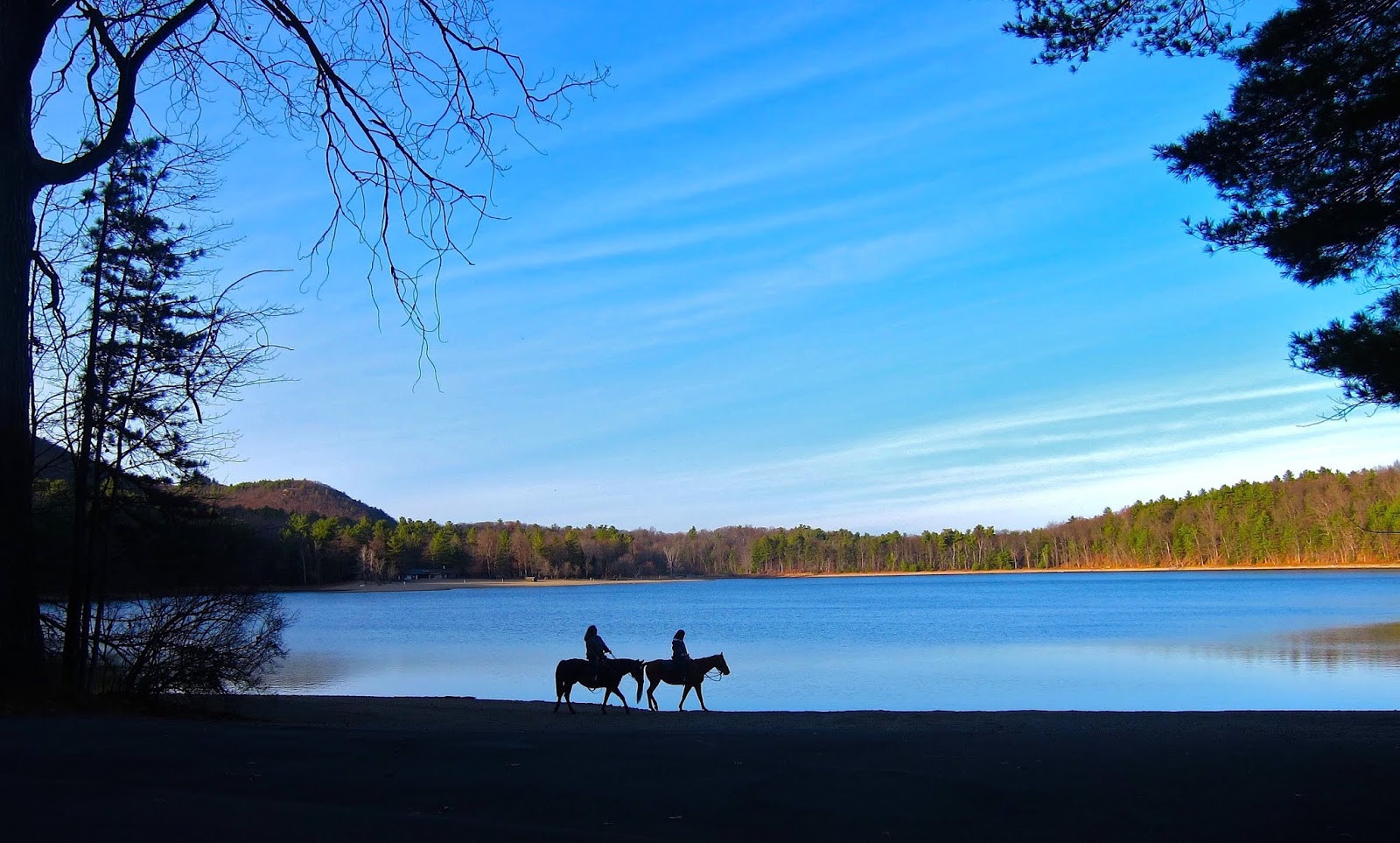
Blue sky, blue water: a quiet afternoon at Moreau Lake State Park
Speaking of Moreau Lake State Park, what a gift this park has been to me as a nature blogger! As for habitats, this park has them all: Mountains and meadows. Lakes and ponds. Streams and waterfalls. Acidic pinewoods and calcareous forest. Sandplain and wetland, even some bogs. The majestic Hudson River! How rewarding it has been to explore them all!
To date, I have documented over 400 species of flowering plants within this park, including three Endangered species (Whorled Mountain Mint, Large-leaved Avens, and Small-flowered Dwarf Bulrush), two Threatened species (Small Floating Bladderwort and Green Rock Cress), and two Rare (Great St. John's Wort and Small-flowered Gerardia). Also, I can count at least 12 species of orchids within the park, 11 of them native and thus protected by law. I want to especially acknowledge park manager Peter Iskenderian (at right in the photo below) for his enthusiastic support for protecting and documenting the remarkable botanical diversity of the park. In this photo, he has joined Rich Ring (left), rare-plant monitor for the state's Department of Environmental Conservation, and Maranda Welch, a nature educator with the park, to ascertain the extent of an abundant population of that endangered Avens mentioned above. (We found more than we could count -- over a hundred! -- thriving under those powerlines.)

Due to its diversity of habitats that support avian life and breeding, Moreau Lake State Park has also been named as one of the state's important Bird Conservation Areas. Among the many species of birds that visit or reside at Moreau are bald eagles and ospreys, great blue herons and the occasional egret, barred owls and great-horned owls, crows and ravens, hawks of several kinds, and many, many species of resident and migrating waterfowl and songbirds.
As for other critters, a walk in the snowy woods reveals the tracks of whitetail deer, coyotes, foxes, otters, opossums, porcupines, raccoons, fishers, bobcats, minks, several weasels, gray and red and flying squirrels, cottontail rabbits, shrews and voles and mice. And doubtless more that I haven't yet seen or identified the tracks of. Oh, and one year we even found the tracks and poop of a moose!
We have Green Frogs, Bullfrogs, Pickerel Frogs, Leopard Frogs and a couple of species of toads. Garter Snakes and Hognose Snakes are frequently found, as are newts and salamanders of several species. Snapping and Painted Turtles are common.
Marvelous bunches of bugs: bees, wasps, butterflies, spiders, moths, dragonflies, damselflies, beetles, hoverflies, snowfleas, bee flies, etc., etc., etc., too many to mention, including their larvae.
And dozens and dozens of fungi! And don't forget the slime molds.
All of these plants and most of these critters have shown up on my blog, some of them many times over. But before I posted them there, I had to find out what they were and what might be interesting about them. What an education for me this blogging has been! Guidebooks and Google were among my teachers, plus a number of Facebook sites and internet web pages. But best of all were my go-to pals that I listed above, whom I count as treasured friends as well as reliable sources of accurate information.
I know I am leaving many friends out of this account, simply for the sake of brevity. So many people have accompanied me along the way, including my readers who have loyally added their appreciative comments, as well as my fellow bloggers, whose own accounts and reflections have enlarged my own experience. (Be sure to check out the Blog List on the right side of this page.) But how could I close without especially thanking the folks at Saratoga PLAN (Preserving Land and Nature), the land conservation organization that has preserved vast acreage of unspoiled woodlands and productive farmlands throughout Saratoga County?
The Foster Sheep Farm is only one of the Saratoga County farms whose lands will be forever
reserved for agricultural use, thanks to a conservation easement supported by Saratoga PLAN.
Many of my most interesting blog posts have recounted explorations of PLAN's wonderful nature preserves (I'm recalling the rare plants along the Bog Meadow Brook Nature Trail, or the herons and osprey that nest near the Ballston Creek Preserve). Under the current executive director Maria Trabka, this organization continues to protect, preserve and expand our green spaces for many years to come.
I also want to mention Margo Bloom Olson, executive director of the Wilton Wildlife Preserve and Park, a geologically significant sandplain, woodland, and wetland preserve with acres of Wild Lupine and other flowers that support a huge population of the federally endangered Karner Blue Butterfly.
Acres and acres of Wild Lupine bloom in the oak/pine savanna areas of the Wilton Wildlife Preserve and Park.
Male (blue) and female (brown) Karner Blue Butterflies can feed on any nectar-producing
flowers, but their larvae can survive only on the leaves of the Wild Lupine pictured above.
And where would I ever have seen a Spadefoot Toad if its specialized habitat had not been protected at the Wilton Wildlife Preserve and Park?
So thank you, thank you, thank you, all you have come along with me, supporting and encouraging me on this blogging journey. What a journey this has been! And it's not over yet.