Sunday, July 22, 2018

Blue Sky, Blue Water, Blue Flowers . . . and Two Others!

With a clear blue sky reflected on the calm water, the very air seemed saturated with blue as I launched my canoe on the Hudson River on Friday.  And all that azure expanse was mine alone, not another boat in sight to ripple the water as I eased my way along the banks, seeking out what flowers might be blooming this week.

Turned out that most of the riverbank blooms were echoing that blue theme.  It's hard to imagine a bluer blue than that of Monkey Flower (Mimulus ringens), abundant now along the banks.


Blue Vervain (Verbena hastata) lifted dense clusters of tiny blue blooms against the dark shadows of the forest behind them.


I could hardly believe that Blue Flags (Iris versicolor) would still be blooming, since they made their first appearance way back in May.  But there they were, still opening their large blue blooms, so voluptuously curvaceous and saturated in hue.


Two species of Skullcap -- Marsh and Mad Dog -- were blooming along the banks today, but the Marsh Skullcap (Scutellaria galericulata) with its larger flowers was easier to photograph.  The white throats of the cobalt blooms make them look as if they were lit from within.


I had to climb out of my boat to check on the tiny blue dots I could just make out hiding among the riverside grasses.    Could those be Marsh Speedwell (Veronica scutellata), I wondered?  Yes, indeed they were! These delicate itty-bitty blooms are held straight out from the stalk on hair-fine stems. Each pale-blue petal is striped with a darker blue.


Some other itty-bitty blooms, but these bore only the faintest tint of blue:  these are Bedstraw Bellflowers (Campanula aparinoides) peeking out from a thicket of Deer-tongue Grass and Marsh Fern.


Not blue yet, but the flowers certainly will be!  There in the center of this cluster of glossy green leaves are the buds that will yield the radiant Blue Gentian (Gentiana clausa) in just a few weeks.  I don't have to worry that the spider will eat any part of the plant, since this looks to me to be a Striped Fishing Spider, a species that dines on fish.


This is a baby Striped Fishing Spider, I believe, since it was only about an inch across.  Its mom could be nearly three inches across.  These spiders dive right into the water to paralyze small fish with their venom, then inject chemicals that liquify their flesh, which makes the fish easier for the spider to eat.   I suspect this infant spider will make do with eating insects until it grows up.


Okay, I admit, this is not a blue flower, except that the color purple does contain blue hues.  This is the Small Purple Fringed Orchid (Platanthera psycodes), and I was quite excited to find it growing right where I found it a year ago.  I bet it won't be there again next year, for orchids can be quite fickle. There are other places I've found this orchid in past years, only to never see them again at those sites.  So hurray!  I am SO happy to see you, you gorgeous orchid, you!


Ta da!  How could I not let this Cardinal Flower (Lobelia cardinalis) join the party today, even if its color doesn't fit the theme?  This is the first of what should be a spectacular display of scarlet blooms along these river banks from now until September.  Sure, these many blue flowers are certainly lovely, but boy, I can't think of any other flower that could rival the Cardinal Flower for colorful intensity!


Friday, July 20, 2018

Exploring the Shore of Lake Desolation


A summer day doesn't come any sweeter than it was on Wednesday: the air clear and dry, temps in the low 80s, and the sky so blue you could see all the way to heaven! This was a perfect day to head up the heights to Lake Desolation, a small lake in the northwestern region of Saratoga County.  I have visited this area often, exploring a forested peatland along the shore of the lake on foot, but today I decided to paddle the shore, wondering what plants I might find from the seat of my canoe.

The first flowers I encountered were the myriad Fragrant Water Lilies (Nymphea odorata) decorating the cobalt-blue surface of the lake, their pristine white petals seeming almost to glow as if lit from within.


Almost as soon as I moved my canoe close to the shore I saw signs of such bog-loving plants as this  Pitcher Plant (Sarracenia purpurea) leaning out from beneath a thicket of Royal Fern (Osmunda regalis).


Carpeting the damp soil beneath those ferns were clumps of Round-leaved Sundew (Drosera rotundifolia) with slender stalks of flower buds about to bloom.  This is another plant I associate with bogs or fens.


Boughs of Mountain Holly (Ilex mucronata) hung low over the water, so I could truly enjoy the beautiful color of their ruby fruits and blue-green leaves.


Mountain Holly has berries of such a saturated red my photos of them look as if I boosted the color.  But they truly are this radiantly red.  They look good enough to eat, don't they?  But these are holly berries and not fit for human consumption.  Leave them for the wild creatures.


But we humans can feast on Highbush Blueberries (Vaccinium corymbosum) all we like!  Yum! In just a week or so, whole handfuls will fall into your palm at just a touch.  I was able to pick just a few ripe ones from the boughs that bent over the water.


I'm not sure what treats this Tiger Swallowtail Butterfly was finding on this Sweet Gale bush (Myrica gale) that occupied it in place for so long. But I was grateful it let me move in close to take its photo.  Maybe, like me, the butterfly just likes the way that Sweet Gale smells.


Lake Desolation has a perfect little forested island, and I'd often wondered what it was like beneath the dense foliage of its trees.  As I approached the shore of the island in my canoe, I could see well-traveled paths leading to the shady interior, where a hand-carved sign welcomed me to to this green and lovely place.


Here, the forest floor was carpeted with such shade-loving plants as Clintonia (Clintonia borealis), its berries just beginning to turn the color that has earned this plant the common name of Blue Bead Lily.


Dalibarda (Dalibarda repens) was another flower happy to grow beneath the trees, its bright-white flowers easy to spot above the dark green of its heart-shaped scalloped leaves.  It was sharing its patch of forest floor with some puffy tufts of Haircap Moss.


Wading out onto the muddy, sunlit verge of the island, I discovered a large patch of this sunny-yellow Horned Bladderwort (Utricularia cornuta), its popcorn-puff blooms held aloft on long, slender, leafless stems.


Crowding a  rocky stretch of the island's shore was a lovely patch of low-growing Pale St. Johnswort (Hypericum ellipticum).  I find it hard to imagine how such a bright-flowered plant acquired the epithet of "pale," especially considering the ruby-red color of its seed pods. It also has flower buds of an intense orange hue.


And here was another species of St. Johnswort occupying the island's sunny shore, a large group of plants standing rooted in damp sand.  Most species of St. Johnswort have yellow flowers, but the Marsh St. Johnswort has pink ones.  I have found Marsh St. Johnswort (Hypericum virginicum) in other places -- in marshy bays of the Hudson River or growing on fallen logs in fens -- but those flowers seemed larger than these.  These blooms were only about two-thirds the size of those I had found before, and the sepals did not protrude beyond the petals in sharp points, as I remembered from before.   Could these be the species called Fraser's Marsh St. Johnswort (H. fraseri)?

 Fraser's Marsh St. Johnswort (Hypericum fraseri)

When I got home I searched my photo files to study the blooms of flowers whose photos I had filed as "Marsh St. Johnswort."  Here's one of the photos I found.  I think it is obvious that the flowers pictured below are larger and with sepals both longer and more pointed than is the case with the Marsh St. Johnsworts pictured above.  After consulting with others more expert than I am, I believe it is safe to say that the smaller Marsh St. Johnsworts growing on Lake Desolation Island are the species called Fraser's Marsh St. Johnswort.

Aha!  Another new flower to add to my wildflower life list.


Virginia Marsh St. Johnswort (Hypericum virginicum)

Tuesday, July 17, 2018

Mid-Summer Along the Ice Meadows

 At last, we Thursday Naturalists got a break in the hot weather!  For two weeks in a row, our regular outings had been cancelled because of dangerously high heat and humidity levels.  But last Thursday proved a delightful day for visiting one of our favorite places of all,  a stretch of Hudson River shoreline north of Warrensburg called the Ice Meadows.  Led by the amazingly youthful Ed Miller (whose agility among the riverside boulders belied his 93 years of age), we explored this distinctive habitat, searching out the rare and beautiful plants that thrive here on these shores that each winter are piled with massive heaps of ice.

Those massive heaps of a particular kind of ice called "frazile" are what suppress the woody growth that would otherwise shade the grassy flat areas leading down to the water's edge.  And it's here among the low shrubs and native grasses that we find some of our state's rarest flowers, including the tiny plant called Sticky Tofieldia (Triantha glutinosa), a species ranked as Endangered in New York.  Although this plant is very small, we could easily spy abundant numbers of the bright-white flower clusters and rosy seedpods scattered in damp sand along the shore.


We could also easily spy the bright-yellow blooms of Frostweed (Crocanthemum canadense) thriving in the sandy soil, a flower remarkable for the way its orange-tipped anthers often seem to flop to one side.


Growing higher up on the banks and swaying above the tall grasses on even taller stems, Tall Cinquefoil (Drymocallis arguta) lifted its snowy blooms.  Another name for this native plant is Tall Wood Beauty, but I have never seen it blooming in the shade of the woods, but always in sunlit roadsides or on open river shores like this one along the Hudson.


A number of native orchids can be found along these shores, and the little Rose Pogonia (Pogonia ophioglossoides) is not only one of the prettiest , it is also one of the most common of New York's orchids. That was certainly true today.  Although we frequently find Shining Ladies' Tresses, Tubercled Orchids, Ragged Fringed Orchids, and Smaller Purple-fringed Orchids at this site, the Rose Pogonia was the only orchid species we found today.


The fragile-looking little Bedstraw Bellflower (Campanula aparinoides) is very small, but its pale-blue flowers stand out amid the other vegetation this weak-stemmed plant must lean on to hold its flowers above the ground.


The deeper-blue Harebell (Campanula rotundifolia) has flowers that look almost as fragile as those of the smaller bellflower pictured above, but this is really one tough plant, thriving as it does on the sun-baked, thin-soiled rocks that are its favored habitat.  I love how the sunlight illumines the translucent flowers as if they were tiny lanterns.


Creeping Spearwort (Ranunculus flammula var. reptans) is a very tiny flower, but its shiny, bright-yellow blooms shine out from among the riverside grasses like stars from the dark sky.


As we ventured upstream along the shore, we came to an area where spring-fed pools filled the hollows in the rocks.


The tiny Racemed Milkwort (Polygala polygama) was hiding out among these rocks, but its bright-purple color made its presence easy to detect.


There was NO chance we would miss seeing the lovely Carolina Rose (Rosa carolina),with its large bright-pink blooms springing up from cracks in the rocks.  This rose can be distinguished from other low-growing wild roses by its narrow stipules and straight, slender thorns. It is as fragrant as it is beautiful.


Several of the pools in this area of the Ice Meadows showed evidence of acidity by the presence of such bog-dwelling plants as this Round-leaved Sundew (Drosera rotundifolia).  The shining droplets that tip the hairs of each leaf are actually quite sticky, capturing insects drawn to what looks like easily accessed nectar, only to be trapped and consumed by the leaves that close over them.


The similar Spatulate-leaved Sundew (Drosera intermedia) also shares these pool edges, attracting and trapping insects in the same way as the Round-leaved Sundew.  Apparently, the wings of insects are not digestible by these plants, for I often see their glossy remains scattered among the stems.


Another bog-dweller abundant around certain pools was this species of Cranberry,  bearing white flowers with sharply reflexed petals.  I can't recall if this is the Large Cranberry (Vaccinium macrocarpon) or the Small Cranberry (V. oxycoccos), since their flowers are basically identical.


I was truly surprised to find these Blue Flags (Iris versicolor) still in bloom, since this species of native iris has long since faded and gone to seed down in Saratoga County.  But I think its late blooming time has less to do with being further north than it does with how the ice heaps deposited here each winter don't completely melt until well into June some years.  So what would normally be spring bloomers often don't bloom on the Ice Meadows until well into summer.


Late-melting ice heaps could also explain the presence now of Wood Lilies (Lilium philadelphicum)  just starting to bloom on the Ice Meadows.  Again, this beautiful native wildflower, long gone to seed in other areas of the state, was only now lifting its spectacular blooms to the sky.


The ice deposits and consequent winter flooding were particularly damaging last winter, as were violent spring floods that raged through this river valley in late May, ripping vegetation from its roots and later depositing the flotsam on the riverside boulders.  We could see evidence of those events still, where the shoreline boulders were strewn with what looked like thick mats of straw.


Here is an even more striking example of how furious the flooding was last winter.  The force of the raging floodwater gouged out half of what used to be the River Road that followed the west bank of the Hudson from Thurman to The Glen.  Since this road can not be rebuilt at this site, a new road will have to be constructed further back into the forested shore.  That will take a long time.  Although some Ice Meadows plants were destroyed in these same floods, it is likely their roots or seeds are still present in the soil, and so they will probably regrow.  Unfortunately, the same cannot be said for this destroyed bank.


Wednesday, July 11, 2018

Plant Buddies of the Piney Woods

Sometimes, when you see one plant, you know you are bound to find some others that share a particular habitat.  That is certainly the case when I see the glossy leaves and dangling pink/white flowers of Pipsissewa (Chimaphila umbellata), as I did today in a piney woods along the shore of Mud Pond at Moreau.


Sure enough, I only had to glance around nearby before my eyes lit on the very similar flowers dangling above the distinctly striped leaves of Striped Wintergreen (Chimaphila maculata).  I was actually a little surprised to see these two closely related wildflowers blooming at the same time, since the Pipsissewa usually blooms a bit earlier than the Striped Wintergreen.  But there they were, both still in perfect bloom, both sharing the same dry pine-needle-  and oak-leaf-littered forest floor, the preferred habitat for both species.


If not for the difference in their leaves, I would have a hard time identifying each plant from its flowers alone, since both plants bear very similar waxy-white flowers with bulbous glossy-green pistils surrounded by these odd little tubular stamens.  And both dangle those flowers downward, so you would never see these fascinating reproductive structures if you didn't stoop down and turn the flowers upward.  These happen to be the flowers of Striped Wintergreen.


Seeing both of these Chimaphila species blooming today alerted me to search around for a third plant that often shares this same territory and blooms at about the same time.  And once again, my hunch was rewarded, for sure enough, a number of these little orchids called Checkered Rattlesnake Plantain (Goodyera tesselata) were lifting their spikes of small white florets above the pine-needle-carpeted forest floor.


I find it nearly impossible to make my camera focus on both this orchid's leaves and flowers in the same shot.  So I moved in close to take a clearer photo of the small hooded florets.


I also took a separate shot of the typical basal leaves.  There were many more of these basal rosettes scattered around the forest floor than there were of plants with protruding flower stalks.  But I certainly felt very lucky to have found any of the flowers at all.  These are orchids, after all.  Fickle flowers.  They rarely reappear in the same place each year.  But your chances of finding them improve if their buddies like Striped Wintergreen and Pipsissewa are growing nearby.


Tuesday, July 10, 2018

Creekside Beauties

The tree-lined creek that runs through the new lands soon to become part of Moreau Lake State Park looked a lot different this week from when I explored here late last November.  Back then, the trees were leafless, the ground frozen, and the creekside grasses were brown and flattened, much easier to move through than the hip-high weeds and sharp-edged sedges I had to push through this time of year.  But the treasure I was here to find was well worth the scratched shins, wet feet, and muck-caked shoes.

When I explored here last November, I had found a large patch of the withered remains of Great St. John's Wort (Hypericum ascyron ssp. pyramidatum), which I recognized then by its dark-brown tulip-shaped seed pods.  This gorgeous wildflower with its large yellow blooms is classified as Rare in New York State, so I was excited to have found what looked to be a thriving population.  Now, I couldn't wait to see these flowers in full bloom.

And there they were!  Dozens of big, beautiful open flowers were flourishing atop stems that reached more than four feet high.  I had arrived rather late in the afternoon, so some of the petals were starting to curl, but the impressive size of the blooms was still quite evident.


A few of the dozens of plants were near the end of their bloom time, their swollen ovaries starting to produce the large distinctive seedpods these flowers are noted for.


But even more of the plants were holding multiple swelling yellow buds that held the promise of many more blooms to come.  For a plant that is classified as Rare, this is certainly a healthy population.  I will report its location to the New York Flora Association, the organization that documents the presence of rare, threatened, and endangered plants in our state.


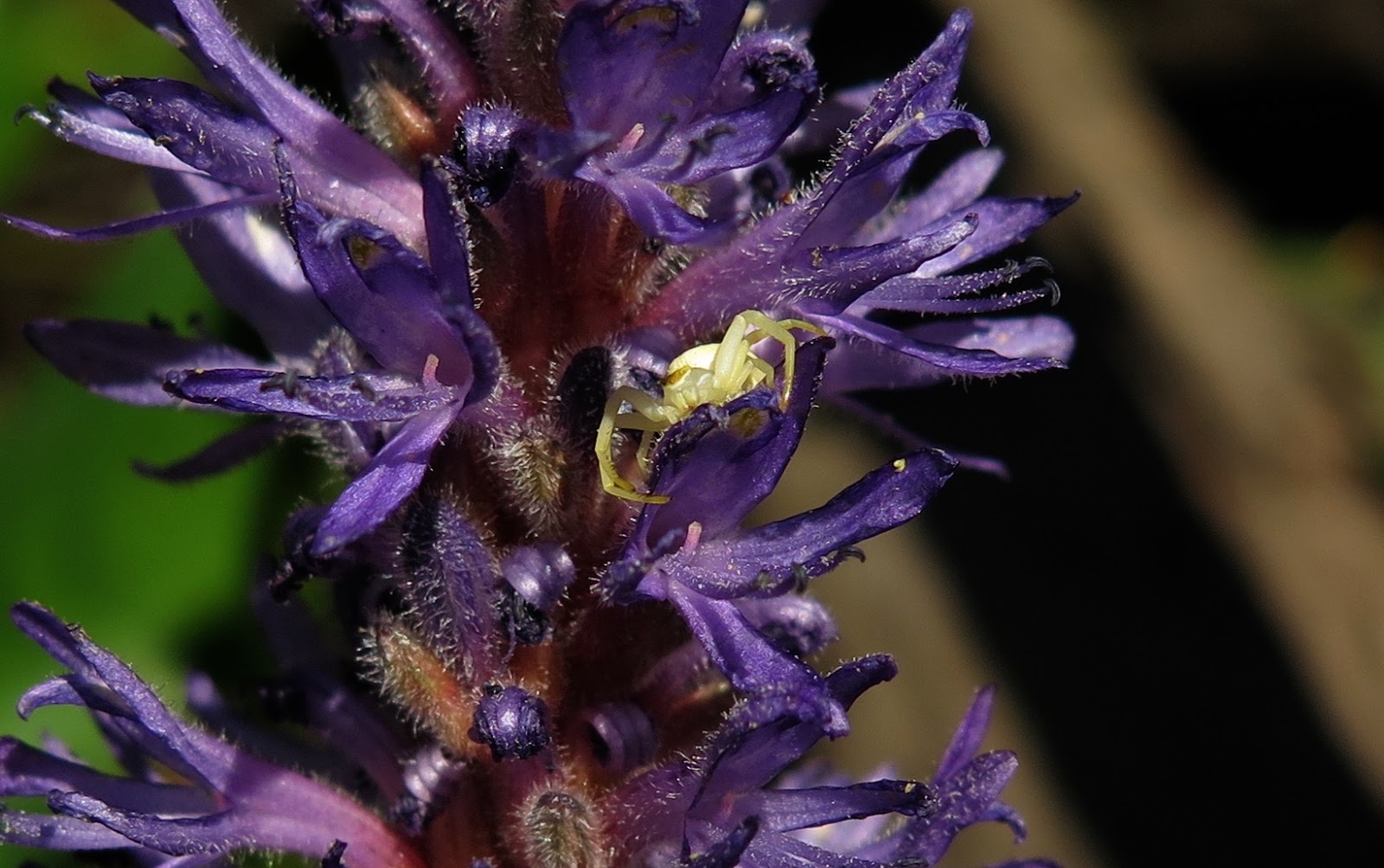
There were other, less rare but equally beautiful plants along the creek, especially where the water was held back by a beaver dam to form a large shallow pool filled with Yellow Pond Lilies and edged with the large purple spikes of Pickerel Weed (Pontederia cordata).


Intrigued by a yellowish dot on that Pickerel Weed's flower, I peered in close and discovered a small Goldenrod Crab Spider lurking among the florets.  This predacious spider can change its color from white to yellow in order to camouflage itself in similarly colored blooms, but it can't match itself to the purple of these florets.  I wonder how much prey it can capture, with its cover blown like this?


This bright-red Meadowhawk dragonfly does not need to camouflage itself and wait for prey, since it is very adept at catching its food on the wing.  Here, it rested on a twig and raised its abdomen in what is called the "obelisk" position, a posture dragonflies assume to minimize sun exposure on hot days.


I found a few stems of Swamp Milkweed (Asclepias incarnata) just starting to open its bright-pink blooms.


I stopped to examine the stems of this milkweed, wondering if I might find it to be the subspecies pulchra, a hairy-stemmed subspecies of Swamp Milkweed missing from the Saratoga County plant atlas.  It wasn't, but when I bent to look at the stem, I found these shiny orange eggs stuck on the underside of a leaf.  I did not recognize them, but when I got home, a quick Google search for "shiny orange insect eggs on milkweed" promptly yielded the answer: these are the eggs of the Swamp Milkweed Leaf Beetle (Labidomera clivicollis).  Of course!


The Swamp Milkweed Leaf Beetle also eats the leaves of Common Milkweed, which is where I found this one a couple of weeks ago in a park in downtown Saratoga Springs. 


Note that no white sap is oozing from the cut edge of the leaf, for the beetle has previously nipped an upstream vein to cut off the flow of sticky sap that could glue its jaws shut.  This is just one of the many insects that feed on milkweeds, their bright coloration advertising their toxicity to predators. Unlike many other species that feed exclusively on members of the Asclepias genus, the Swamp Milkweed Leaf Beetle will also consume the leaves of Swallowwort (Cynachum spp.), an invasive non-native species.