How can it be that a whole week has passed without me posting a blog? Well, it was a very busy week, and much of it was spent in the Skidmore woods. Since I'd promised to lead two nature walks there this past week (one for the Ecological Clearing House of Schenectady and the other for an Audubon chapter), I of course had to go out there to scope it out first.
On Monday, I asked my pal Lindsey to join me there. We started our explorations among some large limestone boulders, where we found some Red Trilliums still in fine bloom.
While checking out the plants that grew on the boulders, we surprised this little Red Eft, who scurried to hide in a crack in the rocks.
Walking Fern is a very unusual-looking fern, with long spear-shaped fronds growing out of the mossy rock. The tiny-leaved Maidenhair Spleenwort also shares these limestone boulders. Both ferns require just such a calcareous substrate to thrive.
Crowning one of those boulders was the first of many Jack in the Pulpits we were going to see this day.
We then moved to one of the main trails through the woods, and I'm going to list here in alphabetical order some of the plants we found along that trail.
Basswood is one of the large trees that make up this mixed-hardwood/conifer forest. We stopped to marvel at the size and softness of the leaves on a Basswood sapling, and I later found some of these tiny seedlings among the leaf litter. These first sprouts, with finger-shaped seedling leaves that look nothing like the mature leaves, often present a puzzle to folks who wonder what tree they might belong to.
Blue Cohosh was almost done blooming, but we were lucky to find a few hangers-on. There are two species of Blue Cohosh that grow in the Skidmore woods. This one, Caulophyllum thalictroides, has yellow-green flowers and is generally a daintier plant than the other species, C. giganteum, that was blooming just across the trail.
These are the purple flowers of Large Blue Cohosh (Caulophyllum giganteum). Even though these two Blue Cohoshes grow within a few feet of each other, they never appear to hybridize.
Columbine was easy to spot, with its brilliant red blooms sprouting bright-yellow anthers.
Dogwoods of several species grow throughout the woods, but only the Flowering Dogwood was in full glorious bloom this week.
Dwarf Ginseng started blooming some time ago, so I didn't know if we would find it still in bloom. Happily, we did.
Ferns of many different species thrive in these woods, but this delicate juvenile fern with a red stipe grows only where heaps of rocks are piled up on each other. Although ferns this young are hard to identify, a botanist friend believes these are Bulblet Fern.
This Grape Fern is quite distinctive, with a separate spore stalk that rises from the center of the fronds. The spores grow in clusters of tiny beads that resemble bunches of grapes.
Geraniums grow throughout the woods, and the Wild Geraniums are just now opening their pretty purple flowers. We also found a second geranium species called Herb Robert, which had yet to open its smaller pink blooms.
Hickory leaves have erupted from their huge pink bud scales, specifically the pinnate leaves of Shagbark Hickory.
Leatherwood shrubs bloomed early in April, and by now the fruits have started to form. Green now, the berries will eventually turn red.
Solomon's Seal dangles these little green flowers from the axils of their soft green leaves.
Trilliums truly thrive in the Skidmore woods, especially the Large-flowered White Trillium pictured here, which grows by the hundreds in soils that are rich with lime. I love that this trillium is flanked by a Canada Violet and a cluster of Sharp-lobed Hepatica leaves, the three plants representing a kind of holy trinity of spring wildflowers found in lime-rich woods.
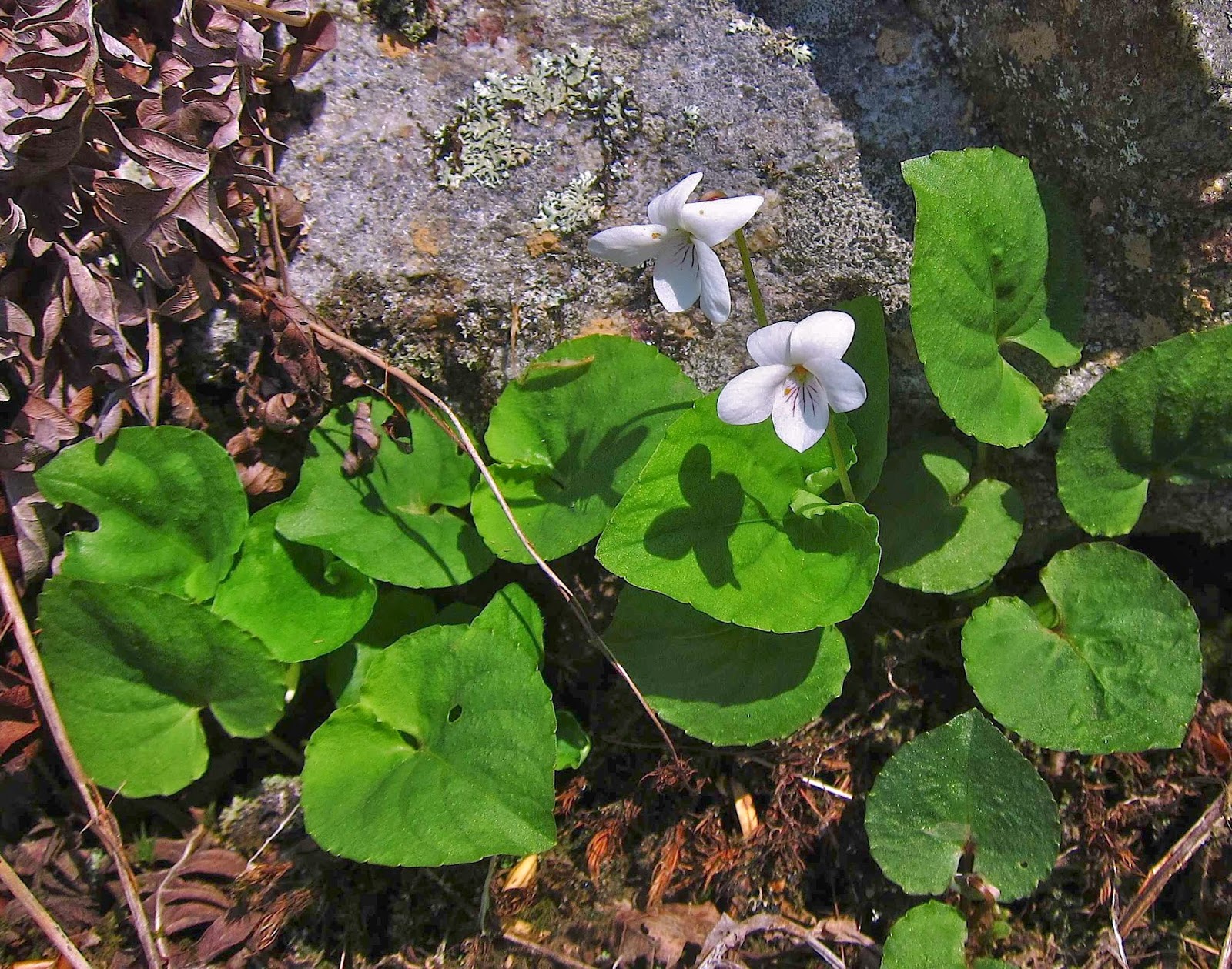
Violets are next, and the Skidmore woods features several violets found only in lime-rich soils. The Canada Violet pictured here is pure white on its face, while the backs of its blooms are tinged with purple.
The Green Violet bears hardly any resemblance at all to other plants in the Violaceae Family. Growing to about 18 inches tall, this plant bears in its leaf axils tiny green flowers, which were still in bud early this week. But the open flowers don't look much different than these little green nubbins.
I've been told that Green Violet is found nowhere else in Saratoga County except here in the Skidmore woods, where it thrives by the thousands among the limestone boulders littering the forest floor. When we see how it flourishes here, it's hard to believe it's considered a rare plant.
The Long-spurred Violet lives up to its name by sporting a long slender spur. It's also distinguished by the pale purple of its petals that seem to have drained their color to the deeper-hued center.
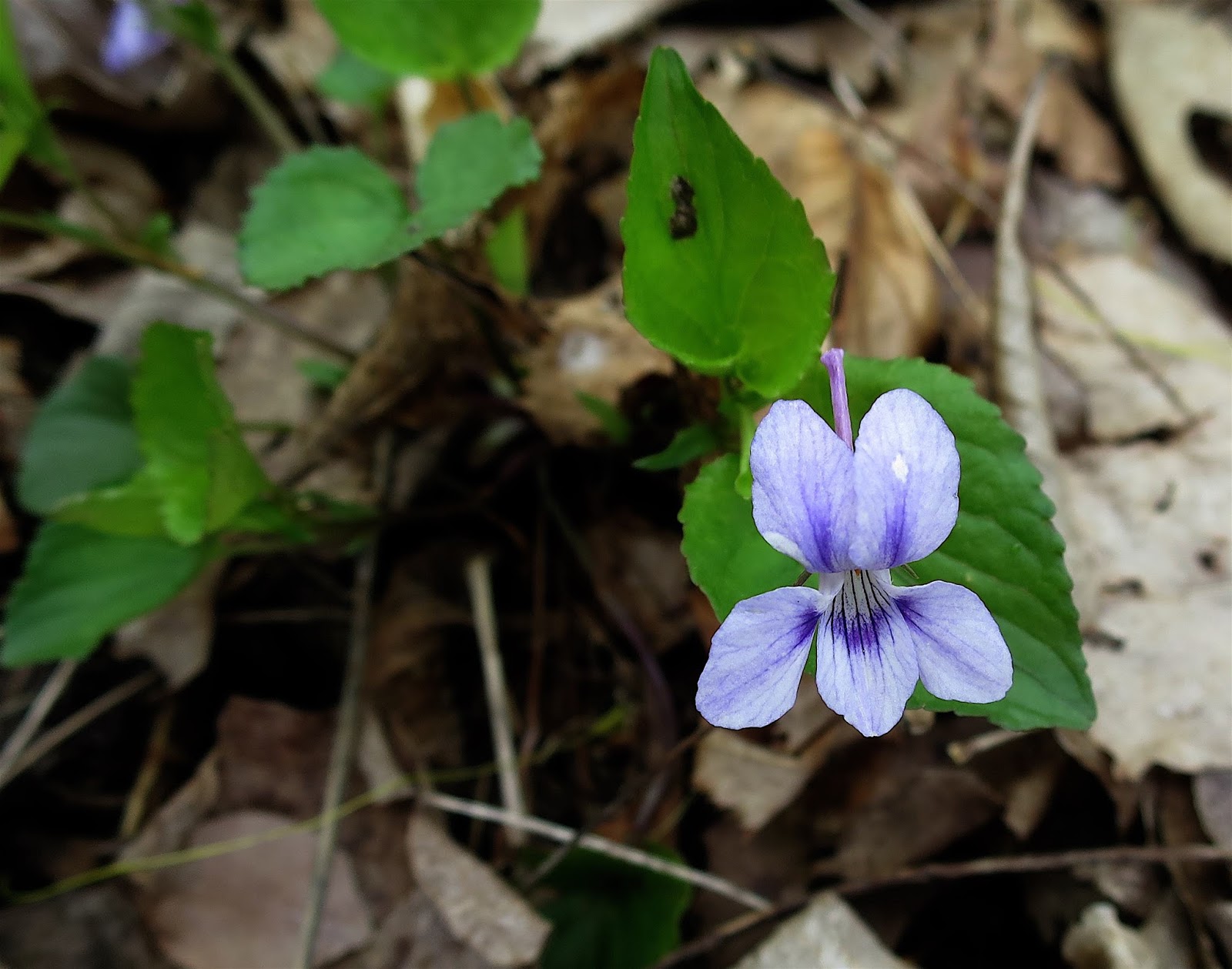
Downy Yellow Violets bloom abundantly in many parts of the Skidmore woods. Note that this "stemmed" violet bears both leaves and flowers on the same stem.
Wood Betony wasn't yet blooming this week, but I think its leaves are quite beautiful in their own right.
Wrinkles, I grant, is not the name of a plant. But I was struck by how the bark of this American Beech had seemed to sag into wrinkles around its roots. Unfortunately, most of our beeches are going to die, and not from a wrinkly old age. Rather, these beautiful silver-barked trees are under a two-pronged assault from both an insect and a fungal pathogen. I'm glad we still have a few unblemished stands here and there, including in some isolated sections of the Skidmore woods.
For more than thirty years I've been wandering the woods and waterways of Saratoga County, New York, and regions nearby, looking closely, listening carefully, and recording what I experience. We are blessed in this region with an amazing amount of wilderness right at hand. With this blog I share my year-round adventures here, seeking out what wonders await in my own Madagascar close to home.
Sunday, May 14, 2017
Sunday, May 7, 2017
I Love My Park, But Not the Phragmites
Lots of willing and able folks turned out on "I Love My Park Day" at Moreau Lake State Park this Saturday, ready to help spruce up our beloved state park for the coming summer season. Even our state asseblywoman Carrie Woerner (yellow jacket) showed up to add her support. Park Manager Peter Iskenderian (above) greeted and thanked us before we teamed up to set to various tasks. Some folks headed up the mountains to cut some new trails, others planted pretty flowers around the parking areas, or spread wood chips in the children's playground, or walked and paddled the shore of the lake picking up trash. My team split up two-by-two to encircle Moreau Lake, carrying nippers and thick plastic bags to cut and contain the seed-heads of Phragmites, the invasive Common Reed that has colonized too many parts of the shoreline, threatening the native plants that offer far more value to wildlife.
Although we experienced a few brief sprinkles, the generally overcast cool day was quite pleasant for those of us exerting ourselves. A hot sun beating down on these shores would have made our tasks much more uncomfortable.
Here's my teammate Karen reaching up to decapitate a Phragmites stalk. When we first observed the masses of it dominating parts of the shore, it sure seemed like a daunting task. And it was. It will take quite a few more days to attack this invasion, but working steadily for over three hours, we sure made a good dent in the population. The existing reeds will rise again from their roots, but by removing the seeds, we will help prevent their spread to parts of the shore that still remain pristine.
Although it appeared that the Phragmites had driven out all other plants, we were delighted to find masses of the tiny Northern White Violet (Viola pallens) carpeting the mud beneath the Phragmites stalks.
We were serenaded at our work by the calls of Spring Peepers and Pickerel Frogs, and we even got a close-up look at one of the Peepers. Very tiny and very cute!
Although we experienced a few brief sprinkles, the generally overcast cool day was quite pleasant for those of us exerting ourselves. A hot sun beating down on these shores would have made our tasks much more uncomfortable.
Here's my teammate Karen reaching up to decapitate a Phragmites stalk. When we first observed the masses of it dominating parts of the shore, it sure seemed like a daunting task. And it was. It will take quite a few more days to attack this invasion, but working steadily for over three hours, we sure made a good dent in the population. The existing reeds will rise again from their roots, but by removing the seeds, we will help prevent their spread to parts of the shore that still remain pristine.
Although it appeared that the Phragmites had driven out all other plants, we were delighted to find masses of the tiny Northern White Violet (Viola pallens) carpeting the mud beneath the Phragmites stalks.
We were serenaded at our work by the calls of Spring Peepers and Pickerel Frogs, and we even got a close-up look at one of the Peepers. Very tiny and very cute!
Friday, May 5, 2017
Bog Meadow Surprises
Chilly and rainy today. And so it will be for days to come. That makes me doubly glad I got out to Bog Meadow Brook Nature Trail yesterday, searching for more of the plants that are missing from the Saratoga County record. The other reason I am glad is that I found both of the missing plants I was searching for, as well as another that surprised me by blooming so early.
At first glance, the trail didn't look very promising for finding plants in bloom.
Except, of course, for the many patches of bright-white Wood Anemone (Anemone quinquefolia) that looked as if someone had tossed down handfuls of stars along the path. So pretty!
A few years ago I was surprised to find a single patch of Rose Twisted-stalk (Streptopus lanceolatus) growing along this trail, hidden beneath the invasive honeysuckle shrubs that dominate this particular section. Every time I've walked this trail since, I've looked for it, and most times I haven't been able to find it again. But on this day I did, and a thriving patch it was, too. This is one of the "missing" plants I'd been looking for, so I was delighted it had not eluded me once more. With so many healthy stems, I felt I could ethically collect just one to submit to the New York Flora Association, the organization that documents the flora of New York State. Chalk another species up for Saratoga County!
The leaf-stalks of this plant seem to reflect the meaning of its common name, since they certainly do look a bit twisty. But I've been told that the name actually refers to the hair-thin twisted peduncles of its tiny pink-tinged flowers that dangle in a row beneath its sessile leaves. I did not expect to find those flowers in bloom this early, but lo and behold: there they were! Tiny twisting stalks and all.
I also found the second missing plant I was hoping to collect on this walk: the Small-flowered Crowfoot (Ranunculus abortivus), which was thriving in great numbers in shadier areas of the trail. These flowers are so small, they are easily overlooked, but I think their starry beauty certainly deserves a closer look. And their presence certainly deserves to be recorded for their home county.
So hurray! My mission was completed for the day. Now I could swing my legs and keep up a fast aerobic pace -- or as fast a pace as one can maintain when tromping the awkwardly-spaced old railroad ties that underlie Bog Meadow Trail. But WHOA! Is that a Nodding Trillium (Trillium cernuum) that I see before me?! ! It certainly was, and it certainly brought my pace to a halt, as well. This species of trillium has reportedly been disappearing from much of its original territory, but so far its population seems quite secure along this trail. I saw only this one in bloom on this day, but I also found many plants with ripening buds.
OK, forget about that aerobic walk, let's see what other flowers are blooming now along Bog Meadow Trail. Next up was a single plant of Red Baneberry (Actaea rubra), its nearly spherical floral cluster rendered lop-sided by some kind of attacker. The roundness of its flower cluster is one way to distinguish this species from the similar White Baneberry, which has a more oblong flower cluster and also blooms a few weeks later.
Holding their own against the invading honeysuckles, the Highbush Blueberry shrubs (Vaccinium corymbosum) were fully in bloom, with clusters of white bell-shaped flowers that will later reward us (or more likely, the birds) with sweet blue fruit.
In some areas where the trail runs close to open marsh, the grassy verge was carpeted with masses of the dainty pale-purple flowers of American Dog Violet (Viola labradorica), one of our stemmed blue violets.
I don't know how this pretty flower came to be named for the dogs, but I remind myself of how to distinguish this species from other blue violets by observing the sharply toothed stipules that surround the leaf nodes on its flower stems. Note the sharp teeth on those stipules? Teeth make me think of canines which make me think of dogs. Who also have sharp teeth. With so many plants to try to remember the names of, mnemonics like this are essential.
Keeping a low profile down on the ground, the tiny flowers of Dwarf Raspberry (Rubus pubescens) would never be noticed if they weren't so bright white. Their sweet red fruits are easier to see, later in the summer.
I had forgotten that patches of Wild Ginger (Asarum canadense) thrive in certain areas along Bog Meadow Trail, but the vivid light-green of their heart-shaped leaves made their presence obvious, even when almost engulfed by masses of blue-flowered Ground Ivy (Glechoma hederacea). I certainly would never have noticed their flowers first, since those little brown nubbins lie flat on the ground beneath the leaves. I usually associate Wild Ginger with calcareous habitats. I wonder if some marble or limestone underlies this patch. Could be, since this is an old railroad bed, and railroad beds are often laid on limestone gravel.
Because Sessile-leaved Bellworts (Uvularia sessilifolia) first came into bloom more than three weeks ago, I was surprised to see a few of their dainty pale-yellow flowers still dangling from their arching stems. It won't be long before I find their perfoliate cousins (U. perfoliata) blooming nearby in wooded sections of this trail.
Strange, but along the entire mile of this trail I walked yesterday, I found but a single shrub of Nannyberry (Viburnum lentago), its flower cluster still in tight bud. Maybe there are more along the section I didn't walk this day.
I'm sure looking forward to coming back here in a week or so, when these tight purple buds will open into the bright-yellow flowers of Golden Ragwort (Packera aurea).
I used to find several examples of Glaucous Honeysuckle (Lonicera dioica) along this trail, but I haven't for several years. I've really missed this native vining honeysuckle with its clusters of confetti-colored flowers. But maybe there is hope that I will find them here yet again, since I did find some beginning shoots of their vines. In recent years, trail workers have widened this trail, cutting down most of the shrubs that supported this vining plant, but I'm hoping these shoots will find their way to whatever shrubs are near enough for them to climb on.
Actually, it might have been beavers that cut down those shrubs that supported the Glaucous Honeysuckle. The beavers have certainly been cutting down lots of small trees to build their dams. I was concerned to find this one damming the stream that runs under the bridge, since it is causing the water in the swamp to rise to a level that could inundate the trail. I guess I'd better notify Saratoga PLAN, the organization that maintains this trail, to alert them of this situation. Today's rain is predicted to be heavy at times and to continue well into next week. This may be the last time in weeks that Bog Meadow Brook Nature Trail will be passable without hip-waders.
At first glance, the trail didn't look very promising for finding plants in bloom.
Except, of course, for the many patches of bright-white Wood Anemone (Anemone quinquefolia) that looked as if someone had tossed down handfuls of stars along the path. So pretty!
A few years ago I was surprised to find a single patch of Rose Twisted-stalk (Streptopus lanceolatus) growing along this trail, hidden beneath the invasive honeysuckle shrubs that dominate this particular section. Every time I've walked this trail since, I've looked for it, and most times I haven't been able to find it again. But on this day I did, and a thriving patch it was, too. This is one of the "missing" plants I'd been looking for, so I was delighted it had not eluded me once more. With so many healthy stems, I felt I could ethically collect just one to submit to the New York Flora Association, the organization that documents the flora of New York State. Chalk another species up for Saratoga County!
The leaf-stalks of this plant seem to reflect the meaning of its common name, since they certainly do look a bit twisty. But I've been told that the name actually refers to the hair-thin twisted peduncles of its tiny pink-tinged flowers that dangle in a row beneath its sessile leaves. I did not expect to find those flowers in bloom this early, but lo and behold: there they were! Tiny twisting stalks and all.
I also found the second missing plant I was hoping to collect on this walk: the Small-flowered Crowfoot (Ranunculus abortivus), which was thriving in great numbers in shadier areas of the trail. These flowers are so small, they are easily overlooked, but I think their starry beauty certainly deserves a closer look. And their presence certainly deserves to be recorded for their home county.
So hurray! My mission was completed for the day. Now I could swing my legs and keep up a fast aerobic pace -- or as fast a pace as one can maintain when tromping the awkwardly-spaced old railroad ties that underlie Bog Meadow Trail. But WHOA! Is that a Nodding Trillium (Trillium cernuum) that I see before me?! ! It certainly was, and it certainly brought my pace to a halt, as well. This species of trillium has reportedly been disappearing from much of its original territory, but so far its population seems quite secure along this trail. I saw only this one in bloom on this day, but I also found many plants with ripening buds.
OK, forget about that aerobic walk, let's see what other flowers are blooming now along Bog Meadow Trail. Next up was a single plant of Red Baneberry (Actaea rubra), its nearly spherical floral cluster rendered lop-sided by some kind of attacker. The roundness of its flower cluster is one way to distinguish this species from the similar White Baneberry, which has a more oblong flower cluster and also blooms a few weeks later.
Holding their own against the invading honeysuckles, the Highbush Blueberry shrubs (Vaccinium corymbosum) were fully in bloom, with clusters of white bell-shaped flowers that will later reward us (or more likely, the birds) with sweet blue fruit.
In some areas where the trail runs close to open marsh, the grassy verge was carpeted with masses of the dainty pale-purple flowers of American Dog Violet (Viola labradorica), one of our stemmed blue violets.
I don't know how this pretty flower came to be named for the dogs, but I remind myself of how to distinguish this species from other blue violets by observing the sharply toothed stipules that surround the leaf nodes on its flower stems. Note the sharp teeth on those stipules? Teeth make me think of canines which make me think of dogs. Who also have sharp teeth. With so many plants to try to remember the names of, mnemonics like this are essential.
Keeping a low profile down on the ground, the tiny flowers of Dwarf Raspberry (Rubus pubescens) would never be noticed if they weren't so bright white. Their sweet red fruits are easier to see, later in the summer.
I had forgotten that patches of Wild Ginger (Asarum canadense) thrive in certain areas along Bog Meadow Trail, but the vivid light-green of their heart-shaped leaves made their presence obvious, even when almost engulfed by masses of blue-flowered Ground Ivy (Glechoma hederacea). I certainly would never have noticed their flowers first, since those little brown nubbins lie flat on the ground beneath the leaves. I usually associate Wild Ginger with calcareous habitats. I wonder if some marble or limestone underlies this patch. Could be, since this is an old railroad bed, and railroad beds are often laid on limestone gravel.
Because Sessile-leaved Bellworts (Uvularia sessilifolia) first came into bloom more than three weeks ago, I was surprised to see a few of their dainty pale-yellow flowers still dangling from their arching stems. It won't be long before I find their perfoliate cousins (U. perfoliata) blooming nearby in wooded sections of this trail.
Strange, but along the entire mile of this trail I walked yesterday, I found but a single shrub of Nannyberry (Viburnum lentago), its flower cluster still in tight bud. Maybe there are more along the section I didn't walk this day.
I'm sure looking forward to coming back here in a week or so, when these tight purple buds will open into the bright-yellow flowers of Golden Ragwort (Packera aurea).
I used to find several examples of Glaucous Honeysuckle (Lonicera dioica) along this trail, but I haven't for several years. I've really missed this native vining honeysuckle with its clusters of confetti-colored flowers. But maybe there is hope that I will find them here yet again, since I did find some beginning shoots of their vines. In recent years, trail workers have widened this trail, cutting down most of the shrubs that supported this vining plant, but I'm hoping these shoots will find their way to whatever shrubs are near enough for them to climb on.
Actually, it might have been beavers that cut down those shrubs that supported the Glaucous Honeysuckle. The beavers have certainly been cutting down lots of small trees to build their dams. I was concerned to find this one damming the stream that runs under the bridge, since it is causing the water in the swamp to rise to a level that could inundate the trail. I guess I'd better notify Saratoga PLAN, the organization that maintains this trail, to alert them of this situation. Today's rain is predicted to be heavy at times and to continue well into next week. This may be the last time in weeks that Bog Meadow Brook Nature Trail will be passable without hip-waders.
Wednesday, May 3, 2017
On the Hunt for the Missing Flowers
Hurray! Thanks to my pal Sue's coaching, I once again have access to my photo files, as well as to the new photos I keep taking every day. Some of my readers may remember my anguish last week when a computer update rendered my photos inaccessible to me. Well, problem solved! At least, sort of. The new operating system makes me add a cumbersome step or two, but at least I can breathe once more, knowing my decades' worth of photos aren't lost to me forever.
Other readers may remember the challenge I accepted last year from the New York Flora Association, to collect, press, and label plants that have not been documented to exist in Saratoga County, although there's every reason to believe they should be here. The list of such plants was over 1,000 strong! I know I will never find them all (I really can't tell most graminoids one from another), but I did locate and process over 80 of them last summer and fall, and now I'm on the hunt for the spring-blooming ones I missed last summer. So that's what I've been doing these days, running all over the county, trying to keep up with the undocumented flowers as they come into bloom. So far this spring, I've collected 30. Many more to go.
Many of the missing plants are such common weeds, it's quite understandable that no self-respecting professional botanist had ever bothered to collect them: Dandelion. Coltsfoot. Queen Anne's Lace. Ground Ivy. Periwinkle. But others are so spectacular, it's hard to believe they never caught some botanist's adoring eye and roused that collector's heart. I'm talking about such beauties as Large-flowered White Trillium (Trillium grandiflorum), scores of which are spreading across the forest floor in the Skidmore Woods right now.
It's a good thing I got out to the Skidmore woods a couple of weeks ago, because the beautiful Bloodroot (Sanguinaria canadensis) was in its glory then. Most of the plants have gone to seed by now, but not before I captured their sunny loveliness in a photo. And obtained one specimen to prove they really do flourish here.
The dainty-flowered Miterworts (Mitella diphylla) are just coming into bloom this week, but I managed to find a stunning cluster with its snowflake-like florets fully open in a swampy spot along the Hudson at Moreau.
I know a bank where Rue Anemone grows, along the maze of roads that follow the rolling hills above Saratoga Lake. I sped out there, wondering if I might yet be too early. But there they were, just where I always found them, starring a steep gravelly bank at the edge of the woods, their fragile blooms held aloft above a whorl of dainty leaves. Thalictrum thalictroides is their scientific name.
Early Saxifrage (Micranthes virginiensis) could probably go unnoticed if it bloomed all by its lonesome, its small white flowers and leafy rosettes easily overlooked if hidden among the underbrush. But it tends to bloom in abundant numbers, creating masses of snowy bloom that stand out against the mounds of green moss that share its spring-watered rocky ledges along Spier Falls Road. This gorgeous little rock garden stands along a waterfall that courses down the mountain to tumble into the Hudson River.
Ah, and then there are the violets! Luckily, we still have a few violets that haven't hybridized with other violet species to create new varieties lying in wait to confuse all but the most steeped-in-the-latest-nomenclature collectors. And luckily, too, I know where to find those few "pure" ones that are on Saratoga County's "Missing" list. The earliest of them to bloom is the English Violet (Viola odorata), a non-native species probably introduced to the woods where Skidmore College now stands by the Victorian ladies who once lived there and who loved to gather fragrant nosegays. If not for its exquisite fragrance and its flower's distinctive hooked style, it would probably pass for just another Common Blue Violet.
You have to start looking early in spring to find the lemon-yellow Round-leaved Violet (Viola rotundifolia), which I have found on a mossy bank along a stream at Orra Phelps Nature Preserve in Wilton. This is a common violet along Adirondack Mountain trails, but I hardly ever see it in Saratoga County. Maybe because it blooms when most county trails are still so muddy or even icy that I would be loathe to walk them.
The Canada Violet (Viola canadense) insists upon a rich habitat, and the Skidmore Woods in Saratoga Springs is one of the richest woods in all the county. That's where I find hundreds of these stunningly beautiful stemmed violets, pure white on the face of its petals and purple on the back, with a yellow throat and strong dark-purple veining. I look for these where limestone boulders litter the forest floor and provide a home for other lime-loving plants like Maidenhair Fern, Goldenseal,Wild Ginger, and Walking Fern.
Okay, this next violet is not on my "Missing" list. But it's one that is often confused for another that is. This is the Northern (or Smooth) White Violet (Viola pallens), a small-flowered early violet I usually find growing in damp ground. Note that its leaves are quite rounded. That trait, and the fact that it likes wet ground are just about all that distinguishes this violet from a second small white violet called Sweet White Violet (V. blanda), our missing flower. I think I know where some V. blanda grows, on a drier site and just a week or so later, and with leaves that are kind of more pointy. Kind of. But not much more. I should feel ashamed that I can't tell these two apart at a glance, but many folks more experienced than I still scratch their heads over these. Maybe I'll manage to collect the right one. Or maybe not. I'll try my best.
P.S.
I did find a photo labeled "Viola blanda" among my old photos. Maybe I was correct in identifying it. Maybe not. Here's what it looked like. Can you tell the difference?
Update: I still have two more "missing" violets I've yet to collect, because I have to wait a bit longer for them to come into bloom. But I might as well add them here, posting photos from my old files.
The first one is Pale Violet (Viola striata), yet another white one, but easier to ID than those mentioned above, because it has leaves on its stems, unlike our other whites with their basal-leaves-only habit of growth. It can also be distinguished by its very furry lateral petals and the sharply toothed stipules on its stems. I have found them in an untended area of Yaddo's gardens (an artists' retreat in Saratoga Springs). Chances are, someone planted them there years ago, and they have naturalized.
The last violet I need to collect is the stunning Marsh Blue Violet (V. cucullata), but they will have to wait until I put my canoe on the river. I know where they grow in a marshy spot -- true to their name! I can't walk through the mud to get to them, but I can paddle right up to them there. They are big and they are tall and they are a vivid blue.
You can't miss the big beautiful Marsh Blue Violets when they are blooming, but you might confuse them with the Common Blue Violet if you didn't peer closely at the hairs on their lateral petals. Those hairs are stubby, rather than finely tipped as on the Common Blues. It helps to look for them with a loupe. Or take a photo with your macro lens.
Other readers may remember the challenge I accepted last year from the New York Flora Association, to collect, press, and label plants that have not been documented to exist in Saratoga County, although there's every reason to believe they should be here. The list of such plants was over 1,000 strong! I know I will never find them all (I really can't tell most graminoids one from another), but I did locate and process over 80 of them last summer and fall, and now I'm on the hunt for the spring-blooming ones I missed last summer. So that's what I've been doing these days, running all over the county, trying to keep up with the undocumented flowers as they come into bloom. So far this spring, I've collected 30. Many more to go.
Many of the missing plants are such common weeds, it's quite understandable that no self-respecting professional botanist had ever bothered to collect them: Dandelion. Coltsfoot. Queen Anne's Lace. Ground Ivy. Periwinkle. But others are so spectacular, it's hard to believe they never caught some botanist's adoring eye and roused that collector's heart. I'm talking about such beauties as Large-flowered White Trillium (Trillium grandiflorum), scores of which are spreading across the forest floor in the Skidmore Woods right now.
It's a good thing I got out to the Skidmore woods a couple of weeks ago, because the beautiful Bloodroot (Sanguinaria canadensis) was in its glory then. Most of the plants have gone to seed by now, but not before I captured their sunny loveliness in a photo. And obtained one specimen to prove they really do flourish here.
The dainty-flowered Miterworts (Mitella diphylla) are just coming into bloom this week, but I managed to find a stunning cluster with its snowflake-like florets fully open in a swampy spot along the Hudson at Moreau.
I know a bank where Rue Anemone grows, along the maze of roads that follow the rolling hills above Saratoga Lake. I sped out there, wondering if I might yet be too early. But there they were, just where I always found them, starring a steep gravelly bank at the edge of the woods, their fragile blooms held aloft above a whorl of dainty leaves. Thalictrum thalictroides is their scientific name.
Early Saxifrage (Micranthes virginiensis) could probably go unnoticed if it bloomed all by its lonesome, its small white flowers and leafy rosettes easily overlooked if hidden among the underbrush. But it tends to bloom in abundant numbers, creating masses of snowy bloom that stand out against the mounds of green moss that share its spring-watered rocky ledges along Spier Falls Road. This gorgeous little rock garden stands along a waterfall that courses down the mountain to tumble into the Hudson River.
Ah, and then there are the violets! Luckily, we still have a few violets that haven't hybridized with other violet species to create new varieties lying in wait to confuse all but the most steeped-in-the-latest-nomenclature collectors. And luckily, too, I know where to find those few "pure" ones that are on Saratoga County's "Missing" list. The earliest of them to bloom is the English Violet (Viola odorata), a non-native species probably introduced to the woods where Skidmore College now stands by the Victorian ladies who once lived there and who loved to gather fragrant nosegays. If not for its exquisite fragrance and its flower's distinctive hooked style, it would probably pass for just another Common Blue Violet.
You have to start looking early in spring to find the lemon-yellow Round-leaved Violet (Viola rotundifolia), which I have found on a mossy bank along a stream at Orra Phelps Nature Preserve in Wilton. This is a common violet along Adirondack Mountain trails, but I hardly ever see it in Saratoga County. Maybe because it blooms when most county trails are still so muddy or even icy that I would be loathe to walk them.
The Canada Violet (Viola canadense) insists upon a rich habitat, and the Skidmore Woods in Saratoga Springs is one of the richest woods in all the county. That's where I find hundreds of these stunningly beautiful stemmed violets, pure white on the face of its petals and purple on the back, with a yellow throat and strong dark-purple veining. I look for these where limestone boulders litter the forest floor and provide a home for other lime-loving plants like Maidenhair Fern, Goldenseal,Wild Ginger, and Walking Fern.
Okay, this next violet is not on my "Missing" list. But it's one that is often confused for another that is. This is the Northern (or Smooth) White Violet (Viola pallens), a small-flowered early violet I usually find growing in damp ground. Note that its leaves are quite rounded. That trait, and the fact that it likes wet ground are just about all that distinguishes this violet from a second small white violet called Sweet White Violet (V. blanda), our missing flower. I think I know where some V. blanda grows, on a drier site and just a week or so later, and with leaves that are kind of more pointy. Kind of. But not much more. I should feel ashamed that I can't tell these two apart at a glance, but many folks more experienced than I still scratch their heads over these. Maybe I'll manage to collect the right one. Or maybe not. I'll try my best.
P.S.
I did find a photo labeled "Viola blanda" among my old photos. Maybe I was correct in identifying it. Maybe not. Here's what it looked like. Can you tell the difference?
Update: I still have two more "missing" violets I've yet to collect, because I have to wait a bit longer for them to come into bloom. But I might as well add them here, posting photos from my old files.
The first one is Pale Violet (Viola striata), yet another white one, but easier to ID than those mentioned above, because it has leaves on its stems, unlike our other whites with their basal-leaves-only habit of growth. It can also be distinguished by its very furry lateral petals and the sharply toothed stipules on its stems. I have found them in an untended area of Yaddo's gardens (an artists' retreat in Saratoga Springs). Chances are, someone planted them there years ago, and they have naturalized.
The last violet I need to collect is the stunning Marsh Blue Violet (V. cucullata), but they will have to wait until I put my canoe on the river. I know where they grow in a marshy spot -- true to their name! I can't walk through the mud to get to them, but I can paddle right up to them there. They are big and they are tall and they are a vivid blue.
You can't miss the big beautiful Marsh Blue Violets when they are blooming, but you might confuse them with the Common Blue Violet if you didn't peer closely at the hairs on their lateral petals. Those hairs are stubby, rather than finely tipped as on the Common Blues. It helps to look for them with a loupe. Or take a photo with your macro lens.
Subscribe to:
Posts (Atom)