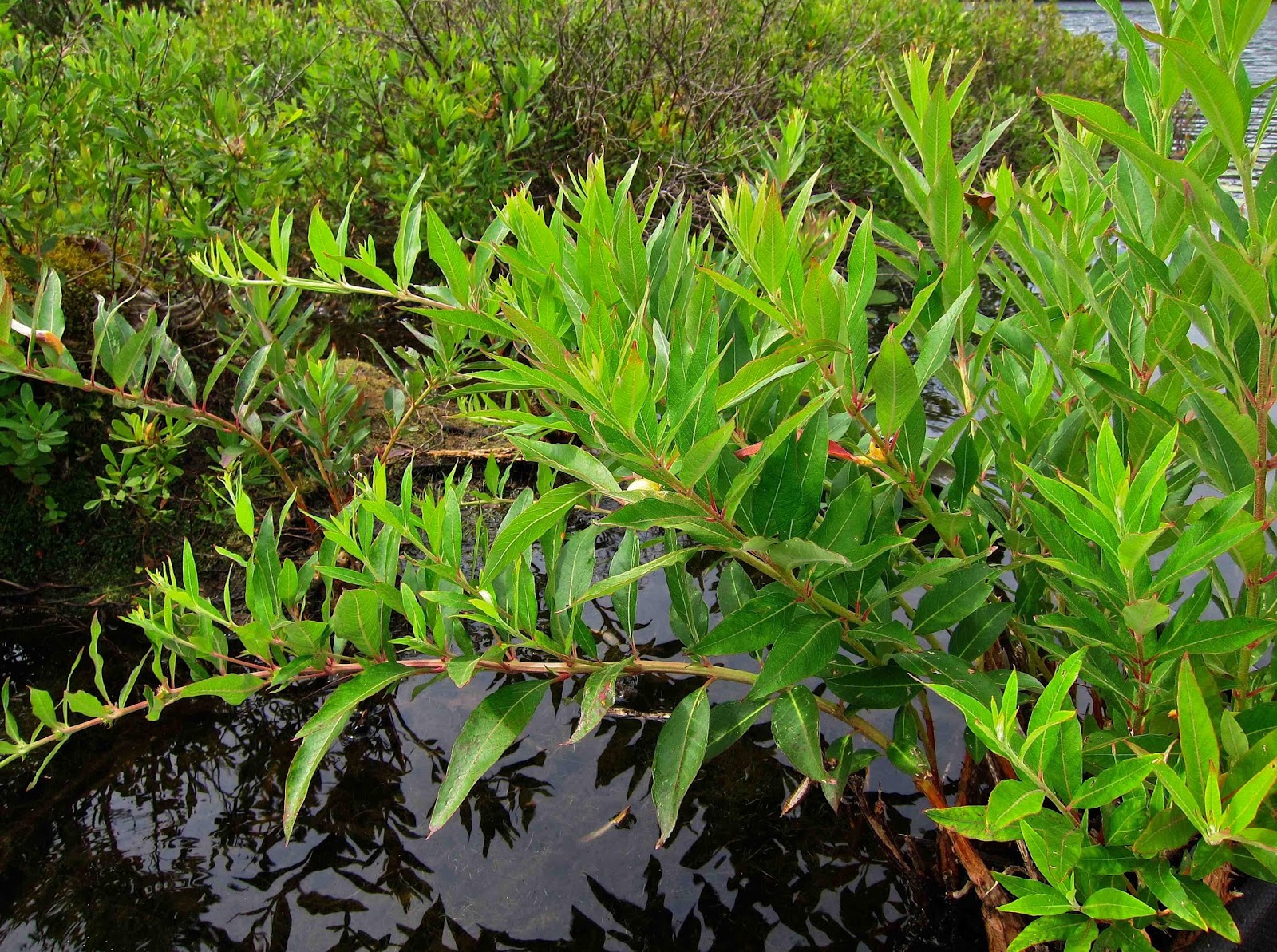
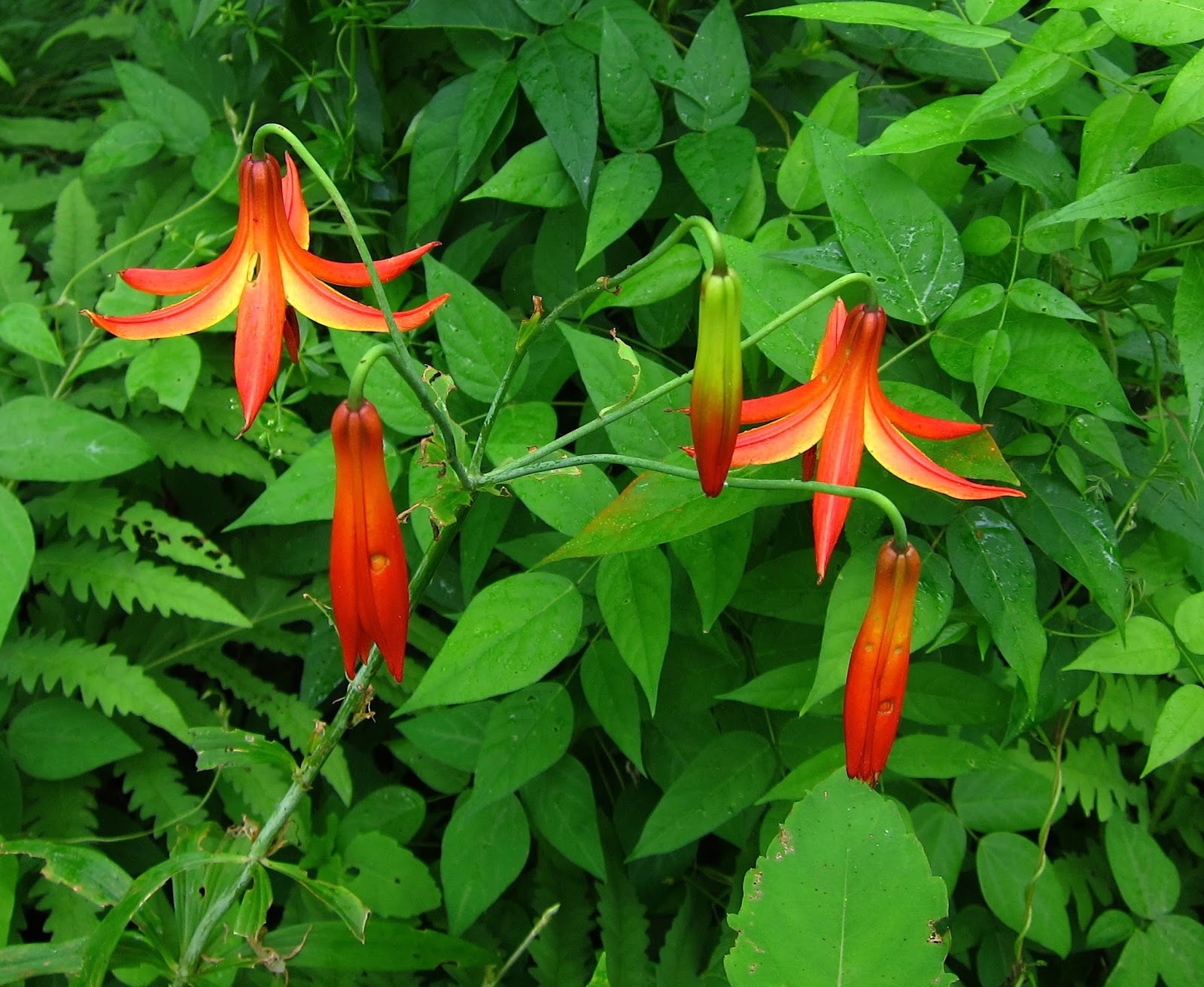
Longtime followers of this blog may recall how excited we were to discover a large, healthy patch of the endangered Whorled Mountain Mint (Pycnanthemum verticillatum var. verticillatum) on the shore of Moreau Lake a couple of years ago. Since I was the one who first stumbled across it, I feel a kind of proprietary concern for it, and often visit its site in a small cove off the main body of the lake. Well, it was time to pay a visit once more, as mid-July is when it usually comes into bloom. So on Monday this week I made my way to that quiet cove, its sandy shoreline much wider than usual this year, due to lower water levels in the lake.
I always feel a little rush of excitement when I find "my" Mountain Mints thriving in their usual spot, especially when I see them exploding with abundant, bee-attracting bloom.
I realize that not everybody would feel much excitement about this rather scraggly, unprepossessing plant, but that could be because they don't understand how truly rare this species is (the designation "Endangered" means there are only 5 or fewer populations in all the state). And also, you have to look really close to see how pretty their purple-polka-dotted white flowers are. In addition, the leaves smell deliciously minty, too! (Mmmm!)
Well, this year my excitement was amplified when I discovered how widely their original patch has expanded. Back in 2014, when Rich Ring, a botanist from the New York Natural Heritage Program, visited Moreau Lake to officially document this population, we counted 273 healthy plants in a limited area. Although I didn't count them this week, those plants remain at their original site and certainly appear to be thriving. But this year, I found a whole new burgeoning patch of several dozen plants, along the same cove shore but separated by many yards from the original site. They especially seemed to like this location under a Buttonbush shrub, where a sandy spur juts into the cove.
The new plants sure looked happy here! Good news for a plant that appears to be disappearing in other locations around the state!
There are lots of other interesting plants inhabiting the shore of this cove, and I was especially curious about this pink-flowered one. On closer examination, I ascertained it was the familiar Blue Vervain (Verbena hastata), but blooming in a totally unexpected color. At least, unexpected by me. Perhaps this is a common color variant in other parts of its range, but its one that I have not seen before.
This vibrant blue is the color I usually associate with Blue Vervain. And of course, it's this very color that suggested its common name. It sure is a lovely native wildflower, and it, too, thrives on the sandy cove were the Mountain Mint grows.
How lucky I feel, to have so many different habitats around this part of the world to explore! And who would think, just taking a glance at what appears to be a rather barren shoreline, how many treasures can be found, if only one looks for them?
For more than thirty years I've been wandering the woods and waterways of Saratoga County, New York, and regions nearby, looking closely, listening carefully, and recording what I experience. We are blessed in this region with an amazing amount of wilderness right at hand. With this blog I share my year-round adventures here, seeking out what wonders await in my own Madagascar close to home.
Wednesday, July 13, 2016
Monday, July 11, 2016
The Special Islands of Lake Bonita
When I wandered out on the ice of Lake Bonita last winter, I was surprised to find the remnants of numerous bog-dwelling plants growing on the tiny islands that dot this pristine lake. Bog or fen habitats are quite rare in Saratoga County, so I was delighted that this beautiful little lake had just become part of Moreau Lake State Park, adding to the park's already remarkable diversity of habitats. Of course, I dreamed back then of when I'd be able to paddle out to these islands in high summer to see what flowers the warmer weather would bring. Maybe there would be orchids!
But when summer came, so did the park's directive that no boating would be allowed on Lake Bonita. None. Not even lightweight car-top boats that a paddler would have to carry a long steep rocky trail before reaching the water.
In many ways, I applauded the park's policy regarding boating, recalling the dismaying quantity of beer cans, bait boxes, and other trash I find whenever I paddle the Hudson, which is open to all kinds of boats. Yes, I concurred, keep the public from despoiling this remarkably pristine mountain lake. Also, keep them from bringing in invasive species along with their watercraft. So yes, I strongly agree, in principle, with the park's stern policy regarding boating. But was I disappointed for myself? Oh boy, you betcha! Now all I could do was stand on shore and gaze at those little islands, knowing they held a treasure that would remain beyond this plant nerd's reach.
So what was I doing out in my boat on Lake Bonita last Thursday?
Conducting an official plant survey, that's what! And boy, did I feel privileged! I guess keeping this blog for almost eight years, documenting all the flowers I find as I wander the woods and waterways, gave me enough credibility with the New York State Park's Regional Natural Resource Steward, Casey Holzworth, that he issued me a "Scientific Research Permit." This permit grants me permission for a limited time to paddle on Lake Bonita in order to identify its flora and fauna. Here's the document I must carry with me and show to anyone who questions my presence on the water.
And here's Casey Holzworth himself, who accompanied me on my first paddle on Lake Bonita last Thursday. I am so very grateful to him for trusting my capabilities for this task. And I also enjoyed his good company!
And here are some of the fascinating flora we found on the islands. First of all, there are the shrubs, low woody plants that thickly cover all of the islands on Lake Bonita. This photo shows the impenetrable thicket of shrubs, in this case mostly Leatherleaf (Chamaedaphne calyculata) and, with a branch protruding above the rest, Sheep Laurel (Kalmia angustifolia). Both of these shrubs flowered earlier this year, the Leatherleaf with arching racemes of small white bells in spring, and the Sheep Laurel with whorls of bright-pink flowers just a week or so ago.
(P.S. Here's how vivid those Sheep Laurel flowers were, just two weeks ago:)
Mixed in with the Leatherleaf and Sheep Laurel was the third of the most common shrubs throughout the islands, the fragrant-leaved shrub called Sweet Gale (Myrica gale), shown here with ripening seedpods.
Occasionally interrupting the almost complete dominance of the three above-mentioned shrubs were the graceful wand-like stems of Swamp Loosestrife (Decodon verticillatus). It will have axillary clusters of bright-purple flowers later in the summer.
All of the islands were thickly carpeted with various species of sphagnum mosses, in colors of red and green and gold. In this photo, nestled among the spongey sphagnum are a variety of plants found in the acidic, low-nutrient conditions of fens or bogs: the red-veined, vase-shaped leaves of Northern Pitcher Plants (Sarracenia purpurea); the tiny-leaved trailing stems of Small Cranberry (Vaccinium oxycoccos); and the rosy-stemmed, opposite-leaved stalks of Marsh St. Johnswort (Hypericum virginicum), which soon will bear small pink flowers. I also see a sprig of Sweet Gale, and there in the center foreground, two tiny leaves of Round-leaved Sundew (Drosera rotundifolia) are peeking out of the sphagnum.
Standing tall above the shrubs were the large rosy-capped flowers of those Northern Pitcher Plants.
Occurring frequently at the edges of the islands were mats of Spatulate-leaved Sundew (Drosera intermedia), their scarlet leaves sparkling with the sticky drops meant to trap insects, the leaves now surmounted by the sundew's tiny white flowers on spindly stems. Sharing this space with the sundew were masses of another carnivorous plant called Horned Bladderwort (Utricularia cornuta), their bright-yellow hooked blooms held high on slender stalks. While the sundew absorbs nutrients from insects trapped and dissolved within its sticky leaves, the bladderwort feeds on tiny organisms that it sucks into small sacs attached to its underwater structures.
Here's a closer view of that sparkling Spatulate-leaved Sundew and its pretty flowers.
I also found clumps of the Round-leaved Sundew (Drosera rotundifolia), which also grows sticky hairs on its leaves for trapping insects.
These tiny white flowers on arcing stems were growing out of another clump of Round-leaved Sundew.
And were there orchids? Oh yes, there were! Lots and lots of the pretty pink native orchid called Rose Pogonia (Pogonia ophioglossoides) growing on many of the islands.
Although most of the Rose Pogonias were starting to fade, I did find a few that still displayed the beauty this little orchid is famous for.
Scattered among the sphagnum and sundews were the small white dots of Pipewort (Eriocaulon aquaticum).
There were also a number of grasses and sedges I didn't feel qualified to identify, but this pretty sedge with its sprightly white tufts on top I do know the name of: it's White Beak Sedge (Rhynchospora alba), a common denizen of fairly acidic wetlands containing few plant nutrients.
Not, strictly speaking, ON the islands, but floating about the edges, were many of the pristine-white blooms of Fragrant Water Lily (Nymphea odorata).
Not as frequently found as the Fragrant Water Lily were the yellow globular blooms of Yellow Pond Lily (Nuphar variegata), held on thick stalks above their large flat floating leaves.
We were constantly investigated by curious dragonflies as we moved among the islands, but few would hold still for the picture-taking, aside from this vivid purple damselfly (I believe its a Variable Dancer), which landed to rest on my knee.
I'm sure I've not listed all the plants that grow on Lake Bonita's islands, so I hope to return later in summer or early autumn when other flowers might be in bloom. I also do not feel confident to name the various mosses, grasses, sedges, and other plants, including the shiny green liverwort pictured here.
But when summer came, so did the park's directive that no boating would be allowed on Lake Bonita. None. Not even lightweight car-top boats that a paddler would have to carry a long steep rocky trail before reaching the water.
In many ways, I applauded the park's policy regarding boating, recalling the dismaying quantity of beer cans, bait boxes, and other trash I find whenever I paddle the Hudson, which is open to all kinds of boats. Yes, I concurred, keep the public from despoiling this remarkably pristine mountain lake. Also, keep them from bringing in invasive species along with their watercraft. So yes, I strongly agree, in principle, with the park's stern policy regarding boating. But was I disappointed for myself? Oh boy, you betcha! Now all I could do was stand on shore and gaze at those little islands, knowing they held a treasure that would remain beyond this plant nerd's reach.
So what was I doing out in my boat on Lake Bonita last Thursday?
Conducting an official plant survey, that's what! And boy, did I feel privileged! I guess keeping this blog for almost eight years, documenting all the flowers I find as I wander the woods and waterways, gave me enough credibility with the New York State Park's Regional Natural Resource Steward, Casey Holzworth, that he issued me a "Scientific Research Permit." This permit grants me permission for a limited time to paddle on Lake Bonita in order to identify its flora and fauna. Here's the document I must carry with me and show to anyone who questions my presence on the water.
And here's Casey Holzworth himself, who accompanied me on my first paddle on Lake Bonita last Thursday. I am so very grateful to him for trusting my capabilities for this task. And I also enjoyed his good company!
And here are some of the fascinating flora we found on the islands. First of all, there are the shrubs, low woody plants that thickly cover all of the islands on Lake Bonita. This photo shows the impenetrable thicket of shrubs, in this case mostly Leatherleaf (Chamaedaphne calyculata) and, with a branch protruding above the rest, Sheep Laurel (Kalmia angustifolia). Both of these shrubs flowered earlier this year, the Leatherleaf with arching racemes of small white bells in spring, and the Sheep Laurel with whorls of bright-pink flowers just a week or so ago.
(P.S. Here's how vivid those Sheep Laurel flowers were, just two weeks ago:)
Mixed in with the Leatherleaf and Sheep Laurel was the third of the most common shrubs throughout the islands, the fragrant-leaved shrub called Sweet Gale (Myrica gale), shown here with ripening seedpods.
Occasionally interrupting the almost complete dominance of the three above-mentioned shrubs were the graceful wand-like stems of Swamp Loosestrife (Decodon verticillatus). It will have axillary clusters of bright-purple flowers later in the summer.
All of the islands were thickly carpeted with various species of sphagnum mosses, in colors of red and green and gold. In this photo, nestled among the spongey sphagnum are a variety of plants found in the acidic, low-nutrient conditions of fens or bogs: the red-veined, vase-shaped leaves of Northern Pitcher Plants (Sarracenia purpurea); the tiny-leaved trailing stems of Small Cranberry (Vaccinium oxycoccos); and the rosy-stemmed, opposite-leaved stalks of Marsh St. Johnswort (Hypericum virginicum), which soon will bear small pink flowers. I also see a sprig of Sweet Gale, and there in the center foreground, two tiny leaves of Round-leaved Sundew (Drosera rotundifolia) are peeking out of the sphagnum.
Standing tall above the shrubs were the large rosy-capped flowers of those Northern Pitcher Plants.
Occurring frequently at the edges of the islands were mats of Spatulate-leaved Sundew (Drosera intermedia), their scarlet leaves sparkling with the sticky drops meant to trap insects, the leaves now surmounted by the sundew's tiny white flowers on spindly stems. Sharing this space with the sundew were masses of another carnivorous plant called Horned Bladderwort (Utricularia cornuta), their bright-yellow hooked blooms held high on slender stalks. While the sundew absorbs nutrients from insects trapped and dissolved within its sticky leaves, the bladderwort feeds on tiny organisms that it sucks into small sacs attached to its underwater structures.
Here's a closer view of that sparkling Spatulate-leaved Sundew and its pretty flowers.
I also found clumps of the Round-leaved Sundew (Drosera rotundifolia), which also grows sticky hairs on its leaves for trapping insects.
These tiny white flowers on arcing stems were growing out of another clump of Round-leaved Sundew.
And were there orchids? Oh yes, there were! Lots and lots of the pretty pink native orchid called Rose Pogonia (Pogonia ophioglossoides) growing on many of the islands.
Although most of the Rose Pogonias were starting to fade, I did find a few that still displayed the beauty this little orchid is famous for.
Scattered among the sphagnum and sundews were the small white dots of Pipewort (Eriocaulon aquaticum).
There were also a number of grasses and sedges I didn't feel qualified to identify, but this pretty sedge with its sprightly white tufts on top I do know the name of: it's White Beak Sedge (Rhynchospora alba), a common denizen of fairly acidic wetlands containing few plant nutrients.
Not, strictly speaking, ON the islands, but floating about the edges, were many of the pristine-white blooms of Fragrant Water Lily (Nymphea odorata).
Not as frequently found as the Fragrant Water Lily were the yellow globular blooms of Yellow Pond Lily (Nuphar variegata), held on thick stalks above their large flat floating leaves.
We were constantly investigated by curious dragonflies as we moved among the islands, but few would hold still for the picture-taking, aside from this vivid purple damselfly (I believe its a Variable Dancer), which landed to rest on my knee.
I'm sure I've not listed all the plants that grow on Lake Bonita's islands, so I hope to return later in summer or early autumn when other flowers might be in bloom. I also do not feel confident to name the various mosses, grasses, sedges, and other plants, including the shiny green liverwort pictured here.
I have a friend who's an expert in mosses and liverworts, so I hope to bring her here in late summer to help me complete this plant survey. (My permit allows me to bring along research assistants.) I also want to bring my friend Sue here, because her super-keen eye often spies things I miss, and her knowledge of birds and insects is astounding. But that will be it, for paddling here. I don't want the public to see me paddling on Lake Bonita very often. I do hope my presence on the water will not inspire others to attempt the same, despite the difficulty of accessing the water from the parking area. The "no boating" policy imposed by the park is important for preserving the quality of this mountain lake. And of course, I do hope my blog readers will understand this prohibition and will help spread the word about its necessity.
Saturday, July 9, 2016
Midsummer Wildflower Finds
I can't believe how lucky I am, to live amid so much natural beauty here in Saratoga County. Each day I have many different choices of where I could walk or paddle: Lake or river? Marsh or meadow? Creekside ramble or mountain trail? Oak/pine savanna or rich woods? How can I choose? This week I let my photo files guide my choices, noting what should be blooming now and where, and heading out to see if I could find those flowers again.
Woods Hollow Nature Preserve
My first choice this week was the Woods Hollow Nature Preserve near Ballston Spa, on the hunt for the tiny white-flowered orchid called Checkered Rattlesnake Plantain (Goodyera tesselata). Woods Hollow is known for its extensive pine woods, the favored habitat for this native orchid.
I did find quite a few spikes of Checkered Rattlesnake Plantain, their small pale-green leaves well hidden beneath the pine needles, but their narrow flower stalks protruding well above the forest floor. The tiny white florets were just beginning to open.
Sharing that same pine-needled open woods were many blooming plants of Pipsissewa (Chimaphila unbellata), holding whorls of pale-pink waxy flowers dangling above glossy green leaves.
Woods Hollow is also home to a dense mixed hardwood/conifer forest surrounding a small pond, and many of my favorite wildflowers grow along the pond's damp shady banks.
The first flower I saw as I started my circumambulation of the pond was the little Swamp Dewberry (Rubus hispidus), carpeting the banks with its glossy green leaves and small white blooms.
Leaning over the quiet water were several stems of Marsh Skullcap (Scutellaria galericulata), bearing twin blooms of pretty blue flowers.
The Hudson River at Moreau
We've had so many perfect paddling days this past week, it's hard for me to remember exactly which day I carried my boat down to the Hudson River, putting in at a quiet cove where the river runs back behind an island, and the rocky banks are covered with deep green mosses. My photo files tell me I took these photos on July 6, which would be last Wednesday, a lovely day to be on the river.
I had chosen this spot so that I could easily check on a patch of Great St. Johnsworts (Hypericum ascyron ssp. pyramidatum) that grow on one of the islands that dot this section of the river. Perhaps they are blooming a bit later this summer than my photo files had indicated, because I found only one in full bloom, and not many others even in swelling bud. A couple of years ago these flowers, which are considered a rare species in New York, were grazed by deer, so I surely hope this population will continue to thrive despite this ill treatment. They have truly impressive blooms for this genus, with flowers more than two inches across.
While paddling back in a marshy area behind another island, I noted several mats of floating vegetation that were supporting masses of colorful blooms and deep-red leaves. The little yellow flowers were those of Golden Pert (Gratiola aurea) and the red-leaved stems belonged to some species of St. Johnswort (Hypericum sp.) I couldn't identify without their flowers.
I found that same Golden Pert massed in other areas along the shore of the river.
Another destination today was a backwater above the Sherman Island Dam, where I knew of a patch of Sweet Flag (Acorus calamus) that I hoped would be blooming in standing water along the shore. And so it was, or at least it was in bud. It bears its "flowers" on this odd finger-shaped protuberance called a spadix, which doesn't look much different whether it's in bloom or in bud. This is a plant with a long history of medicinal uses, and it's said to have a wonderful smell, although I've never been able to detect much aroma from its leaves or flowers. I needed to collect a specimen for my list of plants not yet recorded for Saratoga County, and so I did. But I do wonder how to prepare this rigid spadix for the herbarium files!
Mud Pond at Moreau Lake State Park
After leaving the river on Wednesday, I stopped by Mud Pond at Moreau, amazed to see how little water remains in it. I guess this pond is living up to its name by becoming all mud, and only mud!
It's always fun to see what plants pop up on mud that was once well under water. These chubby little dots of bright-yellow belong to the Humped Bladderwort (Utricularia gibba), a carnivorous plant that can either float free in the water or become affixed to the mud beneath the shallow water. Tiny sacs on its underwater (or under-mud!) branchings can suck in even tinier organisms and digest them for nutrients. I tried to get a little closer to take a better photo of these interesting flowers with their humped lower lips (hence their name), but I promptly sank up to my shins in loose mud as I approached. After a moment's genuine concern about whether I would be able to free my feet, I did manage to struggle to firmer ground. If you go to Mud Pond these days, STAY OFF THE MUD!!!
Safely back on firmer ground, I could look around and enjoy the bright-blue blooms of Monkey Flower (Mimulus ringens) peeking out from among the tall grasses.
I had to look really, really close among the grasses to detect the itsy-bitsy flowers of Three-petaled Bedstraw (Galium trifidum ssp. trifidum), which, as its name implies, has just three petals, unlike most of the others of its genus, which have four. This is another of the flowers not recorded for my county, so of course I wanted to collect a specimen to be pressed and submitted. Easier said than done! The hair-fine and somewhat prickly stems of this plant all stick together in a matted tangle, and untangling a few strands with their flowers and their whorls of four leaves intact proved quite difficult. Oh well, it's not considered a rare or even unusual plant, so maybe the recording botanists don't really need a perfect specimen.
Woods Hollow Nature Preserve
My first choice this week was the Woods Hollow Nature Preserve near Ballston Spa, on the hunt for the tiny white-flowered orchid called Checkered Rattlesnake Plantain (Goodyera tesselata). Woods Hollow is known for its extensive pine woods, the favored habitat for this native orchid.
I did find quite a few spikes of Checkered Rattlesnake Plantain, their small pale-green leaves well hidden beneath the pine needles, but their narrow flower stalks protruding well above the forest floor. The tiny white florets were just beginning to open.
Sharing that same pine-needled open woods were many blooming plants of Pipsissewa (Chimaphila unbellata), holding whorls of pale-pink waxy flowers dangling above glossy green leaves.
Woods Hollow is also home to a dense mixed hardwood/conifer forest surrounding a small pond, and many of my favorite wildflowers grow along the pond's damp shady banks.
The first flower I saw as I started my circumambulation of the pond was the little Swamp Dewberry (Rubus hispidus), carpeting the banks with its glossy green leaves and small white blooms.
Leaning over the quiet water were several stems of Marsh Skullcap (Scutellaria galericulata), bearing twin blooms of pretty blue flowers.
The Hudson River at Moreau
We've had so many perfect paddling days this past week, it's hard for me to remember exactly which day I carried my boat down to the Hudson River, putting in at a quiet cove where the river runs back behind an island, and the rocky banks are covered with deep green mosses. My photo files tell me I took these photos on July 6, which would be last Wednesday, a lovely day to be on the river.
I had chosen this spot so that I could easily check on a patch of Great St. Johnsworts (Hypericum ascyron ssp. pyramidatum) that grow on one of the islands that dot this section of the river. Perhaps they are blooming a bit later this summer than my photo files had indicated, because I found only one in full bloom, and not many others even in swelling bud. A couple of years ago these flowers, which are considered a rare species in New York, were grazed by deer, so I surely hope this population will continue to thrive despite this ill treatment. They have truly impressive blooms for this genus, with flowers more than two inches across.
While paddling back in a marshy area behind another island, I noted several mats of floating vegetation that were supporting masses of colorful blooms and deep-red leaves. The little yellow flowers were those of Golden Pert (Gratiola aurea) and the red-leaved stems belonged to some species of St. Johnswort (Hypericum sp.) I couldn't identify without their flowers.
I found that same Golden Pert massed in other areas along the shore of the river.
Another destination today was a backwater above the Sherman Island Dam, where I knew of a patch of Sweet Flag (Acorus calamus) that I hoped would be blooming in standing water along the shore. And so it was, or at least it was in bud. It bears its "flowers" on this odd finger-shaped protuberance called a spadix, which doesn't look much different whether it's in bloom or in bud. This is a plant with a long history of medicinal uses, and it's said to have a wonderful smell, although I've never been able to detect much aroma from its leaves or flowers. I needed to collect a specimen for my list of plants not yet recorded for Saratoga County, and so I did. But I do wonder how to prepare this rigid spadix for the herbarium files!
Mud Pond at Moreau Lake State Park
After leaving the river on Wednesday, I stopped by Mud Pond at Moreau, amazed to see how little water remains in it. I guess this pond is living up to its name by becoming all mud, and only mud!
It's always fun to see what plants pop up on mud that was once well under water. These chubby little dots of bright-yellow belong to the Humped Bladderwort (Utricularia gibba), a carnivorous plant that can either float free in the water or become affixed to the mud beneath the shallow water. Tiny sacs on its underwater (or under-mud!) branchings can suck in even tinier organisms and digest them for nutrients. I tried to get a little closer to take a better photo of these interesting flowers with their humped lower lips (hence their name), but I promptly sank up to my shins in loose mud as I approached. After a moment's genuine concern about whether I would be able to free my feet, I did manage to struggle to firmer ground. If you go to Mud Pond these days, STAY OFF THE MUD!!!
Safely back on firmer ground, I could look around and enjoy the bright-blue blooms of Monkey Flower (Mimulus ringens) peeking out from among the tall grasses.
I had to look really, really close among the grasses to detect the itsy-bitsy flowers of Three-petaled Bedstraw (Galium trifidum ssp. trifidum), which, as its name implies, has just three petals, unlike most of the others of its genus, which have four. This is another of the flowers not recorded for my county, so of course I wanted to collect a specimen to be pressed and submitted. Easier said than done! The hair-fine and somewhat prickly stems of this plant all stick together in a matted tangle, and untangling a few strands with their flowers and their whorls of four leaves intact proved quite difficult. Oh well, it's not considered a rare or even unusual plant, so maybe the recording botanists don't really need a perfect specimen.
Friday, July 8, 2016
It's Lily Week Along Bog Meadow Trail!
My photo files alerted me to head on out to Bog Meadow Brook Nature Trail this week, if I wanted to catch the brilliant show the Canada Lilies put on. In past years, I've found dozens of this gorgeous native wildflower growing the second week of July in the forested swamp that borders this trail, located just east of Saratoga Springs. I remember in particular a gigantic one that towered over the trailhead sign-in, as soon as one enters the trail from the Rte. 29 parking area. So that's where I started my explorations today, expecting to get my lily fix right away. But my heart truly sank when I stepped on the trail and saw that the mowers had recently been there, mowing a swath so wide a semi truck could drive down the trail. Uh oh! That super-tall lily that towered over the sign was gone! Weed-whacked away, along with much other trailside vegetation. Would I find ANY lilies today?
Well, I needn't have worried! I hadn't gone more than a few frantic steps than I spied this trio shining out from the shadows. And over the next few hundred yards, I counted over 50 in glorious bloom.
Some were quite a distance off in the swamp, glowing like lamps amid the dark shade of the trees.
Others were close to the side of the trail, leaning out as if to greet me.
I found all the colors this beautiful native lily comes in, although most of the flowers were the same deep orange as this carousel of three blooms.
But I did find a few like this sunny yellow pair.
Some were colored about mid-way between orange and yellow, like this plant that had grown up right beside its stem from last year, still tipped with its spent seed pods.
And one or two were colored an orange so deep it was nearly scarlet, with every other tepal lined with yellow. Gorgeous!
Most of the plants I found were about chest high, but I did find a few that towered way over my head. All the better to see your charming freckled faces, my dears!
Well, I needn't have worried! I hadn't gone more than a few frantic steps than I spied this trio shining out from the shadows. And over the next few hundred yards, I counted over 50 in glorious bloom.
Some were quite a distance off in the swamp, glowing like lamps amid the dark shade of the trees.
Others were close to the side of the trail, leaning out as if to greet me.
I found all the colors this beautiful native lily comes in, although most of the flowers were the same deep orange as this carousel of three blooms.
But I did find a few like this sunny yellow pair.
Some were colored about mid-way between orange and yellow, like this plant that had grown up right beside its stem from last year, still tipped with its spent seed pods.
And one or two were colored an orange so deep it was nearly scarlet, with every other tepal lined with yellow. Gorgeous!
Most of the plants I found were about chest high, but I did find a few that towered way over my head. All the better to see your charming freckled faces, my dears!
Subscribe to:
Posts (Atom)