One wetland is called Bog Meadow (although technically it's a swamp not a bog), and the other wetland I explored this week was the genuine thing, a real sphagnum bog. Each offered its own delights.
Most of the leaves are down now, along Bog Meadow Nature Trail, but it was still a pleasant walk on Monday along the Gray Birch-lined path that leads through a forested wetland.
Tawny browns and silvery grays predominate in this landscape, but I still found a few bright points of color, especially among the dogwoods. Out in the swamp, the twigs of Red Osier Dogwood were living up to their name, and along the trail, the pedicels of Panicled Dogwood glowed a brilliant rose, now that their berries have dropped. This bright sprig has caught a puff of milkweed silk in its branchings.
No shrub rivals the Winterberry for adding jolts of color to the late-autumn woods.
In summer, no other flower that grows here outshines the bright showiness of Canada Lilies, with their large dangling bells in shades of orange, yellow and red. Their flowers have long ago faded and fallen, but their erect seed pods offer us another, more subtle, beauty.
Compared to the muted neutrals dominating the woods along Bog Meadow trail, the landscape of the northern bog I visited Tuesday was truly an explosion of bright color. Here in this acidic habitat, underlaid by millennia of Sphagnum Moss, the American Larches were glowing gold as they towered over the ruby-leaved Huckleberries and other heath shrubs.
White puffs of Cottongrass were swaying on long slender stems throughout the bog, each one seeming to dance to its very own music.
The Bog Rosemary plants appeared to be dressed for Christmas with their narrow leaves of emerald and scarlet.
Big shiny Cranberries rested on soft beds of deep-red Sphagnum Moss.
A small Red Russula mushroom had sprouted up amid the moss.
Even though the Highbush Blueberries had shed their leaves, their twigs and next-year's buds still added quite a bit of color to the scene.
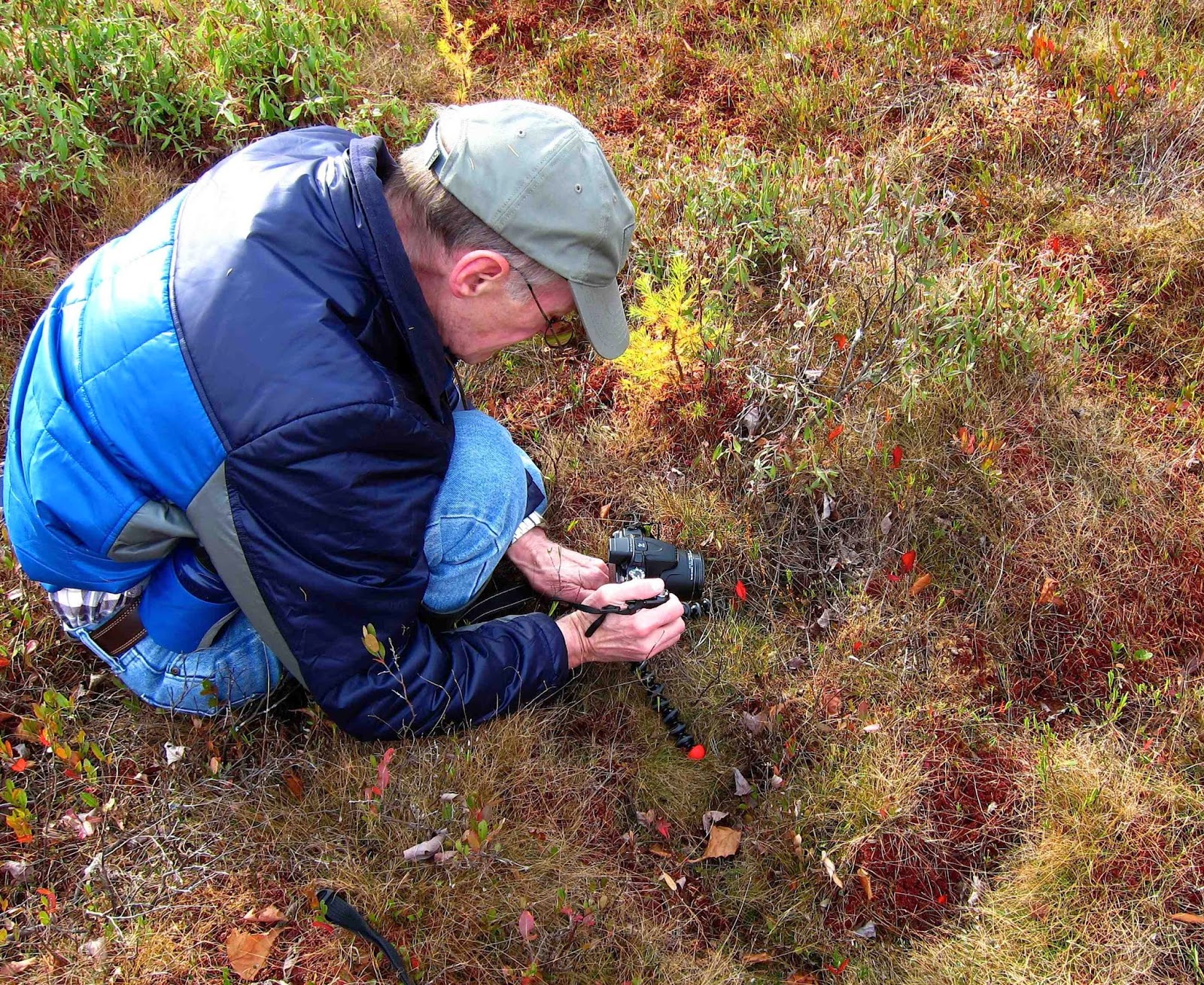
In the midst of all this exuberant beauty, which plant delighted my friend Bob and me the most today? Well, it was very tiny, as well as faded to tan, which made it nearly invisible among the dying grasses. Can you see the plant that Bob is trying to focus his camera on? I very much doubt it. I can hardly believe we managed to see it, ourselves.
Here it is, lit by a brief ray of sunlight against a dark background. This is Yellow Bartonia (Bartonia virginica), a plant not considered rare in New York, but one that is doubtless much overlooked because of its tiny size and pale color, even when flowering. This one has gone to seed, but it really doesn't look much different than it did last summer, when its straw-colored, bell-shaped flowers were in full bloom.
Every time my friends and I come to this bog (sorry, it must remain nameless), we challenge ourselves to see if we can find the Bartonia. Even though we are SURE we remember exactly where we found it last, it often eludes us completely. Today, Bob and I were able to see it in four separate places. Hurray! It doesn't take much to make wildflower nerds like us happy.
But then, who could ever be unhappy, wandering such a beautiful bog as this?
For more than thirty years I've been wandering the woods and waterways of Saratoga County, New York, and regions nearby, looking closely, listening carefully, and recording what I experience. We are blessed in this region with an amazing amount of wilderness right at hand. With this blog I share my year-round adventures here, seeking out what wonders await in my own Madagascar close to home.
Wednesday, November 5, 2014
Sunday, November 2, 2014
Scenes from an Autumn Afternoon
The weather was so beautiful last Friday afternoon, I managed to coax my husband to walk around Moreau Lake with me. Usually, he won't come out with me, because of my habit of stopping every few yards to photograph something that's caught my eye, but this day I promised I'd keep up with him as he strode along on the wide sandy beach. And I almost DID keep that promise.
Who could blame me, though, for wanting to document this Daisy Fleabane exploding into bloom as if it were spring? I had seen a few straggling blooms on other, mostly withering plants, but this was a vigorous plant freshly abloom, with even more buds to come.
I also drew to a halt when this splendid dragonfly landed before me on a sprig of Pitch Pine, and wonder of wonders, stayed put! I was even able to creep in close for the shot, and the pretty creature never budged. I believe this is one of the Darners, a group of dragonflies even the experts have difficulty identifying.
Again, I just had to stop to take in the brilliance of a whole shore of Black Huckleberry bushes, their scarlet leaves set ablaze by a lowering sun.
That low sun was also working miracles on the Lespedezas, transforming the dull, weedy-brown Round-headed Bushclovers into flaming torches, exploding with light.
An oh, just look at the jewels that were strewn at our feet when we passed beneath a Big-toothed Aspen tree!
As the sun sank lower and lower, shadows crept over the mountains and darkened the shore of the lake, while the reflected sky and the forested mountainsides still glowed with a brilliant light. Just one last photo, Dear, I promise, OK? Sure, OK, he said, and he, too, stopped to delight in this beautiful scene.
Who could blame me, though, for wanting to document this Daisy Fleabane exploding into bloom as if it were spring? I had seen a few straggling blooms on other, mostly withering plants, but this was a vigorous plant freshly abloom, with even more buds to come.
I also drew to a halt when this splendid dragonfly landed before me on a sprig of Pitch Pine, and wonder of wonders, stayed put! I was even able to creep in close for the shot, and the pretty creature never budged. I believe this is one of the Darners, a group of dragonflies even the experts have difficulty identifying.
Again, I just had to stop to take in the brilliance of a whole shore of Black Huckleberry bushes, their scarlet leaves set ablaze by a lowering sun.
That low sun was also working miracles on the Lespedezas, transforming the dull, weedy-brown Round-headed Bushclovers into flaming torches, exploding with light.
An oh, just look at the jewels that were strewn at our feet when we passed beneath a Big-toothed Aspen tree!
As the sun sank lower and lower, shadows crept over the mountains and darkened the shore of the lake, while the reflected sky and the forested mountainsides still glowed with a brilliant light. Just one last photo, Dear, I promise, OK? Sure, OK, he said, and he, too, stopped to delight in this beautiful scene.
New Territories, Ancient Rocks
As an amateur naturalist, I couldn't be luckier than to have such friends as those in our group called the Thursday Naturalists. Not only do they, both individually and as a group, possess an enormous amount of knowledge about the natural world, they also know how to get to some of the most interesting natural areas in the region, many of which I would never find on my own. This past week we made our way through winding rural roads and pretty little lakeside villages to visit a fascinating area in central Rensselaer County called the Rensselaer Plateau.
This high rocky region of around 1,000- to 2,000-feet elevation is underlaid by ancient sandstone that was formed some hundreds of millions of years ago in the deepest ocean trenches, but which was forced up from those trenches during continental drift to form mountainous ridges. Originally higher than the Himalayas, these mountains have eroded away over millions of years to what are now known as the Taconic Mountains and the Rensselaer Plateau.
The Rensselaer Plateau is distinguished by a particular kind of sandstone called Graywacke, which consists of crystalline and lithic fragments set in a compact clay-fine matrix. Unlike typical sedimentary sandstone, which is formed by sand settling in undisturbed layers, Graywacke contains a jumble of both older and newer layers, formed when volcanic forces shuffled the older layers above the newer ones.
Because the chemistry of Graywacke tends to be acidic rather than basic, we plant people in the Thursday Naturalists were curious about what flora flourished among such a substrate, and we chose to explore a small nature preserve near Stephentown called the Robert P. Ingalls Nature Preserve. Named for a noted expert on Rensselaer County flora, this preserve features an easy loop trail that follows a pretty creek through a mixed hardwood/conifer forest.
Lying about this woods were many examples of Graywacke, displaying streaks of crystalline rock mixed throughout rock of a finer texture.
A completely unexpected find was a patch of the pretty moss called Rhodobryum roseum growing on the bank of the creek. Because this is a moss that prefers a basic, rather than acidic, substrate, we were quite surprised to find it here in this woodland underlaid by acidic rock. But then we noted that the moss was growing on a tree root rather than on rock, so perhaps that was a factor.
Update: I received a note from my friend Bob Duncan with some interesting information about this particular moss. I quote him directly here (and I also corrected my spelling!):
Hi, Jackie. I decided to catch up on your blog today and enjoyed your last two. Thought I should let you know Rhodobryum is spelled with a 'y' . Also it appears the plant we have is actually R. ontariense. I learned it as R. roseum but a paper published in 1972 established that there are actually two species with overlapping global ranges that are separable by very minor characters. When Crum and Anderson published 'Mosses of Eastern North America' in 1981 they admitted that the plants in our area are R. ontariense but felt the differences were trivial and felt the subject needed more study so they continued using the name R. roseum. I think maybe they also liked that name and didn't want to give up a name they had probably been using for fifty years!
Another feature of the Ingalls Preserve was the presence of enormous White Pines, some with straight trunks of substantial girth, others with split trunks that indicated a long-ago infestation by Pine Weevils. As our friend Kathy (shown here leaning against one double-trunked pine) explained to us, whenever we find a pine trunk the splits at just about nine feet above the ground, it is almost certain to be the result of the action of these weevils. Kathy said she learned this on an outing led by noted terrestrial ecologist and forest historian Tom Wessels.
The trail through the Ingalls Preserve was short enough that we still had lots of time to visit another nearby site, a State Forest Preserve tract adjoining the Cherry Plain State Park near the Massachusetts border. Here, we walked a beautiful woodland trail along a tumbling creek until we reached the site of a splendid waterfall.
Although the day was chilly, the sun-warmed banks by the waterfall made for a wonderful spot for a streamside picnic.
Since we were still in the area of the Rensselaer Plateau, we expected to find more examples of Graywacke, and we were not disappointed. This particular boulder had cracked open to reveal the presence of translucent crystalline fragments within the encasing fine-grained sandstone.
This high rocky region of around 1,000- to 2,000-feet elevation is underlaid by ancient sandstone that was formed some hundreds of millions of years ago in the deepest ocean trenches, but which was forced up from those trenches during continental drift to form mountainous ridges. Originally higher than the Himalayas, these mountains have eroded away over millions of years to what are now known as the Taconic Mountains and the Rensselaer Plateau.
The Rensselaer Plateau is distinguished by a particular kind of sandstone called Graywacke, which consists of crystalline and lithic fragments set in a compact clay-fine matrix. Unlike typical sedimentary sandstone, which is formed by sand settling in undisturbed layers, Graywacke contains a jumble of both older and newer layers, formed when volcanic forces shuffled the older layers above the newer ones.
Because the chemistry of Graywacke tends to be acidic rather than basic, we plant people in the Thursday Naturalists were curious about what flora flourished among such a substrate, and we chose to explore a small nature preserve near Stephentown called the Robert P. Ingalls Nature Preserve. Named for a noted expert on Rensselaer County flora, this preserve features an easy loop trail that follows a pretty creek through a mixed hardwood/conifer forest.
Lying about this woods were many examples of Graywacke, displaying streaks of crystalline rock mixed throughout rock of a finer texture.
A completely unexpected find was a patch of the pretty moss called Rhodobryum roseum growing on the bank of the creek. Because this is a moss that prefers a basic, rather than acidic, substrate, we were quite surprised to find it here in this woodland underlaid by acidic rock. But then we noted that the moss was growing on a tree root rather than on rock, so perhaps that was a factor.
Update: I received a note from my friend Bob Duncan with some interesting information about this particular moss. I quote him directly here (and I also corrected my spelling!):
Hi, Jackie. I decided to catch up on your blog today and enjoyed your last two. Thought I should let you know Rhodobryum is spelled with a 'y' . Also it appears the plant we have is actually R. ontariense. I learned it as R. roseum but a paper published in 1972 established that there are actually two species with overlapping global ranges that are separable by very minor characters. When Crum and Anderson published 'Mosses of Eastern North America' in 1981 they admitted that the plants in our area are R. ontariense but felt the differences were trivial and felt the subject needed more study so they continued using the name R. roseum. I think maybe they also liked that name and didn't want to give up a name they had probably been using for fifty years!
Another feature of the Ingalls Preserve was the presence of enormous White Pines, some with straight trunks of substantial girth, others with split trunks that indicated a long-ago infestation by Pine Weevils. As our friend Kathy (shown here leaning against one double-trunked pine) explained to us, whenever we find a pine trunk the splits at just about nine feet above the ground, it is almost certain to be the result of the action of these weevils. Kathy said she learned this on an outing led by noted terrestrial ecologist and forest historian Tom Wessels.
The trail through the Ingalls Preserve was short enough that we still had lots of time to visit another nearby site, a State Forest Preserve tract adjoining the Cherry Plain State Park near the Massachusetts border. Here, we walked a beautiful woodland trail along a tumbling creek until we reached the site of a splendid waterfall.
Although the day was chilly, the sun-warmed banks by the waterfall made for a wonderful spot for a streamside picnic.
Since we were still in the area of the Rensselaer Plateau, we expected to find more examples of Graywacke, and we were not disappointed. This particular boulder had cracked open to reveal the presence of translucent crystalline fragments within the encasing fine-grained sandstone.
Tuesday, October 28, 2014
Flashes of Color Along Bog Meadow Trail
After a stretch of rainy unpleasant days, summer paid us a brief visit today, with warmth and sunshine to add to the pleasure of a walk along Bog Meadow Trail. I entered the trail from a spur that comes in from Meadowbrook Estates, an access that leads to a boardwalk crossing a wooded wetland.
Although most of the trees have dropped their leaves by now, I still found flashes of brilliant color along the trail, especially among the little oak seedlings when the afternoon sun lit up their ruddy leaves from behind.
The rosy leaves of this baby oak looked so pretty, set among the yellowing leaves of Dwarf Raspberry and set off with a green sprig of hemlock.
Almost every wetland is now ablaze with the crimson fruits of Winterberry, and the Bog Meadow wetlands are no exception.
This sprinkling of the tiny Lemon Drop Fungus looked especially vivid against the dark wood of a rotting stump.
Bog Meadow Trail runs east for about two miles from an entrance on Rte. 50 just outside of Saratoga to its terminus on Meadowbrook Road, near the intersection with Stafford's Bridge Road. I entered the trail about two-thirds of that way along and turned west. Here the trail follows an old railroad bed through forested wetland on either side, with a wide-open marsh about midway along the trail. That open marsh was my destination today, because I hoped to see if migrating waterfowl might be resting on the water.
As I strode along, I noticed that in the dark of the woods, the fluffy white seedheads of Flat-topped Asters glowed with a pearly light.
The leaves of Highbush Blueberry were so brilliantly red, they even dazzled the sensor of my camera, which didn't seem to know what to do with so saturated a color.
I noticed some recent improvements to the trail, with the addition of benches spaced at various points, as well as the placing of distance markers set at quarter-mile intervals. Although the land through which the trail runs is owned by the city of Saratoga Springs, the trail itself is managed by Saratoga P.L.A.N. (a land conservation organization) and is maintained by dedicated volunteers.
When I reached the open marsh, I was a little disappointed not to see a single waterfowl resting on its quiet water, but I still very much enjoyed the beautiful view.
Wondering if there might be some ducks or geese hiding among the tussocks across the water, I took a seat on this waterside bench and let my eyes scan the distance for any movement. At one point, a solitary duck came angling in, but when it saw me, it wheeled around and flew away out of sight before I could try to identify it. One thing I DID see, however, was a little fluffy white clump surrounding the narrow trunk of a spindly Speckled Alder just to the right of the bench. Can you see it in this photo?
A closer look revealed a mass of Wooly Alder Aphids, each tiny insect exuding threads of white waxy material that made them look as if they were covered with fur. Aside from their remarkable appearance, these are indeed fascinating creatures, for each member of this cluster is a clone of a single winged female aphid that landed on this branch and began to produce wingless clonal offspring without mating with a male. And then the clones also began producing more clones. The aphids feed on the sap of the tree, and when they have depleted the resources at this spot, they will produce an aphid with wings who can fly off and establish a new colony.
I was not surprised to find this cluster, since the whole time I'd been walking the trail, I'd noticed these tiny bits of blue fluff wafting about, and finally I had reached out and caught one in my hand. This is the winged form of the Wooly Alder Aphid. I just can't imagine a cuter little bug, with that baby-blue color, gossamer wings, and abdomen covered with fluff.
I have never seen any other plant but Bittersweet Nightshade produce leaves of such a vivid purple.
And oh, when the sun lit those purple leaves from behind, they glowed like stained glass!
The day grew late and I had to turn and hurry home, but I drew to a halt when I saw this patch of Green Shield Lichen with what looked like a brown bat flying forth from its center. Fascinating! And just in time for Halloween!
Although most of the trees have dropped their leaves by now, I still found flashes of brilliant color along the trail, especially among the little oak seedlings when the afternoon sun lit up their ruddy leaves from behind.
The rosy leaves of this baby oak looked so pretty, set among the yellowing leaves of Dwarf Raspberry and set off with a green sprig of hemlock.
Almost every wetland is now ablaze with the crimson fruits of Winterberry, and the Bog Meadow wetlands are no exception.
This sprinkling of the tiny Lemon Drop Fungus looked especially vivid against the dark wood of a rotting stump.
Bog Meadow Trail runs east for about two miles from an entrance on Rte. 50 just outside of Saratoga to its terminus on Meadowbrook Road, near the intersection with Stafford's Bridge Road. I entered the trail about two-thirds of that way along and turned west. Here the trail follows an old railroad bed through forested wetland on either side, with a wide-open marsh about midway along the trail. That open marsh was my destination today, because I hoped to see if migrating waterfowl might be resting on the water.
As I strode along, I noticed that in the dark of the woods, the fluffy white seedheads of Flat-topped Asters glowed with a pearly light.
The leaves of Highbush Blueberry were so brilliantly red, they even dazzled the sensor of my camera, which didn't seem to know what to do with so saturated a color.
I noticed some recent improvements to the trail, with the addition of benches spaced at various points, as well as the placing of distance markers set at quarter-mile intervals. Although the land through which the trail runs is owned by the city of Saratoga Springs, the trail itself is managed by Saratoga P.L.A.N. (a land conservation organization) and is maintained by dedicated volunteers.
When I reached the open marsh, I was a little disappointed not to see a single waterfowl resting on its quiet water, but I still very much enjoyed the beautiful view.
Wondering if there might be some ducks or geese hiding among the tussocks across the water, I took a seat on this waterside bench and let my eyes scan the distance for any movement. At one point, a solitary duck came angling in, but when it saw me, it wheeled around and flew away out of sight before I could try to identify it. One thing I DID see, however, was a little fluffy white clump surrounding the narrow trunk of a spindly Speckled Alder just to the right of the bench. Can you see it in this photo?
A closer look revealed a mass of Wooly Alder Aphids, each tiny insect exuding threads of white waxy material that made them look as if they were covered with fur. Aside from their remarkable appearance, these are indeed fascinating creatures, for each member of this cluster is a clone of a single winged female aphid that landed on this branch and began to produce wingless clonal offspring without mating with a male. And then the clones also began producing more clones. The aphids feed on the sap of the tree, and when they have depleted the resources at this spot, they will produce an aphid with wings who can fly off and establish a new colony.
I was not surprised to find this cluster, since the whole time I'd been walking the trail, I'd noticed these tiny bits of blue fluff wafting about, and finally I had reached out and caught one in my hand. This is the winged form of the Wooly Alder Aphid. I just can't imagine a cuter little bug, with that baby-blue color, gossamer wings, and abdomen covered with fluff.
I found some other pretty things along the shore of the marsh, including this cluster of shiny red rose hips, the fruit of the same deliciously fragrant Swamp Rose I had stopped to delight in last summer.
Bittersweet Nightshade also produces a shiny red fruit, but theirs with a lovely translucency, and many today were dangling from vines that hung over the water.
I have never seen any other plant but Bittersweet Nightshade produce leaves of such a vivid purple.
And oh, when the sun lit those purple leaves from behind, they glowed like stained glass!
The day grew late and I had to turn and hurry home, but I drew to a halt when I saw this patch of Green Shield Lichen with what looked like a brown bat flying forth from its center. Fascinating! And just in time for Halloween!
Sunday, October 26, 2014
Happy Birthday, Ed Miller!
Who could believe that this energetic guy, Ed Miller, just turned 90 years old?! Field botanist extraordinaire, brilliant designer, innovative boat-builder, conquerer of rugged terrains in all weathers, inspiring father and grandfather and beloved friend to many, Ed was celebrated by hordes of loving family members and friends at a birthday celebration on Saturday, October 25, and a grand time was had by all. Including the guest of honor, to judge from his happy expression as he greets his friends Ruth and Kay.
During the course of the festivities, folks who have known Ed in many areas of his many-faceted life rose to honor this remarkable man with stories of his many amazing adventures. Some told tales of him as an exceedingly creative engineer with GE, or as a Boy Scout leader skilled in all kinds of campcraft, or as a longtime and still active downhill skier, or as leader of many rigorous and challenging outdoor excursions. I was just wondering who would speak of his encyclopedic botanical knowledge when Ed's son Scott thrust the microphone at me. Ulp! Oh dear! I had not prepared any remarks in advance, but I was not going to pass up the chance to pay public tribute to my dear friend and mentor, so I managed to stutter out some general expressions of gratitude and celebration. But oh, I could have related so many more telling things about this wonderful guy, if only I'd come prepared. I'm just going to have to use my blog to do that now.
I first met Ed maybe 15 years ago at a photo-lecture our mutual friend Evelyn Green was giving about the Ice Meadows, a remarkable botanical site on the Hudson River north of Warrensburg. I was then still quite a neophyte among wildflower enthusiasts, but I managed to gain Ed's attention when I was the only one in the audience who could name a tiny yellow flower (Creeping Spearwort) that Evelyn had projected on the screen. I guess that must have impressed him, because Ed introduced himself after the lecture, and we started talking and talking and talking about plants and more plants and more plants, while my husband waited patiently by the door. That's how it goes when nature nuts find each other.
As time went on, we would meet each other by chance on this trail or that as we each went about botanizing on our own, but our relationship really became cemented about five years ago when Ed came along on a nature walk I led at Bog Meadow Trail near Saratoga Springs. Long after all the other participants had gone their ways, Ed and I (and also our mutual pal, Sue Pierce), were still happily poking about among the flowers and the ferns and the fungi, our curiosity still unsated.
Since then, Ed and I have shared many other outdoor adventures, including exploring the shores of the Hudson River, especially below the Spier Falls Dam, where together we have found an impressive array of unusual riparian plants. Ed showed me where to find Wild Senna shrubs, and I was able to take him to where the Great St. Johnswort grows. And on and on.
In the course of our explorations, we often enjoyed a picnic and the pleasure of each other's company amid these splendid surroundings.
In this photo, Ed is explaining to me how to distinguish a Quillwort from a Pipewort, while sitting in one of the innovative lightweight canoes that he and his sons designed and built themselves. (And which were the envy, years ago, of his aluminum-canoe-toting fellow paddlers, who regaled us at Ed's birthday party with tales of exhausting portages trying to keep up with Ed and his lightweight boat.)
Through Ed, I have come to find many other friends and fellow nature enthusiasts, especially among the group that calls itself the Thursday Naturalists. Each week, throughout the year, this group of both passionate amateur and professional botanists meets to explore nature preserves throughout the region. Every single member brings a vast store of nature knowledge and lore, but Ed continues to be our go-to guy for distinguishing one plant from another, and he brings an almost childlike enthusiasm and winning delight to every one of our forays.
At Woodcock Preserve in Clifton Park:
At the Hundred-acre Wood in Malta:
At Woodlawn Preserve in Schenectady:
At Mud Pond in Moreau Lake State Park:
One of Ed's special friends is Nan Williams, an equally passionate botanizer and one of his ski buddies who lives in Massachusetts but often joins the Thursday Naturalists on our outings. Together, Ed and Nan have led us more than once on expeditions to old marble quarries on a mountain in Vermont, where we found a wondrous number of rare and beautiful lime-loving plants.
Ed and Nan know of many remarkable habitats where we can find the rarest of New York's native plants. This photo was taken in a Warren County bog where Grass Pink and Fringed White orchids grow as abundantly as Dandelions on a suburban lawn.
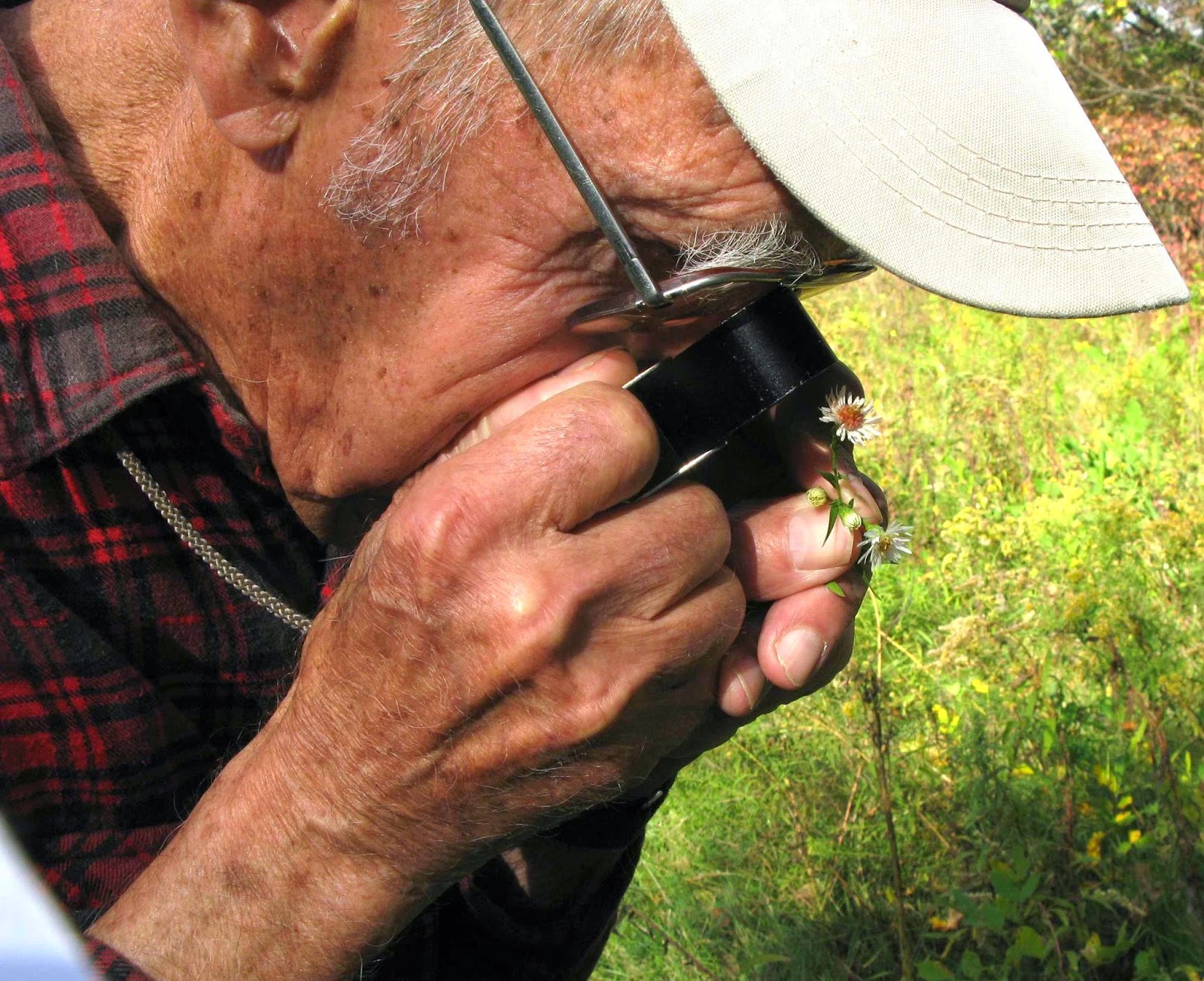
At one time in my quest to identify all the wildflowers I came across, I learned to distinguish each of the dozens of aster species native to our region. But then I set that knowledge aside, content to acknowledge all asters by genus but not bothering any more to parse out which species they may be. (Lord, there are so many! And so many lookalikes!) But when I'm with Ed, that won't do at all, and he whips out his magnifier to demonstrate the characteristics of each species' bracts, stems, leaves, petals, etcetera. He's made a very helpful crib sheet, too, that now I tuck into the pages of my Newcomb's Wildflower Guide. He included the goldenrods, too. So helpful! Thanks, Ed.
I tend to stick pretty close to home in my wildflower explorations, hoping to find and document every plant that is native to Saratoga County. But Ed is continually expanding my botanical horizons, carrying me off to many amazing sites I would never know about on my own. One of these sites is a Nature Conservancy site at Joralemon Park, south of Albany, acknowledged to be "perhaps the richest wildflower site in all of New York" by state botanists, containing abundant numbers of some of the state's rarest plants. It was Ed who recognized the amazing quality of this limestone-underlain site, and it was he who purchased this site with his own money to give it to the Nature Conservancy. Ed is exceedingly familiar with the plants at this site, and here he is searching for the tiny spikemoss called Selaginella that he knows grows here, while the rest of his friends enjoy a picnic overlooking the pond.
Here's Ed again, in that familiar eyes-to-the-ground searching posture, seeking for rarities among the rocks that line the shore of the Hudson River at another Nature Conservancy site along the Ice Meadows in Warren County. In the winter, these shores are heaped with masses of frazil ice up to 12-feet thick or more, creating a frigid habitat that discourages the encroachment of trees and ensures that the rare sub-boreal plants that thrive here will continue to do so.
This remarkable site attracts botanists from many surrounding regions, including those who attended last year's regional meeting of the American Botanical Society, hosted by none other than Ed Miller himself. In this photo, Ed is joined by his longtime dear friend Ruth Schottman, another exceedingly expert botanist, teacher, author, and one of the founders of our Thursday Naturalists group.
The Thursday Naturalists always enjoy an annual foray to the Ice Meadows, as well as the pleasure of each others' company on a picnic in the shade. I'm so glad I found this particular photo in my files, because it shows the laughing (bearded) face of our friend Win Bigelow, a valued fount of woodland knowledge and treasured companion who died last year while wintering in Florida. So many good times together, Win! We sure miss you.
Here's another photo with Win's dear face among the group, taken during the summer of 2013 when Ed led the Thursday Naturalists on a tour of the collection of native woody plants he has personally established at Landis Arboretum, near Esperance.
Landis Arboretum was originally established to showcase exotic species of trees from all over the world, but Ed convinced the directors there that he should create exhibits showcasing the trees and other woody plants that are native to New York. That was back in 2001, and in the years since then Ed has almost single-handedly designed, planted, weeded, fed, and watered the extensive collection, arranged in ways that facilitate easy identification and comparison between species. (To see my 2010 account describing some exhibits, click here.)
Among the more fascinating exhibits Ed has established at Landis is a collection of bog plants, growing on a raft in a tub of acidified water that is carpeted with sphagnum moss to approximate the habitat of a natural bog.
Ed regularly visits his collection at the arboretum, carting water, fertilizer, and gardening tools to each site to tend to all the plants' needs.
This past summer Ed has been working on a new exhibit showcasing New York's native ferns, with most of the plants provided by his friend Nan Williams from the ferns growing on her own property. To honor her contribution, Ed plans to name this exhibit "Nan's Ferns." The site for this exhibit was not exactly plant-ready when I visited there with Ed this summer, but he was undaunted. After quite some effort breaking up tree roots and dislodging rocks with his mattock, Ed proceeded to use his bare hands to tuck some new plantings into their prepared beds.
After all that effort, Ed deserved to rest on one of the benches his sons have built and inscribed to acknowledge his work at the arboretum. Ed, what a legacy you have left to native plant lovers!
I don't downhill ski, but Ed sure does, still hitting the slopes every week in the winter months, and now I hope he gets a special lift-ticket discount reserved for nonagenarians. My preferred winter sport is snow-shoeing, and I felt truly privileged that Ed deigned to slow his pace to mine when we explored the old canal towpaths along the Mohawk River at Vischer Ferry, a marvelous historic site I had never visited before, until Ed took me there.
Another very special adventure with Ed was attending an American Botanical Society annual meeting in Ithaca during the summer of 2011. Ed invited me to join his friends Ruth Schottman, Frank Knight, Nan Williams, and himself on a four-day marathon of botanical forays into the fields, forests, swamps and streams of this spectacular area of central New York State. Of course, the botanizing was fantastic, but the best part was spending whole days (and long car rides) in the delightful company of these wonderful people. I think there must be some special gene unique to plant lovers that makes them so cheerful, patient, smart, and just so much fun to be with.
So Happy Birthday to you, dear Ed! I can't thank you enough for all you have taught me, all the places you've shown me, all the friends I have made because of you, all the joys we have shared together in the woods and on the waterways. I celebrate your friendship and look forward to many more adventures together. I am so very, very proud to call you my friend.
During the course of the festivities, folks who have known Ed in many areas of his many-faceted life rose to honor this remarkable man with stories of his many amazing adventures. Some told tales of him as an exceedingly creative engineer with GE, or as a Boy Scout leader skilled in all kinds of campcraft, or as a longtime and still active downhill skier, or as leader of many rigorous and challenging outdoor excursions. I was just wondering who would speak of his encyclopedic botanical knowledge when Ed's son Scott thrust the microphone at me. Ulp! Oh dear! I had not prepared any remarks in advance, but I was not going to pass up the chance to pay public tribute to my dear friend and mentor, so I managed to stutter out some general expressions of gratitude and celebration. But oh, I could have related so many more telling things about this wonderful guy, if only I'd come prepared. I'm just going to have to use my blog to do that now.
At Lester Park near Saratoga Springs, Ed stands atop an outcropping of stromatolites, the fossilized remains of 490-million-year-old sea creatures.
I first met Ed maybe 15 years ago at a photo-lecture our mutual friend Evelyn Green was giving about the Ice Meadows, a remarkable botanical site on the Hudson River north of Warrensburg. I was then still quite a neophyte among wildflower enthusiasts, but I managed to gain Ed's attention when I was the only one in the audience who could name a tiny yellow flower (Creeping Spearwort) that Evelyn had projected on the screen. I guess that must have impressed him, because Ed introduced himself after the lecture, and we started talking and talking and talking about plants and more plants and more plants, while my husband waited patiently by the door. That's how it goes when nature nuts find each other.
As time went on, we would meet each other by chance on this trail or that as we each went about botanizing on our own, but our relationship really became cemented about five years ago when Ed came along on a nature walk I led at Bog Meadow Trail near Saratoga Springs. Long after all the other participants had gone their ways, Ed and I (and also our mutual pal, Sue Pierce), were still happily poking about among the flowers and the ferns and the fungi, our curiosity still unsated.
Since then, Ed and I have shared many other outdoor adventures, including exploring the shores of the Hudson River, especially below the Spier Falls Dam, where together we have found an impressive array of unusual riparian plants. Ed showed me where to find Wild Senna shrubs, and I was able to take him to where the Great St. Johnswort grows. And on and on.
In the course of our explorations, we often enjoyed a picnic and the pleasure of each other's company amid these splendid surroundings.
In this photo, Ed is explaining to me how to distinguish a Quillwort from a Pipewort, while sitting in one of the innovative lightweight canoes that he and his sons designed and built themselves. (And which were the envy, years ago, of his aluminum-canoe-toting fellow paddlers, who regaled us at Ed's birthday party with tales of exhausting portages trying to keep up with Ed and his lightweight boat.)
Through Ed, I have come to find many other friends and fellow nature enthusiasts, especially among the group that calls itself the Thursday Naturalists. Each week, throughout the year, this group of both passionate amateur and professional botanists meets to explore nature preserves throughout the region. Every single member brings a vast store of nature knowledge and lore, but Ed continues to be our go-to guy for distinguishing one plant from another, and he brings an almost childlike enthusiasm and winning delight to every one of our forays.
At Woodcock Preserve in Clifton Park:
At the Hundred-acre Wood in Malta:
At Woodlawn Preserve in Schenectady:
At Mud Pond in Moreau Lake State Park:
One of Ed's special friends is Nan Williams, an equally passionate botanizer and one of his ski buddies who lives in Massachusetts but often joins the Thursday Naturalists on our outings. Together, Ed and Nan have led us more than once on expeditions to old marble quarries on a mountain in Vermont, where we found a wondrous number of rare and beautiful lime-loving plants.
Ed and Nan know of many remarkable habitats where we can find the rarest of New York's native plants. This photo was taken in a Warren County bog where Grass Pink and Fringed White orchids grow as abundantly as Dandelions on a suburban lawn.
At one time in my quest to identify all the wildflowers I came across, I learned to distinguish each of the dozens of aster species native to our region. But then I set that knowledge aside, content to acknowledge all asters by genus but not bothering any more to parse out which species they may be. (Lord, there are so many! And so many lookalikes!) But when I'm with Ed, that won't do at all, and he whips out his magnifier to demonstrate the characteristics of each species' bracts, stems, leaves, petals, etcetera. He's made a very helpful crib sheet, too, that now I tuck into the pages of my Newcomb's Wildflower Guide. He included the goldenrods, too. So helpful! Thanks, Ed.
I tend to stick pretty close to home in my wildflower explorations, hoping to find and document every plant that is native to Saratoga County. But Ed is continually expanding my botanical horizons, carrying me off to many amazing sites I would never know about on my own. One of these sites is a Nature Conservancy site at Joralemon Park, south of Albany, acknowledged to be "perhaps the richest wildflower site in all of New York" by state botanists, containing abundant numbers of some of the state's rarest plants. It was Ed who recognized the amazing quality of this limestone-underlain site, and it was he who purchased this site with his own money to give it to the Nature Conservancy. Ed is exceedingly familiar with the plants at this site, and here he is searching for the tiny spikemoss called Selaginella that he knows grows here, while the rest of his friends enjoy a picnic overlooking the pond.
Here's Ed again, in that familiar eyes-to-the-ground searching posture, seeking for rarities among the rocks that line the shore of the Hudson River at another Nature Conservancy site along the Ice Meadows in Warren County. In the winter, these shores are heaped with masses of frazil ice up to 12-feet thick or more, creating a frigid habitat that discourages the encroachment of trees and ensures that the rare sub-boreal plants that thrive here will continue to do so.
This remarkable site attracts botanists from many surrounding regions, including those who attended last year's regional meeting of the American Botanical Society, hosted by none other than Ed Miller himself. In this photo, Ed is joined by his longtime dear friend Ruth Schottman, another exceedingly expert botanist, teacher, author, and one of the founders of our Thursday Naturalists group.
The Thursday Naturalists always enjoy an annual foray to the Ice Meadows, as well as the pleasure of each others' company on a picnic in the shade. I'm so glad I found this particular photo in my files, because it shows the laughing (bearded) face of our friend Win Bigelow, a valued fount of woodland knowledge and treasured companion who died last year while wintering in Florida. So many good times together, Win! We sure miss you.
Here's another photo with Win's dear face among the group, taken during the summer of 2013 when Ed led the Thursday Naturalists on a tour of the collection of native woody plants he has personally established at Landis Arboretum, near Esperance.
Landis Arboretum was originally established to showcase exotic species of trees from all over the world, but Ed convinced the directors there that he should create exhibits showcasing the trees and other woody plants that are native to New York. That was back in 2001, and in the years since then Ed has almost single-handedly designed, planted, weeded, fed, and watered the extensive collection, arranged in ways that facilitate easy identification and comparison between species. (To see my 2010 account describing some exhibits, click here.)
Among the more fascinating exhibits Ed has established at Landis is a collection of bog plants, growing on a raft in a tub of acidified water that is carpeted with sphagnum moss to approximate the habitat of a natural bog.
Ed regularly visits his collection at the arboretum, carting water, fertilizer, and gardening tools to each site to tend to all the plants' needs.
This past summer Ed has been working on a new exhibit showcasing New York's native ferns, with most of the plants provided by his friend Nan Williams from the ferns growing on her own property. To honor her contribution, Ed plans to name this exhibit "Nan's Ferns." The site for this exhibit was not exactly plant-ready when I visited there with Ed this summer, but he was undaunted. After quite some effort breaking up tree roots and dislodging rocks with his mattock, Ed proceeded to use his bare hands to tuck some new plantings into their prepared beds.
After all that effort, Ed deserved to rest on one of the benches his sons have built and inscribed to acknowledge his work at the arboretum. Ed, what a legacy you have left to native plant lovers!
I don't downhill ski, but Ed sure does, still hitting the slopes every week in the winter months, and now I hope he gets a special lift-ticket discount reserved for nonagenarians. My preferred winter sport is snow-shoeing, and I felt truly privileged that Ed deigned to slow his pace to mine when we explored the old canal towpaths along the Mohawk River at Vischer Ferry, a marvelous historic site I had never visited before, until Ed took me there.
Another very special adventure with Ed was attending an American Botanical Society annual meeting in Ithaca during the summer of 2011. Ed invited me to join his friends Ruth Schottman, Frank Knight, Nan Williams, and himself on a four-day marathon of botanical forays into the fields, forests, swamps and streams of this spectacular area of central New York State. Of course, the botanizing was fantastic, but the best part was spending whole days (and long car rides) in the delightful company of these wonderful people. I think there must be some special gene unique to plant lovers that makes them so cheerful, patient, smart, and just so much fun to be with.
So Happy Birthday to you, dear Ed! I can't thank you enough for all you have taught me, all the places you've shown me, all the friends I have made because of you, all the joys we have shared together in the woods and on the waterways. I celebrate your friendship and look forward to many more adventures together. I am so very, very proud to call you my friend.
Ed pauses to enjoy the sound of a waterfall plunging through a gorge at Oakwood Cemetery in Troy.
Subscribe to:
Posts (Atom)