What a day for a streamside walk! The day was warm, the air was light and dry, the sun was bright, the sky was blue, and my friend Sue knew just the place for a wonderful stroll along an old canal. And a quite dramatic canal, it was, with water plunging through what remains of a series of old locks called "The Five Combines" on the Feeder Canal in Hudson Falls, in Washington County.
The Feeder Canal was first constructed in 1822 to conduct water from the nearby Hudson River to the Champlain Canal, an important shipping route in the 19th Century. The locks -- or "combines" -- were built about ten years later when the Feeder Canal was widened to allow for boat traffic. All together, the locks allowed boats to descend a total of 55 vertical feet until they reached the level portions of the canal that flowed quietly south toward Ft. Edward, where they entered the Champlain Canal.
The Feeder Canal is no longer used for commercial boat traffic, but the old tow paths are maintained as walking and biking trails that stretch for several miles all the way from Glens Falls to Ft. Edward to the south.
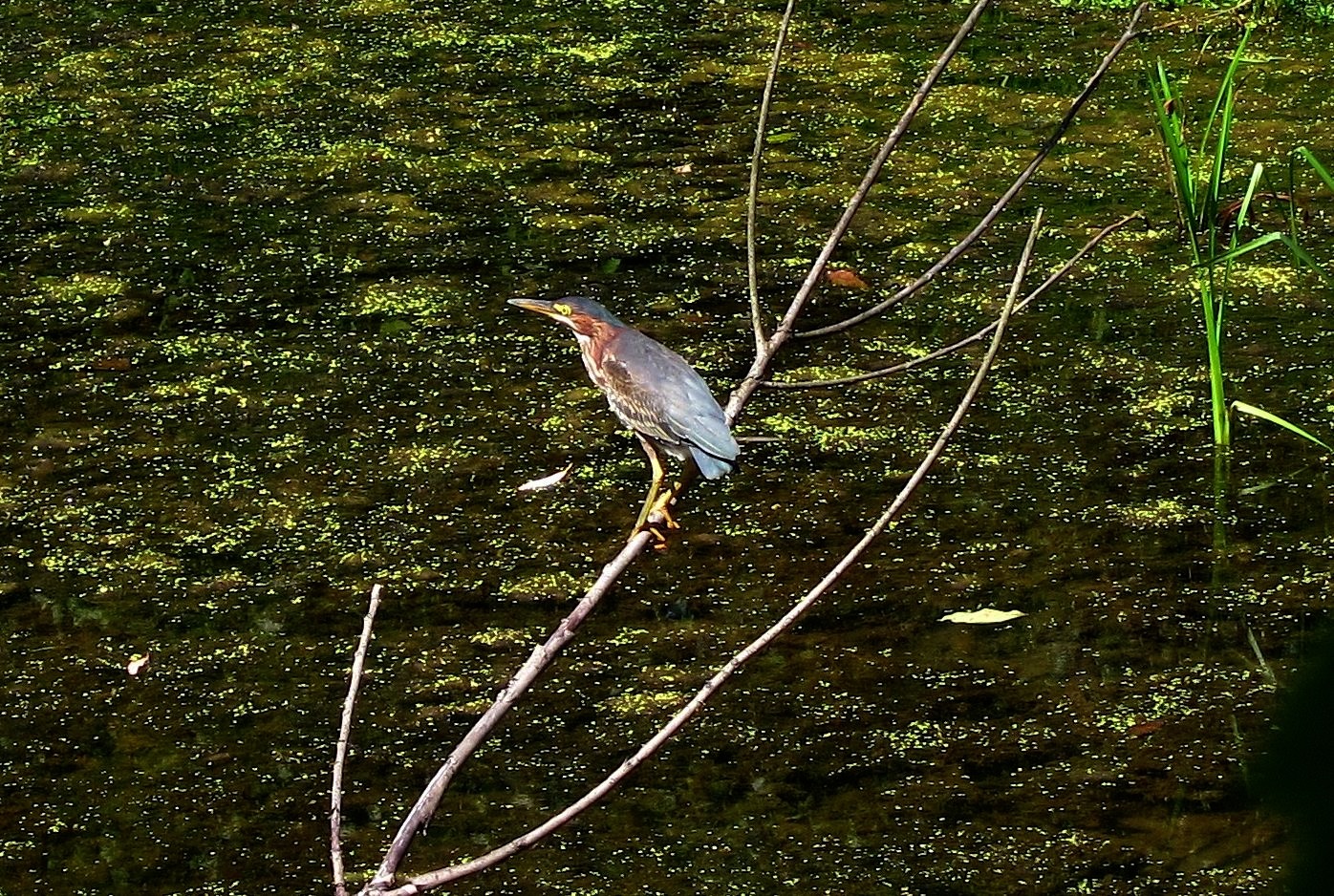
Sue and I were content to stroll just a mile or so along the canal, at times creeping quietly up to the edge to observe a number of Green Herons hunting for fish in the quiet waters. Here, a heron shares a log with several Painted Turtles.
My little pocket camera has a very limited zoom capability, so this was about the best I could do to capture an image of this colorful Green Heron.
There were other hunters, too, along the shore, and we inadvertently frightened this Water Snake into the water from where it was basking on the bank.
I didn't know what this caterpillar was, until I learned that the Yellow Bear (the caterpillar of the Virginian Tiger Moth) can come with orange fur as well as yellow. The long hairs that extend far beyond the rest of the fuzz are a distinguishing feature of this caterpillar.
We could smell the fragrance of this patch of Garden Phlox (Phlox paniculata) before we even saw it, although its intense color would have been hard to miss. What WAS easy to miss was the spectacular Giant Swallowtail Butterfly that came flitting and wafting through this patch of garden escapees. Try as we might, we could not capture its beauty in a photo, it moved so quickly among the blooms and then soared away out of sight. This is a more southerly species of butterfly than we're used to seeing, although we did see one last summer, too. That time, it was puddling in mud and stood very still for the picture taking. Click here and you can see how big and beautiful it is.
The Northern Prickly Ash (Zanthoxylum americanum) was in spectacular color, too, especially when the sunlight picked out the clusters of bright red berries that were just beginning to spit open to reveal its shiny black seeds. When I picked one of these clusters to take a closer look, I was struck by the strong citrus odor of the fruit, reminding me that our friend Ed Miller had told us that this small tree is our only example of citrus that grows this far north. Do take a sniff if you find this tree in fruit. The smell reminded me of fresh-squeezed limeade. But don't try to taste it, or your mouth will go numb for a while. Another common name for this species is Toothache Tree.
There were many other beautiful berries along the trail, and I found the fruit clusters of this Alternate-leaved Dogwood (Cornus alternifolia) particularly colorful, with deep-blue berries on bright-red pedicels.
The frothy cream-colored blooms of Wild Cucumber (Echinocystis lobata) were climbing over many trailside shrubs.
A second Gourd-family vine was thriving along the canal, and although the leaves of One-seeded Bur Cucumber (Sicyos angulatus) resemble those of Wild Cucumber, its flowers appear quite different.
A close-up view of the One-seeded Bur Cucumber's flower. I read in my Newcomb's Wildflower Guide that this species' staminate flowers grow in long-stalked clusters, its pistillate flowers in short-stalked clusters. I wish I had sought out some of each to compare them.
I was surprised that we found only a few plants of Turtlehead (Chelone glabra) along the canal. The few we did see, though, were prettily tinged with pink.
For more than thirty years I've been wandering the woods and waterways of Saratoga County, New York, and regions nearby, looking closely, listening carefully, and recording what I experience. We are blessed in this region with an amazing amount of wilderness right at hand. With this blog I share my year-round adventures here, seeking out what wonders await in my own Madagascar close to home.
Sunday, August 18, 2013
Saturday, August 17, 2013
Mud Pond's Muddy Shore
A gorgeous blue-sky day today, but I only had time for an hour or so outdoors. Mud Pond at Moreau seemed a perfect destination: close to home, easy to access from the road, and always alive with fascinating plant and animal life.
As soon as I set foot on the sandy trail that circles the pond, I saw the tiny radiant flowers of Blue Curls (Trichostema dichotomum), their gracefully arcing stamens curling over the spotted lower petals.
Nearby were some large bushy plants of Tall Blue Lettuce (Lactuca biennis), with little puffs of sky-blue flowers that look like miniature Chicory.
The wild clematis called Virgin's Bower (Clematis virginiana) was climbing over the pathside shrubbery, and there I saw this big beautiful Great Golden Digger Wasp feasting on the dainty white blooms.
It's funny how, in all my years of flower hunting, I never noticed this beautiful brightly colored wasp with its coat of golden fuzz until this summer, and now I have seen it over and over again. I wonder if it only recently came to inhabit our area.
Another beautiful insect, a copper-colored dragonfly, landed on some nearby Sweet Fern, and its wings appeared iridescent when they caught the light.
I made my way around the pond to where I hoped to explore a shore of mud flats, only to find that the mudflats were well under water.
I was happy to find that the mud, despite being submerged, was firm enough to walk on, although I did sink up to my ankles at times.
Numerous tiny bright-yellow Humped Bladderworts (Utricularia gibba) were scattered across the rush-covered mud like stars in the sky.
The chubby yellowish-green blooms of Ditch Stonecrop (Penthorum sedoides) were blooming on vivid red stems.
The sprawling stems of Water Purslane (Ludwigia palustris) held tiny green flowers in the leaf axils.
It was just sheer luck that I happened to see the miniscule pale-blue flowers of False Pimpernel (Lindernia dubia), since they are so exceedingly tiny, and also, there were very few of them.
In contrast, the flowers of Water Smartweed (Persicaria amphibia) are large and brightly colored, with multi-flowered spikes of rosy bloom held high above their glossy green leaves on stiff stout stems.
Several other Persicaria species were thriving out on the mud, including this Arrow-leaved Tearthumb (Persicaria sagitata).
This Tearthumb's dainty pink color and cute little blooms belie its vicious nature, for this is a plant that does indeed tear at one's flesh with stems that are well-armed with lacerating barbs. I might have stayed longer out on the mud, but my shins began to sting from pushing through these prickly plants, so I had to cut my visit short and go home to tend my wounds. Next time I'll wear long pants.
As soon as I set foot on the sandy trail that circles the pond, I saw the tiny radiant flowers of Blue Curls (Trichostema dichotomum), their gracefully arcing stamens curling over the spotted lower petals.
Nearby were some large bushy plants of Tall Blue Lettuce (Lactuca biennis), with little puffs of sky-blue flowers that look like miniature Chicory.
The wild clematis called Virgin's Bower (Clematis virginiana) was climbing over the pathside shrubbery, and there I saw this big beautiful Great Golden Digger Wasp feasting on the dainty white blooms.
It's funny how, in all my years of flower hunting, I never noticed this beautiful brightly colored wasp with its coat of golden fuzz until this summer, and now I have seen it over and over again. I wonder if it only recently came to inhabit our area.
Another beautiful insect, a copper-colored dragonfly, landed on some nearby Sweet Fern, and its wings appeared iridescent when they caught the light.
I made my way around the pond to where I hoped to explore a shore of mud flats, only to find that the mudflats were well under water.
I was happy to find that the mud, despite being submerged, was firm enough to walk on, although I did sink up to my ankles at times.
Numerous tiny bright-yellow Humped Bladderworts (Utricularia gibba) were scattered across the rush-covered mud like stars in the sky.
The chubby yellowish-green blooms of Ditch Stonecrop (Penthorum sedoides) were blooming on vivid red stems.
The sprawling stems of Water Purslane (Ludwigia palustris) held tiny green flowers in the leaf axils.
It was just sheer luck that I happened to see the miniscule pale-blue flowers of False Pimpernel (Lindernia dubia), since they are so exceedingly tiny, and also, there were very few of them.
In contrast, the flowers of Water Smartweed (Persicaria amphibia) are large and brightly colored, with multi-flowered spikes of rosy bloom held high above their glossy green leaves on stiff stout stems.
Several other Persicaria species were thriving out on the mud, including this Arrow-leaved Tearthumb (Persicaria sagitata).
This Tearthumb's dainty pink color and cute little blooms belie its vicious nature, for this is a plant that does indeed tear at one's flesh with stems that are well-armed with lacerating barbs. I might have stayed longer out on the mud, but my shins began to sting from pushing through these prickly plants, so I had to cut my visit short and go home to tend my wounds. Next time I'll wear long pants.
Monday, August 12, 2013
Flower Finds, Here and There
What a lovely string of clear, bright days and crisp cool mornings we've had this past week! That touch of autumnal chill each morning has awakened a bit of urgency in me, although I'm not sure why. I love the autumn and winter and spring as much as I love the summer, after all. But for flower hunting, the season does draw to a close with first frost, so this week I made a special effort to get out there and look for certain flowers I find only in certain places, while I still have the chance. None of them is a rare or important species, except that I don't know any other places to look for them. So I made the rounds. These plants are important to me, if not necessarily to the record books.
August 8: The Bog Meadow Nature Trail
Actually, I DO know other places to find Downy Rattlesnake Plantain (Goodyera pubescens) in addition to the Bog Meadow Nature Trail. But this trail is really easy to get to, just east of Saratoga, and I've been observing a patch of this small native orchid for many years. Last year, there wasn't a single flower stalk in the entire patch, while the year before there had been over a dozen. Orchids are like that, I've heard.
At first sight, I didn't think there were any flowers again this year, but then I saw just a few of the tiny white florets topping a stalk on the plant to the farthest left in this photo.
See? Here they are, as downy as their name suggests. A little past their prime, I'm afraid, and only three blooms instead of a long, full spike, but I was delighted to see them, hoping they're a sign that the plants are recovering enough strength to maybe bloom again next year.
Newcomb's Wildflower Guide describes our native Swamp Thistle (Cirsium muticum) as "common," but I sure don't think of it as all that common, since Bog Meadow is the only place I have ever encountered it. And I explore quite a few swamps. It wasn't quite in bloom on my visit this week, but it did have a fringe of its beautiful purple petals pushing out of its distinctive flower heads. If you click on this photo, you may be able to see the fine white hairs that give a cobwebby appearance to them.
Having found the flowers I was seeking, I was really ready to flee this swampy trail, tormented as I had been by clouds of gnats and whining mosquitoes, sucking them up my nose or getting them caught in my throat with each breath. But I did have to stop to admire the bright-yellow shiny tops of the White Pine Bolete (Suillus americanus) growing along the trail. Another common name for this edible fungus is Chicken Fat Suillus, although my personal name for it, with its brown crusty edge around a yellow center, is Lemon Pie. And it actually has a rather tart flavor when cooked, as if a bit of lemon juice had been added.
Another edible Suillus, called Painted Bolete (Suillus spraguei) had fruited nearby. I've tasted this one and found it not so tasty. It sure is pretty, though, with that rusty red cap that looks like it's made out of mohair.
August 10: A Bog in Warren County
The Cottongrass was waving in the breeze when I stepped through the hedge and onto the sphagnum mat where I hoped to find the Yellow Bartonia (Bartonia virginica) my friend Evelyn had told me was blooming here. I'd found it here before, but only by happenstance. It's so very tiny, it disappears against the surrounding grasses and sedges, especially when the one who is looking for it has eyesight as bad as mine. But Evelyn had given me careful directions, which I carefully followed, and LO! There it was! And lots of it! It helped that a ray of sunlight picked it out against a shady background.
Swamp Loosestrife (Decodon verticillatus) was much easier to spot, with its vivid pink flowers and large green leaves. Although this pretty plant is related to the highly invasive Purple Loosestrife (Lythrum salicaria), and even resembles it, Swamp Loosestrife is a native plant and a welcome inhabitant of swamps and shores.
August 11: The Hawk Road Trail of Moreau Lake State Park
They don't call me a nature nut for nothing. Only someone who's a little bit crazy would risk a broken axle to drive on this Warren County-side, rutted and rocky trail in a Toyota Corolla just to see some Purple Milkwort (Polygola sanguinea). Distribution maps show it as growing just about everywhere in New York State. But hey, if that's the case, how come the only place I've ever found it is here on some rocky outcroppings it shares with Wild Strawberry and Haircap Moss?
Anyway, to me it's worth the risky trip to see these flowers, even if most of what you see are actually the bracts. To find the true blooms, you need to peer inside those tiers of purple layers, and what a colorful mix the blossoms are. I'm not exactly sure what's what among these tiny structures colored yellow and orange and rose, except that they're as pretty as Easter eggs in a basket
.
Well, I doubt many people would think of this next plant as all that pretty, especially when riddled with holes. But it is kind of special to me. This is Slender Three-seeded Mercury (Acalypha gracilens), and distribution maps show it as having been reported in only a few counties in New York State. Now, that may be because it's easy to overlook, rather than because it is rare. But I got kind of excited when I first identified it four years ago, because I was the first to have reported finding it in Warren County. My very first specimen collection. And I still find it every year, right where I found it first.
A close look at the bracts surrounding the tiny flowers reveals the wing-like shape, similar to the wings portrayed on the Roman god Mercury's heels. You can also see the tiny glandular hairs that set this Acalypha species apart from its much more prevalent cousin, the common Three-seeded Mercury (A. rhomboidea) that grows in just about every vacant lot and sidewalk crack.
Close by that rather sparse patch of Acalypha, I always find a nicely abundant patch of American Pennyroyal (Hedeoma pulegioides), a tiny blue Mint-family flower with extremely aromatic leaves. A source for pennyroyal oil, which is used as an herbal medicine, this plant is probably abundant all over the Northeast, but over here in Warren County along this rocky trail is the only place I have ever seen it. But with flowers so small, it could easily be overlooked.
I almost overlooked this next flower, not because it wasn't showy, but rather because I just assumed it was the ubiquitous and invasive Spotted Knapweed and therefore to be shunned. But then I noticed the brown fringes on the bracts beneath the petals, plus the rosy color and abundant size, and decided it must instead be Brown Knapweed (Centaurea jacea), also an introduced species but not considered to be as invasive as its similar cousin. The bees were certainly happy to find it here.
As it happened, there were many specimens of Spotted Knapweed (Centaurea stoebe ssp. micranthos) in the immediate vicinity, so I could hold the two side-by-side and note the differences. The Brown Knapweed is on the left.
August 11: Rte. 50 in the Town of Wilton
I took a bit of a detour on my way home from Moreau Lake State Park, heading north on Rte. 50 toward the Wilton Wildlife Preserve and Park. As soon as I approached the pull-off for the park's Gick Farm parcel, I could see my next sought-after plant rising well above all other surrounding flora. This is Tall Ironweed (Vernonia gigantea), a plant that certainly lives up to both its common and Latin names.
In fact, this plant is so super-tall and showy, I know I would see it if it were growing anywhere else I have traveled in Saratoga or surrounding counties. But I haven't. Further south and west, toward Ohio or Pennsylvania, this plant is as common along roadsides as Queen Anne's Lace is here, but here in Saratoga County it is truly disjunct from its native territories. I'm wondering if its seeds were introduced along with the grass seed that was planted at this site as part of a native grassland restoration project. However it got here, it seems to be thriving. There are three sturdy plants this year, where last year there were only two, and the year before that, only one.
Just a few miles south, along this same route, is another healthy population of a native American but completely disjunct species, Wingstem (Verbesina alternifolia), a flower that rather resembles Sneezeweed on steroids. Once again, this is a plant so tall and showy, it would be hard to miss, if I had seen it growing anywhere else in the area. Which I haven't. Botanists haven't reported it growing anywhere closer than many counties away. Perhaps it was planted, perhaps it fell off a truck. Who knows? All I know is that it is thriving at the intersection of Rte. 50 and Ingersoll Rd. in the Town of Wilton in Saratoga County, and I expect I will find it there for many years to come.
August 8: The Bog Meadow Nature Trail
Actually, I DO know other places to find Downy Rattlesnake Plantain (Goodyera pubescens) in addition to the Bog Meadow Nature Trail. But this trail is really easy to get to, just east of Saratoga, and I've been observing a patch of this small native orchid for many years. Last year, there wasn't a single flower stalk in the entire patch, while the year before there had been over a dozen. Orchids are like that, I've heard.
At first sight, I didn't think there were any flowers again this year, but then I saw just a few of the tiny white florets topping a stalk on the plant to the farthest left in this photo.
See? Here they are, as downy as their name suggests. A little past their prime, I'm afraid, and only three blooms instead of a long, full spike, but I was delighted to see them, hoping they're a sign that the plants are recovering enough strength to maybe bloom again next year.
Newcomb's Wildflower Guide describes our native Swamp Thistle (Cirsium muticum) as "common," but I sure don't think of it as all that common, since Bog Meadow is the only place I have ever encountered it. And I explore quite a few swamps. It wasn't quite in bloom on my visit this week, but it did have a fringe of its beautiful purple petals pushing out of its distinctive flower heads. If you click on this photo, you may be able to see the fine white hairs that give a cobwebby appearance to them.
Having found the flowers I was seeking, I was really ready to flee this swampy trail, tormented as I had been by clouds of gnats and whining mosquitoes, sucking them up my nose or getting them caught in my throat with each breath. But I did have to stop to admire the bright-yellow shiny tops of the White Pine Bolete (Suillus americanus) growing along the trail. Another common name for this edible fungus is Chicken Fat Suillus, although my personal name for it, with its brown crusty edge around a yellow center, is Lemon Pie. And it actually has a rather tart flavor when cooked, as if a bit of lemon juice had been added.
Another edible Suillus, called Painted Bolete (Suillus spraguei) had fruited nearby. I've tasted this one and found it not so tasty. It sure is pretty, though, with that rusty red cap that looks like it's made out of mohair.
August 10: A Bog in Warren County
The Cottongrass was waving in the breeze when I stepped through the hedge and onto the sphagnum mat where I hoped to find the Yellow Bartonia (Bartonia virginica) my friend Evelyn had told me was blooming here. I'd found it here before, but only by happenstance. It's so very tiny, it disappears against the surrounding grasses and sedges, especially when the one who is looking for it has eyesight as bad as mine. But Evelyn had given me careful directions, which I carefully followed, and LO! There it was! And lots of it! It helped that a ray of sunlight picked it out against a shady background.
Swamp Loosestrife (Decodon verticillatus) was much easier to spot, with its vivid pink flowers and large green leaves. Although this pretty plant is related to the highly invasive Purple Loosestrife (Lythrum salicaria), and even resembles it, Swamp Loosestrife is a native plant and a welcome inhabitant of swamps and shores.
August 11: The Hawk Road Trail of Moreau Lake State Park
They don't call me a nature nut for nothing. Only someone who's a little bit crazy would risk a broken axle to drive on this Warren County-side, rutted and rocky trail in a Toyota Corolla just to see some Purple Milkwort (Polygola sanguinea). Distribution maps show it as growing just about everywhere in New York State. But hey, if that's the case, how come the only place I've ever found it is here on some rocky outcroppings it shares with Wild Strawberry and Haircap Moss?
Anyway, to me it's worth the risky trip to see these flowers, even if most of what you see are actually the bracts. To find the true blooms, you need to peer inside those tiers of purple layers, and what a colorful mix the blossoms are. I'm not exactly sure what's what among these tiny structures colored yellow and orange and rose, except that they're as pretty as Easter eggs in a basket
.
Well, I doubt many people would think of this next plant as all that pretty, especially when riddled with holes. But it is kind of special to me. This is Slender Three-seeded Mercury (Acalypha gracilens), and distribution maps show it as having been reported in only a few counties in New York State. Now, that may be because it's easy to overlook, rather than because it is rare. But I got kind of excited when I first identified it four years ago, because I was the first to have reported finding it in Warren County. My very first specimen collection. And I still find it every year, right where I found it first.
A close look at the bracts surrounding the tiny flowers reveals the wing-like shape, similar to the wings portrayed on the Roman god Mercury's heels. You can also see the tiny glandular hairs that set this Acalypha species apart from its much more prevalent cousin, the common Three-seeded Mercury (A. rhomboidea) that grows in just about every vacant lot and sidewalk crack.
Close by that rather sparse patch of Acalypha, I always find a nicely abundant patch of American Pennyroyal (Hedeoma pulegioides), a tiny blue Mint-family flower with extremely aromatic leaves. A source for pennyroyal oil, which is used as an herbal medicine, this plant is probably abundant all over the Northeast, but over here in Warren County along this rocky trail is the only place I have ever seen it. But with flowers so small, it could easily be overlooked.
I almost overlooked this next flower, not because it wasn't showy, but rather because I just assumed it was the ubiquitous and invasive Spotted Knapweed and therefore to be shunned. But then I noticed the brown fringes on the bracts beneath the petals, plus the rosy color and abundant size, and decided it must instead be Brown Knapweed (Centaurea jacea), also an introduced species but not considered to be as invasive as its similar cousin. The bees were certainly happy to find it here.
As it happened, there were many specimens of Spotted Knapweed (Centaurea stoebe ssp. micranthos) in the immediate vicinity, so I could hold the two side-by-side and note the differences. The Brown Knapweed is on the left.
August 11: Rte. 50 in the Town of Wilton
I took a bit of a detour on my way home from Moreau Lake State Park, heading north on Rte. 50 toward the Wilton Wildlife Preserve and Park. As soon as I approached the pull-off for the park's Gick Farm parcel, I could see my next sought-after plant rising well above all other surrounding flora. This is Tall Ironweed (Vernonia gigantea), a plant that certainly lives up to both its common and Latin names.
In fact, this plant is so super-tall and showy, I know I would see it if it were growing anywhere else I have traveled in Saratoga or surrounding counties. But I haven't. Further south and west, toward Ohio or Pennsylvania, this plant is as common along roadsides as Queen Anne's Lace is here, but here in Saratoga County it is truly disjunct from its native territories. I'm wondering if its seeds were introduced along with the grass seed that was planted at this site as part of a native grassland restoration project. However it got here, it seems to be thriving. There are three sturdy plants this year, where last year there were only two, and the year before that, only one.
Just a few miles south, along this same route, is another healthy population of a native American but completely disjunct species, Wingstem (Verbesina alternifolia), a flower that rather resembles Sneezeweed on steroids. Once again, this is a plant so tall and showy, it would be hard to miss, if I had seen it growing anywhere else in the area. Which I haven't. Botanists haven't reported it growing anywhere closer than many counties away. Perhaps it was planted, perhaps it fell off a truck. Who knows? All I know is that it is thriving at the intersection of Rte. 50 and Ingersoll Rd. in the Town of Wilton in Saratoga County, and I expect I will find it there for many years to come.
Wednesday, August 7, 2013
A Very Shallow Pond, An Easy Mountain Climb
Oh, what a day was Monday -- clear blue sky, cool dry air, bright sun. Absolutely perfect! And I got to spend the whole day outdoors in the Adirondacks with my dear friend Bob, exploring both a very shallow pond (more of a wet meadow, really) as well as a mountain trail to a beautiful view that took very little effort.
The pond is called Putty Pond, near Thirteenth Lake. Although it is still pretty damp underfoot, it's hardly the water body it used to be long ago, when a now-defunct dam created a settling pond for adjacent garnet mines (now abandoned). But it's still wet enough to provide a habitat for a number of plants that like to keep their feet in water.
See? It WAS pretty wet.
Hooded Ladies' Tresses (Spiranthes romanzoffiana) is one of those damp-loving plants, and lots of them were blooming on Monday at Putty Pond. They look very much like the more common Nodding Ladies' Tresses (S. cernua), except for the narrower "waist" of the lower lip, the up-tilted angle at which the florets are held on the spike, and a blooming time that is usually a few weeks earlier. To be honest, though, if my much more knowledgeable friends had not identified these for me, I never would have guessed they were this particular species.
On the other hand, Three-square Rush (Schoenoplectus pungens) would hardly ever be confused for any other plant, with its distinctive three-angled stem and cluster of brown flowers on the green stem. This plant is also called Chairmaker's Rush, because its tough stems can be used to weave rush seats for chairs.
Tall Goldenrod was starting to bloom around the dryer edges of the pond, while out in the wetter areas, we found stalks of some other kind of goldenrod about to come into bloom. After consulting our Newcomb's Wildflower Guide and noting the stiffly erect flower clusters and lance-shaped leaves of this unfamiliar species, we decided we had found Bog Goldenrod (Solidago uliginosa var. linoides), a new kind of goldenrod for my life list.
Although we had missed the flowering of the hundreds of Tubercled Orchids (Habenaria flava) thriving at Putty Pond, and thus could not observe the little bump on the lower lip that gives this orchid its name, we could still recognize these abundant orchids by their large leathery leaves and elongated flower bracts.
The bits of downy stuff clinging to the orchid's flower spike came from the numerous plants of Alpine Bulrush (Trichoforum alpinum) that thrive at this wet meadow site. You can see a few of these long-haired sedge-family plants in the background of this photo.
Our friend Evelyn had encouraged us to find the nearby trail up Balm of Gilead Mountain, which she assured us would provide an easy climb through beautiful woods to a lovely view. Neither Bob nor I are enthusiastic mountain climbers, but we decided to give the trail a try, and after searching around the area a bit, we finally found the trail that would take us up the mountain. Actually, the trailhead was much more obvious than the section of overgrown trail in this photo, which was taken much nearer the summit. I wouldn't have minded pushing through all this bushy stuff, except most of the greenery consisted of Wood Nettles, and I was wearing short pants. Ouch!
Evelyn was right. The climb was easy, only a little more than a half a mile, and the view when we reached the summit of Balm of Gilead Mountain was really beautiful. That's Thirteenth Lake in the valley below, with other Adirondack mountains rising to the north.
While we rested on the rocks enjoying the view, we were surrounded by large blue-and-brown dragonflies zipping and zooming this way and that and never landing -- except to tease us. I remembered a similar one from when I visited Putty Pond last year, only that one did land long enough for me to take its picture. I think it's one of the notoriously hard to identify Mosaic Darners (genus Aeshna). Perhaps the ones we were seeing up here were the same species. I can say with certainty that they were big and blue and brown.
This late in the summer, we didn't expect to find many flowers blooming in the deep woods, but we did find lots of plants in fruit as we made our way up the mountain. This is the fruit of Sessile-leaved Bellwort (Uvularia sessilifolia), a small triangular green pod.
The bright blue fruits of Yellow Clintonia (Clintonia borealis) make it obvious why this Lily-family plant is also called Bluebead Lily.
Hobblebush (Viburnum lantanoides) was already displaying autumn colors, with its purple mottled leaves and reddish berries. The fruits will eventually turn a dark blue-black.
Painted Trillium (Trillium undulatum) fruits were a lovely bright red that blazed like a beacon in the otherwise prevalent green of the deep dark woods. Of all our northern species of Trillium, T. undulatum is the only one with distinctly stalked leaves. We also found fruiting plants of Purple Trillium (T. erectum), whose fruits are also red, but more turnip-shaped and with ridges down the sides.
For berries that blazed like a beacon, though, none could outshine the vivid translucent fruits of Rose Twisted Stalk (Streptopus lanceolatus) dangling beneath leafy stems, especially when lit by the sun's rays penetrating the dark woods.
The pond is called Putty Pond, near Thirteenth Lake. Although it is still pretty damp underfoot, it's hardly the water body it used to be long ago, when a now-defunct dam created a settling pond for adjacent garnet mines (now abandoned). But it's still wet enough to provide a habitat for a number of plants that like to keep their feet in water.
See? It WAS pretty wet.
Hooded Ladies' Tresses (Spiranthes romanzoffiana) is one of those damp-loving plants, and lots of them were blooming on Monday at Putty Pond. They look very much like the more common Nodding Ladies' Tresses (S. cernua), except for the narrower "waist" of the lower lip, the up-tilted angle at which the florets are held on the spike, and a blooming time that is usually a few weeks earlier. To be honest, though, if my much more knowledgeable friends had not identified these for me, I never would have guessed they were this particular species.
On the other hand, Three-square Rush (Schoenoplectus pungens) would hardly ever be confused for any other plant, with its distinctive three-angled stem and cluster of brown flowers on the green stem. This plant is also called Chairmaker's Rush, because its tough stems can be used to weave rush seats for chairs.
Tall Goldenrod was starting to bloom around the dryer edges of the pond, while out in the wetter areas, we found stalks of some other kind of goldenrod about to come into bloom. After consulting our Newcomb's Wildflower Guide and noting the stiffly erect flower clusters and lance-shaped leaves of this unfamiliar species, we decided we had found Bog Goldenrod (Solidago uliginosa var. linoides), a new kind of goldenrod for my life list.
Although we had missed the flowering of the hundreds of Tubercled Orchids (Habenaria flava) thriving at Putty Pond, and thus could not observe the little bump on the lower lip that gives this orchid its name, we could still recognize these abundant orchids by their large leathery leaves and elongated flower bracts.
The bits of downy stuff clinging to the orchid's flower spike came from the numerous plants of Alpine Bulrush (Trichoforum alpinum) that thrive at this wet meadow site. You can see a few of these long-haired sedge-family plants in the background of this photo.
Our friend Evelyn had encouraged us to find the nearby trail up Balm of Gilead Mountain, which she assured us would provide an easy climb through beautiful woods to a lovely view. Neither Bob nor I are enthusiastic mountain climbers, but we decided to give the trail a try, and after searching around the area a bit, we finally found the trail that would take us up the mountain. Actually, the trailhead was much more obvious than the section of overgrown trail in this photo, which was taken much nearer the summit. I wouldn't have minded pushing through all this bushy stuff, except most of the greenery consisted of Wood Nettles, and I was wearing short pants. Ouch!
Evelyn was right. The climb was easy, only a little more than a half a mile, and the view when we reached the summit of Balm of Gilead Mountain was really beautiful. That's Thirteenth Lake in the valley below, with other Adirondack mountains rising to the north.
While we rested on the rocks enjoying the view, we were surrounded by large blue-and-brown dragonflies zipping and zooming this way and that and never landing -- except to tease us. I remembered a similar one from when I visited Putty Pond last year, only that one did land long enough for me to take its picture. I think it's one of the notoriously hard to identify Mosaic Darners (genus Aeshna). Perhaps the ones we were seeing up here were the same species. I can say with certainty that they were big and blue and brown.
This late in the summer, we didn't expect to find many flowers blooming in the deep woods, but we did find lots of plants in fruit as we made our way up the mountain. This is the fruit of Sessile-leaved Bellwort (Uvularia sessilifolia), a small triangular green pod.
The bright blue fruits of Yellow Clintonia (Clintonia borealis) make it obvious why this Lily-family plant is also called Bluebead Lily.
Hobblebush (Viburnum lantanoides) was already displaying autumn colors, with its purple mottled leaves and reddish berries. The fruits will eventually turn a dark blue-black.
Painted Trillium (Trillium undulatum) fruits were a lovely bright red that blazed like a beacon in the otherwise prevalent green of the deep dark woods. Of all our northern species of Trillium, T. undulatum is the only one with distinctly stalked leaves. We also found fruiting plants of Purple Trillium (T. erectum), whose fruits are also red, but more turnip-shaped and with ridges down the sides.
For berries that blazed like a beacon, though, none could outshine the vivid translucent fruits of Rose Twisted Stalk (Streptopus lanceolatus) dangling beneath leafy stems, especially when lit by the sun's rays penetrating the dark woods.
Subscribe to:
Posts (Atom)