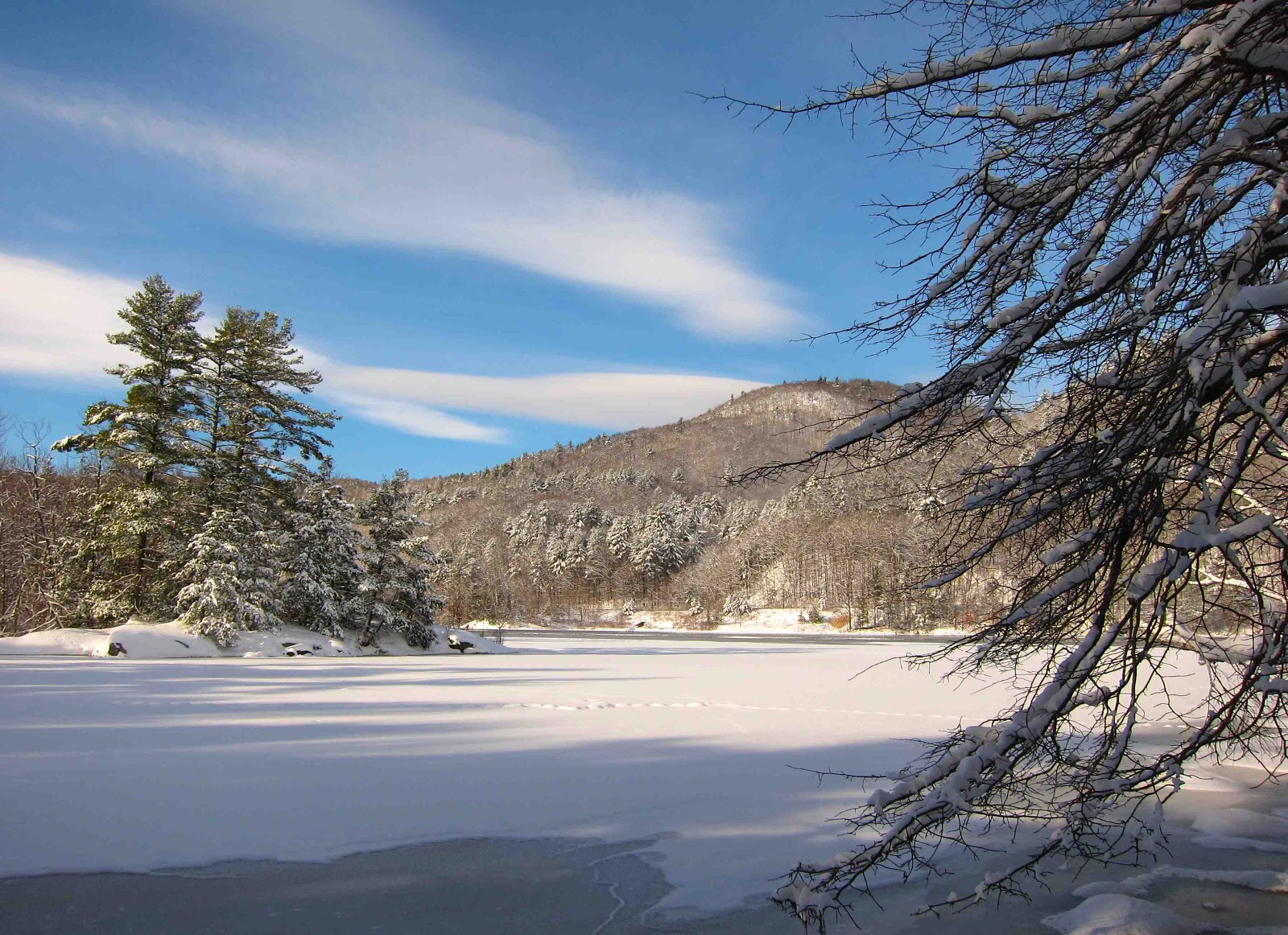
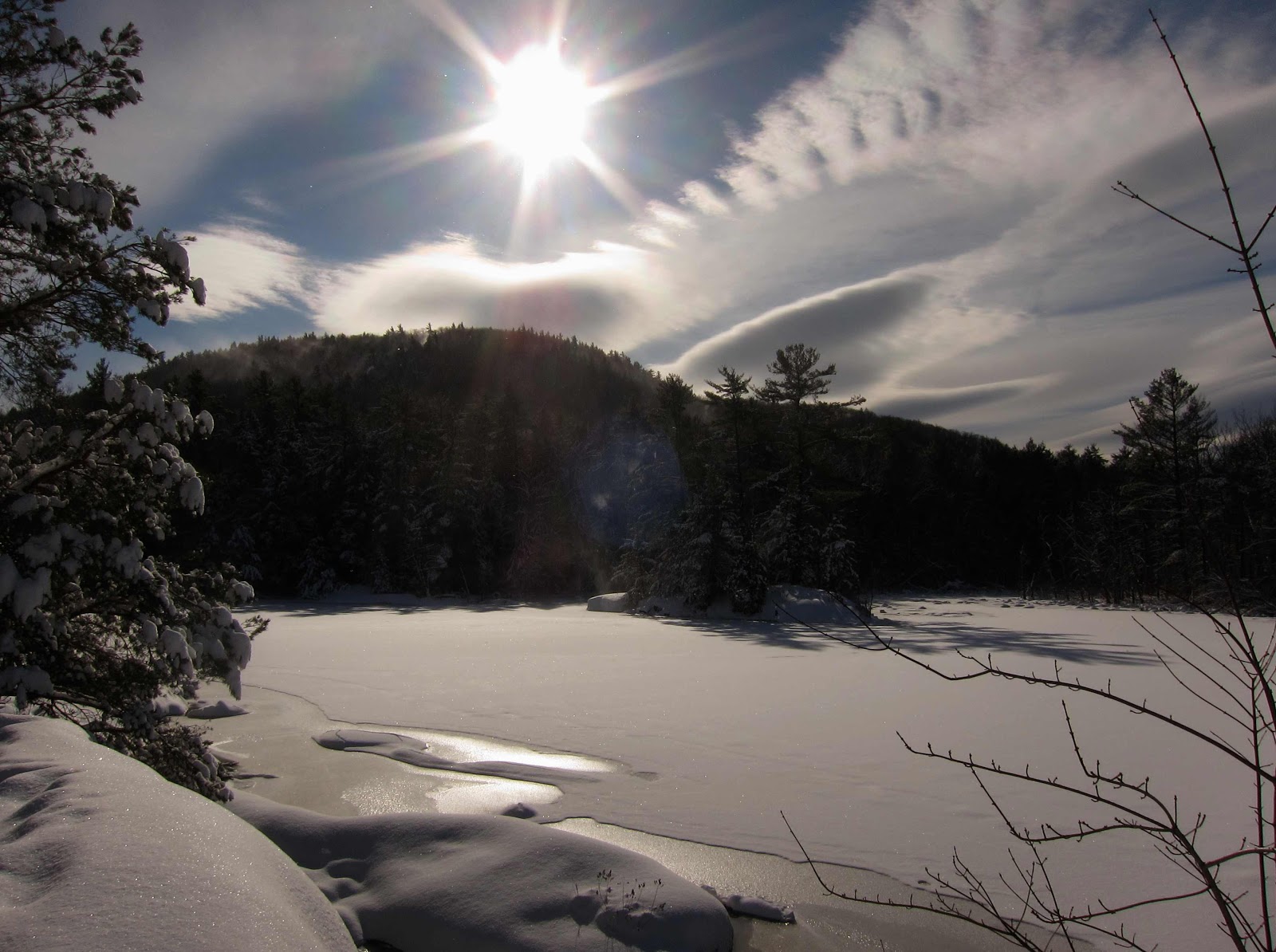
Except for the fact that the balmy air was making the snow quite mushy, yesterday was a perfect day for a walk around -- and across -- Mud Pond at Moreau Lake State Park. Predicted warmer temperatures for the week to come could make venturing out on the ice too risky, but on Thursday the ice was still thick and solid enough to walk on. And oh look! There's a dead deer out there in the middle. I had to go see if any birds or beasts had been gathering for a feast. (Note: Park staff place such roadkilled deer on the ice, the better to track Bald Eagles as they fly in to feed on the carcasses.)
I didn't find any wingprints of raptors nor footprints of other carrion eaters around the deer, which was still intact. Maybe it hadn't been there long enough for the word to go forth. I'll be checking back on other days, if the ice stays strong enough to walk on. In the meantime, I was amused to see the tiny tracks of this little creature, most likely a mouse, as it hopped across the snow and then tunneled beneath.
There were lots of canine tracks on the snow-covered ice, and some of them were no doubt those of coyotes or foxes. But a sure sign that this frolicking trail was made by a domestic dog and not a wild predatory canine is the fact that it was just that: a frolicking trail. Can't you just see that happy doggy, dancing along next to its skiing master, running off to sniff at this or that and then hurrying to keep up? No canine that needs to hunt to survive would waste its energy with such diversions.
I even met one such happy doggy, a darling Jack Russell Terrier named Quin who was trotting along the trail with his master Mike. We stopped for a pleasant chat and a pat, and it turned out Mike was a regular reader of my blog. Small world!
Mud Pond has long been the home of a huge beaver lodge on the east side of the pond, and sometime over the past year or so, a second large lodge has been constructed close to the western shore. As this open channel connecting the two lodges reveals, there's a constant flow of traffic between the two.
Constant traffic, indeed! As I stood and watched, several beavers appeared swimming back and forth along the channel, as well as in and out of dens they had burrowed into the banks. It's not that often I've witnessed such beaver activity in mid-afternoon, since these animals are usually most active during the night.
The afternoons are still very short, this close to Solstice, and the sun soon started sinking behind the trees, a few golden shafts lighting up the tops of the rushes near the shore.
On my way home I stopped along the Hudson to take in the sight of mountains touched by the setting sun, the golden glow of the hills reflected in the dark still river.
I'm glad I lingered yesterday to enjoy this beautiful scene. Today was dark and rainy, and tonight a freezing rain is turning the outdoors treacherous for walkers. Dear snowy cold winter, I hope you come back to us soon!
For more than thirty years I've been wandering the woods and waterways of Saratoga County, New York, and regions nearby, looking closely, listening carefully, and recording what I experience. We are blessed in this region with an amazing amount of wilderness right at hand. With this blog I share my year-round adventures here, seeking out what wonders await in my own Madagascar close to home.
Friday, January 11, 2013
Tuesday, January 8, 2013
Seize the Day!
Yikes! Forecasts call for temperatures close to 50 this week. I'd better get back to the woods, I thought, before the snow gets all mushy, and so made my way to the woods along the Hudson at Moreau. Here the river runs back into quiet coves, with forested mountains rising steeply on the far side. I never get tired of this view.
I was somewhat disappointed by the paucity of animal tracks in the woods today, since this section of riverbank is usually a Grand Central Station of animal activity after a snowstorm. Where are they hiding, those foxes, coyotes, fishers, and minks whose tracks in years past have revealed their habits and dramas and traumas along these shores? Today it appeared as if Red Squirrels were the only inhabitants here, having dined undisturbed at myriad caches throughout the woods.
Ah, but what's this? Somebody's long sliding body has left a trough in the snow. The individual prints were too obscured for me to make them out clearly, but the animal's habit of coasting along on its belly suggested it just might be an otter. Being this close to the river, the habitat is right.
Also, the trails all led to this opening under hemlock roots, the very same spot where I did find an otter's den two years ago. I looked for piles of diagnostic scat full of fish scales and crayfish claws, but found none near the den. Well, you can be sure I will come back to look again another day!
Monday, January 7, 2013
A Whole Week of REAL Winter!
Oh my, a whole week has gone by since I last posted an entry here! That doesn't mean I haven't been out, it just means that there's something about winter hiking that puts me to sleep after dinner (when I should have been writing my blog). And this was a week of REAL winter, snowy and cold and it stayed that way without a thaw or a rainstorm to ruin its wonderful wintery essence. Here's a quick recap of some of the week's adventures.
January 3 : Frazil Forms
Cold? Oh boy was it cold last Thursday! Ten below zero when I got up, and still just a few degrees above when I ventured out after lunch. I didn't spend a lot of time outdoors, but drove up to Lake Luzerne to watch the frazil ice form in the Hudson below Rockwell Falls. Frazil ice is a particular kind of slushy fluid ice that forms in turbulent water, an ice that can form hanging dams in the river and cause huge deposits to pile up along the banks by winter's end. This photo shows a small patch of frazil pushed against the bank on the lower right. As I stood and watched, rafts of this ice would be swept by the current downstream, but new deposits continued to form as the airborne water droplets promptly froze in the frigid air.
I followed the Hudson downstream to Moreau, where hydroelectric dams slow the river's current and cause the river to widen into calmer expanses. At the Sherman Island boat launch this day, the river was completely frozen over, except for an open area just downstream from the Spier Falls Dam.
January 5 : Moreau Lake Freezes Solid
By Saturday, the air had warmed to the 20s, and a bright sun tempted Sue and me to get out and celebrate the solidly frozen lake at Moreau Lake State Park. And we sure weren't the only ones enjoying the park that day, with the cars of skiers and snowshoers and ice fishermen absolutely packing the parking lots. Happily, the park is big enough to absorb all us winter-lovers without crowding one another.
One of the great pleasures of a solidly frozen lake is that we can proceed directly across the ice to some of our favorite spots on the far shore. One such spot is Zen Brook (Sue's name for it), a delightful little stream that dances down the mountainside to create the most beautiful ice formations along its rocky course.
We like to stop and chat with the fishermen (and yes, they are almost always men) hunched over their augured holes. I am always amazed at how cheerfully they endure the frigid vigil, even when the day ends with no fish to show for their patience. But some lucky ones have their trophies laid out on the ice in a colorful array. How beautiful they are! These are (top to bottom) Yellow Perch, Rainbow Trout, and Pickerel. Somebody's going to have a feast tonight!
This fellow named Brian was very proud to show us the splendid Rainbow Trout he had caught that day. Sue and I were happy to inform him (and all other trout-catchers) that this year's stocking of trout in the lake was paid for by a gift from the Friends of Lake Moreau. But I think this particular trout had been in the lake a good deal longer than since this past spring.
January 6: Snowshoeing with the Pirate Paddlers
Sunday was the Feast of the Three Kings, the last day of Christmas, and what better way to celebrate than with a bunch of new friends? My old pal Sue introduced me to a group of her friends known as the Adirondack Pirate Paddlers, a merry band of folks who enjoy all kinds of outdoor sports in addition to the paddling they are known for (see their site here). True to their rascally reputation, they invited us to join them for a snowshoe hike at a spectacular wooded site solidly posted with No Trespassing signs. Ignoring the threat of fines and/or imprisonment, we set off for a two-hour trek through deep snow and hilly woods and a jolly good time.
We had no pirates' grog to warm our innards, but Sue brought along an even better replacement: an ample supply of Baileys Irish Cream to be poured over little snowballs. Trailside cocktail hour!
As we neared the end of our hike, we passed a serene expanse of iced-over pond and a view of mountains to the north. Local readers of this blog will probably recognize this pond as the water supply for an area city and the very reason the surrounding woods has been placed off-limits to the general public (although many ski trails and snowshoe tracks would indicate the restriction is generally ignored). I'm not telling where we were, but I can say we caused the place no harm.
Tuesday, January 1, 2013
Another Year of Wonders in the Woods and on the Waters
Another wonderful year of nature adventures! When I started this blog on January 1, 2009, I intended to keep a one-year journal of my hikes and paddles in and around Saratoga County. Here it is, four years later, and I'm still discovering new amazements almost every time I go out. I guess I will continue to document them in the coming year.
Looking back over the year just ended, I tried to pick out events from each month that stood out in significance for me. Starting with last January's posts, I especially remember a very cold and windy afternoon Sue and I went to the Ft. Edward grasslands to see Short-eared Owls. This rare visitor from the north comes down to this Important Birding Area each winter to feed here in an extensive protected grasslands preserve. This is one of the very few owls we are likely to see hunting while it is daylight, and we were not disappointed, thanks to some fellow birders who had spotting scopes and let us look through them. As this photo reveals, there was no snow on the ground in mid-January, and the ground remained bare throughout most of the winter.
February came, and still hardly any snow. My friend Laurie Williams took me up into the Palmertown Mountains at Moreau Lake State Park to see some very large and old Black Tupelo trees. We did not need snowshoes to go off the trail to explore the swamp where these craggy old trees could be found. I hope this coming year I can interest some dendrologist to core-sample and date these old giants. I don't believe they are quite as old as the 600-year-old tupelos growing in a nearby state forest, but they could be very, very old indeed.
Spring came early, with excessively warm weather in March, causing many of our spring ephemerals to really rush the season. Never in other years had I found Bloodroot blooming before April, but this photo was taken during the last week of March. Throughout the summer, most flowers bloomed at least two weeks earlier than I or other botanical friends had ever recorded.
April was an exciting month for our friends at Moreau Lake State Park, for the beautiful new Nature Center was finally completed and opened to the public. Sue and I attended the dedication ceremonies, where we met other nature enthusiasts who joined us for a walk around the lake. We all remember that walk because we surprised a litter of tiny Red Fox kits, who quickly scrambled to hide in their den among the roots of a tree. They were unbelievably cute!
May is my birthday month, and I got a wonderful birthday surprise when the Cecropia Moth, whose cocoon I had hung on my porch all winter, emerged to spread her big beautiful wings while clinging to my porch screens. I placed her outdoors in a Mountain Laurel bush, and when I looked the next morning, not only was she was still there, but a mate had flown in to find her, using those huge feathery antennae to detect her by her scent. (He's the one on the left in this photo.)
Well, I can't let May go by without noting the thrill of laying eyes on one of New York's rarest orchids, the Hooker's Orchis. I believe that at last count, there were fewer than five plants known as to location in all of New York State, and here were three of them. And another plant grew a few yards away. I was led to this marvelous find by one of my newest naturalist friends, Bob Duncan, who very generously led me to other treasures throughout the summer.
In June, Bob Duncan also escorted me to a site where dozens and dozens of Showy Lady's Slippers were in their glory. When these native orchids find a spot they like, they thrive in great number, but unfortunately, the kind of spots they like -- open calcareous wetlands -- are rapidly disappearing. I am so grateful to friends like Bob, who gladly share with me their knowledge of where to find such spectacular wildflowers.
In July, it was my pleasure to share my wildflower finds with Andrew Gibson, a young botanist who drove straight through from his home in Ohio in order to catch the spectacular White Fringed Orchis blooming in a secret bog. Andrew and I spent three whole days in botanical heaven, traveling from bog to ice meadow to river islands to old-growth forest to Adirondack wilderness lakes. We had so much fun and found so many treasures, Andrew is planning to return this coming May to catch more of New York's orchids in bloom, many species of which can no longer be found in Ohio. Andrew really loves orchids!
July was also the month when I was introduced to many species of alpine flora atop Whiteface Mountain in the Adirondacks. Steve Young, chief botanist for the New York Flora Association, led an excursion to document the fragile plant species that can only grow in this harsh habitat. The other members of our little group recognized these plants as if they were old friends, but oh my, every one of them was brand new to me! I was introduced to 10 new "lifers" in one afternoon and can't wait to go back and find more.
In August, I got my first-ever photographic assignment: to photograph a sheep farm for an art exhibit that raised money toward a conservation easement that would preserve this beautiful river-valley acreage as agricultural land forever. The exhibit was held at the Spring Street Gallery in Saratoga Springs, and the gallery made exquisite professional-quality prints of my photos, framed them handsomely, and actually sold a few! I was glad to contribute my photos for such a good cause, and I especially loved tramping about the farm and its fields and getting to know the people who live and work on this land.
August was also the month that my dear friend Sue purchased her very own Hornbeck canoe, a carbon fiber BlackJack that weighs just 12 pounds, which means that we can now explore together more ponds and rivers that would be too remote for her to carry her old kayak to. One of our first excursions (although not a remote one) was a paddle on Lens Lake in the Adirondacks, where we were joined by our friend Nancy Slack, fellow Hornbecker and a well-known ecologist who could tell us the names of all the different sphagnum mosses populating the extensive bog mats on the lake.
September brought many pleasant nature adventures, but perhaps the highlight of them all was joining Bob Duncan once again on a hunt for a flower I'd never seen (or wouldn't have recognized if I had ever seen it). This was the Yellow Ladies' Tresses, a Spiranthes species that looks so much like the Nodding Ladies' Tresses I doubt I could tell them apart even if I could see them side-by-side. A big clue to its identity though, is that it blooms a few weeks later and in a drier habitat than its look-alike sister. This was my second new Ladies' Tresses species this summer, since my friend Evelyn Greene had taken me to see Hooded Ladies' Tresses in an old granite quarry in July. I am so grateful to have such experienced friends helping me deepen my own botanical knowledge.
In October, my husband and I spent a brief seaside vacation in Montauk, on the very eastern tip of Long Island, where I had a wonderful time botanizing the sand dunes and salt marshes, encountering plants I would never find at home. It's a good thing I brought my Newcomb's along. Three of the plants I found out there -- Maryland Golden Aster, Sickle-leaved Golden Aster, and Hyssop-leaf Boneset -- grow nowhere else in New York but on Long Island.
National Trails Day came in November, and what better way to mark it than helping to create a new trail in Moreau Lake State Park? I am always delighted to donate time, talent, or energy to this park, with its over 4,000 acres of forest, mountains, lake, ponds, streams, river, marshes, islands -- whatever a nature lover is looking for, Moreau Lake State Park has it in abundance! The park even crosses the Hudson now, with extensive wooded holdings on the Warren County side of the river, and that's where we focused our energies one chilly November day, clearing and grooming a new trail that runs along the banks of the Hudson, offering beautiful views of the river.
December arrived, along with our first dusting of snow. The snow promptly melted, but a huge flock of Snow Geese that had landed on Loughberry Lake in the heart of Saratoga Springs stuck around for a week or more.
Although their presence in such numbers was a welcome event that attracted birders from miles around to witness this unusual sight, their presence here was also a sign that things were not right along the geese's regular migration routes. Extended drought and withering heat this past summer wiped out crops in the central states that in other years would offer feeding sites for migrating waterfowl. Many birds were also blown off course by the largest storm ever recorded in the Northeast, a combination of Hurricane Sandy and a huge Nor'easter that caused the sea to rise up and swamp many coastal communities, including the whole southern part of Manhattan. Unusual and destructive weather was one of the biggest stories of the whole year across the U.S. continent, and my hope is that my fellow citizens will at last wake up and address the crucial issue of global warming.
So here we are now, in January 2013, and at least the winter seems to be setting off on the right foot, with more snow in the first couple of days than we had on the ground at any time all last winter. Frigid temperatures are setting up good hard ice on the lakes and ponds and river bays. The woods will soon be filled with animal tracks for us to follow, and the eagles will soon be down from Canada to feed in our local rivers. Winter adventures await! Time to get out and have fun.
I can't let my year-end report conclude without celebrating the many folks who shared my nature adventures, introducing me to wonders I'd never discovered and just being grand companions. I've already mentioned knowledgeable friends like Nancy Slack and Bob Duncan, but here's a whole bunch of others all together in one group, a mix of professional naturalists and passionate amateur nature lovers who call themselves the Thursday Naturalists. I don't manage to join them every Thursday, but every Thursday I do, I have a wonderful time and learn many things.
I want to single out Ruth Schottman (in the center of the front row of the folks above) and Ed Miller (above to Ruth's right and also in the photo below) as delightful friends and hiking companions. Both have made extra efforts to advance my nature education, inviting me along on many excursions to wonderful places, as well as being always available to reliably answer my many questions. Best of all, they are just good fun to be with.
Another star in my firmament of nature friends is Evelyn Greene, who knows where every rare plant or trackless bog can be found in the Adirondacks and is always delighted to escort me and others there in person. To get a sense of the variety of nature adventures I've shared with Evelyn, just type "Evelyn Greene" into my blog's search bar and see how many posts come up. This lady is like the Energizer Bunny, and I just love trying to keep up with her.
Thanks to an introduction through Evelyn, a new friend I made this year is Carol Gracie, shown here photographing a White Fringed Orchis while her husband Scott Mori holds the light-filtering umbrella. Carol is an acclaimed naturalist, photographer and author of books on wildflowers, and it was thanks to her knowledge and professional connections that I was able to identify an unusual water plant I found in the Hudson. This plant, called Slender Milfoil, is hardly ever found blooming, but because of low water levels in the river this past summer, there was such an abundance of blooming plants that I could obtain numerous specimens for various state plant collections. (I suppose only wildflower nuts like me will understand what a thrill this was! Thanks for helping, Carol.)
And then, of course, there's Sue. Frequent readers of this blog will immediately recognize my dear friend and constant nature companion Sue Pierce, who stars in so many of my nature adventures throughout the year. Every nature lover should be blessed with such a companion, one who knows how to take an hour to walk a hundred yards, one who never grows impatient while I struggle to focus my macro on some fascinating tiny bit of flora. That's because she's doing the same thing too. Younger and sharper of senses than I, Sue often serves as my eyes and ears, seeing and hearing so much that I would miss if she were not with me. Thank you, dear friend, for your passion, your joy, and your patience. Here's to another year of wandering the woods and waters with you.
Looking back over the year just ended, I tried to pick out events from each month that stood out in significance for me. Starting with last January's posts, I especially remember a very cold and windy afternoon Sue and I went to the Ft. Edward grasslands to see Short-eared Owls. This rare visitor from the north comes down to this Important Birding Area each winter to feed here in an extensive protected grasslands preserve. This is one of the very few owls we are likely to see hunting while it is daylight, and we were not disappointed, thanks to some fellow birders who had spotting scopes and let us look through them. As this photo reveals, there was no snow on the ground in mid-January, and the ground remained bare throughout most of the winter.
February came, and still hardly any snow. My friend Laurie Williams took me up into the Palmertown Mountains at Moreau Lake State Park to see some very large and old Black Tupelo trees. We did not need snowshoes to go off the trail to explore the swamp where these craggy old trees could be found. I hope this coming year I can interest some dendrologist to core-sample and date these old giants. I don't believe they are quite as old as the 600-year-old tupelos growing in a nearby state forest, but they could be very, very old indeed.
Spring came early, with excessively warm weather in March, causing many of our spring ephemerals to really rush the season. Never in other years had I found Bloodroot blooming before April, but this photo was taken during the last week of March. Throughout the summer, most flowers bloomed at least two weeks earlier than I or other botanical friends had ever recorded.
April was an exciting month for our friends at Moreau Lake State Park, for the beautiful new Nature Center was finally completed and opened to the public. Sue and I attended the dedication ceremonies, where we met other nature enthusiasts who joined us for a walk around the lake. We all remember that walk because we surprised a litter of tiny Red Fox kits, who quickly scrambled to hide in their den among the roots of a tree. They were unbelievably cute!
May is my birthday month, and I got a wonderful birthday surprise when the Cecropia Moth, whose cocoon I had hung on my porch all winter, emerged to spread her big beautiful wings while clinging to my porch screens. I placed her outdoors in a Mountain Laurel bush, and when I looked the next morning, not only was she was still there, but a mate had flown in to find her, using those huge feathery antennae to detect her by her scent. (He's the one on the left in this photo.)
Well, I can't let May go by without noting the thrill of laying eyes on one of New York's rarest orchids, the Hooker's Orchis. I believe that at last count, there were fewer than five plants known as to location in all of New York State, and here were three of them. And another plant grew a few yards away. I was led to this marvelous find by one of my newest naturalist friends, Bob Duncan, who very generously led me to other treasures throughout the summer.
In June, Bob Duncan also escorted me to a site where dozens and dozens of Showy Lady's Slippers were in their glory. When these native orchids find a spot they like, they thrive in great number, but unfortunately, the kind of spots they like -- open calcareous wetlands -- are rapidly disappearing. I am so grateful to friends like Bob, who gladly share with me their knowledge of where to find such spectacular wildflowers.
In July, it was my pleasure to share my wildflower finds with Andrew Gibson, a young botanist who drove straight through from his home in Ohio in order to catch the spectacular White Fringed Orchis blooming in a secret bog. Andrew and I spent three whole days in botanical heaven, traveling from bog to ice meadow to river islands to old-growth forest to Adirondack wilderness lakes. We had so much fun and found so many treasures, Andrew is planning to return this coming May to catch more of New York's orchids in bloom, many species of which can no longer be found in Ohio. Andrew really loves orchids!
July was also the month when I was introduced to many species of alpine flora atop Whiteface Mountain in the Adirondacks. Steve Young, chief botanist for the New York Flora Association, led an excursion to document the fragile plant species that can only grow in this harsh habitat. The other members of our little group recognized these plants as if they were old friends, but oh my, every one of them was brand new to me! I was introduced to 10 new "lifers" in one afternoon and can't wait to go back and find more.
In August, I got my first-ever photographic assignment: to photograph a sheep farm for an art exhibit that raised money toward a conservation easement that would preserve this beautiful river-valley acreage as agricultural land forever. The exhibit was held at the Spring Street Gallery in Saratoga Springs, and the gallery made exquisite professional-quality prints of my photos, framed them handsomely, and actually sold a few! I was glad to contribute my photos for such a good cause, and I especially loved tramping about the farm and its fields and getting to know the people who live and work on this land.
August was also the month that my dear friend Sue purchased her very own Hornbeck canoe, a carbon fiber BlackJack that weighs just 12 pounds, which means that we can now explore together more ponds and rivers that would be too remote for her to carry her old kayak to. One of our first excursions (although not a remote one) was a paddle on Lens Lake in the Adirondacks, where we were joined by our friend Nancy Slack, fellow Hornbecker and a well-known ecologist who could tell us the names of all the different sphagnum mosses populating the extensive bog mats on the lake.
September brought many pleasant nature adventures, but perhaps the highlight of them all was joining Bob Duncan once again on a hunt for a flower I'd never seen (or wouldn't have recognized if I had ever seen it). This was the Yellow Ladies' Tresses, a Spiranthes species that looks so much like the Nodding Ladies' Tresses I doubt I could tell them apart even if I could see them side-by-side. A big clue to its identity though, is that it blooms a few weeks later and in a drier habitat than its look-alike sister. This was my second new Ladies' Tresses species this summer, since my friend Evelyn Greene had taken me to see Hooded Ladies' Tresses in an old granite quarry in July. I am so grateful to have such experienced friends helping me deepen my own botanical knowledge.
In October, my husband and I spent a brief seaside vacation in Montauk, on the very eastern tip of Long Island, where I had a wonderful time botanizing the sand dunes and salt marshes, encountering plants I would never find at home. It's a good thing I brought my Newcomb's along. Three of the plants I found out there -- Maryland Golden Aster, Sickle-leaved Golden Aster, and Hyssop-leaf Boneset -- grow nowhere else in New York but on Long Island.
National Trails Day came in November, and what better way to mark it than helping to create a new trail in Moreau Lake State Park? I am always delighted to donate time, talent, or energy to this park, with its over 4,000 acres of forest, mountains, lake, ponds, streams, river, marshes, islands -- whatever a nature lover is looking for, Moreau Lake State Park has it in abundance! The park even crosses the Hudson now, with extensive wooded holdings on the Warren County side of the river, and that's where we focused our energies one chilly November day, clearing and grooming a new trail that runs along the banks of the Hudson, offering beautiful views of the river.
December arrived, along with our first dusting of snow. The snow promptly melted, but a huge flock of Snow Geese that had landed on Loughberry Lake in the heart of Saratoga Springs stuck around for a week or more.
Although their presence in such numbers was a welcome event that attracted birders from miles around to witness this unusual sight, their presence here was also a sign that things were not right along the geese's regular migration routes. Extended drought and withering heat this past summer wiped out crops in the central states that in other years would offer feeding sites for migrating waterfowl. Many birds were also blown off course by the largest storm ever recorded in the Northeast, a combination of Hurricane Sandy and a huge Nor'easter that caused the sea to rise up and swamp many coastal communities, including the whole southern part of Manhattan. Unusual and destructive weather was one of the biggest stories of the whole year across the U.S. continent, and my hope is that my fellow citizens will at last wake up and address the crucial issue of global warming.
So here we are now, in January 2013, and at least the winter seems to be setting off on the right foot, with more snow in the first couple of days than we had on the ground at any time all last winter. Frigid temperatures are setting up good hard ice on the lakes and ponds and river bays. The woods will soon be filled with animal tracks for us to follow, and the eagles will soon be down from Canada to feed in our local rivers. Winter adventures await! Time to get out and have fun.
* * *
I can't let my year-end report conclude without celebrating the many folks who shared my nature adventures, introducing me to wonders I'd never discovered and just being grand companions. I've already mentioned knowledgeable friends like Nancy Slack and Bob Duncan, but here's a whole bunch of others all together in one group, a mix of professional naturalists and passionate amateur nature lovers who call themselves the Thursday Naturalists. I don't manage to join them every Thursday, but every Thursday I do, I have a wonderful time and learn many things.
I want to single out Ruth Schottman (in the center of the front row of the folks above) and Ed Miller (above to Ruth's right and also in the photo below) as delightful friends and hiking companions. Both have made extra efforts to advance my nature education, inviting me along on many excursions to wonderful places, as well as being always available to reliably answer my many questions. Best of all, they are just good fun to be with.
Another star in my firmament of nature friends is Evelyn Greene, who knows where every rare plant or trackless bog can be found in the Adirondacks and is always delighted to escort me and others there in person. To get a sense of the variety of nature adventures I've shared with Evelyn, just type "Evelyn Greene" into my blog's search bar and see how many posts come up. This lady is like the Energizer Bunny, and I just love trying to keep up with her.
Thanks to an introduction through Evelyn, a new friend I made this year is Carol Gracie, shown here photographing a White Fringed Orchis while her husband Scott Mori holds the light-filtering umbrella. Carol is an acclaimed naturalist, photographer and author of books on wildflowers, and it was thanks to her knowledge and professional connections that I was able to identify an unusual water plant I found in the Hudson. This plant, called Slender Milfoil, is hardly ever found blooming, but because of low water levels in the river this past summer, there was such an abundance of blooming plants that I could obtain numerous specimens for various state plant collections. (I suppose only wildflower nuts like me will understand what a thrill this was! Thanks for helping, Carol.)
And then, of course, there's Sue. Frequent readers of this blog will immediately recognize my dear friend and constant nature companion Sue Pierce, who stars in so many of my nature adventures throughout the year. Every nature lover should be blessed with such a companion, one who knows how to take an hour to walk a hundred yards, one who never grows impatient while I struggle to focus my macro on some fascinating tiny bit of flora. That's because she's doing the same thing too. Younger and sharper of senses than I, Sue often serves as my eyes and ears, seeing and hearing so much that I would miss if she were not with me. Thank you, dear friend, for your passion, your joy, and your patience. Here's to another year of wandering the woods and waters with you.
Monday, December 31, 2012
Boys Just Wanna Have Fun!
I went for a walk in Congress Park today, just a block from my home in downtown Saratoga Springs. Although the fountain called "Spirit of Life" is shut off for the winter, I'm glad the beautiful figure, sculpted by noted American sculptor Daniel Chester French, remains open to view. The sight of her always lifts my spirits. Even when I'm not feeling low. She just makes me smile. Today she looked like she was wearing an ermine cape and bonnet.
Here was another sight that brought a smile to my face: a bunch of boys having lots of fun. When my children were young, they used to delight in sledding down the hills in Congress Park, but now the city has banned sledding, probably for fear of lawsuits should someone get injured. But it looks like these snowboarding boys have rigged up a way to have a few thrills on their own, attaching a long bungee cord to a lamppost and piling up show to make a ramp against a wall. Here, one boy gets ready to fly on his board, while his buddies hold the bungee tight.
There he goes! He drops the cord once it goes slack, and he heads toward the ramp.
Up he goes, and then down again. Looks like a lot of fun. I watched while they tinkered with their design, trying to perfect the track and slide. They were very engaged in their project.
I'm sure once the city's Public Works guys discover what these boys are up to, they will have them dismantle their ramp and take their boards elsewhere. And that's probably as it should be, considering the damage they might do to that lovely old wall. But it did my heart good to see these kids so involved in creating their own diversion and having such fun in the snow. I was almost tempted to ask them to let me try.
Sunday, December 30, 2012
Snowy Woods at Potter Point
Perfect! Just perfect! Soft fresh snow, a bright cold day with a radiant blue sky, a beautiful woods to walk in, and my good buddy Sue to have fun with. And the roads were clear enough today to drive to our favorite places. Who could ask for more?
Sue and I met at the end of Potter Road in Moreau, where we entered the woods to snowshoe down to the Hudson, then along the banks to reach a quiet bay that today was completely frozen over. The main river was mostly ice-covered, too, with just a few open areas here and there.
In the shelter of the woods, all of the trees were thickly laden with snow. Even leafless limbs bore heaps of it, precarious narrow ribbons of snow so thin that the sunlight shone through.
Tufts of White Pine needles holding fluffy puffs of snow resembled little hedgehogs dangling from the branches.
Except for a few deer trails, we saw little evidence of animal traffic through the woods. We did find a couple of spiders, though, which I found kind of amazing. How can such a tiny cold-blooded creature manage to stay mobile on sub-freezing days like today?
This set of tracks across the frozen bay had us puzzled. Instead of leaving depressions in the snow and slush ice, this creature revealed its passage with heaped-up bumps, like those the Star-nosed Mole will make in the mud.
When my husband saw this photo, he suggested that some creature left this trail when the snow on the ice was deeper, compressing the slushy snow beneath its feet. Then when the wind swept the loose snow from the surface of the ice, the compressed footprints remained and collected more snow as the wind blew across them. Yeah, I guess that's possible. But I've never seen such a thing before.
While we were standing on the shore of this bay, the wind began to gust, blowing snow from the trees in misty clouds that rose toward the sky like smoke. The effect was especially pronounced on the mountain that rose from the back of the bay, but photographing the scene was made difficult by the angle of the sun. I was going to toss this photo, but then I noticed those spectacular clouds in the sky above the mountain.
I did manage to get one shot that showed the smoky effect of the blowing snow.
Here's a brief video, too, that also records the sound of the wind that came roaring out of nowhere, and just as suddenly stopped. The effect was quite dramatic, with the mountain and forest engulfed in smoke-like mist, as if a forest fire were raging through.
Subscribe to:
Posts (Atom)