Friday, November 9, 2012

Fun With Friends in the Forest (and Other Fascinating Spots)

We lucked out again here in Saratoga.  That Nor'easter that dumped nearly a foot of snow on already storm-ravaged areas south of here didn't touch us at all.  What was forecast to be a nasty cold day on Thursday turned out to be sunny and pleasantly cool, perfect for a hike with my good friends in the Thursday Naturalists as we explored Rowland Hollow, a 45-acre property on the western edge of Saratoga Springs that is managed as a nature preserve by Saratoga P.L.A.N. (Preserving Land And Nature).


 Only a few steps from a parking area off Grand Avenue, we found ourselves on a forested trail loop that runs for less than a mile through mixed hardwood/pine woods and wetlands, with a short side path to the banks of a creek.  Along the way we encountered evidence that this property once served as farmland in generations past.  Here, we took some time to see what might be growing in the mossy rocks of an old stone wall.


The creek was running quietly today, but heaps of sand and beaten-down grasses along the banks gave evidence that this calm little stream was a raging torrent not too long ago.


Of course, we found no flowers today, but these Swamp Milkweed pods were a reminder  of what had bloomed along the creek last summer


The presence of this charcoal-black fungus called Clinker Polypore (Inonotus obliquus) is a sure sign that the tree it is growing on is certainly dying.  We find them not infrequently in the woods, but it's a rare event indeed to find one with a fruiting surface like the chocolate-brown patch covering the bottom of this one.  Another common name for Clinker Polypore is Chaga, and it is known to have some very powerful medicinal properties.   Update: NO, NO, NO, this is NOT Inonotus obliquus, but rather Phellinus igniarius, otherwise known as Iqmik or Indian Tobacco.  It doesn't have the medicinal qualities of Chaga, but many native peoples of North America would burn the conks and mix the ash with tobacco to create an especially potent smoke.  Thanks to mycologist Sue Van Hook for correcting me about this fungus's identity.


 When my friend Ed Miller learned I had never been to Lester Park, a fascinating geological site very close to the Rowland Hollow Nature Preserve, he insisted that we go there together after the morning's outing.  And I'm very glad I did.  Here's Ed standing on one of the wonders of the ancient world, the fossil remains of some of the earliest life forms to inhabit the planet.  The next photo is of  a placard at the site that provides a brief explanation of the site's importance.


 Here's a closer look at those stromatolites, which resemble sliced-open cabbages turned to stone.  I remember attending a lecture many years ago, where the speaker asserted that the cyanobacteria that formed these rocks were instrumental in creating the atmosphere essential to advanced life forms.  In the process of forming these limestone structures, the cyanobacteria depleted the carbon dioxide that predominated in the primordial atmosphere, allowing for the development of the oxygen-rich air we all now need to breathe.


It amazed me that such a fascinating and important site was just sitting there by the side of the road, so easily accessed just by pulling your car over onto the shoulder.  And there were other interesting sites just across the road.  Here are the remains of what was once a kiln, where lime fertilizer was produced by heating the limestone from an adjacent quarry.


Of course we had to explore that limestone quarry, poking about among the rocks in search of those plants that must have lime to thrive.


We found lots of Herb Robert and a few still-green Columbine leaves, but we'll have to come back in the spring to see what other flowers grow here.  We did find a very pretty patch of mixed liverwort and moss.


Update:  My friend, Bob Duncan, has suggested that this liverwort is Preissia quadrata and the moss is one of three Encalypta species, all of which only grow on lime-rich rocks.

Tuesday, November 6, 2012

Mushroom Hunting at Moreau

In my post for last Saturday, I pictured a fungus -- Cordyceps capitata -- that turned out to be a rather rare species that only grows on underground truffles.  Intrigued by this information and wanting to see these remarkable fungi in situ, I set out on Sunday to see if I could find the spot where the fellows found them while clearing a new trail in Moreau Lake State Park.  Well, I walked that entire trail, both the old and the new parts, and could not for the life of me find them.  I sure had a nice walk though.  The trails through those Warren County woods are certainly lovely.


But I didn't give up.  Today (Tuesday) I called the park's manager, Peter Iskenderian, to ask him to show me on a trail map exactly where he had found those fungi, and he actually went me one better.  He offered to escort me to the very site in person.  So off we went together, on a radiantly lovely brisk autumn afternoon, striding along a trail that followed the Hudson, which was visible through the trees and sparkling in the sun.


Peter led me directly to the site, and there they were, a cluster of Cordyceps capitata, rather mangled by being raked by trail workers, but recognizable all the same, with their worm-like yellow stalks crowned with brownish bonnets.


I was particularly interested to find the truffle-like fungus, Elaphomyces, which grows underground and is a necessary concomitant for the presence of Cordyceps capitata.   When we dug out the soil beneath the visible Cordyceps, we not only found the truffles, we found other hidden Cordyceps, curled up underground.


Very fragile, the Cordyceps broke from the truffle at a touch, but here in my hand are the two fungi arranged as I found them before they broke apart.  That rough brown ball is not the root of the Cordyceps, but is instead the separate truffle-like fungus Elaphomyces.


I sliced one of the truffles open to reveal its black interior.  Unlike the extremely valuable edible truffles, this one had no discernible odor.  Nor should it ever be eaten.  I don't know if it is poisonous, but it is not considered to be edible.


These weren't the only interesting fungi I encountered along Moreau trails this past week.  Last Friday, my friend Sue and I found several more on a very pleasant walk around Moreau Lake, which, despite the gloomy weather, offered a serene and lovely reflection of a low gray sky.


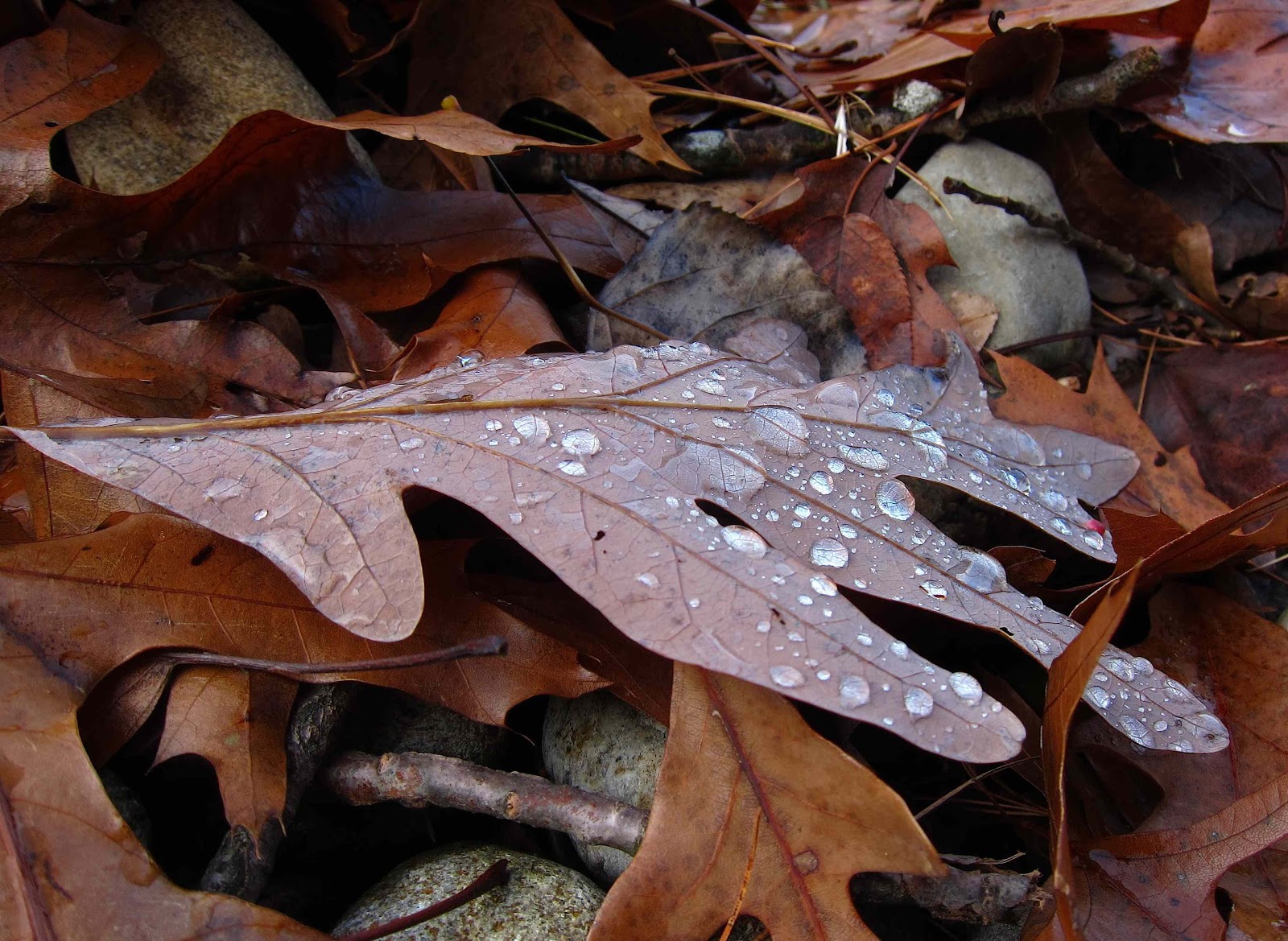
A light misty rain had stopped before we set out along the shore, but the raindrops were still in evidence on the backs of fallen oak leaves.  I'm noticing now, as I look at this photo again, that the drops were beaded up like this only on the undersides of the leaves.  I must look very closely with my hand lens next time I pick up an oak leaf, to see how the textures differ from the upper and under sides of the the leaves.  (For the moment, though, I will just enjoy the beauty of this leaf.)


We always find Turkeytail fungus on our walks through Moreau woods, and I thought this arrangement of older and newer fungi, plus lichens, moss, bark and leaves, was particularly colorful.


Sue and I were mystified by this patch of white stuff spreading across the surface of an oak stump cut level with the ground.  It had covered not only the oak wood, but also a number of acorns resting there, as well as several other little white-capped gilled mushrooms that had sprouted from the same wood.


At first I thought it might be a slime mold, and it may yet be, but after taking a closer look at the ruffly structure of the growth, I thought it looked  more like a fungus than a slime mold.  I hope to get an answer soon from my mushroom-expert friends.


Update:  This IS a slime mold!  I found a photo of it in George Barron's Mushrooms of Northeast North America, which has a nice section on slime molds.  Its name is Ceratiomyxa fruticulosa var. porioides.


There was no wondering what THIS fungus was!  This is a Ravenel's Stinkhorn (Phallus ravenelii), with a shape that matches its Latin name, and a stink that attracted a bunch of red-eyed flies.


Copulating red-eyed flies, at that.


Saturday, November 3, 2012

New Trail at Moreau Lake State Park


What better way to spend National Trails Day, November 3, than helping to mark and groom a new trail in Moreau Lake State Park?  For a number of years now, the park has owned extensive lands on the Warren County side of the Hudson River, but hiking options over there have been rather limited, since only a single trail had been marked and mapped to date.  Today we laid another trail, one that will give much better access to river views than the one that existed already, which runs almost entirely through deep woods.  In the photo above, the guys are setting out with axes and chain saws to remove small trees and fallen logs that obstruct the new trail, while a group of us women started clearing the path of fallen leaves and small limbs, making it easier for hikers to follow.


In the process of raking leaves from the trail, we uncovered this group of Downy Rattlesnake Plantain plants,  one of New York's many species of native orchids, which will bear spikes of very small white flowers next August.  The beautifully patterned leaves will stay green all winter, and to protect them from damage lest we have another snowless winter this year,  I covered them again with the leaves we had raked away.


 I hope to find many other interesting plants along this new section of trail, since it runs through rich woods that have a calcareous substrate, essential for certain plants that require lime-rich soils to thrive.  On other occasions, we have found the lovely pink-and-white Showy Orchids growing in this same area.


The portion of the new trail we worked on today leads directly down to the Hudson, coming out onto the river banks a short distance above Spier Falls Dam.  The land here flattens out into open sunny woods, which should make for a wonderful destination for picnickers.


One of the most interesting features of this new trail are the ruins of old dwellings that remain in the woods, evidence of the early settlers who once farmed the lands along these banks.  Although the portion of the trail we worked on today ended at the location pictured here,  further work will continue the trail upstream along the river to where it will connect with the trail that had been cut in previous years.


While the men were working with pickaxes and chainsaws to clear a hillside, they came upon a cluster of odd-looking mushrooms that nobody recognized.  I was grateful that they thought of me and brought a couple of specimens back to see if I could identify them.  Well, I certainly could not.  They are like nothing I have seen before, either in my woodland travels or in my several mushroom books.


What looked at first glance to be closed caps at the top turned out to not be caps at all, but rather bulbous swellings covered with a brownish crust that was composed of tiny tubes, a crust that flaked off quite easily.  Very unusual, indeed!  I will send photos to mushroom experts I know, and hope that they will be able to give a name to this fascinating little fungus.


Update:  Big thanks go out to mycologist Sue Van Hook, who identified this fungus as Cordyceps capitata, a quite rare fungus that grows on the underground truffle-like fungus Elaphomyces.  When I looked up this species in my Augubon mushroom guide, I discovered that, although neither fungus is known to be edible, the Cordyceps has been used by Mexican shamans to divine the future, and the Elaphomyces has been used by some Europeans and Asians as an aphrodisiac.

Wednesday, October 31, 2012

November's Landscape

October ends tonight, and the earth has already taken on a Novemberish look, involving various shades of brown and gray.  Because they are so rare now, flashes of bright color are especially welcome, and I was pleased to find a few on my walk at Woods Hollow Nature Preserve today.

The sandplain part of the preserve looked especially dull of color, with dark clouds lying low overhead and not a single beam of sunlight to brighten up the scene.


The once-radiant Tall Goldenrod now fills the meadow with its seedheads of ivory fluff.


In some ways, the distinctive feathery tendrils of Virgin's Bower gone to seed are more interesting than its rather nondescript small white summer flowers.


The moss and lichen beds that cover the sand are always worth a closer look.  Today I found Earth Star fungi among the Cladonia lichens.


There were many of these rusty colored gilled mushrooms growing right out of the dry sand.


How appropriate for Halloween!   These tiny bright-pumpkin-colored sac fungi were nestled into a patch of Haircap moss.


The forested part of Woods Hollow Nature Preserve has a lovely pond at its center, and here we find a habitat quite distinct from that of the sandplain portion.


Along the shore of the pond, the bare twigs of Winterberry shrubs are studded with bright red fruit.


Partridgeberry carpets the forest floor with its pale-veined shiny evergreen leaves and two-eyed fruits.


Although its pink flowerspikes have now turned brown, Steeplebush still puts on a pretty show with its gold-and-green leaves.


A moss-covered fallen log was sprinkled with these little jelly-like fungi, presenting a beautiful color combination of emerald green and butter yellow.


A log had fallen across the trail, stained with the distinctive color that indicates this wood was infused with the appropriately-named Blue Stain fungus.


We often find rotting logs stained with this dark blue-green color, but it's not so often we find the little ear-shaped fruiting bodies.  I searched this log and finally found a few very small examples.


Here's a surprise:  a baby Black-eyed Susan just coming into bloom, long after all other flowers have called it quits for the year.   At least, I think it's a Black-eyed Susan, with its very dark center disk and hairy-all-over appearance.  I have never noticed petals emerging like this, with the bases rolled up into tubes.


We Were Lucky. Others Weren't.

We were lucky.  Superstorm Sandy hardly touched us here in Saratoga Springs.  We had some wind, we had some rain, a few downed limbs caused brief power outages for only a small part of town, but nothing worse than a typical passing storm.  These beautiful tall White Pines still tower over the Spirit of Life fountain in Congress Park. Not a one came down in the wind.   I gaze at this lovely statue's upraised arms and I raise up my own thoughts of gratitude that we were spared the ravages so many have suffered all along the Atlantic coast.  Unimaginable damages.  The sea just rose up and smashed everything, drowned everything.  Thousands and thousands of people have lost their homes and their livelihoods, and dozens have lost their lives.  Last year it was Tropical Storm Irene that tore through this part of the world with comparable savagery.  What will the next storm bring?  When will the human race realize that we must stop abusing our planet, or Mother Nature will take her revenge on us?  Or is it already too late?

Saturday, October 27, 2012

One More Paddle

My canoe stays strapped to my car all spring, summer, and fall, lest some aquatic adventure beckon to me at a moment's notice.  But now as this so-called "superstorm" approaches, I'm thinking I'd better put my little boat inside, safely away from any falling trees or wind-driven debris.  But first, I had to have one more paddle, especially on this day so soft and warm and still.

My chosen destination was Lens Lake, a quiet Adirondack lake ringed by mountains and forest and studded with many acres of bog-mat islands.  Except for a small flock of Mallards, which took to the air when I rounded a bend into their sheltering cove, I saw not another soul -- human or animal -- the whole afternoon I spent on the water.  Quiet, indeed!


Although the day was dark, with dense low clouds that allowed only about 30 seconds of sun to shine here all the time I was on the lake,  the colors of the bog mats were as bright as if they were lit from within.


The Sphagnum moss that forms the bog mats comes in many colors: red, yellow, green, pink, brown, and purplish.  I love when several colors intermingle, creating patterns as pretty as Persian carpets.


The Cottongrass nodded and bobbed by the thousands above the bog mats.


Although all the summer flowers had long gone to seed,  the bright-red tubes of the Pitcher Plant leaves were still much in evidence.


Cranberry plants covered much of the bog mats with leaves of both green and purple.  But where were the berries?


Among all the thousands of Cranberry plants I saw today, these were the only berries I found (not counting the one I popped into my mouth).  Where are all the berries this fall?  I haven't seen any Winterberry, either, or Highbush Cranberry or Shining Sumac.  Have they already been eaten up by hungry creatures, who found few summer fruits earlier this year?


I found this little stump covered with Bog Lycopodium today, in the same spot as when I paddled here just a year ago.  At that time, I was puzzled by what flower could have produced the  tulip-shaped seed pods.  I now know that the flower in question is Marsh St. Johnswort, which was abundantly blooming when I last paddled Lens Lake this past August.


After exploring the bog mats, I paddled closer to the forested shore, where the smooth black water mirrored the wooded boulder-strewn banks abundant with Leatherleaf and Sheep Laurel.


With every turn of the convoluted shoreline, I was met with another beautiful vista of mountain, forest, and mirroring lake.


A single Tamarack stands out in all its golden glory against a backdrop of dark-green hemlocks, cedars, and pines.   Although the Tamarack is a conifer like all of its neighbors here, it is the only conifer that is not evergreen, turning a beautiful yellow before shedding its needles each fall.


Ah, who could not feel at peace contemplating a scene such as this?  Although the day was growing late, I was loathe to leave and just put down my paddle and drifted under the sky for a while, overwhelmed by feelings of reverence and gratefulness and pure joy.