Tuesday, August 15, 2023

The Gentians Revive!

Ahh!  One of our favorite ponds in the southern Adirondacks!  It looked so serene and lovely, despite a brisk breeze, when my friends Sue and Ruth joined me there for a paddle last Friday.  I could hardly wait to feel the silken glide of my little canoe as I pushed off from the gravelly shore and drifted along close to the pine-scented banks, hoping to once again delight in lushly moss-covered boulders and colorful wildflowers. But would this pond break my heart again, as it had the past two years?


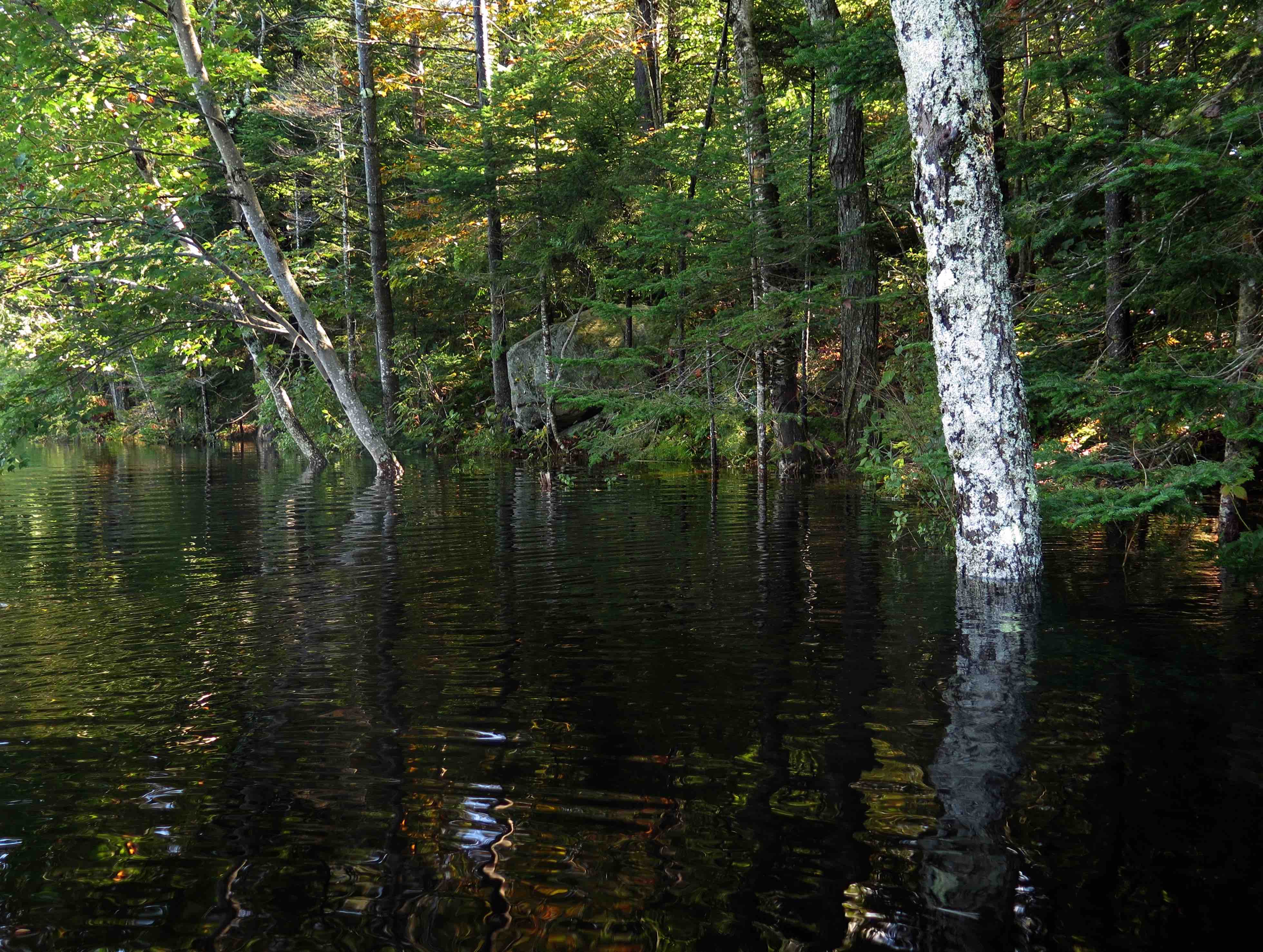
Two years ago, because of a clogged culvert and torrential rainfall, this pond was flooded far back into the surrounding woods.  Every single one of the pond-side floral treasures we'd come here to find was several feet under the water. This photo from 2021 shows all the steep banks flooded, with trees standing several feet deep in water.  By the following year, 2022, many of those trees were dead, as seemed all but one or two of the hundreds of Green Wood Orchids and thousands of Narrow-leaved Gentians that had lined these shores for years. Would we find any signs of revival this year? Oh, how I hoped we would!


Yes, the north-facing rocky banks showed sure signs of life returning.  Some yellowing Painted Trillium leaves indicated a flower had bloomed there just this past May. And the Bunchberry must have as well, since their low-growing wreaths of pleated leaves were centered now with clusters of bright-red berries.  No sign as yet of the carpets of white-flowered, five-petaled Dalibarda, but perhaps they would show by September (I  think I see a single small heart-shaped leaf). The glossy-green trifoliate leaves of Goldthread proved that life was still in them.   I could feel my anxieties ease.


That ease continued with each floral find.  Where hundreds of Green Wood Orchids were nowhere to be found a year ago, now we saw occasional stands of pod-filled stalks, indicating that some, anyway, had made a definite comeback.  


And there!  Like a royal-blue beacon, one glorious bloom of a Narrow-leaved Gentian announced to us that not all was lost. "Keep paddling," this beautiful flower seemed to say, "and you will find many more."


And so we did!  Not nearly as many as two years before, when we could not paddle five yards without seeing dozens upon dozens crowding the shore, but enough to revive our hopes 


Signs of that comeback continued, all around the pond.  There were even more Narrow-leaved Gentians along the south-facing shore, where much more sunlight had spurred their earlier growth, so that now, already, the plump blue flowers were streaked with signs of fading.


Now I could relax and attend to other plants that shared this pondside. Emerging from shallow water, several patches of Arrowhead held multi-flowered stems of snowy-white blooms amid their arrow-shaped leaves.


Even though many Mountain Holly shrubs had been partially toppled by previous flooding, their berry-laden branches hung low over the water, allowing us paddlers to gaze right into the foliage to delight in the super-saturated red of the fruits.


As we dawdled along, poking into every little niche in the rocky banks and pausing among the emergent bur-reeds to observe the hundreds of glittering-winged damselflies, the wind picked up to set the pondside vegetation to swaying. Tall grasses bowed to the breeze, as did the rosy-flowered spikes of Steeplebush.


The flaccid leaves of Narrow-leaved Bur-reed gleamed green and gold on the surface of the water, their colors changing as the rippling water moved in sinuous waves through the massed mats of floating leaves.


Sue called to us to come see what she'd found among the pondside vegetation: a clear jelly glob containing Caddisfly eggs.


I urged my friends to come get a gander at this enormous Striped Fishing Spider, which was clinging to an overhanging tree, watching for likely aquatic prey.  When I peered too close, the spider turned as if to flee, but perhaps it thought if it just froze still, I might go away and leave it be.  Which I did, after I shot this photo.


If that Fishing Spider was huge, this itty-bitty one (species unknown) clinging to a Sweet Gale pod was just the opposite. At first I thought it was doing a backbend, but then I realized it had simply pulled six of its eight legs forward around its head. Perhaps it was using all of those legs to tie complicated knots in its delicate web. Who knows?


When we reached the far end of this oblong pond we pushed into a vast forest of stiffly erect bur-reed leaves. Since the wind was actually chilly this day, it felt very soothing to be held unmoving within the shelter of this sunlit mass, warmed by the noontime rays.


I'm not sure of the species of bur-reed this is, but I bet if I took one of those burs apart and noted the shape of its nutlets I could key it out.  If I had the right guide to aquatic plants, that is. Which I didn't.


Pushing further into the bur-reed mat, I followed the sound of tumbling water to the edge of this beaver dam.  Just beyond the top of the dam, much deeper water was spilling over the edge.  I sure hope that the dam holds and persists, so as not to dump enormous floods of water into the main pond, and possibly flood the waterside plants once again.  What an impressive work, this dam!  It stretched the entire width of the pond across the eastern end.


As I  turned around to contemplate returning to our put-in, I paused to rejoice in the serene beauty of this pond, gleaming like satin below a kind blue sky.  I had come here so many times over the past few years, feeling so blessed by the incredible abundance of Narrow-leaved Gentians (Gentiana linearis), that their temporary loss had truly saddened me.  So now I felt just as elated as I'd felt saddened before.


My friends and I spent a bit more time on shore before heading off to a favorite nearby spot for lunch. For here was a sunlit, sandy-soiled patch of Common Milkweed blooms where we'd often found Monarch Butterflies and their caterpillars.  Would we find any today?


Nope, but we did find others just as amazing:  this crowed clutch of Milkweed Tussock Moth cats. I often find one or two on a milkweed plant, but such a pack of them massed all together was something to behold!


Friday, August 11, 2023

Soggy Pursuits at Bog Meadow

To tempt my friends Sue Pierce and Ruth Brooks to join me at Bog Meadow Brook Nature Trail this week, I promised them we'd probably find the gorgeous Swamp Thistle (Cirsium muticum) blooming there now. When both asked if they would need to wear rubber boots,  I assured them they wouldn't.  Oh no, I told them, there's no standing water, just kind of damp soil in the thickly forested swamp we'd be pushing through. (I always find the Swamp Thistle quite a ways off the trail.)   Well, I was wrong. We've had a tremendous amount of rain this summer.

It was a good thing my friends did wear their boots.  There was actually quite a bit of standing water in the swamp, deep enough to hide the root that tripped me and sent me sprawling, right on my backside, into black mud.


Ah well, that muddy butt was well worth it! For there they were, hidden well back in the mucky woods: quite a number of tall Swamp Thistles, most still in bud but a few displaying their gorgeous pinky-purple blooms.


Even when not in bloom, the Swamp Thistle buds are both beautiful and fascinating, with red-tipped, white-striped green involucre bracts (called "phyllaries" in botanical-speak) interlaced with hair-fine webbing that looks as if a spider has been very busy among the bracts. This webbing is a distinctive trait of this particular thistle species. But in this particular bud cluster, there may indeed have been a spider casting webs around this group of blooms: I had never seen so much webbing outside of the phyllaries!


There were other beauties hiding back here in the muck, including many tall blooming stalks of Great Blue Lobelia (Lobelia siphilitica). The gorgeous blue flowers have an interesting pollination structure, with the stamen protruding outside a slit in the upper petal. When an insect lands on the lower petal, its weight  causes the stamen to spring downward through the slit and bop the insect's back with a load of  pollen. Clever!


This swamp is one of the few places I know of where Wood Horsetail (Equisetum sylvaticum) thrives, its slender forking branches looking very lacy this time of the summer.


At least four other species of Equisetum also grow in Bog Meadow's forested wetlands: E. arvense (Field Horsetail), E. fluviatile (Water Horsetail), E. hyemale (Scouring Rush), and this wee little squiggly mass of curling stems called E. scirpoides (Dwarf Horsetail). The Dwarf Horsetail is an evergreen species, and we found lots and lots of it in this muddy area. 


The leaves of the masses of Skunk Cabbage (Symplocarpus foetidus) that earlier in the summer filled this swamp have mostly withered,  but we did find a few of the wood-hard fruits, which resemble intricately carved oval ornaments.


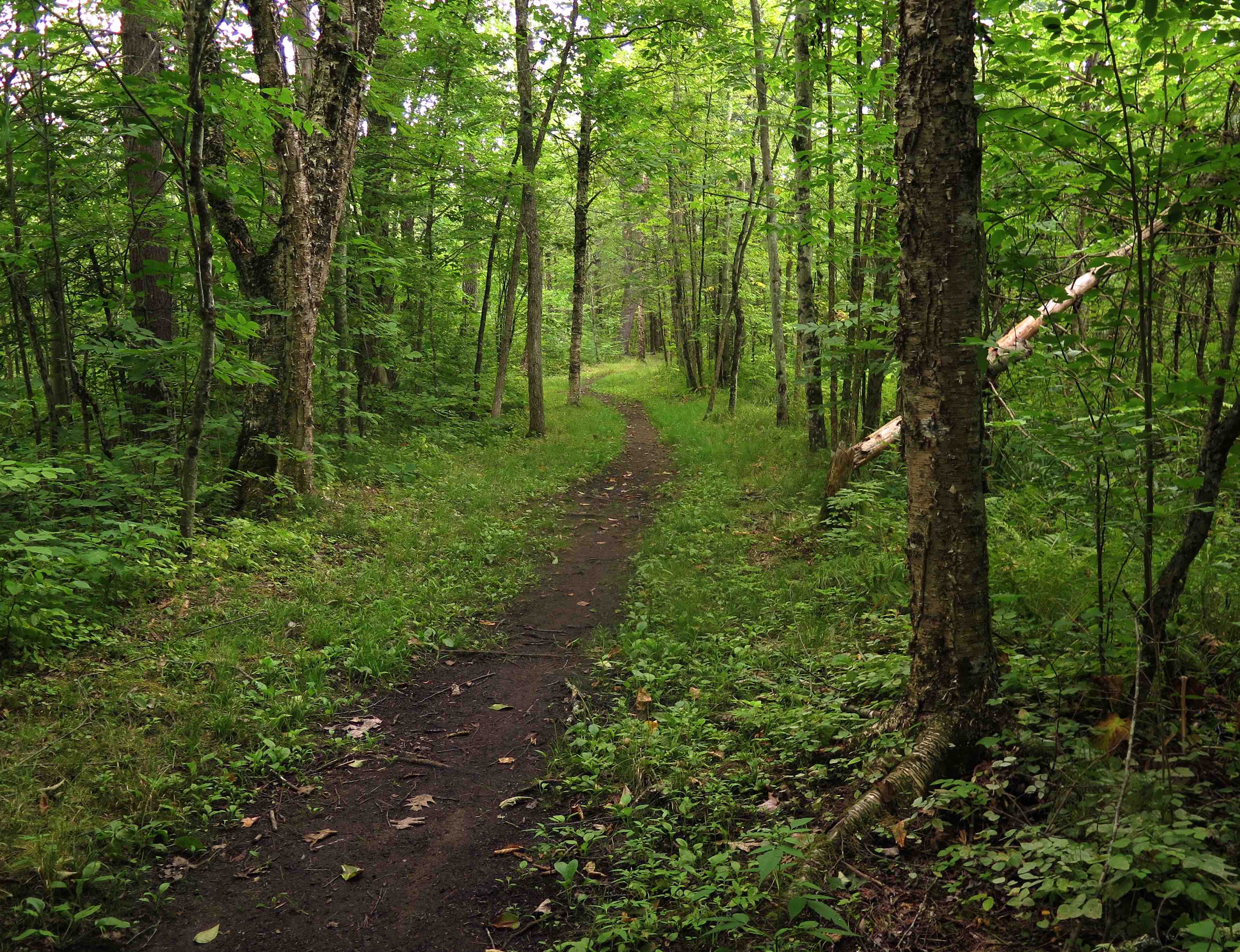
Aah!  Solid ground beneath our feet at last! We emerged from our mucky wetland onto the main trail of this beautiful preserve. The Bog Meadow Brook Nature Trail lies just on the eastern edge of Saratoga Springs and runs for about two miles through several types of wooded wetland, including open marsh and dense forest,  such as the green and shady trail pictured here.


We had barely stepped onto this main trail before we spotted a tiny floral treasure that Sue and Ruth are closely examining here.


My friends are examining Yellow Bartonia (Bartonia virginica), a native wildflower often overlooked, because it is so small.  Also, its greenish-yellow coloring and apparently leafless stems allow it to hide among other low green plants. But luckily, it didn't escape our searching eyes on this day. Usually found in sunlit sphagnum bogs and fens, it was kind of surprising to find a nice patch of it growing along this wooded trail.


This Green-headed Coneflower (Rudbeckia laciniata) would have been much easier to espy among the trailside woods if it hadn't been curving down low to the ground, possibly toppled by some of the torrential rains that have battered our region of late. But its big yellow flowers announced its presence quite clearly.  Normally a very tall plant, this native wildflower is also known as Cutleaf Coneflower, a name suggested by its deeply cut leaves.


This abundant cluster of Indian Pipe (Monotropa uniflora) was mature enough to have turned its previously downturned flowers skyward, the better to reveal its obviously floral internal structures. Sometimes this pale wildflower is mistaken for a white fungus,  and the plant does depend on fungi to  survive. Lacking any green color at all, it does not photosynthesize,  but instead obtains nutrients by parasitizing fungi that associate with plant roots. These mycorrhizal fungi help the plants take up water and nutrients that might otherwise be inaccessible to the plants.


These pale-pink flowers also appeared to have no leaves, on first observation.  But a closer examination would reveal that the flower stalk was attached underground to the group of green leaves next to it on the forest floor.  For this reason, this Pea-family plant is called Naked-flowered Tick Trefoil (Hylodesmum nudiflorum), a wildflower I find much less frequently than the similar Pointed-leaf Tick Trefoil it resembles. We found a number of these dainty-flowered plants today, more than I've ever found in one place before.


And oh yes, we did find ORCHIDS!  And surprisingly, we found these Downy Rattlesnake Plantains (Goodyera pubescens) right where I'd found them before.  Some years, there's not a sign of the flower stalks, although the beautifully patterned basal leaves might be found.  But this was our lucky year!


A second orchid we found today, this Spotted Coralroot (Corallorhiza maculata), was completely unexpected! None of us had ever seen this species of orchid at Bog Meadow Trail before.  And where I usually look for them at another location, not a single one has emerged this year.  Fickle flowers, orchids.


We also found some fascinating fungi.  At first, I thought that this velvety, dark-brown, pale-rimmed disc was a piece of bark, but when I pinched it I found it thick and spongey and actually quite wet, not crispy and thin and dry like a piece of bark.  I could actually squeeze water out of it, as if it were a soaked sponge. Then, when I looked underneath at its fertile surface, I could see it was a toothed fungus. My friend Sue consulted iNaturalist, which suggested Velvet Tooth (Hydnellum spongiosopes), and I believe it was correct.


A peek beneath revealed the "teethy" part of this fungus's vernacular name.


This cute custard-colored cluster of mushrooms has the equally cute common name of Yellow Jelly Baby (Leotia lubrica). Other vernacular names include Lizard Tuft (??) and Gumdrop Fungus.


I do not know the names of either the golden slug or the tiny gilled mushrooms ornamenting this mossy downed log. I just thought they were cute.


But I do know that this white-rimmed colorfully striped fungus goes by the name of Turkey Tail (Trametes versicolor).  Very aptly named, indeed, since "versicolor" means "various colors" and the caps are certainly colored with various different hues.  Also, this same species of fungus can fruit in a wide variety of colors, from tawny earth tones like those of this group, to dark chocolate edged with white, or royal blue alternating with schoolbus yellow, and other combinations.


Sunday, August 6, 2023

Home Again, To My Own Sun-baked Jungle

After over a week away in the lush and lovely mountainous jungles of the Caribbean island of St. Lucia, I returned to my own lush and lovely jungle in my own Saratoga Springs back yard. Well, it's looking a bit more lovely right now than it did the day I returned, now that I've mown the shin-high grass and yanked the errant Virginia Creeper and Moonseed vines from the flower beds and dogwood boughs.  The Tall Goldenrod and native Pale-leaved Sunflowers that flank the red-flowered Oswego Tea have yet to bloom, but the Ruby-throated Hummingbirds have been feasting on those red flowers, and a Catbird has returned to hide in the thickly-vined fence before visiting the birdseed or birdbath on the side yard.  What delights me the most, however, is to see how bushy and tall the Black Locusts have re-grown along the fence line and how thickly the vines have also regrown, once again shielding our summertime view of our rear neighbors' parking lots. Two years ago, this was quite a different scene.


Two years ago last spring, this (photo below) was what the same fence looked like, after our new neighbor cut down every tree in his vacant lot and sheared all the deciduous and evergreen vining growth from our fence, which he erroneously declared intruded on his newly acquired property. (This being early spring, our perennial flowers (like the goldenrods and monardas) had not yet revived for the year.) This denuding occurred without warning, as we awoke to the roar of chain saws.


But there is a good reason Black Locusts are often called "weed trees."  If you cut down one, dozens of scions spring up "like weeds" from the hewn trees' spreading roots.  Our rear neighbor's still-empty lot is once again thick with locust saplings, and after I weeded out the scions from my lawn and flower beds, I left several that had sprouted on my own property to grow in selected locations.  Two of those now tower well over 25 feet tall and are starting to cast cooling summer shade across our yard. And now those trees are OURS!

In the intervening two years, however, bright sunlight flooded our previously shaded yard, and all kinds of wild plants sprouted up to feast on that sunlight.  Some flower seeds doubtless arrived in the birdseed we spread on our patio (or the poop of the birds themselves), and others might have been there all along, just waiting for the light to return.  It sure has been interesting to observe what uninvited but not unwelcome strangers now make themselves at home at our home.  Here's a list of some of them, in alphabetical order:

Acalypha rhomboidea 


Acalypha rhomboidea, also known as Three-seeded Mercury, is an attractive low-growing native plant, even when pin-dotted with holes from the critters that feed on it. But that's exactly what native plants are here for,  and these wildflowers remain short enough and grow densely enough to serve as a native-plant mulch, depriving non-native, perhaps invasive species from gaining a foothold in the same patch of dirt.

To explain the odd vernacular name of this plant, a close look at the flowering stem reveals both the calyces that resemble the wings on the heels of the Roman god Mercury, and the three-parted pod containing the seeds.


Amaranth (species unknown)


I imagine the many Amaranth plants that sprout from the cracks in our bird-feeding paved area arrived there with the birdseed we spread.  We leave the plants to mature and remain all winter, for the birds and other wild critters to harvest the seeds.  One year we had a young groundhog come daily to do just that.


Black Nightshade (Solanum emulans)

The evil-sounding vernacular name of this ubiquitous tiny-tomato plant probably convinces some folks that its fruits must be poisonous.  But some folks who long ago newly arrived in The New World from Europe believed that tomatoes were also poisonous.  While it is true that the green fruit shown in this photo contain the same toxin present in green tomatoes, when the fruits of this native plant are allowed to thoroughly ripen to a glossy pure black, they are even sweeter and more concentrated in tomato flavor than its big red cousins sold in every food market.  And I can attest that sampling them has neither sickened nor killed me.


Buffalo Bur (Solanum rostratum)


Buffalo Bur was a new one in my yard this year. And a new one to me, as well. I sure could not find it in any of my wildflower guides that feature both native and non-native flowering plants of northeastern North America. That's because it is native to America's southwest, where I suppose it earned its vernacular name by being a pest where buffalos roam.  Poor buffalos!  Those spiky thorns are sharp! But thanks to some sharp friends on Facebook, I now know that this plant, a member of the Nightshade Family, has made its way across the continent to every state in the U.S. except Florida. And also to my back yard.


Garlic Chives (Allium tuberosum)


I may have long ago purchased a  tiny pot of Garlic Chives to grow in my herb garden, but these onion-family plants that are native to China did not survive the encroaching shade cast by growing Black Locusts.  Part of them must have survived, though, since ever since strong sunlight has heated the bricks near their original site, they have sprung up in nearly every crack.  Welcome back, dear tasty non-native!  Not only are they delicious snipped into potato salad or atop scrambled eggs, but they also produce slender gracefully curving stalks topped by clusters of pretty white flowers, currently in bud.


Giant Ragweed (Ambrosia trifida)


Whoa!  How big is this Giant Ragweed plant gonna grow? In the one hot rainy week I was gone, it climbed from the top of my side-porch railing to the middle of my kitchen windows.  And I bet it's not done yet.  I have seen this native flowering plant grow about 15 feet tall with stalks as thick as broomsticks. There's no sign yet that it's ready to flower, so I think it still has some height it means to achieve, the better to waft its allergenic pollen on the wind.   Lucky for me and my husband, neither of us suffers from Hay Fever.  I hope that's true for my nearby neighbors, since I do not have any plans to remove this fascinating freak of nature before it fully matures.


Horseweed (Erigeron canadensis)


When this row of green leafy plants started to grow between my slate walk and the paved area where we spread bird seed, I thought the short young plants looked quite attractive. So I left them to grow taller.  And taller. And taller! And finally they sprouted their tiny aster-like flowers the bees and wasps are now avidly feeding on, so now I know they are our native Horseweed. Okay, not so attractive, perhaps, although they do supply a lacy curtain between our house and the often untidy bird-feeding pavement. And boy, do those bees and wasps love them! So there they stay.  Which means we'll have lots more of them next year, prolific seeders that they are.


Lady's Thumb (Persicaria maculosa)


I have become aware, because of Facebook sites that focus on native plant gardens (not native habitats), that this small pretty non-native wildflower is frequently despised. But what's all the vitriol about? Lady's Thumb is such an adaptable smartweed, occurring in both wetland and dry habitats, and it amply spreads to generously and completely cover ugly patches of dry or damp dirt, so no other non-native, much uglier weed can horn in.  I think it is truly pretty, with slender spikes of deep-pink buds and pale-pink mini-blooms held high above dark-smudged green leaves, and lots of small flying insects feed on it, including the adorable Bee Fly. And if I want to plant something else where it's growing now, it's easy to pull it out.  But I'm not a gardener. I love plants that just move in and beautify the place without me having to lift a finger to take care of it. Also, it tolerates the sun as well as the shade. So the Black Locusts may come or go, but the Lady's Thumb abides!


Lance-leaved Sage (Salvia reflexa)


One of the alternative vernacular names for Lance-leaved Sage is Prairie Sage, which hints at this plant's native origins: right smack dab in the middle of the United States (the Central Plains).  But current distribution maps on BONAP (Biota Of North America Project) indicate this small-flowered Mint-family plant has also extended its range to both coasts and north into Canada.  But not into southeastern nor New England states, although its range does now include New York State. And my back yard.  It showed up last year and is flourishing here better than ever this year.  Sadly, it smells neither minty nor sagey, so it's not a culinary herb I could use, but I do welcome it for its pretty blue flowers and its modest habit of growth. So far it has not taken over the place, the way some other mints are known to do.  The New York Flora Atlas claims it does not persist where it suddenly volunteers.  So I shall see.  At least it came back this year.  If our ever-growing-taller Black Locusts once again shade the sunny spot where it's currently growing, it might indeed not persist. If it peters out in the shade, I'll kind of miss its dainty blue flowers.


Purple Morning Glory (Ipomoea purpurea)


About 45 years ago, before Black Locusts grew tall enough to shade the south-facing side of my house (and before I turned over most of my gardening duties to Mother Nature),  I planted some Heavenly Blue Morning Glories. A single seed from this Purple Morning Glory must have come in the seed packet, for there among the Heavenly Blue flowers appeared a deep-purple one with a hot-pink star in the center.  The blue flowers never came back on their own each year, while the purple ones did, and robustly so.  Until the shade grew oppressive to them, oh, maybe 35 years ago.  Not a one had I seen until my backyard neighbor stole all our shade, and that very same summer, look who poked up to eat up all that sunshine once more. Yeah, yeah, I know it's not native.  But oh boy, it sure is beautiful!  And abundant. And now its the third year it came up again on its own and started blooming like crazy this week.  Just the kind of garden flower this non-gardener loves!


Sunflower (Helianthus species)


What species of sunflower produces the seeds that come in bags of mixed birdseed?  Whichever species that may be, the seeds have always sprouted here and there around my backyard, and now with much increased sunlight, they sometimes grow very tall and give me more birdseed when they mature.

As I mentioned, the seeds sprout here and there.  Not always where they will thrive. Sometimes even where this homeowner will rudely yank them out.


White Avens (Geum canadense)

Who would believe that this scrappy looking, tiny-flowered, bur-seeded plant was a ROSE? Well, it is! It's in the Rose Family, anyway.  And who would ever dream you could make a pretty good hot-chocolate drink from its roasted roots? Well, you can, and I will attach a video I found on You Tube that shows you how to do it. Sunny or shady, this modest-appearing native wildflower has popped up in my backyard for years, but I only paid attention this week because I wanted to include it here and I didn't know much about it.  There's probably lots more to learn about it, but the hot-chocolate thing really blew my mind, and I can't think about anything else right now. Who could have guessed such a thing?  I knew that coffee grew in that Caribbean island I visited last week, but I sure never knew that a chocolate-tasting root grew abundantly right in my own back yard.