Thursday, May 18, 2023

Bog Meadow in Beautiful Bloom. Already.

Most years, my friends in our Thursday Naturalist group like to walk the Bog Meadow Brook Nature Trail to visit some special flowers that flourish there. Since I volunteered to lead our visit this year, I checked out my many past blog posts that feature this trail, to determine what would be a good date for this year's walk.  It appeared that late May would be best. So May 25 is the date we will visit Bog Meadow.  But I went there last week, just to see if I could find our targeted flowers in bud. Well, I found the flowers all right. But they were already blooming, not just in bud.

We'll begin our walk from the Rte. 29 trailhead, on the eastern edge of the city of Saratoga Springs.  The trail from here runs eastward through wooded wetland, with open water to the north and forested swamp stretching south as far as the eye can see. Diligent and dedicated trail stewards do their darnedest to keep this trail dry enough to walk on without high boots, since the beavers who occupy the trailside water often do their darnedest to flood it.  So far, so good this spring. Just a few shallow puddles cross the trail for now.


I was delighted to find many sprouting Canada Lily plants (Lilium canadense) in the trailside grass.  And hopeful, too, that these  baby plants might live long enough to produce their whorls of gorgeous flowers by early July.  In past years, Scarlet Lily Beetle larvae ate most maturing plants down to the ground, but today I found not a single beetle among them. Perhaps a predator wasp has found the devourers of this lily population.  Here's hoping!


What a surprise, to still find many spore-bearing stalks of Field Horsetail (Equisetum arvense), along with the spiky green sterile plants that will persist throughout the growing season. I had thought these tan-colored spore stalks would have withered away by now, since it's been nearly a month since I found the first evidence of them. This species of horsetail is quite rampant all along the trail, but despite its abundance, it never seems to overwhelm the other native plants that make their home here.


The swampy verge along this stretch of trail holds many hummocks of Tussock Sedge (Carex stricta), each one an exploding mass of cinnamon-brown bloom at present.


Patches of bright-white tiny blooms of Grove Sandwort (Moehringia lateriflora) spangle the trailside grass. This is not a rare species in our state, but I rarely find it anywhere but here.


I found only a few occasional blooms of Wild Geranium (Geranium maculatum) open yet, but I know these showy purple flowers will be far more abundant by the time my Thursday friends walk here.


And here are the flowers I had hoped to present as the stars of our visit on May25, the beautiful but often overlooked Nodding Trillium (Trillium cernuum).  Not only do the flowers hide beneath the trio of their own wide green leaves, but the plants themselves often hide very well beneath the trailside shrubs and overarching Skunk Cabbage leaves. I had hoped that these unusual trilliums would be the feature attraction of our Thursday Naturalist walk, so I hope at least a few nice blooms might persist until then.


I gently pushed a plant back to reveal the lovely, snow-white Nodding Trillium flowers. This species can be distinguished from the whitish form of Red Trillium (T. erectum) by a number of traits: the sharply reflexed petals and nodding habit of the flowers, as well as the white ovary and the longish filaments of the darker-colored anthers.  Red Trillium's ovary is always red, and its anthers are sessile to it. Also, Nodding Trillium's petals are a pure white, not the yellowish or ivory tint of the white-form Red Trillium's flowers. But sometimes the two species hybridize, and then the color variations can get really confusing! Check out my blog post from 2019 to see some of them!


Here's another lovely flowering plant I hope will still be bearing blooms in a week or so.  Again, these are flowers that often stay hidden beneath the plant's overarching leaves.  This is Rose Twisted-Stalk (Streptopus lanceolatus), a species much more common in the Adirondacks to the north.  I know of only two plants that grow along the entire two-mile length of Bog Meadow Brook Nature Trail.


Since some of us in our Thursday group might find it difficult to get down on their knees and up again, I painfully did it for them, in order to photograph the lovely pink flowers that dangle on twisted or bent pedicels.


I got even lower to photograph the inside of a dainty rose-spotted floret. And it looks as if a dainty white creature (spider or insect?) was sheltering within it!


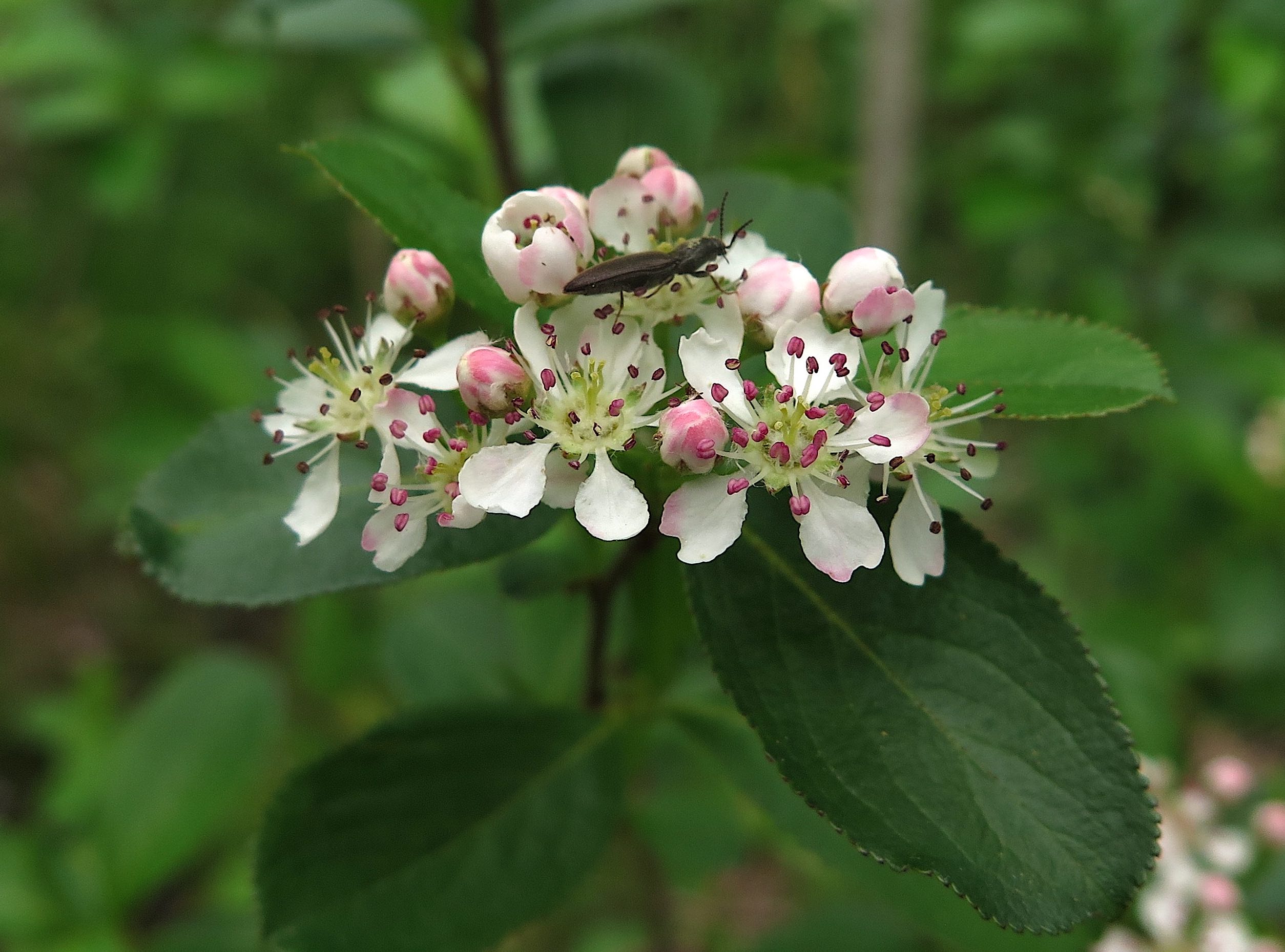
These pretty pink-tinged flowers were growing on shrubs along this section of the trail. I am almost certain that they are chokeberry blooms (Aronia sp.), and because of their woolly flower stalks and the  longish shape of their non-glandular calyx lobes, I am guessing they are the flowers of Purple Chokeberry (A. prunifolia). 


The next section of Bog Meadow Trail follows the shore of a marsh, where the birders in our group might hope to see waterfowl swimming on the open water. And I will point out that here is our opportunity to closely observe a Poison Sumac tree (Toxicodendron vernix, pictured here) without wading knee-deep in a swamp or coming into contact with the tree's rash-producing toxins.


The leaves and flower clusters of Poison Sumac were just emerging on my visit.  The loosely-spaced flower clusters will lengthen by the time they bloom with greenish-white petals. Late into the fall, the dangling clusters of whitish berries provide valuable food for birds.


In places along the open marsh, the grassy verge is virtually carpeted with the dainty blue flowers of Dog Violet (Viola labradorica), a small, stemmed violet with a pale center.


Here's another very generous spreader, the beautiful Starry False Solomon's Seal (Maianthemum stellatum), sporting clusters of star-shaped white flowers atop gracefully arching green-leaved stalks. It was more than a dozen years ago I first encountered these plants, maybe ten of them, clustered about the foot of a large White Pine.  Today, I stopped counting them after a hundred, spread some distance along the trail from where I first found them.


Finally, I enter a deeply shaded section of the trail, a little over a half-mile from where I started. I hope our Naturalist friends will be willing to proceed about a quarter mile further through this woodsy and watery habitat before we turn around. A mile-and-a-half is a long way for us botanizers to explore, inching along at the super-slow pace we usually accomplish in wildflower-rich settings like this.  Flower-heavy limbs of Highbush Blueberry (Vaccinium corymbosum) reach onto the trail in this section, and I wonder why here but not along other parts of the trail.


There were several bees feeding on these blueberry flowers, some of them chewing straight to the nectar source by cutting into the flowers.  At least this big bee with the shiny abdomen (a Carpenter Bee?) appeared to be entering the flower by its usual entrance.


Like the stars in the sky, the seven-pointed, bright-white blooms of Starflower (Lysimachia borealis) appear at their most stunning in the dark, in this case the deeply shaded, needle-strewn forest floor under pines.


Near a partial clearing where the sun's rays made it through the dense tree canopy, I found a sprawling shrub of Round-leaved Gooseberry (Ribes rotundifolium) dangling numerous flowers with stamens that protruded well beyond the sepals.


When I reached a section of the trail where shaded trailside pools were broad enough to reflect the sky's light, I began to search for Bog Buckbean (Menyanthes trifoliata).  In some years, I'm lucky to find only a few specimens protruding from the shallow water. But this year, Bog Buckbean's white flower clusters that crown three-leaved green plants were massed so closely together and in such numbers, I could hardly detect the water beneath them.


Such beautiful and interesting flowers, like five-pointed stars, each petal sprouting squiggly, wiry growths unlike anything I have seen in any other flower.


There was one more flower I hope to find before the turn-around point, and luckily this Perfoliate Bellwort (Uvularia perfoliata) was just coming into bloom.  I saw many emerging plants, but only a couple that were dangling the long-pointed yellow flowers with stems that appeared to be piercing the leaves. By May 25, the whole patch should be dangling these flowers, and that will make them easy to find.


At first glance, the Perfoliate Bellwort looks very much like the related Large-flowered Bellwort. But side from the difference in size between the two species, the certain most distinguishing feature of Perfoliate Bellwort is the presence of tiny glandular bumps on the interior surface of the petals. They are often of a deeper yellow or orange than the petal.


After turning around, I began to hurry my steps as a few raindrops tickled my face.  But I'm glad that was it, for a rainstorm, since I quickly drew to a halt when I spotted this pink-budded, white-blossomed small tree some ways back in the trailside woods. I grew up playing in my grandpa's apple orchard.  Sure looked like an apple tree.


Well, the multiple pistils were a sure indication of a multi-seeded fruit.  So probably an apple.  Maybe a crabapple.  Perhaps a bird pooped a crabapple seed. Or a hiker tossed an apple core.   Not a native woodland tree, but it sure was a pretty one.


Two gorgeous native woody plants do grow in this stretch of the trail, but I did not find them on this walk.  It's likely neither was blooming on this day, but here's hoping they will be on May 25.  I'd love to show my friends the confetti-colored flowers of a Glaucous Honeysuckle (Lonicera dioica), one of several honeysuckle vines that are native to this region. And it grows along Bog Meadow Brook Nature Trail. And it's a real beauty!


Even more, I'd love to have my friends see -- and smell -- this gorgeous Early Azalea (Rhododendron prinophyllum) that grows in the Bog Meadow woods. Quite a ways back in the woods, so I'd need to spy its vivid pink flowers in order to find it.  Usually, if the air is warm and humid, I can detect its nearby presence by the exquisite fragrance that wafts on the air.


I am going to share this post with the Thursday Naturalists, so they will know what to look for when we walk together next Thursday.  Yes, some flowers may be past bloom by then, but other beauties will take their place.  No walk with these friends or along this trail is ever not wonderful.

Tuesday, May 16, 2023

Violets of Hope

Mother Nature offered me some solace this week. I haven't posted a blog of late because I've been distracted, feeling anxious and sad for my darling daughter Jane Donnelly Balter, who was recently diagnosed with a life-threatening illness. She is now set on a course that should bring her healing in time, but only after she must bear months of onerous side effects from the treatments. So my heart has been heavy, even when feeling hopeful. But I felt a surge of happiness yesterday when I found two very rare violets, just where I hoped I would find them.  And these are violets that must endure the ravages of both sub-zero winters and raging spring floods, just as my daughter must now bear the ravages of chemotherapy.  And still these violets survive to bloom again! I am one of the few very lucky folks who know where they grow, so I'm happy to share their beauty here, for folks who will probably never see them. 

This purple violet is the New England Violet (Viola novae-angliae), an Endangered species known from only one location in all of New York State, and (despite the name) absent from all New England states except for rare sightings in Maine. 


The New England Violet might be overlooked as simply one of our more common purple violets, unless it was observed more closely. The long tapering leaves are an important distinction, as are the fine hairs that sprout, not just from the throat, but also from the face of the petals. There are other distinctions, too, but they are not so easily photographed.

This white violet is the Primrose-leaved Violet (Viola primulifolia), a Threatened species in New York.

The Primrose-leaved Violet is not only a Threatened species in New York State,  it was an especially unexpected find in Warren County, many counties away from other known populations in the state. Its beardless white flowers resemble the flowers of other, less-rare spring-blooming white violets, but the distinctive shape of its leaves is among the features that set it apart. The egg-shaped leaves are all basal, the blade twice as long as wide, tapering to a dull point at the tip, nearly straight at the base, the upper stalk narrowly winged. Leaf edges are typically scalloped but may be nearly toothless. Leaves and stems are generally hairless except for a few sparse, compressed hairs along the lower leaf veins and sometimes on the flower stem.


Friday, May 5, 2023

Cherry Puzzler

While traipsing about various habitats (sandy or rocky, open or shady) along Spier Falls Road this week, I found three species of small wild cherry trees in bloom.  Two were native: Prunus susquehanae (Appalachian Cherry) and Prunus pensylvanica (Fire Cherry).  One, Prunus tomentosa (Nanking Cherry), was not, but it was definitely growing wild, far from anyone's garden. The flowers all look pretty much alike, with five white petals and a single stamen surrounded by multiple pistils.  Read on, to learn how I managed to distinguish each species.

Appalachian Cherry (Prunus susquehanae)


Appalachian Cherry was the easiest to ID, since it was the only cherry that grew no higher than maybe 18 inches from the ground, in a thicket of many plants, rather than as a single small tree. Although there's not much about Appalachian Cherry flowers to distinguish them from other species of cherry blossoms, the leaves are unique to this rather uncommon species. Unlike those of other cherries, they narrow toward the base, and they are not toothed below the middle (see the photo below, which better illustrates this trait). This cherry was growing in a sandy-soiled powerline clearcut, with full exposure to the sun. Very fragrant! And also noisy, buzzing with bees! 


Fire Cherry (Prunus pensylvanica)


Prunus pensylvanica is the most common of the small cherry trees around here, since I see it blooming now along many roadsides, as was this one. It was partly shaded by surrounding woods, though. It's a small tree, maybe 8-10 feet tall, with the flower clusters marching in a row along the twigs, each twig sporting a terminal cluster of tapering serrated leaves. Its most distinguishing feature is the reddish color of the flowering branches, a feature that's obvious in the above photo. This cherry has multiple vernacular names: Fire, Bird, or Pin. I call it Fire Cherry to remind me of those red twigs. And also because it is known to populate burned-over sites quite quickly. 


Nanking Cherry (Prunus tomentosa)


I needed help from some pro botanists to decipher the name of this small tree, the Nanking Cherry (Prunus tomentosa). I sure could not find it in my guides to North American trees, because it's an introduced ornamental species that somehow made it from manicured gardens to thrive on some rugged mountainous cliffs and quarries along the Hudson River. Unlike the other cherries in question here, the flowers are sessile to the twigs, not borne on long slender pedicels. And boy, are those twigs fuzzy! As are the leaves. This trait is called "tomentose" in botanical jargon, so hence the scientific name. I found 10 of these cherry trees scattered around an old quarry that was mined way back in the 19th Century. I wonder how they got there. Perhaps they are remnants from ornamental gardens that surrounded the hotels and cabins built back then to house the workers who quarried the mountainside for rock to build the nearby Spier Falls Dam on the Hudson River. Yes, not native, but I was glad to find them. So pretty! And a fun botanical puzzle.


Wednesday, May 3, 2023

Floral Displays Along Spier Falls Road

Rain, rain, rain! It stops for a minute, just long enough for me to get my waterproof boots on, and then it starts again.  Actually, I don't mind walking in the rain for a bit, but my camera doesn't like getting wet. So what can I do to feed my nature addiction?  Aha!  I'll go for a drive. Maybe park somewhere where I can dash back to my car if a downpour approaches.  And I'll bet it's time to check out the roadside rock gardens along Spier Falls Road.  So off I went.

Sure enough, as I approached the first rocky ledges that steeply rise from the edge of Spier Falls Road as the road follows the Hudson River, I could see masses of small white flowers crowding the tops of the jagged rocks.


Oh yes, masses and masses of a single species called Early Saxifrage (Micranthes virginiensis) covered the ledges so thickly, I doubted any other other flower could gain a foothold.


A closer look at these drifts of white flowers revealed a definite wildflower monoculture.


While there may not be any other herbaceous wildflower that intrudes on these masses of saxifrage, there sure are other plants of another kind that add their beauty to these dark spring-watered rocks.  I did not see a single plant of Early Saxifrage that was not growing out of a clump of moss. I believe the  mosses act like sponges to hold the spring water dripping down the rocks, and this would keep the roots of the saxifrage from drying out on this otherwise bare exposed rock.


And what a marvelous mix of mosses thrive on these constantly watered rocks! I know the names of very few mosses, but I have been told that the aptly named Fountain Moss (Philonotis fontana) thrives here.  And perhaps the starry-leaved moss is a species of Haircap (Polytrichum sp.), but I'm not sure. Some brown-colored fern-like mosses (Thuidium?) are poking up through both of the other mosses.


I do know the name of this fluffy-leaved moss with the perfectly spherical spore capsules.  It's called Apple Moss (Bartramia pomiformis). I bet those apple-shaped spore capsules played a role in creating its name!


Oh wait!  I did find one other flower besides Early Saxifrage on these rocks, but this one is a shrub, not a herbaceous plant.  It's called Round-leaved Gooseberry (Ribes rotundifolium), and its flowers can be distinguished from other species of gooseberry flowers by the stamens extending far below the sepals.


I continued on down the road a ways, stopping to observe a waterfall tumble down the mountainside, flush from all the recent rain. 


The sun emerged briefly from behind the clouds, causing the waterfall's droplets to sparkle and also to illuminate a lovely patch of Early Saxifrage thriving atop a creekside boulder.


It was time to head home, but as I passed a parking area at the Spring Trailhead leading up to the Palmertown Mountains, I noticed a shrub off in the woods that was layered with huge clusters of snowy-white flowers. So I parked to investigate these blooms and found a Hobblebush (Viburnum lantanoides) heavy with bloom.  As these big white encircling sterile flowers worked to catch my eye, that's also what they're intended to do to pollinators, drawing them in to feed on the much smaller, less showy fertile florets clustered in the middle. Only a few of the fertile flowers had opened as yet.


Glancing around, I noticed another flowering tree, a small one abloom with white flowers. Drawing close, I noticed clusters of blooms with rounded petals, each flower containing a single stamen surrounded by many pistils.  That single stamen signaled a stone fruit, probably a cherry of some kind (since I noticed a tiny red gland at the base of a leaf). But which cherry?  Checking my Newcomb's Wildflower Guide (one of the few wildflower guides that include flowering trees), I read that Prunus pensylvanica has white flowers in small umbels that grow along reddish twigs, with clusters of leaves growing at the ends of flowering branches.  Seemed like a match! But which vernacular name should I use: Bird, Fire, or Pin Cherry? I think I'll go with Fire Cherry, to remind me of those red twigs. Also, this species of cherry is known to quickly colonize burned-over areas. Newcomb didn't mention this cherry was fragrant, but it certainly was!


Nearby was yet another flowering woody shrub, and I didn't need my Newcomb's to look it up, I've seen it so often.  These creamy-white twin flower clusters and compound leaves virtually shout RED-BERRIED ELDER (Sambucus racemosa) at me.


Across the trail from that elderberry shrub is a patch of Foamflower (Tiarella stolonifera) I visit every spring, such a lovely, crowding-together bunch of flowers it is, the flowers most elegantly silhouetted against the deep shade of the background forest. It was lovely even now, although still in bud.


And just up the trail, crowded masses of tiny Azure Bluets (Houstonia caerulea) were raising their lovely faces to the sky, almost as if they were mirroring the sky's blue radiance in the grass.  Even if, as was true today, the sky was very gray!


Walking back to my car, I decided to cross the road to a wooded area along the Hudson, remembering that Painted Trilliums (Trillium undulatum) sometimes bloomed there. I was doubtful, thinking it way too early to look for this species of trillium.  But this was my lucky day!


Monday, May 1, 2023

Bog Meadow, Brief Notes

I rely on this blog as a personal record of my nature observations over the years, in particular the plants I have found, and where and when I had found them.  So over the past 14+ years I have tried to make this record as complete as I could make it. But this year, due to unseasonable heat early in the blooming season, so many wildflowers are blooming all at once and then fading fast, I just can't keep up with blogging about them. For example, when I walked with my friends at Bog Meadow Brook Nature Trail last Thursday (April 27), I downloaded over 60 photos from my camera.   And on most days since then, my daily outings resulted in similar photo loads.  Time to clear the decks! So this post will be just a digest, only the highlights of the remarkable sightings my friends and I found on this walk through one of the most delightful trails in Saratoga County.

As this photo shows, we had just entered the Bog Meadow Brook Nature Trail from the Meadowbrook Estates spur trail, and just a few feet in, we'd already found many interesting reasons to halt our progress to observe trailside sightings more closely.


And somebody else, from this hollow in a tree, was observing US intruding on his/her domain!


I had suggested this entry point because this spur trail takes us directly into the middle part of Bog Meadow's two-mile long main trail, the part where "most of the good stuff grows," especially at this time of year. For here, the trail promptly descends from an upland mixed forest into a low wooded swamp, habitat for some of our region's most ancient and interesting plants -- the horsetails (Equisetum species). Five different species of horsetails can be found at Bog Meadow, but I particularly wanted to catch two particular species -- Field Horsetail (E. arvense) and Wood Horsetail (E. sylvaticum) -- in their reproductive, spore-producing stage.  And both of those species are easily observed from a boardwalk that crosses this wooded wetland.

The previous night's rain had adorned with crystalline drops this green persistent stalk of Field Horsetail, its whorls of branches just emerging from stiff jointed stalks.  As the growing season progresses, those branches will elongate and continue to photosynthesize until frost spells the end of this year's cycle.


Growing nearby were the fertile stalks of Field Horsetail, each tan-colored segmented stalk topped with a cone-like, spore-bearing structure called a strobilus.  Once the spores have been released, these once-fertile stalks will wither completely away.


Equally abundant in this wooded swamp were the green branching stalks of Wood Horsetail (E. sylvaticum).  Two easily observable features distinguish the Wood Horsetail from the Field Horsetail: the compound branching of each lateral branch, and the presence of spore-producing strobili borne atop occasional specimens of the population.  Once the spores have been shed, these strobili will wither and drop off the host plants, while the host plant will persist, growing larger as the season progresses. (A third distinguishing feature, the reddish color of the teeth that ring each segment of the stalks, is less easily observed from the height of the boardwalk.)


Here are the two species of horsetail, side-by-side, Wood Horsetail on the left, Field Horsetail on the right. In both species, the whorls of branches will lengthen as the growing season progresses.


The constantly damp soil of this low swampy spot supports a number of deciduous ferns that are just now revealing their presence with uncoiling fiddleheads. Many ferns are difficult to identify at this early stage, but this one, with its stalks covered with brown flakes,  suggests to me that it is most likely Northern  Lady Fern (Athyrium angustum), a native fern known to be abundant in damp, shady woodland environments. Some years ago, I came up with a mnemonic phrase to remind me of this fern's ID at this stage: "This lady does not shave her legs."


There's very little about this next fern's early fiddlehead to suggest what its mature appearance will be.  Now quite tiny, cherry-red, and covered with fine pale hairs, it will later grow to be nearly two feet tall with shiny, hairless black stems and a frond that divides into two tapering blades that together curve around to form a near-perfect circle, each blade adorned with delicate fan-shaped leaflets.  This fern's delicate appearance when mature is probably what suggested its name of Maidenhair Fern (Adiantum pedatum).


Another clue is that I found the tiny red fiddleheads sprouting up from where I knew an extensive patch of Maidenhair Fern will appear in the weeks to come.  And I also found one of those fiddleheads already branching and dangling tiny fan-shaped leaflets.


Just before this swamp-crossing spur joins the main Bog Meadow trail, we have to cross a small brook.  There, on the mossy bank of this brook, a spectacular clump of Miterwort (Mitella diphylla) raised numerous spikes of dainty, white, snowflake-shaped florets.


I was delighted to find the beautiful white flowers of Rue Anemone (Thalictrum thalictroides), a native wildflower species I had not encountered along Bog Meadow Brook Nature Trail before.


When we first passed this abundant patch of Wood Anemone (Anemone quinquefolia), the flowers were closed-up in response to the morning's damp and chill.  But later, after the sun broke through clouds and temperatures rose, every flower had opened wide. How beautiful, the bright-white flowers so scattered across the massed green leaves, like constellations of stars in the sky!


I always hope to find Hairy Woodrush (Luzula acuminata) in bloom along this trail, since this is the only place I've regularly encountered it.  When in bloom, its flower cluster looks like a wreath of tiny yellow lilies crowning grass-like leaves that are noticeably hairy at the nodes and edges.  This photo is actually from my files, taken on a year when it bloomed on its normal schedule. The plants I found this year had already gone to seed and weren't nearly as attractive in appearance. I just wanted to show them at their flower-like prettiest.


And here was a second species of woodrush, called Heath Woodrush (Luzula multiflora), and I'm not sure why the sight of it out of the corner of my eye had me screeching to a halt.  It was not nearly as floral in appearance as is L. acuminata, its flowers more reminiscent of sedge spikelets than blooming lilies.  But something about it signaled WOODRUSH to me from afar, and a closer look revealed the fine hairs on the leaves and stems that I've read are typical of Luzula species.   And then there was this: I had never seen this plant before!  A new entry for my life list! And a native plant, at that (although it has a circumpolar distribution).  Hardly a rare plant, having been reported from almost every county in both New York and New England. But it was a new one for me.


After more than 30 years of diligently recording every flowering plant I encounter, as well as when and where I encountered it, it's quite rare now that I find a plant I haven't seen before.  So even though I have not mentioned many of the other plants I noticed during this day's Bog Meadow walk, I am happy to post this finding of Luzula multiflora along this trail today.  Just for the record!