Sunday, March 12, 2023

Spring Awakens Along Spring Run Trail

The sky was blue.  The snow was melting.  I had an hour in an otherwise busy day, and lucky for me, a really nice paved and plowed trail lay right across the street from where my errands had taken me on Saturday:  the Spring Run Trail in the heart of Saratoga Springs.  I could take a quick and pleasant walk, and I didn't even have to change my footwear.


Official Spring may still be more than a week away, but the dogwood shrubs were already dolled up in celebratory color.  I could see from the pin dots decorating the scarlet bark of this tangled mass of shrubbery that this was Red Osier Dogwood (Cornus sericea).


And here was an equally red (but solitary) branch of Silky Dogwood (Cornus amomum) leaning over the stream. If you could see the bark up close, you would notice the lengthwise lenticels instead of pin dots.


The Box Elder bark was also flaunting spring color, at least on its newer twigs.  And this color is the palest blue, literally a "powder blue," since the powdery bloom on the twigs can easily be rubbed off to reveal redder twigs beneath.  Note the opposite buds, a feature of all maple trees and very few other tree species.  Yes, Box Elder (Acer negundo) is indeed a maple, although its compound leaves look more like those of ash trees.


And right on cue, another full-size tree with opposite branching, a White Ash (Fraxinus americana), was standing nearby.  I noticed first the fat red buds that were studding some of the low-hanging branches.


And then my gaze took in the tall straight White Ash trunk with bark that looks like wide-wale corduroy.


Every spring I notice this smooth-barked young tree with distinctive heart-shaped bud scars and big terminal buds.  I think it may be a Pignut Hickory (Carya glabra), but I always forget to come back later when the tree is in leaf or fruit, to have my guess either confirmed or not.  Informed suggestions are always welcome!


Ambling along, I soon approached a trailside ditch filled with mud and standing water.  Poking up out of that mud were more sure signs that Spring was fast approaching: many swelling spathes of our first flower of Spring, the Eastern Skunk Cabbage (Simplocarpus foetidus).  Most were a mottled red color, but this big fat one was yellow.


I confess in my eagerness to discover the state of the spadix within, I inadvertently fractured this redder spathe of another Skunk Cabbage plant.  Well, at least now I could plainly see that the plant was fully in bloom!


And oh my gosh, LOOK!  The first flower of Spring that actually looks like a flower!   One solitary sun-yellow bloom of Coltsfoot (Tussilago farfara) had pushed up through the still-cold leaf-littered mud in a sun-warmed swale by the creek.  In a day or two (if not covered by the deep snow predicted this coming week), this brave little bloom will be surrounded by a whole carpet of its fellows.  Ta da!


As I approached the trailside stone walls my friends and I had studied quite carefully for mosses, lichens, and liverworts about a week ago, I wondered if anything had changed since our last examination.  So I moved in for a closer look.


Well, the leaves of this Fissidens sp. looked a bit more frayed from frost, but some cute little red spore stalks appeared to have popped up since I last looked closely at this patch.  Or did I just miss seeing them before?  What time of year does Pocket Moss usually send up its fruiting bodies?


This nice clump of Plagiomnion moss looked about the same, its tri-colored spore stalks still as sprightly and vivid as they'd seemed a week ago.


Oh gosh, last week I must have missed this clump of lime-green long-leaved moss, nestled up against some darker-green Fissidens.  Maybe it hadn't yet sent up its wispy spore stalks the last time I searched these rocks.  I have no idea what its name may be.


I don't know the name of this posy-shaped moss, either. It must have been really pretty before the winter gnawed its "petal-like" leaves back.  The dark mid-vein looks rather distinctive, so maybe a friend will recognize it and tell us what its name is.


Most fungi-covered fallen logs were still buried under snow, but this fungus was high and dry on a standing trunk.  I believe it's the one called Milk-white Toothed Polypore (Irpex lacteus).  Had it been here all winter and I just missed seeing it?  How wonderful that every walk, even along the same path, can yield new treasures on every visit!


Wednesday, March 8, 2023

Snow Hidden

Remember the blooming Skunk Cabbage I found earlier this week (see last post)?  Well if this "First Flower of Spring" was already blooming in downtown Saratoga Springs,  maybe I'd find many more in bloom at Orra Phelps Nature Preserve in Wilton.  That preserve is where I've found some of the biggest specimens of this wetland plant I've ever seen in my life.  Even though we've had some more snow this week, I bet those huge red spathes would protrude well above it.  Here's my photo of what they looked like about this same time last year: Enormous!


So off I drove to Orra Phelps. But wow, the snow out here sure looked really deep! Maybe down in the swale where the Skunk Cabbage grows, the constant wetness would have melted some of it.


Nope.  The snow lay way too deep in the swale for even the heat-generating powers of Skunk Cabbage to make a dent in it, or for even the most gigantic spathes to peek out above it.


Ah well, the snow looked really pretty along the glittering creek.


All that whiteness made a fine foil for revealing the beaded spore stalks of Sensitive Fern.


With all the fallen logs deeply covered and all the usual denizens of mosses and liverworts and fungi buried beneath, the only colorful fungus I could find were these tiny Lemon Drops studding the cut end of one log.


Here was one more jolt of color in an otherwise black-and-white woods:  the big chrome-yellow buds of a Bitternut Hickory tree.  I know of no other tree buds that display this distinctive color.  The smell of these buds is also distinctive: like old-fashioned Kiwi shoe polish. (I'm sure that reference dates me as really old!)


Here was another tree bud that caught my attention: big, kind of pink, and sprouting from the end of a twig that was uniquely patterned with dots and rings and overlapping scales.  Hmmm. . . ? What could this tree be?


My query found a possible answer when I noticed these spiky burs still dangling from several twigs.  I bet this husk once surrounded the big, smooth, shiny, deep-brown seed of a Horse Chestnut Tree.


Before I headed home, I stopped to take a photo of this big snow-covered boulder that lies near the edge of the road.  I often refer to this same boulder to demonstrate how quickly -- or not! -- the snow disappears from the woods at Orra Phelps Preserve.


Saturday, March 4, 2023

First Signs of Spring. Ignore the Snow

Yeah.  It snowed last night.  Quite a bit, too.  But that's nothing new for March in Saratoga County. 


Meanwhile, my friends and I went looking just yesterday for signs of spring along the Spring Run Trail in downtown Saratoga Springs. And yes, we did find some.  As soon as we stepped onto the boardwalk that crosses the marsh at the east end of the trail, we could hear the Red Winged Blackbirds raucously calling: Conk-a-REEEE-a! A spring song, for sure!  The guys are back in town, choosing and defending nest sites for their mates, who will arrive a bit later.


We even saw a few blackbirds, too.  Too far off for my camera to get a good picture of, but this one that I took at the same time and location a year ago I could have taken today (cattails and alder catkins and all), if only one had flown close enough.


We enjoyed a few other bird sightings too.  A Red-tailed Hawk made several passes overhead, so we got to check each other out.


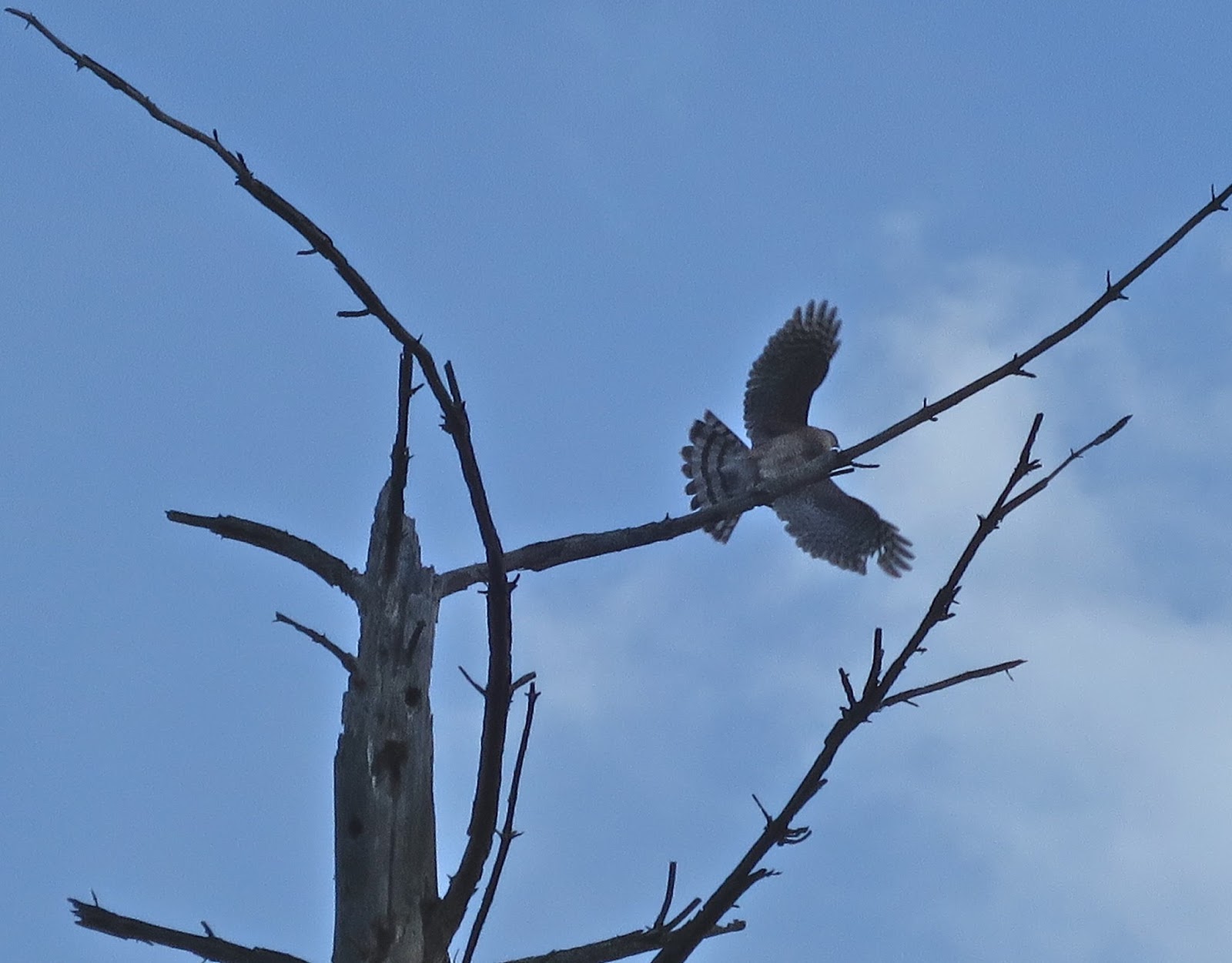
I was only able to briefly glimpse that Red-tail today,  but I have seen other hawks on other walks along this trail.  Lots of snags stand in the trailside marsh, and that's where this Cooper's Hawk (?) was perched before it took flight.


Look up, and see birds.  Look down, and see . . . what?  Just scads of Snowfleas, tiny hexapod springtails crawling and hopping across the snow surface.  Not exactly a sign of spring, since we find these tiny bugs on the snow in deep winter, too.  But they do seem to congregate on the snow's surface on winter's warmer days.


Here's a closer look at the Snowfleas.  They are not actually fleas, in fact they're  not even considered to be insects, despite their six legs.  They don't bite, either.  But they sure do hop, thanks to the spring-loaded appendage on their rears that can send them flying considerable distances.  There were at least five more critters in this picture at the moment I pressed the shutter button. But poof! Before the shutter clicked, they'd just disappeared!


On a nearby fallen log, this lovely frieze of Turkey Tail fungus was nearly as colorful as when it had emerged last fall.


At the very eastern end of the Spring Run Trail, a tiny brook courses through a woods. It looks as if my friends have spotted something of interest here.


Yes indeed, they did! One of those interesting things was this deep-red, bulbous, twin-spathed Skunk Cabbage plant, newly emerged from its winter bracts and actually demonstrating how this interesting wetland species can produce enough interior heat to melt the surrounding snow.


And just a few inches away, out in the shallow, slowly moving water, several plants had opened their spathes enough to allow us to peer at the spadices within.  And lo, the spadices were dotted with blooming flowers!  Ta da!  Here they are, folks: the very first flowers of spring!


Well, that would have been enough excitement for the day, but we continued walking along the trail until we arrived at some steep rock walls towering over both sides of the trail. These walls are most likely the remains of a bridge that passed over what is now our trail but which was once a railroad line.  The sun-warmed south-facing wall was almost completely bare of plant growth, but this north-facing wall turned out to support a plethora of shade-loving mosses, lichens, and liverworts for our bryophile friends to excitedly examine.


While I'm waiting for my moss-expert friends to inform me of the names of the plants that were clinging to this bare rock, I can safely assert that the lime-green growth shown here is a liverwort, while the spiky dark-green stuff surrounding it is a moss.


And look, some of that spiky moss (possibly Schistidium apocarpum, also known as Sessile Grimmia) had produced some red-capped spikes (most likely part of this moss's reproductive organs).


This liverwort, with its overlapping two-lobed leaves is most likely the species called Flat-leaved Scalewort (Radula complanata).


This moss had a beautiful fluffy appearance and was radiantly green. It sure reminds me of an Anomodon species, but that's as far as I will guess.


I do think I recognized this next moss as one of the Fissidens species (known as pocket mosses), thanks to its fern-like appearance. 


Another moss, looking a bit freeze-damaged, still sported its ruddy spore stalks. This one is possibly of the Plagiomnium genus, but species are difficult to determine without magnification.


There was even a tiny evergreen fern sprouting right out of the rock. Since many juvenile ferns look alike, I wouldn't even venture a guess about this one.


Reluctantly pulling ourselves away from this treasure-trove of a stone wall, we ambled along until we reached a bridge crossing Spring Run Creek.  Our approach was loudly announced by some Mallard hybrid ducks that were paddling there.


We also spooked a pair of White-tailed Deer who had been grazing in the nearby woods.


I know this bridge as the site where dozens of gorgeous blue Great Lobelia plants bloom in the summer, and sure enough, we could still find their now-desiccated stalks, studded with the spent seed pods along the stems.  I thought the empty seedpods vaguely resembled tiny big-eyed birds.


Returning the way we came, we stopped to examine some Northern Prickly Ash shrubs, delighted to find the swelling red buds that will soon produce male and female flowers on separate shrubs. I'm not sure if the sex of the shrub can be determined by the appearance of the buds.


A happy morning, spent with good friends on a trail that rendered many unexpected pleasures along with definite signs of spring. And now we are off to more pleasure together, at a nice Thai restaurant downtown for lunch !