Wednesday, March 16, 2022

Spring's First Flower, Some Winter Fungi, and a Wonderful Waterfall

More snow fell this past weekend, and I began to despair that Spring would ever come. But then this photo of Winter Aconite and Snowdrops spreading across the forest floor just one year ago showed up as a Facebook Memory. Oh gosh, could these super-early-bloomers be up already?  All they need is a bit of bare earth to burst into bloom.  So I hurried out to Orra Phelps Nature Preserve in Wilton on Tuesday, with hopes held high. Yes, yes, I know that neither of these plants in a native wildflower, but that doesn't mean I wouldn't be delighted to see their lovely flowers, remnants of a garden abandoned long ago.


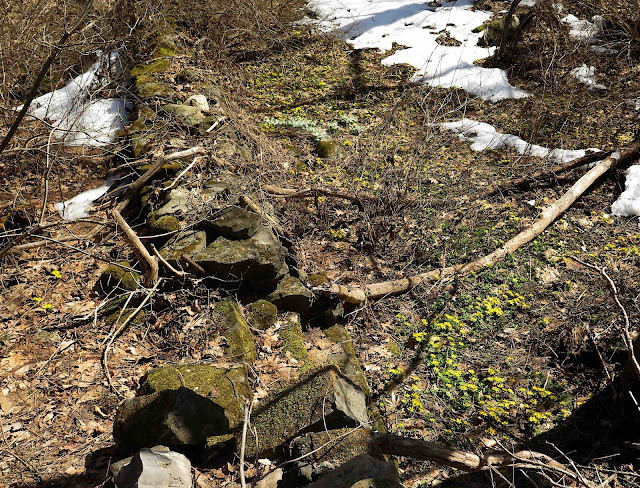
Nope.  Not yet.  Snow still lay deep in the old walled garden where I found those early bloomers on this date a year ago.  Too deep for any flowers to show their faces yet.
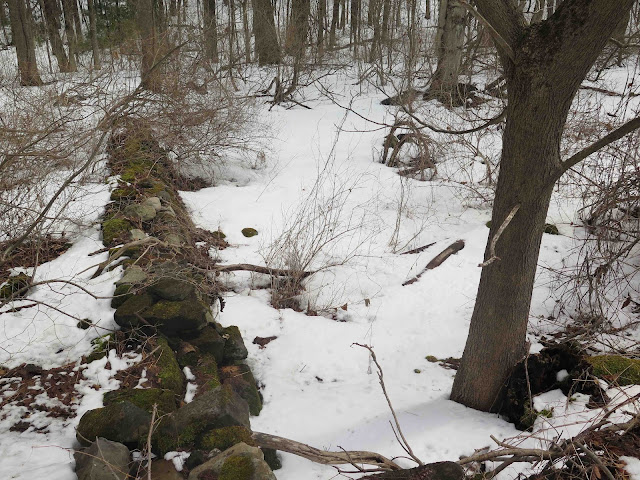

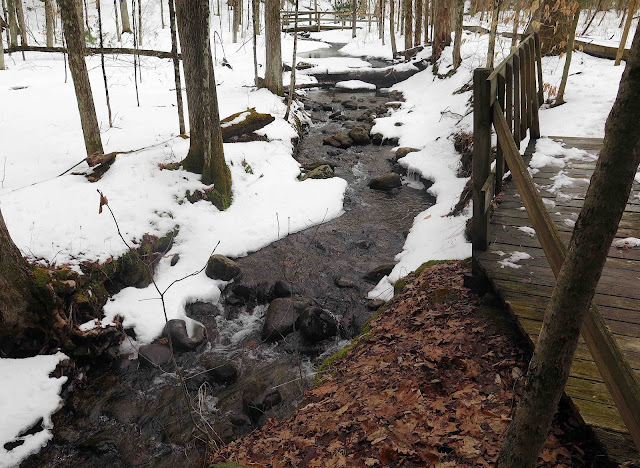
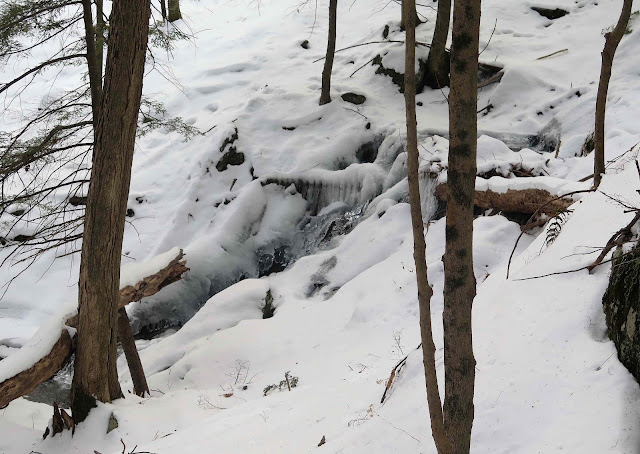
Snow lay deep throughout the woods of this small preserve, although its little creek was splashing and dancing as if it were celebrating Spring.


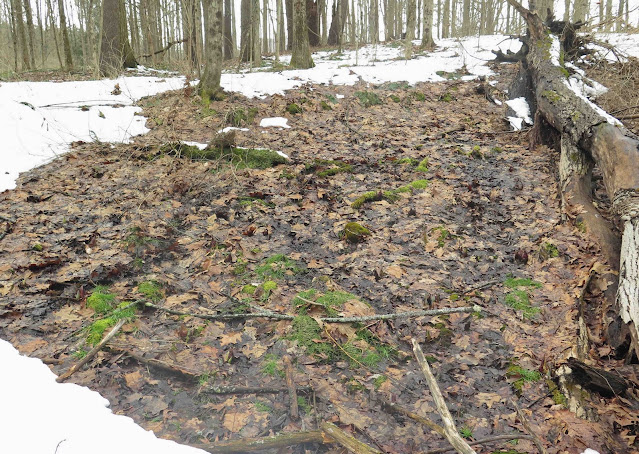
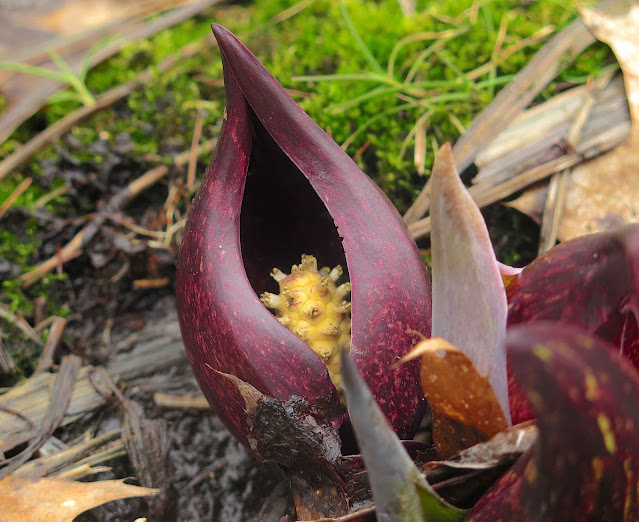
And a whole hillside that's watered by springs was free of snow and studded with the bulbous spathes of our earliest blooming native wildflower, Skunk Cabbage (Simplocarpus foetidus).  I could see many purple plants protruding from the mud.  Would any of them actually be in bloom?


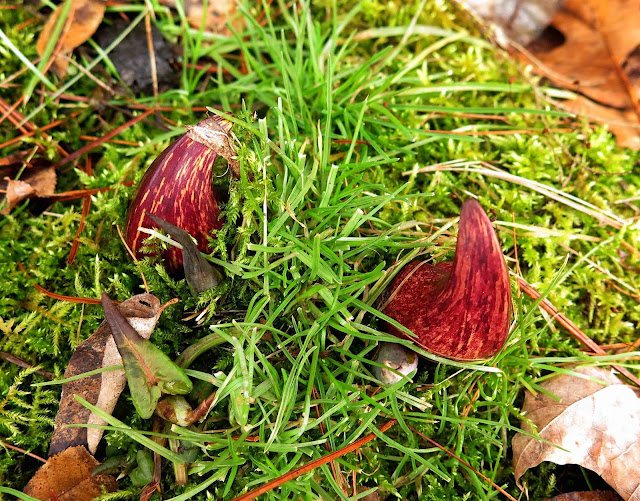
Venturing carefully across boot-sucking mud, I found that most of the spathes, while brightly colored, were still tightly closed, still guarding the not-yet-blooming spadices within, not yet wafting the scent this flower is famous for on the spring air to invite early pollinators in.


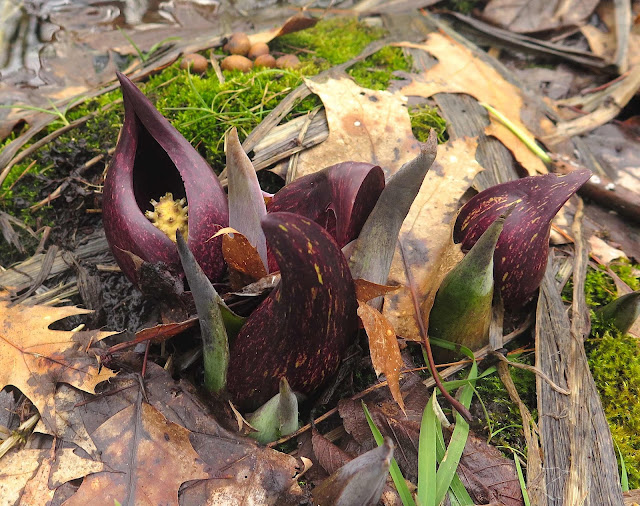
But look! Here was a burgeoning cluster of Skunk Cabbage spathes, and one of them was wide open.


I could see the individual florets studding the spadix.  They were not yet shedding pollen, but they sure looked as if they were ready to. Close enough!  I found the first flower of Spring!


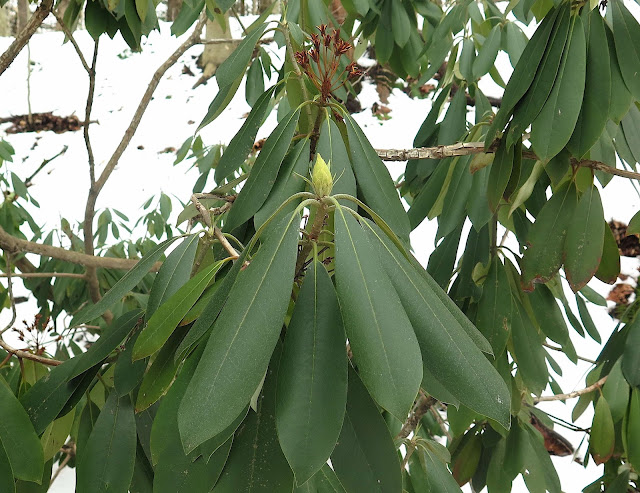
 I was pleased to find evidence of other flowers that will bloom much later in spring. A large Rosebay Rhododendron (Rhododendron maximum) was leaning over the creek, holding many fat flower buds, as well as the remnants of last year's beautiful blooms.


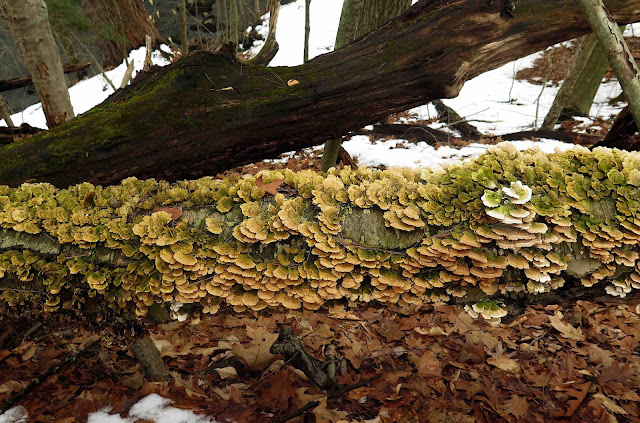
I found many fungi adding their color and interest to this late-winter woods, including these masses of ruffly persistent mushrooms, their golden caps tinged green from the algae that shared their fallen log.


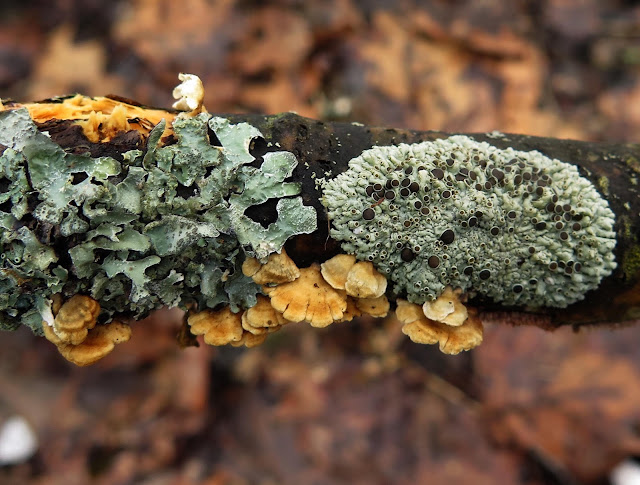
This fallen limb was rendered quite lovely by golden fungi and verdigris-colored lichens, a wonderful combination of colors and textures.


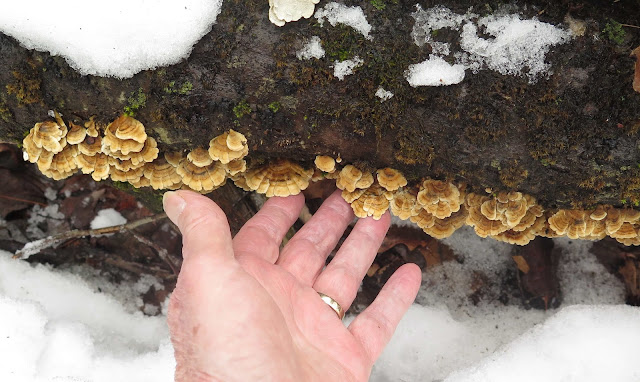
And here was a whole row of that same golden fungus, a ruffly, striped sea-shell-shaped one that I recognized as the Crimped Gill Fungus (Plicaturopsis crispa).


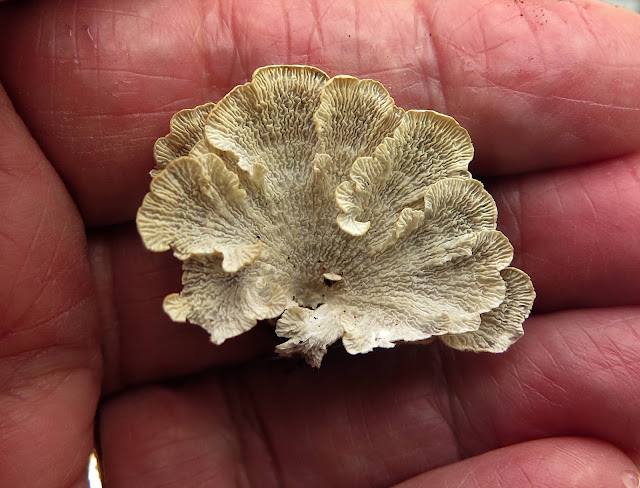
When I turned this little cluster of them over, there were the crinkly, wrinkly gills that are diagnostic for the Crimped Gill Fungus. One of the remarkable things about this common fall-fruiting fungus is that it is also a truly functional winter fungus. Even after it has become thoroughly dried or solidly frozen, it can be brought indoors, moistened and kept in a humid container, and it will produce many spores throughout the winter. It is also really cute!


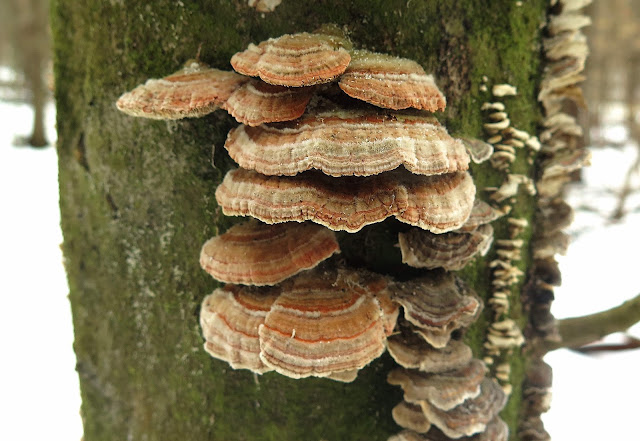
At first glance, I thought I was seeing a whole tree-trunk decorated by Turkey Tail Fungus, a shelf fungus known for its alternating zonal stripes of tan and orange. But I was wrong!


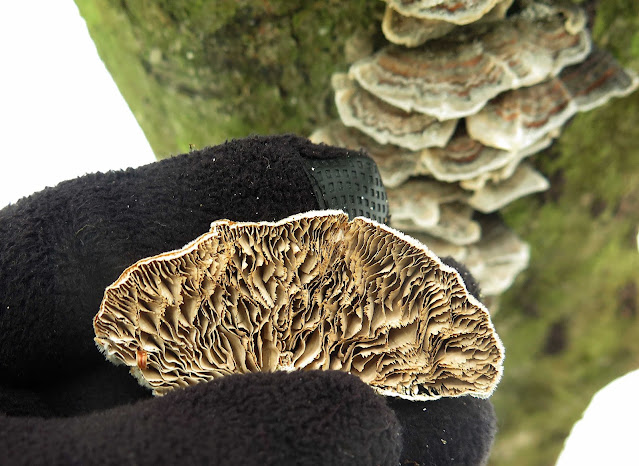
The undersides of these mushrooms were definitely gilled, not like the smooth white surface consisting of tiny pores that is diagnostic for the real Turkey Tail (Trametes versicolor).   I am going to guess that this mushroom is instead Lenzites betulina, which is known to closely resemble the Turkey Tail, except for possessing a gilled fertile surface. In fact, the vernacular name for this fungus is Gilled Polypore (an oxymoronic name if there ever was one!)


While looking up information about this "Gilled Polypore," I discovered that it has been re-named. It is no longer called "Lenzites betulina," but has been moved to the same genus as Turkey Tail and re-named "Trametes betulina." 


As I made my way out of the Orra Phelps Nature Preserve, I lingered by the stream (the Little Snook Kill) to enjoy the lovely sound of its water as it tumbled over rocks in a series of mini waterfalls.


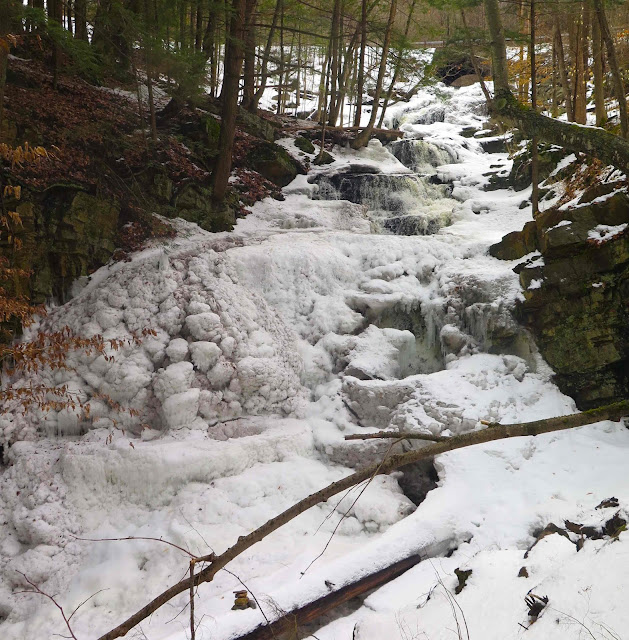
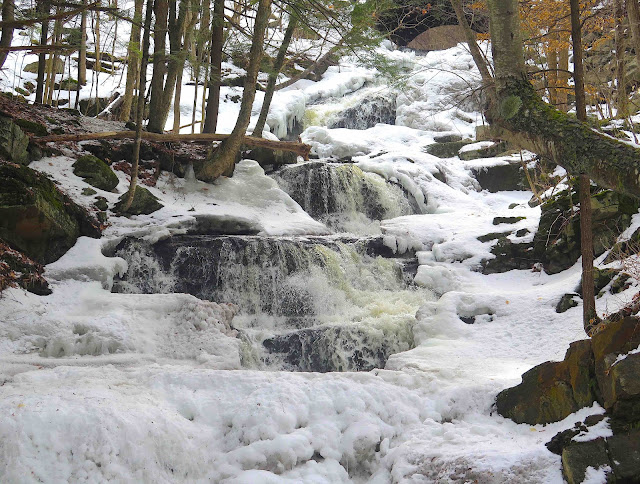
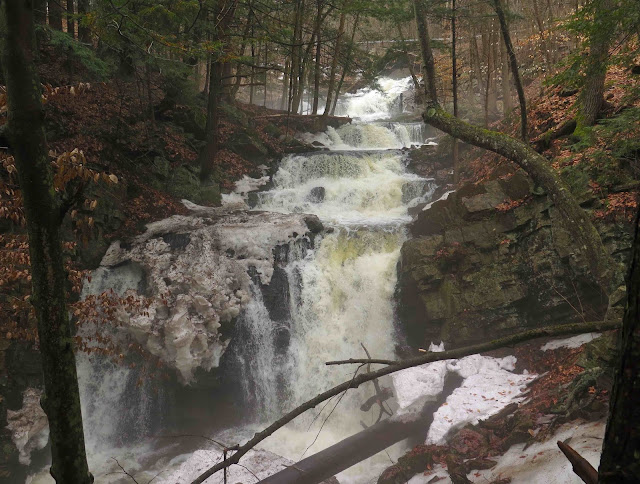
Those mini-waterfalls along the Little Snook Kill at Orra Phelps inspired me to stop by the much larger Snook Kill Waterfall that roars down a steep hillside off of Strakos Road, a short detour from my normal route home along Parkhurst Road.  Recent rains and melting snow have filled this stream to its brim, creating a thundering watercourse that was worth a precarious venture down a very steep bank to observe. Recent and persistent freezing temperatures, though, have covered much of the falls with frozen froth, so much of the actual water was hidden from view. But I could certainly hear its roar beneath that frozen cap.


And the view of this waterfall was still quite dramatic.


UPDATE, 3/19/22:  A few warm rainy days later, this same waterfall has shed much of its ice:


Wednesday, March 9, 2022

Spring Will Be a Little Late This Year

After several above-freezing days that also brought lots of snow-melting rain, I thought that yesterday, with its balmy temps and bright-blue sky, would be a good day to go look for our first flower of spring. And I knew that the Spring Run Trail in Saratoga would be a good place to find it, for lots of Skunk Cabbage thrives in the swampy spots that line this inner-city trail.  Another appealing point about this  trail is that it is regularly plowed, so walking it should have been easy. Or so I thought.


Yes, there were indeed patches of pavement along the trail that were perfectly clear of ice and snow, but the stretch I meant to follow to reach the most likely Skunk Cabbage patch was coated with water-slicked ice.  Expecting a cleared path, I'd neglected to pull my ice grippers over my boots, so the going was slow, either schlumping through shin-deep snow in the ditches, or slithering flat-footed and carefully, carefully, slowly, slowly along the ice.


And after all that, the reward was meager.  In the place where I usually find dozens of swelling Skunk Cabbage spathes this time of year, I found only two visible plants.  Except for these two examples, both of which were growing directly in flowing water, all others were still hiding beneath many inches of not-yet-melted snow.


While the swelling bulbous spathes of both plants had acquired their bright spring colors of mottled red and yellow, the spathes were still closed tight.  When the pollen-bearing flowers within the spathes are actually blooming, the spathes will open wide to waft the flowers' distinctive fly-enticing scent on the air and invite the earliest pollinating insects in.  I think it will be a while yet before we'll be seeing (or smelling!) these first flowers of spring.


Especially now that winter had returned, and for who knows how long?  It sure looks more wintry than spring-like outside my door today!


Sunday, March 6, 2022

Return to the Porcupine Caves

I just stepped outside my door at 5pm this afternoon: it was SEVENTY DEGREES under a sunny sky and the snow was melting fast! What a change from just yesterday, when my friend Sue and I ventured high into the mountains surrounding Moreau Lake.  It was warmish (for winter) but still below freezing then, and snow still lay thick on the woodland trails and atop the solidly frozen lake.  We thought it might be our last chance this year to find the porcupine dens in some marble caves up on the mountain heights, as well as to check out the icy beauty along the creek that tumbles down the mountain.


The caves in which porcupines have been known to den are easy enough to find (although we have to bushwhack off official trails to do so), but whether the porkies still occupy them can only be known by observing their well-trodden trails through the snow.  As we neared the caves, we promptly discovered the packed-down, dirt-stained trails so distinctive of porcupine travels. Porcupines don't wander all over the woods each day in search of food, but head straight from their dens to their chosen tree (usually a  Hemlock), the same tree that they return to daily to feed on the bark. 


The trails become so well-packed no individual footprints can be discerned in them, but the presence of quills and hairs (not to mention much porkie pee and poop) makes it obvious what animal has passed this way, again and again.


And sure enough, these well-trodden trails led straight to the very same caves these porcupines have occupied for years.


Not all of the caves up here would be fit for animal occupation, for some of them still shelter the running stream that was quite likely the force that eroded such caves in the marble bedrock.


I am guessing that the bedrock here is marble, for the plants that populate these rocks are definite calciphiles, requiring lime in order to thrive (and marble is metamorphosed limestone).  Two examples of such calciphiles are pictured here: a clump of long-fronded Walking Fern (Asplenium rhizophyllum)  that is studded with a couple of rosettes of Rose Moss (Rhodobryum ontariense).


This rock-studded stream bed flows directly out of the mouth of one cave.  Sue has noticed an unusual moss that is completely submerged in the shallow water.


This moss's long floppy branches were rippling in the flowing water. The spearhead shape of the individual leaves, as well as this aquatic habitat, suggested to us that the moss might be one of the Fontanalis species, but we could not be sure.  We are definitely missing our bryologist friends like Nancy Slack and Ruth Brooks, either of whom could probably have identified this moss at a glance.


As we wandered around the snow-carpeted woods, we each stopped to admire this fallen limb so beautifully embellished with thick clusters of Turkey Tail Fungus (Trametes versicolor).


We also noticed several new trails where a solitary porcupine had wandered off, quite probably in search of new trees to feed in, since most of the hemlocks surrounding the caves have been stripped of their bark and needles by many previous generations of porcupines.


We also found several trails where fishers had been cruising this territory, most likely seeking their primary prey animals, the porcupines.  Fishers are known to be the porcupines' most successful predator, using their speed and agility to exhaust a porcupine until the fisher can quickly lunge in and flip the weakened creature, exposing the parts of the animal undefended by quills.  We were glad we did not find any evidence of such a kill today.


We took our time descending the mountain, leaving the official trail to follow more closely the ice-embellished stream that tumbles down from the rocky heights.


We knew that rain and warmer temps were predicted for the following day, so this might possibly be our last chance this year to delight in the many beautiful ways that splashing water and freezing air produce their exquisite creations. Here are just a few of the examples we found on our descent.


Each icy creation appeared even more beautiful than the last.  I'm so glad we made the most of what might be the last truly wintry day of winter.  Heavy rains and much warmer air will now contribute to new forms of beauty and fascination along this stream and throughout this mountainside forest as spring approaches. I'm quite eager for that change!

Friday, March 4, 2022

Late-Winter Beauty

I'm not sure if it's remnants of whatever ailed me for over a week last month, or simply loss of fitness from spending a week in bed, but I'm still finding a nap more appealing than a nature walk these afternoons.  Especially as the cold snowy weather continues. Hey, it's MARCH!  Time to go looking for our first flower of spring (Skunk Cabbage) and listening for the first calls of the Red-winged Blackbirds in the marsh. But the morning's temps were down near the single digits yesterday, and snow still lay thick everywhere.  And I might have headed back to my couch if my Facebook Memories had not shown me these next three photos of late-winter beauty still to be found, even when winter lingers.


The gracefully curving leaves of Sweet Fern (Comptonia peregrina) still hold their marvelous fragrance even though brittle and dry. The male catkins formed last fall and wait for warmer weather to fluff out with pollen.


The golden leaves of American Beech (Fagus grandifolia) are as translucent as tissue paper, lying atop the snow.


The gracefully arching flowerheads of Woolgrass (Scirpus cyperinus) remind me of the fireworks that resemble shooting stars.


Spurred by the memory of such late-winter beauty, I was glad I had agreed to meet my friend Sue for a short walk along the Bog Meadow Brook Nature Trail this day. The packed trail made for easy walking, and the blue sky and a warming sun cast a springlike feel to the still-below-freezing air.


We had chosen this wetland site today in the hopes we might find some Skunk Cabbage spathes poking up through the snow.  And we also hoped we might hear the loud calls of early-returning Red-winged Blackbirds claiming their nesting sites in the marshes that line this trail.  But no, the air was perfectly silent of birdcalls, and most of the trailside stream was solidly covered with ice.  Even in the few patches of open water, we found no signs at all of any new plants. Some pretty filigree ice, but no Skunk Cabbage.


We did enjoy the stark beauty of last year's aster remnants, as lovely as ink-drawings against the white snow.


Some of the flower remnants intrigued us as to their identity. We could not figure this one out as to its  species, although it sure looked familiar.


The fluffy filaments of Virgin's Bower Clematis were easy to spot where their twining vines had wound through the branches of trailside shrubs.


We were surprised to find some fungi, like this Turkey Tail (Trametes versicolor) climbing a peeling birch trunk, still looking as firm and colorful as they did last fall.


I took a flash photo of the Turkey Tail to better show how colorful this fungus still remained.


Many small willows line the trail where it passes through open marsh. We searched the twigs, hoping to find some silky puffs emerging from the tight reddish bud scales.  No Pussy Willow catkins yet, but we did find many Shoot-tip Rose Galls at the ends of the twigs, papery growths resembling roses, caused by a tiny fly (Rhabdophaga rosaria) laying its eggs in a slit of the twig.


Many Speckled Alders also line the marsh-side trails, and I was truly surprised to find this fluffy clump of Woolly Alder Aphids.  I cannot believe these soft-bodied insects would still be sipping sap from the winter-brittle alder twigs, or that the insects themselves would not be frozen solid beneath all that waxy fluff.  How odd, though, to still look so fresh and furry after this long cold winter. These aphids usually produce a cloned generation of winged adults that fly off to mate and lay eggs on Silver Maples in the fall, while the wingless generation simply dies and falls off the twigs.


Oh, by the way:  we DID see our first bird of spring while walking the Bog Meadow Brook Trail this day. Soaring high above the trees, a pair of Turkey Vultures displayed their V-winged wobbly flight, the first ones we've seen this year.  As with Skunk Cabbage being the First Flower of Spring, few poets write rapturously about our First Bird of Spring, the Turkey Vulture, either. But we were sure glad to see them.