Wow! Such a pretty snowfall overnight! The world transformed to a fairyland! But sadly, that enchantment lasted for just an hour or so before the rain began to wash all the snow from the trees and turn it all to slush underfoot. But that's the way it goes, this time of year, the weeks between autumn's glorious colors and genuine winter's sparkling snow and glittering ice. The recent days have been so dank and gray, I've had to really push myself to get outdoors, and I probably would have yielded more to the call of the comfy recliner and cat on my lap if my nature buddy Sue Pierce had not urged me to join her out on some local trails.
The Campground Woods at Moreau Lake State Park
Way back before Thanksgiving, Sue lured me out with this message: "Hey, I found a big patch of what looks to be Green Rock Cress near the campgrounds at Moreau Lake State Park! Come check it out!" Which I did. And she was right! Granted, most folks would never look twice at this patch of weedy-looking stuff growing by the roadside, but Sue and I have seen it in other parts of the park, in bloom and in leaf as well as after it goes to seed with distinctive long arching slender pods. And we know that this Mustard Family plant is rated as a Threatened species in New York State. So yes, this patch of Green Rock Cress (Borodinia missouriensis) was indeed worth pulling my longjohns on to see.
And it turned out to be a good thing I was dressed for the cold, since it shortly started snowing. A real squall it was, too, pelting us with rattling pellets of icy stuff falling too fast for my camera to capture in the air (until I used my flash).
But the snow stopped as fast as it came, so we wandered about the woods a bit, seeing what we could see. One of the most amusing things we saw was a patch of Bird's Nest Fungus covering the woodchips under a swing-set in a children's playground. This fungus is always a fun find, and even more so when we find the "eggs" (the fungus's spore packets) flung by rain from their nests and hanging by sticky threads on the swing-set's upright supports. This allows the wind to more easily waft the spores when expelled from the packets.
Here was a big handsome fungus decorating a fallen log, and it could have been any number of similar fungi with alternating stripes of tan and brown.
But a glance at the fertile surface revealed the intricate maze of ridges that convinced us that this was most likely a Maze Polypore (Daedaleopsis confragosa).
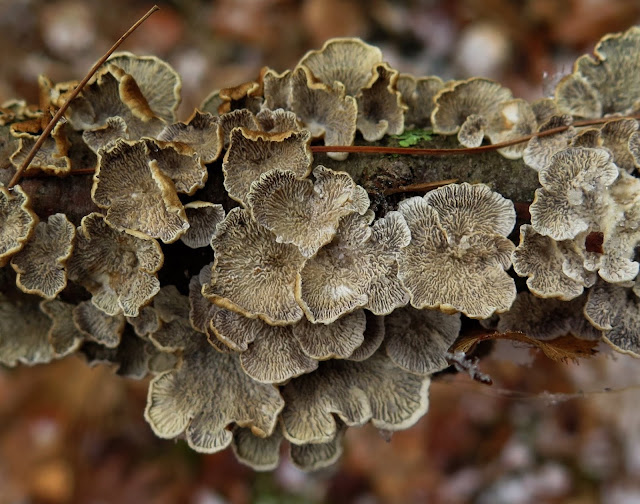
Another fungus, this one with caps so small they almost disappeared beneath a dusting of snow. Again, the brown color and zonal stripes resembled so many different species, further investigation was required to determine which one this was.
A simple flip of the cluster immediately confirmed our suspicion that this must be the Crimped Gill Fungus (Plicaturopsis crispa), thanks to its very distinctive squiggly gills.
I still have not ascertained the name of this linear patch of a tiny toothed fungus dangling down like miniature icicles from cracks in the bark of a fallen tree limb. You can judge how small it was in comparison to the toe of my shoe. Neither Sue nor I had ever encountered it before.
UPDATE: Thanks to a helpful commenter named Steve, I have good reason to believe that this small tooth-like fungus is likely to be Radulodon coplandii, also known as The Asian Beauty because it originated in Asia and has been found in northeastern North America only in recent years. Here's a link to the website "Fungus Fact Friday," where I learned many interesting facts about this (so-far) unusual fungus.
We certainly had no difficulty identifying this gorgeously colorful fungus as Turkey Tail (Trametes versicolor), a shelf fungus that comes (as its specific name suggests) in various colors, all of them beautiful.
With most of our forest finds now displaying just various shades of brown, it's always a treat to encounter a fungus as colorful as Turkey Tail. And shrubs of Panicled Dogwood (Cornus racemosa) also are doing their bit to liven up the fall color scheme, with berry pedicels a vibrant scarlet, even after the birds have devoured the porcelain-white berries.
And here was a final colorful surprise to delight us on this blustery cold day. As the clouds that had pelted us with snow moved off to the northeast, a now-bright sun shining from a clear blue sky blessed us with a beautiful "snow-bow." I had never experienced such an effect before. It sure made me glad I had answered Sue's summons to join her at Moreau Lake State Park today.
First Ice at Moreau Lake
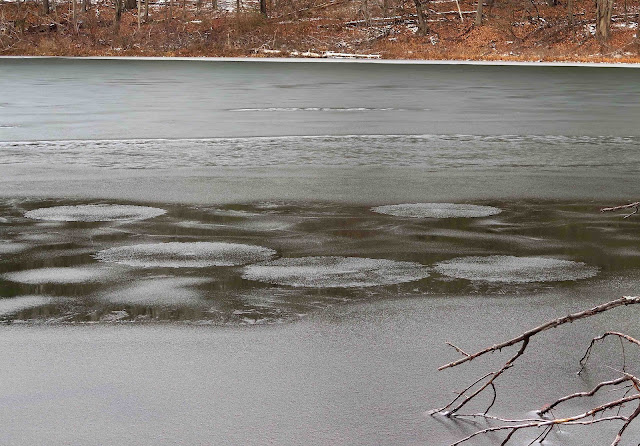
A few days later, Sue again summoned me back to Moreau Lake State Park, this time with the news that new ice had formed on the lake's back bay. "Maybe we'll find some cool ice bubbles," she tempted me with, so of course I had to join her. Ice bubbles are one of the joys that make winters here more marvelous than miserable.
Sadly, though, the ice had formed before or during the most recent snowfall, so the texture was pebbly and almost opaque, instead of the glass-clear sheet that holds bubbles like stacks of silver coins and allows us to see all the way to the lake's sandy or stony bottom. But it still looked rather pretty, with ruddy oak leaves frozen in place and a frosty filigree forming at the water's edge.
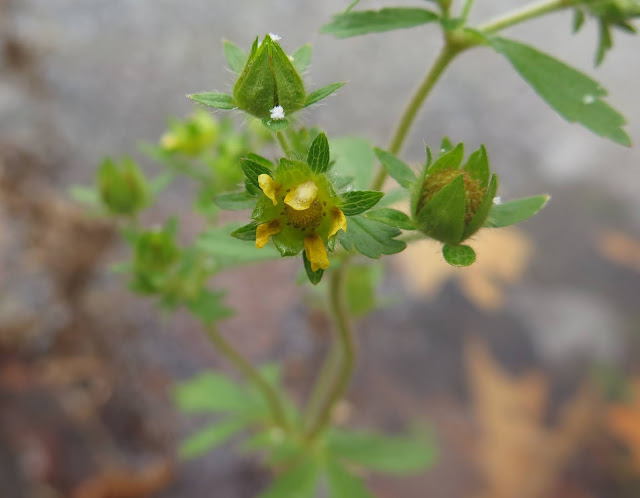
Here was quite a surprising find: a still-blooming plant of our native Rough Cinquefoil (Potentilla norvegica) poking up through the newly formed shoreline ice, its small yellow flowers and green leaves apparently unaffected by the freezing cold. I have always thought of this species as a sturdy plant, but I did marvel at how it had survived these wintry conditions. You can detect a flake or two of snow on the plant in this photo.
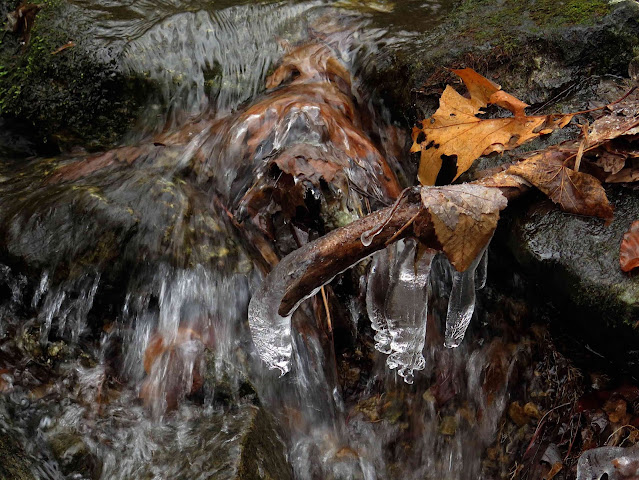
Since the shoreline offered little more to hold us there, we next followed this splashing brook up the mountainside, hoping to find some crystalline ice formations adorning the streamside boulders.
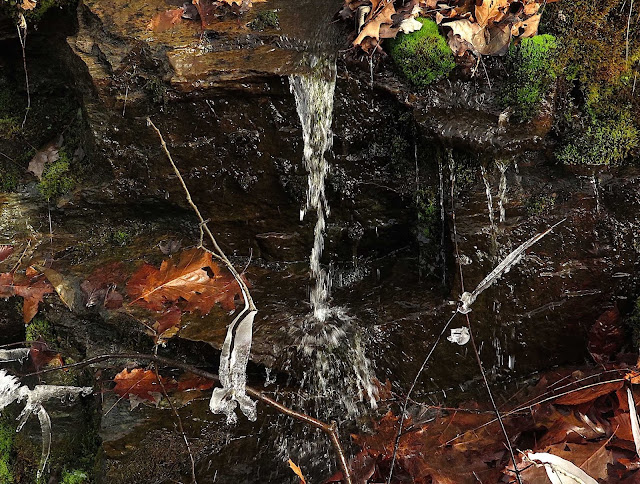
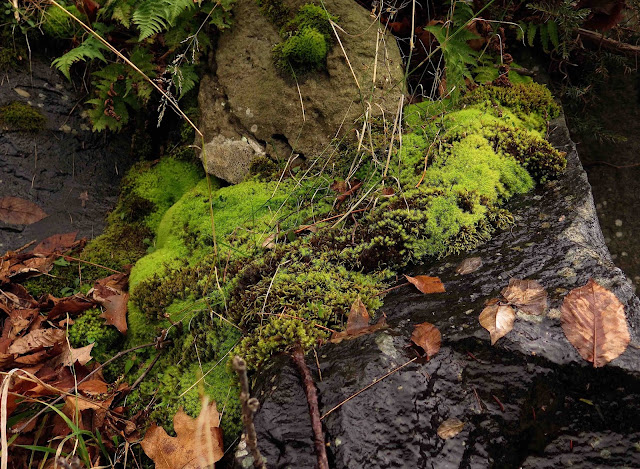
Again, we learned we must wait for colder days and nights for the most fantastic ice to form, but it's always lovely to watch the water flow over mossy rocks. And we did find a few icy embellishments.
As we wandered the streamside woods, we greeted a few of our native evergreen plants, lovely now while dusted with snow and not yet buried beneath heaps of it. Here, the beautifully patterned and curvaceous leaves of Downy Rattlesnake Plantain (Goodyera pubescens) displayed how bravely this native orchid endures whatever winter may bring its way.
The pale-striped, dark-green leaves of Striped Wintergreen (
Chimaphila maculata) displayed the same imperviousness to winter's freezing cold, looking as fresh as when the plants bear flowers in early summer.
Some of our woodland ferns are also green all winter, and we were lucky to find three species of them clustered together, allowing us to compare the differences between the species. The Christmas Fern (Polystichum acrostichoides), on the left, has the plainest leaflets of all, but displays a small "toe" at the base of each leaflet that lends each individual leaflet the look of a Christmas stocking. The middle frond shows the deeply-cut rounded leaflets that distinguish the Marginal Wood Fern (Dryopteris marginalis), while the already-cut leaflets of the Intermediate Wood Fern (Dryopteris intermedia) show themselves to be cut once again, lending a lacier look to this fern's fronds.

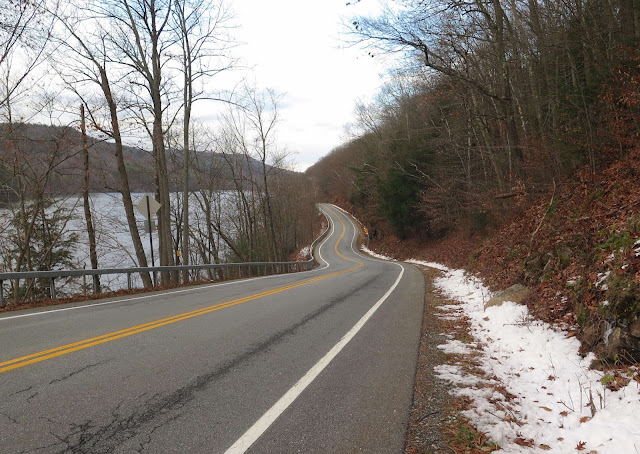
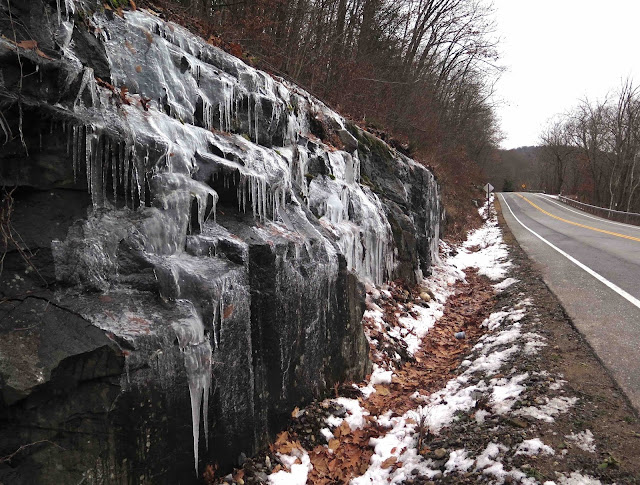
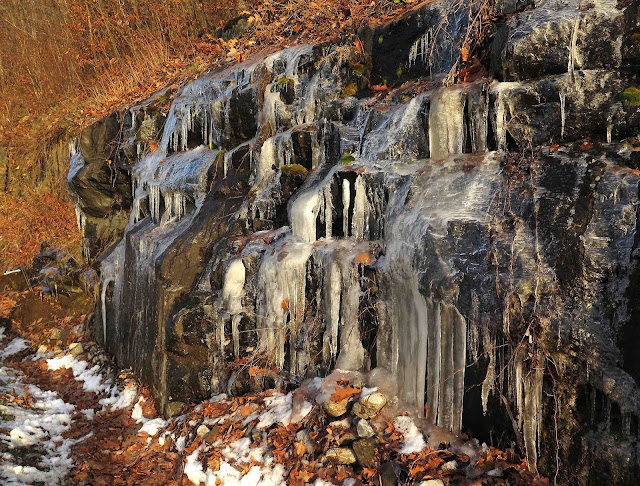
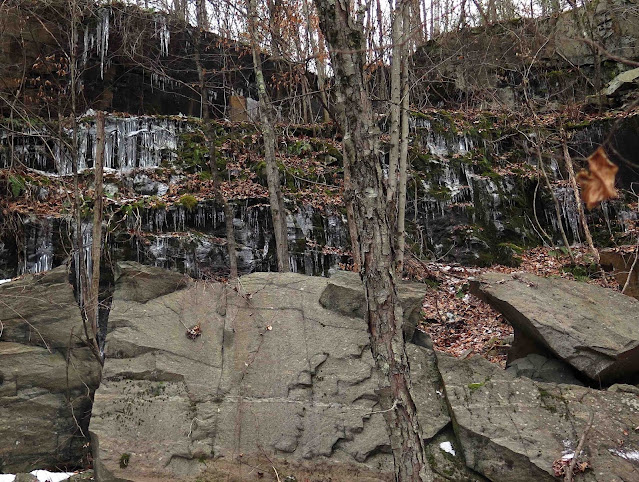
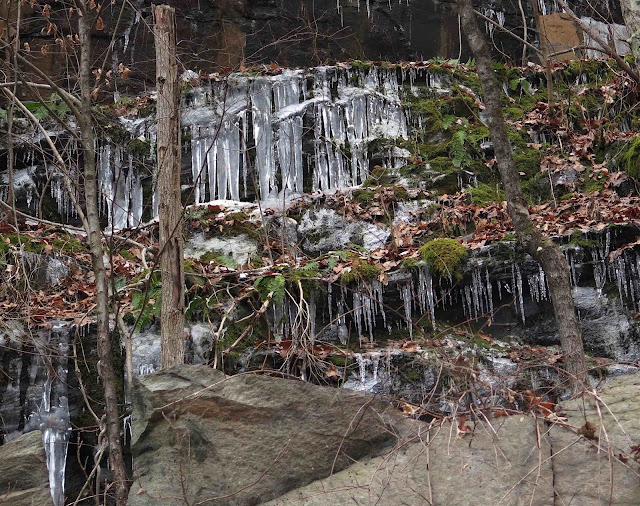
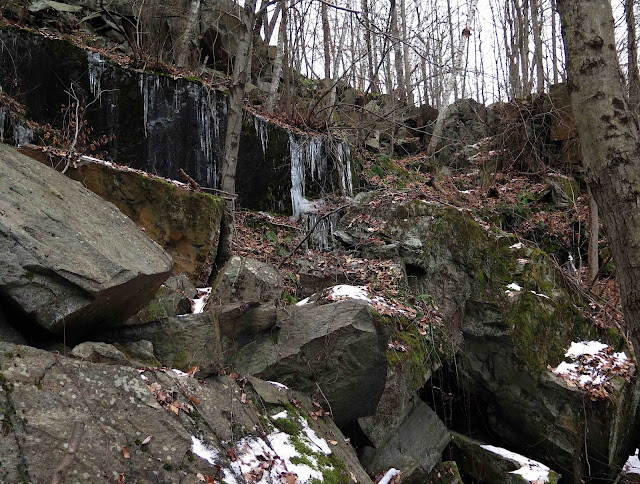
Heading home from the park on Spier Falls Road, which climbs through the Palmertown Mountain Range, I was struck by the long slender icicles cascading from the tree-topped boulders that line this steep and winding road. So I was not completely denied the icy beauty I'd hoped to find when I ventured out this day.
A Sun-warmed Walk at Lake Bonita
A sunny day, at last! And on the first day of December! It was such a pleasure to feel a warm sun on my back as Sue and I strolled the south-facing shore of Lake Bonita, a beautiful small lake high up on Mount McGregor, now one of the most popular hiking destinations in Moreau Lake State Park.
Although the lake is now covered with ice, that ice was still much too thin to allow us to venture out to the tiny islands that dot this lake, islands that are covered with acid-tolerant shrubs and herbaceous plants more usually encountered in northern bogs.
We enjoyed trying to identify the remnants of plants that grow close to shore, including these ruddy pods of Ditch Stonecrop (Penthorum sedoides) poking up through the ice.
Several rocky ledges jut out from the shore, providing welcoming spots to bask in today's warming sun. The sun-warmed rock contains sheltered niches where Pale Corydalis (Corydalis sempervirens) has nestled in, still holding onto its beautiful frosty-green leaves late into the year. I found only leaves this day, although on other years I have found a few of its yellow-tipped rosy-pink flowers blooming as late as early December.

Oh, what a marvelous year it is, for our native Winterberry shrubs (Ilex verticillata)! I haven't seen them fruit so abundantly in several years, but they sure are making up for lost time this fall. On my way home from Lake Bonita, I had to pull over along Corinth Mountain Road to simply gaze in wonder at the spectacular display in this little roadside cattail swamp. Believe me, I did not boost the saturation of this photo to intensify the redness of the fruit. What a treat to liven the otherwise dreary landscape of this post-autumn, pre-winter, dull-colored time of year!