Saturday, May 15, 2021

Favorite Flower Finds Along Bog Meadow Trail

More than a week had passed since I saw those swelling buds of Nodding Trillium along the Bog Meadow Brook Nature Trail. And with the return of sunnier, warmer days this week, I suspected that those buds would have opened by now. So I dashed out there yesterday to see if my suspicions might be correct.

Bog Meadow Trail had become quite lush and lovely now, with the tree canopy leafing out and the trailside plants grown tall and beautifully green. At first glance down the trail, I saw no evidence of any flowers in bloom. But that perception was soon to change.


Sure enough, only a hundred yards or so along the trail I found the first Nodding Trillium (Trillium cernuum) in bloom, hiding well back beneath some thick shrubbery.  And not only was the plant well hidden, the flower itself was also hiding, face down beneath its wide spreading leaves.


Crouching low, I could look up into the face of this lovely flower and note both the long-filamented red anthers and the white ovary that are diagnostic for this not-so-common trillium species.


I found I had company among the trilliums: one yellow-striped, brown-eyed damselfly I couldn't identify, resting atop a broad trillium leaf.

UPDATE: Thanks to a well-informed reader, Bryan Pfeiffer, I can now put a name to this damselfly.  It's a newly emerged female Aurora Damsel (Chromagrion conditum).  Now I know why I could not find its image in my Odonata guidebook.  Newly emerged damselflies do not yet have the distinguishing colors they will acquire as adults. But Bryan knew!  Be sure to check Bryan's comment to this post, in order to gain access to his own remarkable and informative nature blog.

Nearby was a second flower I come here each mid-May to see, and it also blooms about the same time as those trilliums do. From above, the leaves of Rose Twisted Stalk (Streptopus lanceolatus) almost completely shield from view the small rosy bell-shaped flowers that dangle from the leaf axils.  Again, I had to crouch low just to see if the plant had come into bloom.  Yes it had!


Here's a closer look at those small rosy bells, which dangle on the twisted pedicels that suggested this native wildflower's vernacular name.


I was happy to see a number of other flower friends now coming into bloom. There were only a few of the tiny flowers of Grove Sandwort (Moehringia lateriflora) that had opened as yet, but soon the trailside grasses will be starred with abundant numbers of these pretty but diminutive blooms. You have to look very close to appreciate its rather furry pale-green interior.


Wild Geraniums (Geranium maculatum) also thrive along this trail in abundant numbers, but today I found just this one had opened its pale-lavender flower as yet. Believe me, there will be many, many more in the weeks to come!


Sadly, though, the season for admiring the remarkable interior structure of Goldthread flowers (Coptis trifoliata) will soon be over.  This is one of our earliest blooming wildflowers, and I felt lucky to find even this pair in presentable shape. I love the curlicue-tipped, spindle-shaped pistils and the lemon-lollipop-shaped petals of this small ephemeral flower.


Happily, though, the starry, pure-white flowers of Starry Solomon's Seal (Maianthemum stellatum) will be with us yet for a while, to judge from the number of buds that are still to open. When I first encountered this lovely wildflower along this trail more than 10 years ago, I counted 10 specimens, all confined to an area about 12 feet across beneath a large White Pine.  Today, there were more than a hundred in bloom, spread along the trail for a considerable distance, far from that original site.


We will soon see many more of the snowy-white blooms of Starflower (Lysimachia borealis) along Bog Meadow Trail, for this beautiful aptly-named wildflower loves this shaded woodland habitat.  Today, though, I found just this one. For simple pure beauty, I believe this elegant native wildflower wins the prize.


I continued walking along the trail, past the bridge over the Bog Meadow Brook, past the open marsh,  and on into a deep-green woods, where pools of water occupy both sides of the trail. This is Highbush Blueberry territory, and blooming shrubs pressed close to the edge of the trail.  The bell-shaped white blooms of the tall Vaccinium corymbosum shrubs are pretty enough in their own right, but today I was drawn to notice the lovely colors -- deep purple and forest green -- of the calyces that hold the flowers.  Add the cherry-red bud scales and the maroon-edged leaves, and this little cluster of blooms presents quite a colorful spectacle!


As the trail moved closer to the tree-shaded open pools, I was surprised to find such a glorious display of Marsh Marigold (Caltha palustris) still blooming, for this is one of our earliest flowers to bloom in spring. Lovely, yes, but they readied me for the even more delightful surprise I was about to encounter next.


Bog Buckbean! And dozens of them!  And beautifully in bloom!  I discovered this very attractive water plant in this very pool a dozen years ago, but some years I find not a trace of it, some years I see just the leaves, and other years just one or two plants in bloom.  But never have I seen such an abundance of plants in beautiful flower.  This was my lucky day!


Here's a closer look at those Bog Buckbean flowers, adorned with lots of curly hairs on the petals and pretty pink buds to boot.  A lovely find to top off an already wonderful flower-packed walk along Bog Meadow Brook Nature Trail.


Friday, May 14, 2021

Wildflower Wonders: Three Walks in One

What a perfect day to be outdoors, this past Thursday! Warm and sunny at last, after so many cold rainy days.  My friend Sue Pierce had been seeking for weeks, hoping to find the ephemeral Spring Beauty (Claytonia caroliniana) close to her home in Hudson Falls, to no avail.  But a friend had told her of a trail in Moreau Lake State Park where some had been found, so off we went to seek them out.  Did we find Spring Beauty?  We sure did! (See the photo below.) And we also found tons of other gorgeous spring wildflowers as well, at this and two other sites we stopped at on this same day.  


We could have taken this trail all the way up to the mountain heights of the Palmertown Range, but we chose to stay in the lower parts, which consisted mostly of level ground through open woodlands.  When we reached a spot where the trail became more steep and rocky, we stopped to bushwhack around the base of these giant outcroppings, exploring the beds of now-dry creeks and seeking among the fallen leaves on the forest floor for our sought-after Spring Beauty. It seemed like a likely spot. And sure enough, that's where we found our pretty pink-striped flower, and hundreds of their leaves, although only a very few blooms remained open this late in their season.


We also found signs that this was likely a really rich site for wildflowers.  One of those signs was the abundant presence of Maidenhair Fern, a fern that can only thrive where the soil is rich in lime.


We found lots of the delicate Foamflower (Tiarella cordifolia) here, which can be difficult to photograph because our cameras tend to focus past the flowers. It sure helped to have a solid dark mossy boulder behind it! By the way, that's not dirt that has collected in the veins of the Foamflower's leaves. Some Foamflower leaves just turn this color on their own.


Two-leaved Miterwort (Mitella diphylla) is another plant that needs a dark background if you want the teeny-tiny, delicately fringed flowers to be seen to best advantage. This downed tree log did the trick today, in the dry creekbed where these dainty flowers were blooming. 


The bright sun and deeply shaded background also brought the flowers of Two-leaved Toothwort (Cardamine diphylla) into sharp focus.


We found many, many of some finely cut leaves on this wooded site, and we recognized them as belonging to a species of Dicentra. But we weren't sure whether they belonged to Squirrel Corn (D. canadensis) or Dutchman's Breeches (D. cucullaria). But then I found these pantaloon-shaped, rather wizened remains of a bloom, and that clinched the Dutchman's Breeches ID. (The flowers of Squirrel Corn are more heart-shaped.)


And there were VIOLETS! Scads of violets, of several different species.  These large, yellow-centered, purple-budded, bright-white blooms of Canada Violet (Viola canadensis) were another sign that we were in a rich woods, for Canada Violets are found only where the soil is rich in lime.


I have much less confidence determining the species of other violets we found.  For example, what species is this furry-stemmed, white-throated and white-spurred blue violet? I know that several species of blue violets have been lumped together as Viola sororia, but this one sure looked unique. I wonder if it could be a hybrid?


These pretty white violets had ruddy stems. Does that mean they would be Viola pallens? We have several species of small white violets, and I am especially inept in distinguishing them. Opinions welcomed!


Here was another small white violet that grew along the trail, but these had green stems, not ruddy ones. Would that make them Viola blanda? I sure wish I knew!


After spending the morning exploring that Spring Beauty site, we headed next along Spier Falls Road where it follows the Hudson River, on our way to a swampy spot atop Mt. McGregor. But first, we stopped along the way, where jagged cliffs rise directly from the road.  Here, small springs seep down the rocks and soak into the gorgeous green mosses that cling to the ledges. And when the Early Saxifrage (Micranthes virginiensis) that sprouts from these mosses comes into bloom, the multitudes of their flowers transform these jagged rocks into a spectacular rock garden. 


Here's a closer look at the small Early Saxifrage flowers that make up the drifts of snowy white atop those rocky ledges.


These dangling flowers of Round-leaved Gooseberry (Ribes rotundifolium) have very colorful -- and very long -- anthers. This plant loves those craggy cliffs along the Hudson just as much as the Early Saxifrage does.


Our next stop was a small forested swamp atop Mount McGregor where we sought out the tiny orchid called Early Coralroot (Corallorhiza trifida). We look for this small cryptic flower every year, but we don't always find it. But this year, we sure did! And I didn't mind at all that my shoes sunk into the sphagnum-carpeted mud when I crouched to take this photo.


There's a big patch of Fringed Polygala (Polygaloides paucifolia) on the edge of the little swamp where we find that Early Coralroot. I'm glad it was beautifully blooming today, to alert us to start looking for those tiny (and much less visible) orchids among the sphagnum hummocks. There's no missing this gorgeously-pink little wildflower when it carpets the forest floor.


That same little roadside swamp and wooded wetland is home to other shade-loving wildflowers, like these tiny white Goldthread blooms (Coptis trifolia) scattered among the Bazzania liverwort at the base of a tree. A few Starflower leaves crept into this site as well.


Whoa! The star of the day's wildflower hunt, this gorgeous Painted Trillium (Trillium undulatum), took center stage, spot-lighted by a ray of sun in the dark of this wooded swamp. What a scene-stealer, and what an unexpected treat, to find this spectacular flower, just as we were about to head for home.


Wednesday, May 5, 2021

Walking While Wet

Rain, rain, go away!  April's OVER! Now it's MAY!  But the showers continue, day after day. Sigh!

I've begun to run out of shoes that aren't soggy, but I laced the driest ones up this past Monday to dash off to nearby Bog Meadow Brook Nature Trail, hoping to fit in a walk between showers. And I nearly did, the rain holding off until I had only a few hundred yards left to dash to my car under a downpour. 

This is an old photo of the west end of this two-mile-long trail, before it was raised and paved a couple of years ago to compensate for beaver-caused flooding of the trailside wetland.  

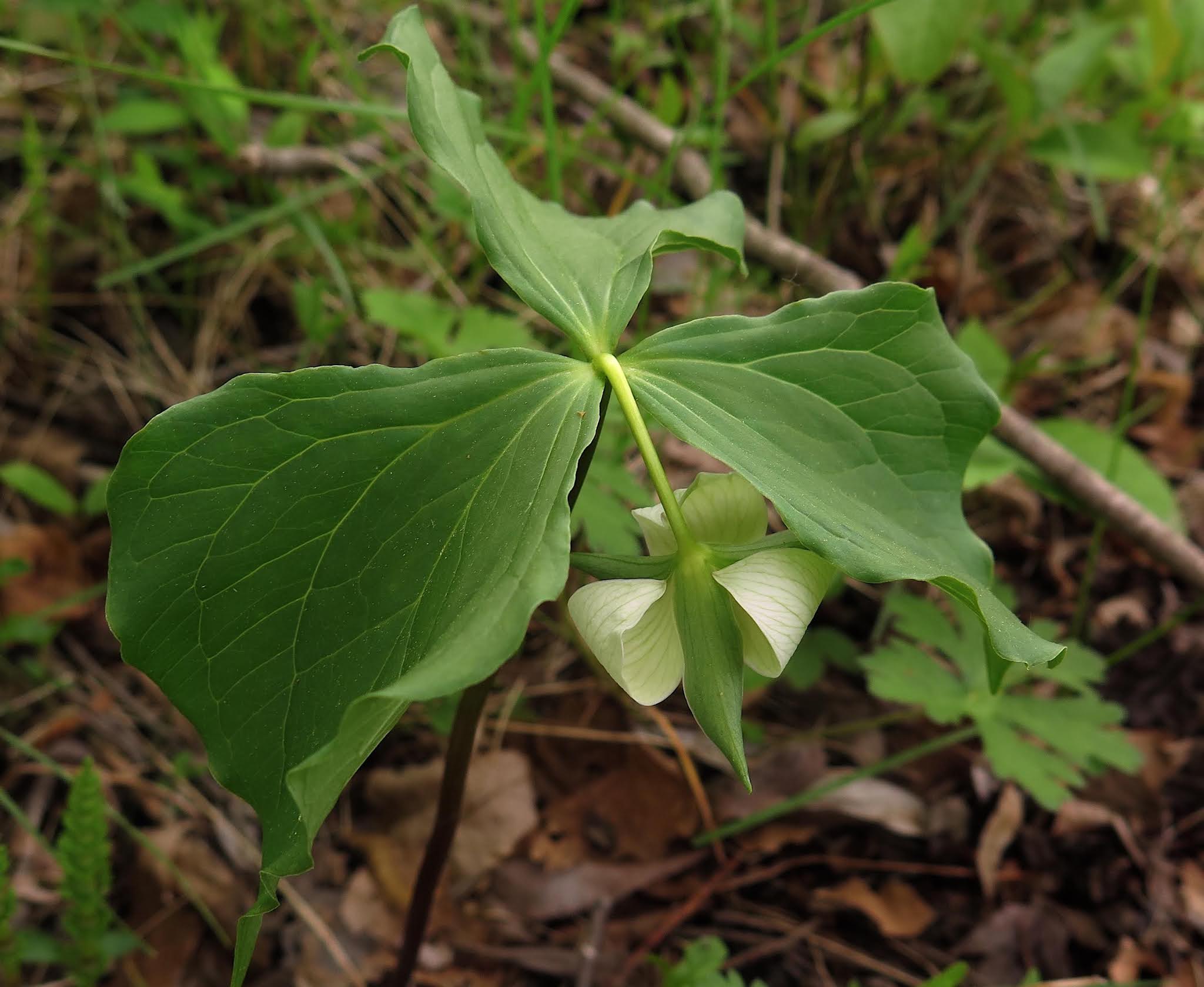
But this photo still shows the birch-lined section of trail where I search for Nodding Trillium (Trillium cernua) each May.  This lovely native wildflower hides beneath the trailside shrubs, and it's always a good idea to locate their early shoots, before the ferns and grasses grow high enough to disguise them.

I didn't really expect to find the Nodding Trillium blooming yet, but considering how cold it has been of late, I was surprised to see them as far advanced as I did, with swelling buds atop fully expanded leaves. (The flower buds will dangle beneath the leaves when they actually open.)


It looks as if it might be a great year for these flowers along this trail.  Here was a cluster of four good-sized plants with buds about to burst.


I found many new trillium plants, some already sporting buds while others might still be too young to bloom this year. A few years ago, a state botanist told me that Nodding Trillium seemed to be disappearing from many of the sites from which it once had been reported, so I am very happy to report that this species appears to be secure along Bog Meadow Brook Trail.


My trillium sleuthing successful, I relaxed and enjoyed an easy walk, noting what wildflowers WERE in bloom along the trail.  The most abundant flowers were those of Wood Anemone (Anemone quinquefolia) forming extensive patches of pristine white flowers atop spreading five-parted green leaves.


Wild Strawberry plants (Fragaria  virginiana) dotted the trailside grassy areas, promising a few sweet treats for hikers as the season progresses (if the birds or chipmunks don't eat them first).


Kidney-leaved Buttercup (Ranunculus abortivus) is often overlooked because its flowers are so small, but when these plants grow in abundant numbers as they do along this trail, it looks as if a handful of tiny bright stars were scattered across the ground.


Sessile-leaved Bellworts (Uvularia sessilifolia) are also easily overlooked, since they dangle their pale-yellow bell-shaped flowers beneath their leaves. It helps to make them easier to spot when they grow massed together in abundant numbers, as these did.


If not for their snowy-white flowers dangling from bright-red budscales, I could easily have walked right by without spotting this isolated tiny shrub of Lowbush Blueberries (Vaccinium angustifolium).


But I never could have missed the masses of Dog Violets (Viola labradorica) that carpeted the grass by the side of the trail.  The flowers are such a pale lavender they almost appear to be translucent, which helps to distinguish this native species of violet from the much-deeper-purple Common Blue Violet.  Another distinguishing feature is that these violets bear leaves on their flower stems (the Common Blues have basal leaves only), and the stipules that wrap the leaf nodes are sharply toothed.


The broad green leaves of a patch of Wild Ginger (Asarum canadense) could be spotted from many yards away, but I had to bend down and peer under the leaves to see its unusual brownish flower resting on the ground.


I wish I had brought some blaze-orange tape to mark this Wild Black Currant shrub (Ribes americanum) so that I might find it later in summer, when it bears its juicy tart fruits. The length of the flowers helps to distinguish this native species from the European garden currants or the native Wild Red Currant, both of which bear flowers that are squatter and more saucer-shaped.


No flowers yet, on this Glaucous Honeysuckle (Lonicera dioca), a vining plant that is one of our few native honeysuckles. I sure hope I can find this vine again when those flower buds burst open into a spray of confetti-colored flowers, orange and yellow and coral.


No flowers on this Red Maple tree (Acer rubrum) either, because the female flowers have faded by now to produce abundant clusters of bright-red winged seeds. I was happy to see this gloriously colorful tree, completing the cycle -- from buds to blooms to seeds --  of beautiful things I found on this pleasant but now growing soggy walk on the Bog Meadow Trail.


Saturday, May 1, 2021

Quick Stop-over at Woods Hollow

I was feeling kind of bummed today.  I'd called the Agway in Ballston Spa to see if they had any native shrubs and was told, oh yes, we have TONS of them. Well, they didn't. Even the two I found that were native species -- a Clethra alnifolia and a Kalmia latifolia -- were "nativars," altered from the straight species of Sweet Pepperbush and Mountain Laurel to appeal to gardeners more than to native pollinators or insect larvae.  I guess the person I spoke with at Agway interpreted "native" to mean anything that would grow in this part of the world, no matter how exotic.  Luckily, Ballston Spa is only a few miles south of Saratoga.  And happily, one of my favorite nature preserves -- Woods Hollow -- is located on the way home. So I pulled in there to soothe my grumpy mood.

The first remarkable thing I noticed at Woods Hollow was a large mass of shiny gold bud scales lying on the entrance path:


I suspected what they might be, but I picked up a handful of the sticky scales and took a sniff, just to be sure.


And I was right.  These were the long, skinny, and very fragrant bud scales that had held the glossy green leaves of Balsam Poplar (Populus balsamifera) now freshly opened on the tree and shining in the sun.


A close look at the back of a leaf revealed the "mudcrack"pattern of tiny veins that clinched the ID.


Balsam Poplar is native to New York State but it really prefers a colder climate than we offer in Saratoga County.  Although this pretty tree thrives in the Adirondack region of New York, we don't see them very often around here.  So this was a nice find today, helping to soothe my irritation regarding a commercial operation that didn't know a native plant from a hole in the ground.  They even offered Burning Bush for sale!  AAARGH!!!


A few more pretty native plants awaited me as I made a quick circuit of a swampy trail that circles the pond at the center of the Woods Hollow Preserve.  The snowy-white bells of Leatherleaf flowers (Chamaedaphne calyculata) dangled on arching stems beneath their leathery oval leaves.


Masses of small white violets prettied a muddy swale.  We have several species of native white violets that are difficult to tell apart, but the damp habitat as well as the rounded leaves led me to believe these were probably Viola pallens, sometimes called Smooth White Violet or Northern White Violet.


The orbs of tiny star-shaped flowers of Dwarf Ginseng (Panax trifolia) were blooming abundantly beneath the trees in a wooded wetland.


The pure-white flowers of Goldthread (Coptis trifolia) were just beginning to bloom in that same shady spot. The flowers were so newly opened that the curly-tipped green pistils had yet to unfurl from amid the cluster of numerous white stamens, and the club-shaped translucent petals were still rather green and had yet to assume their golden yellow color. What look like the showy petals are actually the sepals of these early spring flowers. Although they are out of focus in this photo, you can see on the ground beneath the flower the glossy compound leaves, divided into three scalloped leaflets.


After I returned home, I took a walk in Saratoga's Congress Park, just a block from my house. And there in the grass, I found dozens and dozens of blooming Cuckoo Flowers (Cardamine pratensis).  Remembering it was May Day, when I long ago used to pick little bouquets of dandelions and violets out of the lawn to present to my mom, I picked myself a little bouquet of these native wildflowers before the approaching mowers could shear off their pale-pink fragrant blooms.


I am discovering great discrepancy in opinion regarding the native status of Cardamine pratensis. Several states, New York, Minnesota, and Missouri among them, count this circumpolar wildflower as a native North American species, as does the Newcomb's Wildflower Guide and the Lady Bird Johnson Wildflower Center. Yet BONAP and GoBotany (and probably others) claim it is not native. Since I am a New Yorker, I will concur with what our state botanists declare.  But why is there so much disagreement? I would love to hear some arguments for both decisions.


UPDATE: I have heard from a number of authoritative sources that there are actually TWO distinct species called Cuckoo Flower, one native and one introduced from Eurasia.  Arthur Haines, author of Flora Novae Angliae: A Manual for the Identification of Native and Naturalized Vascular Plants of New England, has informed me that "Cardamine pratensis . . . originated in Eurasia. The problem is that a native and very closely related taxon (Cardamine dentata) has been recognized in the past as Cardamine pratensis var. palustris. Then, some taxonomic authors simply united the species together (considering it one taxon that ranged over North America and Europe). However, the two taxa are readily identifiable. The problem has been that the characteristics are poorly articulated in keys, so that has led to confusion. But, confusion by botanists who fail to accurately describe the differences does not mean these two organisms are not discrete taxa."

According to information I received from several other sources, our NATIVE Cuckoo Flower (Cardamine dentata) has pure-white flowers and is rather rare in this region, being limited to high-pH wetlands. The INTRODUCED Cuckoo Flower (Cardamine pratensis) has pale-purple flowers and is found abundantly throughout our region -- including where I found those in my photo above, the spring-dampened grass at Congress Park in downtown Saratoga Springs.