Thursday, June 13, 2019

Two Rivers, Many Wonders

Well, we made it!  The dire predictions of drenching rain and possible thunderstorms didn't scare off a dozen or so of my Thursday Naturalist friends today. I really shouldn't have been surprised, since the site we were visiting -- Canal Park at Lock 4 of the Champlain Canal in Rensselaer County -- is known as a wonderful site for botanical exploring.  Here, where the Hoosic River joins the Hudson, rich alluvial flats and steep shale cliffs provide not just a beautiful place to walk, but also habitat for many remarkable plants.  So of course, my naturalist friends turned out.  And it hardly rained at all!  (The photo above shows four of my naturalist friends discussing one of their finds on this shore of the Hoosic River.)

When I came here on Tuesday to preview our walk, the sky was blue and sunshine glittered on the Hudson's ripples.  In this view, I am looking downstream toward Mechanicville, with the Hoosic entering the Hudson on the left.  Abundant rainfall over the past few months had turned both rivers full and swift and brown.


One of the Canal Park trails starts on the banks of the Hudson, where trees lean over the river from the heights of steep rocky cliffs and mosses cover the ground.  Another trail leads directly into the woods.


One of the more interesting shrubs along this trail is called Deerberry (Vaccinium stamineum).  Related to blueberries, this shrub bears small white flowers with protruding brown stamens. 


Deerberry flowers can be immediately differentiated from blueberry flowers by being more spreading and open.  The protruding needle-thin pistil and long brown stamens are also distinctive.


The Deerberries grow in the shade of the woods, while the flower in the photo below -- Foxglove Beardtongue (Penstemon digitalis) -- grows out on the sunny banks at the confluence of the two rivers.


Abundant numbers of Hairy Bushclover (Lespedeza hirta) also grow in this sunnier area (although there was more rain than sun when I took this photo on Thursday).  Several other species of Bushclover grow at Canal Park, including the rare Creeping Bushclover (L. repens), which will bloom later in the summer.


When the trail turned to follow the Hoosic River, I was impressed by how brown and turbulent the water was as it rushed along below the steep banks.


I promptly noticed that patches of Frostweed (Crocanthemum canadense) grew close to the trail as I started walking upstream.  It's pretty hard to miss these bright-yellow blooms with their orange-tipped anthers.


On the other hand (and also on the other side of the trail), I had to search to find these miniature plants of Sheep Laurel (Kalmia angustifolia), despite how vividly colored their flowers are. Grasses and low blueberry shrubs had grown up around them and hid them quite effectively.


Eventually, the trail leads down to a low alluvial area, where seasonal floods bring silt to enrich the soil.  Plants grow huge and healthy here, and the view of the landscape upstream is very picturesque.


Huge Sycamores, Cottonwoods, and Silver Maples tower over the rich bottom land.


Here is the plant we come here each year to visit:  Green Dragon (Arisaema dracontium), grown to enormous size in this rich alluvial soil.  Although the New York Flora Association Plant Atlas indicates this is not a rare plant, neither I nor any of my Thursday Naturalist friends have found it anywhere else but here. 


It was about 5 years ago that we found a single specimen of Green Dragon at this site.  Now, they flourish in nearly uncountable numbers and grow to prodigious size. 


I always return to this site later in summer, when these purple-topped Spotted Joe Pye Weeds (Eutrochium maculatum) will reach a towering height and be crowned with puffs of dusty-rose flowers.  Here, too, will grow Giant Ragweed that lives up to its name, and several other midsummer wildflowers that grow to impressive size in this rich soil.


And here was a tiny little flower that equally impresses me, such dainty little pink blooms erupting from the bulblet pod of a Canada Onion plant (Allium canadense).  This plant doesn't take any chances when it comes to reproduction, producing both clonal bulblets as well as flowers that will sexually produce seed through pollination.  And aren't they pretty? Hard to believe they're an onion!


Here was another tiny flower that's remarkably pretty, although it is not a native plant like that of the Canada Onion.  Three years ago, I found this one wee little Kenilworth Ivy plant (Cymbalaria muralis) tucked into a niche in a steep shale bank, and to date it has not budged from that niche nor appeared anywhere else along these banks.  For an introduced plant, it seems remarkably non-invasive, at least at this location.


Unfortunately, the same cannot be said for this equally pretty introduced plant, the Yellow Flag (Iris pseudacorusis).  A wetland plant that is extremely showy, the Yellow Flag colonizes in large masses, forming very dense stands and outcompeting other wetland plants.  Its appearance in this site so rich in unusual native plants is a great cause for concern.  I hope I can influence some invasive-species management folks to come here to eradicate the many plants that are beginning to colonize this site. The roots are very difficult to dislodge, so it will take quite an effort to remove the plants.


This photo below shows how the Yellow Flag has colonized a low area on the Hudson River banks  just across from Lock 4.  I truly hope this is not what the future holds in store for the site we Thursday Naturalists visited today.


Saturday, June 8, 2019

First Paddle on the Hudson, 2019

 At long last, a warm sunny day on Friday! Perfect for a paddle on my beautiful Hudson River at Moreau, my first time out on the river this year.  After weeks and weeks of rain, the river was still full and fast, but at least the surface was quiet as I pulled hard against the current to reach some little islands that lie just offshore from the Sherman Island boat launch along Spier Falls Road.


I was afraid I might be too late this year to witness the Early Azaleas blooming abundantly on these little islands, but I could detect their incredible fragrance even before I saw their big bright-pink blooms along the rocky shore.


These little islands used to be covered with tall oaks and birches, but what consistent flooding over the past 10 years hasn't killed, the beavers have toppled, so that what were once shady glades on a hot summer day are now open areas filled with Lowbush Blueberry and Black Huckleberry shrubs. Plus lots of azalea shrubs.


If the birds don't eat them first, all these berry bushes will provide quite a feast in midsummer. I loved seeing the ruby-red flowers on the Black Huckleberry shrubs.


Some bright-pink and yellow Pale Corydalis flowers had sprung from cracks in a boulder along the shore.


When I returned to my canoe after walking around the island, I found I had a passenger with this very large Striped Fishing Spider.  Sorry, buddy, I can't take you fishing with me today.  I do love spiders,  but not crawling around in my boat! I gently tipped him off the gunwale onto the sand.


Wow!  Look how the spider virtually disappeared against the sand!


High water on the river this year has drowned most of the beautiful wildflowers that grow close to the water, so I never saw any Blue Flags or Small Sundrops or any of the other June flowers that usually delight me along this section of the river.  Plus, my arms were growing weary from paddling against a strong current.  So I beached my boat after an hour or so and headed home.  But on the way, I stopped at the powerline clearcut that runs at the top of Mud Pond.  Would our native Climbing Bittersweet be blooming now? 

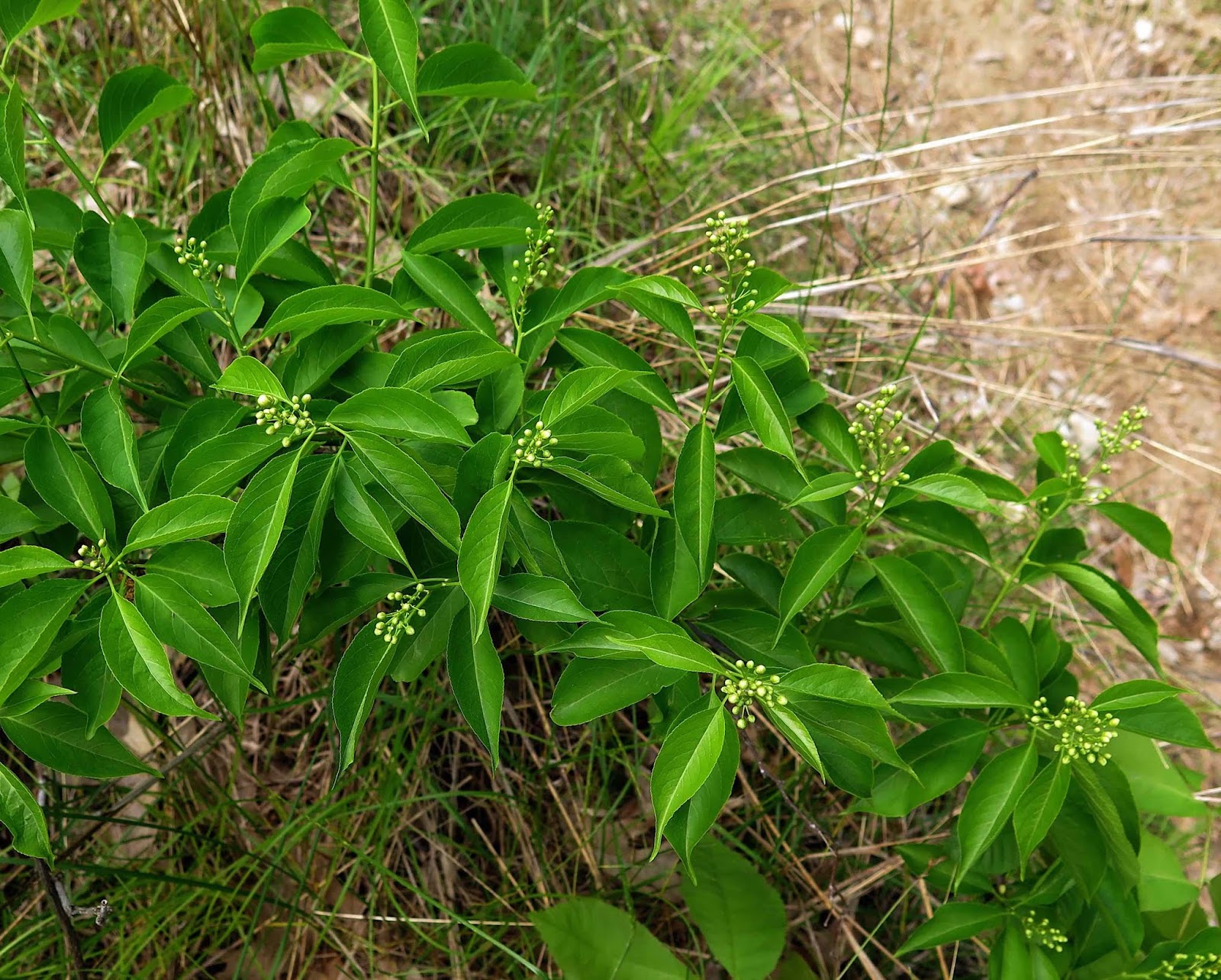
American Climbing Bittersweet is a native vine that is seriously threatened by the introduced Oriental Bittersweet that strangles many of our roadside trees now. So I'm happy to know where some of our native bittersweet grows, and I found it thriving this year, although mostly still in tight bud.


Here was one little greenish-white flower opening atop a terminal cluster of buds.  The presence of terminal flower clusters is one of the features that distinguish this native vine from the introduced one, which bears its flowers in leaf axils along the vines.


The sandy soil of this clearcut provides a perfect habitat for our native Wild Lupine, too.  This lovely perennial Pea-family plant is not abundant at this site, but a few patches of it do thrive here, and they were in gorgeous full bloom today.  This plant is the only larval food for the federally endangered Karner Blue Butterfly, and I did see a small brown butterfly busy among the leaves of this patch.  The female Karner Blue is small and brown, but this butterfly did not land long enough in one place for me to get a clear photo, and thus a certain identification.


Another gorgeous wildflower that thrives along this sandy clearcut is the Pink Lady's Slipper, and I found over 50 today, in full glorious bloom. They tend to grow just at the edge of the pine woods that lines the clearcut, but a few grow out in the mossy verge.  I thought this one was especially pretty, set off by a baby spruce.


Wednesday, June 5, 2019

It's Showtime Now at Wilton Wildlife Preserve!

If you live anywhere within reasonable driving distance from Wilton, NY, you really shouldn't miss the floral extravaganza going on right now at the Wilton Wildlife Preserve and Park.  Acres and acres of beautiful blue Wild Lupines (Lupinus perennis) are in their glory now, and WOW!  What a sight to see!  Come on, let's take a walk through the lupine fields.

The show starts almost immediately as you set out on a sandy trail.  The Wilton Wildlife Preserve manages several sites for the cultivation of Wild Lupine (the only larval food for the federally endangered Karner Blue Butterfly), but the site I am visiting here is called the Gick Farm Parcel, located on Rte. 50 a few miles north of Saratoga Springs.


Every turn of the trail reveals another vista, masses of stately blue-flowered plants spread out across the gently rolling land of this oak/pine savanna.


More lupines.


Still more lupines.


LOTs  more lupines!


Never-ending lupines!


Massive carpets of lupines that seem to roll on forever.


Sometimes you just need to rest your eyes and look at something else.  I loved the spiky verticals of this patch of Tower Mustard (Turritis glabra) marching along the path.  Some folks dismiss this plant as a weed, but it's actually a native wildflower with a fascinating habit of growth, holding its long skinny seed pods close to the stem as it reaches for the sky.


There are several other sand-plain preserves in our region that cultivate Wild Lupine to support populations of the Karner Blue Butterfly, but the best-known of these -- the Albany Pine Bush -- manages the land to suppress the growth of pine forest.  That's not completely the case at Wilton, for here we find an extensive pine woods, dark and cool on a hot spring day, with a forest floor teeming with native shade-loving wildflowers, including the gorgeous native orchid called Pink Lady's Slipper (Cypripedium acaule).  As soon as you step from the bright light of the open meadows and your eyes adjust to the gloom, look what lies at your feet:  More Pink Lady's Slippers than you can take in with one glance.


Here's a duo of Lady's Slippers rising from a carpet of sweet-smelling Canada Mayflower (Maianthemum canadense).


Here are three, all crowded together on the pine-needle-carpeted forest floor.


What a gorgeous cluster of four!  At Wilton Wildlife Preserve and Park, I find more multiple clusters like this than at any other pine-woods preserves I have explored.


Here's what the whole lupine extravaganza is all about: the wee little butterfly called the Karner Blue.  But wait, that butterfly is feeding on a Dewberry bloom, not Wild Lupine!  Yes.  The adult Karner Blue (and this is the brightly colored male, the female being a muted brown) can sip nectar from any flower that produces that sweet fluid.  It's the babies, the larvae, that have to have lupine leaves to eat, or they will not survive.  But I think as my photos here have revealed, that won't be an issue at Wilton Wildlife Preserve and Park.  Go see for yourself!
 

Tuesday, June 4, 2019

A Violet Hunt Along the Hudson

We've had so much rain this spring, our rivers have remained rushing torrents long after in other years I would have been paddling their quiet waters. And many of the native wildflowers I paddle to visit can't yet be found, since their usual sites are still well under water.  So when my friend Sue invited me to join her for a trip to the Hudson River shores north of Warrensburg, I had my doubts we would find many of the rare plants this stretch of riverbank is famous for.  But it's still a beautiful shore, with interesting marble outcroppings, and the path from the parking lot to the river passes through a pine woods abounding in gorgeous Pink Lady's Slippers.  So of course I said yes, let's go!


When we reached the river's edge, we were immediately struck by the scent of cherry blossoms filling the air.  In all the years I've been exploring this site, I have never seen such an abundance of Dwarf Sand Cherry (Prunus pumila var. depressa) sprawling across the rocks.  It seems that, instead of damaging the plants, the excessive flooding we've experienced this spring has only encouraged the vigor of this threatened species of low-growing cherry.  The blossoms were as beautiful as they were fragrant.


It was obvious from the damp sand and flood-flattened grasses along the shore that the river had only recently receded. I was sorry to see this, since I had hoped I might find here again the rare Primrose-leaved Violet (Viola primulifolia var. primulifolia) I had discovered among the shoreline pebbles a few years back. Could ANYthing be growing yet, on land so recently under water?  Sue helped me search the gravelly shoreline.


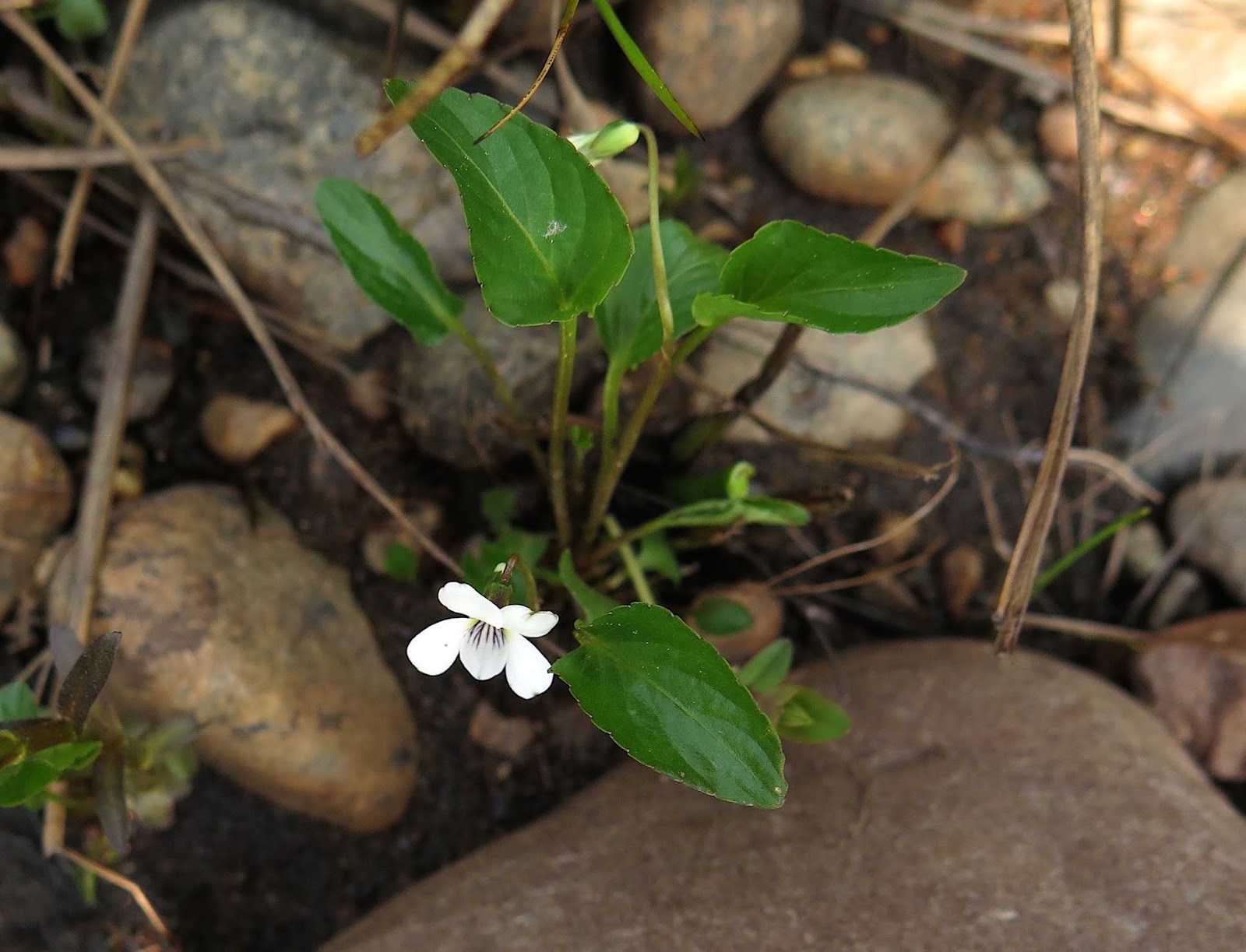
My hopes leaped high when she spotted some tiny white violets struggling up from the mud, for the Primrose-leaved Violet bears a white flower.  But this violet had heart-shaped leaves, not the more ovate ones that distinguish the Primrose-leaved one.  This violet looked to be one of our early white violets that I have difficulty distinguishing, either V. pallens or V. blanda,  both pretty but neither one rare.


A second white violet raised my hopes again, but again, the shape of the leaves revealed that this was not the one I was seeking.  Those long slender leaves indicated that this was the Lance-leaved Violet (V. lanceolata), not V. primulifolia.  An interesting find, but not a rare species.


But then, at last, Eureka!  Here was the sought-after Primrose-leaved Violet, tucked in among the rocks down close to the water.  This solitary plant appeared considerably diminished from the many-stemmed clump of them I had found just two years ago, but it was still hanging on, despite the rushing torrents that could have uprooted it. This violet, classified as a Threatened species in New York, surprised state botanists by appearing here, far from any other location it has been documented as growing.


The Primrose-leaved Violet, though, is not the only exceptional violet said to grow on this remarkable riverside.  Botanical records reveal that another, even rarer violet has been found at this site, the purple-flowered New England Violet (Viola novae-angliae). In fact, there is no other place in all of New York from which this species of violet, classified as Endangered,  has been reported.  I, personally, had never found it, despite diligent searching for several years.  But with hopes buoyed by the Primrose-leaved find, I decided to search for the New England Violet once again.


There are several species of purple-flowered violets that grow on this shore, so of course, I had to bend down to examine each one, to see if I could detect any distinguishing characteristics. Again and again, none of the purple-flowering violets struck me as being unusual, even this wooly ovate-leaved one, which I recognized as the Northern Downy Violet (Viola sagittata var. ovata), a common denizen of gravelly, sandy habitats.  Pretty, but not the one I was looking for.


(Another pretty inhabitant here, this brightly-colored American Lady Butterfly, distracted me momentarily from my botanical searching. This butterfly can be distinguished from the remarkably similar Painted Lady by the larger eyespots on the lower wings and a single white spot on each upper wing.  By such subtle but critical distinctions are species separated, whether botanical or zoological!)


After several hours of exploring the eastern shore of the Hudson and finding many other interesting plants (but no New England Violets), our hunger for food began to overcome our hunger for more botanizing, so we headed back to Warrensburg for some lunch before we drove around to the western shore of the river.  Thus fortified, we made our way down to the rocky outcroppings that typify the shoreline here.


This side of the riverbank is distinguished by many seeping springs and pools in the rocks, and the water levels were still so high, we had difficulty making our way without wading through shin-deep water.  Also, none of the more interesting plants that grow close to the river were yet in bloom.  No Sticky Tofieldia nor Rose Pogonia, not even some Kalm's Lobelia nor Harebells were anywhere to be seen.  So we headed up the banks toward the woods, and that is where we found a beautiful patch of Golden Ragwort (Packera aurea) glowing in the shade of the trees.


Almost hidden in the tall grass was a patch of the amusing little graminoid called Alpine Bulrush (Trichophorum alpinum).  I am always delighted by the white hairy tufts that give these Sedge-family plants the appearance of a group of tiny trolls.


A big patch of radiant Wild Columbine (Aqualegia canadensis) resembled ruby-glass lamps hung on wire-fine stems.


Sue and I were quite excited to find a patch of One-flowered Broomrape (Aphyllon uniflora) growing in exactly the same place we had seen it six years ago. Since this is a parasitic plant that feeds off nutrients provided by other organisms, it often disappears from a location once those nutrients have been depleted.  That had seemed to be the case in the intervening years, but somehow this plant found a way to bloom once more, right where we thought it was gone forever.


Lots of purple violets were blooming in the grass, most of them resembling the Common Blue Violet, but this cluster of blooms stood out for the intensity of its flowers' color. We were tired and my feet hurt from a full day of scrambling over rocks, so I almost passed them by without examining them.  But the sunlight picked out a distinctive hairiness of the stems, and the leaves looked narrower and more tapered than those of the Common Blues.  Oh heck, I decided, let's take a closer look.


That closer look revealed a violet flower that was far more hairy than any flower of Common Blue I had ever seen, and with hairs not confined to the lower petals but even tufting on the upper petals as well. My Newcomb's Wildflower Guide was no help to me here, since it included no violet that displayed this feature.  Could this be that rare New England Violet? Newcomb's didn't list that species nor describe it. There was no way I could know until I consulted a violet expert.  So I took lots of photos of various parts of the plant (leaves front and back, stem, spur, ovary and style, and more views of the flower's face) and went on my way.


I bet my readers have already guessed the happy ending of this story.  Thanks to confirmation from Steve Young, chief botanist for the New York Natural Heritage  Program, I can confidently assert that this violet really WAS the extremely rare New England Violet.  And I bet my readers can also guess how glad I am that I stopped to examine it.  Whoo hoo!  Yee haw!  High five!  Oh, happy day!  My fellow wildflower nerds will understand how psyched I am to have found it.