Saturday, September 8, 2018

Lots More Dwarf Bulrush!

As I related in my previous post, Rich Ring's and my search for a very rare species of flat sedge was cut short by a thunderstorm Thursday afternoon.  But the following day (Friday) dawned calm and cool and very pleasant for me to resume the search for Small-flowered Dwarf Bulrush (Cyperus subsquarrosus) around the shore of Moreau Lake.  And oh my, did I find it!

The photo below shows the sandy eastern shore of Moreau Lake.  The several green lines of vegetation along the shore reveal how water levels in the lake have fallen over the past few years, with each line marking another stage of low water levels.


As I bent to examine the make-up of the vegetation that formed those lines, I could hardly believe my eyes!  The vegetation was almost entirely made up of the pale-green swirly stems of Small-flowered Dwarf Bulrush.  Remember, this plant is rated by New York State as an Endangered species, and its presence at Moreau Lake has not been reported since 1961.   For 57 years, its seeds must have lain in wait underwater for lake levels to recede and grant them once more the sunlight and air they needed to flourish.  I would say, this plant has surely made a comeback!


For a moment or two, I attempted to count individual plants, but I soon gave up the effort.  There were so many of them, all entangled with one another, I had a hard time telling where one plant ended and another began.  If you click on this photo, you will be able to better see the distinctive seedheads that resemble miniature pinecones.


After noting how far that population extended along the eastern shore, I next rounded a curve past a shoreline cottage to enter a deep cove.  Parts of this cove's shoreline are sandy and sunny, while other parts are muddy and shaded. I was curious to see if I could find more plants of Dwarf Bulrush along the shore of this cove.


Tall stalks of Round-headed Bushclover (above) and Blue Vervain (below) were among the many sun-loving plants that populate this part of the cove's south-facing shoreline.


The sunny shore of this cove is also where I found another Endangered species a few years ago, called Whorled Mountain Mint (Pycnanthemum verticillatum var. verticillatum).  Although it was long past blooming now, I could still identify the plant by its distinctive spiky seed heads (below), and I'm happy to report that it continues to thrive at this location.
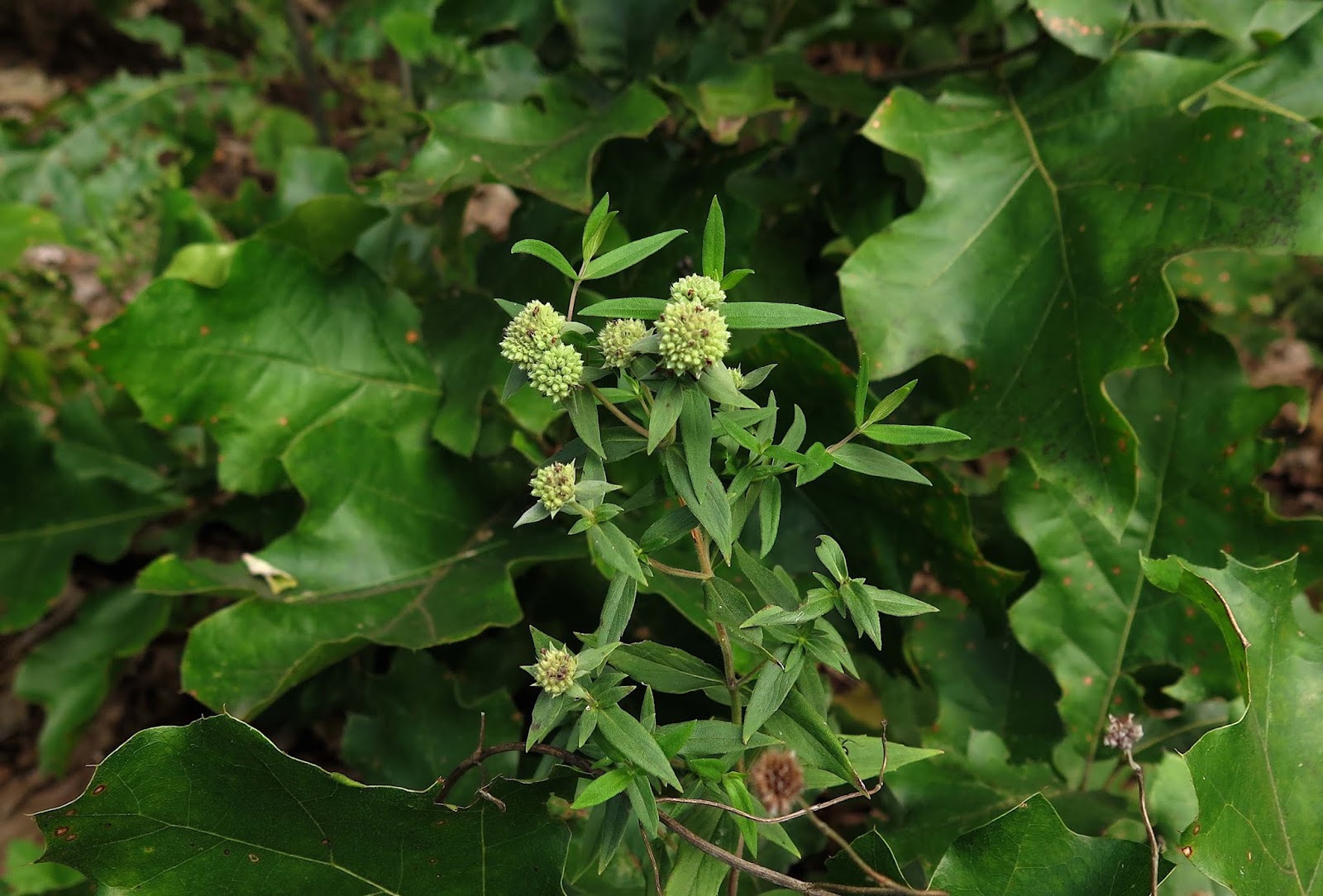


I'm also happy to report that hundreds of Small-flowered Dwarf Bulrush are also thriving along the cove, especially where the shore was sandy or pebbly.


I even found a few little plants where the shore began to turn muddy.  But the numbers petered out to none as I entered a shady stretch of the cove where shrubs and trees and tall cattails extended down to the water's edge.


Having satisfied myself that I had located the bulk of the Small-flowered Dwarf Bulrush's population at this part of the lakeshore,  I allowed myself to attend to some of the other plants that grow here. I was especially charmed by this miniature Nodding Bur Marigold (Bidens cernua), a plant that usually reaches more than a foot in height.


I also found a large patch of the beautiful Scarlet Smartweed (Persicaria coccinea), each tall flower stalk surmounted by a spike of pretty pink flowers.


A ruckus in the leaves of a tall Sassafras tree (Sassafras albidum) alerted me to the presence of a Pileated Woodpecker high up in the branches, feasting on the blue-black fruits that are held aloft on scarlet pedicels.


Uh oh!  I was so distracted, trying to get a better glimpse of that woodpecker up in the tree that I nearly bumped into this wasps' nest hanging from a Red Maple branch.   Luckily, I halted in time, before I enraged its inhabitants.  I did hang around for a moment, though, because I was curious to see that these wasps were striped black and yellow, and not the black and white of the Bald-faced Hornets I usually associate with these hanging nests. I wonder what species they are.


I DO know the species of this lovely wasp eating pollen and sipping nectar from Boneset blossoms. And I also knew I had nothing to fear from it, for this jet-bodied, white-striped, blue-winged Mason Wasp (Monobia quadridens) is a non-aggressive solitary wasp that has no colony to defend and so has no need to sting you.  While the adult wasp feeds on plant pollen and nectar, it will also sting and paralyze caterpillars to feed to its young, including many caterpillars that are considered garden pests.  So think good thoughts about Mason Wasps, as beneficial as they are beautiful.


Here's another insect that looks quite ferocious with its tiger stripes and blood-red legs, but it's really quite a mild-mannered beetle called a Locust Borer (Megacyllene robiniae).  It does have mandibles that might deliver a bite if you handled it roughly, but Black Locust trees have far more to fear from it than humans do.  Its bright coloring tends to scare off birds that might prey on it, and its colors do go beautifully with its favorite flowers to feed on, the goldenrods.


I saw one more bug, and one I had never seen before and sure didn't know the name of.  Or whether I should keep my distance, which is why this photo is so blurry.  Turns out, I had no reason to fear, since BugGude.net has informed me that this is the Hunchback Bee Fly (Lepidophora lutea).  It has no stinger, and that scary-looking appendage sticking out in front is only the harmless proboscis the bee fly uses to feed on nectar and pollen.


On a site called Eye on Nature, I read that the common name, bee fly, is an apt name because its larvae are parasites on the larvae of burrowing solitary bees and wasps.  Adults are strong fliers that can hover and quickly dart about in all directions.  They use their hovering skills during mating and while feeding on flowers, and females also hover near the ground while searching for the entrance of a bee or wasp nest to host their offspring.  If the bee fly spots what looks like a nest entrance, she'll fling an egg toward it from her hovering position with remarkable accuracy.

Wow!  So many amazing things I find, just walking around the lake!

Thursday, September 6, 2018

Tiny Treasure Along the Shore

Another sweltering day today.  I would have preferred to remain in air-conditioned comfort somewhere.  But I had agreed to meet Rich Ring, rare-plant monitor for the New York Natural Heritage Program,  to help him assess a rare-plant population along the shore of Moreau Lake.  So off I went to the lake to meet him, and oh, am I glad I did!

I'm also glad we got there early enough to still find some shade along the shore.


I had alerted Rich about the teeming numbers of Small-flowered Gerardia (Agalinis paupercula) that crowd Moreau's lakeshore.  Rich informed me that this species had recently been removed from the Rare list, but because it was still on the Watch list, populations as large as what I was reporting were certainly worth an assessment and documentation.  And we sure did find LOTS of it, growing in uncountable numbers.


Sometimes we found almost pure stands of it, as in the photo above, but other times we found it as part of the marvelous mix of shoreline plants that decorated the sandy stretch between the water's edge and the forest behind.


I was delighted to find Noddding Bur Marigold (Bidens cernua) blooming now, such a sunny little flower!


To me, this Toothed Flatsedge (Cyperus dentatus) is as pretty as any flower, with those bicolored seedheads arranged in a herringbone pattern.


Rich asked me to keep an eye out for other flatsedges, most notably a tiny one called Small-flowered Dwarf Bulrush (Cyperus subsquarrosus), an Endangered species that last had been reported from Lake Moreau in 1961.  He said he had searched for it here another year, to no avail.  So we didn't have very high expectations that we would find it today.  I did find other tiny flatsedges , though (like the one pictured below that I don't remember the name of).  But nope, this wasn't the one that Rich was looking for.


UPDATE:  Thanks to Steve Young, chief botanist with the New York Natural Heritage Program, for suggesting the name of this little flat sedge: Cyperus bipartitus or Shining Flat Sedge.


Hmmm?  How about this one, Rich?  It looked so different from the other small graminoids scattered along the damp sand, with these curving stems and squat little seedheads that almost looked like miniature clover flowers.


And oh my gosh, this was IT!  This was indeed the Small-flowered Dwarf Bulrush that no one had seen on these shores for 57 years!  I don't know if anyone but other plant nerds can understand how elated we felt to have found it.  There were no other folks on the shore to see and hear us, but if there had been, we certainly would have attracted attention with our whoops! and hurrays! and high-fives!


Okay.  Settle down.  So we found this one.  And yes, there's another.  Two more, in fact.  How many others are there?  Rich went back to where we had begun our plant search to see if we had missed any back there.  Oh yes, we sure had!  (They are really very tiny!)  So Rich started counting individual specimens from back at our starting point (he's the tiny figure in the photo below), while I continued along the shore to see how far this population extended.


By the time I reached a place on the shore where I could find no more plants, Rich already had counted 750 specimens, and he still had many more yards of shoreline to assess before he caught up with me.  So there must have been at least a thousand.  A THOUSAND individual plants of a species rated as Endangered, and on just this limited stretch of shoreline! We had only begun our search.

Unfortunately, a thunderstorm blew up with drenching rain and threats of lightning, so we were forced to terminate our botanizing for today.  But we will be sure to come back to explore other sandy stretches of shoreline along Moreau Lake.  A few years back, the water level in this lake was much higher than it is today, and there were fewer stretches of broad sandy beach than there are today.  So it's possible that seeds of this extremely rare tiny flatsedge had just been biding their time underwater, waiting for water levels to fall and restore them to their place in the sunlight and air.  Where one happy day,  a couple of plant-obsessed people like Rich and me would come along and find them.

Wednesday, September 5, 2018

Pink!

September:  when the days grow short, and the grasses turn pink!  Here are some views of acres and acres of lovely pink grass, from around Saratoga County.

Masses of Pink Love Grass (Eragrostis spectabilis), backed by the rusty-rose stems of Little Bluestem Grass (Schizachyrium scoparium).  The Saratoga Sandplain grassland restoration site at the Wilton Wildlife Preserve and Park in Wilton.


Here's more of the Little Bluestem Grass, which sometimes looks as pink as the Pink Love Grass.  Oak/pine savanna habitat, Gick Farm Parcel of the Wilton Wildlife Preserve and Park.


Pink Love Grass in an open meadow of the New York State Tree Nursery, which adjoins the Saratoga Spa State Park in Saratoga Springs.


A vacant lot full of wonderful "weeds":  Curly Dock, Pink Love Grass, Tall Goldenrod, Cattails, and more.  Near the Skidmore College riding stables on Daniels Road.


Tall clumps of Indian Grass (Sorghastrum natans) wave in the wind at the Saratoga Sandplain grassland-restoration site, Wilton Wildlife Preserve and Park.


Tuesday, September 4, 2018

Farewell to Summer. Or Not.

Okay.  Labor Day has come and gone.  That means summer is over, doesn't it?  Heck no!  The sweltering heat remains in full force, unfortunately, at least for the next few days.  Longing to be outdoors, but hating this heat, I took my canoe to the Hudson yesterday, knowing I could douse myself with cool river water whenever I started to wilt.  But I also stopped off at Orra Phelps Nature Preserve on the way, wondering if maybe this heat had impelled the Fringed Gentians that grow there  to bloom this early.

At least the Orra Phelps Preserve is deeply shaded, and the rushing and bubbling sound of the stream that runs through it offers at least the suggestion of coolness.


Maybe this little Green Frog was feeling the heat, too, since it didn't seem to want to make the effort to hop away when I stuck my camera in close.


Sure enough, the Fringed Gentians were open!  Well, one or two of them were.


There are many more of these gorgeous royal-blue flowers yet to come, to judge by the abundance of buds that were swelling in the sandy open area where they grow.  I know of nowhere else in Saratoga County to find them.


I also love to visit Orra Phelps for the abundance of Indian Cucumber Root that grows along the stream.  This time of year, the top tier of leaves is decorated with splashes of rosy red, surmounted by clusters of blue-black berries.  A beautiful combination!


Thanks to recent rains, the forest floor is abounding with mushrooms now, and one of the most abundant at Orra Phelps was this lemon-yellow one, the Suillus americanus, also known by the common names of White Pine Bolete or Chicken-fat Suillus.  I think it looks rather like a lemon cheesecake, and it does have a lemony flavor when cooked.


Next stop, the Hudson River at Moreau, where it forms the northern boundary of Saratoga County.  Here, forested mountains fall straight to the water's edge, and pretty little islands dot the broad waters of the river.  The water was low yesterday, and it must have been low for a while, for this muddy flat area edging one island was covered with green grasses and flowering plants.  Most of the summer, this flat expanse had been under water.


Taking advantage of this exposure to sunlight and air, masses of Golden Pert were blooming among the sedges and grasses.  This is a plant that is quite happy to spend most of its days submerged, creating a carpet of green on the river's bottom beneath shallow water.  As the water level  falls, it will burst into bloom almost overnight, carpeting large areas with these tiny bright-yellow trumpets.


Pristine-white blooms of Arrowhead were also dotting this watery flat.


This kind of wet soil is exactly the habitat that this shrub called Buttonbush likes best.  Although its perfect spheres of white trumpet-shaped flowers had fallen, the cherry-red seed heads remained -- and were just as lovely.


The pink-satin flowers of Marsh St. Johnswort had also faded by now, but in their place were these even-more-colorful ruby-red seed pods.  I could see that some of the pods had already split open to spill the little brown seeds.


Paddling back to shore under overhanging trees, I was delighted to see numerous Closed Gentians gracefully bending over the banks, holding their lovely blue flowers right at eye level as I passed.


Higher up on the banks, bright blossoms of Sneezeweed shone like beacons from out of the dark shade.


As I pulled my canoe from the water, this Black Duck drake and his harem of hens seemed not the least bit disturbed by my nearby presence.


Saturday, September 1, 2018

Once More, Around the Back Bay

Sometimes, my friends ask me why I don't tire of returning to the same nature sites over and over again.  Well, the simple answer is, they're never the same place twice!  I certainly experienced that this past week, when I explored the back bay of Moreau Lake four times:  twice to lead nature walks for two different groups, once to preview what I would show to the groups, and finally, once again yesterday, all by myself. Each time, I discovered something new to amaze me. Yesterday, I just moseyed aimlessly along, letting the spell of this wooded lakeshore lead me where it would, revealing its treasures without my purposefully searching them out.

Since I wasn't constantly searching the shoreline, trying to isolate and name the astounding variety of native plants that grow there, I could lift my eyes to all that surrounded me, including the bordering  woods.  How beautiful the deep dark shade, the soaring height of the trees, the mix of multiple textures and colors of shrubs beneath those trees!


I also paid more attention to the lake itself, noting how the water level had fallen so low that, close to shore,  the Fragrant Water Lily blooms were lifted up on their stems, rather than floating on the surface as they usually do.  The flowers were still as luminous as ever, and I loved the black reflection of them in the dark water.  I wondered, though, how that stem would withdraw that pristine white flower, as soon as it was pollinated, and deposit it under the water in the mud, since the water there was barely over an inch deep.  (We never see a wilted or discolored Water Lily, because this is what normally happens to fertilized Water Lilies.)


Because I was all by myself, not constantly raising my "outdoor" voice  to name the plants we were there to discern, I could creep slowly and quietly along.  Thus, I was able to approach quite near to this Little Green Heron before it opened its wings to soar away in search of a more private fishing perch.


Yes, I could put a name to most of the plants in this photo, but today I just enjoyed the marvelous crazy-quilt of their commingling, amazed by how they could coexist so companionably.


Many more Closed Gentians had achieved their optimal radiance now, the gorgeous royal-blue of their blooms so beautifully complimented by the rosy-pink of the nearby Slender Gerardia.


On my previous walks this week along this shore, I had isolated individual plants of Canada St. Johnswort in order to distinguish this tiny-flowered plant from the equally tiny-flowered Dwarf St. Johnswort, noting this plant's slender leaves and blood-red seedpods. Today, I could simply marvel at how the numerous tiny bright-yellow blooms were scattered across the sandy shore like stars in the sky.


Here is another beautiful scattering, of the bright-red berries of Partridgeberry, nestled among a patch of lime-green Pincushion Moss.


Best of all, today I could stand stock-still for as long as it took to observe the various flying, creeping, or spinning creatures going about their food-gathering ways.  This little brown moth, a Schinia arcigera, appeared like a fuzzy brown blur as it flitted from aster flower to aster flower.  Although this moth species does lay its eggs on certain species of aster, today it appeared simply to be feeding on the flowers' pollen. It was impossible to achieve a perfectly clear photographic image, since it never stayed long enough on each bloom.


The Meadowhawk dragonfly was much more accommodating to my photographic efforts, returning to this same perch again and again as I crept closer and closer, until I finally got the shot of its tomato-red abdomen, big brown eyes, and black-lace wings.


It was easy to photograph this multicolored Brown Owlet Moth caterpillar, since it was happily feeding on goldenrod and wasn't in any hurry to leave.


This Grasshopper Hunter Wasp was also very loath to leave its perch in a cluster of Sweet Everlasting blooms. Although this wasp's larvae dine only on grasshopper meat,  the adult wasps themselves happily feast on plant pollen.  I was able to re-position the flower to better observe the wasp's brick-red abdomen, and I never worried I might get stung, since this wasp is known to be very placid, saving its stinger venom for its only prey, grasshoppers.  (To see one in action, check out my blog post for July 24, this year.)


I was truly amazed that I happened upon this next scene, as a small Striped Garden Spider captured, stunned, and wrapped in silk for later consumption a shiny Green Bottle Fly.  In this first photo, we see the underside of the spider as it sinks its jaws into the fly to introduce the venom that will paralyze the fly so its frantic efforts to escape don't destroy the spider's web.


I moved around to observe the top side of the spider, which displayed the striped pattern that distinguishes this Argiope species, the Striped Garden Spider (A. trifasciata), from the Yellow Garden Spider (A. aurantia).  Both species can grow to prodigious size, although this one was rather small, its body a bit less than an inch long (not counting the tiger-striped legs).


As I watched, the spider wrapped the stunned fly in silk and suspended it in her web.  It then retreated to rest a while before dinner.  Note the zigzag weaving in the web, one of the distinctive features of webs woven by spiders of the Argiope genus.