Showing posts with label bugs. Show all posts

Tuesday, June 19, 2012

Blooms and Bugs

This is turning out to be a very flower-filled week, with far-flung excursions planned for the rest of it.  So yesterday and today I hurried off to catch up on some of my favorite places close to home.  My first stop yesterday was Woods Hollow Nature Preserve in Ballston Spa, where almost as soon as I stepped from my car, I was nearly bowled over by the beauty of this meadow chock full of snowy Oxeye Daisies and pretty pink Crown Vetch.


That sunny meadow was so full of just those two flowers,  I had to really search to locate the one I had come to find.  But find it I did:  Spiked Lobelia.


The air over the meadow was filled with darting and dashing dragonflies, and I couldn't believe my good luck when this Widow Skimmer sat still for its portrait, the sun glinting off its gossamer wings and touching its body with gold.


These two flower beetles were too wrapped up in each other to pay me the slightest mind, as I poked my camera into their intimate space.


There were several species of tiny hoverflies zipping in and out of the Common Milkweed flowers, and this tiger-tailed one took a moment to rest on a blade of grass.


As the mid-day heat bore down on my head, I was glad to seek the shade of the pine woods that makes up much of Woods Hollow.


It's under these pines that I know to look for the elusive Checkered Rattlesnake Plantain.  I always find the distinctively patterned basal leaves of many plants, but finding a flowering stalk is not always a given.  This year, I found but two flower stalks among some 20 plants in one area.  Sometime in the next few weeks, those tight green buds will open into tiny white orchids.


Sharing that same pine-needled forest floor were many Pipsissewa plants, easily seen, with their glossy evergreen leaves.  And as with the Rattlesnake Plantain, not so easy to find are the occasional flower clusters.


Tiny flies have no problem finding these flowers.  I don't think I have ever turned over one of these waxy pink blooms when I didn't find it crawling with little black flies.


When and where Pipsissewa blooms, it's almost a guarantee  that Shinleaf Pyrola will not be far away.


I see I wasn't the first one to find this lovely fat boletus mushroom with the rusty brown cap.


I next headed down to the pond that forms the heart of Woods Hollow Preserve, so cool and green and shady on this hot summer day.


There's a sweet little brook that flows into this pond, and its water (which must be spring-fed) is always icy cold and refreshing to my hot dusty feet.


I didn't have to wade far to find American Brooklime with its dainty little blue flowers, one of our native Speedwells.


 *  *  *

Well, today was even hotter and muggier than yesterday, and I really thought twice about visiting Bog Meadow Nature Preserve just outside Saratoga, a beautiful trail but which is more infested with Deer Flies than any other place I know.  Ah, but then I remembered my Tred-not Deerfly Patches, which, as this photo reveals,  saved me from being bitten by these 18 flies.


But not all the bugs along this trail are the kind we dread.   This butterfly eluded me for the longest time, but eventually it lit on a leaf and spread its glorious wings.   If it had closed its wings, it would have looked more like a dead brown leaf.  But then I could have determined if it was a Question Mark or a Comma, according to little white marks that can only be seen on the underside of the wings.  One thing I can say for sure is that this is one of the angel-winged butterflies, a species that will winter over as adults.

Update:  A loyal reader has left a comment positively IDing this butterfly as an Eastern Comma (Polygonia comma), noting the three dark spots across the middle of the forewing.  A Question Mark Butterfly would have a 4th spot that looks like a dash.


This little guy, on the other hand, has underwings  that are showier than the top.  I believe that this is an Eastern Eyed Brown, but there are several brown butterflies that look very much alike, and this one was not about to let me examine it closely.  It's a wonder I even got this close to it.


I hope this little Candy-striped Leafhopper is not some dreaded pest, because I am always delighted to see one.  Have you ever seen a little bug more colorfully attired?


It even sat still long enough for me to get a side view, so I could see its vivid yellow underside.


This tiny blue leafhopper, species unknown, did not sit still for one moment, so my camera had to keep chasing it as fast as it ran away.  It was quite a vivid blue, and if it had not been so colorful, I never would have noticed it.


And if I hadn't been chasing that little blue bug all over the leaves, I never would have turned this leaf over to find this little green caterpillar all snug in its silken hammock.  What a lovely sheer veil it has spun for itself.  I wonder if it's just resting in there, or is it getting ready to undergo metamorphosis?


Sunday, June 26, 2011

Fun Finds at Mud Pond

I wonder if Sue wore that orange tee on purpose, so she would match the gorgeous orange Wood Lilies we hoped we would find today on the sandy path at the top of Mud Pond at Moreau. We guessed we would find a few, since we did last year around this date, but wow! were we surprised by the multitudes! Like bright orange stars in a deep green sky in places.

We walked the entire length of the power line right-of-way and tried to count the numbers. We think we found somewhere around 85, but every time we looked again we found some others hiding. You wouldn't think that flowers as vividly colored as this could hide from view, but they did.


Another flower we found blooming along that sandy path was Clasping Milkweed (Asclepias amplexicaulis), also called Blunt-leaved Milkweed. Sue had discovered it some days ago, and I was eager for her to show it to me, since I'd never seen it before.


With such a vividly colored flower (and as fragrant as it is colorful), how could I have missed finding it all the years I've been hiking around Mud Pond? There were at least a dozen plants along that power line right-of-way. This one was leaning right over the path, so you couldn't possibly miss it.


Here's a closer look at its pretty pink flower cluster. Newcomb's Wildflower Guide describes its color as "greenish-purple," but I'd say that this was a vivid deep rose.


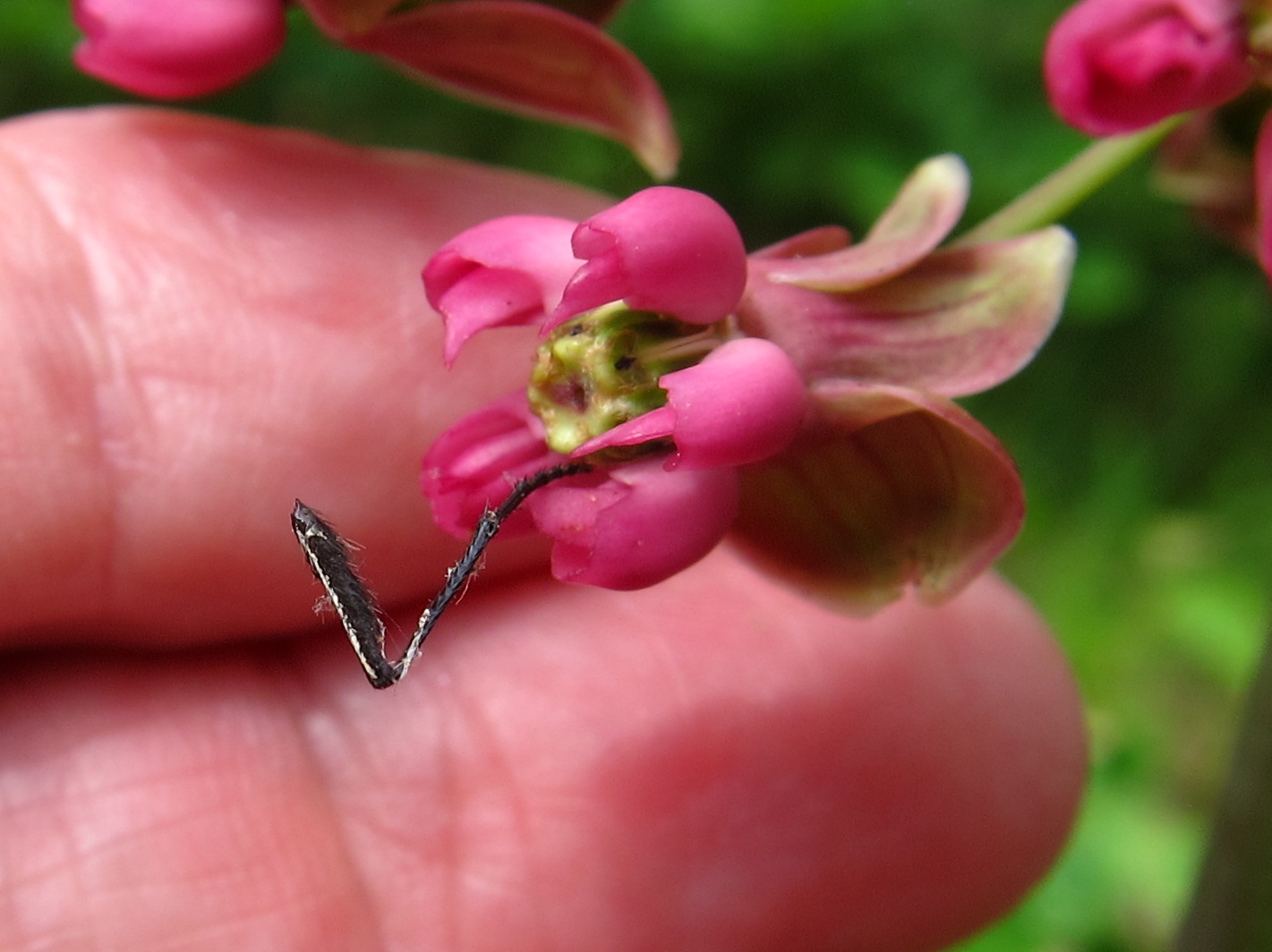
Leaning in close to inhale the flower's sweet clove-like fragrance, I discovered this insect leg dangling from one of the florets. It sometimes happens that pollinators' legs will get trapped in milkweed flowers, entangled in the threads that join the pollen bundles inside, and often the insect will eventually die of starvation since it can't pull its leg free. It appears that the previous owner of this leg escaped by sacrificing the entrapped appendage. Or maybe the rest of the bug was eaten by an insect predator.


Today was a good one for finding all kinds of interesting critters, including these beautifully iridescent Dogbane Beetles, hanging out on (what else?) some Spreading Dogbane.


Can you tell who's who or what's what with this mating pair of dragonflies? The male (on the right) is clasping the back of the female's head with the tip of his abdomen, while the female has bent her abdomen forward so as to join her sex part with his sex part, which is up there under his thorax somewhere. They're both facing the same direction, although it's pretty hard to see her face, stuck under his abdomen as it is. Lucky for her she doesn't have to breathe through a nose. Male dragonflies can be rough at times, sometimes actually ripping off their female partners' heads.


Here's a coppery-colored damselfly that doesn't follow the normal habit of damselflies, which is to close their wings at rest, unlike dragonflies, which rest with wings spread open. This is one of the Spreadwing damselflies that hold their wings partly open when not in flight. And just see what marvelous wings they are -- so iridescent! Be sure to click on this photo to better see those wings. Also note that l-o-o-o-n-g abdomen, easily twice as long as most damselflies'.


I love the rich brown of this moth's wings, with a scalloped pattern that looks like inlaid wood. I love that furry face, as well. Anybody know its name?


Well, here was a puzzle, indeed! Looks like a wasp, with its wasp-narrow waist, and also looks like a mantis, with those huge grabber arms underneath that long skinny neck. BugGuide.net came through for me again, almost before I finished submitting my photo: this is a Wasp Mantidfly (Climaciella brunnea), and it's not a wasp nor a mantis nor a fly, but belonging to a family of its own, the Mantispidae, which also includes other predators like Antlions. This one had been enjoying its lunch when we disturbed it, for we could see bits and pieces of some other insect strewn across the leaf. And its jaws were moving. Mean as it looks, though, it couldn't hurt you.


This little guy couldn't hurt you, either. And I didn't want to hurt IT, so I made sure I washed the bug dope off my hands before I picked up this tiny toad, still sporting a little bit of its tadpole tail. There were lots and lots of these wee little creatures testing out their new land legs, hopping around close to the shore of Mud Pond.


On the other hand, this guy COULD hurt you, although it looks innocent enough when it's feeling calm, just moseying along eating its leaves, as any Black-etched Prominent Caterpillar is wont to do. Sue was the one who first saw this creature, which was not easy to do, what with its cryptic coloring and almost undetectable movement. Can you tell which end is which? That's its little black head on the right, munching along the leaf edge, tucked up under its lime-green cowl.


I sure guessed wrong at first, especially when it started waving these anal appendages around like front-end feelers. And then these little red tendrils began to emerge, and what we thought was its rear end began to swell up and turn blue.


Then it started to whip those red tendrils around in a frenzy, at the same time arching its other end up until nearly vertical. It really did look pretty scary. Good thing I didn't touch it, since I later read that when it gets really, really mad, it sprays out acid "from a gland on the venter of the first thoracic segment."


Here's a little sweeter image to close this post. New Jersey Tea, a native shrub that the early colonists did use to make tea, was growing thickly along the road as I made my way home. I love how those little puffs of flowers look like exploding fireworks.


Here's a close-up view of a flower cluster. See how those little flower buds are perfect five-pointed stars? How appropriate then, that these flowers always bloom right around the Fourth of July!


Tuesday, June 14, 2011

Bog Meadow Abloom and Abuzz

I just had time today for a quick jaunt along Bog Meadow Trail near Saratoga Springs, which, despite the damp cool weather, was blooming and buzzing as if it were midsummer.

When I first saw these very large hover flies (probably Eristalis tenax), I though they were bees, since they were visiting every bloom in their paths. And they look like bees, with those stripey, fuzzy bodies. This fly was at least an inch long. They don't sting, but their similar appearance to bees could possibly warn away predators.


You have to look really close to notice the itsy-bitsy flowers of Deertongue Grass. It helps to put a yellow notebook cover behind them. I first found the fluffy red flowers last summer, but this is the first time I noticed those dangling black parts. Hmmm. . . . Are those the styles? Or stamens? Anybody know?


I do know that these Y-shaped things are the styles of Partridgeberry flowers.


And these little prongs sticking up are the staminate parts. These two different sexes were growing in entirely separate patches, quite a distance apart.

A really interesting thing about Partridgeberry is that it takes two flowers to make one berry, and both flowers of the pair have to be pollinated for a berry to grow.


Winterberry was just coming into bloom, with the branches still holding many clusters of tight little ball-shaped buds. I noticed that only staminate flowers were blooming today. Where are the pistillate ones?


There was lots of fluttering along the trail, but only a very few insects stopped long enough for me to take a photo. I know that this butterfly is a Skipper, because of its short fat body and the way it holds its wings, but I don't know which kind.


Aha! Gotcha! I chased this Pearl Crescent all up and down the trail and had just given up any hope of taking a photo, when finally it landed. And stayed there. Open winged. So beautiful in its complementary surroundings. Thank you, dear little butterfly. You made my day.