Sunday, May 19, 2013

Poor Turtle!


When I first spied this turtle on a pondside path at Woods Hollow Nature Preserve today, I felt quite excited.  Wow!  A Map Turtle!  I see Painteds and Snappers frequently, but I've only ever glimpsed a Map Turtle for a fleeting second a few years ago as it slipped off a log into the Hudson River.  But my excitement soon turned to sadness, for this turtle was dead.  Oh dear!

Oh well, at least I was able to get a really good look at the poor creature.  The yellow stripes on the dark-olive skin are typical, as are the large patches of yellow behind the eyes.  Not so evident in my photo is a raised ridge down the center of the shell, which is also diagnostic for Map Turtles.  The map-like lines on its shell that inspired this turtle's common name are unfortunately obscured by a whitish film.


The turtle's underside was quite colorful, with black paintbrush swatches on rosy-pink plates trimmed with yellow.


I don't have any idea what might have killed this turtle.  It also seemed odd to find it in the middle of a path.  Any theories?

Thursday, May 16, 2013

A Nature Walk Preview

Since I'm leading a nature walk for a garden club at Moreau Lake on Friday morning, I thought I'd better get over there today and see what might be in store.  With most of the spring ephemerals now faded, and the showy summer flowers not yet in bloom,  I wasn't sure I'd find much of interest.  But of course, there's always something of interest in the out of doors.  Here's  a preview of some of the things I hope to show our group tomorrow.


My plan is to lead the group around the back bay of Moreau Lake, which this year has a broad sandy beach all the way around, which should make for easy walking.  With the forest canopy now closed in, we wouldn't find many flowers blooming now under dense shade, but here on the sunlit shore of the lake we should find quite a few.  The first flowers to catch my eye as I stepped from the woods to the sand were many, many tiny white violets scattered up and down the shore, a fragrant species called Sweet White Violet (Viola blanda). 


There's a truly majestic Highbush Blueberry shrub along this stretch of shore, and today it was full of flowers, waxy white bells capped with rosy bracts.


We will be able to compare a number of different Heath Family shrubs along this stretch of shore, for close by the Highbush Blueberry are numerous shrubs of Lowbush Blueberry and even more of Black Huckleberry.  The huckleberry flowers pictured here were still in tight red buds, but when they open they will resemble the bell-shaped flowers of the blueberries, although a little bit pinker.   I will have our group pinch the leaves of the huckleberry bushes to see how the leaves stick to our fingers, because of the resinous secretions on the backs of the leaves.  The leaves of either blueberry will not be sticky.


Here was a fourth Heath Family shrub, a Maleberry, although it did not as yet have any of its globular bell-shaped flowers.  The dried fruits from last year still remained on the bush, fruits that are hard as rocks and as yet uneaten by any wildlife.  The fact that this shrub never develops edible fruit hints at how it got its common name. It is also called He-huckleberry.  Its scientific name is Lyonia ligustrina.


The vividly colored and intricately shaped Fringed Polygala is often the favorite find on wildflower walks, and our group will not be disappointed.  Masses of this lovely flower are carpeting the banks near the shore.


Columbines are also a big crowd-pleaser, and they won't be hard to find, since their brilliant color causes them to stand out in even the shadiest woods.


Not as showy, but still rather pretty in its own right, is Bastard Toadflax.  Although most of the plants were still in tight bud, a few had opened their small starry blooms that cluster at the top of the stems.


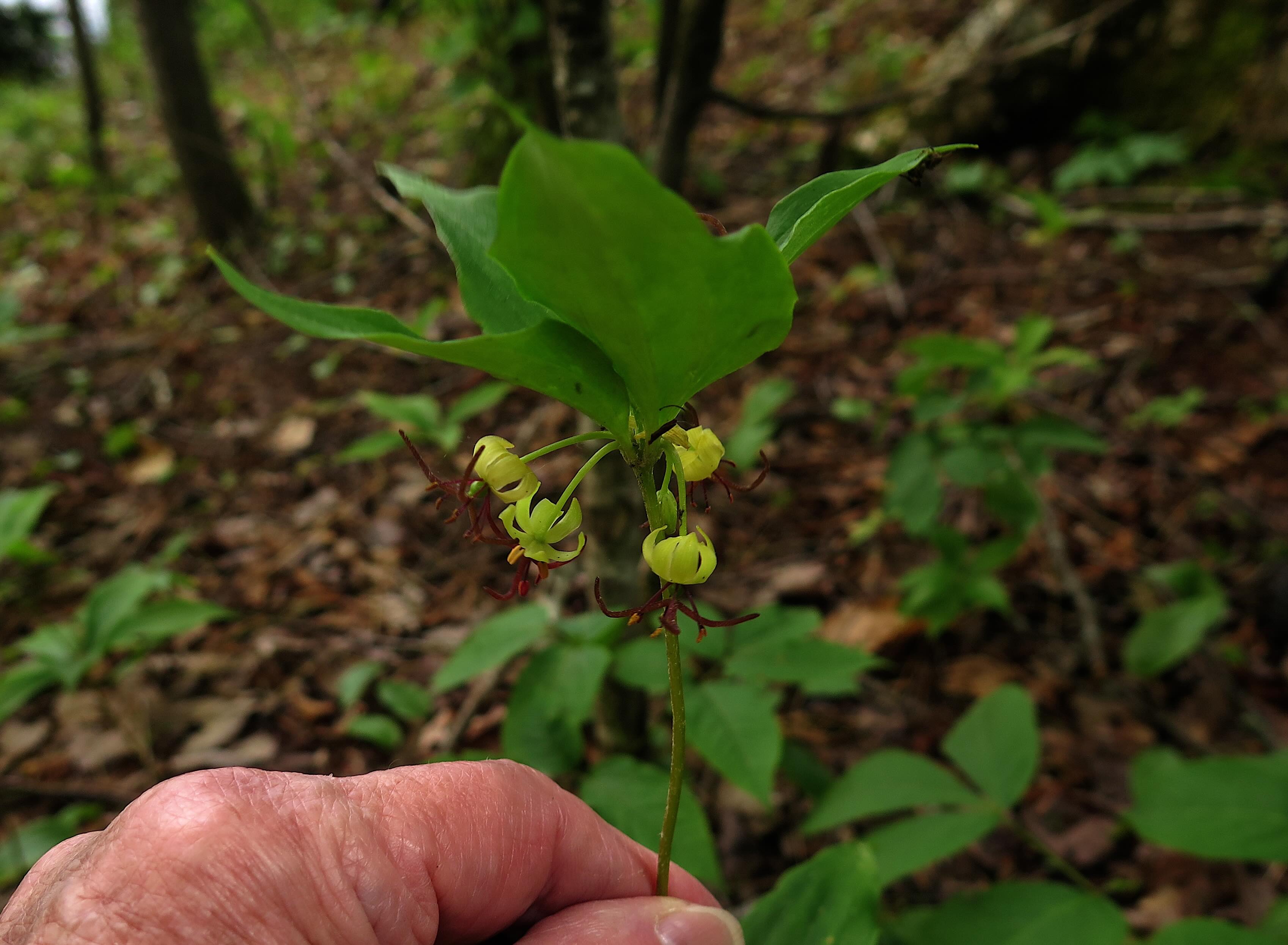
The green flowers of Solomon's Seal are easy to miss, since they dangle hidden below the leaves.  I hope I can find them again when I lead the walk.


After we've circled the back bay of Moreau Lake, we will come out on the broad beach of the main part of the lake and walk along in the soft sand.  The weather is supposed to be lovely on Saturday, much less windy than it was today.


Here on the beach we will be able to examine the interesting flowers of Pitch Pine.  I even found a branch that included both male and female flowers as well as a young cone that was formed a year ago.  The female flower is that small red tuft near the top of the new growth, the male flowers (as yet unopened) are the chubby green things circling the growth spike, and the yearling cone is hidden among the needles below.


If we had all day for our walk, I would next lead our group through the woods to Mud Pond and explore the shoreline over there.  We won't be able to do that on Saturday, but today I took myself over there to have a look around.


There's a flat muddy area along one shore, an area my friend Sue and I call "The Delta."  This is where (when it's full of water)  a stream enters the pond, creating a wide sandy expanse that is home to many interesting wetland plants.


I was curious to see if that floating liverwort called Ricciocarpus natans was still stranded on the mud where I had found it several weeks ago.  Indeed, it was.  Still waiting for the spring rains to flood the shore and carry it off to deeper water.


Just behind the shore was a field packed full with Golden Ragwort, brilliantly yellow against the dark green of its foliage.


This enormous fly with a fuzzy butt, big brown eyes, and a yellow nose was busily feeding on the ragwort flowers.  This is one of the Tachinid flies, possibly of the genus Juriniopsis, that like to eat flower nectar.


If the staff of Moreau Lake State Park would allow it, I would like to lead a nature walk along the bed of the stream (now dry) that feeds into Mud Pond, for many interesting plants grow here. 


I counted many dozens of Jack-in-the-Pulpits, some with plain green spathes but most with purple stripes.  There was Toothwort, too (you can see its leaves in this photo), plus Miterwort and Foamflower.  There were also Downy Yellow Violets and Long-spurred Violets, as well as extensive patches of Plantain-leaved Sedge, all plants I usually associate with a lime-rich woods.


One of the most populous plants along this streambed is Dutchman's Breeches, and today I found a number of plants with their rosy-red underground corms uncovered.  Although the stream was dry today, it looks as if there might have been water passing here recently, perhaps after the heavy rain we had a few days ago.


A Busy Week in Various Woods

It's that time of year, the wildflower explosion that keeps me hopping from woods to woods to keep up with the latest to come into bloom.  Happily, two nights of near-freezing temperatures this past week did not seem to slow the progression.  Here's a quick recap of the past week in the woods.

On Friday, I had the honor of escorting some of my favorite plant people through the Skidmore Woods to check on some of that rich habitat's rarest species.  Here (l-r)are Bob Duncan, Evelyn Greene, Nancy Slack, and Ed Miller making their way to one of the secret areas where Goldenseal has been known to grow.


Why so secret about where it grows?  That's because over-collecting has very nearly extirpated this medicinal herb from the region, with the Skidmore Woods being one of the last areas in Saratoga County where it might be found.  And we were in luck, for we found an extensive patch that was looking very healthy.


Another plant that thrives in Skidmore's limey woods but at very few other locations is Green Violet.  Neither Bob nor Evelyn had ever seen this unusual member of the Violet Family before, and I was a bit disappointed that it wasn't yet fully in bloom.  But its little green flowers really don't look much different from the buds, even when fully open.  Nor do its little green flowers look much like any other violet.


We did find lots of violets that looked like typical violets and which were indeed fully open.  There were abundant numbers of Long-spurred, Downy Yellow, Canada, and Common Blue, including this quite unusual bicolor variety.


This Tuesday, my friend Sue Pierce and I returned to the Denton Wildlife Preserve in Washington County to prepare for the wildflower walk we'll be leading there on Saturday morning.  Since the walk is sponsored by the area Audubon chapter, I imagine we'll have avid birders along, so our job will be to try to direct some of the folks' attention to the plant life, surrounded as we will be by a habitat favored by birds as well as plants.


One of the interesting plants at this site is a rather stunted little Jack Pine, an anomalous occurrence for Washington County, which is far out of the natural range for this native American pine.  We were really surprised on Tuesday to find this little pine under attack by a swarm of budworms wreaking serious damage to the new growth.  No wonder the tree is stunted!  I wonder if this happens every spring.  (I also wonder if we should attempt to destroy this infestation, since budworms can devastate other conifers, not just Jack Pine.)


If our walkers are repulsed by the sight of the budworms, we will quickly find remedy in the beauty of Fringed Polygala, which thrives in abundant numbers at many places along the trails that wind through the preserve.


 Equally charming are the many Starflower plants just coming into bloom.


We will find plenty of Foamflower, too, in the places where our trail passes near to a stream.


If we're lucky, we'll once again find the little patch of Rue Anemone we saw on Tuesday, its pristine sepals of purest white opening above a whorl of dainty rue-like leaves.


There are lots of Bear Oaks at the Denton Preserve, and wherever we find oaks, we also find galls.  I've seen galls of many shapes and colors on oaks, but never one that looked like these little green balloons.  Undoubtedly, they are caused by some insect laying its eggs on the leaves, but I don't know which insect is responsible for this particular gall.


Of all our finds at Denton Preserve, a nice patch of Nodding Trillium excited us most of all.  The New York Flora Association has expressed concern that this species of trillium appears to be disappearing from its range, so to find a new site like this is cause for celebration.  I hope our birder friends will appreciate what a privilege it is to see this pretty flower.


Encouraged by that Nodding Trillium find, I stopped at Bog Meadow Nature Trail on my way home to Saratoga Springs.  This trail is one of the few sites in Saratoga County where Nodding Trillium may still be found. 


I hurried to the area where I usually find them, but I was disappointed.  I saw many Red Trilliums, fading now, but only one Nodding Trillium, which was still in tight bud.  I noticed that the area had been cleared of the shrubs that once grew close by the trail, so perhaps this shade-loving trillium will no longer thrive at this site.  A pity.


One plant that is surely thriving at Bog Meadow is Star-flowered Solomon's Seal (Maianthemum stellata), which bears a cluster of white star-shaped flowers at the end of a graceful stalk of leaves of the prettiest blue-green color.  Over the years, this lovely plant has increased its population many times over.


I stooped to admire the bright-yellow star-shaped flowers of Bristly Crowfoot and found this shiny green red-eyed bug arrayed on a leaf.  I think it may be a nymph of some kind of Assassin Bug.


This rusty-brown bird kept hopping around in the bushes and finally landed on a branch that gave me a nice clear view.  If only it had opened its bill and sung, that would have clinched its ID.  I believe that this is a Veery, although one with very faint spots on its breast, so it doesn't look exactly like the pictures in my bird guides.


Since my route home took me right by the entrance to Yaddo, I turned into the drive of this artists' retreat center.  Last year, Yaddo's groundskeepers had cut down all the American Bladdernut shrubs that grew by a bridge over a stream.  I contacted some of the people responsible and asked them to do what they could to protect these native shrubs in the future, since this species is really uncommon in northern Saratoga County.   This day, I was happy to see that the shrubs were recovering nicely, and were even bearing the clusters of blooms that would later produce the distinctive hollow pods for which this shrub is named.


Wednesday, May 8, 2013

Summer-like Days in May

I've packed all my scarves and mittens and snowboots away and dug out my shorts and tee shirts and sandals.  The weather turned summer-warm this week, and I spent so much time outside enjoying it, I neglected to take the time to write my blog.  So here's a quick recap about some of the woodsy and watery places I've been enjoying the past few days.


Sunday, May 5:  Saratoga Spa State Park

The wonderful native-plant nursery, Fiddlehead Creek Farm, held a plant sale on Sunday on the lawn of the Lincoln Bathhouse, with a share of the proceeds going to support programs of the Spa Park.  I was happy to do my bit by purchasing four pots of Miterwort and another of Bluets to add to my personal woodland garden in my own backyard.  And I was also happy to head on over to the Ferndell Trail to enjoy one of the prettiest spots in the park, a shady ravine that follows a tumbling stream. 


 Park Manager Mike Greenslade had told me about a project planting native species along this trail, and I was eager to see what had been planted.  There were several species of ferns and sedges to add to the greenery and help stabilize the steep banks, but I also found a number of flowering plants that will soon be blooming along the stream.  In the patch shown here, there were Jacob's Ladder and Golden Ragwort, with buds about to burst into bloom and add their blue and gold to the shady woods.


These newly planted species join the long-established wildflowers that grow along this trail.  Red Trillium, Small-flowered Crowfoot, and Jack-in-the-pulpit were blooming on Sunday, but the showiest flowers of all were on the Hobblebush shrubs that grow on the banks and lean their branches over the trail so that I could enjoy a close-up view of their pristine white flowers.


The Ferndell Trail terminates at the road that runs by the picnic area of the park, which is also the area where most of the natural mineral springs can be found.  I stopped to take an invigorating -- and tasty! -- drink from one of the springs.  This water obviously contains much iron, to judge by the blood-red oxides that have built up over the years.


Monday, May 6:  The Hudson River at Moreau

Monday was a perfectly wonderful day for a paddle:  the water was calm and not another soul was around to roil its glassy surface.   That's not counting the Great Blue Heron that mounted up with thumping wingbeats each time I rounded a bend and disturbed this magnificent bird at its wading.


The sun was so hot, the river's still-cold water felt wonderfully refreshing when I trailed my hands over the side of my canoe.  I drifted close to the banks, where masses of tiny Bluets were scattered through the grasses and tumbled over the edge.


When I passed by a certain niche in a rock where I know to look for Lance-leaved Violets, I was surprised to find its slender white flowers already in bloom.   Because this patch of violets grows so close to the water's edge, I usually don't look to find them until June, after the river has subsided from its spring flood.  We haven't had much rain this spring, nor snow this past winter, so consequently, no spring flood.


I pulled my boat up onto a little rocky island and walked about on its mossy ground.  From inside a grove of overhanging trees already well in leaf,  I was struck by the vivid stained-glass glow of these baby Chestnut Oak leaves backlit by the sun.


On my way back home along Spier Falls Road,  I stopped at the dam and got out of my car to take in the beauty of cliff-dwelling Early Saxifrage exploding into bloom out of beds of dark and bright-green moss.


A closer look revealed that one of the mosses had produced its own tiny garden of perfectly spherical fruits on hair-fine stalks.   The fruits look very much like those of Apple Moss, but the worm-shaped leaves don't resemble those of that species of moss at all.  I will have to consult some of my moss-expert friends and come back to add an update.


Update: My more knowledgeable friends Bob Duncan and Evelyn Greene came through with a name for this pretty moss.  It's Philonotis fontana, also called Fountain Moss, a name that's appropriate for a moss that grows on rocks that are damp from seeping water.  And it does belong to the same family (Bartramiaceae) as Apple Moss (Bartramia pomiformis), as the shape of its fruits suggest.  In fact, one of its common names is Spring Apple Moss.


Tuesday, May 7:  Cole's Woods in Glens Falls, NY

 My friend Sue had alerted me that the Rosybells were about to bloom in Cole's Woods, a remarkably woodsy spot right in the middle of the city of Glens Falls.   So that's where I went to meet and walk with Sue on Tuesday, and oh, what a wonderful walk it was, in a spring-green woods resounding with beautiful birdsong.  Here, Sue listens to hear the call of the Blue-headed Vireo ringing out from the treetops, while the fluting, trilling, piping lilt of a Winter Wren seemed to follow us from point to point wherever we went along our path.


And yes, the Rosybells were blooming indeed!  Only a single bell or two as yet, but oh, what a pretty little pink-speckled thing it was.  You really have to search to find this flower (also known as Rose Twisted Stalk), because it dangles -- on a fine twisted stalk -- out of sight beneath the cover of its leaves.


Dwarf Ginseng was also beginning to bloom, and I've never found any other place, in all of my woodland wanderings, where this flower blooms so abundantly as in Cole's Woods.  In only a week or two or three,  it will disappear completely, gone without a trace of seeds or leaves, until it pops up again next spring.


Wintergreen, on the other hand, is one of the most persistent plants we have, with both leaves and fruits looking fresh and plump all winter long, well into the following summer.


The berries we found today -- and they were last year's berries -- were the plumpest and reddest we had ever seen on any Wintergreen plant.  I think they must like it here in Cole's Woods.  Sue and I certainly do.