Tuesday, September 13, 2022

Checking in on Rare Plants at Moreau Lake State Park

How could it be, that in one of the driest summers I can recall, the water level at Moreau Lake remained so high for most of the season I could not walk around the lake on the shore?  And yet now, after several days of drenching rain that filled other water bodies to the brim, the level of Moreau Lake has fallen enough to reveal long stretches of sandy or pebbly or muddy shore? The cause of the rising and falling water levels in this kettle lake remain quite a mystery, but the important thing for me is that I can now walk around the lake.  Most of the way, anyway, with my feet on dry or only damp land.  And I was excited to be able to do so.  A number of really rare plants grow along this shore, and at last I could go check on them.

The first plant I went to check on was Whorled Mountain Mint (Pycnanthemum verticillatum var. verticillatum),  an Endangered species in New York State with only five other populations recorded across the entire state.  When a state rare-plant monitor assessed our Moreau Lake population back in 2014, he counted 273 individual plants thriving along the shore of a cove, making it one of New York's  most abundant populations of this plant.  How many would I find today?  Over the nine years since I first discovered this super-rare plant at Moreau, the lake has risen and fallen remarkably and many times over, sometimes completely submerging the original site of that Mountain Mint population and drowning many plants.  And now, the shrub cover has spread substantially, shading so densely the original site, the habitat might no longer be congenial for this rare plant.  As I made my way down a forested bank to the sandy shore, I was relieved when I saw one of the original patches of this plant still intact. The plants had finished flowering, but their signature spiky seedheads remained quite noticeable.  As did the strong minty fragrance they emitted when I pinched them!  Whew!  At least a few Whorled Mountain Mints still survive, still producing the seeds that could re-build the original population.


I  found very few others, though.  Maybe 20 plants in all, in two widely separated patches along the shore.  There might be more, still holding on beneath the dense shrubs that I could not push through.  But at least I did find some very healthy-looking plants, and some still retained a few of their tiny blooms.


The shoreline shrubs certainly appeared healthy, their numbers not at all diminished, but rather enhanced by the intermittent flooding.  The most abundant of these shrubs is Buttonbush (Cephalanthus occidentalis), whose perfect orbs of tiny white flowers have yielded now to rosy red seed heads.


The most abundant wildflower on this sandy shore was Boneset (Eupatorium perfoliatum), each plant abuzz with many visiting pollinators.  I recognized this Northern Paper Wasp (Polistes fuscatus)  immediately because of the two red spots adorning its yellow-striped black abdomen.  When this colonial wasp is guarding its honeycomb-like paper nest, it would be unwise to get this close to it, for Paper Wasps are known to defend their nests quite fiercely.  But away from their nests, this wasp is not at all aggressive.  And it's also likely the nests have already emptied of the young that required  defending.


Here was another visitor. Or, more likely, a regular inhabitant of this cove: a young Green Frog that was kind enough to sit still for its portrait.


My next destination was a stretch of dry sand along the south-facing north shore of Moreau Lake.  No matter how high or low the lake's waters rise or fall,  there always seems to be enough sandy shoreline here to support a second truly rare plant, this one another state-ranked Endangered species called Small-flowered Dwarf Bulrush (Cyperus subsquarrosus).  When I first encountered this wee little flatsedge back in 2018, a year when the water was very low, I found literally thousands of these tiny plants thriving on just about every foot of either sandy or pebbly shore.   Would I still find some today?


Oh yes, I sure did!  I really didn't bother to count them this year, when I saw how abundantly they were  thriving in both the dry and the damp sand along this stretch.  Even though this plant is very, very tiny, it is relatively easy to spot, with its swirly leaves of a distinctive gray-green color, two features that distinguish it from the many other flatsedges and other ground-hugging plants that share the shoreline.


This photo gives a better indication of how small the Small-flowered Dwarf Bulrush is. You can also see the little rounded spikelets that resemble tiny pinecones.  The spikelets of other flatsedge species tend to be, as might be expected, flatter than these.


Satisfied that "my" Small-flowered Dwarf Bulrushes were still abounding here, I continued around the lake, crossing over a bridge that separates the main lake from a back bay.  I was impressed by this exuberant spray of Goldenrod flowers (Solidago sp.) among the many that lined the trail over the bridge.


A single plant of New England Aster (Symphyotrichum novae-angliae) growing nearby announced its presence by the vivid purple of its large flowers.


A crowded patch of  Bird's Nest Fungus (species unknown to me) was not yet ripe enough to display the tiny "eggs" that rest in these cup-shaped "nests."  At present they resembled some miniature marshmallows covered with toasted coconut.


Now I have reached the newly walkable shore of Moreau Lake's back bay, only recently emerged from inundation. This is a muddy (rather than sandy or pebbly) shoreline that supports a wide variety of plants I seldom find along other stretches of shore around the lake.


This back bay shoreline is where I find the most abundant numbers of the native wildflower called Small-flowered Agalinis (Agalinis paupercula). This dainty purple-flowered species was until recently rated as a Rare plant in New York, but since equally abundant populations have been found, it is no longer classified as a rare species.  In my experience, though, I have not found this pretty plant, which bears its small flowers on very short stalks, at any other location I have explored but this one.


This Small White Aster is an equally abundant wildflower along the back bay.  I am surmising it is  Symphyotrichum racemosum, an aster species known to grow at this location.  But I confess I have difficulty distinguishing among several species of small white asters that can be found here.


I was happy to find a single plant of Water Smartweed (Persicaria amphibia) still blooming this late in summer.  The shallow muddy water along this shoreline is this native wildflower's favored habitat,  and  (true to its specific name) it can occasionally be found growing on the muddy shore as well as floating  on the water.


What a sweet little blue wildflower!  It's our native Small-flowered Forget-me-not (Myosotis laxa), and it is so small it helps to have bunches of them like this, in order to detect them.


This Pickerel Frog can be hard to detect, as well, for its spotted skin serves as good camouflage along this shore.


There was one more rare plant  I wanted to check on, and this one is really rare!  Until we found it at Moreau Lake State Park in 2019Pringle's Autumn Coralroot (Corallorhiza odontorhiza var. pringlei) had been considered to be extirpated from New York since a last sighting in 1903, way out west of Saratoga in Monroe County.   We have since found dozens of this tiny native orchid at Moreau, although this drought-ridden summer has discouraged their numbers significantly.  Although I could not find any plants on the same day I walked around the lake to check on those other rare plants,  I did find a small group of them when I returned two days later. And this time I was accompanied by noted New York botanist David Werier, author of the important botanical resource, Catalogue of the Vascular Plants of New York State.  We were in luck. The flowers had opened, revealing the single broad purple-spotted lower petal that helps to distinguish this super-rare Pringle's variety from the very common standard variety of Autumn Coralroot.


An even more significant feature of the Pringle's variety of this orchid is the fact that the florets are open, revealing the reproductive structures within (including the pollen bundles),  unlike the closed, self-pollinating florets of the standard C. odontorhiza var. odontorhiza.


This open-floret feature proved to be especially interesting to Mr. Werier, who was actually able to examine the minute interior reproductive organs through his magnifying loupe.


Mr. Werier explained to me that structural features of the reproductive organ he was able to observe could be instrumental in supporting his and other botanists' assertion that the Pringle's Autumn Coralroot is a genuine, distinctive, and definable variety.  Apparently, there is some controversy about this issue among taxonomists.

I bet if we could bring those skeptical taxonomists to Moreau Lake State Park when both varieties are fully in bloom (as they are now),  they could see for themselves how different the two varieties appear, even to the naked eye. And if they apply their magnifying loupes, they could see for themselves what Mr. Werier was quite elated to have observed.  I bet there aren't many other places, besides this location, where the flowers of both varieties can be seen blooming at the same time.

Friday, September 9, 2022

Summer Flowers Yield Fascinating Fruits and Seeds

I had a request from a friend to show him the seeds of Early Blue Cohosh (Caulophyllum giganteum), and that was an easy task for me. All I had to do was take him out to the nearby Skidmore Woods here in Saratoga Springs,  where this species of Blue Cohosh thrives on that forest's limestone-underlaid soil. And the large seeds of this plant sure are easy to see, colored a lovely bright blue that stands out from the background greenery.  They look like berries, but they are instead hard seeds covered with a thin blue skin, not juicy or fleshy as berries would be. You can sometimes find them looking just as pretty as this, even in the dead of winter, long after the leaves are gone.


Delighted by how pretty these seeds are, I decided to look around some of the other places I haunt, seeking out other examples of how our native wildflowers continue to bless us with their beauty, even after their spring and summer blooms have faded.  Here are a few of the ones I found, so far.


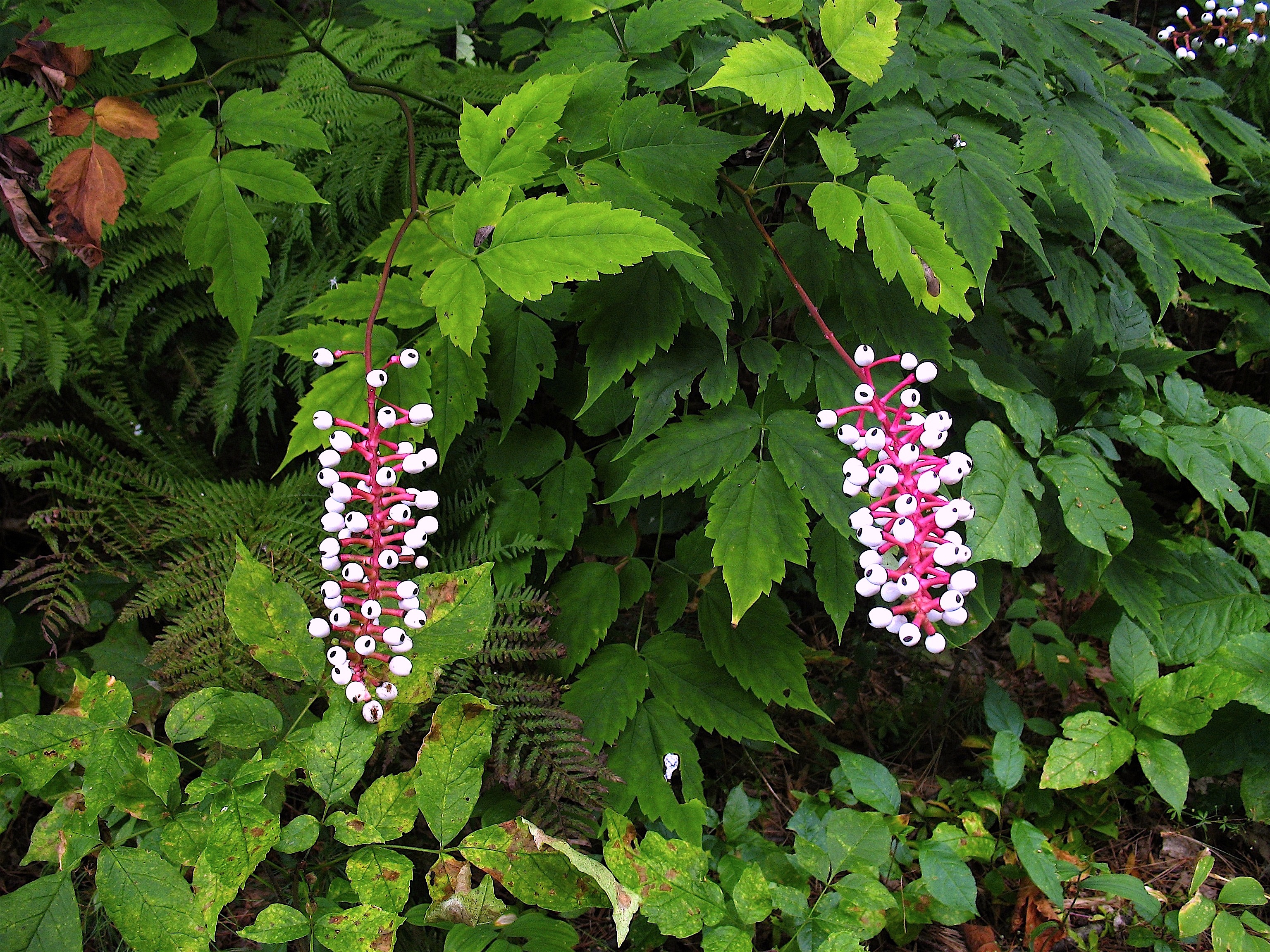
The porcelain-white berries of White Baneberry (Actaea pachypoda)  are far more showy now than their wispy white flowers had been last spring. And with this plant, the hot-pink pedicels rival for showiness the berries they hold.  By the way, there's a reason this plant is called "Baneberry," since, despite how tempting they may appear, the berries are quite poisonous to humans.


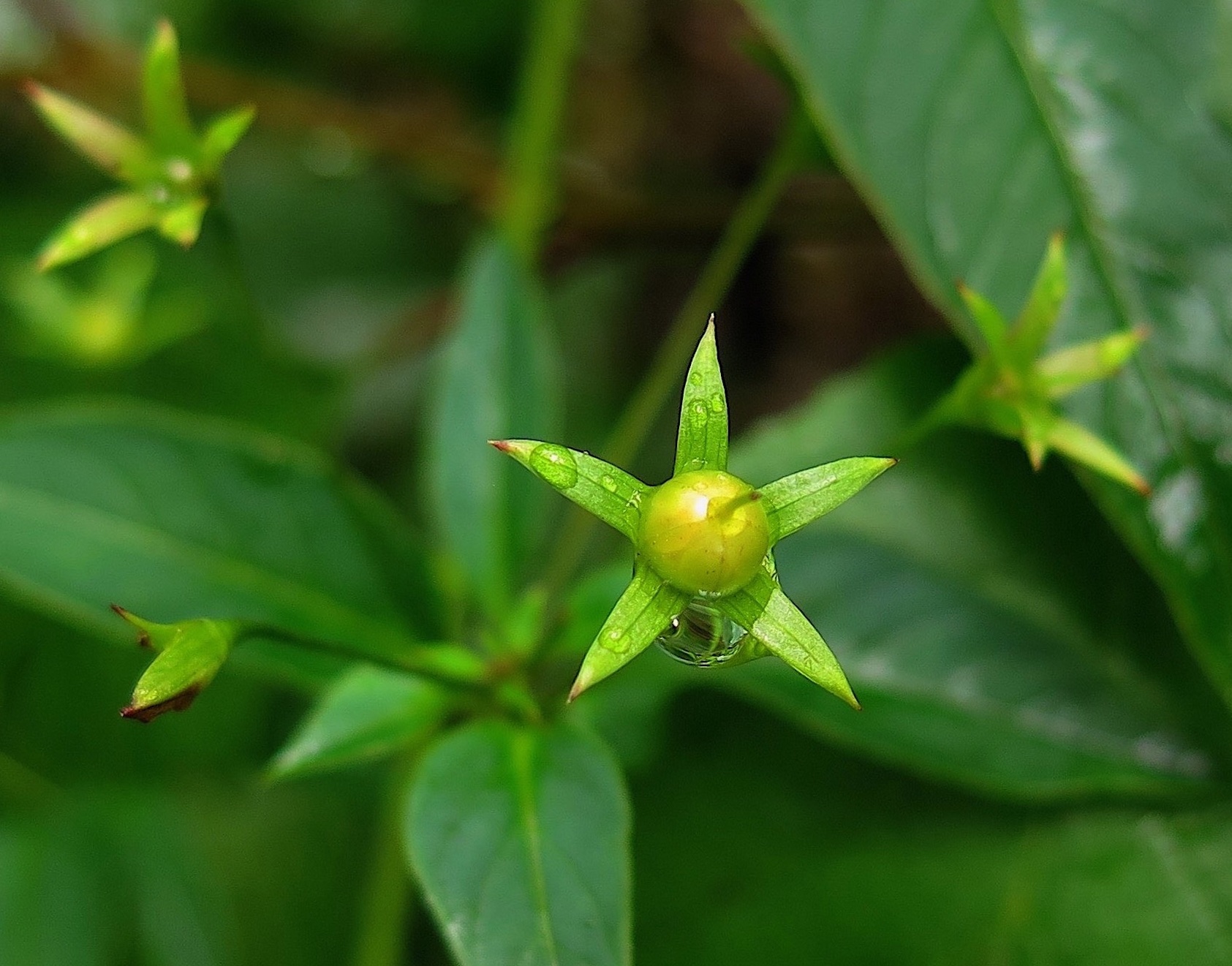
The seedpods of Fringed Loosestrife (Lysimachia ciliata) won't broadcast their beauty across the swampy spots where they live, they are so small.   You have to peer close to notice the shiny greenish-yellow orbs set within green stars.


When I noticed the shiny-red berries of this American Ginseng plant (Panax quinquefolia), I wondered if I should remove them.  Most of the summer, this native plant has flourished among the surrounding Virginia Creeper and other low-growing woodland species, hidden from the eyes of poachers who  might be tempted to uproot this valuable medicinal herb.  But now those bright berries sure do attract attention.  I wondered if covering the berries with leaf litter to hide them might provide an alternative to destroying them.  The fruits are how this ever-rarer plant increases its population. So I did leave them.


Who would ever guess that these large tapering leaves were those of a violet?  The seedpods, however, do offer a clue that this 18-inch-tall Green Violet plant (Hybanthus concolor) might be related to those more ground-hugging spring wildflowers. 


I plucked a pod, three-parted like any violet seedpod, and opened it to reveal its spherical seeds. This part of the plant is about the only part that says "violet" to me.  But it does belong to the Violet Family (Violaceae), even though its genus is not Viola.


These bright-orange fruits that circle the stem make this Orange-fruited Horse Gentian (Triosteum aurantiacum) easy to find this time of year. The meter-tall plants often hide among equally tall meadow flowers like goldenrods and native sunflowers, even when in flower with tiny red tubular flowers that by September produce these showy fruits.


The wispy greenish-white spring flowers of Indian Cucumber Root (Medeola virginiana) dangle beneath the top-tier of leaves, and usually go unseen.  But eventually, the flowers migrate to crown the plant and hold high the clusters of shiny black fruits. This time of year, the still-green leaves often develop a splash of bright scarlet at the center.


The seedpods of American Lopseed (Phryma leptostachya) are neither large nor colorful, but they do have the fascinating behavior of bending straight down and clinging to the flower stalk.  I am amused by the challenge of finding them, so skinny and greenish as to be nearly undetectable amid the general greenery of the forest floor.


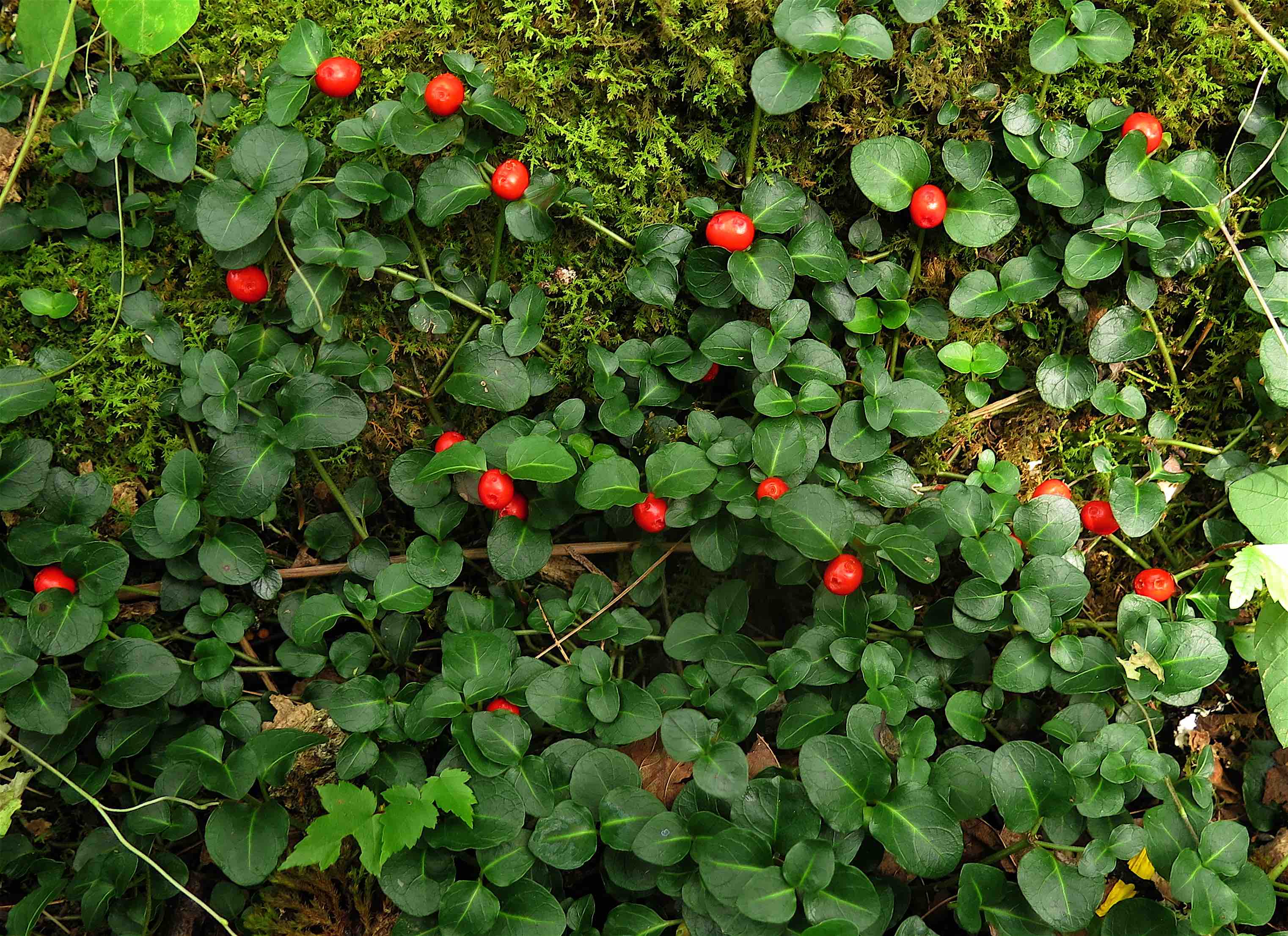
I certainly have no trouble noticing patches of Partridgeberry (Mitchella repens), even when no scarlet fruits are peppering the carpets of shiny evergreen leaves that often spread widely across the forest floor.  But this time of year, most patches do bear these shiny fruits that have a unique feature: each berry has two blossom ends!  This is because each berry requires that two flowers, a pair of small white trumpets connected by a single ovary, be pollinated in order to produce the fruit.


I am quite puzzled by the appearance of Round-leaved Dogwood's berry clusters.  Are all those tiny pink orbs aborted fruits that never developed into the greenish-white berries that otherwise develop on the cluster? Or are they some part of the berry that remains on the pedicels when the ripe fruit is removed? Whatever, the combination of white berries and tiny pink orbs atop deep-pink pedicels make this species of dogwood (Cornus rugosa) particularly attractive.


Eventually, the speckled fruits of Solomon's Plume (Maianthemum racemosum) will turn a translucent solid red when fully ripe.  But it appears that some creatures have been quite happy to devour these berries already.


Although the two native woodland plants, Solomon's Plume (above) and Solomon's Seal (Polygonatum biflorum), can be confused when not in flower or fruit,  by this time of year they are easy to distinguish.  Instead of producing a terminal cluster of red fruits,  Solomon's Seal bears blue-black berries, dangling in pairs from the leaf axils.


For years, I have hoped to find the ripe fruits of Spicebush (Lindera benzoin), because I have read that they taste like Allspice. They must taste like something good to whatever critters get there first, because I rarely find any ripe fruits on these shrubs that are very common in a local woods. But this year I DID find some.  Almost ripe. I'll wait to pick one until it is fully ripe.  (What are the odds there will be any left by then?)


This has been just a sampling of some of the colorful or otherwise interesting fruits and seedpods that can delight a woodswalker this time of year.  I thought I had covered just about all of those that could be found right now, but then I noticed these pale-blue orbs held atop yellowish stars.  The fading fruits of Starflower (Lysimachia borealis)!  I'm so glad I noticed them before the seeds dropped to the ground.


Wednesday, September 7, 2022

Gentians and More, at Orra Phelps

Several friends have been posting photos of Fringed Gentians (Gentianopsis crinita) on Facebook  this week, which surprised me.  Already?  But then I remembered: Oh yeah, it's September!  This gorgeous native wildflower always suggests to me that summer saves her best flowers for last.  I can certainly think of very few summer blooms that rival for gorgeousness this stunning flower.  So off to Orra Phelps Nature Preserve in nearby Wilton I hurried.  And sure enough, there they were!  Although they grow in an area crowded with other tall plants and grasses, their radiant blue color, vividly illuminated by the bright sun, made them easy to spot.

There were many fewer blooms this year than last, but since this species is a biennial, that doesn't mean there won't be more next year.  But I do fear that this population of Fringed Gentians may eventually die out at this site if the weedy poplars and pines aren't removed from the open wet meadow where these gentians have thrived for many years. The trees will not only steal the sunlight from these sun-loving flowers, but also their roots will draw the water from the damp soil that Fringed Gentians require.  I did count 11 separate plants this week, and each plant possessed many more buds, so the show should continue for a while longer this year.


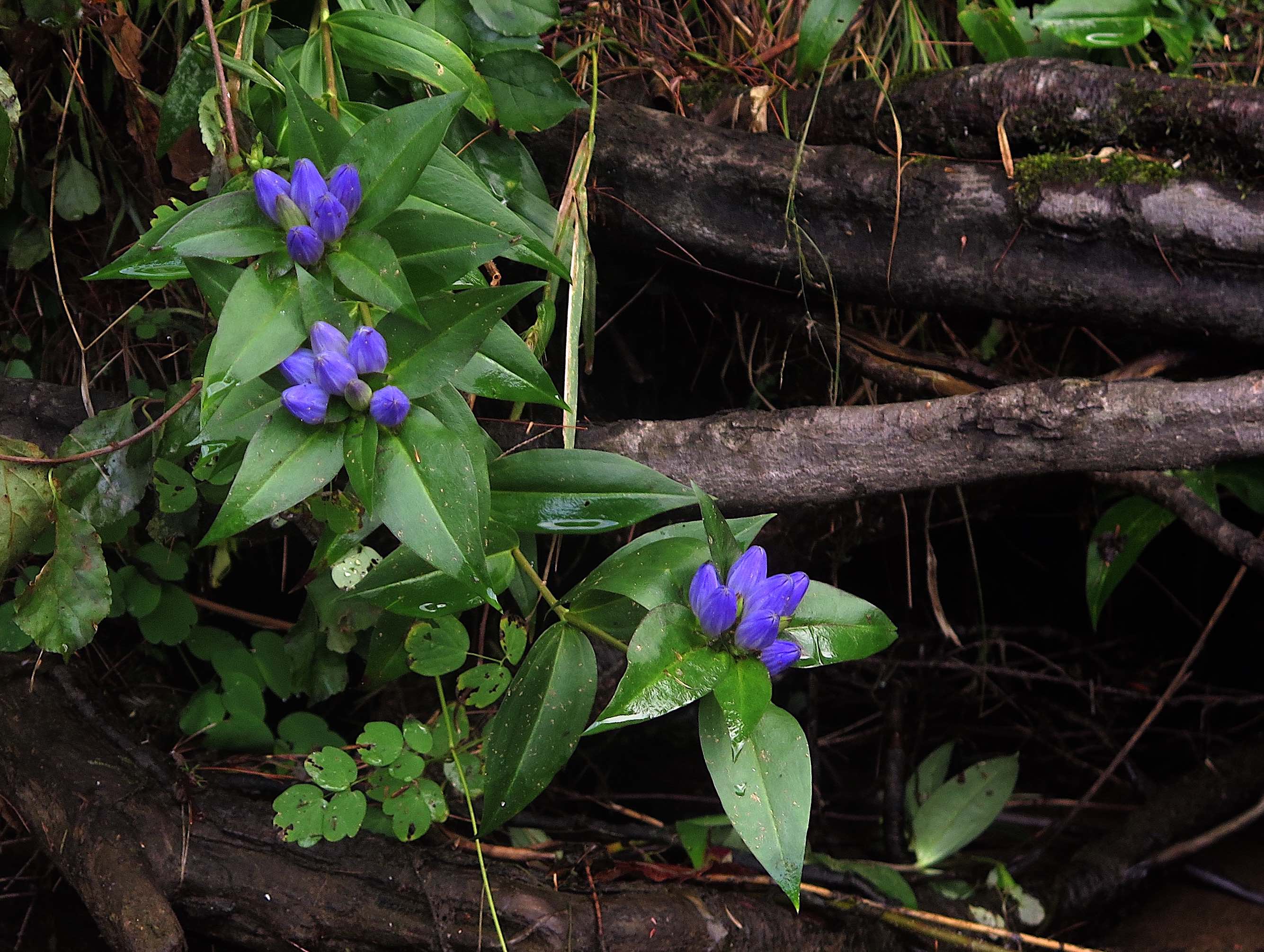
After sating my gaze sufficiently with the beauty of these wispy-fringed flowers, I remembered that another kind of gentian had made a surprise appearance at Orra Phelps last year, down along the shaded creek that runs through this small preserve.  Curious to see if this interloper had persisted, I followed a trail through the woods that descended to the creek.  And sure enough, there it was: a Closed Gentian plant (Gentiana clausa), its stems flattened by the creek's occasional floods but with multi-bloom flower clusters held upright against the muddy ground.  Another cobalt-blue beauty blooms at Orra Phelps!


There were several other lovely finds in the woods along the creek. The Indian Cucumber-root plants (Medeola virginiana) were now in fruit, holding their shiny black berries above the top-tier of leaves, the still-green leaves now colored with splashes of crimson. 


Some White Baneberry plants (Actaea pachypoda) also stood along the creek, with porcelain-white berries held on chubby rosy-red pedicels.  Noting the black dots on the blossom-ends of the white berries, it's easy to see how the vernacular name "Doll's Eyes" came to be another name for this plant.


Some big bright-yellow flowers also bloomed along the creek, probably one of our native sunflowers (Helianthus sp.) that prefers the shade of the woods to the bright sunlight of open meadows. Many similar-looking species of sunflowers bloom in our area, and I have great difficulty distinguishing their species.


Many species of asters are blooming now, and many of them are also difficult to distinguish. But I think I would win a wager if I asserted that this pretty bunch growing close beside the tree-shaded stony-bottomed creek was the White Wood Aster (Eurybia divaricata).


Plop!  Plop! Plop!  With every step I took along the creek, little Green Frogs vaulted away from my feet, most of them quite promptly burying themselves into the mud or hiding under the rocks that lined the bottom of the creek.  For some reason, though, this one decided to keep its head above water.  The better for each of us to get a good gander at the other.  And my camera to zoom in for a photo!


The spring-watered swale that surrounds the creek is a bryophyte Paradise, with mosses and liverworts of many species abounding here. I was struck by how each rounded rock that lies in the mud was thickly covered with a near-pure population of a single species.  This rock was home to almost nothing but Delicate Fern Moss (Thuidium delicatulum), although a few leaves of Water Pennywort (Hydrocotyle americana) were sharing the moss's territory.


And this rock had little room for anything else but the broad scaly leaves of a Conocephalum liverwort.


This ruffly-looking, yellow-edged, lime-green liverwort has the wonderful name of Handsome Woollywort (Trichocolea tomentosa), and I wonder whether I love it more for its whimsical name or its fluffy appearance. I don't encounter this liverwort all that often, so I'm glad to know it seems to be secure in the muddy parts of the Orra Phelps Nature Preserve, quite close to my home. I can visit it often, and in nearly every season.  These liverworts and mosses stay green and beautiful all winter, although they do hide out under deep snow.


A closer look at this nearly-exclusive mound of Handsome Woollywort reveals a few visitors.  The most prominent one is Atrichum undulatum, a moss that resembles a wee little vegetable hedgehog with its spiky "undulating" leaves.  A leaf of that Water Pennywort pokes up from amid the Atrichum. And way off to the bottom right of this photo, I also detect a single flat leaf of that scaly-looking Conocephalum. Maybe there's some Delicate Fern Moss paying a visit, too. It's nice to know that all these bryophytes get along so well.


Monday, September 5, 2022

Two Perfect Days on the River

Occasionally, random folks will comment on how expensive my Hornbeck carbon-fiber canoe must have been. "Oh yes," I tell them: "Quite  expensive!  My boat cost about as much as a weekend in a fancy resort hotel."  That was certainly true when I bought it, some 25-plus years ago, and I suppose prices of each have increased about the same, proportionally.  The thing is, that weekend in a fancy resort hotel would be but a faint memory by now, but I am still paddling my Hornbeck. And it has carried me to places far more beautiful than any resort hotel, places that offer features far more interesting to me than any of the entertainments offered by such hotels.  One of my very favorite places my canoe has carried me to (many times!) is a stretch of the Hudson River at Moreau, and I was happily blessed this past week with two of the most beautiful days of the summer to paddle this always-interesting waterway. And with two of my favorite fellow paddling companions, Ruth Brooks and Sue Pierce, to enjoy these waters with me.

Wednesday, August 31: Upstream toward the Spier Falls Dam

Ruth was my sole companion on this delightfully cool day, a refreshing change from the many sweltering days that preceded it.  We set off from the boat launch site along Spier Falls Road, each of us in our own Hornbeck solo canoe, to paddle upstream, moving closely and slowly along the wooded banks to see what we might see.


In places, the steeply bouldered shore was so impressive in its own right, we slowed our pace even more, just to take in the rugged beauty of the rocks.


Ruth, who has a passionate interest in mosses and liverworts, moved in really close to examine the many bryophytes that have made a home in the bedrock's nooks and crannies.


The riverside was abloom with many gorgeous late-summer flowers, adding their bright color to the deep-green of the forested banks.


Every few feet of shoreline offered a lovely variety of native wildflowers.


Sneezeweed (Helenium autumnale) displayed the brightest blooms of all!


There was White Turtlehead (Chelone glabra), too, with plump blooms closed so tight, only the strongest of bumblebees can manage to pry their way inside to sample this flower's nectar and pollen.


In shallower pools along the shore, the bright-white flowers of Grass-leaved Arrowhead (Sagittaria graminea) protruded from the still water, freely offering their floral feasts to hordes of small dark-colored flies, who crowded their wide-open blooms.


Ah, but the star of the riverside floral show now is the glorious Closed Gentian (Gentiana clausa)!


It was hard not to linger at every patch of Closed Gentian to deeply admire its royal-blue beauty.


It appears to be a very good year for Closed Gentians: this single flower stalk held TEN flower heads!  Again, only the burliest of bumble bees can feast on these closed-tight blooms, but somehow those bees must manage to achieve the magic of pollinating all these plants, since they grow so abundantly along this Hudson River shore.


The riverside rocks were also quite beautiful, this one crowned with Polypody Fern and with its surface mottled with a mix of lichens and mosses.


This past rain-insufficient summer has apparently discouraged the plethora of fungi we've come to expect this time of year.  So I was delighted to find this ruffly patch of Turkey Tail (Trametes versicolor) displaying a freshly sprouted patch of brown-striped caps, while last year's caps still displayed an emerald patina supplied by a green alga.


These abundant overlapping rows of sea-shell shaped and striped Stereum ostrea fungi had populated the decaying trunk of a tree that had fallen into the river.


After ambling upstream for a couple of hours and covering less than a quarter-mile of riverbank, we turned around and let the gentle current carry us back downstream,  surrounded by forested mountains overtopped by a cloud-dappled radiant blue sky. I rested my paddle and raised my eyes, blissing out on all this unspoiled wild beauty, so easily available to me as I drifted along in my little Hornbeck canoe.  Heaven!


As I trailed my hand in the water, I was mesmerized by the slowly waving underwater leaves of Clasping-leaved Pondweed (Potamogeton perfoliatus), the sunlight glowing through its translucent, pale-striped, emerald-green leaves.


Wild Celery (Vallisneria americana) is another underwater plant that dances and flows with the current, at the same time holding its tiny three-parted white female flowers exactly at the surface. These flowers are held on slender curlicue stems that lengthen or retract as the water level rises or falls.  The invisibly small male flowers float up from the base of the plants to lie on the surface and freely flow with the current, dropping handily into the female flowers waiting for them.  I have personally never witnessed this form of pollination taking place, but somehow it must happen.  There's certainly no dearth of this fascinating aquatic species, here on this stretch of the Hudson River, my happy place for paddling.


Thursday, September 1: Downstream Toward the Sherman Island Dam

The following day, our mutual friend Sue Pierce joined Ruth and me to explore another section of the Hudson, this section a mile or more downstream, closer to the Sherman Island Dam.  We all three carried our super-lightweight Hornbeck canoes down through the woods, putting in at a quiet backwater where the water lay mirror-still -- except for the shimmer caused by our paddling there. Once again, we were blessed by a day of dazzling weather: clear blue skies and a fresh cool air that made the sun's warmth feel welcome.


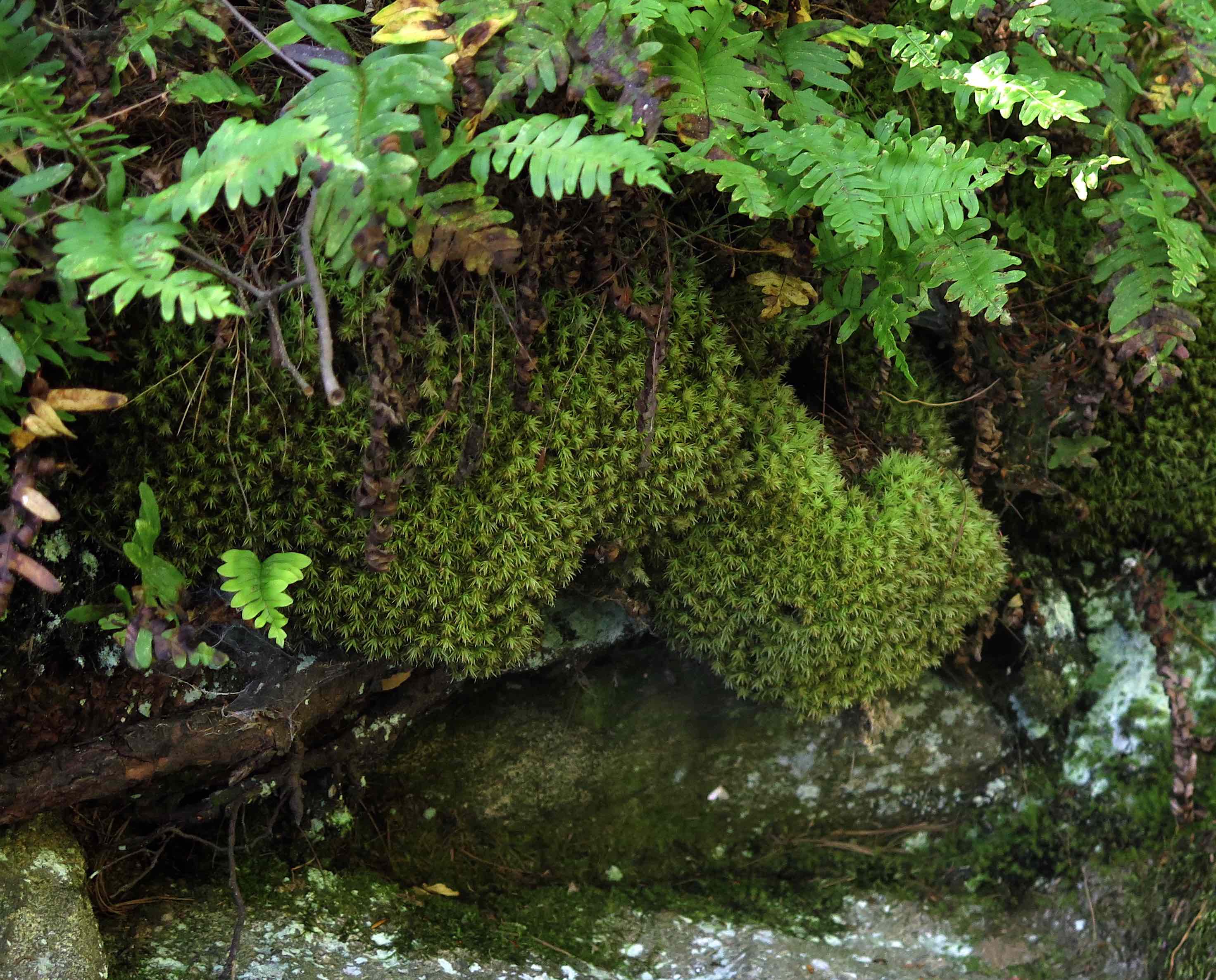
This section of the Hudson lies behind a large island, sheltered from most of any wind that might be roiling the main course of the river.  There are several rocky promontories here, and a number of coves where the bouldered shore is carpeted with thick green mats of moss.  This lovely mound of wispy-leaved moss was overhung by a crowning abundance of Polypody ferns. Thanks to our moss-loving friend, Ruth, we now know that this mound consisted of Apple Moss (Bartramia pomiformis).


A really close look at the mound revealed its tiny spore capsules, round as apples, that suggested this native moss's names, both the scientific and the vernacular.


We did not have to closely peer along the shore to spot the brilliant blooms of Cardinal Flower (Lobelia cardinalis), a native wildflower that along other parts of the river are well past their prime.


We also spotted beautiful patches of Closed Gentian (Gentiana clausa), the flowers of which were very nearly as brilliantly blue as the Cardinal Flower's were red.


In all the years Sue and I have been paddling this backwater, we had never found the underwater solid masses called Pectinatella magnifica here.  But since a fierce straight-line wind a few years ago toppled many huge trees into the water, these filter-feeding bryozoans ("moss animals")  have apparently found sufficient underwater twigs to form their colonial masses around.  However, these masses did not look typical.  Their normally rusty-brown surface was covered by a transparent green jelly.  And the normally solid masses were falling apart.  I wonder if that green jelly is not just hitching a ride on the Pectinatella, but is also devouring it.


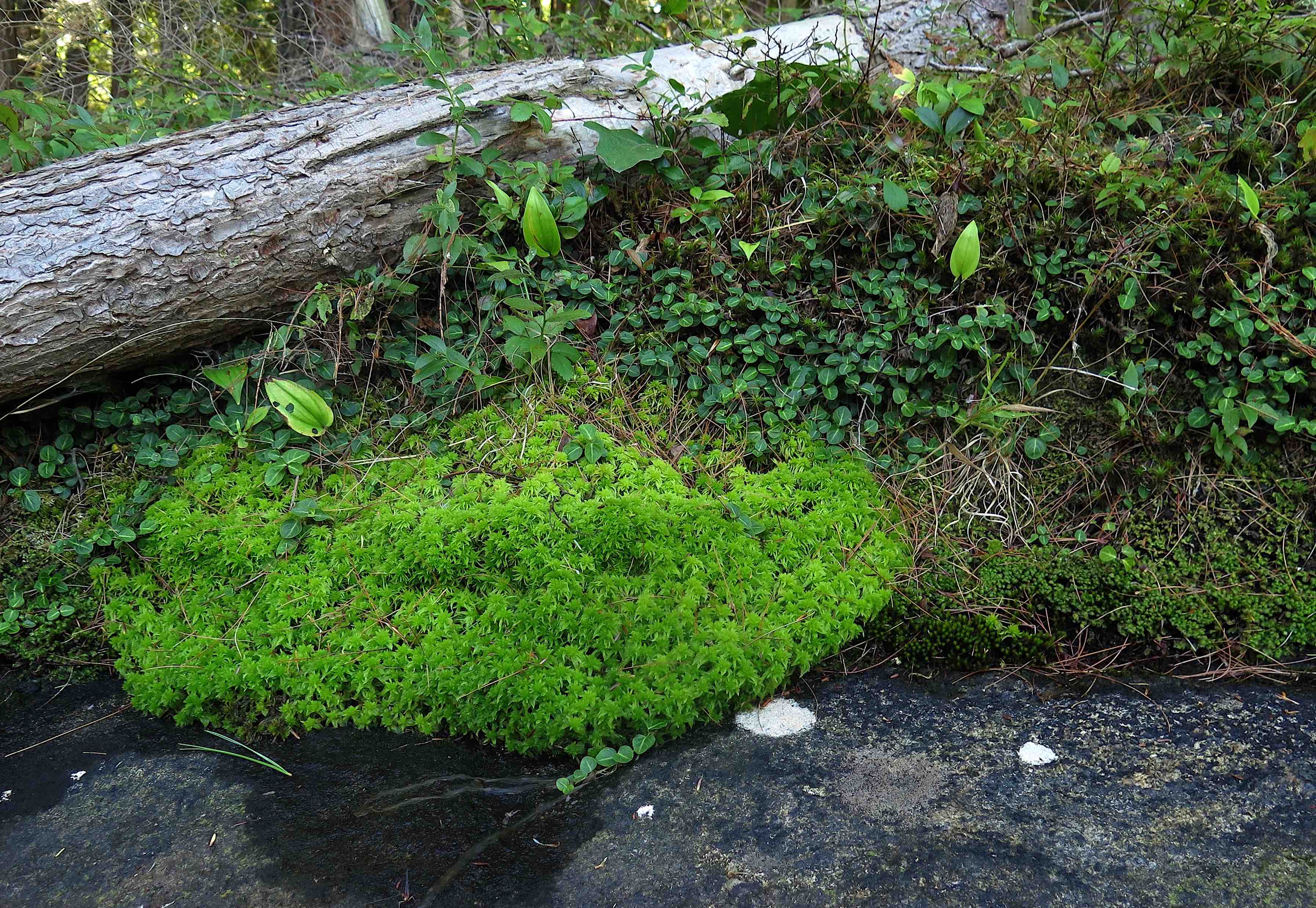
As we paddled close to some steep rocky banks on our passage toward the open river, this vivid lime-green patch of Sphagnum Moss caught our attention -- and how could it not? A sprawling carpet of Partridgeberry (Mitchella repens) looked lush and lovely, and . . . hmmm? What is that low-growing green stuff right at the edge of the rock?


Our friend Ruth and her loupe and her knowledge of bryophytes came through for us once again.  A really close look at this green "mossy" stuff revealed that it was NOT a moss, but rather a liverwort.  Most likely a liverwort of the genus Scapania.


Lunchtime! And weren't we lucky to have such a beautiful spot to picnic as this rocky point, our little boats safely berthed among the boulders?


Sue seems to have found something to point out to me.  I think she thought it might be the liverwort called Handsome Woollywort.  I demurred (too sunbaked a habitat, I thought) and didn't take a photo. But now I wish I had.  She might have been right.  She has a habit of finding very cool stuff.


Sue also pointed out a still-blooming patch of Pale Corydalis (Capnoides sempervirens), with flowers so small I might not have seen them if Sue had not shown them to me. This species of Capnoides does love to grow in the seams and cracks of exposed rock.


We next set off to explore another part of this stretch of the Hudson.  As this photo reveals, it sure was a beautiful day to be on the water, and in such a scenic spot.


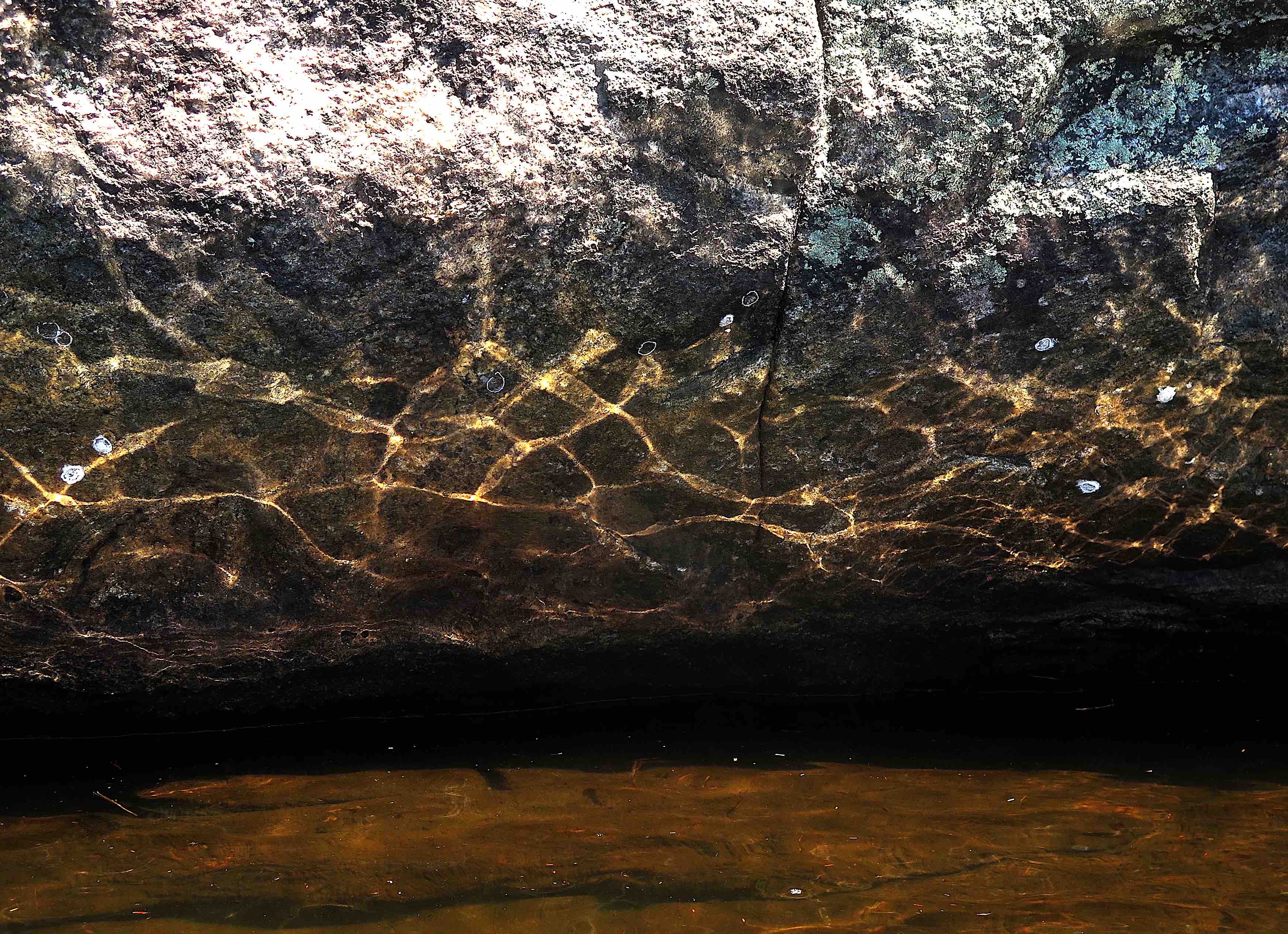
As we passed along overhanging rocky projections, the sunshine reflecting off rippling water cast dancing golden ribbons of light on the shadowed overhangs.


Here, we've entered a quiet marsh, surrounded by beaver-girdled (but still surviving!) Black Tupelo trees (Nyssa sylvatica), dotted with mounds of glistening Tussock Sedge (Carex stricta), and edged with thick stands of purple-flowered Pickerelweed (Pontederia cordata).


The healthiest of those Black Tupelo trees were already turning their signature scarlet, earlier than all other trees along the river.


Paddling beneath a Black Tupelo's overhanging limbs,  I could look up and marvel at its scarlet leaves, translucent as stained glass against a cobalt-blue sky.


Birds had consumed or disfigured most of the Tupelo fruits on the female tree.  Craving to see once again the lovely blue berries dangling from hot-pink stems, I went and found this older photo of them in my files.


The afternoon breeze had picked up, causing the slender shining leaves of the Tussock Sedge to dance and wave with the wind.


We encountered several Winterberry shrubs (Ilex verticillata) with many leafless twigs, but at least the twigs that still held leaves had put forth a beautiful display of scarlet fruits.


Autumn Meadow Hawk dragonflies were soaring around the marsh, and lucky for me, this one landed on a canoe-side twig and stayed put for the picture-taking.


It was hard to leave this charmed and beautiful river while sunlight still sparkled on the wavelets, but two of us had husbands who expected their dinners this evening.   So, shouldering our lightweight canoes (mine weighs less than my cat!), we hiked back up the hill toward our cars.  But eagle-eyed Sue called out to Ruth and me, "Wait!  Here's a big patch of Red Pinesap right by the path!"  And so there was! 


Hypopitys lanuginosa is this Red Pinesap's scientific name, a later-blooming and much-redder species than the Yellow Pinesap (H. monotropa) that blooms earlier in the summer.  Cherry-red it was, and how appropriate! This find was like a cherry on top of the last two days: paddling this marvelous river with two great pals on two of the most beautiful days of the summer, in canoes that have given us many more pleasures than any fancy resort could ever match!