Thursday, June 6, 2024

Back in Action !

Oh my, just LOOK at these gorgeous Blue Flags!  This old photo of mine showed up in my Facebook Memories yesterday, and it reminded me of how much I've been missing the past few weeks.  During the middle part of May, I suffered an intestinal illness that laid me low and sapped my energies even after the acute symptoms subsided.  So I haven't been wandering the woods and waterways as has been my wont, or even if I did go out for short forays, I didn't feel enough oomph to post blogs about what I found out there.  But man, I sure would hate to miss seeing these beauties this year!  So I dragged my canoe from under the porch, strapped it to the roof of my car, and set off to go look for them where I knew they grew along the Hudson River.


Lucky for me, the day was gorgeous, and the river ran smooth as silk as I set off to explore the banks and islands of the Hudson at Moreau.


I always feel profoundly at peace paddling this stretch of the river between the Spier Falls and Sherman Island dams, where forested mountains fall right down to the water, and bouldered shores are adorned with some of our most beautiful native plants.  Both sides of the Hudson here are part of Moreau Lake State Park, their pristine beauty unmarred by most human development, even though I still can hear autos passing along Spier Falls Road as I mosey along close to the Saratoga County side of the river.


Where the banks are undercut by the force of the river's current, these gracefully curving fronds of Long Beech Fern formed a lovely drapery over the shadowed hollows.


Inching as close as possible to the rocky banks, I spied some spikes of small white florets nestled among the grasses.  Ooh, could these be Shining Ladies' Tresses, our earliest species of Spiranthes to bloom around here?


Indeed they were!  Spiranthes lucida, one of our region's nearly 60 species of native orchids, distinguished from other white-flowered Spiranthes by its florets' yellow lower lips, as well as its early bloom time. In my experience, this little orchid does seem to like to grow along river banks, and thus must be able to tolerate the inundations of seasonal flooding. And in this particular stretch of river, varying water levels are caused by upstream and downstream hydropower dam operations.


Over the past 30-plus years I've been paddling this catchment, those varying water levels appear to have killed most of the deciduous trees that once forested the little islands that stud the Hudson along this section.  (Abundant beavers also contributed to the deforestation.) For various reasons, what once were lower water levels following spring flood are now year-long high water levels, and this change of hydration has changed the habitat of these islands from shaded forest to sun-baked wet meadow.  On this day, the water level was remarkably low, revealing broad swaths of muddy shoreline, because the river water had been lowered for over a week while the downstream dam was undergoing maintenance and repair.  This catchment was still in the process of refilling.


I stopped off to explore this island, curious to see if a second orchid, the Tubercled Orchid, was still abundant along the shore.  I could not find a single one this year (orchids can be quite fickle), but I was quite surprised to come upon this nearly intact deer skeleton lying amid the Royal Ferns.  I know that sometimes coyotes chase deer across the frozen river, where the coyotes have surer footing than the deer do on the ice.  I wonder if that's how this creature met its end.


I was curious to see if the Royal Ferns were once again serving as birthing centers for some insect larvae (moth or cutworm?).  And indeed they were!  In plant after plant, the terminal leaflets had been drawn into hollow orbs wrapped by silken threads, thereby creating chambers where the larvae sheltered, consuming the fern tissue before undergoing pupation.


I reported finding these same pupation chambers on this same island a year ago and posted information about them on this blog at that time.


Although my explorations of this island's interior were hampered this year by the extensive spreading of Poison Ivy, I did enjoy a few floral finds, such as this abundant patch of our native Dwarf Forget-me-nots (Myosotis laxa).


Here's a close-up of those wee little flowers to demonstrate how adorably tiny they are.


Lots of other blue flowers make this island their home as well, especially abundant populations of Blue-eyed Grass (Sisyrinchium sp.).


Another populous wildflower on the island are these bright-yellow Small Sundrops (Oenothera perennis).


Although I did find a few scattered plants of Blue Flags (Iris versicolor) on the island, I wanted to find the abundant patch of them I had photographed a few years ago and so headed across the river to the Warren County shore.  And sure enough, there they were, just as glorious as ever, picked out by the sunlight to glow against the deep shade of the forest behind!  Oh yes, I delighted to bask in the beauty of them! But because of that full sunshine creating deep shadows and bright highlights,  I was not able to achieve the marvelous depth of color of the flowers that I'd achieved in my former photo, taken under conditions of bright overcast, which eliminated both shadows and highlights. But still . . . .  Oh joy!


And of course, the addition of a Tiger Swallowtail nectaring among the blooms only added to the beauty.


Too bad this neighboring gigantic clump of Yellow Iris (Iris pseudacorus) threatened to spoil my elation.  Yeah, yeah, the flowers are gorgeous, but this plant is one of the most destructive invasive species imaginable.  Left to do its thing, this single clump could completely overtake this entire shoreline, supplanting every native wildflower in its way.  I would need a pickaxe to uproot it, but at least I had my small Leatherman tool with a knife blade to cut every flowering or budding branch, so no seeds could be dropped in the water this year to spread new plants down the shore. I will report its presence here to the Invasive Management Program folks, and hope they might bring their heavy-duty uprooting tools to eradicate it from this stretch of shoreline anyway. I hope to always be able to return to "my" spectacular patch of native Blue Flags.


I'm on my way to trash these interlopers.  And I urge all my readers to be on the look-out for any occurrences of Yellow Flags they might find and seek to destroy them as well.


Tuesday, May 21, 2024

The Swampy Part of Bog Meadow Brook Trail

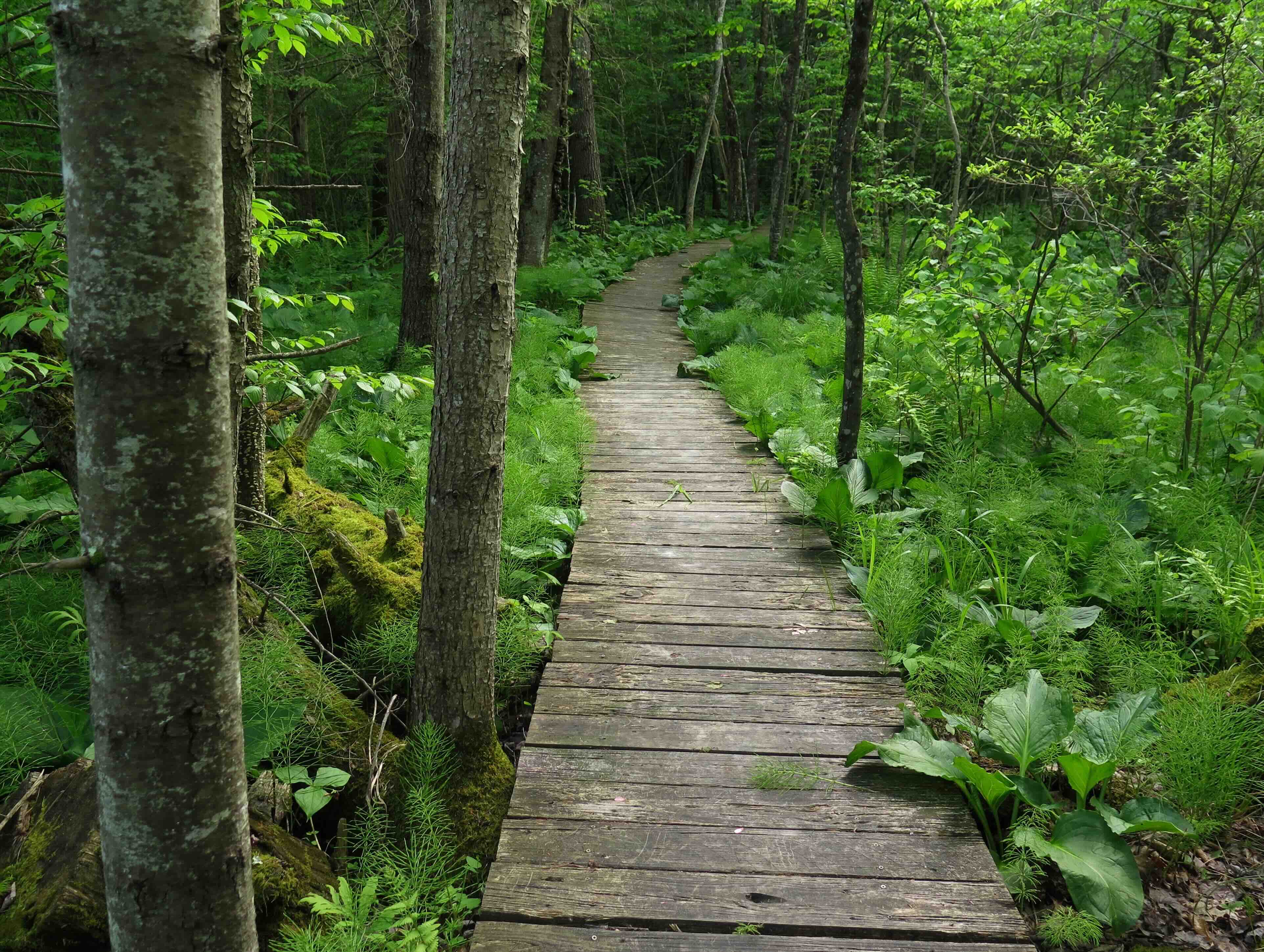
I often think that Bog Meadow Brook Nature Trail in Saratoga Springs is kind of mis-named, since there's really only a tiny portion of this two-mile trail that's actually the kind of acidic, sphagnum-lined  wetland that might properly be called a "bog."  Most of this trail is bordered by shaded forested wetlands of varying pH and sunnier shrubby wet meadow, with creeks either rushing or ambling alongside, and three sections of open marsh.  All parts of the trail provide marvelous habitat for a wide variety of native wildflowers and birds, but to me, the richest trove of wildflower treasures can be found in the trail's mid-section that's mostly pure swamp, densely wooded and wet underfoot, except for the raised main trail that once underlaid railroad tracks. This very convenient boardwalk, accessed from a housing development, brings me right into the center of Bog Meadowbrook Nature Trail without sinking up to my ankles in muck.


This boardwalk grants me easy viewing of a marvelous mix of swamp-loving plants, like this broad-leaved Skunk Cabbage, lime-green Sensitive Fern, and lacy-branched Wood Horsetail.


Fallen trees support many species of mosses, and colorful flowers like Wild Geranium and ferns like these dark-stalked Lady Ferns add beauty and textural variety.


The Wild Geranium flowers ranged in color from a near-white pale lavender to this more vivid purple.


Three different species of horsetails thrive along the boardwalk, including these two, Field Horsetail (right) with non-branching leaves and the lacier-looking Wood Horsetail, with dividing leaves.


To find the third species, the minute squiggly-stemmed Dwarf Horsetail, I had to sweep aside some of those broad Skunk Cabbage leaves to locate this ground-hugging curling mass, two of its stems now topped with spore-producing strobili.


To find a fourth species of horsetail, I had to walk further along Bog Meadow's main trail to where I found standing water, the habitat required by the aptly-named Water Horsetail, with its tall slender stalks bearing whorls of leaves. (A fifth species, Scouring Rush, grows in sunnier sections of the trail.)


In each population of Water Horsetail, only a few specimens bear the spore-producing strobili atop the branching stalks.


Also seeking wet habitat, as its name implies, is Water Avens, an attractive plant if you bend down low and peek at its pale-yellow petals held close within deep-red sepals (are they sepals?).


I was delighted that the dark water of a tiny stream served as a backdrop for this cluster of Two-leaved  Miterwort growing right at the edge of the stream.  The Miterwort's delicate snowflake-like florets would disappear against a busier background, they are so small.


Here's a closer look at those tiny Miterwort florets.


There's no chance I would miss seeing the bright-yellow clusters of Golden Ragwort blooms, standing out so luminously against the other tall plants that share its wooded wetland.


I might miss seeing these tiny flowers of Hooked Crowfoot, though, if the flowers were not so bright. It does take a close look to notice the little hooks on each ovary that suggested this wetland buttercup's name.


Here's a closer look at those tiny hooks, this plant's way of grabbing onto your pants for seed distribution purposes when ripe:


I did not have to LOOK for this Early Azalea shrub, even though it was blooming quite a ways off the trail, well back in the trailside swamp.  I could detect its nearby presence just by its fragrance wafting on the air.  Then, its vividly colorful blooms were easily discerned amid the thick shrubbery that surrounded it.  To approach it for this photo, I had to avoid grabbing Poison Sumac trees to not topple as I teetered my way atop tussocks.


At last, I arrived at the only part of this trail that might be called "bog," a Sphagnum Moss-lined pool nearly covered with the three-parted leaves of Bog Buckbean.  Sadly, almost all of its bright-white flowers had already fallen, except for an occasional remnant of bloom too far away for me to get a clear photo. (Since this pool is actually fed by a stream, though, it might more accurately be called a "fen.")

Here's a clearer photo of the now-fallen flowers, taken on another year on this same date, when every Bog Buckbean plant in this pool bore clusters of snowy five-parted blooms that were lined with squiggly hairs.


For the rest of my walk today, I kept to higher and drier ground along this preserve's main trail, observing some of Spring's prettiest forest-floor flowers.  Many Canada Mayflower plants bore clusters of small white fragrant flowers.


Foamflower also bore similar clusters of starry white florets held on strictly erect stalks.  The heart-shaped leaves help to distinguish this native wildflower from the Canada Mayflowers.


Here's another photo of dainty Foamflower and its pretty leaves. We once called this species by the scientific name Tiarella cordifolia, but taxonomists have recently decided that our local Foamflowers are actually the species stolonifera, due to its underground networks of stolons. The species cordifolia grows in more southern states than ours.


Low-growing plants of Dwarf Raspberry each held a single white-petaled bloom, which later will produce a single beautiful berry, translucent and ruby-red.


I am rarely able to get a photo of Wild Sarsaparilla that includes both its three stalks of compound leaves and the orbic clusters of tiny white flowers that grow on separate stalks beneath the leaves. Today was my lucky day!


The trail was lined with many Starflower plants, each bearing the lovely white star-shaped flowers that suggested its name.


There were several patches of Perfoliate Bellwort, each plant bearing a single nodding pale-yellow flower and with leaves that appeared to be pierced by the stems.


A look inside each Perfoliate Bellwort bloom revealed the granular dots that help to distinguish this species from one other species of bellwort that also has perfoliate leaves.


Just before I turned around to retrace my steps, I encountered an extensive patch of Star-flowered False Solomon's Seal, each plant bearing a terminal cluster of small starry-white florets.   When I first encountered this lovely wildflower along this trail more than 12 years ago, I counted 10 specimens, all confined to a grassy area beneath a large White Pine.  Today, there were more than a hundred in bloom, spread along the trail for a considerable distance, far from that original site.


Striding more quickly now along a portion of trail densely shaded by giant White Pines, I drew to a halt when I spied the vividly patterned basal leaves of Downy Rattlesnake Plantain spreading among the pine needles. This native orchid won't bloom until later in summer.  If it blooms at all.  Some years I find many of its erect multi-flowered stalks, and other years none at all.  That's orchids for you.  Fickle.


I did see many ferns today, in various stages of maturity:  Cinnamon Fern, Interrupted Fern, Christmas Fern, Marginal Wood Fern, Royal Fern, Lady Fern, and this one I love best of all: the circling fronds of Maidenhair Fern.  Those other ferns grow either singly or in small groups, but Maidenhair Fern, when it finds the lime-rich soil it requires, will often completely cover a bank with its trembling fronds that just seem to shimmer, even when not moving at all.  So beautiful!  Like so much else along this swampy stretch of Bog Meadow Brook Nature Trail.


Tuesday, May 14, 2024

It's Violet Time on the Riverbanks!

At first sight, this stretch of rocky riverbank doesn't look all that promising for a wildflower walk.  But my friends Sue (orange shirt) and Ruth and I knew there were many floral treasures growing here to show to our friends in the Thursday Naturalists when Sue leads them along this shore later this week.  We had come on a balmy Monday to make sure we could point out those treasures when we returned with our friends on Thursday.


For sure, not all those floral treasures were hidden!  Spectacular masses of Red Columbine were blazing away, sprung from cracks in the marble outcroppings that line this stretch of the Hudson and lit up by the sun like tiny Japanese lanterns.


Here's a closer look at the complex flowers of that Columbine (Aquilegia canadensis), one of our most spectacular native wildflowers, and one that is not at all rare.


My friends and I were here today to make sure we could locate one of the rarest flowers that thrives at this location, the New England Violet (Viola novae-anglieae). As far as is known to date, this violet grows nowhere else in New York State but along these northern riverbanks.   And yes, indeed, we did find some! At a glance, they may look just like the Common Blue Violets that grace every alleyway and unmowed lawn right now, but closer examination would reveal the most immediately telling feature of this species, the long tapered basal leaves (among other distinctive traits). We were quite happy to observe that the numbers of this truly rare violet had increased significantly since we first noticed them a few years ago.


We were also delighted to find a healthy number of another somewhat less-rare violet, the white-flowered  Primrose-leaved Violet (Viola primulifolia). This violet is rated as a Threatened species in our state, and other known populations have been reported only from locations quite far from this site.  It was quite a surprise to find it growing at this location when I first reported it here, back in 2016. Since this violet likes to grow way out in the cobble close to the shore, annual floods often diminish the numbers at any one previously known site only to distribute new plants a bit further downstream.  The most important feature for identifying this violet is the shape of its leaves, which resemble slightly those of a primrose plant.


A couple of other not-at-all-rare white violets were blooming now along the shore, the tinier of which has a truly appropriate new scientific name, Viola minuscula. Northern White Violet is one of its several vernacular names, but I want to call it Minuscule Violet to properly acknowledge how tiny it truly is.  Quite fragrant, too, which helps to distinguish it from other smallish white violets. (Previous scientific names include V. pallens and V. macloskeyi.) This little violet often grows in a spreading mass, but we found mostly occasional individual plants along the shore.


One other white violet was the Lance-leaved Violet (Viola lanceolata), and we found quite a few plants at various locations.  The lance-shaped leaves make this species easy to ID.


We could detect numerous Ovate-leaved Violets (Viola fimbriatula) at a glance, thanks to their vivid purple blooms.  The ample fuzziness of leaves and stems is one of the distinctive features of this lovely species, along with its oval-shaped leaves, as well as is its preference for dry, exposed sites like sandpits and riverside cobble.  For just a few years, this violet species was listed as a variety (ovata) of the Arrow-leaved Violet (V. sagittata), but a foremost violet expert named Harvey Ballard has returned it to the name I first learned it by, V. fimbriatula.  Another good vernacular name for this denizen of open, low-nutrient habitats is Sand Violet. 


Here was one violet I could not put a name to, neither vernacular nor scientific.  It had basal leaves only that were sharply pointed, hairless dark stems, and slender, pale flowers with no apparent hairs on the bottom petals, and noticeable veins on all petals.  Suggestions for ID would be most welcome.


Lots of violets, indeed!  But other lovely flowers caught our attention, too, including these sprawling low branches of Dwarf Sand Cherry (Prunus pumila var. depressa) wafting their beautiful fragrance on the breeze.  Although listed as a Threatened species in our state, it sure looked happy along these rocky shores, its desired riparian habitat.


With every spring visit to this site, I have always examined the glossy evergreen leaves of a large patch of Bearberry (Arctostaphylos uva-ursi) that sprawls amid the cobble here, searching and searching for its pretty pink-tipped white flowers.  In all the years I have looked for them, this is only the second time I have found this trailing sub-shrub in bloom, and what a bonanza of bloom we found today! One of many happy surprises that starred our visit to this amazing site, home to so many rare plants.


Here's one last beautiful flower we found on our visit today, a spreading patch of Fringed Polygala (Polygaloides paucifolia).  This native wildflower is not at all a rare plant, blooming abundantly in nearly every shady pinewoods I visit right now.  And sure enough, it wasn't until we left the sunbaked rock-strewn riverbank and climbed up into the densely shaded pine woods to make our way back to our cars that we found it.  And how could we miss these vividly colored little blooms? They reminded me of tiny pink-purple single-engine airplanes zooming across the forest floor. What a treat to end our adventure!