Friday, October 6, 2023

Return to My Personal Paradise


My eyes filled with tears as I beheld the scene pictured above.  I had thought I would never again visit Pyramid Life Center, a place of great natural beauty and profound spiritual resonance for me, located on Pyramid Lake in the Adirondacks.  But thanks to dear friend Margie Litwin, who helped me find my way back here, I once again stood on this shore and gazed across the lake's still waters this week. I could even hear the loons' haunting calls, and interpret them as their way of welcoming me home.

Pyramid Lake is certainly one of the jewels of the Adirondacks. But this crystal-clear wilderness lake encircled by forested mountains had meant far more to me than just a pretty place to visit. It was to this spiritual retreat center that I fled in the summer of 1991, full of anguish over the war my nation had waged against Iraq, angry and sad that my fellow Americans were so excited and proud and happy to go to war. And here, at a retreat with the late Jesuit priest and anti-war activist Daniel Berrigan, I found I was not alone in my feelings of alienation. And more than that, here I found heroes -- social workers, drug counselors, healthcare providers, advocates for the homeless and poor -- whose witness gave me the courage to choose for myself a more authentic way to live. I left a job that required me to be very nice to the very rich just because they were very rich, to learn how to care for the dying as a nursing assistant for Hospice -- a choice that brought me far more joy and spiritual riches than I ever dreamed possible. So yes, my love for Pyramid Life Center runs very deep, indeed.

I expressed my deep love for this place by volunteering twice a year, both in the spring to prepare the center for offering a wide variety of life- and spirit-enhancing retreats, and again each October, to help ready the center's rustic accommodations for the long winter ahead. I did this for 27 years. And I was preparing to do so again in 2019, when  Pyramid Life Center's beloved founder and director, Sister Monica Murphy, was killed in an auto accident.  A replacement director was quickly found, and in addition to having to cope with taking over the duties of managing the retreat center, the new director had to cope with restrictions required by the Covid pandemic.  No volunteers nor casual visitors were allowed to even set foot on the property. While I acknowledge the severe strains that this situation posed for the new director,  a number of us former volunteers felt disrespected and therefore alienated from this deeply loved place. I had given up hope of ever returning.

But as it happened, my friend and fellow volunteer Margie Litwin (pictured below), had managed to maintain a good relationship with Pyramid Life Center, and when a new (and far more accommodating) director of the center took over recently, she invited me to return to this deeply missed place and enjoy a paddle with her. For several years, Margie and I had labored together to clean and refurbish the many guest rooms in the center's main lodge, so she knew very well how greatly I had missed feeling welcome here.


I cannot imagine a more beautiful day to celebrate my return to Pyramid Lake. Sunny and warm, with barely a breeze to riffle the still water that reflected the splendor of forest and mountains in full autumnal beauty.


Oh, how I had missed the voluptuous curves of the shoreline here, made especially gorgeous with autumn color!


Each of us has a special part of the lake we love to re-visit, and I also cherish this favorite of Margi's, a quiet bay where great boulders (actually resembling pyramids!) rise from the shallow water.


Both of us also love to explore the swampy ends of the lake, where our lightweight Hornbeck canoes are ideal for floating over very shallow water.


From this western end of the lake, we can gaze across the open water to where Bear Mountain rises, its lakeside face made rugged by steep cliffs of bare rock.


As we pushed our way over mats of underwater vegetation, we noticed thousands of tiny green Nostoc balls, which contain colonies of cyanobacteria enclosed within membranous spheres. This is not the toxic "blue-green algae" that pollute some lakes, but rather an organism found in mainly very clean waters.  I once carried a sample of them to Skidmore Biology Professor David Domozych, who showed me the colonies under a microscope.  He was quite happy to have these Nostoc specimens, explaining that these balls are quite uncommon, occurring in only about 2% of lakes and ponds.  Here's a LINK to my blogpost reporting on this visit to Dr. Domozych, including the magnified images and explanations.


Poking up from mats of floating vegetation were a few of the tiny bladderworts called Humped Bladderwort (Utricularia gibba).  We could also see the thread-like underwater structures by which the bladderworts obtain nutrients. Numerous tiny sacs are attached to these threads, and these sacs suck in underwater organisms that are then digested to provide nutrients to the leafless plants.


I reached into this muddy mass to try to extract some of the bladderworts' underwater threadlike structures, but when I lifted this thready growth in the photo below, I detected a certain "skunky" smell  that informed me I had obtained not a bladderwort growth but rather a specimen of Chara, a green alga known as Muskgrass or Skunkweed because of its pronounced odor.

Chara superficially resembles land plants because of stem-like and leaf-like structures. These algae are found in freshwater, particularly in high pH areas throughout the northern temperate zone, where they grow submerged, attached to the muddy bottom. I was aware that Pyramid Lake was more alkaline than acidic, thanks to its underlying calcareous substrate. Because Chara algae are covered with calcium carbonate deposits that give them a gritty texture, they are sometimes known as stoneworts.


Paddling back toward the open waters of the lake, I detected another interesting underwater growth, a colony of bryozoans ("moss animals") called Pectinatella magnifica.  This solid, heavy mass is composed of tiny filter-feeding animals that attach themselves to underwater tree limbs and secrete the dense jelly-like substance that holds all the creatures together on the surface of the mass. These colonies are often found underwater along the shores of many Adirondack lakes.


Paddling back to shore, I lingered to take in this view of both Bear Mountain and the shore of an island where I had camped several times, once with my eldest granddaughter.  Here, I'd been thrilled by the experience of true wilderness, with no sign of human habitation visible from this side of the island, the only sounds that of wavelets lapping the shore, the soft sighing of wind in the pines, the calls of loons echoing off the mountainsides, and the sweet lilting song of a Winter Wren to wake me at dawn. All the surrounding forest is part of the Pharaoh Lake Wilderness Area, over 46,000 acres of forever-wild Adirondack Forest Preserve.  There are few other sites in this wilderness area so accessible to me, which is part of the reason I felt so sad those years I had been denied ready access to it.


I could understand why the former director did not want me to participate in group activities during the Covid pandemic, but all I really wanted to do was check on a thriving population of state-ranked Endangered plants that grew by the dining-hall's trash bins. I explained I would not interact with other folks at all. But rules are rules, and I didn't challenge them. Nor did the then-director invite further conversation.  But now, before I left this beloved place, I made sure to visit these Large-leaved Avens plants (Geum macrophyllum), which I was heartily relieved to find still flourishing, even in a high-traffic spot. Now I can look forward to visiting them again in July, when they will be in bloom with yellow flowers. Like so many other aspects of Pyramid Life Center, these native wildflowers are truly treasures.


Friday, September 29, 2023

Autumn Color Everywhere!

Autumn's glory approaches its fullness! And where better to witness this glory's arrival than paddling a quiet Adirondack lake, especially one ringed by forested mountains? When I joined my friends Ruth and Sue at Lens Lake in Warren County this week, we could see that the colorful foliage had yet to reach full crazy-quilt vibrancy, but there was no denying that it was surely beautiful, while yet promising even more vibrant colors to come.


Even the Fragrant Water Lily pads were assuming warm hues to match the shoreline trees, the sphagnum-carpeted bog mats, and the shrubs that crowded the boulders along the rocky banks. 


Before we headed out to explore the bog mats, we drifted closely along the shore,  where quiet backwaters were lined with colorful shrubs, and the still water reflected lovely gardens that had sprouted from waterlogged fallen trees.


My moss-loving pals found much to engage their attention among the moss-covered logs and lichen-frosted stumps.


I felt less obsessed than usual to put names to every beauty I found, and let my eyes instead of my intellect have full rein today.  I did happen to know the name of these dew-spangled Round-leaved Sundew plants, but even if I hadn't, just enjoying their rosy sparkle was adequate and joy-filled satisfaction.


The same, for these tiny red-capped fruticose lichens poking up from a verdant velvety moss.  Even if I did not already know that they were called Lipstick Powderhorns, I bet I could have assigned them that name, just from the way they looked.


The flowering shoreline shrubs held just as much beauty as they had held when they first bloomed last June, the Sheep Laurel actually putting out a second explosion of bright-pink flowers.


And the Labrador Tea shrubs were studded with pretty pink terminal "buds,"  but not buds that were due to open soon.  These cone-shaped growths won't open until next spring, when clusters of pretty white flowers will emerge.


This fallen log was covered so thickly with such a variety of colors and shapes, it reminded me of a  colorful medieval tapestry.  I could almost imagine a Unicorn prancing amid the tiny Large Cranberry leaves and its bright-pink orbs,  the urn-shaped pot-bellied green leaves of a Purple Pitcher Plant, and the scarlet-blotched leaves of a baby Red Maple.


But the bog mats soon beckoned, glowing gold and surmounted by multi-colored mountain slopes.


Drifts of white-tufted Cottongrass floated above the carpets of red and gold sphagnum moss. The Cottongrass tufts danced in the breeze, and also danced again in rippling reflections.


This clump of glossy scarlet and lime-green Pitcher Plant leaves was remarkably robust.


Two different species of sphagnum, one red, one gold, mingled their colors like those in a Persian carpet.


Studding the golden sphagnum were many ripe red fruits of Large Cranberry.


The formerly pink and green leaves of Marsh St. John's Wort had assumed their autumnal ruby red.


A second St. John's Wort species also decorated the bog mat, but this one, called Dwarf St. John's Wort,  had much daintier leaves of a gentler shade of rosy red.


Small floating mats bore the meandering yellow-green ropey branches of Bog Club Moss,which shared its crowded muddy habitat with the spiky remains of Yellow-eyed Grass, Pipewort, and White Beaksedge.


Here and there on the vast bog mats, small young Tamarack Trees still held onto their bright-green needles, which soon will turn golden before dropping off for the winter.  This common denizen of bogs is our only deciduous conifer.


Tamaracks can grow quite tall, but none will ever grow taller than our native White Pines, some of which have attained astonishing heights on the rocky islands that dot the surface of Lens Lake.


One Red Maple stood out from others along the shore, both for its height as well as for the vibrancy of its scarlet leaves.


From craning my eyes to admire these tall trees, I next turned my gaze to see what I could see beneath the water's surface. I soon spied some feathery ropes of Common Bladderwort floating free while submerged, and a few of them held bulbous green orbs at their tips.  These orbs are called "turions," and they are the winter buds of these bladderworts. The turions will sink into the mud after the rest of the plant disintegrates from freezing, and a new plant, a clone of its parent,  will sprout from the turion in the spring.  Although these bladderworts do produce above-water flowers and are capable of reproducing sexually by the production of seeds, they also continue to spread their populations by this vegetative method.


Paddling over some sunken tree limbs, we saw what looked like lengths of green yarn caught in the twigs and waving around underwater.  I lifted up a portion of this "green yarn" to examine it more closely. Its gritty texture, composed of silica, convinced me that this was Freshwater Sponge, a colony of tiny animals that filter water through their bodies, absorbing oxygen from the water and feeding on waterborne food particles.  Their presence in a lake is usually an indication of clean water.


But here was the most amazing underwater "being" we saw today, a bulbous mass of transparent greenish jelly submerged in shallow water close to the shore.  These blobs, which occur frequently in this lake, are formed by a colonial microscopic single-celled protozoan called Ophrydium versatile.  As I once learned from the Ask the Naturalist blog, these colonies can be found all over the world in fresh water.  The individual cells line up side-by-side and attach themselves to a jelly-like substance they secrete, eventually forming blobs of different sizes, from as small as a marble to as big as a bathtub.  They are symbiotic with microscopic Chlorella algae that live inside the Ophrydium cells and give the blob its green color.  When the sunlight illumines these colonies beneath the water, they assume a wonderfully mysterious green glow!


Here was one last amazing thing we found at Lens Lake this day: a mass of baby spiders, still residing in their webby nest before wafting off on breeze-lofted filaments of their own web.  Sue saw this mass first, attached to the twigs of a waterside shrub.  


At first, especially when I saw the pale, dry, cast-off skins of the molting spiderlings, I was concerned that all were dead, perhaps killed by frost.   But then I spotted the larger, darker spiderlings that were definitely wriggling around. They were too small for me to determine their species, so I will just call them Adorables. This was just one more delight of this absolutely delightful day in one of the most beautiful places on earth.

Monday, September 25, 2023

Powerline Perambulations

 An east/west powerline intersects a north/south lane in the middle of the densely wooded Daniels Road State Forest Preserve, just north of Saratoga.  Two straight lines, easy walking, no way to get lost in the woods.  A friend had told me about an abundant patch of Purple Milkwort (Polygala sanguinea) alongside this powerline, the flowers massed just steps from the preserve's parking area, he said.  So on Friday,  off I went to find them, driving north about a half-mile into the woods to the parking area, then headed east on the powerline. I could easily see this intersection pictured below from where I parked my car.


Here's what Purple Milkwort looks like.  It's small (similar in size to a clover flower), but such a bright pink I was sure I couldn't miss it. 


But miss it, I did!  I walked and walked and walked along the powerline, heading east, searching the grass along either side, but found no dots of bright purple.  Hmm, I thought to myself, I must be walking the wrong side of the powerline. (I'd forgotten my friend's directions.)  Better go back to the lane I drove in on and continue on the powerline heading west.  But just as I thought this, I spied some beautiful Yellow Ladies' Tresses (Spiranthes ochroleuca) off trail near the woods.  Oh boy, I rarely see these!  Better get some good photos.  So I knelt down, circling around the plants to get shots of it from all angles.  That was my first mistake.


But I did not realize my mistake until some time later. When I rose from my knees I started walking what I assumed was back toward the lane, not realizing that I had got myself turned around and was actually walking away from the lane. I walked and walked and walked, feeling a bit amazed that I had come so far. But then I started noticing trailside features that I knew I'd not passed before.  WHAT?!!!  Oh dear, I must be going the wrong direction! So I turned around and walked and walked and walked and walked and never found the lane.  Stunned and disoriented, I questioned my sense of direction once more, and after repeating my exertions again and never finding the lane in either direction, I totally panicked. I had enough sense to know that I had left the lane by traveling east, so all I had to do was keep heading west and that lane would eventually appear. But clouds had covered the sun so there were no afternoon shadows to indicate east from west, and I had no compass.  (Lesson learned: never leave home without one!) Frightened and exhausted, but lucky there was cell service here and I had a charged-up cellphone, I stationed myself by a numbered power pole and dialed 911.  Long story short, a dear young sheriff's deputy found me not 15 minutes after my call for help and escorted me out through the woods to where he had parked his patrol car nearly a mile away. He then drove me back to where my car was parked. Oh boy, did I feel stupid!  I could not thank my escort enough, but he told me he'd much rather help a lady find her way out of the woods than stop somebody for speeding.  How dear and kind of him! He made me feel very happy that my taxes go to provide such help for the lost.

But I still felt much chagrin that I had made such a stupid mistake, and even worse, that I'd never found the flowers!  So back to the scene of the drama I returned the next day, full of strategies about how to determine directions, as well as clear instructions from my friend about exactly where to find the Purple Milkworts, just steps from the parking area.  This time I headed WEST on the powerline.  And I kept turning around to keep the lane well in view.  I also gazed beyond the lane to where I could see mountains rising far to the east. I could see no mountains, even from a rise in the path, by gazing to the west.  So now I had a sure reference. Those mountains weren't going anywhere. Now I could relax and enjoy the walk.


Just as my friend had told me, the milkworts were only a few yards away from the intersection of powerline and roadway.  And oh my gosh, there were HUNDREDS!  I could hardly walk among them without fear of trampling them.


I have seen this lovely flower before, but never with blooms of such an intense color.


Secure that I could still see the lane from a kneeling position, I once again knelt down to closely admire and photograph the blooms.


Just look at the teeny tiny multicolored flowers held within the surrounding purple bracts! Like a tiny bouquet wrapped in purple tissue paper. They remind me of those Italian porcelains called Capodimonte, which render tiny delicate flowers, often contained in little porcelain baskets.  


These flowers must keep blooming for quite a long time, continuing to add new tiers of delicate bracts as the blossoms age. Evidently, these Purple Milkworts have been blooming for quite a while!


Mission accomplished and shame assuaged, I continued walking west on the powerline clearcut,  delighting in many of the other wildflowers along the way.  The wayside meadows were a sea of goldenrods, probably of several species, but I was content to enjoy their beauty without having to know their exact names.  This bumblebee didn't care whose nectar it was imbibing.


I did recognize these small yellow flowers as belonging to Rough Hawkweed (Hieracium scabrum), one of our native hawkweeds and one with roughish leaves that climb the hairy stems.


At first glance, I surmised that these starry white flowers were those of Frostweed Aster (Symphyotricum pilosum), because of their relatively large size and the plant's open habit of growth.  But wait:  these stems were smooth, not hairy, as the specific name "pilosum" would indicate.  So this aster is likely the hairless variety of S. pilosum called Pringle's Aster: Symphyotrichum pilosum var. pringlei.


This thickly florabundant pale-purple aster could be the Wavy Aster (Symphyotrichum undulatum), to judge from how the pedicels of its lower leaves widened before they met the stems. But I am never sure of species when it comes to asters.  We have so many species, and they do hybridize with each other at times.


This bumblebee was feeding on what I at first assumed was Spotted Knapweed.  But then I noticed the slender lance-like leaves along the stem, not the deeply-cut leaves of that very invasive non-native weed.  I then decided this must be Brown Knapweed (Centaurea jacea) instead.  The Brown Knapweed (a species introduced from Europe) is possibly just as invasive in the U.S. as the Spotted Knapweed, but I do find it growing wild much less often and much less abundantly in the places I usually visit.


The brown fringed bracts on the Brown Knapweed's involucre are one of the keys to its identification, along with those narrow uncut leaves.


When I saw the bright-yellow blooms of Nodding Bur-marigold (Bidens cernua), I guessed that it had found its way to a bit of a wetland beneath these powerlines.  Sure enough, as I approached, I stepped down into a swale that was thick with the barbed stems of Arrowleaf Tearthumb grabbing at my pantlegs, and my feet could feel soft damp soil beneath my shoes.


Slender Agalinis (Agalinis tenuifolia) is another denizen of damp places, and sure enough, I found in this little swale a few of its pretty purple flowers still blooming among the frothy remains of its many plants now gone to seed.


And sure enough, here also bloomed the well-named wetland denizen called Swamp Aster (Symphyotricum puniceum).  Another name for this aster is Purple-stemmed Aster, although it doesn't always have a purple stem.  But it does always grow where the soil is damp.  And it always has a hairy stem. Since "puniceum" means "pink" in Latin, I'm still pondering why it earned that name, since its flowers look more blue than pink. This is our earliest showy aster to bloom, and it keeps on blooming very late in the season.


There were also rocky outcroppings along the powerline, perfect habitat for many interesting mosses and lichens and clubmosses.  I recognized the spiky Bristly Haircap Moss (Polytricum piliferum) poking up through these wavy-leaved mounds of a gray-green lichen, but I will have to ask one of my bryologist friends to help me put a name to the lichen. I found it beautiful, but it was quite unfamiliar to me.


I did recognize these pale fruiticose lichens as one of the Reindeer Lichens (Cladonia species), but my attention was taken up almost entirely by the green spiky tufts of Rock Spikemoss (Selaginella rupestris), which is not really a moss, being more closely related to ferns. Although it is quite widespread in its range, it is not a very common find.


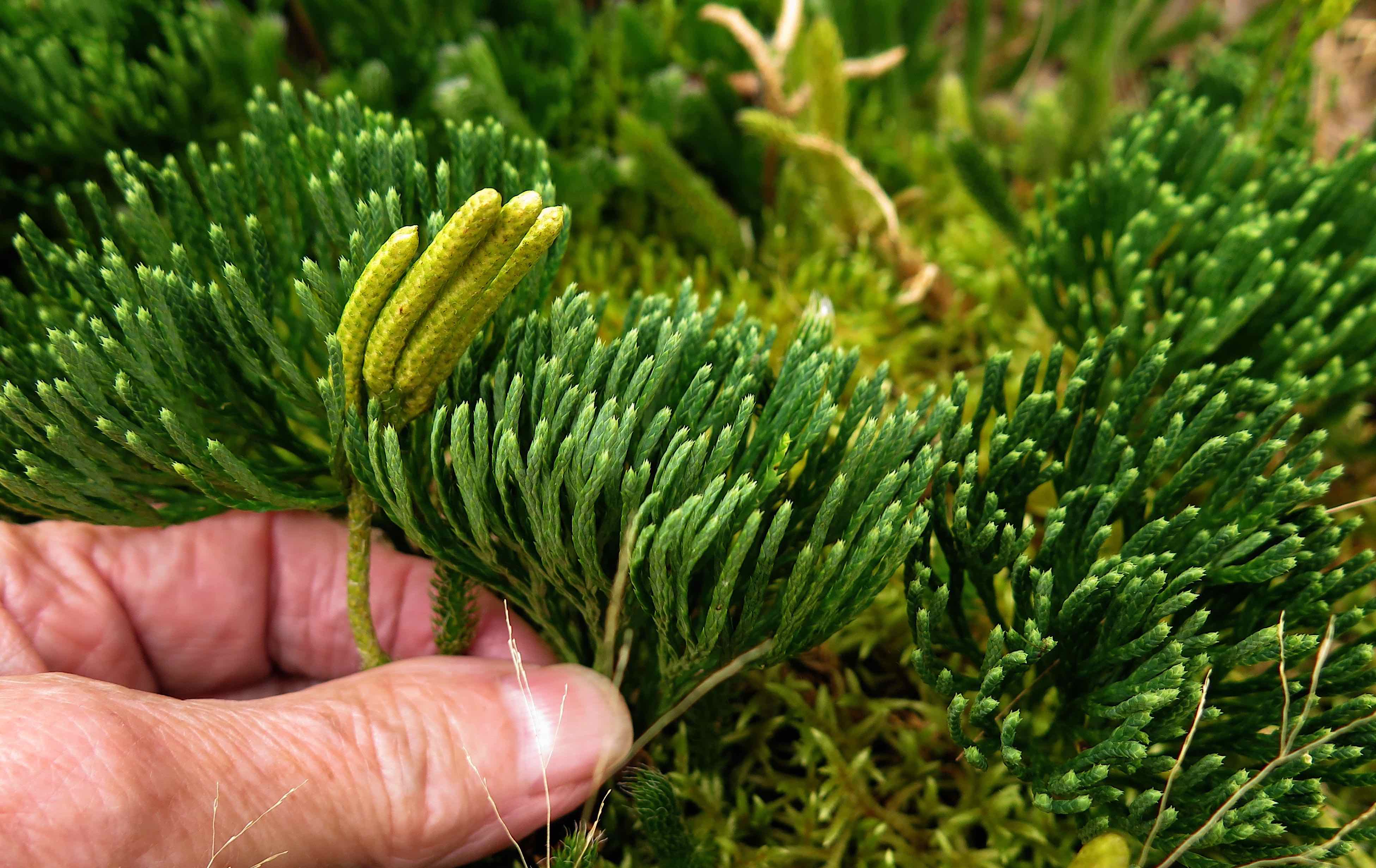
The white tufts on the ends of these Running Clubmoss branches have suggested other vernacular names for Lycopodium clavatum: Wolf's Claw and Stag's Horn among them.  The yellow candelabras are the clubmoss's spore stalks.


Here was another clubmoss,  a species called Blue Clubmoss (Diphasiastrum tristachyum), although it's only a little bit bluer than other Diphasiastrum species. What distinguishes this one is that its stolons run beneath the surface of the ground instead of along the top. And yes, a bluish cast to its green leaves.


The grassy meadows under the powerline had their own way of being beautiful. I particularly love our native Little Bluestem Grass  (Schizachyrium scoparium) in the fall, when its fine stalks (more red than blue!) hold fluffy tufts of the seedheads all along the stems.


There was one section where the  grass was distinctly yellow, and its seedheads looked like fluffy yellow-orange caterpillars.  Can any one of my readers put a name to this pretty grass? I confess that grasses are one of my areas of ignorance. But that doesn't mean my appreciation for their beauty is lacking.


I did see some small yellow butterflies along the way, very busy among the asters, but none would hold still for the picture-taking. But this handsome fellow (gal?) did hold still.  A beautiful insect indeed! Note that it was perched on the hairless stems of a Pringle's Aster!


On the other hand, this little critter did not hold still at all!  It was all I could do to hold onto this wee little Dekay's Brown Snake as it wriggled and swayed in my hand -- let alone get its cute little face in focus!  I've been told that this snake never gets much bigger than this, so I'm glad to know my grip wasn't terrifying a helpless little baby. I promptly let it go.