Wednesday, August 10, 2022

Will There Be Gentians?

At last! Woke up this morning to cool, dry air wafting in open windows instead of the suffocatingly steamy, already-sweltering sog we had suffered through for more than a week. That steamy sog kept me indoors next to the AC for much of last week, except for the day I ventured up to one of my favorite woodland ponds near Lake Desolation.  At least when I'm paddling, I can throw water on my back to cool me off.  And I planned to stay close to the deeply shaded, steep rocky banks of the north-facing shore.


I ventured out because it was time to check on some gorgeous shoreline flowers that should be blooming now. I feared for them, ever since massive flooding last September (caused by a culvert blockage) sent this pond's water levels clear up into the woods.  An earlier paddle here this summer revealed that much of the shoreline vegetation looked drowned and dead.  Would any have recovered, now that the flood has receded?


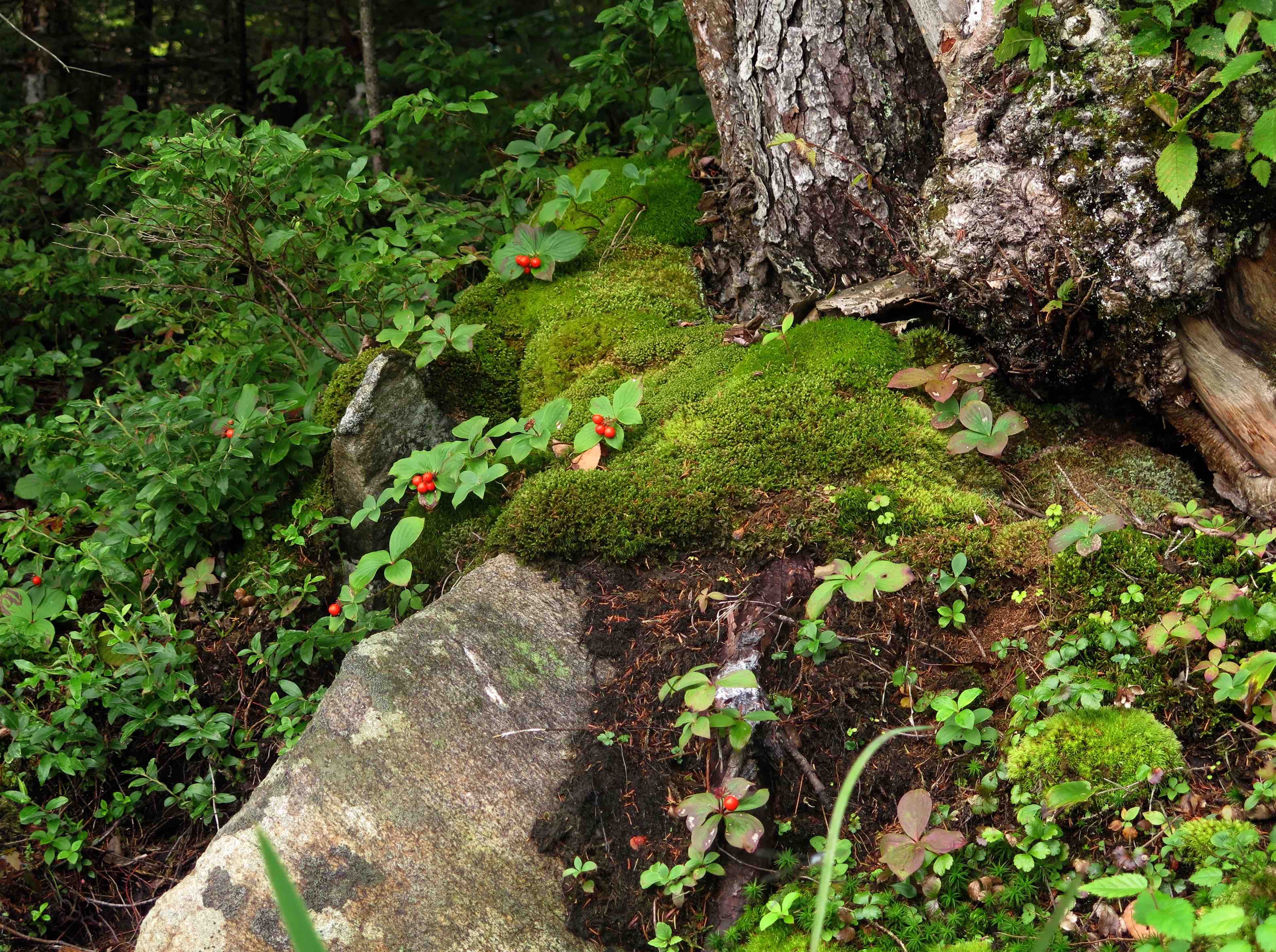
The mosses seemed OK, anyway.  As did the patches of Bunchberry (Cornus canadensis), now bearing clusters of bright-red fruit.  But I could find not a single ground-hugging white flower of Dalibarda, which normally would be spreading across these green mossy banks like stars in the sky.


Species that are happiest growing in swamps were doing okay.  This Royal Fern (Osmunda regalis) looked gorgeous, bearing its plumes of cinnamon-brown spores, and the few stems of White Meadowsweet (Spiraea alba) sharing its bank looked none-the-worse for the drowning.


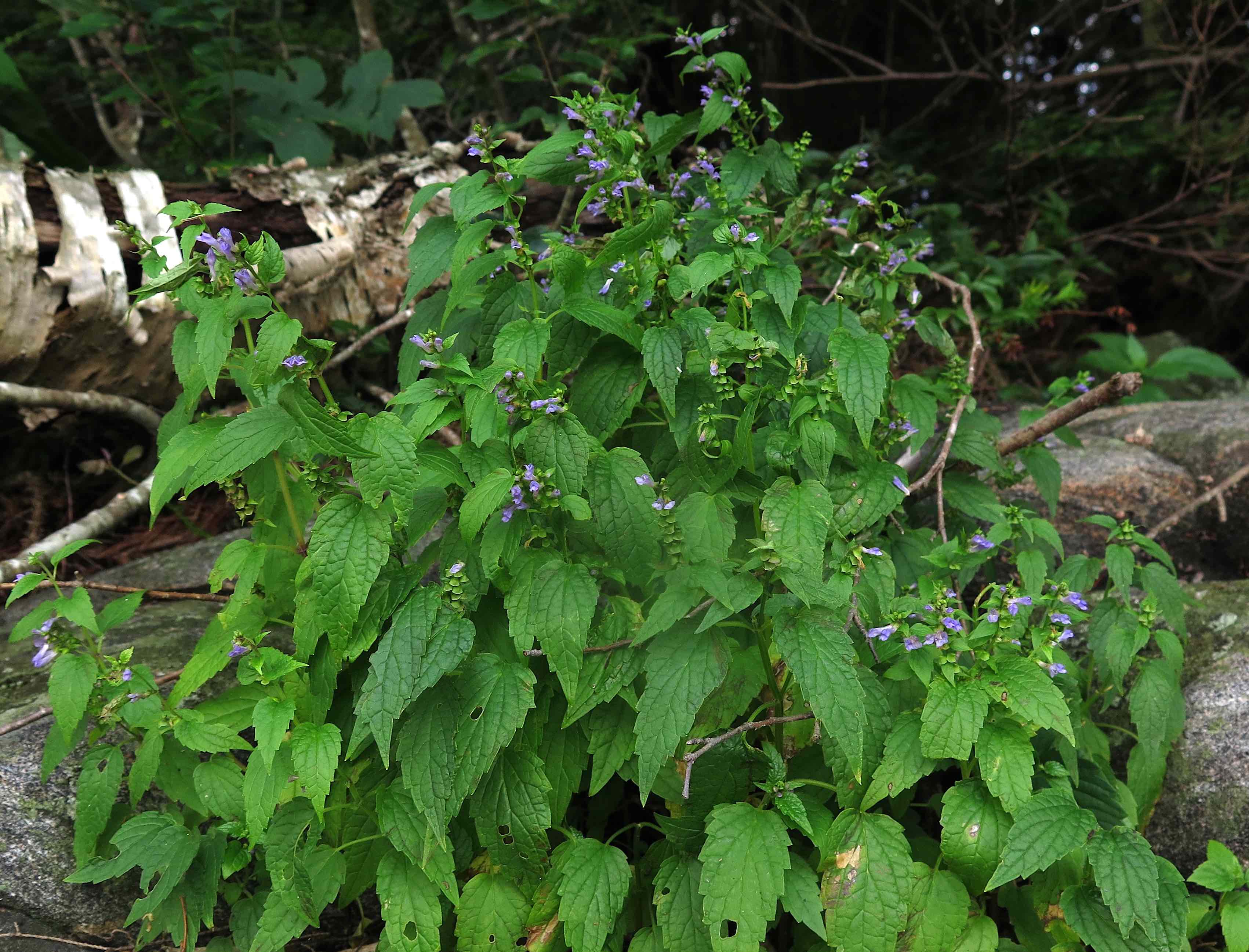
The flower I feared for most, called Narrow-leaved Gentian (Gentiana linearis), in past years bloomed along these banks by the thousands.  My heart leaped up when I beheld a glimpse of royal blue down the shore, for royal blue is the color of the gentians' flowers. Ah, but 'twas just a clump of Marsh Skullcap (Scutellaria galericulata).  Pretty enough, but  not what I'd hoped to find.


Oho!  There's one! There's two!  Yay!  Now I knew for sure that this flower would be in bloom at this location.  But alas!  These two lonely specimens, growing high up on the bank on the rootball of a flood-toppled tree, were the last I would see today.  That was it: only two Narrow-leaved Gentians along a shore where thousands bloomed in past years.


Sigh!  What a loss!  As I scanned the shoreline all around the pond,  these red-needled dead conifers attested that the gentians weren't the only plants affected by last year's flooding.


At least the true aquatic species were still thriving.  I was glad to see flowering stalks protruding above the flaccid floating leaves of Narrow-leaved Bur-reed (Sparganium angustifolium).


Closer to shore, the slender stiffly upright leaves of another species of bur-reed (Sparganium americanum?) were aglitter with the sunlight flashing off the faceted transparent wings of hordes of damselflies.


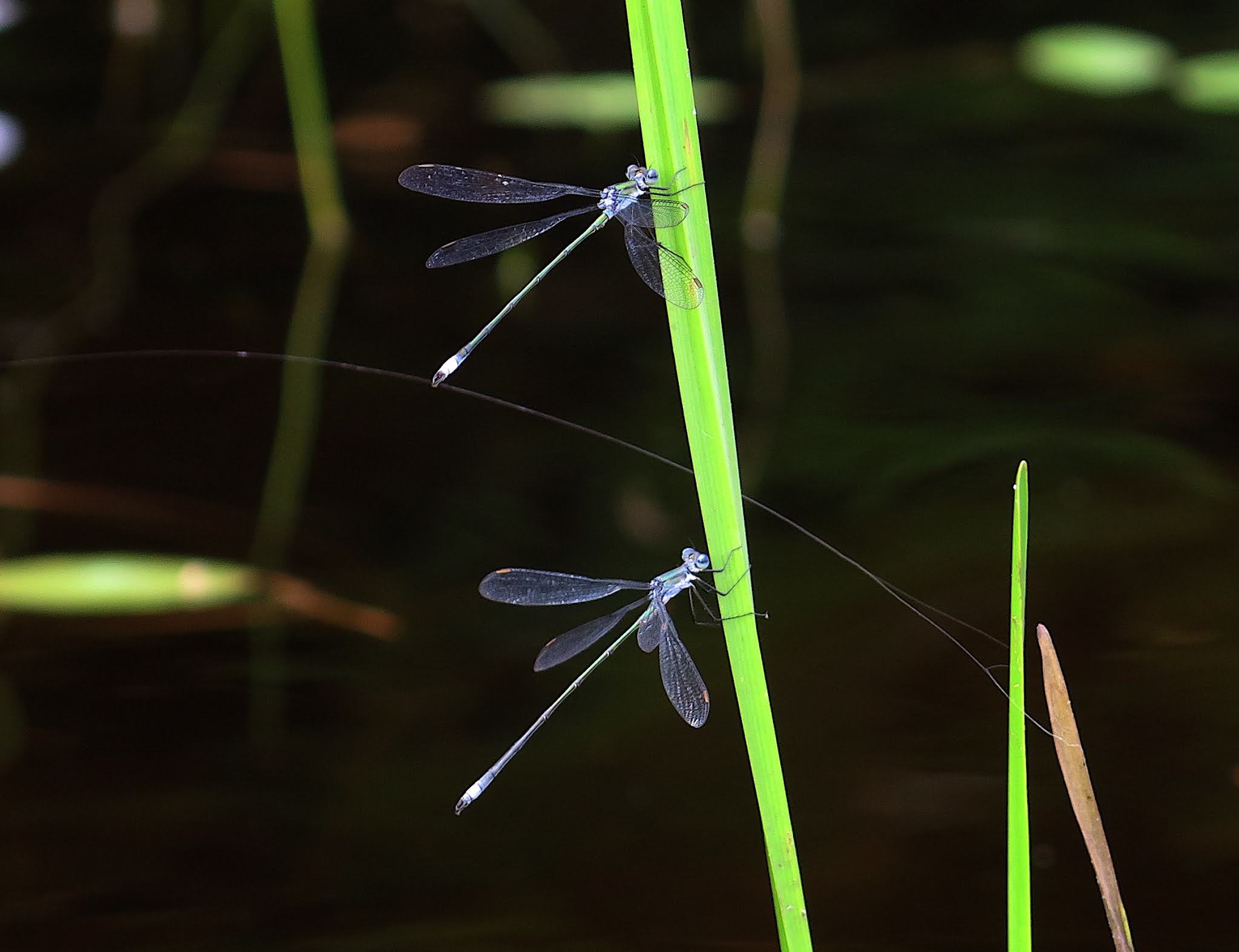
It was very hard to get close enough for clear photos of the evasively flighty damselflies. But at least my camera's zoom caught the blue eyes, iridescent green thorax, and white band at the end of the abdomen to indicate that this pair could be Swamp Spreadwings (Lestes vigilax), especially since shoreline vegetation is their typical habitat.


Also, a thick stand of American Bur-reed is exactly the kind of place where Swamp Spreadwings prefer to mate and lay eggs.


Here's another insect I expect to find resting on bur-reed leaves, a beetle in the Chrysomelidae Family,  of a genus, Donacia, that is difficult to pin down as to species. It looked especially beautiful with sunlight glinting off shiny wingcovers that resembled hammered copper.


 Even though the Spreadwings seemed to dominate the bur-reeds, an occasional Bluet Damselfly (Enallagma sp.) found the shoreline vegetation a likely place to take a rest or keep vigil for insect prey.


An abundant patch of Goldenrod (Solidago sp.) near the canoe launch site attracted several species of butterflies, including this somewhat tattered Tiger Swallowtail.


A brief walk through the neighboring woods had me stopping to admire the bright-red fruit of a Painted Trillium (Trillium undulatum). But I soon hurried on to my car and its air conditioned comfort, since the sweat dripping into my eyes made it hard to see, and my glasses kept swimming off the end of my nose.


To understand how disappointed I feel regarding the loss of those Narrow-leaved Gentians, here's a photo I took of their abundance last year.  This photo represents only a couple of feet of the entire shoreline on which these gorgeous native wildflowers thrived.  You can visit the blog I posted last year to see what I'm talking about: https://saratogawoodswaters.blogspot.com/2021/08/blue-blooms-and-bounty-of-beautiful-bugs.html


Thursday, August 4, 2022

Rare Plant, Pretty Plants, New Plant at the Saratoga Battlefield

With the weathermen blaring so many "heat advisories" lately,  especially for old people like me, I do ponder whether to stay indoors with the AC blasting.  But the Winged Monkey Flower should be blooming now!  This species (Mimulus alatus) is rated as a Rare plant in New York (even rarer in New England), and if I didn't get out to look for it now, all this heat might cause it to fade.   Luckily, it grows along a creek that flows through deep shade, so that's where I went to meet my fellow wildflower-obsessed pals Sue Pierce and Ruth Brooks this week.  Sue is the person who first discovered this flower at this Saratoga Battlefield location --  and it wasn't even in bloom when she first noticed its spent flower stalks, on a mid-autumn hike three years ago.


When we first reached the creek via a hiking trail, we were disappointed to find most of the nearby Winged Monkey Flower plants had already dropped their pale lavender blooms.  But as we gingerly picked our way along the nearly dry rocky creek bottom, we came upon a cooler, wetter area where many plants still held their flowers.  Sue documented their presence with photographs and a specimen count.  As of yet, this species has not been documented as present in Saratoga County, although I hope that will change when Sue submits a specimen to state botanists.


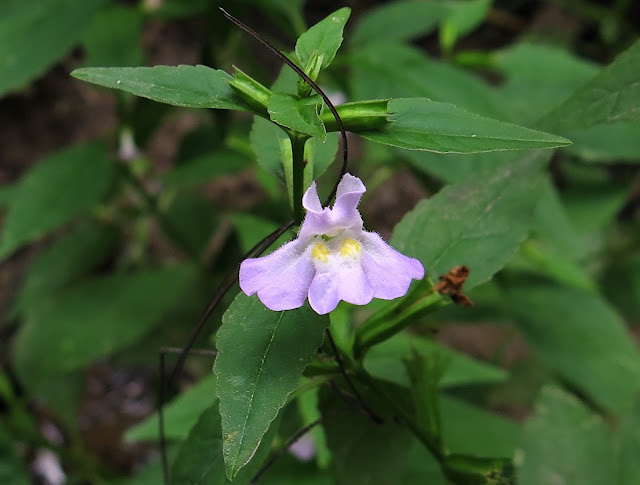
This is my photo of Winged Monkey Flower, displaying the winged leaf petioles that suggested both its scientific and vernacular names.  This photo also demonstrates the long leaf stalks and very short flower stalks of this species, just the opposite of the leaf/flower arrangement of the much more common species of Monkey Flower (Mimulus ringens).


This is my photo of the very common Monkey Flower (M. ringens) that thrives in almost every kind of wetland across nearly every county in New York State.  Note the differences: royal-blue (not lavender) flowers held on long stalks, and unstalked leaves that are sessile to the stem.


The flowers of both species are similar in shape (this is the flower of Winged Monkey Flower).  Supposedly, the vernacular name was inspired by the flower's resemblance to the face of a monkey.  Personally, I  don't see it.  But that's the story.


Now that we were reassured that our rare flower was still where we'd found it before and that its numbers were still abundant, we continued our walk.  We even briefly ventured out onto the sunny meadows, the splendid beauties of which compensated for the discomforts of midday heat.  Spotted Joe Pye-Weed (Eutrochium maculatum) was in full gorgeous bloom, with big fluffy rosy-pink flowerheads flourishing across the open fields.


Acres of Tall Goldenrod (Solidago altissima) vied with that Joe Pye-Weed for floral abundance and color, and the lower-growing, white-flowered Narrow-leaved Mountain Mint (Pycnanthemum tenuifolium) also bloomed profusely (dotted with occasional rosy blooms of Brown Knapweed [Centaurea jacea]).


A close look at the flowers of Narrow-leaved Mountain Mint reveals that those small white flowers are dotted with tiny purple spots.  The same close look also reveals this beautifully-colored Scarlet Plant Bug (Lopidea sp.) roaming around the florets.  This bug is difficult to pin down as to species, but most are known to cause little damage to plants, aside from occasionally disfiguring the leaves they feed on.  Since mountain mints have very strongly scented leaves, I kind of doubt that many insects feed on them.


Such floral abundance of course meant there would be insect abundance as well, and the very air was humming from the clouds of bugs, bees, beetles, butterflies, and moths that were busily feeding on the blooms.  Although the blooms on this particular patch of Wild Bergamot (Monarda fistulosa) were  beginning to fade, they apparently held sufficient nectar to entice this big beautiful Giant Swallowtail Butterfly (Papilio cresphontes) to stop for a taste of it.


Almost every cluster of Wild Bergamot was being explored by Hummingbird Clearwing Moths (Hemaris thysbe), large colorful moths that hummed and hovered just like a hummingbird.  Their flight was so rapid and erratic I could not capture a photo worth using here, but I found a photo in my files that looked just like the same ones I was seeing today.  Even the flower species was the same!


Damp sections of the open meadows held vast thickets of colorful Gray Dogwood (Cornus racemosa), the fruit ripening to porcelain-white berries held on scarlet pedicels.  Even now, some of the leaves were turning, on their way to becoming the deep burgundy-red of their autumn coloration.


Then there was this spiny multi-flowered plant, standing tall above all the other plants of the field.  A thistle, of course.  But which one?  My friend Ruth took out her smartphone and promptly took a picture to send off to iNaturalist for suggested IDs.  In the meantime, I looked for distinguishing features that might set this thistle apart from others of the Cirsium genus.


A close look at the flowerhead revealed slender hairy leafy bracts that curled up to create a cage around the not-yet-flowering involucre. Each scale-like bract (phyllary) around the involucre was armed with a long slender spine that appeared to be bent at the base.  Each of the flat green phyllaries (involucre bracts) displayed a white central vein. The whole flowerhead appeared to be wrapped with fine silken threads, but that might have been woven there by a visiting spider or other web-spinning creature, and not be a distinguishing feature of this species.
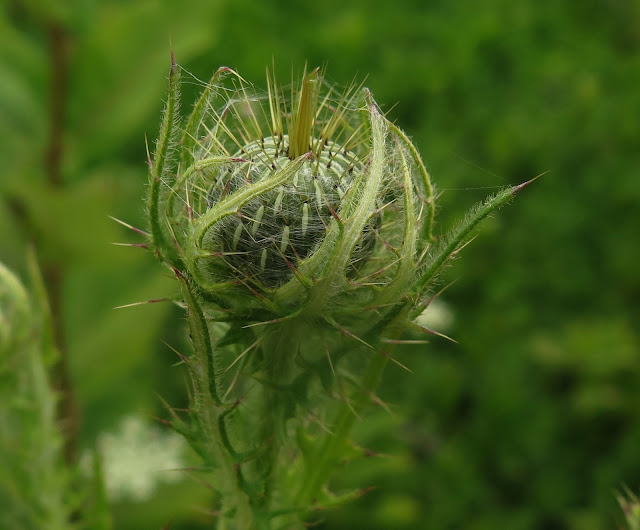


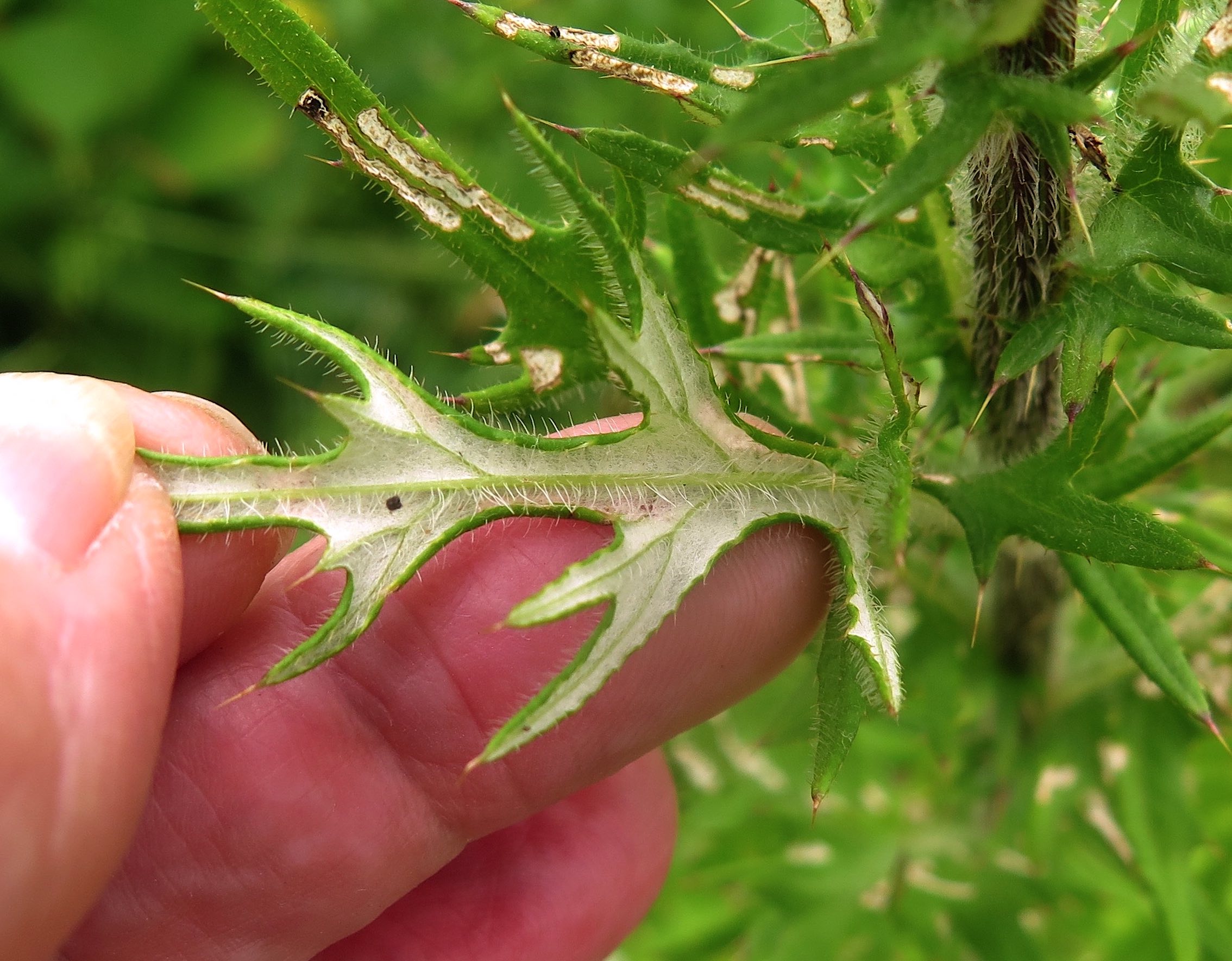
The thistle's long leaves were both hairy and spined, while the stalk was hairy without spines.  The  most distinguishing feature of the green leaves was the white undersurface, caused by dense mats of fine white hairs.  It was this feature, of leaves of two colors, that made me think of the botanical term discolor, meaning of two colors. Then bingo!  The app iNaturalist came through with the name Field Thistle, scientific name Cirsium discolor.  How about that?!  I myself eschew the use of cellphone apps, but it sure was fun to have a confirmed ID while standing out in an open field, far from my wildflower guides at home.  Thanks, Ruth!


So.  Field Thistle it is.  A native thistle species, but not a rare one at all.  But it was a new plant for my life list, so I was mighty glad to have seen it and learned its name.


By the way, I found on-line a drawing that illustrates some of the plant parts I mention in this discussion of the thistle. It appeared in the book San Diego County Native Plants by James Lightner (2011), and I found it very useful for when I tried to describe the parts of this  (or any other) plant.


Wednesday, August 3, 2022

Rocking the Waters Among the Bogmats

While my usual paddle-pals Sue and Ruth were off on an Adirondack adventure that I feared might be too strenuous for my aging abilities, I set off last week on what I expected to be an easier paddle: browsing among the bogmats of Lens Lake.  Except that it wasn't so easy, after all.  The wind was actually whipping up whitecaps on this usually placid eastern-Adirondack mountain lake.  Usually, paddling my low-profile Hornbeck canoe is not all that difficult in the wind; most often, I can plow right through quite a bluster without breaking a sweat.  But I was hoping to photograph the many high-summer beauties that flourish among this lake's sphagnum-covered islands, and this was a feat made very difficult with the waves rocking my boat and the wind whipping the bog-plants in and out of focus.  Except for the few I'm posting here, almost all my photos were total blurs. 

I did manage to find a few quiet spots by threading my way among the bog mats, which were edged with multi-color carpets of Sphagnum Moss and crowned with dancing tufts of fluffy Cotton Grass.


Since Large Cranberry vines (Vaccinium macrocarpon) lie close down on the mat, the ripening fruit sat nicely still for the picture-taking.


I could not say the same for the tall flowering stalks of Northern Pitcher Plant (Sarracenia purpurea) and Pickerelweed (Pontederia cordata), which were waving around quite wildly. Luckily, the wind stopped just for an instant (as if to catch its breath  to blow even harder!) and SNAP!  Gotcha!


The teeny-tiny flowers of Yellow-flowered Grass (Xyris sp.) grow atop long spindly stalks, which yielded to every puff of the breeze.  I managed to snap a photo of this three-petaled yellow flower by holding tight to its stem.


Luckily, I did not have to grasp the sticky pads of this Round-leaved Sundew (Drosera rotundifolia) to hold them still, thanks to their sturdy structure and low-growing habit. The ruby-red pads were snuggled tightly in among the golden moss, their glistening glue-tipped hairs tempting insects to stop for a taste of what surely looks like nectar.   Except, of course, it isn't! Bugs thus get stuck while the pads curl over them and feed on the hapless creatures.


Here were two of such hapless creatures stuck in a cluster of this equally sticky Spatulate Sundew (Drosera intermedia).  I noticed that these two damselflies, their gossamer wings trapped by the glue-tipped threads of this carnivorous plant, were still struggling to get free.  Which meant they might have a chance to live if I managed to unstick their wings.  I did manage to do just that, and even though their wings appeared to be slightly crumpled, both promptly flew away. (At least, that's what I hoped they did.  It's possible that the rowdy wind just reached in and whipped them both away.)


If I'd arrived at Lens Lake in the early morning, I might have been able to paddle on calmer waters.  But then I probably would have been gone by 3:00 PM, the magic hour at which Marsh St. John's Wort (Hypericum virginicum) opens it lovely pink-satin flowers.  I did pass this particular pair's patch around 2:30, and every bud was still closed tight.  But on my return: Ta Da!  Bloom time!  Right on schedule!


As I paddled back toward my put-in spot, I moved in close to the lakeshore to avoid strong headwinds.  But I still had to reach up and hold this wind-tossed twig of Mountain Holly (Ilex mucronata) steady for the picture-taking. I don't believe there is any berry more beautiful than these.  How to describe this rich-red color? This color appears so super-saturated, these fruits seem to pop right out of the photo.


Before finally landing my boat, I pushed back into a quiet pine-sheltered cove where the water was still enough to give me a clear view of this green-tinted, transparent gelatinous mass suspended underwater. A ray of sunlight caused it to truly glow amid the dark water. This organism is called Ophrydium versatile, and Lens Lake is the first and only body of water I have ever found it in. I find masses of it here every time I visit. 

These masses of transparent greenish jelly are formed by the colonial microscopic single-celled protozoan called Ophrydium versatile, and they can be found all over the world in fresh water.  The individual cells line up side-by-side in the "blob"and attach themselves to a jelly-like substance they secrete.  They are symbiotic with microscopic Chlorella algae that live inside the Ophrydium cells and give the blob its green color.  Over the years of paddling on Lens Lake, I have found masses of it as small as a softball and as large as a bathtub.  I was glad I could find water still enough on this windy day to lay eyes on it once again.

Monday, August 1, 2022

Surprise Find at Mud Pond

With the return of semi-sweltering weather this past week, I sought the shade of the forested trail that circles Mud Pond at Moreau Lake State Park.  I wasn't expecting to find many woodland flowers in bloom by this time of the summer.  But I did find some plants that totally surprised me.


The typical forest-floor vegetation here is oak and pine saplings, native shrubs like Witch Hazel and Lowbush Blueberry, and many native shade-tolerant herbaceous plants, such as Pipsissewa, Cow Wheat, Wintergreen, Checkered and Downy Rattlesnake Plantain, and lots of White Wood Aster. (That's just a sampling!) But now, another native plant called Pilewort (Erichtites hieraciifolius) has shown up, and in alarming abundance.  Why is this  aggressive open-field colonizer suddenly colonizing this deeply shaded habitat? Could it eventually supplant the woodland plants that have thrived here all these years?

When I say that Pilewort has moved into this woods abundantly, I'm not kidding. Here it is lining the trail.


And in many places, the Pilewort has ventured well off the trail to spread across the forest floor.


The Pilewort has made itself at home here well enough to begin flowering, even in deep shade.  By the way, this is as open as those flowers will ever be, until they open up to big silken seed puffs.


I have actually often stopped to enjoy examining the flowers, which consist of merely a yellowish fringe atop tightly closed vase-shaped green calyces.  Here, you can see the pistils protruding from the Pilewort blossoms.


And here are the pollen-laden stamen tubes. I do find these flowers rather cute, even though I have to peer very close in order to see them.  The thing is, I have always in the past observed these flowers under direct sunlight in open fields.  How did the Pilewort make its way into this woods?

I've been walking this forested trail for many years and never noticed Pilewort in here, especially not in the abundant numbers that have moved in just this past year.  Another vernacular name for this species is Burnweed, suggested by its propensity to quickly colonize burned-over clearings in forests.  Could it be that this summer's unusually hot and dry weather, combined with the nearly complete defoliation of this woods earlier this summer (caused by a plague of Spongy Moths), have created the very sun-baked conditions similar to Pilewort's normally preferred habitat?   Whatever the causes, I was truly stunned to see how this plant is thriving now where I never found it before.


I did find a few other flowers in bloom as I made my way around the pond.  I did not expect to find Rough Hawkweed (Hieracium scabrum) along the wooded trail, since it, too, like the Pilewort, usually prefers a sunnier habitat. But there it was, despite the fact that shade has returned to this trail with the re-growth of deciduous tree leaves.


The White Wood Aster (Eurybia divaricata) appeared to be happy the shade has returned, since it lined the trail all around the pond with its snowy-white blooms.


Two different species of our native orchid called Rattlesnake Plantain (Goodyera spp.) can usually be found along this trail, but the population of both species seemed quite reduced.  I wonder if the changed sunlight and rainfall conditions this year had an impact on their numbers. In the spring, I found abundant rosettes of the evergreen basal leaves of Checkered Rattlesnake Plantain (G. tesselata), but now I could find only two blooming plants, despite a diligent search. This one still held some intact flowers, while the other plant had already gone to seed.


I found but a single flowering stem among an otherwise abundant patch of Downy Rattlesnake Plantain leaves (G. pubescens), the florets still in tight bud. But at least there was one!


Since the new tree leaves have once again re-grown to deeply shade the woods, it's no wonder I didn't see the web of this Spined Micrathena Spider strung at face height between two distant saplings. If I felt annoyed to be picking the web off my eyelashes, I imagine the spinner was even more annoyed that I had blundered through her handiwork.  (I know that this is a female Spined Micrathena, because the much smaller all-black males have no spines.)  She immediately shot along her escape line for a stationary post to await her chance to rebuild her web. That gave me a good chance to closely observe her remarkably spiky abdomen while (I imagine) she glared at me through all eight of her eyes, impatient for me to get lost.


I also imagined this pair of Jagged Ambush Bugs wanted me gone, since my presence would discourage any of their insect prey from landing among these Spreading Dogbane florets. I believe the pair were engaged in predation, not copulation.  I have read that the smaller male will often attach himself to a larger female, since she is more successful at snagging prey, which he can then also partake of, once she has had her fill.