Monday, May 16, 2022

A Surging Wildflower Flood

Oh gosh, I can hardly keep up! After a prolonged cold spring when the wildflowers just stayed under their winter covers, followed by nearly a week of unseasonably wilting warmth, everything's bursting into bloom at once! And fading just as fast. I barely saw one Bloodroot before they were already gone, the Trout Lilies bloomed for about three days, and now all the Trilliums that used to bloom sequentially -- first Red, then Large-flowered White, then Painted, then Nodding -- are flowering all at the same time.  Since I depend on this blog as my record of what wildflowers were blooming when, I do feel a bit duty-bound to get out there and document their passage.   Well, this year's public record will be incomplete.  All I can manage right now is to hit the highlights. 

Here is just a digest of some of the plants that intrigued me this past  week.

The Craggy Cliffs Along Spier Falls Road


When the Spier Falls Dam was built on the Hudson River at Moreau late in the 19th Century and a road was created to follow the river, the sloping sides of the Palmertown Range of mountains were blasted and quarried,  resulting in steep cliffs and ledges of jagged rock.  These rocks are constantly watered by rills and springs, creating perfect habitat for marvelous mosses and rock-dwelling wildflowers -- such as the snowy drifts of Early Saxifrage (Micranthes virginiensis) seen in the photo above.  And growing out of clumps of water-retaining moss like this pretty cluster in the photo below.  


Shrubs of Round-leaf Gooseberry manage to find a foothold in the cracks in the rocks, and dangle their long-staminate flowers over the ledges.


The constant dripping of springs create ideal conditions for mosses that only will grow in such wet places.  This small patch of Marsh Cardinal Moss (Ptychostomum pseudotriquetrum) is here surrounded by abundant patches of Spring Apple Moss (Philonotis fontana).


It's easy to see how Apple Moss (Bartramia pomiformis) earned its name, with these perfectly apple-round spore capsules. This species has the most delicate fine leaves. The above-mentioned Spring Apple Moss also produces equally round spore capsules, and the two species both belong to the same family.


Hobblebush (Viburnum lantanoides) grows in the forest that surmounts these rocky ledges, bearing  rings of showy big sterile flowers to attract pollinators to its much smaller fertile flowers at the center.


Lake Bonita in Moreau Lake State Park


This pretty little lake lies near the summit of Mount McGregor and is one of three lakes that lie within the boundary of Moreau Lake State Park. Lake Bonita is dotted with tiny Sphagnum-covered islands that are populated by many sun-loving plants that prefer an acidic habitat (Pitcher Plants, Rose Pogonia orchids, Cranberries, Sundews, etc.), while the surrounding forest is home to shade dwellers, many of which are more tolerant of a wider range of pH values.

The dainty white-flowered Goldthread (Coptis trifolia) likes shade and dampish soil, and it's also one of the few wildflowers we're likely to find growing in Hemlock-dense woods. The vernacular name Goldthread was suggested by this plant's bright-yellow thread-like roots. If you see one Goldthread flower, you're likely to see many more in the same area.


Dwarf Ginseng (Panax trifolia) often grows in the same shady damp conditions as Goldthread does, and the two wildflowers are often seen close together, usually blooming at the same time.


The fragrant-flowered Trailing Arbutus (Epigaea repens) prefers drier soils and often grows on sunnier, sloping land, which helps its evergreen leaves avoid being covered by dense layers of fallen leaves. Since this is a very early bloomer, we were both delighted and surprised to see it still producing its beautiful blooms.


Pink Lady's Slippers (Cipripedium acaulae) are one of our showiest native orchids.  It won't be long before these big green buds open to reveal the large pink flowers within.


And here was the treasure we were hoping to encounter at Lake Bonita: the gorgeous Painted Trillium (Trillium undulatum)!  We always hope to find two or three in the hemlock-dominated north-facing woods, but this year we found many more than we ever have.  This is actually one of the very few wildflowers that can tolerate the deep shade and tannin-infused soils beneath dense stands of Eastern Hemlock trees (Tsuga canadensis).  (At least, that has been my experience.) Seeing this gorgeous flower was a wonderful reward for completing a rather arduous trek over rocky terrain as we made our way completely around the lake.


Bog Meadow Brook Nature Trail


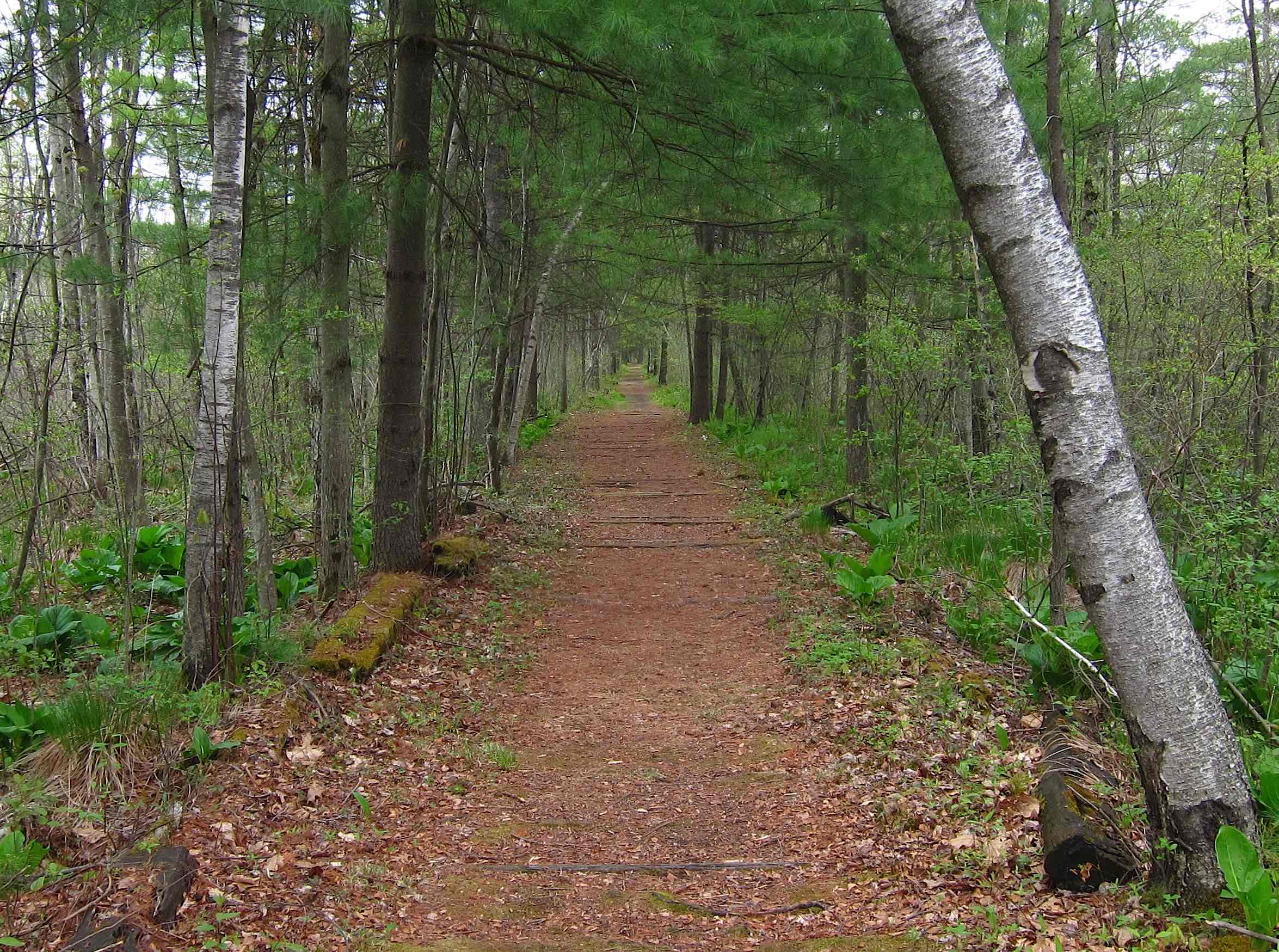
In some ways, the name Bog Meadow is a misnomer.  For sure, this two-mile trail at the outskirts of Saratoga Springs is surrounded by wetlands, but most of these are stream-watered forest or open marsh, not the Sphagnum-dominated wetlands that fit the definition of a bog. While the photo above was taken where the trail moves through densely forested wetland,  I entered the trail this week where it is surrounded by swamp on one side and marsh on the other but is sadly dominated by invasive honeysuckle shrubs close to the sides of the trail. A redeeming feature, though, is that one of the plants I most wanted to find this week -- the Nodding Trillium (Trillium cernuum) -- seems to be quite happy hiding from view beneath the crowded trunks and tangled branches of honeysuckle shrubs.

And find it I did! Quite a few, in fact, and all nicely in bloom.  Although to actually see its flowers I had to risk scratching my face on honeysuckle twigs to crouch down far enough to see under the big broad leaves.


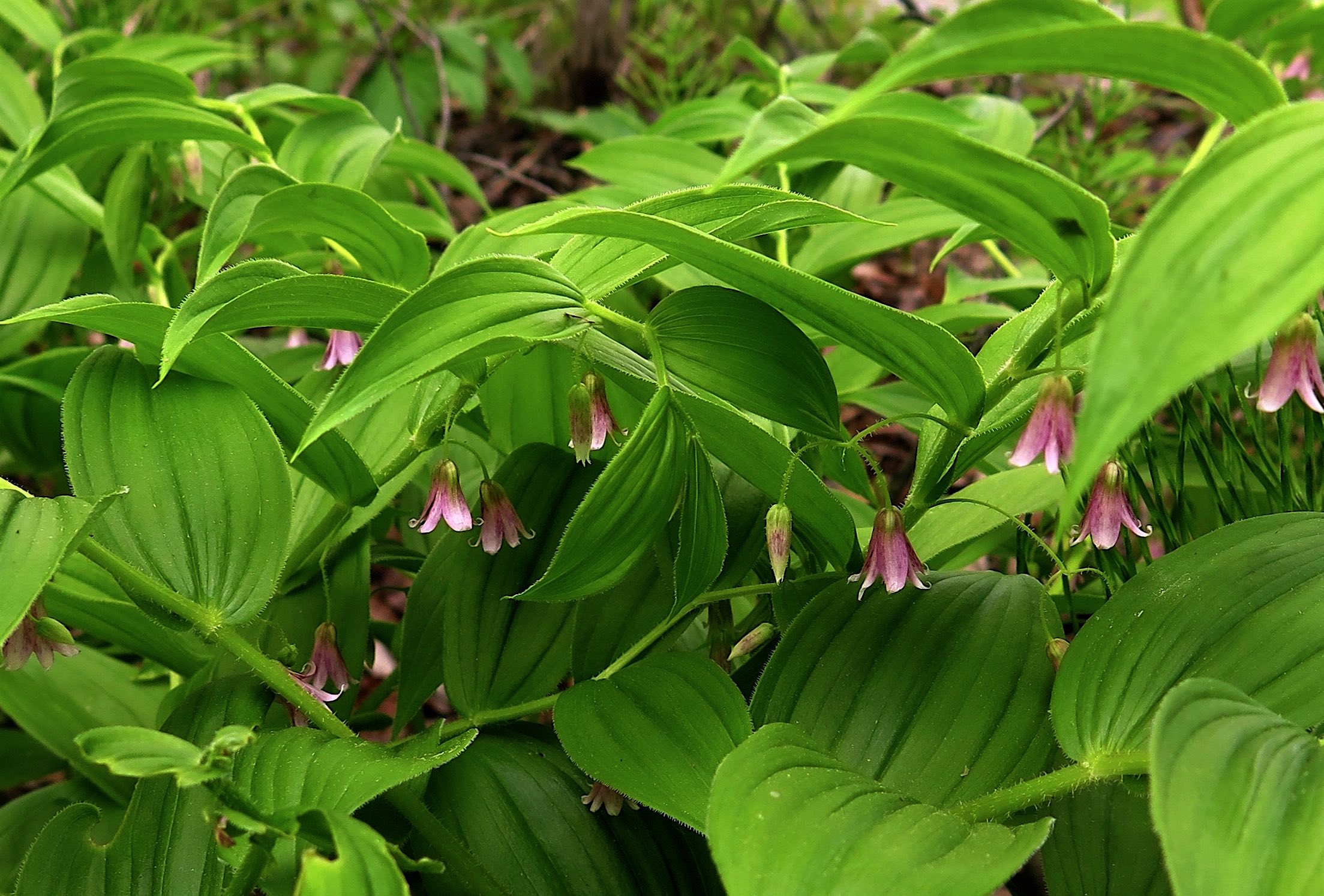
Another favorite flower, called Rose Twisted Stalk (Streptopus lanceolatus), also hides well under the trailside shrubbery.  But even if it grew out in the open, I'd still have to lie nearly flat on the ground to spy the pretty pink bell-shaped flowers that dangle (on twisted stalks!) beneath the arching green leaves.


And guess what?  There actually IS a small bog-like wetland about a mile from the trailhead, a sphagnum-lined pool that is home to the reed-like stalks of Water Horsetail and a large population of the beautiful flowering plant called Bog Buckbean (Menyanthes trifoliata).  Some years I have to search diligently to find a few of its furry-lined white flowers protruding from standing water, but this year there must have been a hundred!


The fluffy white flowerheads of Heart-leaved Foamflower (Tiarella cordifolia) are hard to make my camera focus on.  It helps to have a dark background, like the deep shade beneath the huge leaves of a neighboring Skunk Cabbage plant (Symplocarpus foetidus).


There are lots of violets that thrive along this wooded wetland trail, but most of the species blooming now are called Dog Violet, a low-growing stemmed violet with a pale lavender flower.  But that's not what THIS violet was. With those purple blooms marked with deeper-purple centers,  the flowers held well aloft above its basal leaves on slender leafless stems,  I thought these must be Marsh Blue Violet (Viola cucullata). Further evidence was provided by the water the plant was nearly standing in.


But the clincher regarding this violet's identity was the presence of stubby hairs on the flower's lateral petals, a distinguishing feature of the Marsh Blue Violet alone. Other violet species often have hairs, but they are finely tipped, not stubby as these are.


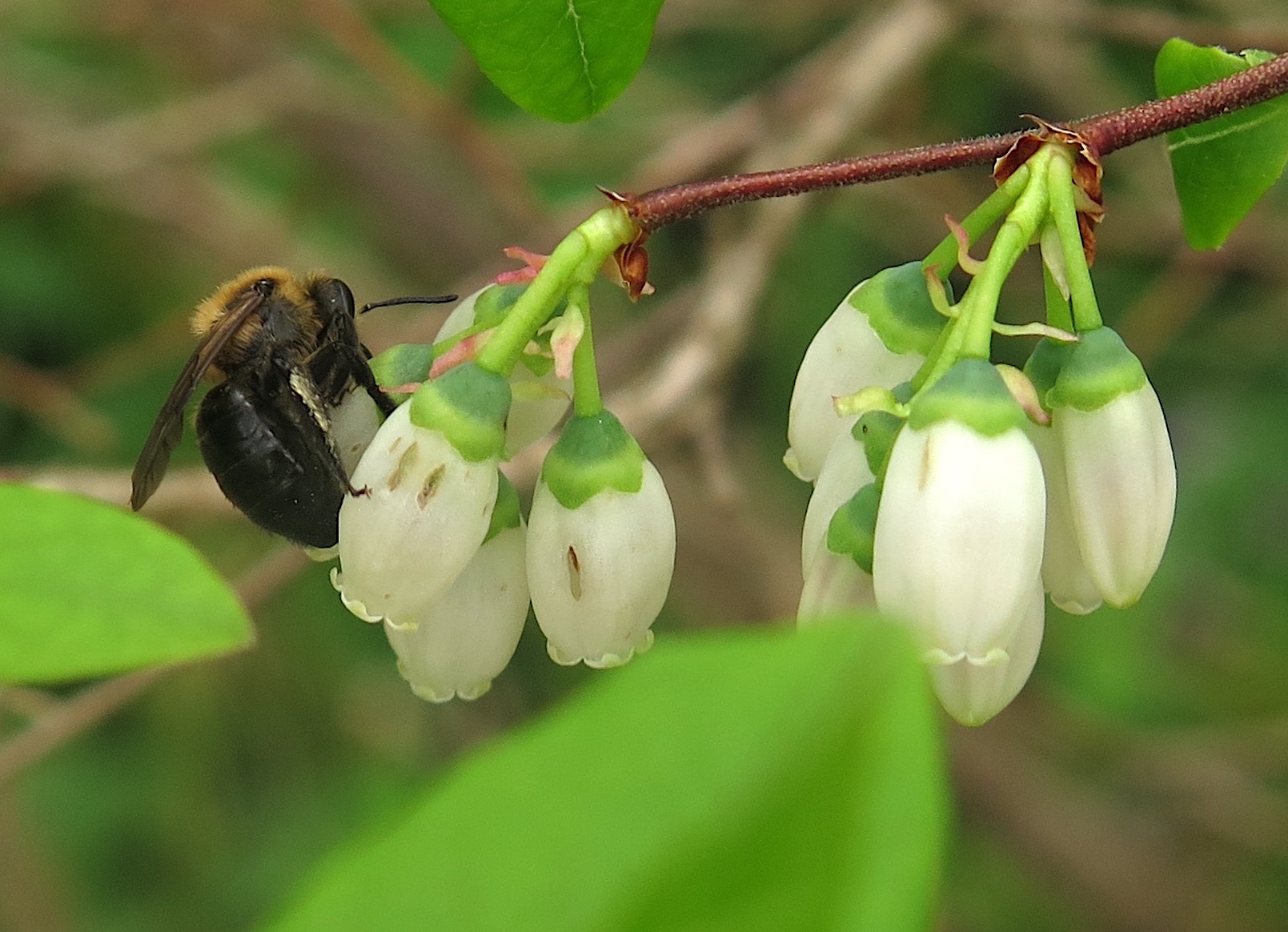
When I focused close in on these Highbush Blueberry flowers (Vaccinium corymbosum) and what I thought was a bee feeding on them, I was startled to see the slits made in the blooms.  Did that insect make those slits to more readily access the goodies inside? Well, that wouldn't surprise me. But what did surprise me was that narrow waist on that fuzzy-thoraxed "bee." Could this be a bee-mimic wasp instead? I could not find an image on Google to match this insect, and I did not get a picture of its face, so I doubt BugGuide.net can help me with an ID.  Informed opinions would be most welcome!         


Thursday, May 12, 2022

Sex Among Some Wetland Shrubs

It takes two to tango, for the wetland shrub called Sweet Gale (Myrica gale), which is blooming now along the shore of Lake Bonita in Moreau Lake State Park.  And most likely, many, many other wetlands across the northern regions of North America. It tends to prefer wetlands that are on the lower pH scale (more acidic), which would certainly describe the waters of Lake Bonita, a lovely little mountain-top lake that is home to many other plants (Pitcher Plants, Sundews, Rose Pogonia orchids, etc.)  that prefer an acidic habitat.

The pistillate (female) flowers are blazing red, but so tiny you have to look close for them.  It is very easy to pass by a thicket of female-flowering shrubs without noticing the flowers.  It helps to have bright sunlight igniting the flame-colored blooms!


 The tan-colored staminate (male) flowers are ripening their pollen on separate shrubs, counting on the wind to carry their pollen to the pistillate flowers nearby.

Sweet Gale's vernacular name is well deserved, for its leaves and seedpods are exquisitely aromatic with a scent very similar to that of Bayberry or Sweet Fern. That similarity of scent is not surprising, considering that all three belong to the same botanical family, the Myriaceae. That sweet scent can be enjoyed by crushing a leaf and breathing its fragrance, and the fragrance also persists in the seedpods that can be found clinging to twigs throughout the winter.

Although Sweet Gale typically bears male and female flowers on separate shrubs,  I have read that the same shrub can switch sexes from one year to another.  And it is not unheard-of for an occasional shrub to bear flowers of both sexes on the very same shrub.  So sex-switching does occur naturally from time to time in the botanical world. Perhaps this knowledge could help to assuage the outrage some folks feel about trans-sexuality among homo sapiens!


Friday, May 6, 2022

All The Whites At Woods Hollow

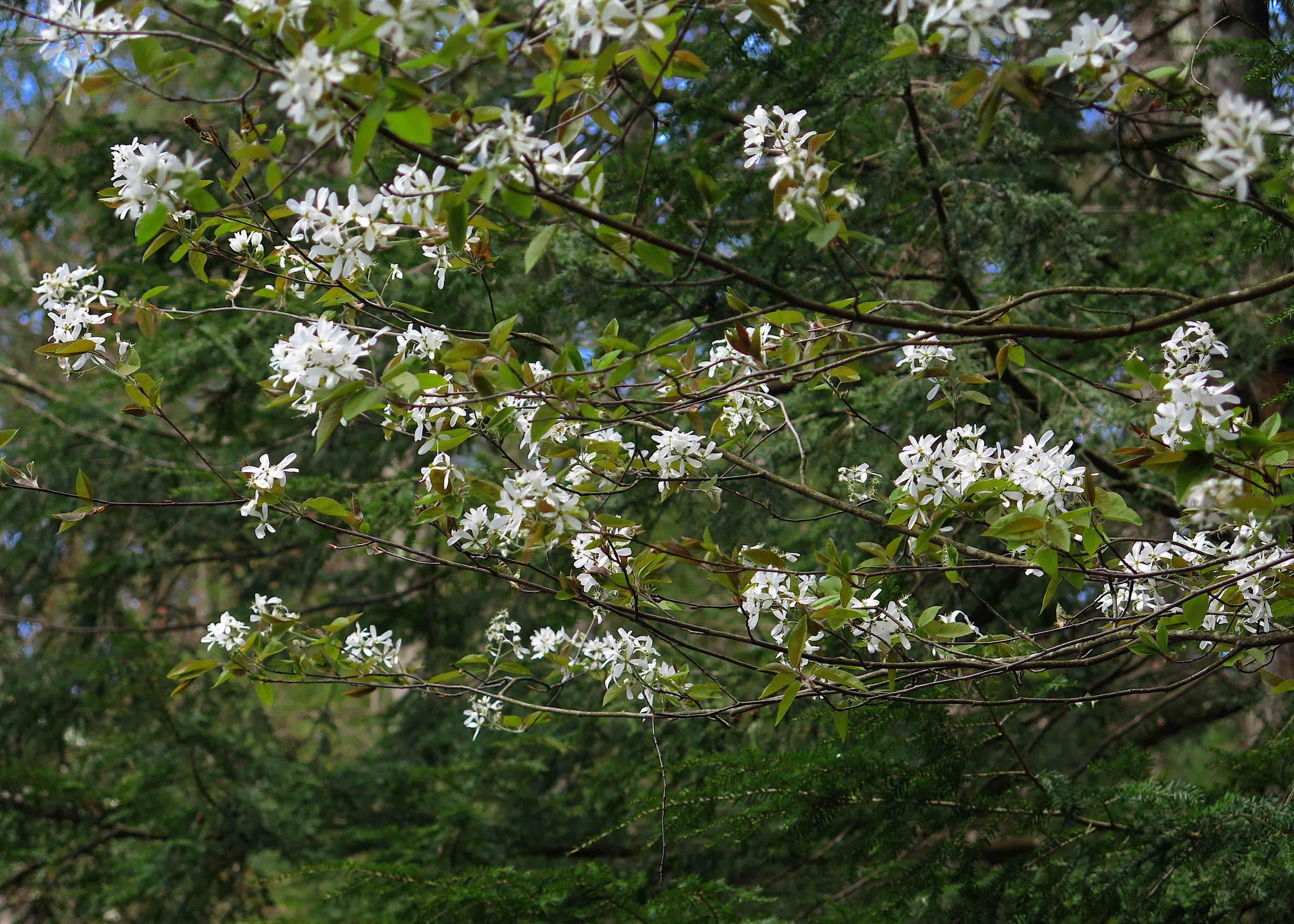
While yellow flowers took center stage in the Skidmore Woods this week (see last post), the whites were what were blooming at Woods Hollow Nature Preserve when I stopped in there briefly yesterday.  The bloom-laden boughs of a Shadblow tree (Amelanchier sp.), its flower clusters floating like puffs of white clouds against the dark trees, set the theme as I made my way to the pine-edged pond that lies at the center of this 130-acred preserve just north of Ballston Spa.


OK, the first flowering shrub that I passed as I made my way around the pond held buds that were definitely pink, not white.  But these were the buds of Highbush Blueberry flowers (Vaccinium corymbosum), which will indeed be white when the bell-shaped flowers emerge in a very few days.  A bit pink-tinged, but mostly white.


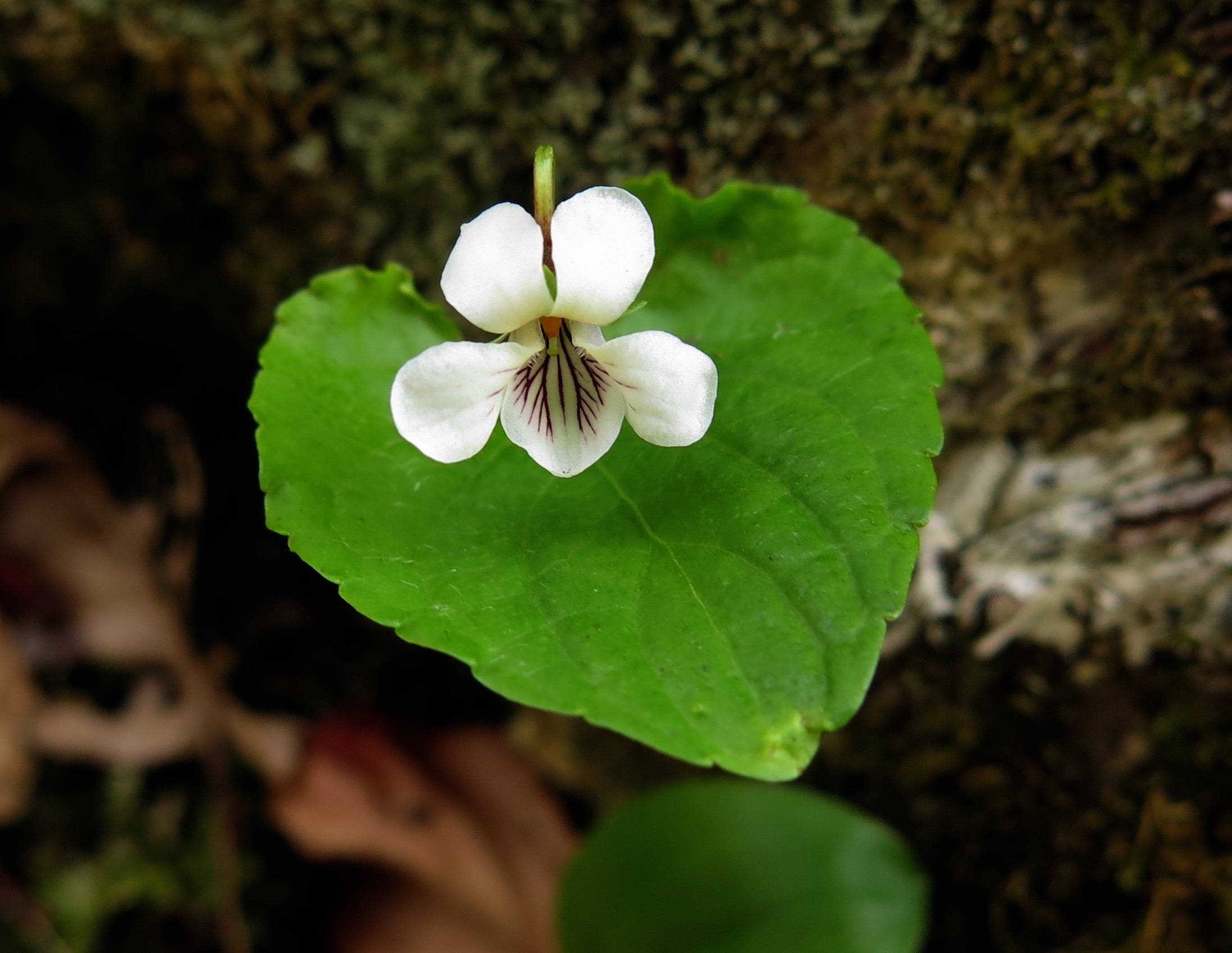
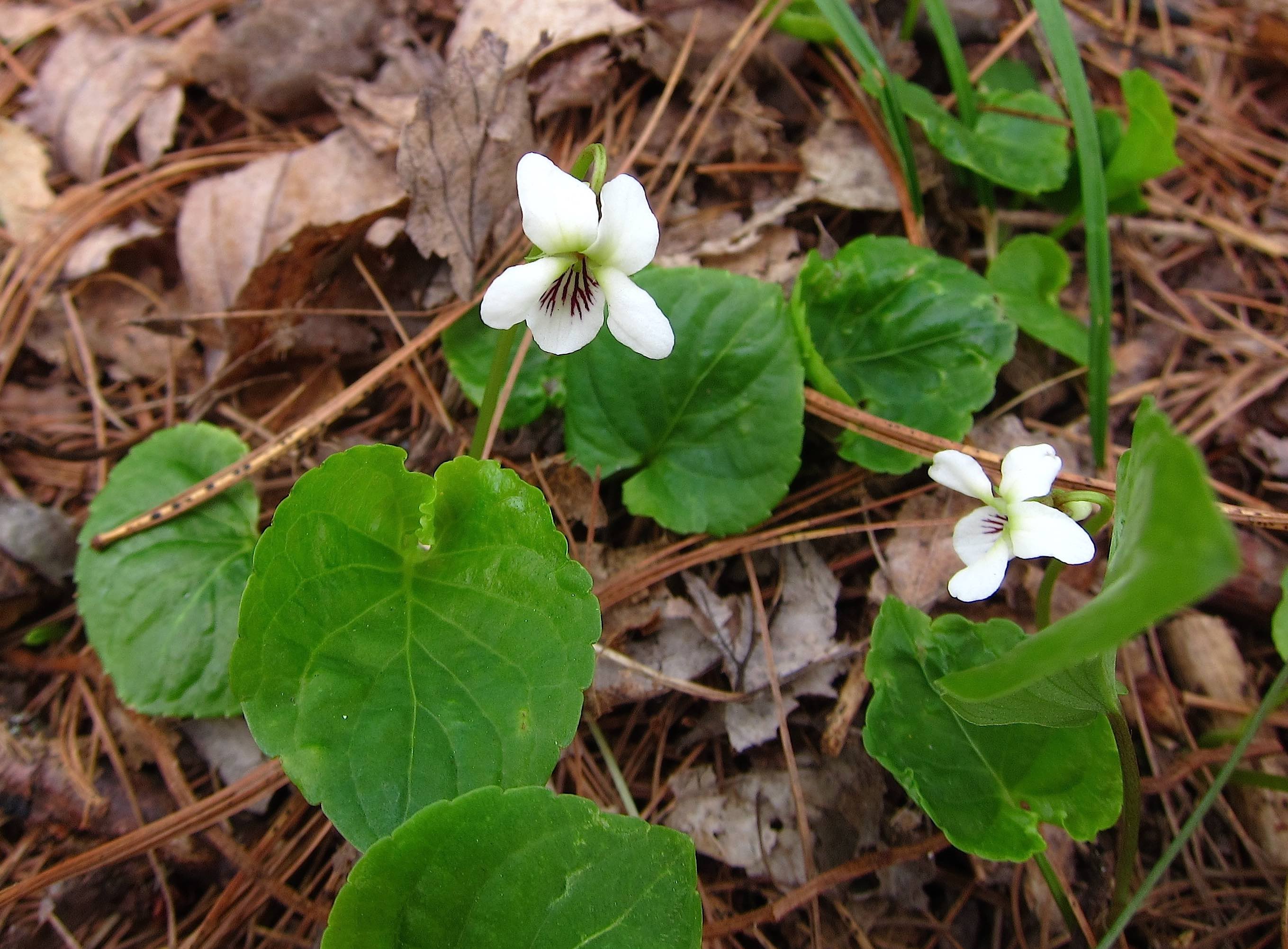
When I turned onto a wooded trail at the far north-eastern end of the pond,  I was met with the sight of uncountable numbers of tiny white violets carpeting almost an entire hillside.  


I'm not sure which Viola species this is, since we have several species of small white basal-leaved violets that I have difficulty distinguishing. But my best guess is Northern White Violet (V. pallens), based on the rounded shape of its leaves, sweet fragrance, and early bloom time. Another option might be the Sweet White Violet (V. blanda), equally white and small and fragrant.  But as Juliet once explained about roses to Romeo, a violet "by any other name would smell as sweet." And be just as beautiful.


Just beyond these masses of violets lies a low swampy area paved with more white flowers.  Among them were these delicate beauties called Goldthread (Coptis trifolia), holding their flowers on slender stems above their ground-hugging three-parted leaves. The "gold" implied by this pretty plant's vernacular name does not refer to those yellow lollipop-shaped "petals" (the white parts are actually sepals), but rather to its bright-yellow thread-like underground roots. 


The most abundant denizen of this swampy spot is the low-lying species called Dwarf Ginseng (Panax trifolius), which was just beginning to open its umbels of tiny white star-shaped flowers.  This plant is a true "spring ephemeral," since as soon as its flowers drop the seeds that replace its blooms, all evidence of this plant's existence will disappear until the following spring.  I'm happy I was able to catch it in bloom, even if only partially so.


I eventually made my way to the southern end of the pond, where a sphagnum-lined boggy spot on the shore supports a population of Leatherleaf shrubs (Chamaedaphne calyculata). I feel lucky I didn't miss the long arching stalks dangling rows of bell-shaped flowers while they still appeared pristine. This is one of our earliest-to-bloom flowering shrubs, and I feared that I might have missed seeing them this year. Our cold spring must have delayed or sustained their bloom. Yay!


No flowers on these plants of Checkered Rattlesnake Plantain (Goodyera tesselata) as yet, but when they shoot up from the center of their pale-patterned basal leaves in a month or so, they will indeed be white: tiny white orchids climbing their leafless stalks.  As the litter of pine needles surrounding these plants suggests, this native orchid loves the acidic soil of a pine-populated woods.


All right, what's this blue flower (a Round-leaved Hepatica) doing in my post about white-flowered plants? Well, I couldn't ignore it, because I was so surprised to see it.  Most of our hepaticas, both the Round-lobed (Hepatica americana) and the Sharp-lobed (H. acutiloba) have finished their blooming for the year and have already gone to seed.  This plant, too, is already producing the spiky seedpods set within three-parted bracts you can see right behind the blue flower. How happy I am that I got to see just one more of its beautiful flowers, especially one that wasn't plain white (which many of them are), but one of this radiant blue color instead.


Wednesday, May 4, 2022

Yellow Flowers Take Center Stage

The yellow flowers took center stage in the Skidmore College woods late last week.  And the Red-necked False Blister Beetles soon showed up to feast on the pollen. 

Happily, I found dozens of beautiful Yellow Trout Lilies (Erythronium americanum) in full bloom, and most with their pollen intact. This lovely group of blooms was tucked into a protective tree-root niche, and its anthers still held the deep-red pollen that will shortly attract (and be consumed by) hordes of hungry beetles.


Large-flowered Bellwort (Uvularia grandiflora) was dangling its large yellow blooms with flaring petals below stem-perforated leaves. I find this species of bellwort only in lime-rich habitats, which certainly describes the limestone-underlaid woods at Skidmore College.


The later-blooming species of Blue Cohosh (Caulophyllum thalictroides) was now bearing its open yellow (not purple) flowers. The purple-flowered species called Early Blue Cohosh (Caulophyllum giganteum) had bloomed a week or so earlier and still held many flowers.  The two species grow within a few feet of each other in the Skidmore woods with no signs of hybridizing.  As the plants mature, they become quite difficult to tell apart, so I am delighted I know where to find both species so readily observable as they first come into bloom.


I had found the first yellow trumpet-shaped blooms of Leatherwood (Dirca palustris) just peeking out of their brown furry buds a couple of weeks ago, so I feared that they would be gone by now.  But no, these lime-loving shrubs with their tough leathery bark were still festooned with bright-colored flowers, even as their green leaves began to unfold.


The Spicebush shrubs (Lindera benzoin) were now fully in flower, with sessile tufts of bright-yellow blooms, male and female flowers borne on separate shrubs. If you want to know how Spicebush acquired its vernacular name, just gently scratch the bark of a twig and take a sniff. Aromatic! Also, the female shrubs will later bear red berries that can be dried and ground to substitute for Allspice in baking. Or so I've been told.


Well, it didn't take long for the Red-necked False Blister Beetles to find the pollen-bearing male Spicebush flowers. The shriveled brown tips of several anthers indicate that these two have finished their meal and are now engaged in post-prandial activity to ensure the continuation of their species.


But as this photo of an eating-orgy reveals, there doesn't seem to be any population shortage among these pollen-eating insects. They really do love Trout Lily pollen! 


When I returned the next day, I could not find a single Trout Lily that hadn't had all of its pollen devoured, leaving the anthers shriveled and black.


Luckily, unlike those beetles, Trout Lilies don't have to depend on sexual activity to reproduce. They are well able to increase their numbers clonally, by underground runners called stolons. The white stolons can sometimes be seen emerging from under the ground as they travel across the forest floor.  But it seems that they must quickly return underground, to judge by tiny "croquet wickets" I sometimes discover surrounding their patches of speckled leaves.


As the summer approaches, all traces of Trout Lily -- leaves included -- disappear from the forest floor. I wonder where the Red-necked False Blister Beetles go next, to eat their fill.

Friday, April 29, 2022

Bedrock, Early Bloomers, and Bugs

What with birthday-cake baking and present shopping, houseguests arriving, dentist appointments, etc., etc. this past week, I haven't had time to post an extensive blog. But I do want to share these photos of flowers, taken early this week in a beautiful area of the Palmertown Mountain Range in Moreau . The spring wildflower rush is upon us now, and by next week so many more flowers will be blooming, these will seem like old news by then.  And they deserve to be celebrated now!  

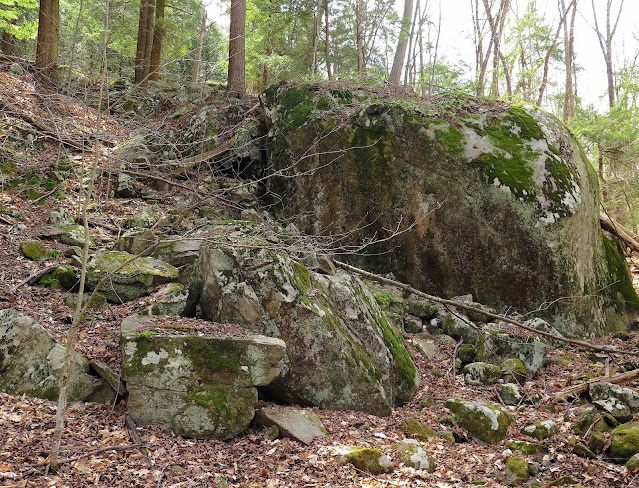
There's a trail that leads up to the heights of the Palmertown Mountains at the northern boundary of Saratoga County, but my favorite spot along this trail is right where the trail begins to sharply ascend. Old lady with bad knees that I am, I don't go higher, but I linger here in this stream-crossed sunlit area, surrounded by impressive bedrock and boulders, delighting in the masses of wildflowers blooming now and soon, including many lime-lovers. Must be some marble in those rocks, or emerging in springs that water the rocks or join the streams that tumble down the mountain slopes. 

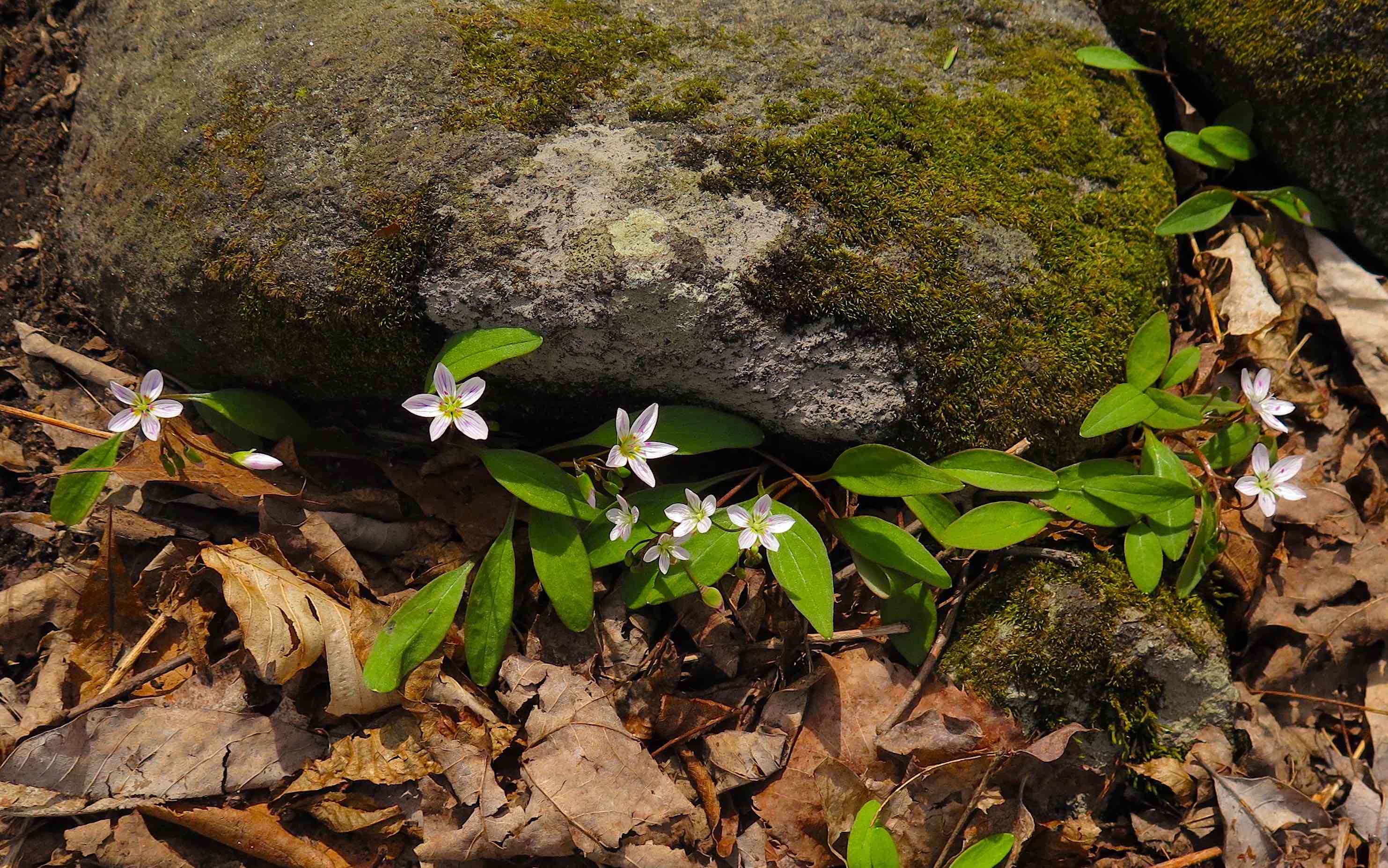
Uncountable numbers of Carolina Spring Beauty (Claytonia caroliniana) abound in this spot so thickly, it is hard to walk without stepping on them. This pretty pink-striped, pink-anthered, early-blooming wildflower has certainly earned its vernacular name of Spring Beauty. It's amazing to watch the bees visiting these lovely flowers and then flying off with pollen baskets colored pink from the pollen gathered here.  


In fact, there's a particular species of bee, called the Spring Beauty Miner (Adrena eriginiae), that my friend Sue Pierce managed to get an amazing photo of:

Photo by Sue Pierce


My friend Sue and I found many, many mounds of Dutchman's Breeches (Dicentra cucullaria) leaves at this site, but only a few were blooming yet. I was grateful to find some with dark shade behind the blooms, the better to show off their pantaloon shape.


The Hepatica Festival continues, well into its third week now since the fur-covered buds first released the lovely blooms, usually in more muted colors than the two pictured here. It's rare to find the flowers so vividly colored, so these gorgeous magenta Sharp-lobed Hepatica blooms (Hepatica acutiloba) really stood out against the leaf litter. This species of Hepatica is known to prefer a calcareous habitat, and other lime-loving plants at this site -- Canada Violets, Plantain-leaved Sedge, and Maidenhair Fern -- attest to that soil chemistry. 


Quite unusual for Bloodroot (Sanguinaria canadensis), there was only this one single flower along the trail. This lovely flower usually blooms -- ah, too briefly! -- in groups. Maybe that's why this bee was loathe to leave this solitary pollen provider and stayed put for the picture-taking. 


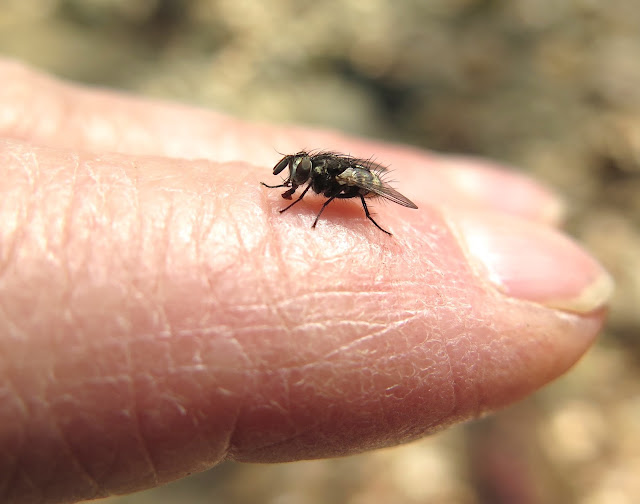
Here was another critter that stayed around for the picture-taking. This cute little tachinid fly (a nectar-eating fly of the kind I call "bristly butts") landed on my finger and spent a considerable amount of time walking back and forth, dabbing its "tongue" on my sweat-dampened skin.  I know that the adults of these important pest-controlling insects (their larvae consume many destructive insect pests) like to sip sweet flower nectar, but in this case the fly appeared to be sipping my sweat.  Maybe it likes salty as well as sweet.


I was disappointed not to find the beautiful lime-loving Canada Violets blooming yet, but two other violets, notable for being early bloomers, had opened their beautiful flowers.  The bright-yellow blooms of Round-leaved Violet (Viola rotundifolia) were easy to spot among the leaf litter.  This violet is known to abound in the Adirondacks, but I rarely find it in the lowland woods I usually haunt. But this site in the Palmertown mountains is actually within the same eco-range as the Adirondacks, so it was not such a surprise to find it here.


These tiny white violets are probably the Northern White species (Viola pallens), due to their tiny size, roundish leaves, and early bloom-time.  I have difficulty distinguishing them from other small early white violets, so I'm glad my life doesn't depend on being correct. By whatever name they might be called, I was delighted to find them blooming abundantly along the trail. 


For a preview of the floral feast that's just beginning now, I stopped on my way home along Spier Falls Road to search among the rocky ledges lining the road for a plant that's soon to turn these ledges into amazing rock gardens.  Sure enough, the Early Saxifrage (Micranthes virginiensis) was very close to opening its clusters of tiny white blooms among the moss-covered cracks and crevices in the rock.  Red Trilliums will soon follow, joined by Shadblow Trees with their drifts of snowy flowers, and shortly after that, the deep-pink, super-fragrant blooms of Early Azalea will be spilling over these cliffs. Stay tuned!