Wednesday, January 5, 2022

One (Just ONE!) Cold Day

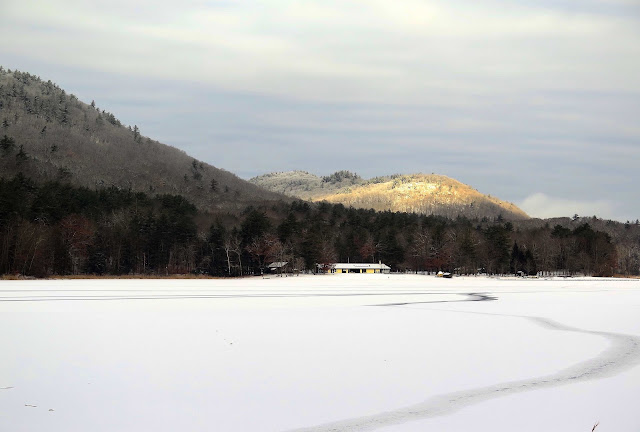
OK, we had one really cold day this week. Temps down into the single digits.  That was yesterday (Tuesday), and since that one cold day had been preceded by a week of warmish rainy days, my friend Sue and I got all excited about the prospect of clear ice on Moreau Lake and hurried there in the morning.  Well darn it!  The lake froze, yes, but a dusting of snow fell on it, too. Guess we won't see any stacks of ice bubbles in crystal-clear ice this year.  (If you're curious why we two get so excited about lake ice, check out my blogpost from one of the most spectacular years of it.)


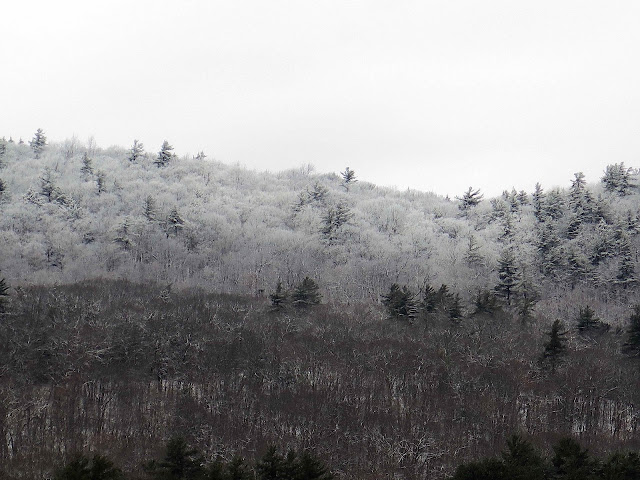
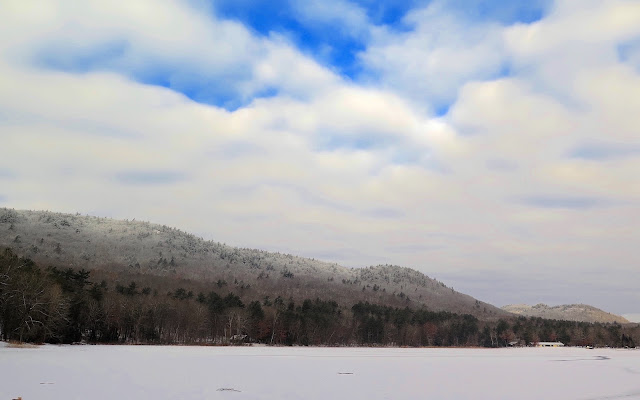
We did get to see some hoarfrost though, atop the ridge along the western shore of the lake.   Had it been just enough colder higher up on the ridge, or had a cloud of mist settled there to coat every twig and leaf with frost? I was amazed by how sharp was the line of demarcation between the hoary trees and the lower ones just dusted with snow.


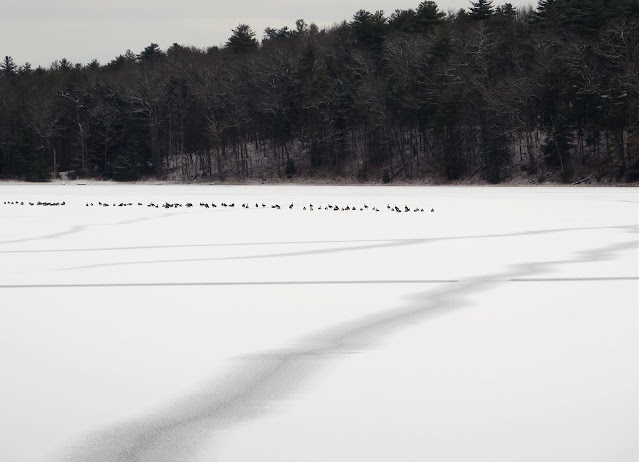
A flock of Canada Geese still occupied the lake, but they were strangely quiet. Were they stunned to find their stretch of water suddenly closed over?


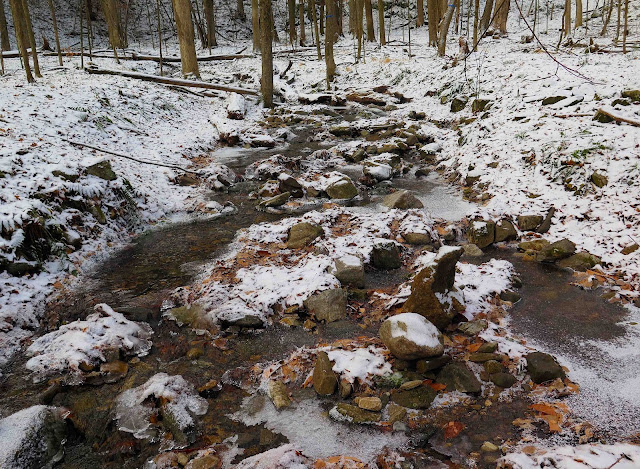
Since the lake held little of wintry interest today, we headed over to what Sue has named Zen Brook, a lovely little stream that tumbles down the steep slope of the western ridge. This stream's water seldom reaches the lake before it sinks into underground channels, but today -- thanks to the previous week of occasional rain -- the water was dancing and tumbling amid the rocky banks all the way to the lake shore.


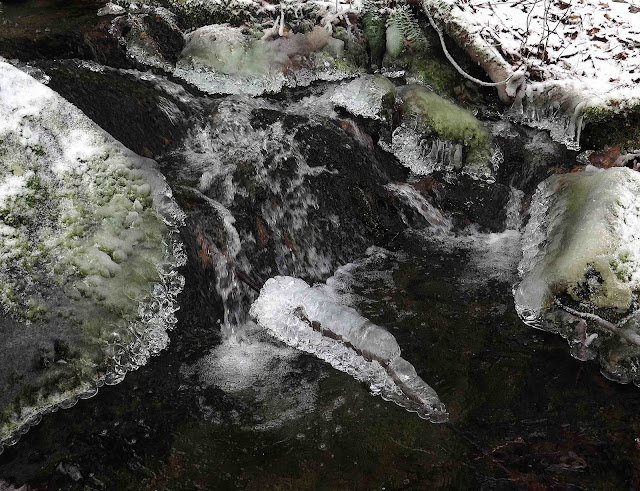
We weren't going to find any lovely lake ice today,  but the stream would offer plenty to delight us. Thin plates of crinkly ice lined the banks where the stream flowed through level ground.


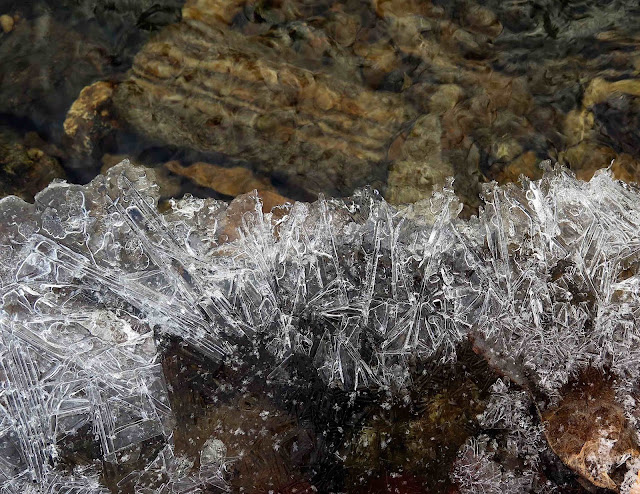
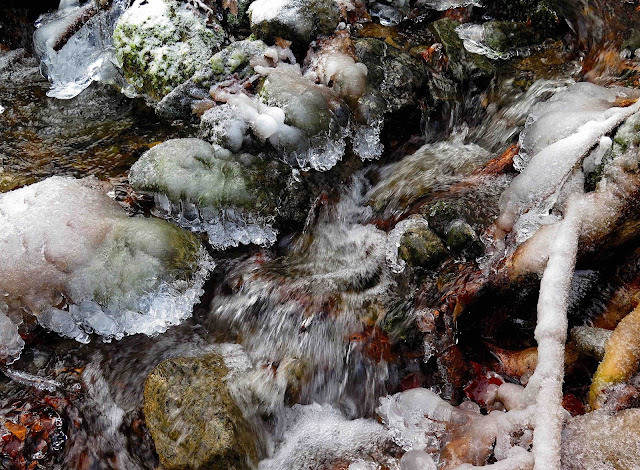
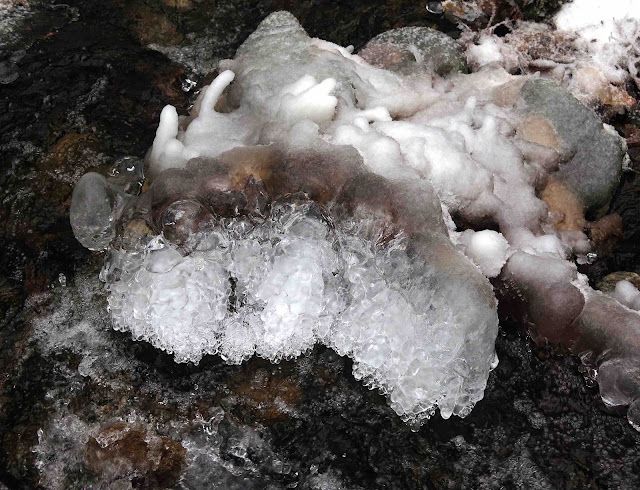
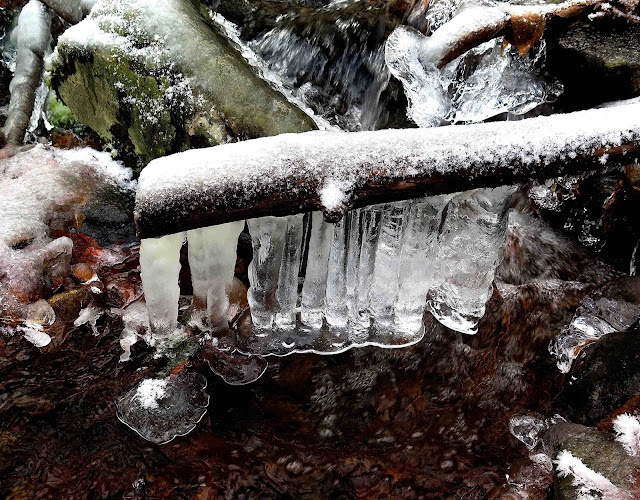
But as we climbed higher, the ice took on thicker and glassier shapes, formed as the rushing water tossed up droplets into the sub-freezing air.


The exertion of climbing up the steep rocky streambed kept us warm for a while, and we kept hoping the promised clear skies would deliver some warming sunshine.  But the skies never cleared enough to warm our cold-stiffened cheeks, so we soon headed home. Just as we left the lake shore, a stray sun beam broke through the clouds to light up this distant peak. This peak forms the "brow" of what we think of a "the lady of the lake."  Go back to the first photo of this post and note how her reclining body, hip and bosom swelling, rests along the western shore of the lake.


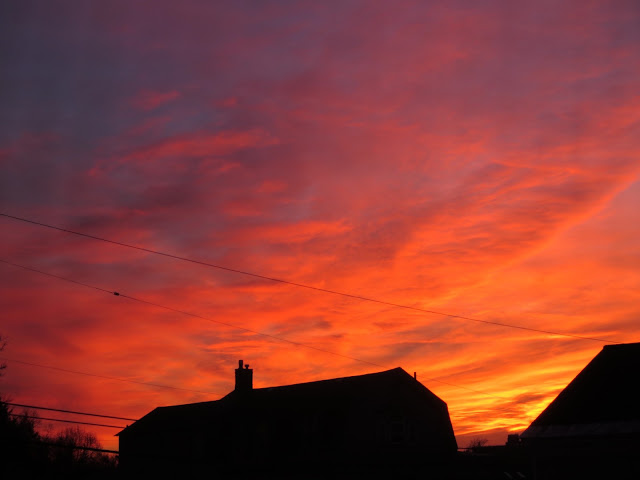
Temps climbed back up close to 40 today (Wednesday).  So much for winter.  But we sure had a spectacular sunset tonight.  I can't see much of the western sky from my downtown Saratoga kitchen window, but what I could see was truly astounding!


Friday, December 31, 2021

Time for Some Woodsy Watery Therapy

So much for a white Christmas this year.  More like a soggy and gray one. But that gray sogginess actually mirrored my mood, since once again as it did last year, Covid caused the cancellation of our plans for a festive gathering with family and friends. Oh well, at least those who fell ill were fully vaxed and boosted, so their symptoms were relatively mild.  And so far, I have escaped it.   But my mood stayed glum for so long, I finally decided I needed some woodsy, watery therapy to lift my spirits.  So despite yet another gloomily-gray day,  off I went yesterday to the Hudson River side of Moreau Lake State Park. And all I had to do was step from my car on the shore of the river to begin to feel peace and joy infuse my heart. Who wouldn't be soothed by such serene beauty as this?


Since the river's too cold to risk paddling now, I chose to walk a portion of the Cottage Park Trail, with its trailhead just across the road from the river. This trail takes its name from the remnants of now fallen buildings that once housed the workers who constructed the Spier Falls Dam on the nearby Hudson near the close of the 19th Century.  


The buildings are long gone, but their stone foundations remain.


As Nature gradually repossesses these old stone foundations, the mosses that thrive on the rock are startling in their vibrant green beauty.


Some of the mosses still possess their spore capsules standing tall above their green leaves, impervious to winter's snowy cold.


As I set off through woods, I can glimpse the mountain range rising in the distance.  This trail will eventually climb to the mountain heights, but I will confine my exertions today to the lowland woods, still colorful with the ruddy leaves of sapling American Beeches (Fagus grandifolia), which won't shed the old leaves until new ones sprout in the spring.


Other evidence of the beech trees' presence is scattered across the forest floor,  with multitudes of spiky Beechdrops (Epifagus virginiana), a leafless flowering plant that obtains its nutrients from the roots of American Beech.


These small fleur-de-lys-shaped seed scales scattered across the snow are evidence of another tree species here in this woods, the Gray Birch (Betula populifolia).


 I was surprised to see in this woods Gray Birches of a truly grand scale, since this birch species is rather short-lived and usually topples before it grows as large as a few I found growing here. The dark inverted Vs of the bark are one of the distinguishing marks of this species of birch, which often has bark as white as that of Paper Birch.


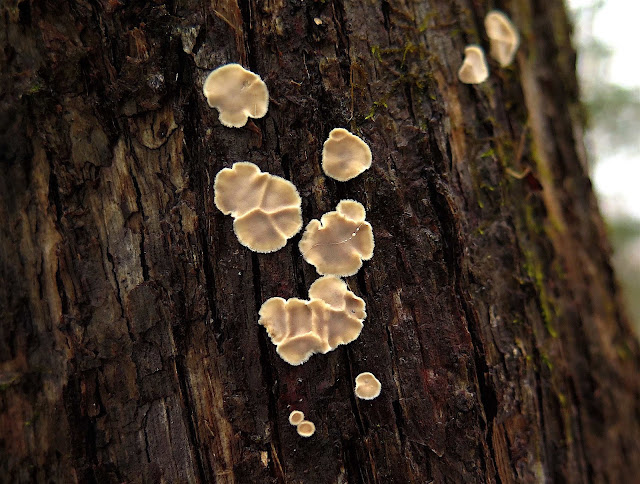
When I saw these small tan discs crowding together on a de-barked small treetrunk, I recognized them as the fungus called Hophornbeam Disc Fungus (Aleurodiscus oaksii).  But since the bark was mostly shed, I could not distinguish the host tree as either a Hop Hornbeam or a species of oak.  This fungus is known to grow on either tree species.


I found other fungi occupying fallen limbs that were lying about the forest floor, including this colorful patch of orange Stereum sharing its woody habitat with some beautifully green foliose lichens.


Another fallen limb held an abundant patch of the fungus called Tree Ear (Auricularia auricula). I believe it is obvious how this species obtained such a descriptive name. (Or is this Amber Jelly (Exidia recisa) instead?)


Before the Cottage Park Trail starts to ascend the mountainous heights, it crosses an open area beneath the power lines that carry electricity produced by the hydroelectric Spier Falls Dam on the nearby river.  The area under the powerlines is kept mowed to prevent trees growing into the wires, and this open area is home to many sun-loving native meadow flowers during the warmer months.


Round-headed Bush Clover (Lespedeza capitata) is among those sun-loving plants, and its brown spiky seedheads are easily identifiable even in the winter.


I continued on until the trail began to ascend, and the level terrain of the woods began to change to a steeper, rockier terrain. I recalled exploring this particular area last spring, when small creeks were tumbling down the mountainsides and the forest floor was covered with lovely wildflowers. (To see what this woods looks like in May, you can click here. )


One of the plants I did NOT see last spring was the species that now dangled abundantly over the face of this gigantic rocky outcropping. What plant could that be?


I could not reach the dangling vines on foot, so I  had to rely on my camera's zoom to show me a closer look at the still-green leaves sprouting from rosy-pink vines.  The scallop-edged heart-shaped leaves do resemble those of Foamflower (Tiarella cordifolia), but I have never seen cascading vines of Foamflower draping across the face of a boulder like this.  For sure, I must return next spring to see if I can confidently put a name to this interesting plant.


UPDATE:  I have heard from a reader named Erik Danielsen, who assured me that this plant is indeed Foamflower, but he also argued that it is more likely the species called Tiarella stolonifera, which botanists now are arguing should be split off from the species T. cordifolia, due to its habit of regularly producing long stolons like those illustrated in my photo.


Other evergreen plants were abundant at this site, including the aptly-named Christmas Fern (Polystichum acrostichoides), which I recognized despite its distinctive Christmas-stocking-shaped pinnae being partially obscured. I was captivated by the curvaceous frond, with the points of the pinnae so sharply protruding from the snow.


I was surprised by how many people I met on this trail today, including several people who witnessed me down on my hands and knees peering at the underside of some fungi.  And surprise of all surprises, these people recognized me from this blog, and were kind enough to tell me how eagerly they followed it and learned so much from it.  My spirits were already high from simply having walked in this marvelous woods, but now they truly soared.  I continue to keep this blog, if only for my own documentary purposes, but knowing that others learn from it is truly rewarding to me. Walking back to my car, I felt I was drifting along on Cloud Nine!


Back on the riverside, I lingered a while, feeling blissed-out by the serene beauty I beheld, even on this darkish day, growing darker now as the afternoon grew late.


I even found a few flower friends I could greet, including these still-lovely stalks of Meadowsweet (Spiraea alba), their residual beauty enhanced by the riverside setting.


I was especially pleased to find these sturdy seed pods of Great St. John's Wort (Hypericum ascyron), rated a Rare species in New York but happy to grow in several sites along this stretch of the Hudson.


I stood for quite a while taking in this scene,  of small rocky islands perfectly reflected in the still water and steeply forested banks receding in the distance, their dark shapes growing more misty with each bend of the river.  Elated by the power of such serene beauty, I found it hard to leave. 


Tuesday, December 21, 2021

Cold At Last: Winter Transformations at Moreau Lake

Whoa!  Big change from just a few days ago when temps approached 60 degrees! But when I woke up Monday morning after a clear cold windless night, I was startled to read the thermometer: SEVEN DEGREES ABOVE ZERO!!! I'm so glad my pal Sue Pierce and I had agreed to meet at Moreau Lake this day.  We'd bet we'd find new ice on the lake, and we were not disappointed.


Although the lake was still open in areas out toward the middle, along the north-facing shore the ice had formed crystal clear and hugging the shore.  Not quite thick enough to walk on though, as my tentative step revealed: CRACK!


This is exactly the kind of ice that thrills Sue and me: clear as glass and prone to capture stacks of silvery bubbles as organic material on the bottom releases gases.  No bubbles as yet had been caught within this thin-as-crystal coating, but this ruddy oak leaf sure looked pretty captured beneath a finely etched glaze.


Here was an ice formation neither Sue nor I had ever noticed before.  Where tiny twigs protruded above the thin ice, frosty disks with spiky edges had formed around each twig. And what were those spidery lines that were swirling around that middle twig?


A closer look revealed that feathery threads of waterfowl down had caught in the twigs and been captured and held within the thin layer of ice.  So pretty!


A large flock of Canada Geese had congregated on patches of open water, and they sent up quite a cacophony of cackles and hoots as they visited with one another.


It was fun to see some of the flock waddling about on the ice sheet that rimmed the open water. Sometimes they'd slip just as you or I would on that slick water-covered ice.


Sue noticed that some of the waterfowl at the edge of this flock were quite a bit smaller and whiter of head than the geese, and they also would disappear suddenly beneath the surface from time to time.  I'm glad my camera's zoom could see these diving ducks better than my eyes could, or I would never have known that a few Buffleheads were sharing Moreau's open water with all those geese today.


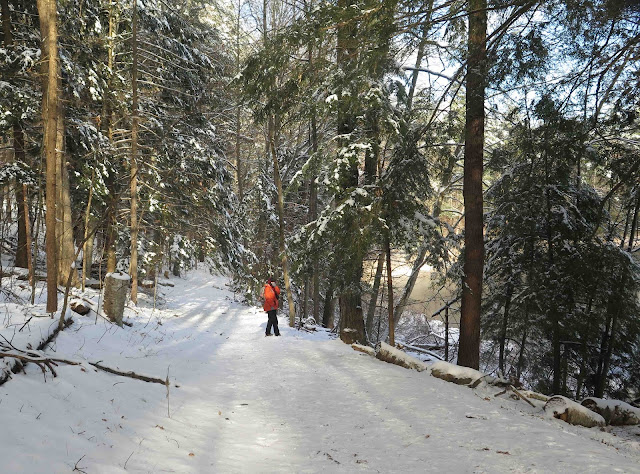
Here's the snow-covered trail we took as we walked part-way around the lake. A sleety wintry mix followed by snow two days before had whitened the evergreen boughs and caused them to sparkle in the sunlight that made it through the trees today.


A snow-covered fern. I believe it's a Marginal Wood Fern.  Sue and I like to test our knowledge of plants in their winter guises, but this fern doesn't look much different in winter than it does the rest of the year.


The dried seedpods of Spotted Coralroot, one of our native orchids. I doubt I would have been able to ID this plant from these remnants alone.  But we found it right where we'd seen a large patch of Spotted Coralroot last fall.


Same goes for these pods of Pyrola.  No doubt it is Shinleaf Pyrola,  since that was the species we'd found growing here along this trail last summer.


When we reached the building that houses the locker rooms for the swimming beach, I was struck by this pattern of icicles dangling from the eaves.


As we walked across the bridge that divides the main lake from the back bay, we noted that the main lake remained wide open at this south-facing end of the lake, while the bay just beyond the bridge was completely frozen over from shore to shore.


I  was fascinated by the ice formations along the railings of the bridge, lacy half-melted snow remnants above and crystalline needles below.


It was barely noon, but a low Solstice sun cast a golden glow on the steep forested banks that line the back bay, the smooth ice below the banks capturing that glow in a shimmering reflection.


Despite that golden sunlight and because clouds were moving in and the wind picked up, we were beginning to feel the bitter cold that hadn't climbed much into the double digits.  Time to pick up the pace and hurry back to the warmth of our cars.  But we drew to a halt when we found some patches of pretty frozen bubbles close to the shore.  They weren't the stacks of silvery disks we had hoped to find in this glassy ice, but they were pretty enough to cause us to pause to enjoy them.