Sunday, October 17, 2021

Back to Lens Lake

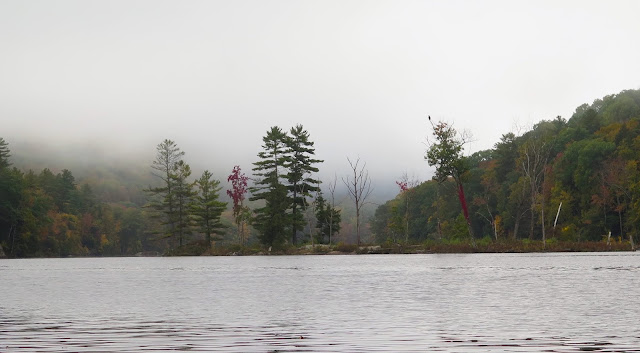
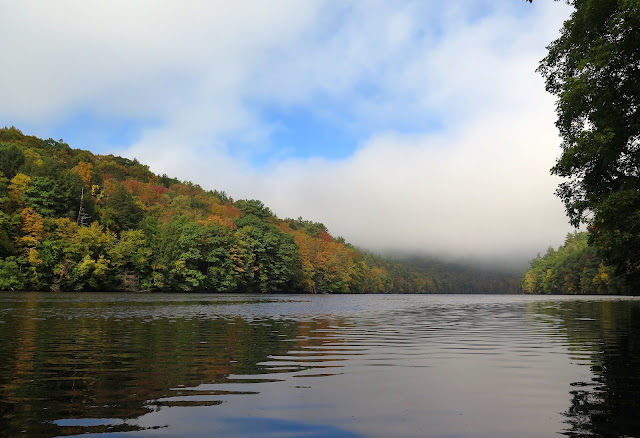
On October 5, I scouted a favorite Adirondack lake to see how the autumn color was developing.  As my blog post for October 6 revealed, I could see that the color was already spectacular, even though rainclouds obscured the mountainsides on that visit.  Time to alert my friends Ruth and Sue that we'd better get up to Lens Lake very soon, before the foliage passes peak color.  So October 12 found the three of us setting out on the lake in our solo canoes, just as the morning fog was lifting to reveal a beautiful blue sky,  with lakeshore and mountainsides ablaze in autumn splendor.


One of the most inviting features that Lens Lake offers a paddler is the presence of acres and acres of sphagnum-covered floating bog mat, plus miles of convoluted forested shoreline to explore for interesting plants.  It is also a very quiet lake, with very few homes along a short stretch of its shore, and with very strict limits on how fast a low-horsepower motor boat can travel on its waters. As we inched along close to shore or wended through narrow channels in the bog mat, we were never in danger of exceeding even that very low speed limit.


Cottongrass danced on the bogmats, weaving and bobbing, but each white tuft atop each slender stem  was moving as if to its own music, never in unison with its neighbors.


The grasses and shrubs were still wet from the morning fog,  so all of the doily webs spun overnight were strung with droplets that glistened in the early sunlight.


Here's a closer look at one of those webs strung with water droplets, the spider that spun it resting at the center.


As the fog burned off, we could see the entire blue sky, adorned with some of the most beautiful clouds we had ever seen.  Their upswept forms appeared to be echoing our delight at being present to witness their grandeur.


As we made our way among the bog mats,  we greeted our favorite bog plants as if they were old friends.  This crowded clump of Northern Pitcher Plant displayed a variety of the gorgeous colors this familiar denizen of northern bogs is known to exhibit.


We found a few ripe Large Cranberries, too.  This was a bit of a surprise, since one of our cranberry-picking friends had informed us that she had already picked them all. But with acres and acres of bog mat to cover, she couldn't have combed every inch.


We were not surprised to find the spring-blooming Sheep Laurel in beautiful bloom once again. That has been our experience every time we visit this lake in the fall.


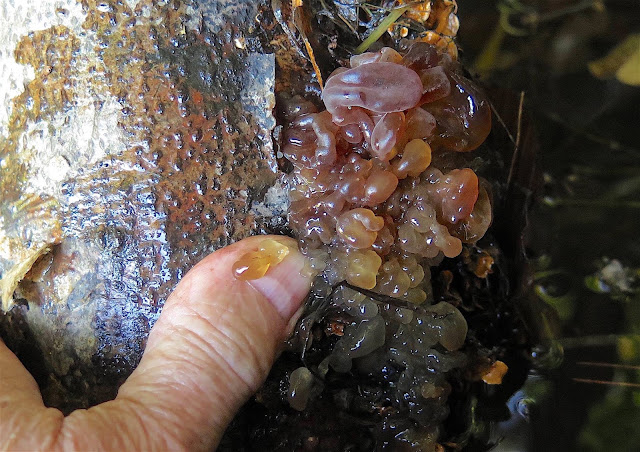
I was not surprised, either, to find once again many of these green-tinted, transparent gelatinous masses suspended underwater.  This lake is the first and only body of water I have ever found them in, and I find them here again each year. The first year I saw them, I searched the internet to see what I could learn about them.  According to the Ask the Naturalist blog, these masses of transparent greenish jelly are formed by a colonial microscopic single-celled protozoan called Ophrydium versatile, and they can be found all over the world in fresh water.  The individual cells line up side-by-side in the "blob"and attach themselves to a jelly-like substance they secrete.  They are symbiotic with microscopic Chlorella algae that live inside the Ophrydium cells and give the blob its green color.


Here was another interesting underwater species we find at Lens Lake and seldom at other waterbodies we paddle.  This is a freshwater sponge, probably Spongilla lacustris.  Despite its green color and seaweed-like appearance, this is actually a colony of animals, not a plant. A lake sponge is a simple filter-feeding animal, possessing many cells but lacking a mouth or a brain or muscles or heart or any ability to move, once it becomes attached to a submerged rock or fallen limb. It somewhat resembles a green plant because of the green algae that inhabit it in a symbiotic relationship.  The algae help the sponge utilize available food, while the sponge supplies the algae with a place to live.


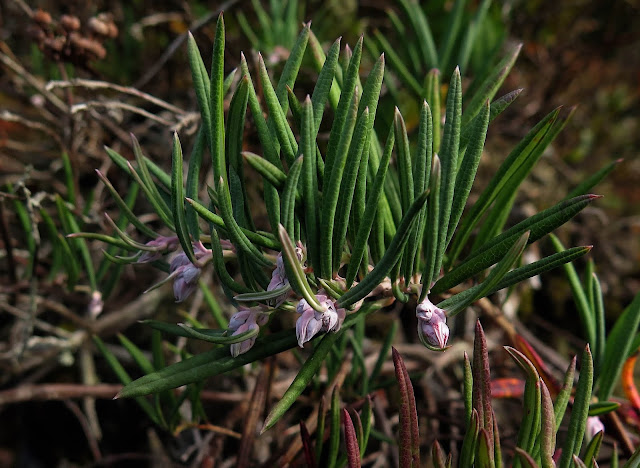
I was certainly puzzled by the pink growths on this Bog Rosemary bush.  They looked like neither the small pink pumpkin-shaped fruits I'd expect to find this time of year, nor the pink-tinged white globular bells of the spring flowers.  These growths were rather hard to the touch, the pink covering dry and papery.  I wonder if they could be galls instead of fruits.


This photo of a Merganser family perched atop a lichenous boulder is three years old.  When I first saw the ducks, they were all arrayed with their bills pointing the same direction, but just at the moment I pushed the camera's shutter, one rebel turned to look in the opposite direction.  Even so, all the bills were held perfectly level, at the very same angle. It appeared that the wind was blowing the upstart's crest feathers in the opposite direction, too. I have always loved the quirky moment this photo captured, enhanced by the glorious colors of the background trees.  On every return to Lens Lake, I hope to find Mergansers atop this same rock.


And this year, there they were! Six of them, this year.  But not at all as neatly arranged as they had been the first year I saw them.  This time, each individual was doing its own thing, either preening or gazing off in a different direction.


And this year, I could not approach them as closely as I had before, so my zoomed image is not nearly so clear.  But still, it pleased me enormously to find these Mergansers atop this same boulder once again. And just before they tore away at my too-near approach, they almost assumed the same poses I'd captured in my photo three years ago.


This waterfowl reiteration represents one of the reasons I love returning to this beautiful lake again and again.  I expect to find many of the same treasures I have found here before. But I also expect some fascinating surprises.

Monday, October 11, 2021

Inching Along the Hudson Banks

The weather forecast said "clear and mild," so my friend Ruth and I agreed to meet for a paddle on the Hudson River at Moreau last week.  As we prepared to launch at mid-morning, however, that clear sky still remained obscured by fog.  No matter.  We were there to inch along the banks looking for mosses, not scan the skies nor bask in the sun.

  
UPDATE:  I DO wish I had scanned the trees with binoculars, though! As some folks in the comments have pointed out,  there's a Bald Eagle perching atop the tallest tree.

Soon, we began to glimpse blue sky, as the fog lifted off to reveal some autumn colors among the shoreline forest.


Before long, we were grateful for the leafy overhanging branches offering shade.


Right off, I was delighted to find these plants of Great St. John's Wort (Hypericum ascyron),  now bearing their distinctive fat seed pods.  This plant is rated as Rare in New York, but it does seem to like these unspoiled banks of the Hudson River.


Forested mountains fall directly down to the shore along this stretch of river, and in places, the rocky banks are thickly carpeted with many mosses.


This particular rocky bank was home to masses of Apple Moss (Bartramia pomiformis), a lovely green moss that bears spore capsules as round as apples.


Here was a moss that was covering the wood of a tree root instead of rock, but since it is a known calciphile (lime-lover), the surrounding rocks undoubtedly contributed the nutrients if prefers.


A closer look at this moss revealed stems as ropy as dreadlocks, along with sharply pointed spore capsules.  Called Entodon seductrix, it has no descriptive common name that I could find, although with a sexy scientific specific name like seductrix, it might be fun to make one up. Maybe "Rapunzel's Hair" or "Medusa's Head"?


My attention was drawn first to these brilliant orange fungi (small as baby peas), but then I noticed the fern-frond-like leaves of Pocket Moss (Fissidens osmundioides) covering the rock face beneath them.


I just this year learned to ID Pocket Moss, and now I seem to find it all over the place.  I picked up a rock to examine the flat-leaved liverwort covering it and discovered many tiny fronds of Pocket Moss poking up through it.  But then I neglected to ascertain the name of the liverwort!

UPDATE: Ruth has since reminded me that this liverwort is most likely a species of Pellia.

I did not get a liverwort name, either, for this green stuff covering a wave-wetted rock right at the waterline.  And I never will, either, since Ruth has since told me that this is a LICHEN, not a liverwort. (She found its name and description on a site posted by The Ohio Moss & Lichen Association.)  Called Dermatocarpon luridum, this lichen grows on wet rocks exclusively, with its typical habitat being rocks often washed by water.  Like these rocks at the waterline of the Hudson River.


Here's a closer look at this water-washed lichen, Dermatocarpon luridum.


Another lichen we found was this patch of cup-shaped Cladonia lichens, sharing a niche in an exposed tree root with a patch of green moss.  A much drier habitat than the previous lichen prefers.


When lunch-time arrived, we found a tiny quiet cove out of the river's current where we could rest our paddles and stretch our legs.


This beautiful Flowering Dogwood tree (Cornus florida) towered over the cove, its leaves well on their way to the bright-red color they usually turn in the fall.


Lining the shore of this little cove were a number of Leatherwood shrubs, a rather unusual find along these banks.  Leatherwood (Dircus palustris) is known to prefer a lime-rich habitat, and most of the riverbank rocks along this stretch are basic granitic rocks.  But marble outcroppings occur, and marble is also rich in lime.


An interesting fungal find was this Leafy Jelly Fungus (Tremella foliacea) growing on a fallen tree trunk.


At the base of this same trunk, but right at the water's edge, I discovered this jelly-like mass and did not recognize it.  I wonder if it's the same as the Leafy Jelly Fungus above, but with the leafy parts swollen from being constantly wet. UPDATE: Some mushroom expert friends have confirmed that my guess about this water-swollen fungus was correct!


Some sections of the shoreline here are ruggedly rocky, great chunks of boulders having toppled down from steep cliffs above.  Rosy-leaved Virginia Creeper (Parthenocissus quinquefolia) twined amid the boulders.


Overhead, American Basswood branches (Tilia americana) dangled clusters of seeds, their golden leaves brilliant against the clear blue sky.


These trailing leaves of Groundnut (Apios americana) had achieved a beautiful variegated pattern as their chlorophyll retreated. (Note the large sharply-toothed leaves of American Elm [Ulmus americana] on the right.)


Such a lovely surprise, to find the dainty pink flowers of Herb Robert (Geranium robertianum) still vigorously blooming above their beautiful lacy leaves!


Well, we had spent nearly four hours moseying along the banks, and maybe we had traveled a quarter-mile. As we turned our canoes around to head for home, we spied this young woman vigorously paddling down the middle of the river, her dog so handsomely standing in the prow.  She would certainly go much further and faster than we had paddled today! But I bet she wouldn't see nearly as much of the treasures these riverbanks offer.  As they say, "different strokes for different folks."


Wednesday, October 6, 2021

A High Road to Autumn's Glory

I was beginning to despair that we would have a gorgeous autumn this year in Saratoga County.  Here it was, October, and most of our deciduous trees were still stubbornly green, with maybe just a touch of gold or rust.   So I headed north, up to Warren County, wondering when I would start to see the foliage colors our region of New York is famous for.  I was all the way up to Stony Creek ten miles north of Lake Luzerne and hadn't yet seen much to amaze me. But then I started up a mountain, and within two turns of the road I found the kind of brilliance I'd been hoping for. Wow!


Up and up I drove, finally reaching a quiet lake ringed by mountainsides. It was raining a little, and the clouds were resting atop the lakeside mountains, veiling the crazy-quilt of colors I could discern  through the mist. 


I continued slowly along a narrow dirt road,  rejoicing in all the vivid trees that pressed close to the road.


I pulled over when I reached the end of the lake, where a gold and red sphagnum-carpeted bog mat stretched between forested banks, the mountains rising beyond and disappearing into the clouds.


Just gorgeous!


This gift of autumn's glory is one of our consolations for enduring our long cold winters.  Few other places throughout the whole world offer such seasonal beauty.


My canoe was atop my car, but I chose to walk the roadside instead of paddling in the light rain that was falling now.  The leafy plants sharing this sphagnum patch were bejeweled with sparkling raindrops.


I could hardly believe my eyes when I saw this Bunchberry blooming now.  And looking around, I saw quite a few of these normally spring-blooming flowers dotting the forest floor. An autumn surprise, for sure!


Many of the woodland mushrooms were just as colorful as the trees.  I did not know the names of most of them, since to accurately determine their species I would have had to dismember them. I was content to simply enjoy their beauty in situ, enhanced by their surroundings.  The Partridgeberry leaves and fruits did indeed provide a lovely foil for these caramel-colored disks.


A single yellow Sugar Maple leaf provided a lovely companion for this solitary pink-capped, white-stalked Russula.


These buttery-yellow caps were topped by a single Bunchberry plant.


A nearby stump was completely encircled by an abundant mass of similar butter-colored mushrooms.


This snowy-white button poked up from a lush green patch of Brocade Moss, where a golden Silver Maple leaf and a scarlet Red Maple leaf rested nearby.


I was drawn to peer more closely at this cluster of rain-wet tawny caps when I noticed them speckled by dozens of teeny-tiny Snow Fleas.


A single pink-capped mushroom had emerged from a bed of red sphagnum moss, edged by a patch of glossy-green, red-berried Wintergreen plants.


I ventured a few steps onto the bog mat and found lush mounds of this shaggy green sphagnum.


Here were Northern Pitcher Plants, too, still bearing the remains of their summer flowers.


As is usual in much of the Adirondack forest, Hobblebush shrubs predominated. Most bore yellow or wine-red leaves, but this shrub stood out for its leaves of brilliant ruby.


After a while, the rain stopped and the clouds began to lift, allowing me full view of the forested mountains as I descended the road home. As this photo reveals, the full spectacle of autumn's glory awaits in the week or so to come.  The show has just begun!