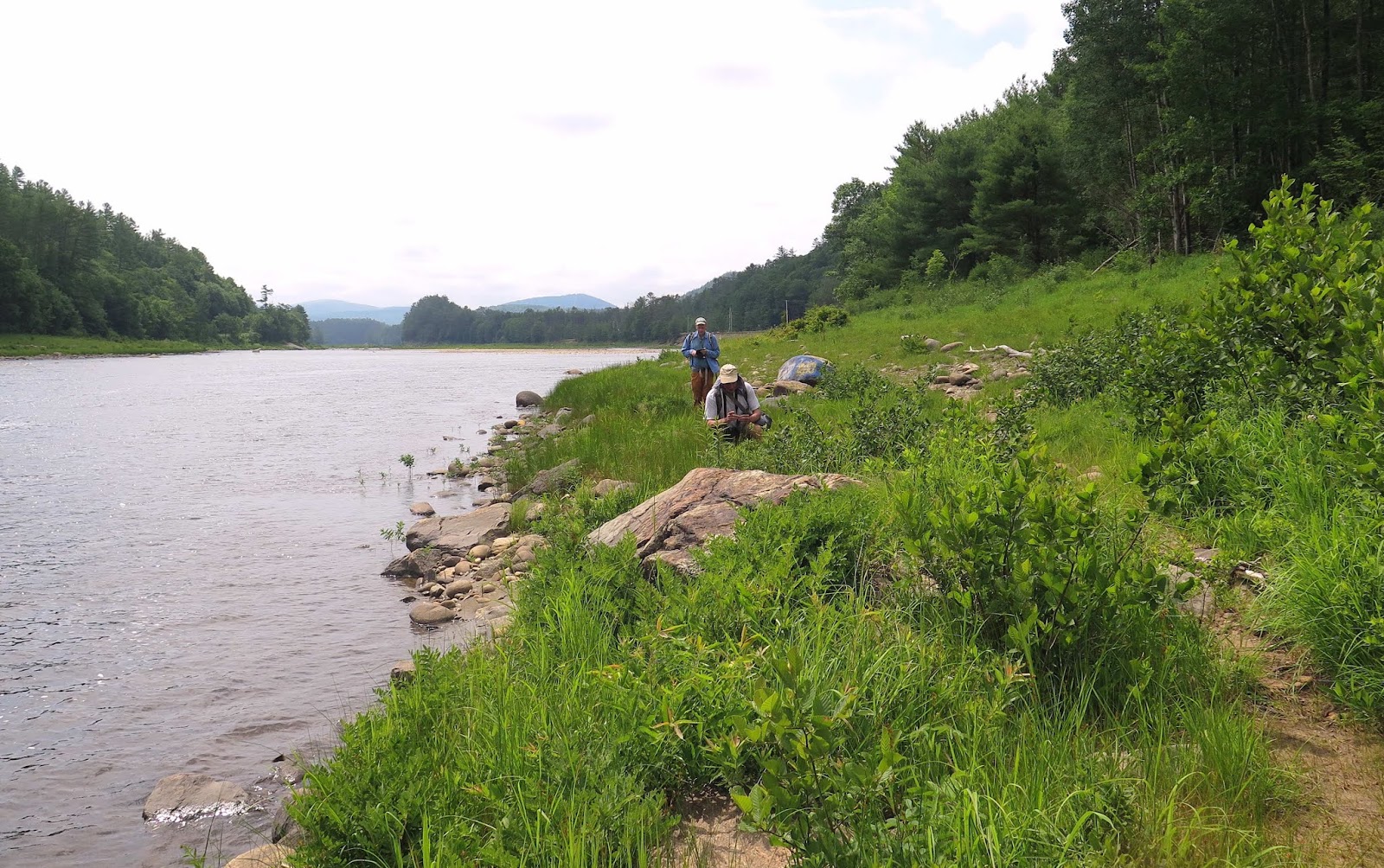
Because of the social distancing required by this year's pandemic, the official field trip was canceled. That was the one originally scheduled by the New York Flora Association to explore a stretch of Hudson River riverbank considered one of the richest botanical sites in all the state. But that didn't mean I could not go there myself -- or invite a very limited number of friends to join me. So this past Wednesday, I and three other NYFA members (Anne Johnson, Steven Daniel, and Rich Ring) made our way out to a stretch of Warren-County river shore called the Ice Meadows, named for the heaps of a special kind of ice, called frazil, that achieves prodigious heights here in winter, creating habitats uniquely suited to an amazing variety of native plants, some of them exceedingly rare. Consider this post a virtual, albeit limited, version of that field trip.
The very weight of all that ice suppresses the growth of the forest that might otherwise reach to the water's edge. Thus the ice allows a sunlit grassland to flourish here for a considerable distance along the shore. Occasional woody plants persist in this grassy verge, but they remain dwarfed and do not shade out the herbaceous wildflowers and native grasses that thrive in this open habitat.
A bit further upstream, craggy bedrock juts into the river, creating another kind of habitat for plants that make their home among boulders and cracks in the rocks.
Extending back from that craggy shore, flowing springs collect in quiet pools and deliver lime-enriched water from deep in the earth, neutralizing some areas that would otherwise tend to be acidic, due to the surrounding granitic rock. Other areas among these pools are carpeted with sphagnum moss and thus present a fen-like habitat. I have heard from botanists who were amazed to discover both calciphiles and acid-loving plants growing within a few feet of each other among these pools.
I can hardly begin to catalogue the extensive number of plants my friends and I found on our visit last Wednesday. With four of us searching, I know that I didn't even lay eyes on many of them. But I did manage to photograph some of the plants, which I will list alphabetically here, starting with a few of the dwarfed woody shrubs.
Dwarfed Woody Shrubs
Blueberry, Highbush (Vaccinium corymbosum)
There were lowbush blueberries here, too, but I was most drawn to the huge dark-blue fruits on these shrubs, so dwarfed on this site that they didn't even reach our knees. The better to easily collect handfuls of luscious ripe berries!
Dwarf Sandcherry (Prunus pumila var. depressa)
The fragrant flowers of this sprawling cherry (a Threatened species in New York) have now produced small green fruits that will later ripen to red.
Gray Dogwood (Cornus racemosa)
This is a dogwood that normally towers over a tall man's head. It barely reached my knees.
Shadblow (Amelanchier sp.)
Again, a shrub that normally grows much taller than I do, barely grazing my shin, despite being mature enough to bear nearly ripe fruit.
There were other shrubs, too, and some trees that were dwarfed to the size of shrubs. But I did not get photos of them. These next photos are all of wildflowers. Again, they are listed alphabetically.
Wildflowers
Bladderwort, Flat-leaved (Utricularia intermedia)
OK, I said flowers, so where are the flowers? Actually, they bloomed some time ago, chubby little yellow ones, back in May, probably. But their whorled leaves are so distinctive, forming mats in some of the shallow pools, that I wanted to include them here. Few bladderworts have any leaves at all, depending solely on their underwater sacs (utricles) to acquire nutrients. So I find these leaves quite remarkable.
Bladderwort, Humped (Utricularia gibba)
A tiny, leafless bladderwort, usually found attached to wet mud and not floating free. Later in summer, I often find these flowers poking up through the leaves of
U. intermedia (the species shown above) in these shallow pools. That surely did confuse me, the first time I saw them! The flower shown here is among the larger examples I have ever seen.
Bladderwort, Horned (Utricularia cornuta)
This is another bladderwort I usually find embedded in damp mud or sand, standing tall on slender leafless stems, very close to the water's edge. But we found this one high and dry, several feet back from the water, among other plants sharing the pebbled sand. Granted, the river water was higher earlier in spring. But still . . .? How will its utricles grab any nutrients out of that sterile sand?
Butterflyweed (Asclepias tuberosa)
A real dazzler of all the milkweeds! Very easy to spot among the tall grasses that thrive on the Ice Meadows.
Cranberry, Large (Vaccinium macrocarpum)
I usually find these trailing vines nestled among sphagnum moss in a bog, but out here on the Ice Meadows I find them sprawling across the rocks in well-watered spots. This site is full of botanical surprises!
Creeping Spearwort, Narrow-leaved (Ranunculus flammula var. reptans)
This photo does not well represent how truly tiny these wee little buttercups are, sprawling across the damp sand on slender curving stems that root at each node. They look like somebody sprinkled a handful of miniature stars along the shore.
Frostweed (Crocanthemum canadense)
If you want to see how this pretty yellow flower that thrives in sandy sunny spots got the name "Frostweed," you must return on one of the first sub-freezing but windless mornings of autumn.Then you will see the frothy fragile curls of frozen sap that have curved around the frost-split stems. (Or, you could visit
this blog I posted on one of those frosty mornings back in 2014.)
Harebell (Campanula rotundifolia)
This lovely flower looks so dainty and fragile, I wonder how it can thrive in such an exposed environment and harsh habitat as this flood-ravaged, ice-battered bedrock. But it does, beginning early in summer and opening bloom after bloom well into September.
Marsh Bellflower (Campanula aparinoides)
An even daintier, much smaller relative of the Harebell, this one sprawling on fine, weak stems among the grasses and other vegetation that crown the riverside rock. It appears white from a distance, but a close look reveals faint pale-blue stripes.
Racemed Milkwort (Polygala polygama)
Such a wee flower, we probably would overlook it where it hides in the grass, if not for its brilliant color. Luckily, this one was blooming against a rock, making it easy to see. Each tiny floret looks like a miniature version of its much larger cousin, Fringed Polygala.
Rose Pogonia (Pogonia ophioglossoides)
This is one of New York's prettiest and most accommodating orchids, found in both acidic bogs and the more-neutral shores of rivers and ponds. It thrives abundantly here on the Ice Meadows, its lovely pink flowers easily detected among the surrounding greenery.
Smooth Rose (Rosa blanda)
I believe that several species of low-growing native wild roses grow on the Ice Meadows, but the ones we found blooming on Wednesday were all this Smooth Rose, so called because of the lack of thorns on its stems. Its beautiful color was matched by its wonderful fragrance.
Sticky Tofieldia (Triantha glutinosa)
To judge from its many numbers that thrive in the damp sand along these shores, it's hard to believe that this very small plant is rated as Endangered in New York State. Most of the plants had closed their flowers by now and were well on the way to forming seeds, but I did find a few still with clusters of small white flowers.
The developing seed pods of Sticky Tofieldia are an attractive ruby red.
St. John's Wort, Dwarf (Hypericum mutilum)
There are several species of Hypericum here on the Ice Meadows, but this Dwarf St. John's Wort is one of the tiniest. Canada St. John's Wort rivals it for smallness of flower, but I did not find that one in bloom on this trip.
St. John's Wort, Pale (Hypericum ellipticum)
I have always thought that the common name for this native wildflower is a gross misnomer. Whoever could have considered a plant with such bright-yellow flowers, vivid-orange buds, and scarlet seedpods to be a pale
anything?
Sundew, Round-leaved (Drosera rotundifolia)
Two species of sundews grow on the damp rocks surrounding the pools. Both species of carnivorous plants attract insects to the glittering drops of sticky fluid on their leaves, in this case the round leaves of Round-leaved Sundew. The sticky stuff traps the bugs so they can't escape when the leaves fold over and consume them with digestive enzymes.
Sundew, Spatulate-leaved (Drosera intermedia)
The more oval-shaped leaves of this sundew species are just as glittering and just as mortally tempting to unwary insect victims. Both species also have similar small white flowers.
Swamp Candles, akaYellow Loosestrife (Lysimachia terrestris)
I know of two more yellow-flowered native loosestrifes that grow out here on the Ice Meadows (Whorled Loosestrife and Fringed Loosestrife), but this one was the most photogenic today, with its compact terminal raceme of bright-yellow florets ringed with red in the center.
Violet, New England (Viola novae-angliae)
Again, no flowers. They bloomed back in May. But this is such a remarkably special plant, no visit to the Ice Meadows is complete without acknowledging its presence. And its recognizably tapered leaves do persist, so I was able to find it where I last saw it. What's so special about it? According to all accounts, this purple-flowered violet is found nowhere else in the state but here on this particular stretch of river shore. As I've indicated before, the Hudson River Ice Meadows is a very remarkable place!
Violet, Ovate-leaved (Viola sagittata var. ovata)
This was another violet we pondered today, wondering if it might be another rare violet called
V. primulifolia. But all that furriness of leaves and stems sure said Ovate-leaved Violet to me.
Wood Lily (Lilium philadelphicum)
Whoa! A Wood Lily still in bloom? They have already faded where I live in Saratoga County, but this location is farther north. And blooming seasons here are often delayed, due to the ice that often heaps high here in winter. And
whoa again! That's a Coral Hairstreak Butterfly resting on that tepal! See how the dots on its wings are matched with the color of the flower. So pretty!
Many other wildflowers grow here throughout the summer into the fall, but I have limited my focus on this post to those of greatest interest blooming now, neglecting many that are easily seen in other locations. Importantly, I want to switch now to that class of plants called the graminoids, the grasses, sedges, rushes, and reeds that are just as interesting -- and many just as beautiful -- as any of the wildflowers that share their turf.
The Graminoid Hunters
My companions on this trip -- Rich Ring (seated), Anne Johnson, and Steven Daniel -- were all much more focused on the sedges, grasses, rushes, and reeds than I was. They spent a good deal of their time here debating the finer points of various species, and I hope to eventually add a list of those they found to this post. As for me, I do know a few of the more photogenic of this group.
Alpine Bulrush (Trichophorum alpinum)
Despite the vernacular name, this crazy-haired plant with flowing white tresses is a sedge, not a rush. Found globally throughout the northern hemisphere in both bogs and calcareous mountain meadows, this plant thrives here in the spring-dampened soils near the edge of the pools.
Buxbaum's Sedge (Carex buxbaumii)
Another circumboreal species with a widespread distribution throughout the northern hemisphere, Buxbaum's Sedge is nevertheless considered a Threatened species in New York State. An attractive sedge with plump lime-green spikelets, its presence on the Hudson Ice Meadows attests to a calcareous soil and water chemistry here, for this species is a known calciphile.
Turkeyfoot Grass (Andropogon gerardi)
This tall grass, reaching heights well over my head at times, is also called Big Bluestem, although I can see more of a resemblance to a turkey's foot in its inflorescence than I can a blue cast to its stem. A typical prairie grass, its presence here on the Hudson shore illustrates the grassland aspects of this Ice Meadows habitat.
Off to the Marble Shore!
After we had spent several hours exploring a west-bank section of the Ice Meadows, one of my companions, Steven Daniel, expressed a wish to visit an east-bank section of riverbank notable for impressive outcroppings of marble. So off we went to the other side, where wide glittering areas of what had once been molten rock appeared to ooze into the river.
One of the major reasons Steven wished to visit this side was to witness wide swaths of Whip Nut Rush (
Scleria triglomerata) populating the shore as amply as grass in a hayfield. That's not a sight many New Yorkers get to see, since this sedge is rated as Endangered in the state. But we got to see a whole lot of it, and to peer at its distinctive inflorescence, too, wherein nestled the perfect orbs of its seeds, some shiny green, others pearly white.
Other botanical treasures also abound along this shore, and I was especially delighted to learn a new (to me!) rush called Jointed Rush (
Juncus articulatus). I found its six-parted "flowers" as pretty as lilies, with tiny white feathery pistils protruding from the tepals.
Well, it was quite a day, with friendly companions and many wonderful finds, discovered over several hours of diligent botanizing. We'd been lucky it started out cooler and overcast at the start, for by now the sun was beating down on the bare unshaded rocks. My feet were tired and sweat was trickling down my back. Oh boy, did that cool clear water feel wonderful! I think Steven's photo of me captures something about how much I love this river, as well as its banks abounding with botanical treasures.
UPDATE: Here's a list (most likely, incomplete!) of many of the sedges and other graminoids my friends identified along the Ice Meadows. I sure do miss a lot, by focusing mainly on forbs!
SEDGES:
Carex buxbaumii (Brown Bog Sedge)
Carex castanea (Chestnut Sedge)
Carex echinata (Star Sedge)
Carex festucacea (Fescue Sedge)
Carex flava (Yellow Sedge)
Carex stricta (Tussock Sedge)
Carex viridula (Little Green Sedge)
Cladium mariscoides (Smooth Sawgrass)
Dulichium arundinaceum (Three-way Sedge)
Eleocharis elliptica (Elliptic Spikerush)
Eriophorum virginicum (Tawny Cottongrass)
Rhynchospora capitellata (Brownish Beaksedge)
Scleria triglomerata (Whip Nut Rush)
Trichophorum alpinum (Alpine Bulrush)
Trichophorum clintonii (Clinton's Bulrush)
RUSHES:
Juncus articulatus (Jointed Rush)
Juncus marginatus (Grassleaf Rush)
Juncus pelocarpus (Brownfruit Rush)
GRASSES:
Andropogon gerardi (Turkeyfoot Grass)
Agrostis gigantea (Redtop Grass)
Calamagrostis canadensis (Bluejoint Grass)
Danthonia spicata (Poverty Oat Grass)
Deschampsia cespitosa (Tufted Hair Grass)
Dichanthelium boreale (Northern Panic Grass)
Dichanthelium clandestinum (Deer Tongue Grass)
Dichanthelium implicatum (Panic Grass)
Dichanthelium lanuginosum (Woolly Rosette Grass)
Dichanthelium lindheimeri (Lindheimer Panic Grass)
Glyceria canadensis (Rattlesnake Mannagrass)
Muhlenbergia glomerata (Spiked Muhly)
Phalaris arundinacea (Reed Canary Grass)
Poa compressa (Flattened Meadow Grass)
Poa pratensis (Kentucky Bluegrass)